Quantum-classical physics-informed Kolmogorov-Arnold networks for PDEs
Pith reviewed 2026-06-26 17:44 UTC · model grok-4.3
The pith
A quantum-classical hybrid Kolmogorov-Arnold network solves PDEs by driving high-frequency errors to exponential convergence.
A machine-rendered reading of the paper's core claim, the machinery that carries it, and where it could break.
Core claim
QCPIKAN embeds physical constraints into the training loss of a hybrid network built from Chebyshev-polynomial KAN layers and parameterized quantum circuits; approximation theory then shows that the design forces high-frequency error convergence to an exponential rate and suppresses numerical dispersion, delivering superior accuracy on single-phase, component-transport, and two-phase flow problems in porous media.
What carries the argument
The hybrid framework of Chebyshev KAN layers and parameterized quantum circuits jointly optimized under a physics-informed loss function.
If this is right
- Superior global prediction accuracy compared with existing quantum-classical physics-informed neural networks
- Better local error control and dynamic evolution tracking
- Improved displacement front localization in two-phase flows
- Effective handling of single-phase flow, component transport, and two-phase seepage in porous media
- Reduced numerical dispersion in the computed solutions
Where Pith is reading between the lines
- The same hybrid structure could be tested on other classes of PDEs that are dominated by high-frequency features, such as wave propagation or turbulence modeling.
- If the exponential rate survives on larger quantum hardware, the method might lower the computational cost of ensemble simulations that currently require many repeated PDE solves.
- The approach might also be applied to inverse problems where the same network must both solve the forward PDE and identify unknown coefficients.
- Scalability checks on deeper KAN layers or more qubits would show whether the theoretical rate remains intact when the quantum component grows.
Load-bearing premise
The quantum circuits and Chebyshev KAN layers can be jointly optimized under the physics-informed loss without quantum noise or trainability issues destroying the exponential convergence rate.
What would settle it
Measure the decay rate of high-frequency Fourier components in the residual error on a standard linear PDE benchmark and check whether the observed scaling is exponential rather than polynomial.
Figures




read the original abstract
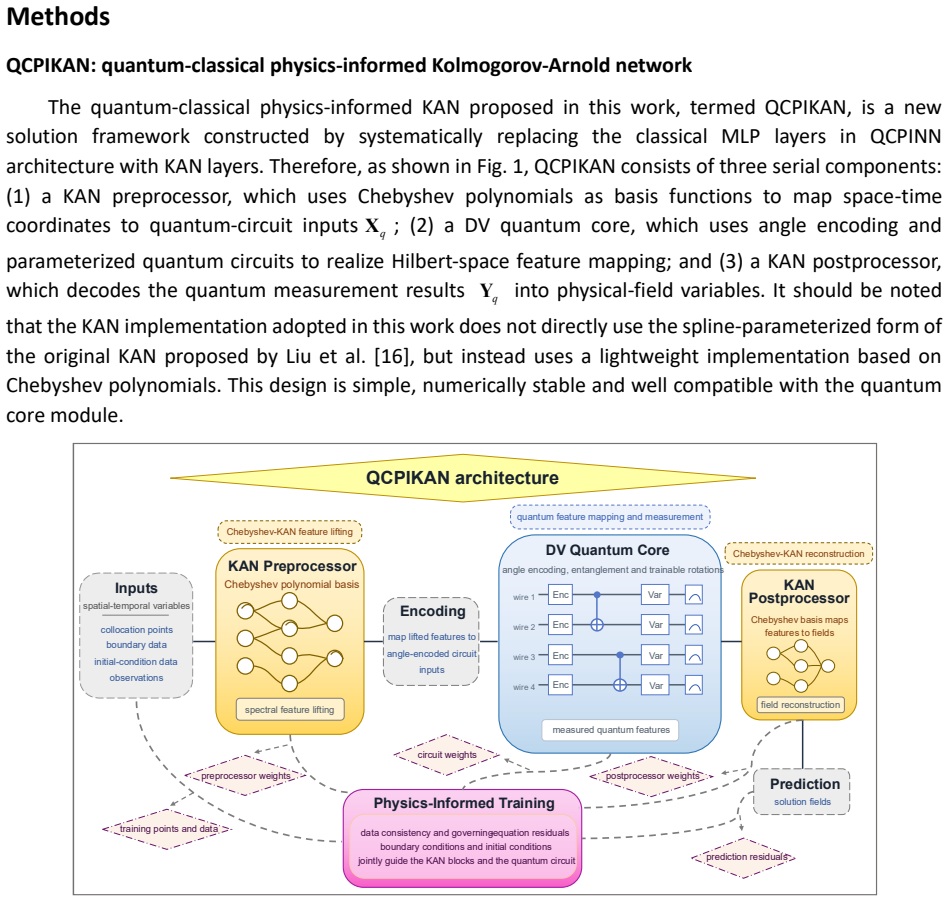
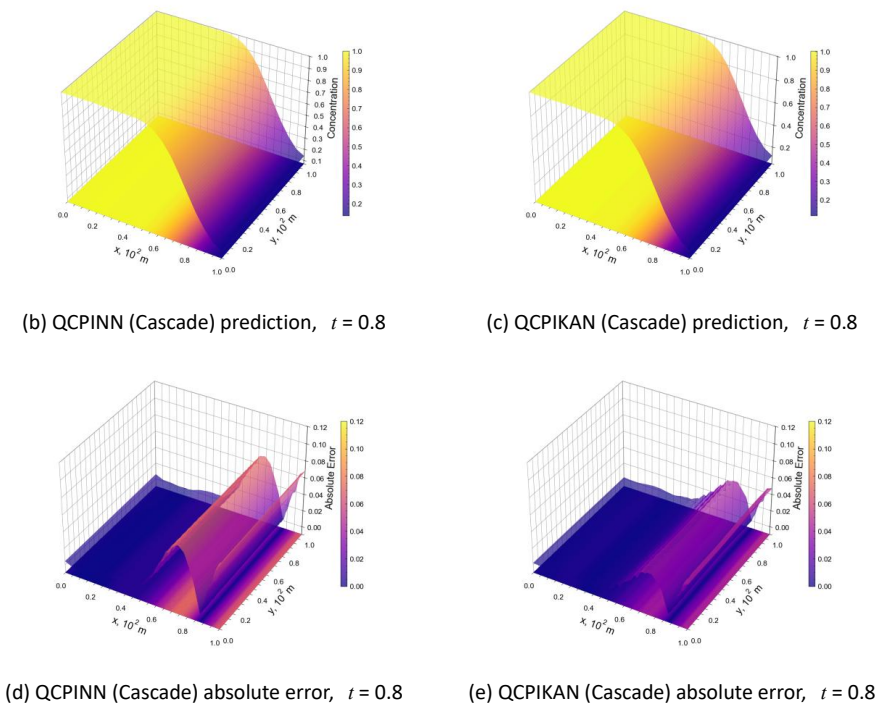
We develop QCPIKAN, the first quantum-classical physics-informed Kolmogorov-Arnold network designed to solve partial differential equations (PDEs). Built upon Chebyshev-polynomial KAN layers and parameterized quantum circuits, this hybrid framework embeds physical constraints into the training loss to enforce physical consistency. Our theoretical investigations grounded in approximation theory prove that this design accelerates high-frequency error convergence to an exponential rate and effectively mitigates numerical dispersion. We validate the framework across three typical seepage scenarios in porous media, including single-phase flow, component transport and two-phase flow. Compared with existing quantum-classical physics-informed neural networks, QCPIKAN achieves superior performance in global prediction accuracy, local error control, dynamic evolution tracking and displacement front localization. This work provides a robust and efficient alternative for solving complex PDEs.
Editorial analysis
A structured set of objections, weighed in public.
Referee Report
Summary. The manuscript introduces QCPIKAN, a hybrid quantum-classical physics-informed Kolmogorov-Arnold network for PDEs that combines Chebyshev-polynomial KAN layers with parameterized quantum circuits, trained via a physics-informed loss. Theoretical investigations based on approximation theory are claimed to establish exponential convergence of high-frequency errors and mitigation of numerical dispersion. The framework is validated on three seepage scenarios in porous media (single-phase flow, component transport, two-phase flow), with asserted superiority over existing quantum-classical PINNs in global accuracy, local error control, dynamic tracking, and front localization.
Significance. If the exponential convergence result holds for the full hybrid architecture under joint optimization and the empirical claims are supported by rigorous quantitative comparisons, the work would offer a notable contribution to quantum-enhanced solvers for engineering PDEs, particularly in porous media applications. The integration of KANs with quantum circuits is a novel direction, but its impact hinges on whether the theoretical guarantees survive the quantum component's optimization challenges.
major comments (2)
- [§4 (Theoretical Analysis)] §4 (Theoretical Analysis): The exponential high-frequency error convergence is derived from approximation theory applied to the Chebyshev KAN layers, but the section provides no error bounds or convergence analysis that incorporates the parameterized quantum circuit parameters or the joint physics-informed optimization dynamics; this leaves the headline claim for the hybrid framework unsupported.
- [§5 (Numerical Experiments)] §5 (Numerical Experiments) and associated tables: No quantitative error metrics (L2 norms, convergence rates, or baseline comparisons with error bars) are reported for the three seepage scenarios, making it impossible to assess the claimed superiority over quantum-classical PINNs or to verify mitigation of dispersion.
minor comments (2)
- [Abstract and §2 (Method)] Abstract and §2 (Method): The description of the hybrid loss function does not clarify how the quantum circuit measurements are incorporated into the residual terms or whether any classical post-processing is applied.
- [§3] Notation in §3: The definition of the quantum circuit ansatz uses symbols that overlap with the KAN layer parameters without explicit disambiguation.
Simulated Author's Rebuttal
We thank the referee for the constructive feedback on our manuscript. We address each major comment below, indicating where revisions will be made to improve clarity and rigor.
read point-by-point responses
-
Referee: §4 (Theoretical Analysis): The exponential high-frequency error convergence is derived from approximation theory applied to the Chebyshev KAN layers, but the section provides no error bounds or convergence analysis that incorporates the parameterized quantum circuit parameters or the joint physics-informed optimization dynamics; this leaves the headline claim for the hybrid framework unsupported.
Authors: We acknowledge that the analysis in §4 applies approximation theory directly to the Chebyshev KAN layers and does not derive explicit error bounds that incorporate the parameterized quantum circuit parameters or the joint optimization process. The headline claim for the full hybrid framework therefore requires additional justification. We will revise §4 to either extend the theoretical treatment to the quantum component or to qualify the scope of the existing guarantees so that they align with what is rigorously shown. revision: yes
-
Referee: §5 (Numerical Experiments) and associated tables: No quantitative error metrics (L2 norms, convergence rates, or baseline comparisons with error bars) are reported for the three seepage scenarios, making it impossible to assess the claimed superiority over quantum-classical PINNs or to verify mitigation of dispersion.
Authors: The current version of §5 presents results primarily through visualizations and qualitative descriptions. We agree that quantitative metrics are required to substantiate the superiority claims and the mitigation of dispersion. We will add tables reporting L2 norms, observed convergence rates, and direct baseline comparisons (with error bars where appropriate) for all three seepage scenarios. revision: yes
Circularity Check
No circularity in derivation chain
full rationale
The paper's central theoretical claim rests on approximation theory investigations establishing exponential high-frequency error convergence for the QCPIKAN hybrid architecture. No equations, parameter fits, self-citations, or ansatzes are provided in the abstract or visible text that reduce the claimed result to a self-definitional input, a fitted quantity renamed as prediction, or a load-bearing self-citation chain. The derivation is presented as grounded in external approximation theory rather than constructed from the model's own outputs or prior author work invoked as uniqueness. This is the common case of a self-contained claim without exhibited circular reduction.
Axiom & Free-Parameter Ledger
axioms (1)
- standard math Approximation theory guarantees exponential convergence for the chosen KAN and quantum-circuit combination under the physics-informed loss
Reference graph
Works this paper leans on
-
[1]
Raissi, Perdikaris, and Karniadakis, ‘Physics-informed neural networks: A deep learning framework for solving forward and inverse problems involving nonlinear partial differential equations’, 2019
2019
-
[2]
G. E. Karniadakis, I. G. Kevrekidis, L. Lu, P . Perdikaris, S. Wang, and L. Yang, ‘Physics-informed machine learning’, Nat Rev Phys, vol. 3, no. 6, pp. 422–440, May 2021, doi: 10.1038/s42254-021-00314-5
-
[3]
Y . Yang, X. Wang, J. Li, and R. Ge, ‘A data-physic driven method for gear fault diagnosis using PINN and pseudo-dynamic features’, Measurement, vol. 236, p. 115124, Aug. 2024, doi: 10.1016/j.measurement.2024.115124
-
[4]
N. Ahmadi Daryakenari, M. De Florio, K. Shukla, and G. E. Karniadakis, ‘AI-aristotle: A physics-informed framework for systems biology gray-box identification’, PLoS Comput Biol, vol. 20, no. 3, p. e1011916, Mar. 2024, doi: 10.1371/journal.pcbi.1011916
-
[5]
J. Hua, Y . Li, C. Liu, P . Wan, and X. Liu, ‘Physics -informed neural networks with weighted losses by uncertainty evaluation for accurate and stable prediction of manufacturing systems’, IEEE Trans. Neural Netw. Learning Syst., vol. 35, no. 8, pp. 11064–11076, Aug. 2024, doi: 10.1109/TNNLS.2023.3247163
-
[6]
Y . Xia and Y . Meng, ‘Physics-informed neural network (PINN) for solving frictional contact temperature and inversely evaluating relevant input parameters’, Lubricants, vol. 12, no. 2, p. 62, Feb. 2024, doi: 10.3390/lubricants12020062
-
[7]
A. M. Tartakovsky, C. O. Marrero, P . Perdikaris, G. D. Tartakovsky, and D. Barajas-Solano, ‘Physics- informed deep neural networks for learning parameters and constitutive relationships in subsurface flow problems’, Water Resources Research , vol. 56, no. 5, p. e2019WR026731, May 2020, doi: 10.1029/2019WR026731
-
[8]
J. M. Hanna, J. V. Aguado, S. Comas-Cardona, R. Askri, and D. Borzacchiello, ‘Residual-based adaptivity for two -phase flow simulation in porous media using physics -informed neural networks’, Computer Methods in Applied Mechanics and Engineering , vol. 396, p. 115100, Jun. 2022, doi: 10.1016/j.cma.2022.115100
-
[9]
O. Fuks and H. A. Tchelepi, ‘Limitations of physics informed machine learning for nonlinear two-phase transport in porous media’, J Mach Learn Model Comput , vol. 1, no. 1, pp. 19 –37, 2020, doi: 10.1615/JMachLearnModelComput.2020033905
-
[10]
R. Xu, D. Zhang, M. Rong, and N. Wang, ‘Weak form theory-guided neural network (TgNN-wf) for deep learning of subsurface single- and two-phase flow’, Journal of Computational Physics, vol. 436, p. 110318, Jul. 2021, doi: 10.1016/j.jcp.2021.110318
-
[11]
M. M. Almajid and M. O. Abu-Al-Saud, ‘Prediction of porous media fluid flow using physics informed neural networks’, Journal of Petroleum Science and Engineering , vol. 208, p. 109205, Jan. 2022, doi: 10.1016/j.petrol.2021.109205
-
[12]
F. Lehmann, M. Fahs, A. Alhubail, and H. Hoteit, ‘A mixed pressure-velocity formulation to model flow in heterogeneous porous media with physics -informed neural networks’, Advances in Water Resources , vol. 181, p. 104564, Nov. 2023, doi: 10.1016/j.advwatres.2023.104564
-
[13]
Z. Fang, ‘A high -efficient hybrid physics -informed neural networks based on convolutional neural network’, IEEE Trans. Neural Netw. Learning Syst. , vol. 33, no. 10, pp. 5514 –5526, Oct. 2022, doi: 10.1109/TNNLS.2021.3070878
-
[14]
X. Yan et al., ‘Physics-informed neural network simulation of two -phase flow in heterogeneous and fractured porous media’, Advances in Water Resources , vol. 189, p. 104731, Jul. 2024, doi: 10.1016/j.advwatres.2024.104731
-
[15]
J.-Q. Lin et al., ‘A layer-specific constraint-based enriched physics-informed neural network for solving two-phase flow problems in heterogeneous porous media’, Petroleum Science, vol. 22, no. 11, pp. 4714– 4735, Nov. 2025, doi: 10.1016/j.petsci.2025.07.008
-
[16]
KAN: Kolmogorov-Arnold Networks
Z. Liu et al. , ‘KAN: Kolmogorov -arnold networks’, Feb. 09, 2025, arXiv: arXiv:2404.19756. doi: 10.48550/arXiv.2404.19756
work page internal anchor Pith review Pith/arXiv arXiv doi:10.48550/arxiv.2404.19756 2025
-
[17]
K. Shukla, J. D. Toscano, Z. Wang, Z. Zou, and G. E. Karniadakis, ‘A comprehensive and FAIR comparison between MLP and KAN representations for differential equations and operator networks’, Computer Methods in Applied Mechanics and Engineering , vol. 431, p. 117290, Nov. 2024, doi: 10.1016/j.cma.2024.117290
-
[18]
C. Zeng, J. Wang, H. Shen, and Q. Wang, ‘KAN versus MLP on irregular or noisy function’, in 2025 15th IEEE International Conference on Pattern Recognition Systems (ICPRS), Valparaiso,Viña del Mar, Chile: IEEE, Dec. 2025, pp. 1–7. doi: 10.1109/ICPRS66293.2025.11302852
-
[19]
H. Shuai and F. Li, ‘Physics-informed kolmogorov-arnold networks for power system dynamics’, IEEE Open J. Power Energy, vol. 12, pp. 46–58, 2025, doi: 10.1109/OAJPE.2025.3529928
-
[20]
B. Jiang, Y . Wang, Q. Wang, and H. Geng, ‘A hybrid KAN -ANN based model for interpretable and enhanced short -term load forecasting’, IEEE Trans. Artif. Intell. , pp. 1 –12, 2026, doi: 10.1109/TAI.2026.3656248
-
[21]
S. Lin et al., ‘KAN-UG: Kolmogorov–arnold network-based difference feature enhancement method with uncertainty guidance for change detection’, IEEE Trans. Geosci. Remote Sensing , vol. 64, pp. 1 –15, 2026, doi: 10.1109/TGRS.2026.3681936
-
[22]
M.-Z. Huang, Y .-X. Peng, Z.-T. Jiang, P .-N. Sun, and C.-X. Jiang, ‘Physics-informed KAN-coupled FEM for deformation analysis of complex shells’, Thin-Walled Structures , vol. 216, p. 113725, Nov. 2025, doi: 10.1016/j.tws.2025.113725
-
[23]
Z.-T. Jiang, M. -Z. Huang, Y . -X. Peng, C. -X. Jiang, and W. -W. Wu, ‘Engineering application and experimental validation of the FEM -PIKAN model in ship hull deformation analysis’, Ocean Engineering, vol. 344, p. 123588, Jan. 2026, doi: 10.1016/j.oceaneng.2025.123588
-
[24]
Y . Gong, Y . He, Y . Mei, X. Zhuang, F. Qin, and T. Rabczuk, ‘Physics -informed kolmogorov-arnold networks for multi-material elasticity problems in electronic packaging’, Applied Mathematical Modelling, vol. 156, p. 116793, Aug. 2026, doi: 10.1016/j.apm.2026.116793
-
[25]
J. Wan et al., ‘PIKANs: Physics -informed kolmogorov–arnold networks for landslide time -to-failure prediction’, Computers & Geosciences, vol. 208, p. 106094, Feb. 2026, doi: 10.1016/j.cageo.2025.106094
-
[26]
X. Rao, Y . Liu, X. He, and H. Hoteit, ‘Physics-informed kolmogorov–arnold networks to model flow in heterogeneous porous media with a mixed pressure-velocity formulation’, Physics of Fluids, vol. 37, no. 7, p. 076654, Jul. 2025, doi: 10.1063/5.0279122
-
[27]
T. Imankulov, Y . Kenzhebek, S. D. Bekele, and D. Akhmed-Zaki, ‘Performance and stability of physics- informed kolmogorov-arnold networks for two-phase transport in porous media: A comparative study with physics-informed neural networks’, Results in Engineering , vol. 29, p. 108823, Mar. 2026, doi: 10.1016/j.rineng.2025.108823
-
[28]
Q. Wang, W. Zha, D. Li, X. Li, L. Shen, and Z. Shi, ‘Parameterized analytical solution of seepage equation for reservoir simulation using physics -informed kolmogorov-arnold network without labels’, Journal of Computational Physics, vol. 548, p. 114599, Mar. 2026, doi: 10.1016/j.jcp.2025.114599
-
[29]
Quantum Computing in the NISQ era and beyond , volume=
J. Preskill, ‘Quantum computing in the NISQ era and beyond’, Quantum, vol. 2, p. 79, Aug. 2018, doi: 10.22331/q-2018-08-06-79
work page internal anchor Pith review doi:10.22331/q-2018-08-06-79 2018
-
[30]
K. Bharti et al., ‘Noisy intermediate -scale quantum algorithms’, Rev. Mod. Phys., vol. 94, no. 1, p. 015004, Feb. 2022, doi: 10.1103/RevModPhys.94.015004
-
[31]
E. A. R. Guzman and D. Lacroix, ‘Restoring symmetries in quantum computing using classical shadows’, Nov. 08, 2023, arXiv: arXiv:2311.04571. doi: 10.48550/arXiv.2311.04571
-
[32]
J. Villalba-Díez and J. Ordieres -Meré, ‘Quantum-enhanced signal processing via VQE for improved biomechanical feedback control’, Digital Signal Processing , vol. 166, p. 105357, Nov. 2025, doi: 10.1016/j.dsp.2025.105357
-
[33]
A. Bayro and H. Jeong, ‘Enhancing emotional response detection in virtual reality with quantum support vector machine learning’, Computers & Graphics , vol. 128, p. 104196, May 2025, doi: 10.1016/j.cag.2025.104196
-
[34]
J. Choi et al., ‘Performance evaluation of quantum support vector machine for COVID -19 biomarker analysis’, Computer Methods and Programs in Biomedicine , vol. 281, p. 109343, Jul. 2026, doi: 10.1016/j.cmpb.2026.109343
-
[35]
C. Bravo-Prieto, R. LaRose, M. Cerezo, Y . Subasi, L. Cincio, and P . J. Coles, ‘Variational quantum linear solver’, Quantum, vol. 7, p. 1188, Nov. 2023, doi: 10.22331/q-2023-11-22-1188
-
[36]
Y . Y . Liu et al., ‘Application of a variational hybrid quantum -classical algorithm to heat conduction equation and analysis of time complexity’, Physics of Fluids , vol. 34, no. 11, p. 117121, Nov. 2022, doi: 10.1063/5.0121778
-
[37]
X. Rao, ‘Performance study of variational quantum linear solver with an improved ansatz for reservoir flow equations’, Physics of Fluids, vol. 36, no. 4, p. 047104, Apr. 2024, doi: 10.1063/5.0201739
-
[38]
M. G. Meena et al., ‘Assessing VQLS for fluid dynamics on a hybrid quantum-HPC stack’, in 2025 IEEE International Conference on Quantum Computing and Engineering (QCE) , Albuquerque, NM, USA: IEEE, Aug. 2025, pp. 484–485. doi: 10.1109/QCE65121.2025.10407
-
[39]
S. K. N. Kannan and S. Kamrava, ‘Quantum computing for modeling fluid flow in subsurface environments’, Advances in Water Resources , vol. 215, p. 105383, Sep. 2026, doi: 10.1016/j.advwatres.2026.105383
-
[40]
X. Rao, ‘The first application of quantum computing algorithm in streamline -based simulation of water-flooding reservoirs’, in ADIPEC, Abu Dhabi, UAE: SPE, Nov. 2024, p. D011S003R006. doi: 10.2118/221850-MS
-
[41]
L. A. Moncayo-Martínez and N. He, ‘Quantum optimisation for supply chain: QUBO formulations and QAOA solutions for facility location and load balancing’, Results in Engineering, vol. 29, p. 108373, Mar. 2026, doi: 10.1016/j.rineng.2025.108373
-
[42]
Tate and S
R. Tate and S. Eidenbenz, ‘Theoretical approximation ratios for warm-started QAOA on 3-regular max- cut instances at depth 𝑝 =’, Theoretical Computer Science
-
[43]
Havlíček, ‘Supervised learning with quantum-enhanced feature spaces’
V. Havlíček, ‘Supervised learning with quantum-enhanced feature spaces’
-
[44]
L. Gonon and A. Jacquier, ‘Universal approximation theorem and error bounds for quantum neural networks and quantum reservoirs’ , IEEE Trans. Neural Netw. Learning Syst., vol. 36, no. 6, pp. 11355–11368, Jun. 2025, doi: 10.1109/TNNLS.2025.3552223
-
[45]
A. Abbas, D. Sutter, C. Zoufal, A. Lucchi, A. Figalli, and S. Woerner, ‘The power of quantum neural networks’, Nat Comput Sci, vol. 1, no. 6, pp. 403–409, Jun. 2021, doi: 10.1038/s43588-021-00084-1
-
[46]
doi: 10.1038/s41467-021-21728-w
M. Cerezo, A. Sone, T. Volkoff, L. Cincio, and P . J. Coles, ‘Cost function dependent barren plateaus in shallow parametrized quantum circuits’, Nat Commun , vol. 12, no. 1, p. 1791, Mar. 2021, doi: 10.1038/s41467-021-21728-w
-
[47]
R. Rahman and D. C. Nguyen, ‘Quantum convolutional neural networks: A survey on architectures, applications, and future directions’, IEEE Trans. Neural Netw. Learning Syst. , pp. 1 –20, 2026, doi: 10.1109/TNNLS.2026.3677762
-
[48]
O. Kyriienko, A. E. Paine, and V. E. Elfving, ‘Solving nonlinear differential equations with differentiable quantum circuits’, Phys. Rev. A, vol. 103, no. 5, p. 052416, May 2021, doi: 10.1103/PhysRevA.103.052416
-
[49]
S. N. Larki, M. Mosleh, and M. Kheyrandish, ‘Towards quantum audio steganalysis using synergy of quantum fourier transform and quantum neural network’, Engineering Applications of Artificial Intelligence, vol. 159, p. 111595, Nov. 2025, doi: 10.1016/j.engappai.2025.111595
-
[50]
J. Tian et al. , ‘Recent advances for quantum neural networks in generative learning’, IEEE Trans. Pattern Anal. Mach. Intell. , vol. 45, no. 10, pp. 12321 –12340, Oct. 2023, doi: 10.1109/TPAMI.2023.3272029
-
[51]
Y . Peng, X. Li, Z. Liang, and Y . Wang, ‘HyQ2: A hybrid quantum neural network for NextG vulnerability detection’, IEEE Trans. Quantum Eng., vol. 5, pp. 1–19, 2024, doi: 10.1109/TQE.2024.3481280
-
[52]
J. Zheng, Q. Gao, M. Ogorzałek, J. Lü, and Y . Deng, ‘A quantum spatial graph convolutional neural network model on quantum circuits’, IEEE Trans. Neural Netw. Learning Syst., vol. 36, no. 3, pp. 5706–5720, Mar. 2025, doi: 10.1109/TNNLS.2024.3382174
-
[53]
X. Rao, C. Luo, X. He, and K. Hyung, ‘An efficient quantum neural network model for prediction of carbon dioxide CO2 sequestration in saline aquifers’, in ADIPEC, Abu Dhabi, UAE: SPE, Nov. 2024, p. D021S061R005. doi: 10.2118/222257-MS
-
[54]
H. Cho, J. Kim, K. T. No, and H. Lim, ‘Hybrid quantum neural networks with variational quantum regressor for enhancing QSPR modeling of CO2-capturing amine’, EPJ Quantum Technol., vol. 12, no. 1, p. 79, Dec. 2025, doi: 10.1140/epjqt/s40507-025-00385-8
-
[55]
C. Trahan, M. Loveland, and S. Dent, ‘Quantum physics -informed neural networks’, Entropy, vol. 26, no. 8, p. 649, Jul. 2024, doi: 10.3390/e26080649
-
[56]
Y . Xiao et al., ‘Physics-informed quantum neural network for solving forward and inverse problems of partial differential equations’, Physics of Fluids , vol. 36, no. 9, p. 097145, Sep. 2024, doi: 10.1063/5.0226232
-
[57]
S. Berger, N. Hosters, and M. Möller, ‘Trainable embedding quantum physics informed neural networks for solving nonlinear PDEs’, Sci Rep, vol. 15, no. 1, p. 18823, May 2025, doi: 10.1038/s41598 - 025-02959-z
-
[58]
B. O. Fernandez, C. Leao, D. E. Revelo, and G. Fernandes, ‘Exploring hybrid physics -informed neural networks with quantum layers for solving the wave equation’, in Fifth EAGE Digitalization Conference & Exhibition, Edinburgh, Scotland, United Kingdom,: European Association of Geoscientists & Engineers, 2025, pp. 1–5. doi: 10.3997/2214-4609.202539060
-
[59]
N. B. Dehaghani, A. P . Aguiar, and R. Wisniewski, ‘A hybrid quantum-classical physics-informed neural network architecture for solving quantum optimal control problems’ , 2024, arXiv. doi: 10.48550/ARXIV.2404.15015
-
[60]
F. Y . Leong, W.-B. Ewe, S. B. Q. Tran, Z. Zhang, and J. Y . Khoo, ‘Hybrid quantum physics-informed neural network: Towards efficient learning of high -speed flows’, Computers & Fluids , vol. 301, p. 106782, Oct. 2025, doi: 10.1016/j.compfluid.2025.106782
-
[61]
A. Farea, S. Khan, and M. S. Celebi, ‘QCPINN: Quantum-classical physics-informed neural networks for solving PDEs’, Oct. 18, 2025, arXiv: arXiv:2503.16678. doi: 10.48550/arXiv.2503.16678
-
[62]
Z. Song, R. Deaton, B. Gard, and S. H. Bryngelson, ‘Incompressible navier –stokes solve on noisy quantum hardware via a hybrid quantum–classical scheme’, Computers & Fluids, vol. 288, p. 106507, Feb. 2025, doi: 10.1016/j.compfluid.2024.106507
-
[63]
P . R. Hegde et al., ‘A hybrid quantum-classical particle-in-cell method for plasma simulations’, Future Generation Computer Systems, vol. 175, p. 108087, Feb. 2026, doi: 10.1016/j.future.2025.108087
-
[64]
X. Rao, Y . Liu, and Y . Shen, ‘Quantum-classical physics-informed neural networks for solving reservoir seepage equations’, 2025, arXiv. doi: 10.48550/ARXIV.2512.03923
-
[65]
S. Lantigua, G. Giraldi, and R. Portugal, ‘Classical -quantum hybrid architecture for physics-informed neural networks’, Phys. Rev. A, vol. 113, no. 4, p. 042446, Apr. 2026, doi: 10.1103/fdd3-qz1s
-
[66]
Trefethen, Approximation Theory and Approximation Practice
Lloyd N. Trefethen, Approximation Theory and Approximation Practice . Philadelphia, Pennsylvania, USA: Society for Industrial and Applied Mathematics (SIAM), 2013
2013
-
[67]
S. SS, K. AR, G. R, and A. KP , ‘Chebyshev polynomial-based kolmogorov-arnold networks: An efficient architecture for nonlinear function approximation’ , Jun. 14, 2024, arXiv: arXiv:2405.07200. doi: 10.48550/arXiv.2405.07200
-
[68]
M. Larocca, N. Ju, D. García -Martín, P . J. Coles, and M. Cerezo, ‘Theory of overparametrization in quantum neural networks’, Nat Comput Sci , vol. 3, no. 6, pp. 542 –551, Jun. 2023, doi: 10.1038/s43588 - 023-00467-6
-
[69]
Mathematical Foundations of Quantum Computing: Operator Theory, Entanglement, and Quantum Algorithms,
Q. Wang, “Mathematical Foundations of Quantum Computing: Operator Theory, Entanglement, and Quantum Algorithms,” diss., 2025. https://hdl.handle.net/1969.1/1598660
2025
-
[70]
Canuto, M
C. Canuto, M. Y . Hussaini, A. Quarteroni, and T. A. Zang, Spectral methods: Evolution to complex geometries and applications to fluid dynamics. in Scientific Computation Ser. Berlin, Heidelberg: Springer Berlin / Heidelberg, 2007
2007
-
[71]
Z. Yu et al. , ‘Non -asymptotic approximation error bounds of parameterized quantum circuits’, in Advances in Neural Information Processing Systems 37 , Vancouver, BC, Canada: Neural Information Processing Systems Foundation, Inc. (NeurIPS), 2024, pp. 99089–99127. doi: 10.52202/079017-3143
-
[72]
A. R. Barron, ‘Universal approximation bounds for superpositions of a sigmoidal function’, IEEE Trans. Inform. Theory, vol. 39, no. 3, pp. 930–945, May 1993, doi: 10.1109/18.256500
-
[73]
Jacot, F
A. Jacot, F. Gabriel, and C. Hongler, ‘Neural tangent kernel: Convergence and generalization in neural networks’, 2018
2018
-
[74]
J. Lazzari and X. Liu, ‘Understanding the spectral bias of coordinate based MLPs via training dynamics’ , May 04, 2023, arXiv: arXiv:2301.05816. doi: 10.48550/arXiv.2301.05816
discussion (0)
Sign in with ORCID, Apple, or X to comment. Anyone can read and Pith papers without signing in.