Resonant heterodyne conversion applied to a low-frequency haloscope for dark matter axion searches in the 1-35 MHz range
Pith reviewed 2026-06-26 14:57 UTC · model grok-4.3
The pith
Resonant heterodyne up-conversion in a two-port cavity enables axion searches from 0.9 to 34.6 MHz with projected sensitivity to 10^{-15} GeV^{-1}.
A machine-rendered reading of the paper's core claim, the machinery that carries it, and where it could break.
Core claim
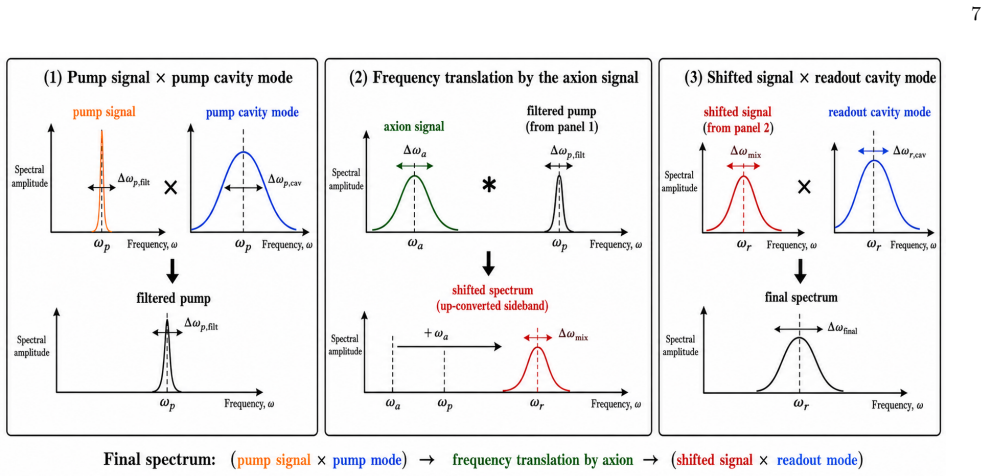
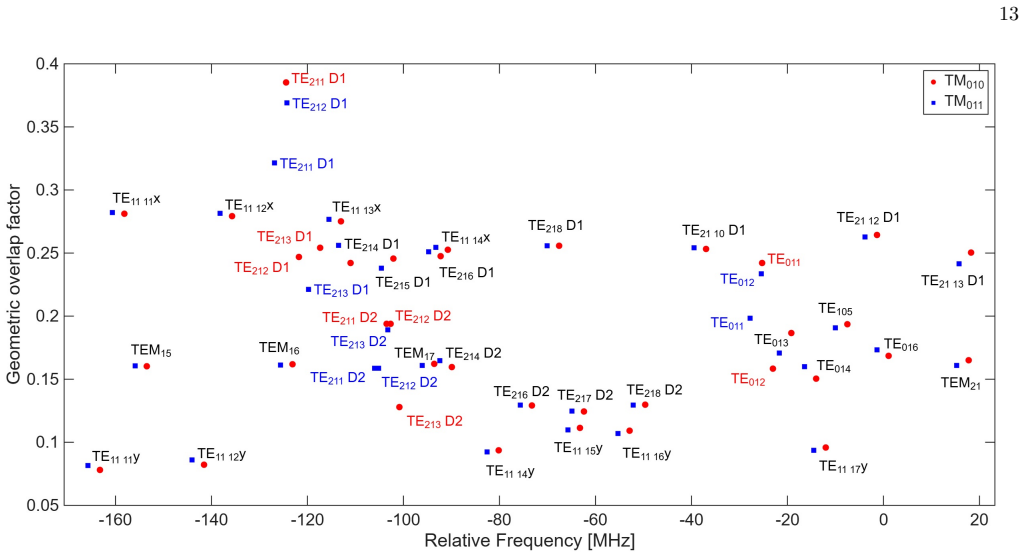
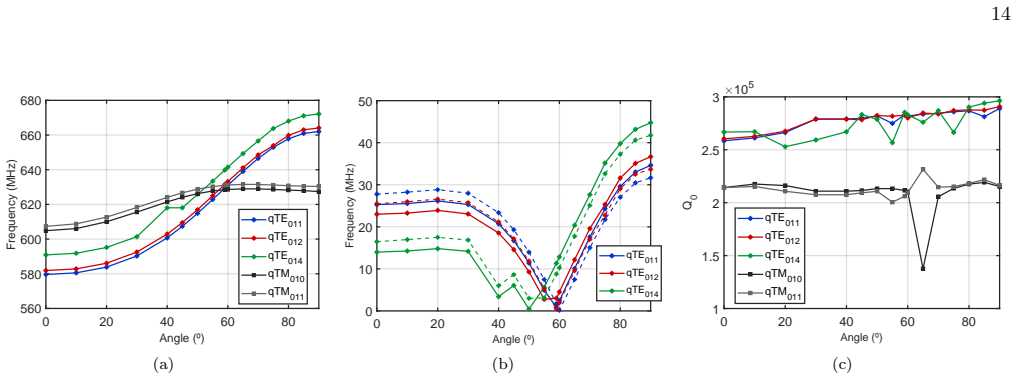
The axion-induced source term in the cavity leads to effective quality factors that govern the mixing between pump and axion modes, the detection bandwidth, and the extracted signal power. For the largest RADES-BabyIAXO cavity, the quasi-TE011-quasi-TM010 mode pair is favorable for frequencies between 0.9 and 34.6 MHz. Analytical predictions match full-wave simulations at resonance, with the latter better describing off-resonance behavior and pump leakage. Under thermal-noise-limited conditions with sufficient leakage rejection, the setup could detect axion-photon couplings as small as 10^{-15} GeV^{-1} at 90% confidence level.
What carries the argument
Effective quality factors determined by the finite axion linewidth, which control pump-axion mixing, bandwidth, and detected power in the heterodyne process.
If this is right
- The quasi-TE011-quasi-TM010 mode pair covers axion frequencies from 0.9 to 34.6 MHz.
- Optimal port couplings are identified that maximize the scanning rate.
- Cryogenic copper and superconducting niobium cavities reach 10^{-15} GeV^{-1} at 90% CL under the stated conditions.
- The full-wave model gives accurate off-resonance predictions and leakage characterization beyond analytic results.
- This represents an improvement over previous heterodyne-based axion searches.
Where Pith is reading between the lines
- The technique could extend searches into a low-mass window that is difficult for conventional haloscopes.
- The formalism might apply to other cavity designs to cover additional frequency bands.
- Practical leakage rejection would likely require additional filtering or isolation methods beyond those modeled.
- Achieving this sensitivity could begin to constrain axion models in the micro-eV mass range.
Load-bearing premise
Pump leakage into the readout channel can be rejected sufficiently well to reach the thermal-noise-limited regime.
What would settle it
A demonstration that pump leakage cannot be suppressed to a level below the thermal noise floor in the readout channel would prevent the projected sensitivity from being achieved.
Figures





read the original abstract
We study resonant heterodyne up-conversion in the RADES-BabyIAXO haloscope as a method to search for low-mass dark matter axions using microwave cavities. Starting from axion electrodynamics, we derive the axion-induced source term and the power extracted through a readout mode, explicitly accounting for the finite axion linewidth. This leads to effective quality factors that determine the pump-axion mixing, detection bandwidth, and detected signal power. We extend the BI-RME 3D full-wave formulation to heterodyne axion detection in a realistic two-port cavity, including pump leakage into the readout channel. Applying the formalism to the largest RADES-BabyIAXO cavity identifies the $\mathrm{quasi\textrm{-}TE}_{011}-\mathrm{quasi\textrm{-}TM}_{010}$ mode pair as a favorable configuration, enabling sensitivity to axion frequencies between 0.9 and 34.6 MHz. Analytical and full-wave predictions show excellent agreement at resonance, while the full-wave model provides a more accurate description off resonance and allows a precise characterization of the pump leakage. We also derive the optimal port couplings that maximize the scanning rate. Sensitivity projections for cryogenic copper and superconducting niobium cavities indicate that, under thermal-noise-limited conditions and assuming sufficient pump-leakage rejection, the experiment could probe axion-photon couplings down to $10^{-15}\,\mathrm{GeV}^{-1}$ at 90% confidence level, representing a significant improvement over previous heterodyne-based searches.
Editorial analysis
A structured set of objections, weighed in public.
Referee Report
Summary. The paper derives the axion-induced source term and extracted power for resonant heterodyne up-conversion in a two-port cavity from axion electrodynamics (accounting for finite axion linewidth and effective Q factors), extends the BI-RME 3D full-wave method to include pump leakage, identifies the quasi-TE011–quasi-TM010 mode pair in the largest RADES-BabyIAXO cavity as favorable for 0.9–34.6 MHz, shows analytical/full-wave agreement at resonance, derives optimal port couplings, and projects sensitivity to g_{aγ} ∼ 10^{-15} GeV^{-1} (90% CL) for cryogenic copper/niobium cavities under thermal-noise-limited conditions with sufficient pump-leakage rejection.
Significance. If the central claims hold, the work would provide a substantiated path to improved low-frequency axion reach via heterodyne conversion, with the electrodynamics derivation, BI-RME extension, and mode identification constituting clear technical contributions. The conditional sensitivity projection, however, limits the immediate impact until the leakage-rejection assumption is addressed.
major comments (1)
- [Abstract and sensitivity-projections section] Abstract and sensitivity-projections section: the headline claim that the experiment could reach g_{aγ} down to 10^{-15} GeV^{-1} is explicitly conditioned on 'sufficient pump-leakage rejection' to realize thermal-noise-limited performance, yet the BI-RME 3D extension is described only as characterizing leakage for the quasi-TE011–quasi-TM010 pair without supplying a quantified rejection factor, filtering scheme, or cancellation method that would keep leakage below the thermal floor for the stated integration times and cavity Q values. This renders the reach an unverified conditional rather than a substantiated projection.
Simulated Author's Rebuttal
We thank the referee for their careful review and constructive feedback. We address the major comment below.
read point-by-point responses
-
Referee: [Abstract and sensitivity-projections section] Abstract and sensitivity-projections section: the headline claim that the experiment could reach g_{aγ} down to 10^{-15} GeV^{-1} is explicitly conditioned on 'sufficient pump-leakage rejection' to realize thermal-noise-limited performance, yet the BI-RME 3D extension is described only as characterizing leakage for the quasi-TE011–quasi-TM010 pair without supplying a quantified rejection factor, filtering scheme, or cancellation method that would keep leakage below the thermal floor for the stated integration times and cavity Q values. This renders the reach an unverified conditional rather than a substantiated projection.
Authors: We agree that the sensitivity projection is conditional on sufficient pump-leakage rejection, as explicitly stated. The BI-RME 3D extension quantifies leakage power into the readout channel for the identified mode pair via full-wave simulation, providing the leakage levels needed to determine required rejection. While the manuscript focuses on electrodynamics, mode identification, and leakage characterization rather than specific hardware implementations, we will revise the sensitivity-projections section to include example rejection factors derived from the simulated leakage (for the quoted integration times and Q values) and outline feasible methods such as narrowband filtering or active cancellation. The abstract will be updated for clarity. This will convert the projection from conditional to substantiated within the paper's scope. revision: yes
Circularity Check
Derivation chain self-contained from axion electrodynamics with no reductions by construction
full rationale
The paper derives the axion-induced source term and effective quality factors directly from axion electrodynamics, then extends the existing BI-RME 3D full-wave method to model leakage in a two-port cavity. Analytical and full-wave results are compared for agreement at resonance, with no evidence that any prediction reduces to a fitted input, self-defined quantity, or load-bearing self-citation. Sensitivity projections are explicitly conditional on an external assumption (pump-leakage rejection) rather than forced by the formalism itself. This is the normal case of an independent derivation.
Axiom & Free-Parameter Ledger
axioms (2)
- domain assumption Axion electrodynamics supplies the source term for the electromagnetic fields induced by axions.
- domain assumption The BI-RME 3D full-wave formulation can be extended to heterodyne axion detection in a realistic two-port cavity while accounting for pump leakage.
Reference graph
Works this paper leans on
-
[1]
The pump mode is injected through the portµ= 1, while the read- out signal is extracted from the portµ= 2
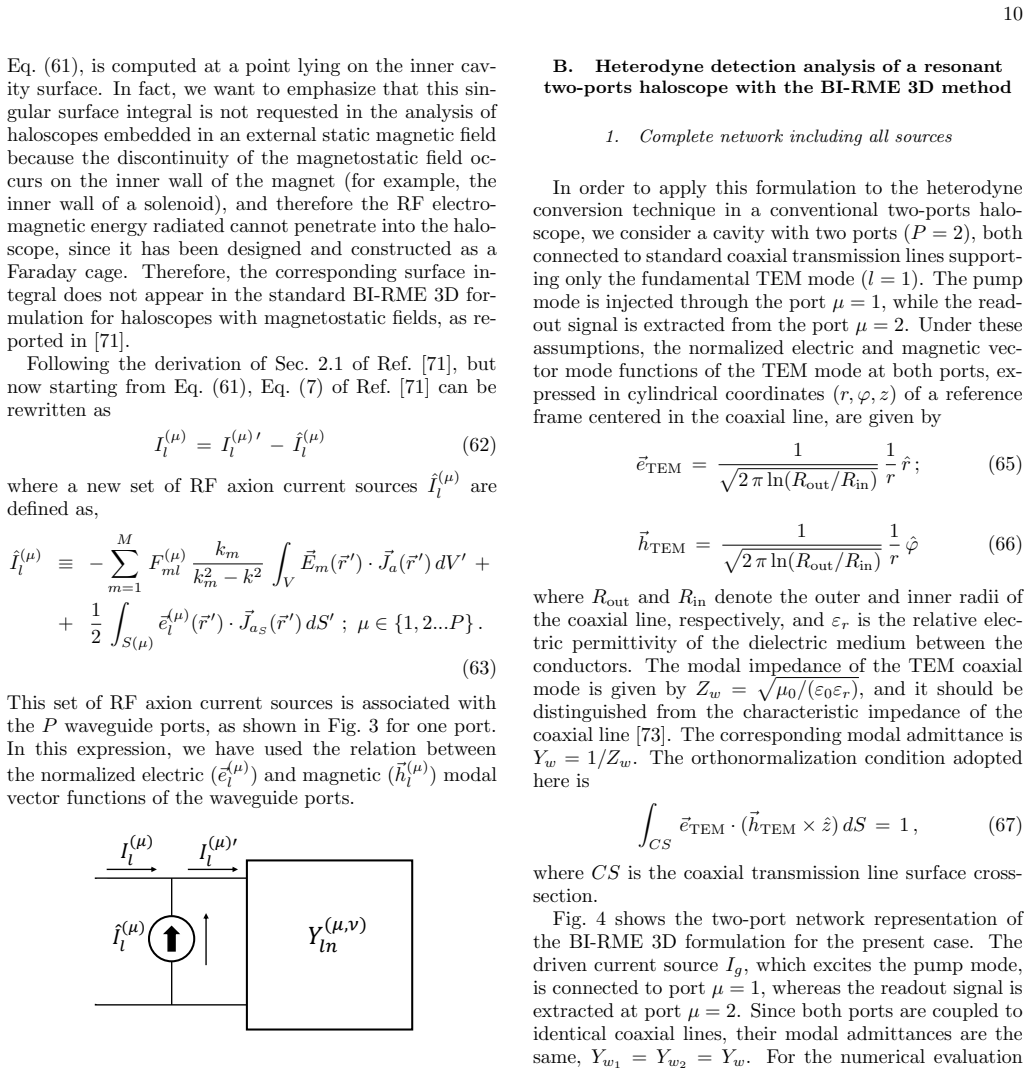
Complete network including all sources In order to apply this formulation to the heterodyne conversion technique in a conventional two-ports halo- scope, we consider a cavity with two ports (P= 2), both connected to standard coaxial transmission lines support- ing only the fundamental TEM mode (l= 1). The pump mode is injected through the portµ= 1, while ...
-
[2]
Pump network For the present application, it is important to establish the relationship between the pump current sourceI g and the power generated by the current sourceP g ≡P inc,p. Therefore, now we have to analyze the network of Fig. 5, where the axion current sources have been removed be- cause they are open-circuited. In this case, the Kirchhoff laws ...
-
[3]
R. D. Peccei and H. R. Quinn, CP Conservation in the Presence of Pseudoparticles, Phys. Rev. Lett.38, 1440 (1977)
1977
-
[4]
J. E. Kim and G. Carosi, Axions and the Strong CP Problem, Rev. Mod. Phys.82, 557 (2010), [Erratum: Rev.Mod.Phys. 91, 049902 (2019)], arXiv:0807.3125 [hep- ph]
arXiv 2010
-
[5]
Weinberg, A New Light Boson?, Phys
S. Weinberg, A New Light Boson?, Phys. Rev. Lett.40, 223 (1978)
1978
-
[6]
Wilczek, Problem of StrongPandTInvariance in the 24 Presence of Instantons, Phys
F. Wilczek, Problem of StrongPandTInvariance in the 24 Presence of Instantons, Phys. Rev. Lett.40, 279 (1978)
1978
-
[7]
Preskill, M
J. Preskill, M. B. Wise, and F. Wilczek, Cosmology of the Invisible Axion, Phys. Lett. B120, 127 (1983)
1983
-
[8]
L. F. Abbott and P. Sikivie, A Cosmological Bound on the Invisible Axion, Phys. Lett. B120, 133 (1983)
1983
-
[9]
Dine and W
M. Dine and W. Fischler, The Not So Harmless Axion, Phys. Lett. B120, 137 (1983)
1983
-
[10]
Duet al.(ADMX), A Search for Invisible Axion Dark Matter with the Axion Dark Matter Experiment, Phys
N. Duet al.(ADMX), A Search for Invisible Axion Dark Matter with the Axion Dark Matter Experiment, Phys. Rev. Lett.120, 151301 (2018), arXiv:1804.05750 [hep- ex]
Pith/arXiv arXiv 2018
-
[11]
Kwonet al.(CAPP), First Results from an Axion Haloscope at CAPP around 10.7µeV, Phys
O. Kwonet al.(CAPP), First Results from an Axion Haloscope at CAPP around 10.7µeV, Phys. Rev. Lett. 126, 191802 (2021), arXiv:2012.10764 [hep-ex]
arXiv 2021
-
[12]
S. Ahnet al.(CAPP), Extensive Search for Axion Dark Matter over 1 GHz with CAPP’S Main Axion Experi- ment, Phys. Rev. X14, 031023 (2024), arXiv:2402.12892 [hep-ex]
arXiv 2024
-
[13]
K. M. Backeset al.(HAYSTAC), A quantum-enhanced search for dark matter axions, Nature590, 238 (2021), arXiv:2008.01853 [quant-ph]
arXiv 2021
-
[14]
Rettaroliet al.(QUAX), Search for axion dark matter with the QUAX–LNF tunable haloscope, Phys
A. Rettaroliet al.(QUAX), Search for axion dark matter with the QUAX–LNF tunable haloscope, Phys. Rev. D 110, 022008 (2024), arXiv:2402.19063 [physics.ins-det]
arXiv 2024
-
[15]
B. T. McAllister, G. Flower, E. N. Ivanov, M. Goryachev, J. Bourhill, and M. E. Tobar, The ORGAN experiment: An axion haloscope above 15 GHz, Physics of the Dark Universe18, 67 (2017)
2017
-
[16]
´Alvarez Melc´ on, S
A. ´Alvarez Melc´ on, S. A. Cuendis, C. Cogollos, A. D´ ıaz- Morcillo, B. D¨ obrich, J. D. Gallego, B. Gimeno, I. G. Irastorza, A. J. Lozano-Guerrero, C. Malbrunot, P. Navarro, C. P. Garay, J. Redondo, T. Vafeiadis, and W. Wuensch, Axion searches with microwave filters: the RADES project, Journal of Cosmology and Astroparticle Physics2018(05), 040
-
[17]
A. ´Alvarez Melc´ onet al., Scalable haloscopes for axion dark matter detection in the 30µeV range with RADES, JHEP07, 084, arXiv:2002.07639 [hep-ex]
arXiv 2002
-
[18]
B. Ajaet al., The Canfranc Axion Detection Experiment (CADEx): search for axions at 90 GHz with Kinetic Inductance Detectors, JCAP11, 044, arXiv:2206.02980 [hep-ex]
-
[19]
I. G. Irastorza and J. Redondo, New experimental ap- proaches in the search for axion-like particles, Progress in Particle and Nuclear Physics102, 89 (2018)
2018
-
[20]
Bradley, J
R. Bradley, J. Clarke, D. Kinion, L. J. Rosenberg, K. van Bibber, S. Matsuki, M. M¨ uck, and P. Sikivie, Microwave cavity searches for dark-matter axions, Rev. Mod. Phys. 75, 777 (2003)
2003
-
[21]
P. Sikivie, N. Sullivan, and D. B. Tanner, Proposal for Axion Dark Matter Detection Using an LC Circuit, Phys. Rev. Lett.112, 131301 (2014), arXiv:1310.8545 [hep-ph]
Pith/arXiv arXiv 2014
-
[22]
Y. Kahn, B. R. Safdi, and J. Thaler, Broadband and Resonant Approaches to Axion Dark Matter Detection, Phys. Rev. Lett.117, 141801 (2016), arXiv:1602.01086 [hep-ph]
Pith/arXiv arXiv 2016
-
[23]
Lasenby, Microwave cavity searches for low-frequency axion dark matter, Phys
R. Lasenby, Microwave cavity searches for low-frequency axion dark matter, Phys. Rev. D102, 015008 (2020)
2020
-
[24]
Lasenby, Parametrics of electromagnetic searches for axion dark matter, Phys
R. Lasenby, Parametrics of electromagnetic searches for axion dark matter, Phys. Rev. D103, 075007 (2021)
2021
-
[25]
Berlin, R
A. Berlin, R. T. D’Agnolo, S. A. R. Ellis, and K. Zhou, Heterodyne broadband detection of axion dark matter, Phys. Rev. D104, L111701 (2021)
2021
-
[26]
Goryachev, B
M. Goryachev, B. T. McAllister, and M. E. Tobar, Axion detection with precision frequency metrology, Physics of the Dark Universe26, 100345 (2019)
2019
-
[27]
C. A. Thomson, B. T. McAllister, M. Goryachev, E. N. Ivanov, and M. E. Tobar, Upconversion Loop Oscilla- tor Axion Detection Experiment: A Precision Frequency Interferometric Axion Dark Matter Search with a Cylin- drical Microwave Cavity, Phys. Rev. Lett.126, 081803 (2021)
2021
-
[28]
P. Sikivie, Superconducting Radio Frequency Cavities as Axion Dark Matter Detectors (2013), arXiv:1009.0762 [hep-ph]
Pith/arXiv arXiv 2013
-
[29]
C. A. Thomson, M. Goryachev, B. T. McAllister, E. N. Ivanov, P. Altin, and M. E. Tobar, Searching for low- mass axions using resonant upconversion, Phys. Rev. D 107, 112003 (2023)
2023
-
[30]
Berlin, D
A. Berlin, D. Blas, R. T. D’Agnolo, S. A. R. Ellis, R. Harnik, Y. Kahn, J. Sch¨ utte-Engel, and M. Wentzel, Electromagnetic cavities as mechanical bars for gravita- tional waves, Phys. Rev. D108, 084058 (2023)
2023
-
[31]
M. E. Tobar, C. A. Thomson, W. M. Campbell, A. Quiskamp, J. F. Bourhill, B. T. McAllister, E. N. Ivanov, and M. Goryachev, Comparing instrument spec- tral sensitivity of dissimilar electromagnetic haloscopes to axion dark matter and high frequency gravitational waves, Symmetry14, 10.3390/sym14102165 (2022)
- [32]
-
[33]
Y. Kim, D. Kim, J. Jeong, J. Kim, Y. C. Shin, and Y. K. Semertzidis, Effective approximation of electro- magnetism for axion haloscope searches, Physics of the Dark Universe26, 1 (2019)
2019
-
[34]
Primakoff, Photoproduction of neutral mesons in nu- clear electric fields and the mean life of the neutral meson, Phys
H. Primakoff, Photoproduction of neutral mesons in nu- clear electric fields and the mean life of the neutral meson, Phys. Rev.81, 899 (1951)
1951
-
[35]
Sikivie, Experimental Tests of the Invisible Ax- ion, Phys
P. Sikivie, Experimental Tests of the Invisible Ax- ion, Phys. Rev. Lett.51, 1415 (1983), [Erratum: Phys.Rev.Lett. 52, 695 (1984)]
1983
-
[36]
J. D. Jackson,Classical Electrodynamics, 3rd ed. (John Wiley and Sons, Inc., 1999)
1999
-
[37]
R. E. Collin,Foundations for Microwave Engineering, 2nd ed. (McGraw-Hill, Inc., 1992)
1992
-
[38]
R. E. Collin,Field Theory of Guided Waves, 2nd ed. (IEEE Press, 1991)
1991
-
[39]
Sikivie, Invisible axion search methods, Rev
P. Sikivie, Invisible axion search methods, Rev. Modern Physics93, 015004 (2021)
2021
- [40]
-
[41]
M. E. Tobar, C. A. Thomson, B. T. McAllister, M. Gory- achev, A. V. Sokolov, and A. Ringwald, Sensitivity of Resonant Axion Haloscopes to Quantum Electromagne- todynamics, Annalen der Physik536, 2200594 (2024)
2024
-
[42]
A. J. Hatch and H. B. Williams, Multipacting modes of high-frequency gaseous breakdown, Physical Review 112, 681 (1958)
1958
-
[43]
J. R. M. Vaughan, Multipactor, IEEE Transactions on Electron Devices35, 1172 (1988)
1988
-
[44]
Woode and J
A. Woode and J. Petit,Diagnostic Investigations into the Multipactor Effect, Susceptibility Zone Measurements 25 and Parameters Affecting a Discharge, Tech. Rep. Work- ing Paper 1556 (European Space Agency (ESA), Noord- wijk, The Netherlands, 1989)
1989
-
[45]
Kishek, Y
R. Kishek, Y. Y. Lau, L. K. Ang, A. Valfells, and R. M. Gilgenbach, Multipactor discharge on metals and di- electrics: Historical review and recent theories, Physics of Plasmas5, 2120 (1998). [44]Multipacting Design and Test, Tech. Rep. ECSS-20- 01A (European Cooperation for Space Standardiza- tion (ECSS), Noordwijk, The Netherlands, 2003) eSA- ESTEC, ESA...
1998
-
[46]
A. M. Perezet al., Prediction of multipactor break- down thresholds in coaxial transmission lines for trav- eling, standing, and mixed waves, IEEE Transactions on Plasma Science37, 2031 (2009)
2031
-
[47]
Gonz´ alez-Iglesias,´O
D. Gonz´ alez-Iglesias,´O. Monerris, B. G. Mart´ ınez, M. E. D´ ıaz, V. E. Boria, and P. M. Iglesias, Multipactor rf breakdown in coaxial transmission lines with digitally modulated signals, IEEE Transactions on Electron De- vices63, 4096 (2016)
2016
-
[48]
V. E. Semenov, E. I. Rakova, E. Sorolla, D. Gonz´ alez- Iglesias, ´O. Monerris, B. Gimeno, J. Puech, and J. B. Sombrin, Enhancement of the multipactor threshold in- side nonrectangular iris, IEEE Transactions on Electron Devices65(2018)
2018
-
[49]
Vague, J
J. Vague, J. C. Melgarejo, M. Guglielmi, V. E. Boria, S. Anza, C. Vicente, M. R. Moreno, M. Taroncher, B. Gi- meno Mart´ ınez, and D. Raboso, Multipactor effect char- acterization of dielectric materials for space applications, IEEE Transactions on Microwave Theory and Techniques 66(2018)
2018
-
[50]
Gonz´ alez-Iglesias, B
D. Gonz´ alez-Iglesias, B. Gimeno, D. Esperante, P. Mart´ ınez-Reviriego, P. Mart´ ın-Luna, N. Fuster- Mart´ ınez, C. Blanch, E. Mart´ ınez, A. Menendez, J. Fuster,et al., Non-resonant ultra-fast multipactor regime in dielectric-assist accelerating structures, Results in Physics56, 107245 (2024)
2024
-
[51]
W. D. Kilpatrick, Criterion for vacuum sparking designed to include both rf and dc, Review of Scientific Instru- ments28, 824 (1957)
1957
-
[52]
Germain and F
C. Germain and F. Rohrbach, High voltage breakdown in vacuum, Vacuum18, 371 (1968)
1968
-
[53]
K. L. F. Bane, V. A. Dolgashev, T. Raubenheimer, G. V. Stupakov, and J. Wu, Dark currents and their effect on the primary beam in an x-band linac, Physical Re- view Special Topics - Accelerators and Beams8, 064401 (2005)
2005
-
[54]
Grudiev, S
A. Grudiev, S. Calatroni, and W. Wuensch, New local field quantity describing the high gradient limit of ac- celerating structures, Physical Review Special Topics - Accelerators and Beams12, 102001 (2009)
2009
-
[55]
Wuensch, A
W. Wuensch, A. Degiovanni, S. Calatroni, A. Korsb¨ ack, F. Djurabekova, R. Rajam¨ aki, and J. Giner-Navarro, Statistics of vacuum breakdown in the high-gradient and low-rate regime, Physical Review Accelerators and Beams20, 011007 (2017)
2017
-
[56]
Mart´ ınez-Reviriego, N
P. Mart´ ınez-Reviriego, N. Fuster-Mart´ ınez, D. Esper- ante, M. Boronat, B. Gimeno, C. Blanch, D. Gonz´ alez- Iglesias, P. Mart´ ın-Luna, E. Mart´ ınez, A. Menendez, L. Pedraza, J. Fern´ andez, J. Fuster, A. Grudiev, N. Cata- lan Lasheras, and W. Wuensch, High-power performance studies of an s-band high-gradient accelerating cavity for medical applicati...
2023
-
[57]
Bogorad, A
Z. Bogorad, A. Hook, Y. Kahn, and Y. Soreq, Prob- ing Axionlike Particles and the Axiverse with Supercon- ducting Radio-Frequency Cavities, Phys. Rev. Lett.123, 021801 (2019)
2019
-
[58]
Janish, V
R. Janish, V. Narayan, S. Rajendran, and P. Riggins, Axion production and detection with superconducting rf cavities, Phys. Rev. D100, 015036 (2019)
2019
-
[59]
Posen and D
S. Posen and D. L. Hall, Nb3Sn superconducting radiofre- quency cavities: fabrication, results, properties, and prospects, Supercond. Sci. Technol.30, 033004 (2017)
2017
-
[60]
D. M. Pozar,Microwave Engineering, 4th ed. (John Wi- ley and Sons, Inc., 2012)
2012
-
[61]
D. Kim, J. Jeong, S. Youn, Y. Kim, and Y. Semertzidis, Revisiting the detection rate for axion haloscopes, Jour- nal of Cosmology and Astroparticle Physics2020, 066
-
[62]
Conciauro, M
G. Conciauro, M. Guglielimi, and R. Sorrentino,Ad- vanced Modal Analysis. CAD Techniques for Waveguide Components and Filters, 1st ed. (John Wiley and Sons, Ltd, 2000)
2000
-
[63]
Arcioni, M
P. Arcioni, M. Bressan, and L. Perregrini, A new bound- ary integral approach to the determination of resonant modes of arbitrarily shaped cavities, IEEE Transactions on Microwave Theory and TechniquesMTT-43, 1848 (1995)
1995
-
[64]
Arcioni, M
P. Arcioni, M. Bozzi, M. Bressan, G. Conciauro, and L. Perregrini, Frequency/time-domain modelling of 3d waveguide structures by a bi-rme approach, International Journal of Numerical Modeling15, 3 (2002)
2002
-
[65]
San-Blas, B
A. San-Blas, B. Gimeno, and V. Boria, Study of the mul- tipactor phenomenon using a full-wave integral equation technique, International Journal of Electronics and Com- munications79, 286 (2017)
2017
-
[66]
San Blas, F
´Angel A. San Blas, F. Mira, V. E. Boria, B. Gimeno, M. Bressan, and P. Arcioni, On the fast and rigorous analysis of compensated waveguide junctions using off- centered partial-height metallic posts, IEEE Transactions on Microwave Theory and Techniques55, 168 (2007)
2007
-
[67]
F. Mira, M. Bressan, G. Conciauro, B. Gimeno, and V. Boria, Fast s-domain modeling of rectangular waveg- uides with radially symmetric metal insets, IEEE Trans- actions on Microwave Theory and Techniques53, 1294 (2005)
2005
-
[68]
J. Gil, A. S. Blas, C. Vicente, B. Gimeno, M. Bressan, V. Boria, G. Conciauro, and M. Maestre, Full-wave anal- ysis and design of dielectric-loaded waveguide filters us- ing a state-space integral-equation method, IEEE Trans- actions on Microwave Theory and Techniques57, 109 (2009)
2009
-
[69]
J. Gil, A. M. P´ erez, B. Gimeno, M. Bressan, V. Bo- ria, and G. Conciauro, Analysis of cylindrical dielec- tric resonators in rectangular cavities using a state-space integral-equation method, IEEE Microwave and Wireless Components Letters16, 636 (2006)
2006
-
[70]
P. Arcioni, M. Bozzi, M. Bressan, G. Conciauro, and L. Perregrini, The bi-rme method: an histori- cal overview, 2014 International Conference on Numer- ical Electromagnetic Modeling and Optimization for RF, Microwave, and Terahertz Applications (NEMO) 10.1109/NEMO.2014.6995653 (2014)
-
[71]
Bressan, S
M. Bressan, S. Battistutta, M. Bozzi, and L. Perregrini, Modeling of inhomogeneous and lossy waveguide compo- nents by the segmentation technique combined with the 26 calculation of green’s function by ewald’s method, IEEE Transactions on Microwave Theory and Techniques66, 633 (2018)
2018
-
[72]
Navarro, B
P. Navarro, B. Gimeno, A. ´Alvarez Melc´ on, S. A. Cuendis, C. Cogollos, A. D´ ıaz-Morcillo, J. Gallego, J. G. Barcel´ o, J. Golm, I. Irastorza, A. L. Guerrero, and C. P. Garay, Wide-band full-wave electromagnetic modal anal- ysis of the coupling between dark-matter axions and pho- tons in microwave resonators, Physics of the Dark Uni- verse36, 101001(2022)
2022
-
[73]
Tai,Generalized Vector and Dyadic Analysis
C.-T. Tai,Generalized Vector and Dyadic Analysis. Ap- plied Mathematics in Field Theory, 1st ed. (IEEE Press, 1991)
1991
-
[74]
The characteristic impedance of the coaxial line is given byZ 0 = Zw 2π ln Rout Rin
-
[75]
L. D. Duffy, P. Sikivie, D. B. Tanner, S. J. Aszta- los, C. Hagmann, D. Kinion, L. J. Rosenberg, K. van Bibber, D. B. Yu, and R. F. Bradley, High resolution search for dark-matter axions, Physical Review D74, 10.1103/physrevd.74.012006 (2006)
-
[76]
Alesini, D
D. Alesini, D. Babusci, P. Beltrame, F. Bossi, P. Ciambrone, A. D’Elia, D. Di Gioacchino, G. Di Pirro, B. D¨ obrich, P. Falferi, C. Gatti, M. Giannotti, P. Gi- anotti, G. Lamanna, C. Ligi, G. Maccarrone, G. Mazz- itelli, A. Mirizzi, M. Mueck, E. Nardi, F. Nguyen, A. Ret- taroli, J. Rezvani, F. E. Teofilo, S. Tocci, S. Tomassini, L. Visinelli, and M. Zante...
2023
-
[77]
S. Ahyouneet al., A Proposal for a Low-Frequency Ax- ion Search in the 1-2µeV Range and Below with the BabyIAXO Magnet, Annalen Phys.535, 2300326 (2023), arXiv:2306.17243 [physics.ins-det]
arXiv 2023
-
[78]
Abeln, K
A. Abeln, K. Altenm¨ uller, S. Cuendis, E. Armengaud, D. Atti´ e, S. Aune, S. Basso, L. Berg´ e, B. Biasuzzi, P. Borges de Sousa, P. Brun, N. Bykovskiy, D. Calvet, J. Carmona, J. Castel, S. Cebri´ an, V. Chernov, F. Chris- tensen, M. Civitani, and A. Yanes-D´ ıaz, Conceptual de- sign of BabyIAXO, the intermediate stage towards the International Axion Obse...
2021
-
[79]
Since the cavity geometry is not canonical and incor- porates tuning mechanisms, the resonant modes are re- named as quasi-TE and quasi-TM, abbreviated as qTE and qTM, respectively
-
[80]
Reina-Valero, J
J. Reina-Valero, J. R. Navarro-Madrid, D. Blas, A. D´ ıaz- Morcillo, I. G. Irastorza, B. Gimeno, and J. Monz´ o- Cabrera, High-frequency gravitational waves detection with the BabyIAXO haloscopes, Phys. Rev. D111, 043024 (2025)
2025
discussion (0)
Sign in with ORCID, Apple, or X to comment. Anyone can read and Pith papers without signing in.