Shadow Completion in Celestial OPEs
Pith reviewed 2026-06-26 15:52 UTC · model grok-4.3
The pith
Celestial OPEs do not close on Mellin-basis exchanges alone and must include shadow-basis representatives of the same bulk particle.
A machine-rendered reading of the paper's core claim, the machinery that carries it, and where it could break.
Core claim
From OPE consistency, the ordinary celestial OPE does not close on Mellin-basis exchanges alone. Rather, the same exchanged bulk particle must also appear through its shadow-basis representative. This leads to a shadow-completed OPE, with the shadow OPE coefficient fixed by the ordinary collinear coefficient through the universal shadow factor. The shadow transform does not introduce new bulk degrees of freedom yet provides a distinct primary state in the boundary celestial theory.
What carries the argument
Shadow-completed OPE, in which the shadow transform of each Mellin-basis operator supplies a distinct primary whose coefficient is fixed by the universal shadow factor.
If this is right
- The shadow OPE coefficient is determined by the ordinary collinear coefficient via the universal shadow factor.
- The same completion applies to gluon and graviton exchanges.
- The boundary Hilbert space must accommodate both Mellin and shadow representatives for each bulk particle.
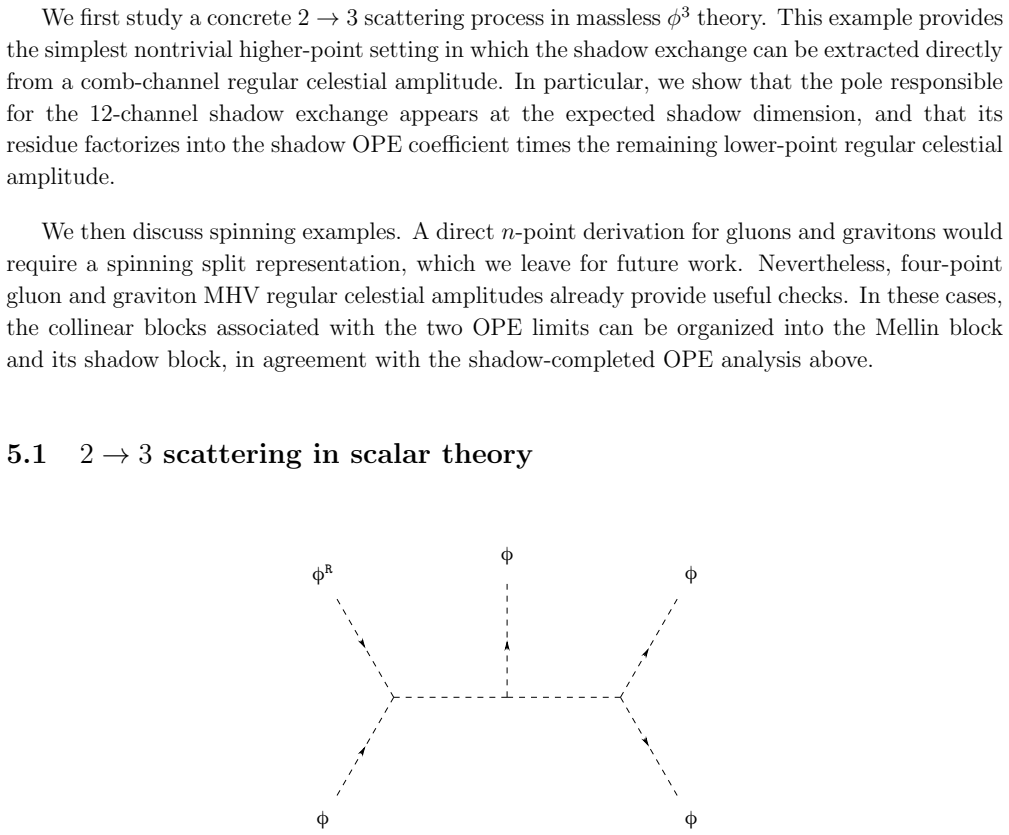
- The completion is verified explicitly in scalar 2 to n tree-level amplitudes and in a five-point example.
Where Pith is reading between the lines
- Correlation functions built from the completed OPE would automatically incorporate shadow contributions at every order.
- The structure may link to known relations between different conformal weights in two-dimensional CFTs.
- Higher-loop or higher-point celestial amplitudes could provide further tests of the required shadow terms.
Load-bearing premise
That OPE consistency in the boundary theory requires the algebra to close on all primary states generated by the shadow transform without introducing new bulk degrees of freedom.
What would settle it
A concrete four-point celestial amplitude computed using only Mellin exchanges that nevertheless reproduces the full bulk result without any shadow contribution would contradict the claim.
Figures

read the original abstract
We argue that celestial OPEs must be supplemented by shadow-basis operators. Although the shadow transform does not introduce new bulk degrees of freedom, it provides a distinct primary state in the boundary celestial theory. From OPE consistency, we show that the ordinary celestial OPE does not close on Mellin-basis exchanges alone. Rather, the same exchanged bulk particle must also appear through its shadow-basis representative. This leads to a shadow-completed OPE, with the shadow OPE coefficient fixed by the ordinary collinear coefficient through the universal shadow factor. We discuss the corresponding boundary Hilbert-space interpretation, extend this argument to gluons and gravitons, and verify the shadow exchange directly in tree-level regular celestial amplitudes, including a scalar $2\rightarrow n$ analysis and an explicit five-point example.
Editorial analysis
A structured set of objections, weighed in public.
Referee Report
Summary. The manuscript argues that celestial OPEs must be supplemented by shadow-basis operators. Although the shadow transform introduces no new bulk degrees of freedom, it supplies a distinct primary in the boundary theory. OPE consistency on the celestial sphere implies that the ordinary celestial OPE does not close on Mellin-basis exchanges alone; the same bulk particle must also appear via its shadow-basis representative. The resulting shadow-completed OPE has its shadow coefficient fixed by the ordinary collinear coefficient through a universal shadow factor. The construction is verified directly in tree-level regular celestial amplitudes (scalar 2 o n processes and an explicit five-point example) and extended to gluons and gravitons, with a discussion of the corresponding boundary Hilbert-space interpretation.
Significance. If the central consistency argument holds, the result supplies a systematic completion of celestial OPEs that resolves closure without new bulk degrees of freedom. The explicit verifications in tree-level amplitudes and the parameter-free fixing of the shadow coefficient via a universal factor are strengths. The work could affect operator-algebra constructions in celestial holography.
minor comments (3)
- [§2] §2: the precise normalization convention for the shadow transform relative to the Mellin transform should be stated explicitly, including any overall constants that enter the universal factor.
- [§4.2] The five-point example in §4.2: while the presence of the shadow exchange is shown, the numerical coefficient matching to the universal factor is presented only graphically; an analytic comparison would improve clarity.
- [§5] The boundary Hilbert-space discussion in §5 would benefit from a short diagram or table contrasting the Mellin and shadow primaries for a single bulk exchange.
Simulated Author's Rebuttal
We thank the referee for the positive assessment of our work and the recommendation of minor revision. No specific major comments were raised in the report.
Circularity Check
No significant circularity identified
full rationale
The derivation proceeds from requiring OPE consistency on the celestial sphere, showing that Mellin-basis exchanges alone do not close and that the same bulk particle must appear via its shadow representative, with the shadow coefficient fixed by the ordinary coefficient through a universal shadow factor. This is independently verified by explicit computation in tree-level regular celestial amplitudes (scalar 2→n and five-point cases) and extended to gluons/gravitons. No step reduces by construction to a fitted parameter, self-definition, or load-bearing self-citation; the shadow transform is treated as providing a distinct boundary primary without new bulk degrees of freedom, yielding an independent result rather than a renaming or ansatz smuggling.
Axiom & Free-Parameter Ledger
axioms (1)
- domain assumption OPE consistency requires the algebra to close on all relevant boundary primary states including shadows
Forward citations
Cited by 1 Pith paper
-
Topics in Celestial holography: A bottom-up perspective
A review of symmetries, celestial CFT, twistor theory interplay, and AdS/CFT connections in the bottom-up search for a celestial dual to flat-space quantum gravity.
Reference graph
Works this paper leans on
-
[1]
4D scattering amplitudes and asymptotic symmetries from 2D CFT
Clifford Cheung, Anton de la Fuente, and Raman Sundrum. “4D scattering amplitudes and asymptotic symmetries from 2D CFT”. In:JHEP01 (2017), p. 112.doi:10 . 1007 / JHEP01(2017)112. arXiv:1609.00732 [hep-th](cit. on p. 2)
Pith/arXiv arXiv 2017
-
[2]
Flat Space Amplitudes and Conformal Symmetry of the Celestial Sphere
Sabrina Pasterski, Shu-Heng Shao, and Andrew Strominger. “Flat Space Amplitudes and Conformal Symmetry of the Celestial Sphere”. In:Phys. Rev. D96.6 (2017), p. 065026.doi: 10.1103/PhysRevD.96.065026. arXiv:1701.00049 [hep-th](cit. on p. 2)
work page internal anchor Pith review Pith/arXiv arXiv doi:10.1103/physrevd.96.065026 2017
-
[3]
A Conformal Basis for Flat Space Amplitudes
Sabrina Pasterski and Shu-Heng Shao. “Conformal basis for flat space amplitudes”. In:Phys. Rev. D96.6 (2017), p. 065022.doi:10.1103/PhysRevD.96.065022. arXiv:1705.01027 [hep-th](cit. on p. 2)
work page internal anchor Pith review Pith/arXiv arXiv doi:10.1103/physrevd.96.065022 2017
-
[4]
Prince- ton University Press, 2018.isbn: 978-0-691-17973-5
Andrew Strominger.Lectures on the Infrared Structure of Gravity and Gauge Theory. Prince- ton University Press, 2018.isbn: 978-0-691-17973-5. arXiv:1703.05448 [hep-th](cit. on p. 2)
Pith/arXiv arXiv 2018
-
[5]
Lectures on Celestial Holography
Ana-Maria Raclariu. “Lectures on Celestial Holography”. In: (July 2021). arXiv:2107.02075 [hep-th](cit. on p. 2)
arXiv 2021
-
[6]
Lectures on celestial amplitudes
Sabrina Pasterski. “Lectures on celestial amplitudes”. In:Eur. Phys. J. C81.12 (2021), p. 1062.doi:10.1140/epjc/s10052-021-09846-7. arXiv:2108.04801 [hep-th](cit. on p. 2)
-
[7]
Sabrina Pasterski, Monica Pate, and Ana-Maria Raclariu. “Celestial Holography”. In:Snow- mass 2021. Nov. 2021. arXiv:2111.11392 [hep-th](cit. on p. 2)
arXiv 2021
-
[8]
The SAGEX review on scat- tering amplitudes chapter 11: soft theorems and celestial amplitudes
Tristan McLoughlin, Andrea Puhm, and Ana-Maria Raclariu. “The SAGEX review on scat- tering amplitudes chapter 11: soft theorems and celestial amplitudes”. In:J. Phys. A55.44 (2022), p. 443012.doi:10.1088/1751-8121/ac9a40. arXiv:2203.13022 [hep-th](cit. on p. 2)
-
[9]
State-operator correspondence in celestial conformal field theory
Erin Crawley, Noah Miller, Sruthi A. Narayanan, and Andrew Strominger. “State-operator correspondence in celestial conformal field theory”. In:JHEP09 (2021), p. 132.doi:10. 1007/JHEP09(2021)132. arXiv:2105.00331 [hep-th](cit. on p. 2)
arXiv 2021
-
[10]
Con- formal blocks from celestial gluon amplitudes
Wei Fan, Angelos Fotopoulos, Stephan Stieberger, Tomasz R. Taylor, and Bin Zhu. “Con- formal blocks from celestial gluon amplitudes”. In:JHEP05 (2021), p. 170.doi:10.1007/ JHEP05(2021)170. arXiv:2103.04420 [hep-th](cit. on p. 2)
arXiv 2021
-
[11]
Con- formal blocks from celestial gluon amplitudes. Part II. Single-valued correlators
Wei Fan, Angelos Fotopoulos, Stephan Stieberger, Tomasz R. Taylor, and Bin Zhu. “Con- formal blocks from celestial gluon amplitudes. Part II. Single-valued correlators”. In:JHEP 11 (2021), p. 179.doi:10.1007/JHEP11(2021)179. arXiv:2108.10337 [hep-th](cit. on p. 2)
-
[12]
Chi-Ming Chang, Wei Cui, Wen-Jie Ma, Hongfei Shu, and Hao Zou. “Shadow celestial am- plitudes”. In:JHEP02 (2023), p. 017.doi:10.1007/JHEP02(2023)017. arXiv:2210.04725 [hep-th](cit. on p. 2). 27
-
[13]
Missing corner in the sky: massless three-point celestial amplitudes
Chi-Ming Chang and Wen-Jie Ma. “Missing corner in the sky: massless three-point celestial amplitudes”. In:JHEP04 (2023), p. 051.doi:10.1007/JHEP04(2023)051. arXiv:2212. 07025 [hep-th](cit. on pp. 2, 3, 7)
-
[14]
Celestial two-point functions and rectified dictionary
Hideo Furugori, Naoki Ogawa, Sotaro Sugishita, and Takahiro Waki. “Celestial two-point functions and rectified dictionary”. In:JHEP02 (2024), p. 063.doi:10.1007/JHEP02(2024)
-
[15]
arXiv:2312.07057 [hep-th](cit. on p. 2)
-
[16]
Conformal blocks from celestial graviton amplitudes
Iustin Surubaru and Bin Zhu. “Conformal blocks from celestial graviton amplitudes”. In: JHEP06 (2025), p. 174.doi:10.1007/JHEP06(2025)174. arXiv:2501.05805 [hep-th] (cit. on p. 2)
-
[17]
Shadow celestial operator product expansions
Elizabeth Himwich and Monica Pate. “Shadow celestial operator product expansions”. In: JHEP11 (2025), p. 139.doi:10.1007/JHEP11(2025)139. arXiv:2505.09499 [hep-th] (cit. on pp. 2, 14)
-
[18]
Double-soft limit and celestial shadow OPE from charge bracket
Daniele Pranzetti and Domenico Giuseppe Salluce. “Double-soft limit and celestial shadow OPE from charge bracket”. In: (Oct. 2025). arXiv:2510.26520 [hep-th](cit. on p. 2)
arXiv 2025
-
[19]
Amplitude from crossing-symmetric celestial OPE
Reiko Liu and Wen-Jie Ma. “Amplitude from crossing-symmetric celestial OPE”. In: (Mar. 2025). arXiv:2503.21512 [hep-th](cit. on pp. 2, 3, 10, 17)
arXiv 2025
-
[20]
Ambidextrous light transforms for celestial amplitudes
Atul Sharma. “Ambidextrous light transforms for celestial amplitudes”. In:JHEP01 (2022), p. 031.doi:10.1007/JHEP01(2022)031. arXiv:2107.06250 [hep-th](cit. on p. 2)
-
[21]
Celestial amplitudes in an am- bidextrous basis
Carmen Jorge-Diaz, Sabrina Pasterski, and Atul Sharma. “Celestial amplitudes in an am- bidextrous basis”. In:JHEP02 (2023), p. 155.doi:10 . 1007 / JHEP02(2023 ) 155. arXiv: 2212.00962 [hep-th](cit. on p. 2)
arXiv 2023
-
[22]
Light transformed gluon cor- relators in CCFT
Sourish Banerjee, Rudranil Basu, and Sayali Atul Bhatkar. “Light transformed gluon cor- relators in CCFT”. In:JHEP01 (2023), p. 075.doi:10.1007/JHEP01(2023)075. arXiv: 2203.06657 [hep-th](cit. on p. 2)
-
[23]
Light transformation: a celestial and Carrollian perspective
Sourish Banerjee, Rudranil Basu, and Sayali Atul Bhatkar. “Light transformation: a celestial and Carrollian perspective”. In:JHEP12 (2024), p. 122.doi:10.1007/JHEP12(2024)122. arXiv:2407.08379 [hep-th](cit. on p. 2)
-
[24]
Light and Shadow OPEs: A Carroll Symmetric Ap- proach to Flat Holography
Sourish Banerjee and Rudranil Basu. “Light and Shadow OPEs: A Carroll Symmetric Ap- proach to Flat Holography”. In: (June 2025). arXiv:2506.17413 [hep-th](cit. on p. 2)
arXiv 2025
-
[25]
On bulk reconstruction in Lorentzian AdS and its flat space limit
N´ uria Navarro and Ana-Maria Raclariu. “On bulk reconstruction in Lorentzian AdS and its flat space limit”. In: (May 2026). arXiv:2605.16641 [hep-th](cit. on p. 2)
Pith/arXiv arXiv 2026
-
[26]
Soft Limits of Yang-Mills Amplitudes and Conformal Correlators
Wei Fan, Angelos Fotopoulos, and Tomasz R. Taylor. “Soft Limits of Yang-Mills Amplitudes and Conformal Correlators”. In:JHEP05 (2019), p. 121.doi:10.1007/JHEP05(2019)121. arXiv:1903.01676 [hep-th](cit. on pp. 2, 14)
work page internal anchor Pith review Pith/arXiv arXiv doi:10.1007/jhep05(2019)121 2019
-
[27]
Celestial oper- ator products of gluons and gravitons
Monica Pate, Ana-Maria Raclariu, Andrew Strominger, and Ellis Ye Yuan. “Celestial oper- ator products of gluons and gravitons”. In:Rev. Math. Phys.33.09 (2021), p. 2140003.doi: 10.1142/S0129055X21400031. arXiv:1910.07424 [hep-th](cit. on pp. 2, 14). 28
-
[28]
Conformal Basis, Optical Theorem, and the Bulk Point Singularity
Ho Tat Lam and Shu-Heng Shao. “Conformal Basis, Optical Theorem, and the Bulk Point Singularity”. In:Phys. Rev. D98.2 (2018), p. 025020.doi:10.1103/PhysRevD.98.025020. arXiv:1711.06138 [hep-th](cit. on p. 2)
work page internal anchor Pith review Pith/arXiv arXiv doi:10.1103/physrevd.98.025020 2018
-
[29]
Notes on reso- nances and unitarity from celestial amplitudes
Diego Garc´ ıa-Sep´ ulveda, Alfredo Guevara, Justin Kulp, and Jingxiang Wu. “Notes on reso- nances and unitarity from celestial amplitudes”. In:JHEP09 (2022), p. 245.doi:10.1007/ JHEP09(2022)245. arXiv:2205.14633 [hep-th](cit. on p. 2)
arXiv 2022
-
[30]
Con- formal block expansion in celestial CFT
Alexander Atanasov, Walker Melton, Ana-Maria Raclariu, and Andrew Strominger. “Con- formal block expansion in celestial CFT”. In:Phys. Rev. D104.12 (2021), p. 126033.doi: 10.1103/PhysRevD.104.126033. arXiv:2104.13432 [hep-th](cit. on p. 2)
-
[31]
Bulk locality from the celestial amplitude
Chi-Ming Chang, Yu-tin Huang, Zi-Xun Huang, and Wei Li. “Bulk locality from the celestial amplitude”. In:SciPost Phys.12.5 (2022), p. 176.doi:10.21468/SciPostPhys.12.5.176. arXiv:2106.11948 [hep-th](cit. on p. 2)
-
[32]
Celestial Yang-Mills amplitudes and D = 4 conformal blocks
Wei Fan, Angelos Fotopoulos, Stephan Stieberger, Tomasz R. Taylor, and Bin Zhu. “Celestial Yang-Mills amplitudes and D = 4 conformal blocks”. In:JHEP09 (2022), p. 182.doi: 10.1007/JHEP09(2022)182. arXiv:2206.08979 [hep-th](cit. on p. 2)
-
[33]
Split representation in celestial holography
Chi-Ming Chang, Reiko Liu, and Wen-Jie Ma. “Split representation in celestial holography”. In: (Nov. 2023). arXiv:2311.08736 [hep-th](cit. on pp. 2, 3, 15)
arXiv 2023
-
[34]
Celestial conformal blocks of massless scalars and analytic continuation of the Appell function F 1
Wei Fan. “Celestial conformal blocks of massless scalars and analytic continuation of the Appell function F 1”. In:JHEP01 (2024), p. 145.doi:10.1007/JHEP01(2024)145. arXiv: 2311.11345 [hep-th](cit. on p. 2)
-
[35]
Massive celestial amplitudes and celestial amplitudes beyond four points
Reiko Liu and Wen-Jie Ma. “Massive celestial amplitudes and celestial amplitudes beyond four points”. In:JHEP01 (2025), p. 180.doi:10.1007/JHEP01(2025)180. arXiv:2404. 01920 [hep-th](cit. on pp. 2, 3, 10, 17, 18, 22)
-
[36]
Celestial optical theorem
Reiko Liu and Wen-Jie Ma. “Celestial optical theorem”. In:Phys. Rev. D111.2 (2025), p. 025017.doi:10 . 1103 / PhysRevD . 111 . 025017. arXiv:2404 . 18898 [hep-th](cit. on pp. 2, 3)
2025
-
[37]
Celestial Holography Revisited
Charlotte Sleight and Massimo Taronna. “Celestial Holography Revisited”. In:Phys. Rev. Lett.133.24 (2024), p. 241601.doi:10.1103/PhysRevLett.133.241601. arXiv:2301.01810 [hep-th](cit. on p. 2)
-
[38]
Celestial holography revisited. Part II. Correlators and K¨ all´ en-Lehmann
Lorenzo Iacobacci, Charlotte Sleight, and Massimo Taronna. “Celestial holography revisited. Part II. Correlators and K¨ all´ en-Lehmann”. In:JHEP08 (2024), p. 033.doi:10 . 1007 / JHEP08(2024)033. arXiv:2401.16591 [hep-th](cit. on p. 2)
arXiv 2024
-
[39]
Celestial Mellin Amplitudes: Spin-1 and Spin-2 Exchange and Beyond
S´ ebastien Malherbe, Paolo Pergola, Charlotte Sleight, and Massimo Taronna. “Celestial Mellin Amplitudes: Spin-1 and Spin-2 Exchange and Beyond”. In: (Nov. 2025). arXiv:2511. 09501 [hep-th](cit. on p. 2)
2025
-
[40]
Regular celestial amplitudes
Reiko Liu and Wen-Jie Ma. “Regular celestial amplitudes”. In: (Dec. 2025). arXiv:2512. 05882 [hep-th](cit. on pp. 2, 3, 4, 7, 10, 14, 15, 16, 20, 22, 23, 24)
2025
-
[41]
Unifying soft and hard dynamics: The hard current algebra in celestial holography
Reiko Liu and Wen-Jie Ma. “Unifying soft and hard dynamics: The hard current algebra in celestial holography”. In: (Jan. 2026). arXiv:2601.10601 [hep-th](cit. on p. 3). 29
arXiv 2026
-
[42]
Gluon Amplitudes as 2d Conformal Correlators
Sabrina Pasterski, Shu-Heng Shao, and Andrew Strominger. “Gluon Amplitudes as 2d Con- formal Correlators”. In:Phys. Rev. D96.8 (2017), p. 085006.doi:10.1103/PhysRevD.96. 085006. arXiv:1706.03917 [hep-th](cit. on p. 7)
work page internal anchor Pith review Pith/arXiv arXiv doi:10.1103/physrevd.96 2017
-
[43]
Gel’fand and G.E
I.M. Gel’fand and G.E. Shilov.Generalized Functions, Volume 1. Elsevier Science, 2014. isbn: 9781483261591.url:https://books.google.com/books?id=dgnjBQAAQBAJ(cit. on p. 10)
2014
-
[44]
Gel’Fand and G.E
I.M. Gel’Fand and G.E. Shilov.Generalized Functions, Volume 2. Elsevier Science, 2013. isbn: 9781483262307.url:https://books.google.com/books?id=iMo3BQAAQBAJ(cit. on p. 10)
2013
-
[45]
Morimoto.An Introduction to Sato’s Hyperfunctions
M. Morimoto.An Introduction to Sato’s Hyperfunctions. Graduate Studies in Mathematics. American Mathematical Society, 1993.isbn: 9780821887677.url:https://books.google. com/books?id=pcSumZ4aPX0C(cit. on p. 10)
1993
-
[46]
Asymptotic Symmetries and Celestial CFT
Laura Donnay, Sabrina Pasterski, and Andrea Puhm. “Asymptotic Symmetries and Celestial CFT”. In:JHEP09 (2020), p. 176.doi:10.1007/JHEP09(2020)176. arXiv:2005.08990 [hep-th](cit. on p. 10)
-
[47]
Carrollian holography with agentic AI: Real mass is imaginary
Reiko Liu, Wen-Jie Ma, Hu Zheng, and Yu-fan Zheng. “Carrollian holography with agentic AI: Real mass is imaginary”. In: (June 2026). arXiv:2606.05401 [hep-th](cit. on p. 10)
Pith/arXiv arXiv 2026
-
[48]
Poincare constraints on celestial amplitudes
Y. T. Albert Law and Michael Zlotnikov. “Poincare constraints on celestial amplitudes”. In: JHEP03 (2020). [Erratum: JHEP 04, 202 (2020)], p. 085.doi:10.1007/JHEP03(2020)085. arXiv:1910.04356 [hep-th](cit. on p. 22). 30
discussion (0)
Sign in with ORCID, Apple, or X to comment. Anyone can read and Pith papers without signing in.