String Axiverse Enhancement of Superradiant Dark Matter Production
Pith reviewed 2026-06-26 16:42 UTC · model grok-4.3
The pith
Emission of many light axions during primordial black hole evaporation increases black hole spin and thereby boosts superradiant dark matter production.
A machine-rendered reading of the paper's core claim, the machinery that carries it, and where it could break.
Core claim
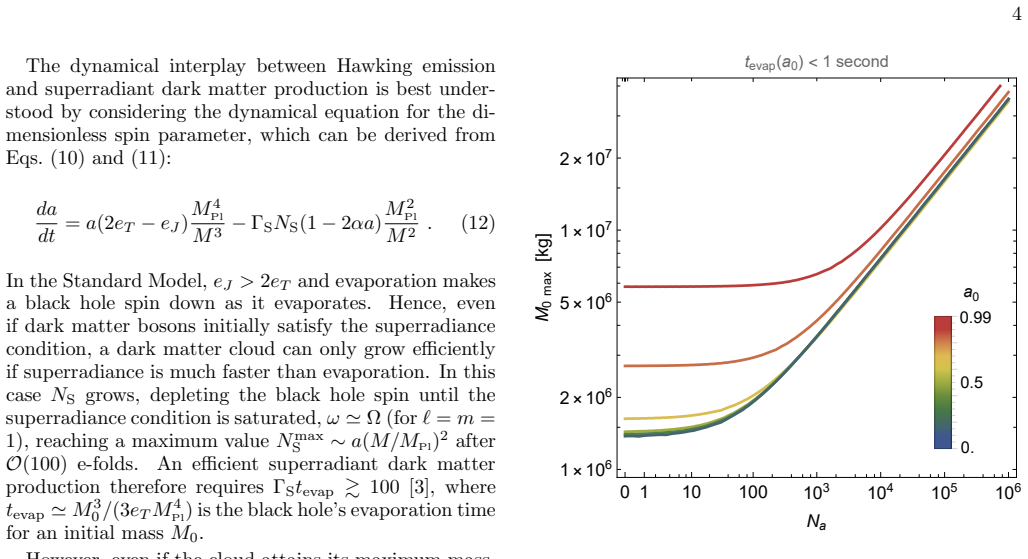
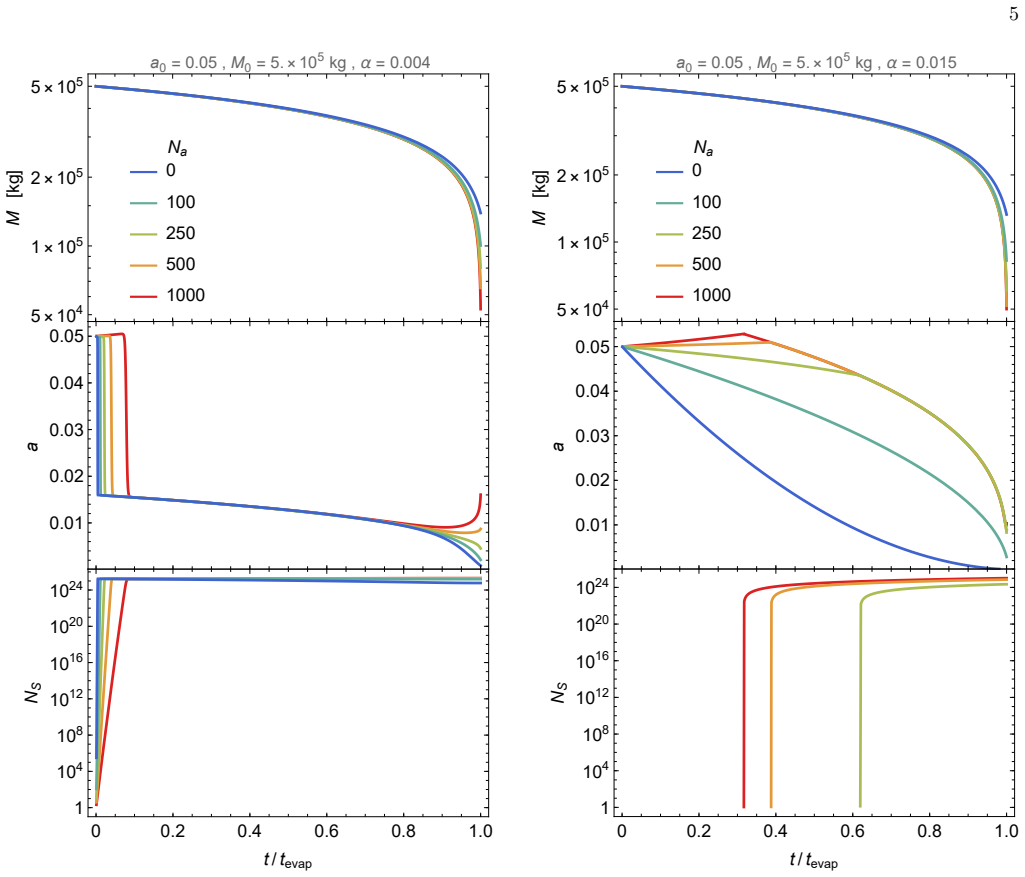
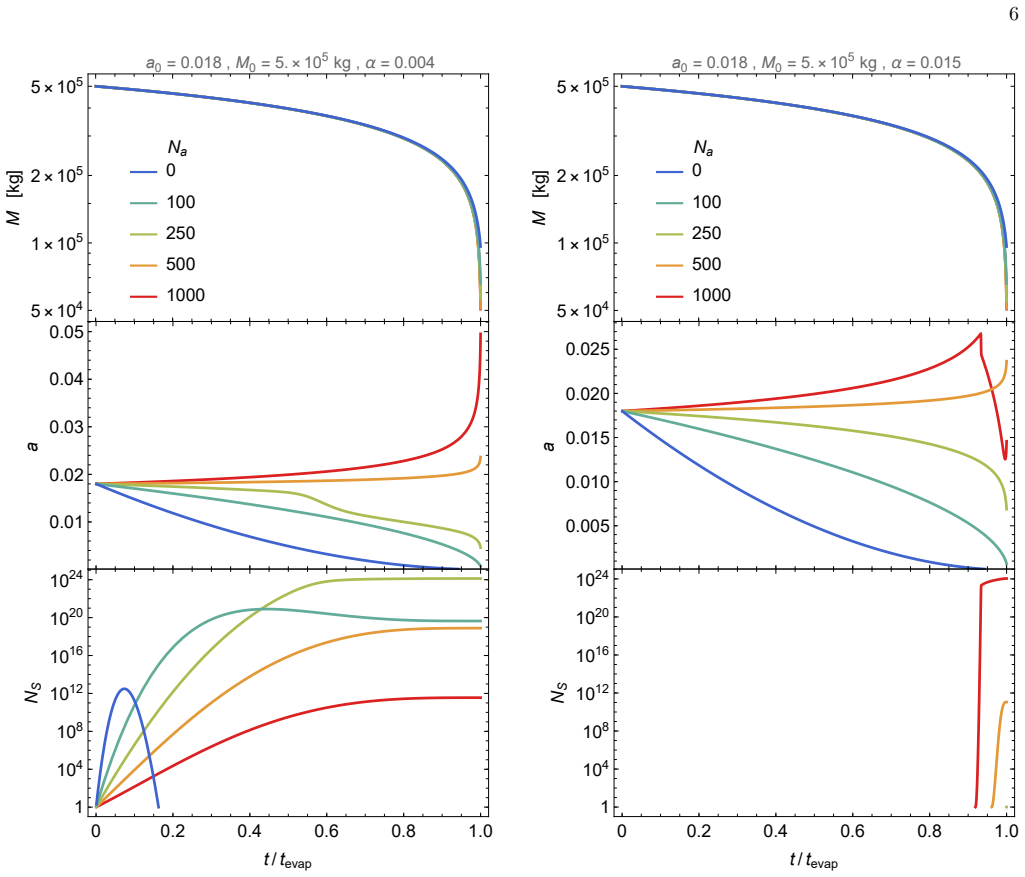
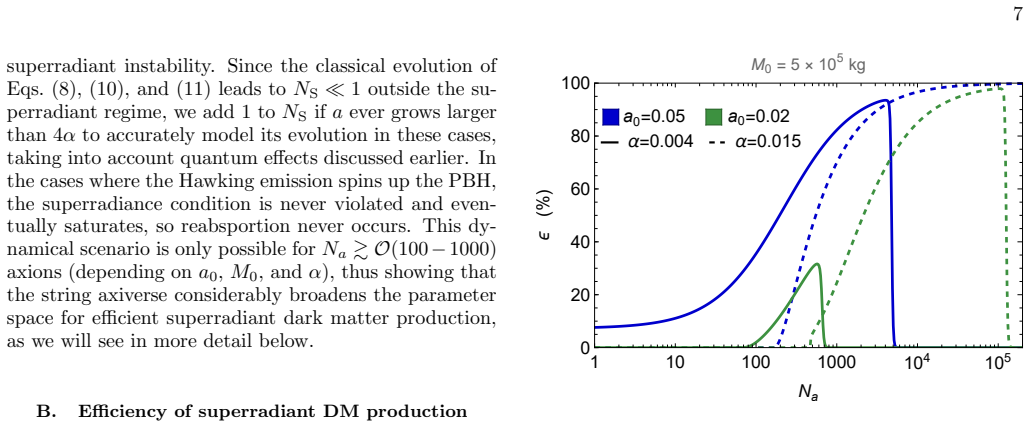
The Hawking emission of O(100-10^5) light axion species predicted in realistic string theory constructions can significantly enhance the efficiency of superradiance, given the associated increase in the PBH spin. The string axiverse thus significantly expands the parametric regions (dark matter mass and PBH mass and spin) for which a sizeable fraction of dark matter may presently be in the form of micro-boson stars, the self-gravitating remnants of superradiant dark matter clouds. Conversely, for too large a number of axion species PBHs evaporate too quickly for superradiant clouds to attain their maximum mass.
What carries the argument
The string axiverse multiplicity of light axions, which controls both the rate of PBH spin-up and the duration of the evaporation phase that sets the window for superradiant cloud growth.
If this is right
- The viable window in dark matter mass and PBH mass-spin parameter space for forming a sizeable fraction of dark matter as micro-boson stars becomes substantially larger.
- When the number of axion species exceeds roughly 10^5, the evaporation timescale drops below the time needed for superradiant clouds to reach maximum mass.
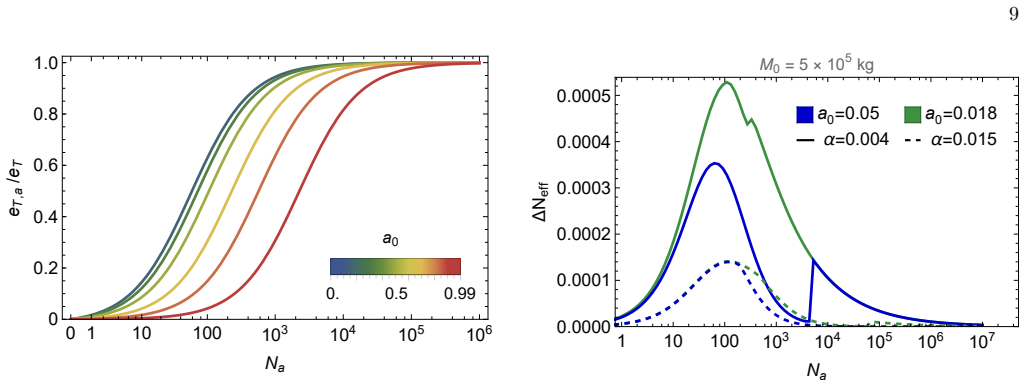
- Axions emitted directly by PBH evaporation add an immeasurably small contribution to the relativistic degrees of freedom at recombination, even under the assumption that all dark matter originates from PBHs.
Where Pith is reading between the lines
- Models of early-universe black hole populations may need to track the cumulative spin evolution induced by multiple light species rather than treating each species independently.
- Constraints on the primordial black hole fraction derived from superradiance limits could shift once the axiverse multiplicity is included in the spin calculation.
- Future gravitational-wave or pulsar-timing searches for boson-star mergers could be reinterpreted as indirect probes of the number of light axions present during the black hole epoch.
Load-bearing premise
The emission of many light axions during Hawking radiation increases PBH spin without other compensating effects that would cancel the spin gain.
What would settle it
A measurement showing that the typical spin of evaporating primordial black holes in the relevant mass window remains low even when the number of light axions is O(100) or higher.
Figures


read the original abstract
We study the effects of string axion emission on dark matter production by light primordial black holes (PBHs), through both evaporation and superradiance. We show, in particular, that the Hawking emission of $\mathcal{O}(100-10^5)$ light axion species predicted in realistic string theory constructions can significantly enhance the efficiency of superradiance, given the associated increase in the PBH spin. The string axiverse thus significantly expands the parametric regions (dark matter mass and PBH mass and spin) for which a sizeable fraction of dark matter may presently be in the form of ``micro-boson stars'': the self-gravitating remnants of superradiant dark matter clouds. Conversely, for too large a number of axion species PBHs evaporate too quickly for superradiant clouds to attain their maximum mass. Finally, assuming that all dark matter is produced by PBHs (through both superradiance and Hawking emission), we show that the axions emitted during PBH evaporation give an immeasurably small contribution to the relativistic degrees of freedom at recombination.
Editorial analysis
A structured set of objections, weighed in public.
Referee Report
Summary. The paper studies the impact of O(100-10^5) light axion species from the string axiverse on dark matter production by light primordial black holes (PBHs) via both Hawking evaporation and superradiance. It claims that axion emission during Hawking radiation increases PBH dimensionless spin a*, thereby enhancing superradiant cloud growth and expanding the parameter space (DM mass, PBH mass, and spin) where a sizeable DM fraction can reside in micro-boson stars; excessive species cause overly rapid evaporation that prevents maximum cloud mass; and evaporated axions contribute negligibly to relativistic degrees of freedom at recombination.
Significance. If the central mapping from axion multiplicity to net spin-up holds, the result links string-theory axiverse predictions to observable PBH-driven DM channels and micro-boson-star phenomenology, potentially widening viable PBH parameter regions without introducing new free parameters beyond standard Hawking and superradiance formulae.
major comments (2)
- [§3.2, Eq. (12)] §3.2 and Eq. (12): the assertion that Hawking emission of N axion species produces a net increase in a* = J/M² rests on the ratio dJ/dM remaining favorable, yet the text applies standard greybody factors without demonstrating that the mode-sum ratio is independent of N or that no compensating spin-down channels arise; this ratio is load-bearing for the claimed expansion of the superradiance parameter space.
- [§4.1, Fig. 3] §4.1, Fig. 3: the parametric boundaries for micro-boson-star DM fraction are derived assuming the spin-up effect scales linearly with N up to 10^5, but no explicit integration of the coupled dM/dt and dJ/dt equations with N-dependent evaporation timescale is shown; the transition to “too rapid evaporation” at large N therefore lacks a quantitative threshold derivation.
minor comments (2)
- [§2–3] Notation for the number of axion species is introduced as N in §2 but switches to N_a in §3 without a cross-reference; consistent use would improve readability.
- [§5] The abstract states the contribution to g_* is “immeasurably small,” yet §5 only quotes an order-of-magnitude estimate; a brief numerical value or upper bound would strengthen the claim.
Simulated Author's Rebuttal
We thank the referee for their careful reading of the manuscript and for the constructive major comments. We address each point below and indicate the revisions we will make.
read point-by-point responses
-
Referee: [§3.2, Eq. (12)] §3.2 and Eq. (12): the assertion that Hawking emission of N axion species produces a net increase in a* = J/M² rests on the ratio dJ/dM remaining favorable, yet the text applies standard greybody factors without demonstrating that the mode-sum ratio is independent of N or that no compensating spin-down channels arise; this ratio is load-bearing for the claimed expansion of the superradiance parameter space.
Authors: The ratio dJ/dM is independent of N. The energy and angular momentum emission rates for each axion species are computed from the standard greybody factors for a single massless scalar; because the species are identical and non-interacting, the totals are exactly N times the single-species rates. Consequently dJ/dM equals the single-species value and does not depend on N. Our model includes only the Hawking emission of the axiverse axions plus standard-model fields; no additional spin-down channels are present. We will add an explicit paragraph in §3.2 stating this scaling and confirming the absence of compensating channels. revision: yes
-
Referee: [§4.1, Fig. 3] §4.1, Fig. 3: the parametric boundaries for micro-boson-star DM fraction are derived assuming the spin-up effect scales linearly with N up to 10^5, but no explicit integration of the coupled dM/dt and dJ/dt equations with N-dependent evaporation timescale is shown; the transition to “too rapid evaporation” at large N therefore lacks a quantitative threshold derivation.
Authors: The boundaries follow from the N-linear scaling of the evaporation timescale together with the requirement that the superradiance growth time remain shorter than the PBH lifetime. While the main text presents the resulting parametric regions, we did not display the numerical integration of the coupled equations. The transition to overly rapid evaporation is the point at which the lifetime drops below the time needed for the cloud to reach maximum mass; this occurs near N ≈ 10^5 for the masses considered. We will add a concise description of the integration procedure and the threshold derivation, either in the main text or as a short appendix. revision: yes
Circularity Check
No circularity: standard formulas applied to external string axiverse multiplicity
full rationale
The paper's central claim applies established Hawking emission rates and superradiance dynamics to an externally supplied O(100-10^5) axion species count from string theory. No equation or step reduces by construction to a fitted parameter, self-definition, or self-citation chain; the axion multiplicity enters as an independent input rather than being derived from the superradiance efficiency or PBH spin evolution being computed. The derivation remains self-contained against external benchmarks with no load-bearing self-referential steps.
Axiom & Free-Parameter Ledger
Reference graph
Works this paper leans on
-
[1]
0.5 0.99 0 1 10 100 103 104 105 1060 0.2 0.4 0.6 0.8 1.0 Na eT,a /eT FIG. 9. The ratio of axion to total emissivity coefficients is independent ofa 0 for low initial spins,a 0 ≲0.1. In the large Na limit, evaporation is dominated by axion emission. that for low spins, withN a ∼ O(100), axions already comprise 60%−90% of Hawking emission. Combining Eqs. (2...
-
[2]
B. Carr, K. Kohri, Y. Sendouda and J. Yokoyama, Rept. Prog. Phys.84, no.11, 116902 (2021) [arXiv:2002.12778 [astro-ph.CO]]
Pith/arXiv arXiv 2021
- [3]
-
[4]
J. March-Russell and J. G. Rosa, Phys. Rev. D113, no.10, L101304 (2026) [arXiv:2205.15277 [gr-qc]]
arXiv 2026
-
[5]
O. Lennon, J. March-Russell, R. Petrossian-Byrne and H. Tillim, JCAP04, 009 (2018) [arXiv:1712.07664 [hep- ph]]
Pith/arXiv arXiv 2018
-
[6]
R. Allahverdi, J. Dent and J. Osinski, Phys. Rev. D97, no.5, 055013 (2018) [arXiv:1711.10511 [astro-ph.CO]]
Pith/arXiv arXiv 2018
- [7]
-
[8]
N. Bernal and ´O. Zapata, JCAP03, 015 (2021) [arXiv:2011.12306 [astro-ph.CO]]
arXiv 2021
-
[9]
N. Bernal and ´O. Zapata, Phys. Lett. B815, 136129 (2021) [arXiv:2011.02510 [hep-ph]]
arXiv 2021
-
[10]
I. Masina, Eur. Phys. J. Plus135, no.7, 552 (2020) [arXiv:2004.04740 [hep-ph]]
arXiv 2020
- [11]
-
[12]
P. Gondolo, P. Sandick and B. Shams Es Haghi, Phys. Rev. D102, no.9, 095018 (2020) [arXiv:2009.02424 [hep- ph]]
arXiv 2020
- [13]
- [14]
-
[15]
T. Chiba and S. Yokoyama, PTEP2017, no.8, 083E01 (2017) [arXiv:1704.06573 [gr-qc]]
Pith/arXiv arXiv 2017
-
[16]
M. Mirbabayi, A. Gruzinov and J. Nore˜ na, JCAP03, 017 (2020) [arXiv:1901.05963 [astro-ph.CO]]
arXiv 2020
-
[17]
V. De Luca, V. Desjacques, G. Franciolini, A. Malhotra and A. Riotto, JCAP05, 018 (2019) [arXiv:1903.01179 [astro-ph.CO]]
arXiv 2019
-
[18]
T. Harada, C. M. Yoo, K. Kohri and K. I. Nakao, Phys. Rev. D96, no.8, 083517 (2017) [erratum: Phys. Rev. D 99, no.6, 069904 (2019)] [arXiv:1707.03595 [gr-qc]]
Pith/arXiv arXiv 2017
-
[19]
M. M. Flores and A. Kusenko, Phys. Rev. D104, no.6, 063008 (2021) [arXiv:2106.03237 [astro-ph.CO]]
arXiv 2021
- [20]
- [21]
- [22]
- [23]
-
[24]
S. V. Fallon, J. Halverson, L. McAllister and Y. Zhu, [arXiv:2511.20458 [hep-th]]
-
[25]
P. Svrcek and E. Witten, JHEP06, 051 (2006) [arXiv:hep-th/0605206 [hep-th]]
Pith/arXiv arXiv 2006
-
[26]
A. Arvanitaki, S. Dimopoulos, S. Dubovsky, N. Kaloper and J. March-Russell, Phys. Rev. D81, 123530 (2010) [arXiv:0905.4720 [hep-th]]
Pith/arXiv arXiv 2010
-
[27]
A. Arvanitaki and S. Dubovsky, Phys. Rev. D83, 044026 (2011) [arXiv:1004.3558 [hep-th]]
Pith/arXiv arXiv 2011
-
[28]
N. Gendler, D. J. E. Marsh, L. McAllister and J. Moritz, JCAP09, 071 (2024) [arXiv:2309.13145 [hep-th]]
arXiv 2024
-
[29]
M. Calz` a, J. March-Russell and J. G. Rosa, Phys. Rev. Lett.133, no.26, 261003 (2024) [arXiv:2110.13602 [astro- ph.CO]]
arXiv 2024
-
[30]
M. Calz` a, J. G. Rosa and F. Serrano, JHEP05, 140 (2024) [arXiv:2306.09430 [hep-ph]]
arXiv 2024
-
[31]
D. J. E. Marsh, Phys. Rept.643, 1-79 (2016) [arXiv:1510.07633 [astro-ph.CO]]
Pith/arXiv arXiv 2016
-
[32]
C. A. J. O’Hare, PoSCOSMICWISPers, 040 (2024) [arXiv:2403.17697 [hep-ph]]
arXiv 2024
-
[33]
P. Chen, Y. C. Ong and D. h. Yeom, Phys. Rept.603, 1-45 (2015) [arXiv:1412.8366 [gr-qc]]
Pith/arXiv arXiv 2015
-
[34]
M. Baryakhtar, M. Galanis, R. Lasenby and O. Simon, Phys. Rev. D103, no.9, 095019 (2021) [arXiv:2011.11646 [hep-ph]]
arXiv 2021
-
[35]
N. P. Branco, R. Z. Ferreira and J. G. Rosa, JCAP04, 003 (2023) [arXiv:2301.01780 [hep-ph]]. 12
arXiv 2023
- [36]
-
[37]
S. W. Hawking, Commun. Math. Phys.43, 199-220 (1975) [erratum: Commun. Math. Phys.46, 206 (1976)]
1975
-
[38]
J. B. Hartle and S. W. Hawking, Phys. Rev. D13, 2188- 2203 (1976)
1976
-
[39]
A. A. Starobinskii, Sov. Phys. JETP37, no.1, 28-32 (1973)
1973
-
[40]
V. Cardoso, O. J. C. Dias, J. P. S. Lemos and S. Yoshida, Phys. Rev. D70, 044039 (2004) [erratum: Phys. Rev. D 70, 049903 (2004)] [arXiv:hep-th/0404096 [hep-th]]
Pith/arXiv arXiv 2004
-
[41]
P. Pani, V. Cardoso, L. Gualtieri, E. Berti and A. Ishibashi, Phys. Rev. D86, 104017 (2012) [arXiv:1209.0773 [gr-qc]]
Pith/arXiv arXiv 2012
-
[42]
J. G. Rosa, JHEP02, 014 (2013) [arXiv:1209.4211 [hep- th]]
Pith/arXiv arXiv 2013
-
[43]
P. Pani, V. Cardoso, L. Gualtieri, E. Berti and A. Ishibashi, Phys. Rev. Lett.109, 131102 (2012) [arXiv:1209.0465 [gr-qc]]
Pith/arXiv arXiv 2012
-
[44]
H. Witek, V. Cardoso, A. Ishibashi and U. Sperhake, Phys. Rev. D87, no.4, 043513 (2013) [arXiv:1212.0551 [gr-qc]]
Pith/arXiv arXiv 2013
-
[45]
R. Brito, V. Cardoso and P. Pani, Class. Quant. Grav. 32, no.13, 134001 (2015) [arXiv:1411.0686 [gr-qc]]
Pith/arXiv arXiv 2015
-
[46]
A. Arvanitaki, M. Baryakhtar and X. Huang, Phys. Rev. D91, no.8, 084011 (2015) [arXiv:1411.2263 [hep-ph]]
Pith/arXiv arXiv 2015
-
[47]
R. Brito, V. Cardoso and P. Pani, Physics,” Lect. Notes Phys.906, pp.1-237 (2015) 2020, ISBN 978-3- 319-18999-4, 978-3-319-19000-6, 978-3-030-46621-3, 978- 3-030-46622-0 [arXiv:1501.06570 [gr-qc]]
Pith/arXiv arXiv 2015
-
[48]
J. G. Rosa and T. W. Kephart, Phys. Rev. Lett.120, no.23, 231102 (2018) [arXiv:1709.06581 [gr-qc]]
Pith/arXiv arXiv 2018
-
[49]
V. Cardoso, ´O. J. C. Dias, G. S. Hartnett, M. Middle- ton, P. Pani and J. E. Santos, JCAP03, 043 (2018) [arXiv:1801.01420 [gr-qc]]
Pith/arXiv arXiv 2018
-
[50]
D. Baumann, H. S. Chia and R. A. Porto, Phys. Rev. D 99, no.4, 044001 (2019) [arXiv:1804.03208 [gr-qc]]
Pith/arXiv arXiv 2019
-
[51]
D. Baumann, H. S. Chia, J. Stout and L. ter Haar, JCAP 12, 006 (2019) [arXiv:1908.10370 [gr-qc]]
arXiv 2019
-
[52]
D. N. Page, Phys. Rev. D14, 3260-3273 (1976)
1976
-
[53]
C. M. Chambers, W. A. Hiscock and B. Taylor, Phys. Rev. Lett.78, 3249-3251 (1997) [arXiv:gr-qc/9703018 [gr-qc]]
Pith/arXiv arXiv 1997
-
[54]
B. E. Taylor, C. M. Chambers and W. A. Hiscock, Phys. Rev. D58, 044012 (1998) [arXiv:gr-qc/9801044 [gr-qc]]
Pith/arXiv arXiv 1998
-
[55]
L. A. Kofman, Phys. Lett. A87, 281-284 (1982)
1982
-
[56]
L. Fu, H. Omiya, T. Tanaka, X. Tong, Y. Wang and H. Y. Zhu, [arXiv:2512.06790 [gr-qc]]
-
[57]
N. Aghanimet al.[Planck], Astron. Astrophys.641, A6 (2020) [erratum: Astron. Astrophys.652, C4 (2021)] [arXiv:1807.06209 [astro-ph.CO]]
Pith/arXiv arXiv 2020
- [58]
- [59]
-
[60]
G. Franciolini and D. Racco, Phys. Rev. D113, no.12, 123505 (2026) [arXiv:2603.02322 [astro-ph.CO]]
arXiv 2026
-
[61]
N. Jia, C. Zhang and X. Zhang, [arXiv:2603.29790 [astro- ph.CO]]
- [62]
-
[63]
D. Baumann, D. Green and B. Wallisch, JCAP08, 029 (2018) [arXiv:1712.08067 [astro-ph.CO]]
Pith/arXiv arXiv 2018
-
[64]
Hananyet al.[NASA PICO], [arXiv:1902.10541 [astro- ph.IM]]
S. Hananyet al.[NASA PICO], [arXiv:1902.10541 [astro- ph.IM]]
Pith/arXiv arXiv 1902
- [65]
-
[66]
N. Sanchis-Gual, F. Di Giovanni, M. Zilh˜ ao, C. Herdeiro, P. Cerd´ a-Dur´ an, J. A. Font and E. Radu, Phys. Rev. Lett.123, no.22, 221101 (2019) [arXiv:1907.12565 [gr- qc]]
arXiv 2019
-
[67]
F. Di Giovanni, N. Sanchis-Gual, P. Cerd´ a-Dur´ an, M. Zilh˜ ao, C. Herdeiro, J. A. Font and E. Radu, Phys. Rev. D102, no.12, 124009 (2020) [arXiv:2010.05845 [gr- qc]]
arXiv 2020
-
[68]
A. S. Dmitriev, D. G. Levkov, A. G. Panin, E. K. Push- naya and I. I. Tkachev, Phys. Rev. D104, no.2, 023504 (2021) [arXiv:2104.00962 [gr-qc]]
arXiv 2021
- [69]
-
[70]
M. Baryakhtar, D. Cyncynates and E. Henry, [arXiv:2602.23424 [hep-ph]]
discussion (0)
Sign in with ORCID, Apple, or X to comment. Anyone can read and Pith papers without signing in.