Topological Codes from Space Groups: A Route beyond Translation Invariance
Pith reviewed 2026-06-26 16:57 UTC · model grok-4.3
The pith
Space-group CSS codes that break translation invariance can achieve enhanced locality while preserving topological order.
A machine-rendered reading of the paper's core claim, the machinery that carries it, and where it could break.
Core claim
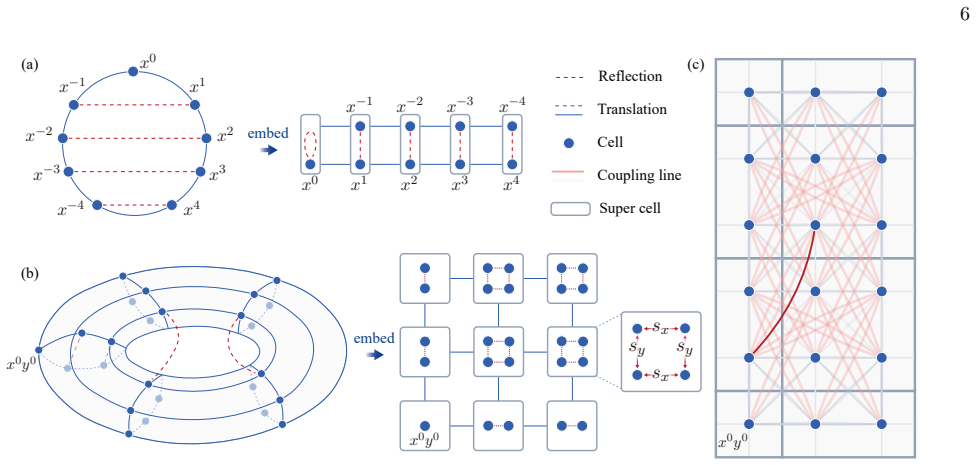
We introduce a framework for constructing Calderbank–Shor–Steane codes based on space groups which combine translations with point-group operations, thereby breaking translation invariance. To characterize these codes, we develop a module-theoretic approach based on invariant theory that provides a rigorous criterion for topological order and enables the computation of the number of independent anyon types. Although the inclusion of point-group operations might naively appear to hinder practical implementation, we find that these codes can actually exhibit enhanced locality compared to their purely translation-invariant counterparts.
What carries the argument
Module-theoretic approach based on invariant theory, which supplies a criterion for topological order and counts anyon types in codes whose stabilizers arise from space-group actions.
If this is right
- Topological order can be certified for stabilizer codes whose symmetry group is larger than the translation subgroup.
- The number of independent anyon types becomes computable for a wider class of CSS codes without requiring translation invariance.
- Stabilizer generators can have smaller support when point-group operations are included, reducing the number of qubits each check acts on.
- The design space for topological codes expands to include lattices whose natural symmetries include rotations and reflections.
Where Pith is reading between the lines
- Codes built this way could be matched to hardware whose physical interactions already respect a crystal point group rather than only translations.
- The same invariant-theory test might apply to other discrete symmetry groups that appear in quantum many-body systems with defects or boundaries.
- Explicit small examples on common 2D space groups could be used to search for anyon models whose braiding statistics differ from those of the standard toric code.
Load-bearing premise
The module-theoretic construction using invariant theory correctly identifies topological order and anyon content for codes whose stabilizers are defined via space-group actions that break translation invariance.
What would settle it
An explicit space-group code for which the invariant-theory module predicts a given number of anyon types, yet direct computation of the ground-state degeneracy on a torus or the commutation relations of logical operators yields a different count.
Figures

read the original abstract
Topological codes, including the toric code, are among the most important classes of stabilizer codes. Existing constructions and analyses of such codes, however, overwhelmingly assume translation invariance. Here we introduce a framework for constructing Calderbank--Shor--Steane (CSS) codes based on space groups which combine translations with point-group operations, thereby breaking translation invariance. To characterize these codes, we develop a module-theoretic approach based on invariant theory that provides a rigorous criterion for topological order and enables the computation of the number of independent anyon types. Although the inclusion of point-group operations might naively appear to hinder practical implementation, we find that these codes can actually exhibit enhanced locality compared to their purely translation-invariant counterparts. Our framework thus broadens the landscape of topological codes and opens new avenues for their co-design with quantum computing platforms.
Editorial analysis
A structured set of objections, weighed in public.
Referee Report
Summary. The paper introduces a framework for CSS topological codes constructed from space groups (combining translations with point-group operations, thereby breaking translation invariance). It develops a module-theoretic characterization based on invariant theory that supplies a criterion for topological order and a method to compute the number of independent anyon types. The authors further claim that the resulting codes can exhibit improved locality relative to their translation-invariant counterparts.
Significance. If the algebraic criterion is rigorously derived and the locality improvement holds under the stated assumptions, the work meaningfully enlarges the design space for topological codes beyond the translation-invariant setting that dominates the literature. The explicit use of invariant theory to obtain a module-theoretic test for topological order and anyon content is a methodological strength that could support systematic enumeration and analysis of new codes.
minor comments (2)
- [Abstract] The abstract asserts enhanced locality but does not indicate the metric (e.g., stabilizer weight or interaction range) or provide a concrete comparison; a short illustrative statement would strengthen the claim without lengthening the abstract.
- Because the module-theoretic construction replaces the usual Laurent-polynomial ring with an invariant ring, the manuscript should include at least one fully worked low-dimensional example (e.g., a small space group and the resulting module rank) to allow readers to verify the criterion in practice.
Simulated Author's Rebuttal
We thank the referee for the positive assessment of our framework for CSS topological codes based on space groups and the recommendation for minor revision. No specific major comments were raised in the report.
Circularity Check
No significant circularity detected
full rationale
The provided abstract and context introduce a new framework for space-group CSS codes and a module-theoretic characterization via invariant theory, but no equations, self-definitional reductions, fitted inputs renamed as predictions, or load-bearing self-citations are exhibited. The characterization is presented as developed within the work to analyze the codes rather than presupposed by definition or prior self-citation chains. Without specific paper text showing a derivation step that reduces to its own inputs by construction, the central claims remain independent of the flagged assumption.
Axiom & Free-Parameter Ledger
Reference graph
Works this paper leans on
-
[1]
Two syndromes are equivalent if they differ by the boundary of a finite-support Pauli operator
Infinite lattices The quotient modules below record equivalence classes in the syndrome module. Two syndromes are equivalent if they differ by the boundary of a finite-support Pauli operator. For standard local translation-invariant sta- bilizer models, these quotient data count independent 11 anyon types [14, 44]. For space-group codes, we adopt the lift...
-
[2]
Algebraically, finite size is imposed by replacing the Laurent ringℛ0 with the quotient ℛ0,𝐿=ℛ0/𝐼𝐿, (91) where𝐼𝐿is generated by the periodic boundary relations
Finite periodic lattices This subsection explains how the module calculation on the infinite lattice descends to a finite periodic sys- tem. Algebraically, finite size is imposed by replacing the Laurent ringℛ0 with the quotient ℛ0,𝐿=ℛ0/𝐼𝐿, (91) where𝐼𝐿is generated by the periodic boundary relations. For example, an𝐿𝑥×𝐿𝑦periodic system has 𝐼𝐿=⟨𝑥𝐿𝑥 + 1, 𝑦𝐿...
-
[3]
Fujii,Quantum Computation with Topological Codes: from qubit to topological fault-tolerance, Vol
K. Fujii,Quantum Computation with Topological Codes: from qubit to topological fault-tolerance, Vol. 8 (Springer, 2015)
2015
-
[4]
Bombín, arXiv preprint arXiv:1311.0277 (2013)
H. Bombín, arXiv preprint arXiv:1311.0277 (2013)
Pith/arXiv arXiv 2013
-
[5]
Dennis, A
E. Dennis, A. Kitaev, A. Landahl, and J. Preskill, Jour- nal of Mathematical Physics43, 4452 (2002)
2002
-
[6]
Kitaev, inProceedings of Symposia in Applied Math- ematics, Vol
A. Kitaev, inProceedings of Symposia in Applied Math- ematics, Vol. 58 (2002) pp. 267–272
2002
-
[7]
A. Y. Kitaev, Annals of physics303, 2 (2003)
2003
-
[8]
Dijkgraaf and E
R. Dijkgraaf and E. Witten, Communications in Mathe- matical Physics 129, 393 (1990)
1990
-
[9]
Wen, Physical review letters70, 355 (1993)
X.-G. Wen, Physical review letters70, 355 (1993)
1993
-
[10]
Kitaev, Annals of Physics321, 2 (2006)
A. Kitaev, Annals of Physics321, 2 (2006)
2006
-
[11]
A. G. Fowler, M. Mariantoni, J. M. Martinis, and A. N. Cleland, Physical Review A—Atomic, Molecular, and Optical Physics 86, 032324 (2012)
2012
-
[12]
Horsman, A
D. Horsman, A. G. Fowler, S. Devitt, and R. V. Meter, New Journal of Physics14, 123011 (2012)
2012
-
[13]
A. G. Fowler, A. M. Stephens, and P. Groszkowski, Phys- ical Review A—Atomic, Molecular, and Optical Physics 80, 052312 (2009)
2009
-
[14]
Y. Zhao, Y. Ye, H.-L. Huang, Y. Zhang, D. Wu, H. Guan, Q. Zhu, Z. Wei, T. He, S. Cao,et al., Physical Review Letters 129, 030501 (2022)
2022
-
[15]
Bravyi, A
S. Bravyi, A. W. Cross, J. M. Gambetta, D. Maslov, P. Rall, and T. J. Yoder, Nature627, 778 (2024)
2024
-
[16]
Liang, K
Z. Liang, K. Liu, H. Song, and Y.-A. Chen, PRX Quan- tum 6, 020357 (2025)
2025
- [17]
-
[18]
Z. Liang and Y.-A. Chen, arXiv preprint arXiv:2605.04151 (2026)
Pith/arXiv arXiv 2026
-
[19]
K. Chen, Y. Liu, Y. Zhang, Z. Liang, Y.-A. Chen, K. Liu, and H. Song, Physical Review Letters 135, 076603 (2025)
2025
-
[20]
Kobayashi, Y
R. Kobayashi, Y. Li, H. Xue, P.-S. Hsin, and Y.-A. Chen, Physical Review X16, 011010 (2026)
2026
-
[21]
C. Zhao, C. Duckering, A. Gu, N. Maskara, and H. Zhou, arXiv preprint arXiv:2604.16209 (2026)
Pith/arXiv arXiv 2026
-
[22]
G. Li, A. Wu, Y. Shi, A. Javadi-Abhari, Y. Ding, and Y. Xie, inProceedings of the Eight Annual ACM Inter- national Conference on Nanoscale Computing and Com- munication (2021) pp. 1–7
2021
-
[23]
J. Liu, A. Zang, M. Suchara, T. Zhong, and P. D. Hov- land, in2025 62nd ACM/IEEE Design Automation Con- ference (DAC)(IEEE, 2025) pp. 1–6
2025
-
[24]
A. Strikis, D. E. Browne, and M. E. Beverland, arXiv preprint arXiv:2603.05481 (2026)
arXiv 2026
-
[25]
F. Tripier, W. C. Chung, J. Young, S. Alam, B. Bjork, A. Brodutch, F. L. Buessen, N. J. Coble, T. Del- laert, D. Maslov,et al., arXiv preprint arXiv:2604.19481 (2026)
Pith/arXiv arXiv 2026
-
[26]
Bluvstein, S
D. Bluvstein, S. J. Evered, A. A. Geim, S. H. Li, H. Zhou, T. Manovitz, S. Ebadi, M. Cain, M. Kalinowski, D. Hangleiter,et al., Nature 626, 58 (2024)
2024
-
[27]
B. Tan, D. Bluvstein, M. D. Lukin, and J. Cong, inPro- ceedings of the 41st IEEE/ACM International Confer- ence on Computer-Aided Design(2022) pp. 1–9
2022
-
[28]
H. Wang, P. Liu, D. B. Tan, Y. Liu, J. Gu, D. Z. Pan, J. Cong, U. A. Acar, and S. Han, in2024 ACM/IEEE 51st Annual International Symposium on Computer Ar- chitecture (ISCA)(IEEE, 2024) pp. 293–309
2024
-
[29]
S. J. Evered, D. Bluvstein, M. Kalinowski, S. Ebadi, T. Manovitz, H. Zhou, S. H. Li, A. A. Geim, T. T. Wang, N. Maskara,et al., Nature 622, 268 (2023)
2023
-
[30]
Bluvstein, A
D. Bluvstein, A. A. Geim, S. H. Li, S. J. Evered, J. P. Bonilla Ataides, G. Baranes, A. Gu, T. Manovitz, M. Xu, M. Kalinowski,et al., Nature 649, 39 (2026)
2026
-
[31]
Radnaev, W
A. Radnaev, W. Chung, D. Cole, D. Mason, T. Bal- lance, M. Bedalov, D. Belknap, M. Berman, M. Blakely, I. Bloomfield,et al., PRX Quantum6, 030334 (2025)
2025
-
[32]
B. W. Reichardt, A. Paetznick, D. Aasen, I. Basov, J. M. Bello-Rivas, P. Bonderson, R. Chao, W. van Dam, M. B. Hastings, R. V. Mishmash,et al., arXiv preprint arXiv:2411.11822 (2024)
Pith/arXiv arXiv 2024
-
[33]
I. Cong, H. Levine, A. Keesling, D. Bluvstein, S.-T. Wang, and M. D. Lukin, Physical Review X12, 021049 (2022)
2022
-
[34]
Q. Xu, J. P. Bonilla Ataides, C. A. Pattison, N. Raveen- dran, D. Bluvstein, J. Wurtz, B. Vasić, M. D. Lukin, L. Jiang, and H. Zhou, Nature Physics20, 1084 (2024)
2024
-
[35]
Wang and F
M. Wang and F. Mueller, Quantum10, 2009 (2026)
2009
-
[36]
C. M. Hopkin, V. V. Albert, and D. J. Williamson, arXiv preprint arXiv:2605.19298 (2026). 19
Pith/arXiv arXiv 2026
-
[37]
K. Sahay, D. J. Williamson, and B. J. Brown, arXiv preprint arXiv:2602.22770 (2026)
Pith/arXiv arXiv 2026
-
[38]
Komoto and K
D. Komoto and K. Kasai, npj Quantum Information11, 154 (2025)
2025
-
[39]
M. A. Nielsen and I. L. Chuang,Quantum computation and quantum information (Cambridge university press, 2010)
2010
-
[40]
M. F. Atiyah and I. G. Macdonald,Introduction to com- mutative algebra(CRC press, 2018)
2018
-
[41]
A. M. Steane, IEEE Transactions on Information Theory 45, 2492 (1999)
1999
-
[42]
Gottesman, Stabilizer codes and quantum error cor- rection (California Institute of Technology, 1997)
D. Gottesman, Stabilizer codes and quantum error cor- rection (California Institute of Technology, 1997)
1997
-
[43]
M. H. Freedman and D. A. Meyer, Foundations of Com- putational Mathematics 1, 325 (2001)
2001
-
[44]
Bombin and M
H. Bombin and M. A. Martin-Delgado, Journal of math- ematical physics 48 (2007)
2007
-
[45]
N. P. Breuckmann and J. N. Eberhardt, PRX quantum 2, 040101 (2021)
2021
-
[46]
Haah, Communications in Mathematical Physics324, 351 (2013)
J. Haah, Communications in Mathematical Physics324, 351 (2013)
2013
-
[47]
Gallian,Contemporary abstract algebra(Chapman and Hall/CRC, 2021)
J. Gallian,Contemporary abstract algebra(Chapman and Hall/CRC, 2021)
2021
-
[48]
Eisenbud, Commutative Algebra: With a View To- ward Algebraic Geometry, Graduate Texts in Mathemat- ics, Vol
D. Eisenbud, Commutative Algebra: With a View To- ward Algebraic Geometry, Graduate Texts in Mathemat- ics, Vol. 150 (Springer, 1995)
1995
-
[49]
Cahill, J
J. Cahill, J. W. Iverson, D. G. Mixon, and D. Packer, Foundations of Computational Mathematics 25, 1047 (2025)
2025
-
[50]
Derksen and G
H. Derksen and G. Kemper, Computational invariant theory (Springer, 2015)
2015
-
[51]
Lam, Serre’s Problem on Projective Modules (Springer, 2006)
T.-Y. Lam, Serre’s Problem on Projective Modules (Springer, 2006)
2006
-
[52]
D. Cox, J. Little, D. O’shea, and M. Sweedler,Ideals, varieties, and algorithms(Springer, 1997)
1997
-
[53]
Greuel, G
G.-M. Greuel, G. Pfister, O. Bachmann, C. Lossen, and H. Schönemann,A Singular introduction to commutative algebra, Vol. 2 (Springer, 2008)
2008
-
[54]
D. A. Buchsbaum and D. Eisenbud, Advances in Mathe- matics 18, 245 (1975)
1975
-
[55]
J. M. Koh, A. Gong, A. C. Diaconu, D. B. Tan, A. A. Geim, M. J. Gullans, N. Y. Yao, M. D. Lukin, and S. Ma- jidy, arXiv preprint arXiv:2601.20927 (2026)
arXiv 2026
-
[56]
K. Yin, X. Fang, J. Ruan, H. Zhang, D. Tullsen, A. Sorn- borger, C. Liu, A. Li, T. Humble, and Y. Ding, arXiv preprint arXiv:2412.02885 (2024)
arXiv 2024
-
[57]
A. Gu, J. Ataides, M. D. Lukin, and S. F. Yelin, arXiv preprint arXiv:2604.08358 (2026)
Pith/arXiv arXiv 2026
-
[58]
M. B. Hastings, arXiv preprint arXiv:1608.05089 (2016)
Pith/arXiv arXiv 2016
- [59]
-
[60]
A. Aydin, I. Tamo, and A. Barg, arXiv preprint arXiv:2606.17268 (2026)
Pith/arXiv arXiv 2026
-
[61]
Artin,Algebra (Pearson, 2014)
M. Artin,Algebra (Pearson, 2014)
2014
-
[62]
Lin and L
H.-K. Lin and L. P. Pryadko, Physical Review A109, 022407 (2024)
2024
-
[63]
J. Guo, Y. Hong, A. Kaufman, and A. Lucas, PRX Quan- tum 7, 010301 (2026)
2026
-
[64]
L. Voss, S. J. Xian, T. Haug, and K. Bharti, Physical Review A 111, L060401 (2025)
2025
discussion (0)
Sign in with ORCID, Apple, or X to comment. Anyone can read and Pith papers without signing in.