Benchmark of quantum algorithms for ground state preparation in the presence of noise
Pith reviewed 2026-06-26 16:54 UTC · model grok-4.3
The pith
Adiabatic evolution prepares ground states better in trivial phases of noisy fermionic systems, while multi-frequency cooling is superior in topological phases.
A machine-rendered reading of the paper's core claim, the machinery that carries it, and where it could break.
Core claim
Using an exactly solvable family of quadratic fermionic Hamiltonians subject to depolarizing noise, the authors show that the performance of ground-state preparation algorithms depends on the phase: adiabatic evolution is favorable in the trivial phase, while a multi-frequency cooling algorithm becomes competitive or superior in the topological phase, where gap-closing limits adiabatic protocols. The cooling protocol also shows enhanced robustness to parameter imperfections.
What carries the argument
Exactly solvable quadratic fermionic Hamiltonians with depolarizing noise, used to derive scaling of relative energy with noise rate for comparing adiabatic, cooling, and QAOA algorithms across trivial and topological phases.
If this is right
- Adiabatic protocols should be preferred for ground state preparation in trivial phases of noisy systems.
- Multi-frequency cooling algorithms offer better performance near quantum phase transitions in topological phases.
- QAOA performs similarly to cooling in trivial phases but lags in topological regimes.
- Cooling methods maintain advantage under parameter imperfections in this model.
Where Pith is reading between the lines
- These benchmarks could guide algorithm selection for other noisy many-body systems beyond fermions.
- Future hardware tests might compare these algorithms on actual quantum devices using similar phase diagrams.
- Extensions to interacting Hamiltonians could reveal if the phase-dependent ranking persists.
Load-bearing premise
The exactly solvable family of quadratic fermionic Hamiltonians with depolarizing noise represents general noisy quantum systems well enough to rank preparation algorithms.
What would settle it
A numerical or experimental demonstration that adiabatic methods outperform cooling in the topological phase of a different noisy Hamiltonian would falsify the ranking.
Figures




read the original abstract
We compare the performance of representative cooling, adiabatic, and optimization algorithms for ground-state preparation in the presence of noise. Using an exactly solvable family of quadratic fermionic Hamiltonians subject to depolarizing noise, we derive the scaling of the achievable relative energy as a function of the noise rate and support these results with numerical simulations. The Hamiltonian exhibits two phases, separated by a quantum phase transition. As expected, the performance of the different algorithms depends on the phase: adiabatic evolution is favorable in the trivial phase, while a multi-frequency cooling algorithm, as proposed in [1], becomes competitive or superior in the topological phase, where gap-closing limits adiabatic protocols. We further present numerical results for the quantum approximate optimization algorithm [2], showing that it performs competitively with cooling in the trivial phase but is typically outperformed in the topological regime. Finally, we show that for this model the cooling protocol exhibits enhanced robustness to parameter imperfections, highlighting its potential advantage for realistic implementations of noisy quantum state preparation. The analytical approach developed here, in conjunction with numerical validation, establishes an extendable approach to benchmarking ground-state preparation algorithms.
Editorial analysis
A structured set of objections, weighed in public.
Referee Report
Summary. The manuscript compares cooling, adiabatic, and optimization algorithms for ground-state preparation under noise. Using an exactly solvable family of quadratic fermionic Hamiltonians with depolarizing noise, the authors derive scaling laws for relative energy versus noise rate, supported by numerics. The model has trivial and topological phases separated by a quantum phase transition. Adiabatic evolution is favorable in the trivial phase; a multi-frequency cooling algorithm is competitive or superior in the topological phase due to gap closing. QAOA is competitive in the trivial phase but typically outperformed in the topological regime. Cooling shows enhanced robustness to parameter imperfections. The work frames the analytical approach as an extendable benchmarking method.
Significance. If the results hold, the exact solvability enabling derivation of scaling laws (supported by numerics) is a clear strength, providing concrete, non-fitted predictions for this model class. The phase-dependent performance comparison and the robustness result for cooling are useful insights for noisy state preparation. The extendable benchmarking framing could template similar studies, though its scope remains to be demonstrated.
major comments (1)
- [Abstract] Abstract: the positioning of the work as establishing an 'extendable approach to benchmarking' is load-bearing for the paper's framing, yet the manuscript provides no concrete argument, example, or evidence that the phase-dependent ranking or robustness properties extend beyond quadratic fermionic Hamiltonians and depolarizing noise.
minor comments (1)
- The abstract references [1] and [2] without full bibliographic details; ensure these are expanded in the reference list.
Simulated Author's Rebuttal
We thank the referee for the positive assessment and the recommendation for minor revision. We address the single major comment below.
read point-by-point responses
-
Referee: [Abstract] Abstract: the positioning of the work as establishing an 'extendable approach to benchmarking' is load-bearing for the paper's framing, yet the manuscript provides no concrete argument, example, or evidence that the phase-dependent ranking or robustness properties extend beyond quadratic fermionic Hamiltonians and depolarizing noise.
Authors: We agree that the manuscript contains no explicit demonstrations, examples, or arguments showing that the observed phase-dependent rankings or the robustness advantage of cooling extend to Hamiltonians outside the quadratic fermionic class or to noise models other than depolarizing. The phrasing in the abstract and conclusion frames the analytical method (exact solvability plus noise-channel analysis) as potentially reusable, but this is an aspirational statement rather than a substantiated claim. To address the concern directly, we will revise the abstract and the final paragraph of the conclusion to remove the implication that the specific performance ordering or robustness result is already shown to be general, and instead state that the present work supplies an exactly solvable benchmark for this model family while the broader applicability of the method remains to be explored in future studies. revision: yes
Circularity Check
No significant circularity; derivations are model-driven and independent
full rationale
The paper analytically derives relative-energy scalings from the closed-form spectrum of an exactly solvable quadratic fermionic Hamiltonian under depolarizing noise, then numerically validates algorithm performance on the same model. Phase-dependent rankings (adiabatic vs. multi-frequency cooling) follow directly from the model's gap-closing behavior at the quantum phase transition; no fitted parameters are relabeled as predictions, no self-citation chain supplies the central result, and the model is chosen precisely because its solvability permits exact comparison independent of the algorithms. The representativeness claim is presented as an 'extendable approach' rather than a derived theorem, so the derivation chain remains self-contained against external benchmarks.
Axiom & Free-Parameter Ledger
axioms (1)
- domain assumption Depolarizing noise acts uniformly on the quadratic fermionic system and preserves the exact solvability
Reference graph
Works this paper leans on
-
[1]
(A27) and Fig
In order to choose those quantities, we note that in the weak coupling limit the cooling rate as a function of the mode energy ϵk is given by a Lorentzian function centered at ∆ and with a linewidth γ0 ∝ 1/t (see Eq. (A27) and Fig. 3). That is, if we choose one particular ∆ it will cool down the modes k with ϵk around the interval ∆ ±γ 0. Thus, we have to...
-
[2]
prod” (product/trivial phase) and “ent
When the peaks overlap sufficiently ( x≲ 1), the averaged cooling rate γc k becomes approximately independent of k, ensuring uniform cooling of all modes in the range [ϵm, ϵM] (green area). cycle is composed of a small number of cooling cycles with nonlocal couplings (coupling range rc; see Eq. (8)), each cycle having its own bath frequency ∆, cycle time ...
-
[3]
Those are valid in the weak coupling and cooling limits, and for low noise rate
Weak-coupling and cooling limits In Section V we provided some analytical expressions for the energy in steady state after the cooling proce- dure in the presence of noise. Those are valid in the weak coupling and cooling limits, and for low noise rate. Furthermore, they will be obtained after averaging over different realizations of the cooling maps. In ...
-
[4]
In the main text the noise is written as a channel [Eq
Steady-state energy in the low-noise limit We now include depolarizing noise and derive the steady-state relative energy of mode k in the low-noise limit κt≪ 1. In the main text the noise is written as a channel [Eq. (13)], equivalently generated by the depolarizing master equation [Eq. (12)]. Acting on a mode pair during one cooling subcycle of duration ...
-
[5]
The parameter regime in which Eq
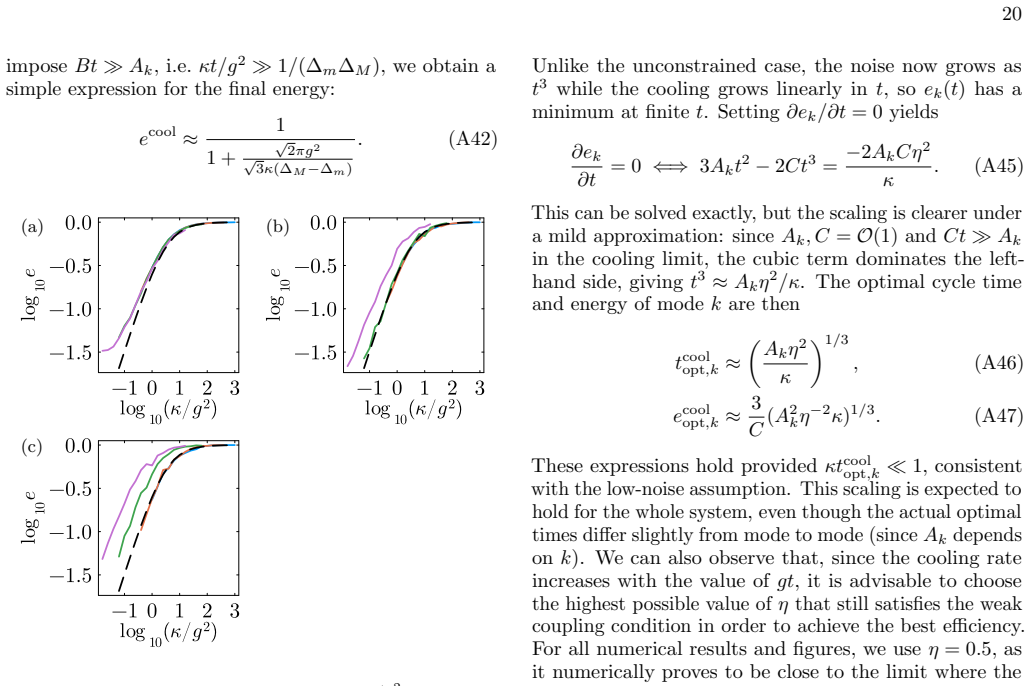
Optimal cycle time and energy Having identified the regime in which cooling occurs, we now optimize the average cycle time t at fixed noise rate κ to obtain the lowest achievable relative energy. The parameter regime in which Eq. (A42) approximates the relative energy well is illustrated in Fig. 9: we can see that the weak-coupling condition prevents us f...
-
[6]
We now consider two alter- natives: the single-frequency ( R = 1) and few-frequency (R≳ 1) regimes
The few frequency case In the previous subsections, we have analyzed the many- frequency regime, R≫ 1, which allowed us to cool all modes in the system evenly, while at the same time keep- ing the effect of noise low. We now consider two alter- natives: the single-frequency ( R = 1) and few-frequency (R≳ 1) regimes. These regimes are advantageous when the...
-
[7]
We start with the Schr¨ odinger equation for a time-dependent two-level system corre- sponding to a single momentum mode k
Trivial phase: first-order adiabatic perturbation theory Let us first review the adiabatic approximation and then apply it to our protocol. We start with the Schr¨ odinger equation for a time-dependent two-level system corre- sponding to a single momentum mode k. For clarity we 22 (a) (b) (c) (d) FIG. 10. Optimal relative energy ecool opt versus noise str...
-
[8]
In this regime, the energy can instead be determined using the Landau–Zener formal- ism [3, 40, 41]
Topological phase: Landau–Zener transition When the adiabatic path crosses the phase transition, the perturbative treatment fails for modes in the vicinity of the gap-closing point. In this regime, the energy can instead be determined using the Landau–Zener formal- ism [3, 40, 41]. We apply the standard Landau–Zener formulas to our adiabatic evolution. Th...
-
[9]
[ 1] and Section III C)
Adding noise For depolarizing noise of strength κ, the noise channel commutes with the unitary evolution (see Ref. [ 1] and Section III C). For our model, the maximally mixed state (a) (b) FIG. 11. Relative energy e versus total evolution time T (log- log scale) for adiabatic evolution targeting (a) θf = π/8 and (b) θf = π/3 at several noise rates κ, for ...
-
[10]
To this end, we apply the cooling procedure at θ = π/2 for a given noise rate κ (see Section A 4)
Realistic adiabatic evolution Instead of starting from the ideal product state |0⟩⊗N, we consider a more realistic scenario in which the initial state is already affected by noise. To this end, we apply the cooling procedure at θ = π/2 for a given noise rate κ (see Section A 4). This yields a state ρcool(π/2) that is diagonal in the mode basis, with each ...
-
[11]
Molpeceres, S
D. Molpeceres, S. Lu, J. I. Cirac, and B. Kraus, Phys. Rev. Res.7, 033162 (2025)
2025
-
[12]
A Quantum Approximate Optimization Algorithm
E. Farhi, J. Goldstone, and S. Gutmann, A quantum ap- proximate optimization algorithm (2014), arXiv:1411.4028 [quant-ph]
work page internal anchor Pith review Pith/arXiv arXiv 2014
-
[13]
Albash and D
T. Albash and D. A. Lidar, Rev. Mod. Phys.90, 015002 (2018)
2018
-
[14]
Zhou, S.-T
L. Zhou, S.-T. Wang, S. Choi, H. Pichler, and M. D. Lukin, Phys. Rev. X10, 021067 (2020)
2020
-
[15]
Cerezo, A
M. Cerezo, A. Arrasmith, R. Babbush, S. C. Benjamin, S. Endo, K. Fujii, J. R. McClean, K. Mitarai, X. Yuan, L. Cincio, and P. J. Coles, Nat. Rev. Phys.3, 625 (2021)
2021
-
[16]
Kraus, H
B. Kraus, H. P. B¨ uchler, S. Diehl, A. Kantian, A. Micheli, and P. Zoller, Phys. Rev. A78, 042307 (2008)
2008
-
[17]
Verstraete, J
F. Verstraete, J. I. Cirac, and J. I. Latorre, Phys. Rev. A 79, 032316 (2009)
2009
-
[18]
Diehl, A
S. Diehl, A. Micheli, A. Kantian, B. Kraus, H. P. B¨ uchler, and P. Zoller, Nat. Phys.4, 878 (2008)
2008
-
[19]
B. M. Terhal and D. P. DiVincenzo, Phys. Rev. A61, 022301 (2000)
2000
-
[20]
Lloyd, A
J. Lloyd, A. A. Michailidis, X. Mi, V. Smelyanskiy, and D. A. Abanin, PRX Quantum6, 010361 (2025)
2025
-
[21]
J. Lloyd and D. A. Abanin, Quantum thermal state preparation for near-term quantum processors (2025), arXiv:2506.21318 [quant-ph]
-
[22]
Y. Zhan, Z. Ding, J. Huhn, J. Gray, J. Preskill, G. K.-L. Chan, and L. Lin, Phys. Rev. X16, 011004 (2026)
2026
- [23]
-
[24]
X. Mi, A. A. Michailidis, S. Shabani, K. C. Miao, and P. V. Klimov, Science383, 1332 (2024)
2024
- [25]
-
[26]
J. Langbehn, G. Mouloudakis, E. King, R. Menu, I. Gornyi, G. Morigi, Y. Gefen, and C. P. Koch, Universal cooling of quantum systems via randomized measurements (2025), arXiv:2506.11964 [quant-ph]
-
[27]
Ramon-Escandell, A
C. Ramon-Escandell, A. Prositto, and D. Segal, Phys. Rev. Res.7, 043012 (2025)
2025
-
[28]
K. Wang and Z. Ding, Beyond Lindblad dynamics: Rigor- ous guarantees for thermal and ground state preservation under system bath interactions (2026), arXiv:2512.03457 [quant-ph]
-
[29]
D. Motlagh, M. S. Zini, J. M. Arrazola, and N. Wiebe, Ground state preparation via dynamical cooling (2024), arXiv:2404.05810 [quant-ph]
-
[30]
C.-F. Chen, M. Kastoryano, F. G. S. L. Brand˜ ao, and A. Gily´ en, Nature646, 561 (2025)
2025
-
[31]
Model-agnostic cooling algorithms for strongly interacting fermions
H. Schl¨ omer, L. Chen, S. F. Yelin, and H.-Y. Hu, Model-agnostic cooling algorithms for strongly interacting fermions (2026), arXiv:2605.01029 [cond-mat.str-el]
work page internal anchor Pith review Pith/arXiv arXiv 2026
-
[32]
W. H. Zurek, U. Dorner, and P. Zoller, Phys. Rev. Lett. 95, 105701 (2005)
2005
-
[33]
Dziarmaga, Phys
J. Dziarmaga, Phys. Rev. Lett.95, 245701 (2005)
2005
-
[34]
J. R. McClean, S. Boixo, V. N. Smelyanskiy, R. Babbush, and H. Neven, Nat. Commun.9, 4812 (2018)
2018
-
[35]
J. F. Poyatos, J. I. Cirac, and P. Zoller, Phys. Rev. Lett. 77, 4728 (1996)
1996
-
[36]
Ding, C.-F
Z. Ding, C.-F. Chen, and L. Lin, Phys. Rev. Res.6, 033147 (2024)
2024
-
[37]
A. M. Childs, E. Farhi, and J. Preskill, Phys. Rev. A65, 012322 (2001)
2001
-
[38]
Sarovar and K
M. Sarovar and K. C. Young, New J. Phys.15, 125032 (2013)
2013
- [39]
-
[40]
Pfeuty, Ann
P. Pfeuty, Ann. Phys.57, 79 (1970)
1970
-
[41]
Greiter, V
M. Greiter, V. Schnells, and R. Thomale, Ann. Phys.351, 1026 (2014)
2014
-
[42]
G. B. Mbeng, A. Russomanno, and G. E. Santoro, SciPost Phys. Lect. Notes , 82 (2024)
2024
-
[43]
A. Y. Kitaev, Phys. Usp.44, 131 (2001)
2001
-
[44]
Ortiz, J
G. Ortiz, J. Dukelsky, E. Cobanera, C. Esebbag, and C. Beenakker, Phys. Rev. Lett.113, 267002 (2014)
2014
-
[45]
Murg and J
V. Murg and J. I. Cirac, Phys. Rev. A69, 042320 (2004)
2004
-
[46]
T. W. B. Kibble, J. Phys. A: Math. Gen.9, 1387 (1976)
1976
-
[47]
W. H. Zurek, Nature317, 505 (1985)
1985
-
[48]
Polkovnikov, Phys
A. Polkovnikov, Phys. Rev. B72, 161201 (2005)
2005
-
[49]
del Campo and W
A. del Campo and W. H. Zurek, Int. J. Modern Phys. A 29, 1430018 (2014)
2014
-
[50]
L. D. Landau, Phys. Z. Sowjetunion2, 46 (1932)
1932
-
[51]
Zener, Proc
C. Zener, Proc. R. Soc. Lond., Contain. Pap. Math. Phys. Character137, 696 (1932)
1932
-
[52]
J. J. Sakurai and J. Napolitano,Modern Quantum Me- chanics, 3rd ed. (Cambridge University Press, Cambridge, 2020)
2020
-
[53]
Chen, Z.-C
X. Chen, Z.-C. Gu, Z.-X. Liu, and X.-G. Wen, Science 338, 1604 (2012)
2012
-
[54]
Bravyi, M
S. Bravyi, M. B. Hastings, and F. Verstraete, Phys. Rev. Lett.97, 050401 (2006)
2006
-
[55]
Chen, Z.-C
X. Chen, Z.-C. Gu, and X.-G. Wen, Phys. Rev. B82, 155138 (2010)
2010
-
[56]
Gu´ ery-Odelin, A
D. Gu´ ery-Odelin, A. Ruschhaupt, A. Kiely, E. Tor- rontegui, S. Mart´ ınez-Garaot, and J. G. Muga, Rev. Mod. Phys.91, 045001 (2019)
2019
-
[57]
A. M. Childs, Y. Su, M. C. Tran, N. Wiebe, and S. Zhu, Phys. Rev. X11, 011020 (2021)
2021
-
[58]
J. T. Barreiro, M. M¨ uller, P. Schindler, D. Nigg, T. Monz, M. Chwalla, M. Hennrich, C. F. Roos, P. Zoller, and R. Blatt, Nature470, 486 (2011)
2011
discussion (0)
Sign in with ORCID, Apple, or X to comment. Anyone can read and Pith papers without signing in.