Counting axions with IAXO
Pith reviewed 2026-06-26 16:19 UTC · model grok-4.3
The pith
IAXO can discriminate a two-axion signal from a single-axion hypothesis by resolving spectral signatures from flavor oscillations.
A machine-rendered reading of the paper's core claim, the machinery that carries it, and where it could break.
Core claim
If more than one axion couples to photons, their combined signal in helioscope experiments may mimic that of a single axion with different parameters. Spectral signatures of axion flavor oscillations in the quasi-degenerate and hierarchical mass regimes allow IAXO to discriminate a two-axion signal from the single-axion hypothesis given the expected energy resolutions of the detector. These results extend to a broad class of N-axion systems.
What carries the argument
Spectral signatures arising from axion flavor oscillations, examined separately in the quasi-degenerate and hierarchical mass regimes.
If this is right
- IAXO can observe signals in identified regions of the two-axion parameter space.
- Discrimination between one- and two-axion signals is possible in the quasi-degenerate mass regime.
- Discrimination between one- and two-axion signals is possible in the hierarchical mass regime.
- The discrimination method extends to systems with any number of axions.
Where Pith is reading between the lines
- Current CAST data already constrain portions of the two-axion space, so any future IAXO signal would start from a narrowed set of possibilities.
- Detector designs that improve energy resolution beyond current projections would enlarge the mass ranges where counting axions becomes feasible.
- The oscillation signatures provide a direct test of whether the detected particles obey the flavor-mixing dynamics assumed in the two-axion analysis.
Load-bearing premise
The energy resolution of the IAXO detector is sufficient to resolve the spectral signatures arising from axion flavor oscillations in the relevant mass regimes.
What would settle it
A measured energy spectrum from an IAXO axion signal that matches the shape expected for a single axion but lacks the deviations predicted by two-axion oscillations in the quasi-degenerate or hierarchical regimes, or conversely shows those deviations when a single axion is assumed.
Figures





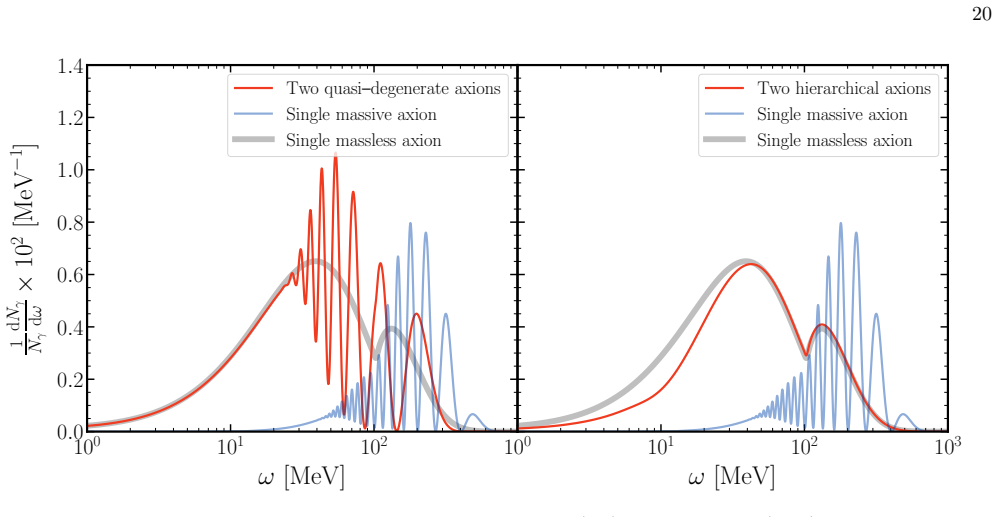

read the original abstract
The existence of multiple axion species is a generic prediction of a number of extensions of the Standard Model. If more than one axion couples to photons, their combined signal in helioscope experiments may mimic that of a single axion with different parameters. This raises a fundamental question: if a next-generation helioscope such as IAXO detected a signal, would we be able to disentangle whether it originated from one or multiple axions? To answer this question, we first recast current CAST bounds and derive IAXO/IAXO+ projections in the two-axion parameter space, identifying the regions where a signal could be observed. Then, we analyze the spectral signatures of axion flavor oscillations in both the quasi-degenerate and hierarchical mass regimes, and point out where IAXO can discriminate a two-axion signal from the single-axion hypothesis given the expected energy resolutions of the detector. Finally, we show that these results extend to a broad class of $N$-axion systems.
Editorial analysis
A structured set of objections, weighed in public.
Referee Report
Summary. The paper claims that a next-generation helioscope like IAXO can discriminate a two-axion signal from the single-axion hypothesis by analyzing spectral signatures arising from axion flavor oscillations. It first recasts existing CAST bounds and derives IAXO/IAXO+ sensitivity projections in the two-axion parameter space. It then examines the quasi-degenerate and hierarchical mass regimes, folds the oscillation-induced spectral features with the expected detector energy resolution, and identifies regions where discrimination is feasible. The analysis is extended to a broad class of N-axion systems.
Significance. If the central claim holds, the result is significant for the interpretation of any future axion signal in helioscope experiments. By explicitly computing the folded spectra and mapping the parameter regions where the two-axion hypothesis produces distinguishable features, the work supplies a concrete, falsifiable test rather than a generic statement about resolution. The generalization to N-axion systems and the recasting of existing limits add practical value for experimental planning.
minor comments (2)
- The abstract and introduction refer to 'expected energy resolutions' without a dedicated subsection summarizing the numerical values adopted for IAXO (e.g., FWHM at 1 keV and 10 keV). Adding a short table or paragraph with these benchmark numbers would improve reproducibility.
- In the discussion of the hierarchical regime, the transition between oscillation-dominated and resolution-limited regimes is described qualitatively; a quantitative criterion (e.g., an inequality involving Δm^{2} and the resolution width) would make the boundary between the two regimes sharper.
Simulated Author's Rebuttal
We thank the referee for their positive assessment of the manuscript and for recommending minor revision. No major comments were listed in the report.
Circularity Check
No significant circularity
full rationale
The paper recasts existing CAST bounds into the two-axion parameter space and then performs an explicit forward calculation: it derives the expected spectral signatures from axion flavor oscillations in the quasi-degenerate and hierarchical regimes, convolves those spectra with the stated IAXO energy resolution, and identifies the mass and coupling regions in which the resulting binned event distributions differ enough to allow discrimination. This chain is self-contained; each step is a direct computation from the oscillation probability formulas and the detector response function rather than a fit to the target observable or a self-referential definition. No load-bearing premise reduces to a prior result by the same authors, and no parameter is fitted to a subset of the data and then relabeled as a prediction. The derivation therefore stands on its own equations and external detector specifications.
Axiom & Free-Parameter Ledger
axioms (1)
- domain assumption Axions interact with photons through the standard two-photon coupling term.
Reference graph
Works this paper leans on
-
[1]
(6) are approximately equal, sinc(m2 1L/4ω)≃ sinc(m2 2L/4ω), and Eq
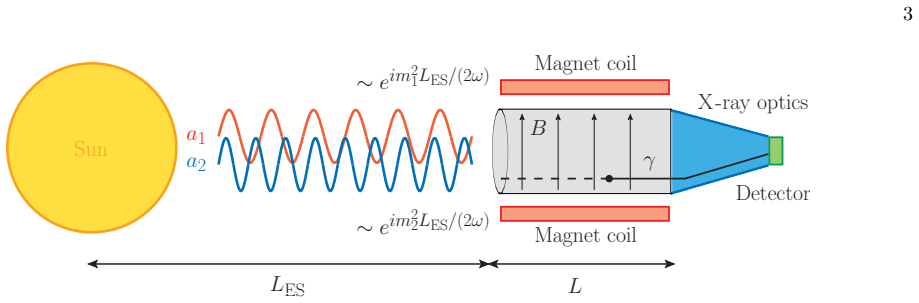
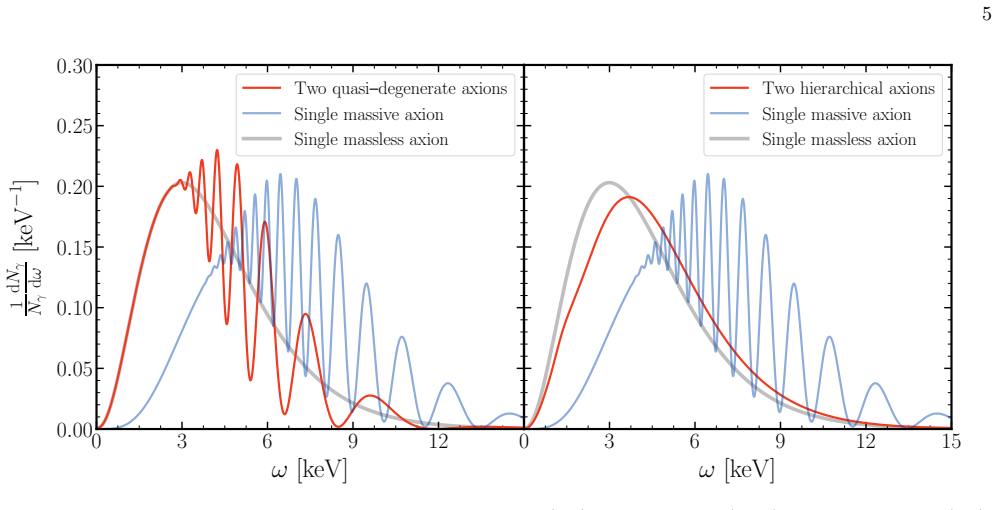
Quasi-degenerate regime Whenm 1 ≃m 2 (i.e.∆m 2 21 ≪m 2 1,2), the two sinc fac- tors in Eq. (6) are approximately equal, sinc(m2 1L/4ω)≃ sinc(m2 2L/4ω), and Eq. (6) reduces to Paγ →γ ≃ gaγBL 2 2 sinc2 m2 1L 4ω × " c4 φ +s 4 φ + 1 2 s2 2φ cos ∆m2 21LES 2ω # .(7) Using the identityc 4 φ +s 4 φ = 1− 1 2 s2 2φ, this can equiva- lently be written as a disappear...
-
[2]
Therefore, Eq
Hierarchical regime When one axion is much lighter than the other,m 1 ≪ m2, we have ∆m2 21 ≃m 2 2, and the first sinc factor satisfies sinc2(m2 1L/4ω)≃1. Therefore, Eq. (6) reduces to Paγ →γ ≃ gaγBL 2 2" c4 φ +s 4 φ sinc2 m2 2L 4ω + 1 2 s2 2φ sinc m2 2L 4ω cos m2 2LES 2ω # .(8) In this regime, there are in principle two ranges where the two-axion spectrum...
-
[3]
(7) are shown in the left panel of Fig
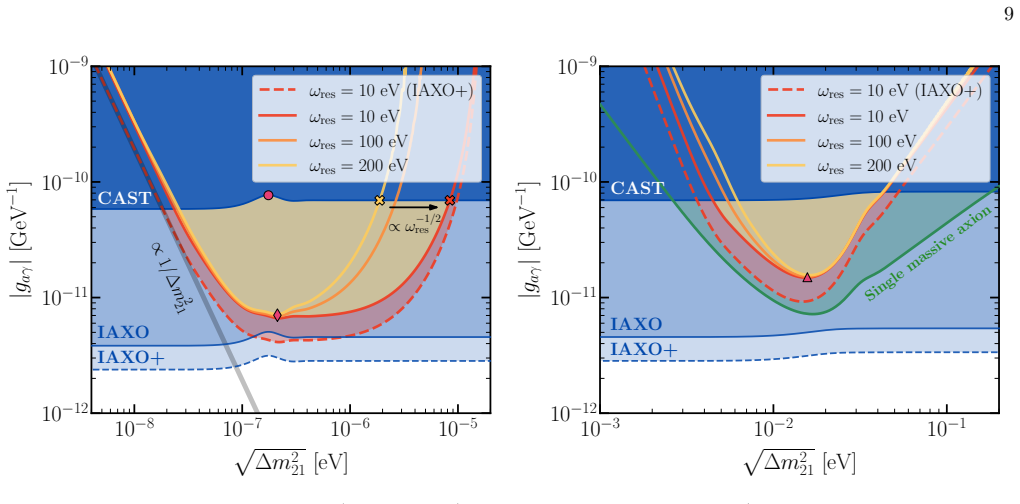
Quasi-degenerate regime The results for the quasi-degenerate regime governed by the conversion probability in Eq. (7) are shown in the left panel of Fig. 4 for equal photon couplingsφ=π/4 andm 1 < m c,magnet ∼10 −2 eV. The light blue band marks the CAST-allowed region where IAXO would ob- serve a statistically significant signal from two solar ax- ions. H...
-
[4]
4, where p ∆m2 21 ≃m 2 sincem 1 ≪ m2
Hierarchical regime The results for the hierarchical regime are shown in the right panel of Fig. 4, where p ∆m2 21 ≃m 2 sincem 1 ≪ m2. The relevant conversion probability is Eq. (8), whose dominant feature is the sinc 2 envelope fromm 2, visible in the right panel of Fig. 3. The green line shows the minimum coupling at which IAXO can detect the axion mass...
-
[5]
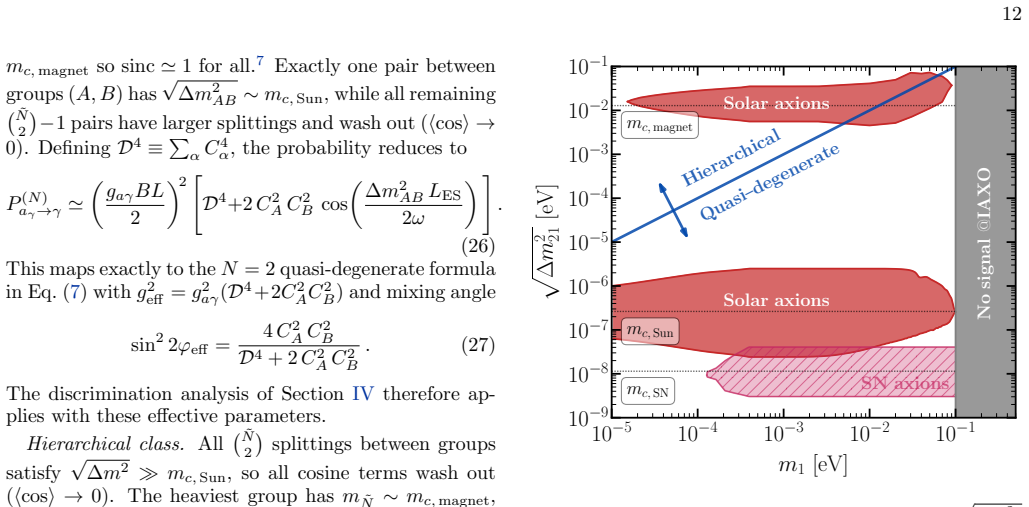
Supernova axions Although IAXO was originally proposed to operate as a helioscope [38], its potential to detect axions pro- duced in core-collapse supernovae has been recently in- vestigated in Ref. [59]. SN axions could, in principle, allow us to probe different ranges of the axion mass split- ting p ∆m2 21 since SNe are further away than the Sun, LSN ≫L...
2020
-
[6]
CP Conservation in the Presence of Instantons,
R. D. Peccei and H. R. Quinn, “CP Conservation in the Presence of Instantons,”Phys. Rev. Lett.38(1977) 1440–1443. 1
1977
-
[7]
Constraints Imposed by CP Conservation in the Presence of Instantons,
R. D. Peccei and H. R. Quinn, “Constraints Imposed by CP Conservation in the Presence of Instantons,”Phys. Rev.D16(1977) 1791–1797
1977
-
[8]
A New Light Boson?,
S. Weinberg, “A New Light Boson?,”Phys. Rev. Lett. 40(1978) 223–226
1978
-
[9]
Problem of Strong p and t Invariance in the Presence of Instantons,
F. Wilczek, “Problem of Strong p and t Invariance in the Presence of Instantons,”Phys. Rev. Lett.40(1978) 279–282. 1
1978
-
[10]
Some Properties of O(32) Superstrings,
E. Witten, “Some Properties of O(32) Superstrings,” Phys. Lett.149B(1984) 351–356. 1
1984
-
[11]
A. Arvanitaki, S. Dimopoulos, S. Dubovsky, N. Kaloper, and J. March-Russell, “String Axiverse,”Phys. Rev. D81(2010) 123530,arXiv:0905.4720 [hep-th]. 1
Pith/arXiv arXiv 2010
-
[12]
Axion-like Particles from String Compactifications,
M. Cicoli, “Axion-like Particles from String Compactifications,” inProceedings, 9th Patras Workshop on Axions, WIMPs and WISPs (AXION-WIMP 2013): Mainz, Germany, June 24-28, 2013, pp. 235–242. 2013.arXiv:1309.6988 [hep-th]. 1
Pith/arXiv arXiv 2013
-
[13]
Invisible axions and large radius compactifications,
K. R. Dienes, E. Dudas, and T. Gherghetta, “Invisible axions and large radius compactifications,”Phys. Rev. D62(2000) 105023,arXiv:hep-ph/9912455. 1
Pith/arXiv arXiv 2000
-
[14]
Extra-dimensional axion patterns,
A. de Giorgi and M. Ramos, “Extra-dimensional axion patterns,”Phys. Rev. D111no. 7, (2025) 075006, arXiv:2412.00179 [hep-ph]. 1
arXiv 2025
-
[15]
A Cosmological Bound on the Invisible Axion,
L. F. Abbott and P. Sikivie, “A Cosmological Bound on the Invisible Axion,”Phys. Lett.B120(1983) 133–136. 1
1983
-
[16]
The Not So Harmless Axion,
M. Dine and W. Fischler, “The Not So Harmless Axion,”Phys. Lett.B120(1983) 137–141
1983
-
[17]
Cosmology of the Invisible Axion,
J. Preskill, M. B. Wise, and F. Wilczek, “Cosmology of the Invisible Axion,”Phys. Lett.B120(1983) 127–132. 1
1983
-
[18]
New experimental approaches in the search for axion-like particles,
I. G. Irastorza and J. Redondo, “New experimental approaches in the search for axion-like particles,”Prog. Part. Nucl. Phys.102(2018) 89–159, arXiv:1801.08127 [hep-ph]. 1, 2
Pith/arXiv arXiv 2018
-
[19]
Axion Dark Matter,
C. B. Adamset al., “Axion Dark Matter,” inSnowmass
-
[20]
3, 2022.arXiv:2203.14923 [hep-ex]
arXiv 2022
-
[21]
The landscape of QCD axion models,
L. Di Luzio, M. Giannotti, E. Nardi, and L. Visinelli, “The landscape of QCD axion models,”Phys. Rept. 870(2020) 1–117,arXiv:2003.01100 [hep-ph]. 3
Pith/arXiv arXiv 2020
-
[22]
Invisible Axion Search Methods,
P. Sikivie, “Invisible Axion Search Methods,”Rev. Mod. Phys.93no. 1, (2021) 015004,arXiv:2003.02206 [hep-ph]. 1
arXiv 2021
-
[23]
The type IIB string axiverse and its low-energy phenomenology,
M. Cicoli, M. Goodsell, and A. Ringwald, “The type IIB string axiverse and its low-energy phenomenology,” JHEP10(2012) 146,arXiv:1206.0819 [hep-th]. 1
Pith/arXiv arXiv 2012
-
[24]
M. Demirtas, C. Long, L. McAllister, and M. Stillman, “The Kreuzer-Skarke Axiverse,”JHEP04(2020) 138, arXiv:1808.01282 [hep-th]
Pith/arXiv arXiv 2020
-
[25]
N. Gendler, D. J. E. Marsh, L. McAllister, and J. Moritz, “Glimmers from the axiverse,”JCAP09 (2024) 071,arXiv:2309.13145 [hep-th]
arXiv 2024
-
[26]
M. Demirtas, N. Gendler, C. Long, L. McAllister, and J. Moritz, “PQ axiverse,”JHEP06(2023) 092, arXiv:2112.04503 [hep-th]
arXiv 2023
-
[27]
Fuzzy axions and associated relics,
E. Sheridan, F. Carta, N. Gendler, M. Jain, D. J. E. Marsh, L. McAllister, N. Righi, K. K. Rogers, and A. Schachner, “Fuzzy axions and associated relics,” JHEP09(2025) 016,arXiv:2412.12012 [hep-th]. 1
arXiv 2025
-
[28]
S. V. P. Fallon, J. Halverson, L. McAllister, and Y. Zhu, “F-theory Axiverse,”arXiv:2511.20458 [hep-th]. 1
-
[29]
Heterotic String Theory Suggests a QCD Axion Near 0.5 neV,
J. N. Benabou, G. A. Dainelli, M. Reig, and B. R. Safdi, “Heterotic String Theory Suggests a QCD Axion Near 0.5 neV,”arXiv:2605.04142 [hep-th]. 1
-
[30]
B. Gavela, P. Qu´ ılez, and M. Ramos, “The QCD axion sum rule,”JHEP04(2024) 056,arXiv:2305.15465 [hep-ph]. 1, 2, 13
arXiv 2024
-
[31]
Axion-like particle oscillations,
F. Chadha-Day, “Axion-like particle oscillations,” JCAP01no. 01, (2022) 013,arXiv:2107.12813 [hep-ph]. 4, 12
arXiv 2022
-
[32]
Multiple Axions in Laboratory Experiments,
A. de Giorgi, J. Jaeckel, S. Monath, and V. Takhistov, “Multiple Axions in Laboratory Experiments,” arXiv:2512.16837 [hep-ph]. 1
-
[33]
F. Chadha-Day, J. Maxwell, and J. Turner, “ALP anarchy,”JCAP09(2024) 056,arXiv:2311.13658 [hep-ph]. 1, 12
arXiv 2024
-
[34]
Strongly broken Peccei-Quinn symmetry in the early Universe,
F. Takahashi and M. Yamada, “Strongly broken Peccei-Quinn symmetry in the early Universe,”JCAP 10(2015) 010,arXiv:1507.06387 [hep-ph]. 1
Pith/arXiv arXiv 2015
-
[35]
Enhanced photon coupling of ALP dark matter adiabatically converted from the QCD axion,
S.-Y. Ho, K. Saikawa, and F. Takahashi, “Enhanced photon coupling of ALP dark matter adiabatically converted from the QCD axion,”JCAP10(2018) 042, arXiv:1806.09551 [hep-ph]
Pith/arXiv arXiv 2018
-
[36]
Resonant nonlinear pairs in the axiverse and their late-time direct and astrophysical signatures,
D. Cyncynates, T. Giurgica-Tiron, O. Simon, and J. O. Thompson, “Resonant nonlinear pairs in the axiverse and their late-time direct and astrophysical signatures,” Phys. Rev. D105no. 5, (2022) 055005, arXiv:2109.09755 [hep-ph]
arXiv 2022
-
[37]
QCD axion on hilltop by a phase shift ofπ,
F. Takahashi and W. Yin, “QCD axion on hilltop by a phase shift ofπ,”JHEP10(2019) 120, arXiv:1908.06071 [hep-ph]
arXiv 2019
-
[38]
Resonant Landau-Zener conversion in multi-axion systems,
D. I. Dunsky, C. A. Manzari, P. Qu´ ılez, M. Ramos, and P. Sørensen, “Resonant Landau-Zener conversion in multi-axion systems,”JHEP01(2026) 077, arXiv:2507.06287 [hep-ph]. 1 [33]ALPS IICollaboration, D. C. Brothertonet al., “Any Light Particle Searches with ALPS II: first science results,”arXiv:2512.14110 [hep-ex]. 1, 4
arXiv 2026
-
[39]
Experimental Tests of the Invisible Axion,
P. Sikivie, “Experimental Tests of the Invisible Axion,” Phys. Rev. Lett.51(1983) 1415–1417. [Erratum: Phys.Rev.Lett. 52, 695 (1984)]. 1, 2
1983
-
[40]
A Practical Laboratory Detector for Solar Axions,
K. van Bibber, P. M. McIntyre, D. E. Morris, and G. G. Raffelt, “A Practical Laboratory Detector for Solar Axions,”Phys. Rev. D39(1989) 2089. 1 [36]CASTCollaboration, V. Anastassopouloset al., “New CAST Limit on the Axion-Photon Interaction,”Nature Phys.13(2017) 584–590,arXiv:1705.02290 [hep-ex]. 1, 7 [37]CASTCollaboration, K. Altenm¨ ulleret al., “New Up...
Pith/arXiv arXiv 1989
-
[41]
T. Dafni, C. A. J. O’Hare, B. Laki´ c, J. Gal´ an, F. J. Iguaz, I. G. Irastorza, K. Jakovˇ cic, G. Luz´ on, J. Redondo, and E. Ruiz Ch´ oliz, “Weighing the solar axion,”Phys. Rev. D99no. 3, (2019) 035037, arXiv:1811.09290 [hep-ph]. 1, 3, 4, 5, 7, 8, 9, 13
Pith/arXiv arXiv 2019
-
[42]
The structure of multi-axion solutions to the strong CP problem,
M. Fern´ andez Navarro, M. F. Zamoro, M. Pesut, and X. Ponce D´ ıaz, “The structure of multi-axion solutions to the strong CP problem,”arXiv:2605.06787 [hep-ph]. 2
-
[43]
Experiments to test the hypothesis for solar and dark matter axions,
B. D¨ obrich and I. G. Irastorza, “Experiments to test the hypothesis for solar and dark matter axions,” arXiv:2507.06414 [hep-ph]. 2 [42]BREADCollaboration, J. Liuet al., “Broadband Solenoidal Haloscope for Terahertz Axion Detection,” Phys. Rev. Lett.128no. 13, (2022) 131801, arXiv:2111.12103 [physics.ins-det]
arXiv 2022
-
[44]
Axion and hidden photon dark matter detection with multilayer optical haloscopes,
M. Baryakhtar, J. Huang, and R. Lasenby, “Axion and hidden photon dark matter detection with multilayer optical haloscopes,”Phys. Rev. D98no. 3, (2018) 035006,arXiv:1803.11455 [hep-ph]. [44]ADMXCollaboration, G. Carosiet al., “Search for Axion Dark Matter from 1.1 to 1.3 GHz with ADMX,” (4, 2025) ,arXiv:2504.07279 [hep-ex]. 13
Pith/arXiv arXiv 2018
-
[45]
Axion Searches with Microwave Filters: the RADES project,
A. ´A. Melc´ onet al., “Axion Searches with Microwave Filters: the RADES project,”JCAP05(2018) 040, arXiv:1803.01243 [hep-ex]. 2
Pith/arXiv arXiv 2018
-
[46]
Asymptotic formulae for likelihood-based tests of new physics,
G. Cowan, K. Cranmer, E. Gross, and O. Vitells, “Asymptotic formulae for likelihood-based tests of new physics,”Eur. Phys. J. C71(2011) 1554, arXiv:1007.1727 [physics.data-an]. [Erratum: Eur.Phys.J.C 73, 2501 (2013)]. 2, 6, 7, 16, 17 [47]IAXOCollaboration, A. Abelnet al., “Conceptual design of BabyIAXO, the intermediate stage towards the International Axi...
Pith/arXiv arXiv 2011
-
[47]
Window for preferred axion models,
L. D. Luzio, F. Mescia, and E. Nardi, “Window for preferred axion models,”Phys. Rev.D96no. 7, (2017) 075003,1705.05370. 2
Pith/arXiv arXiv 2017
-
[48]
cajohare/axionlimits: Axionlimits
C. O’Hare, “cajohare/axionlimits: Axionlimits.” https://cajohare.github.io/AxionLimits/, July,
-
[49]
An Improved limit on the axion-photon coupling from the CAST experiment,
2, 6 [50]CASTCollaboration, S. Andriamonjeet al., “An Improved limit on the axion-photon coupling from the CAST experiment,”JCAP04(2007) 010, arXiv:hep-ex/0702006. 3
Pith/arXiv arXiv 2007
-
[50]
Mixing of the Photon with Low Mass Particles,
G. Raffelt and L. Stodolsky, “Mixing of the Photon with Low Mass Particles,”Phys. Rev.D37(1988) 1237. 3
1988
-
[51]
J. Redondo and A. Ringwald, “Light shining through walls,”Contemp. Phys.52(2011) 211–236, arXiv:1011.3741 [hep-ph]. 3
Pith/arXiv arXiv 2011
-
[52]
Design of the ALPS II optical system,
M. D. Ortizet al., “Design of the ALPS II optical system,”Phys. Dark Univ.35(2022) 100968, arXiv:2009.14294 [physics.optics]. 4
arXiv 2022
-
[53]
ALP searches at the LHC: FASER as a light-shining-through-walls experiment,
F. Kling and P. Qu´ ılez, “ALP searches at the LHC: FASER as a light-shining-through-walls experiment,” Phys. Rev. D106no. 5, (2022) 055036, arXiv:2204.03599 [hep-ph]. 4
arXiv 2022
-
[54]
The Forward Physics Facility at the High-Luminosity LHC,
J. L. Fenget al., “The Forward Physics Facility at the High-Luminosity LHC,”J. Phys. G50no. 3, (2023) 030501,arXiv:2203.05090 [hep-ex]. 4
arXiv 2023
-
[55]
Oscillations of neutrinos and mesons in quantum field theory,
M. Beuthe, “Oscillations of neutrinos and mesons in quantum field theory,”Phys. Rept.375(2003) 105–218, arXiv:hep-ph/0109119. 4
Pith/arXiv arXiv 2003
-
[56]
Disentangling neutrino oscillations,
A. G. Cohen, S. L. Glashow, and Z. Ligeti, “Disentangling neutrino oscillations,”Phys. Lett. B678 (2009) 191–196,arXiv:0810.4602 [hep-ph]. 4
Pith/arXiv arXiv 2009
-
[57]
Neutrino Oscillation Measurements Computed in Quantum Field Theory,
A. Kobach, A. V. Manohar, and J. McGreevy, “Neutrino Oscillation Measurements Computed in Quantum Field Theory,”Phys. Lett. B783(2018) 59–75,arXiv:1711.07491 [hep-ph]. 4
Pith/arXiv arXiv 2018
-
[58]
Detecting supernova axions with IAXO,
P. Carenzaet al., “Detecting supernova axions with IAXO,”JCAP07(2025) 075,arXiv:2502.19476 [hep-ph]. 10
arXiv 2025
-
[59]
Axion emission from supernovae: a cheatsheet,
P. Carenza, “Axion emission from supernovae: a cheatsheet,”Eur. Phys. J. Plus138no. 9, (2023) 836, arXiv:2309.14798 [hep-ph]. 10
arXiv 2023
-
[60]
Probing protoneutron stars with gamma-ray axionscopes,
A. Lella, F. Calore, P. Carenza, C. Eckner, M. Giannotti, G. Lucente, and A. Mirizzi, “Probing protoneutron stars with gamma-ray axionscopes,” JCAP11(2024) 009,arXiv:2405.02395 [hep-ph]. 10, 19
arXiv 2024
-
[61]
Upper Limit on the QCD Axion Mass from Isolated Neutron Star Cooling,
M. Buschmann, C. Dessert, J. W. Foster, A. J. Long, and B. R. Safdi, “Upper Limit on the QCD Axion Mass from Isolated Neutron Star Cooling,”Phys. Rev. Lett. 128no. 9, (2022) 091102,arXiv:2111.09892 [hep-ph]. 10
arXiv 2022
-
[62]
Getting the most on supernova axions,
A. Lella, P. Carenza, G. Co’, G. Lucente, M. Giannotti, A. Mirizzi, and T. Rauscher, “Getting the most on supernova axions,”Phys. Rev. D109no. 2, (2024) 023001,arXiv:2306.01048 [hep-ph]. 10
arXiv 2024
-
[63]
Presupernova neutrinos: directional sensitivity and prospects for progenitor identification,
M. Mukhopadhyay, C. Lunardini, F. X. Timmes, and K. Zuber, “Presupernova neutrinos: directional sensitivity and prospects for progenitor identification,” Astrophys. J.899no. 2, (2020) 153,arXiv:2004.02045 [astro-ph.HE]. 10 [65]IAXOCollaboration, A. Arcusaet al., “The International Axion Observatory (IAXO): case, status and plans. Input to the European Str...
arXiv 2020
-
[64]
Proposal for a Cosmic Axion Spin Precession Experiment (CASPEr),
D. Budker, P. W. Graham, M. Ledbetter, S. Rajendran, and A. Sushkov, “Proposal for a Cosmic Axion Spin Precession Experiment (CASPEr),”Phys. Rev.X4 no. 2, (2014) 021030,arXiv:1306.6089 [hep-ph]. 13
Pith/arXiv arXiv 2014
-
[65]
G. F. Giudice and M. McCullough, “A Clockwork Theory,”JHEP02(2017) 036,arXiv:1610.07962 [hep-ph]. 13
Pith/arXiv arXiv 2017
-
[66]
M. Farina, D. Pappadopulo, F. Rompineve, and A. Tesi, “The photo-philic QCD axion,”JHEP01(2017) 095, arXiv:1611.09855 [hep-ph]. 13
Pith/arXiv arXiv 2017
-
[67]
Solving the Hierarchy Problem Discretely,
A. Hook, “Solving the Hierarchy Problem Discretely,” Phys. Rev. Lett.120no. 26, (2018) 261802, arXiv:1802.10093 [hep-ph]. 13
Pith/arXiv arXiv 2018
-
[68]
L. Di Luzio, B. Gavela, P. Quilez, and A. Ringwald, “An even lighter QCD axion,”JHEP05(2021) 184, arXiv:2102.00012 [hep-ph]
arXiv 2021
-
[69]
Dark matter from an even lighter QCD axion: trapped misalignment,
L. Di Luzio, B. Gavela, P. Quilez, and A. Ringwald, “Dark matter from an even lighter QCD axion: trapped misalignment,”JCAP10(2021) 001, arXiv:2102.01082 [hep-ph]. 13
arXiv 2021
-
[70]
Astrophysical Axion Bounds: The 2024 Edition,
A. Caputo and G. Raffelt, “Astrophysical Axion Bounds: The 2024 Edition,”PoSCOSMICWISPers (2024) 041,arXiv:2401.13728 [hep-ph]. 20
arXiv 2024
-
[71]
Pions in hot dense matter and their astrophysical implications,
B. Fore and S. Reddy, “Pions in hot dense matter and their astrophysical implications,”Phys. Rev. C101 no. 3, (2020) 035809,arXiv:1911.02632 [astro-ph.HE]. 20 16 Appendix A: Hypothesis testing In this appendix, we provide further details on the statistical methodology applied to derive the main results of this work. In Appendix A 1, we first introduce the...
arXiv 2020
-
[72]
(11) and (12), respectively
Binned likelihood analysis The binned likelihood function consists of the product of the Poisson probability distribution,P(k|λ) = λk k! e−λ, for the number of observed photons in each energy bini,N i obs, given an expected numberN i exp(gaγ, m2,∆m 2 21, φ): L(gaγ, m2,∆m 2 21, φ) = NbinsY i=1 P N i obs |N i exp(gaγ, m2,∆m 2 21, φ) .(A1) It is straightforw...
-
[73]
For a bin size ∆ω i →0, the integral in Eq
Small bin size limit Once we have presented the details of the binned likelihood analysis, it is straightforward to take the limit of small bins. For a bin size ∆ω i →0, the integral in Eq. (A3) can be computed as eN i exp(m2,∆m 2 21, φ)≃enexp(ωi ;m 2,∆m 2 21, φ) ∆ωi ,(A14) where the expected number density of events per unit energyn exp has been defined ...
discussion (0)
Sign in with ORCID, Apple, or X to comment. Anyone can read and Pith papers without signing in.