Scattering, Hawking Radiation and Neutrino Energy Deposition in Euler-Heisenberg Black Holes Surrounded by Perfect Fluid Dark Matter
Pith reviewed 2026-06-26 16:04 UTC · model grok-4.3
The pith
The PFDM parameter contracts the optical structure of Euler-Heisenberg black holes, raising oscillation frequencies and damping rates while suppressing transmission.
A machine-rendered reading of the paper's core claim, the machinery that carries it, and where it could break.
Core claim
In Euler-Heisenberg black holes surrounded by perfect fluid dark matter, the PFDM parameter contracts the optical structure, increases the oscillation frequency, enhances the damping rate and suppresses transmission; the Euler-Heisenberg correction produces a weaker near-horizon deformation whose effect becomes relevant only for sufficiently large charge.
What carries the argument
The Euler-Heisenberg plus perfect-fluid-dark-matter metric together with scalar, electromagnetic, and effective axial spin-2 perturbations constructed on that fixed background.
If this is right
- Quasinormal-mode spectra exhibit higher real frequencies and larger imaginary parts as the PFDM parameter grows.
- Greybody factors decrease with increasing PFDM, which alters the Hawking emission spectra.
- Near-extremal configurations develop a purely imaginary quasinormal-mode branch whose damping rate rises with the PFDM parameter and remains nearly spin-independent.
- The relativistic enhancement of the neutrino-antineutrino annihilation channel outside the black hole is modified by both the PFDM halo and the Euler-Heisenberg charge.
Where Pith is reading between the lines
- Ringdown signals from real black holes embedded in dark-matter halos could display systematic shifts in frequency and decay time that scale with halo density.
- Varying the charge while holding the dark-matter parameter fixed would isolate the Euler-Heisenberg correction in future observations.
- The same metric and perturbation setup can be extended to rotating cases to test whether the contraction of the optical structure persists.
Load-bearing premise
The particular effective axial spin-2 channel on the fixed background serves as a usable proxy for the gravitational perturbation problem.
What would settle it
A set of observed quasinormal-mode frequencies or Hawking spectra from a black-hole candidate whose surrounding dark-matter density is independently known and that show no increase in damping rate or decrease in transmission with rising dark-matter density.
Figures





read the original abstract
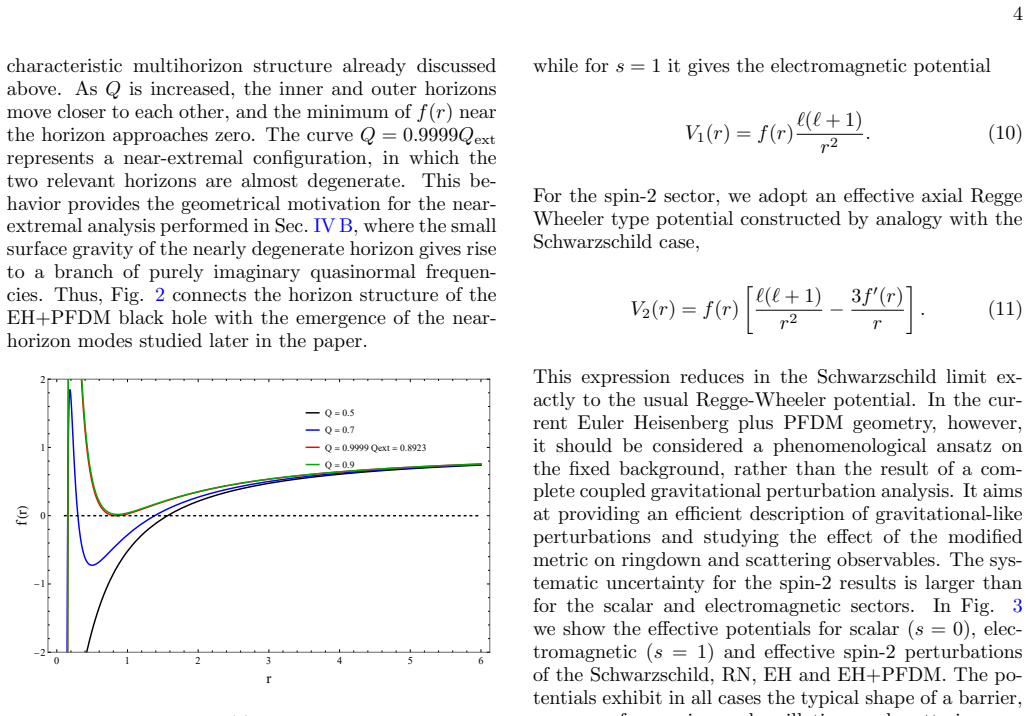
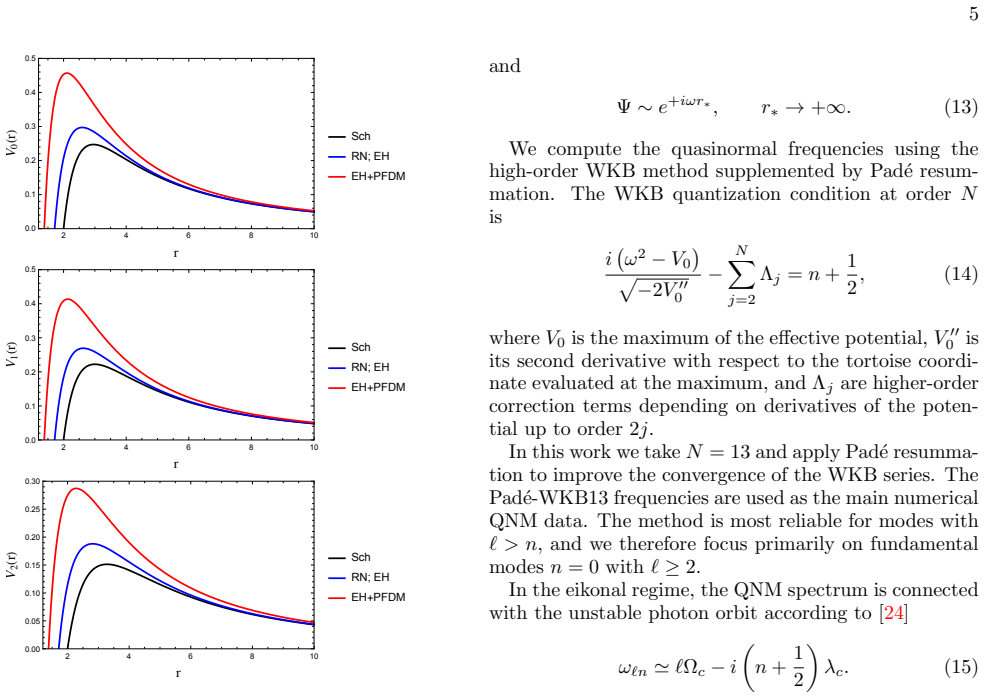
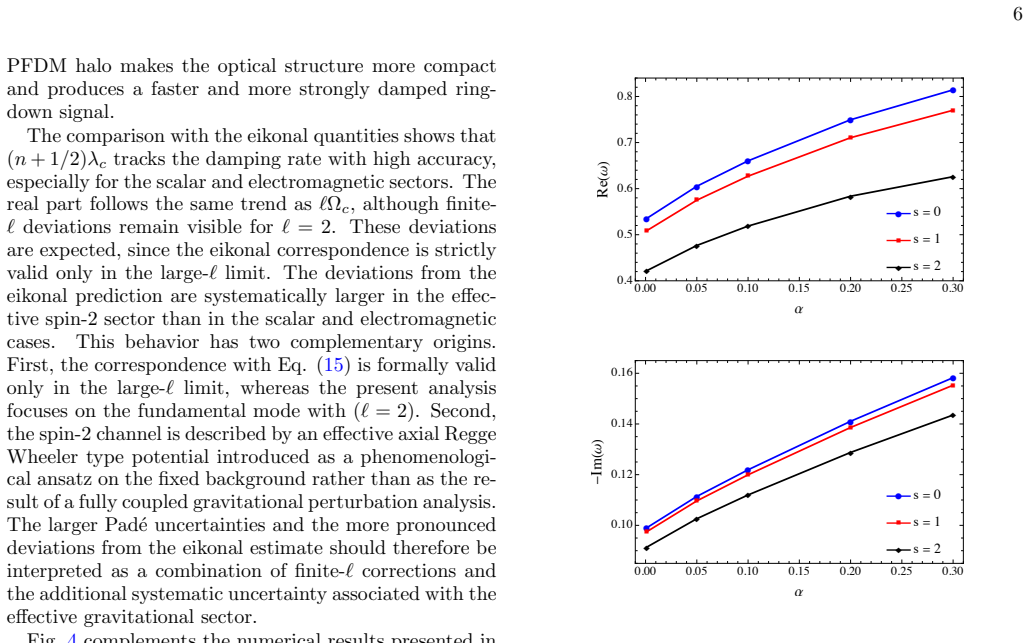
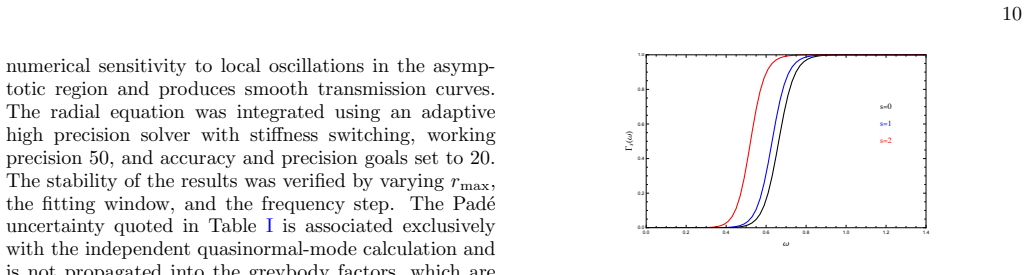
We study the dynamical and scattering properties for the Euler-Heisenberg BH surrounded by perfect fluid dark matter. The geometry contains a compact non-linear electrodynamic correction governed by the EH coupling and a logarithmic dark-matter contribution governed by the surrounding PFDM halo. We study the scalar, electromagnetic and a particular effective axial spin-2 channel constructed on the fixed EH plus PFDM background, acting as a proxy for the gravitational-like perturbation problem and not for the fully coupled gravitational perturbation problem. We compute the quasinormal-mode spectrum employing a thirteenth-order WKB method supplemented with Pad\'e resummation and compare it with the eikonal prediction calculated in terms of the angular frequency of the photon sphere and the Lyapunov exponent. Moreover, we study the near-extremal configurations and derive a purely imaginary branch of quasinormal frequencies in the near-horizon region, whose damping rate increases with the PFDM parameter and is nearly spin-independent. We then compute exact greybody factors by direct numerical integration of the radial wave equation and compare them to analytical lower bounds. We also analyze the absorption cross sections and the Hawking emission spectra. We also calculate the relativistic enhancement of the neutrino-antineutrino annihilation channel outside the EHPFDM black hole. We find that the PFDM parameter contracts the optical structure, increases the oscillation frequency, enhances the damping rate and suppresses transmission. On the other hand, the Euler-Heisenberg correction leads to a weaker near-horizon deformation whose effect becomes relevant for sufficiently large charge. These results provide a common scattering framework for comparing the impact of dark-matter environments and nonlinear electrodynamics
Editorial analysis
A structured set of objections, weighed in public.
Referee Report
Summary. The manuscript studies scattering, quasinormal modes, greybody factors, absorption cross sections, Hawking spectra, and neutrino-antineutrino annihilation for Euler-Heisenberg black holes surrounded by perfect fluid dark matter. It analyzes scalar, electromagnetic, and an effective axial spin-2 channel (explicitly constructed on the fixed background as a proxy for gravitational-like perturbations, not the fully coupled problem) via 13th-order WKB with Padé resummation, eikonal approximation, direct numerical integration of the radial equation, and comparison to analytic bounds. The central findings are that the PFDM parameter contracts the optical structure, raises oscillation frequencies, enhances damping rates, and suppresses transmission, while the Euler-Heisenberg correction produces weaker near-horizon effects that become relevant only at large charge.
Significance. If the numerical results and proxy construction hold, the work supplies a comparative framework for the combined effects of nonlinear electrodynamics and dark-matter halos on black-hole dynamics and radiation. Methodological strengths include the high-order WKB supplemented by Padé resummation, direct numerical integration of the radial wave equation compared against eikonal predictions and analytic lower bounds, and the derivation of a purely imaginary near-extremal QNM branch; these elements allow internal cross-validation and are explicitly credited.
major comments (1)
- [Abstract and perturbation construction section] Abstract (and the section constructing the perturbation channels): the effective axial spin-2 channel is built on the fixed EH+PFDM metric and is stated to serve only as a proxy, not the fully coupled gravitational perturbation problem. No demonstration is given that this proxy captures the leading gravitational degrees of freedom or that the omitted couplings to the nonlinear electromagnetic field and PFDM background remain negligible across the reported parameter range. Because the central claims about PFDM-induced changes in oscillation frequency, damping, and transmission are extracted from this channel, the omission constitutes a load-bearing limitation for the gravitational-like results.
minor comments (2)
- [Introduction] The notation and definition of the PFDM halo parameter and the Euler-Heisenberg coupling should be collected in a single table or introductory paragraph for clarity when comparing multiple channels.
- [Figures on greybody factors] Figure captions for the greybody factors and absorption cross sections should explicitly list the fixed values of the EH coupling and PFDM parameter used in each panel.
Simulated Author's Rebuttal
We thank the referee for the careful reading and the recommendation for major revision. We address the single major comment below, agreeing that further clarification of the proxy's scope is appropriate while maintaining that the presented results remain useful within their stated limitations.
read point-by-point responses
-
Referee: [Abstract and perturbation construction section] Abstract (and the section constructing the perturbation channels): the effective axial spin-2 channel is built on the fixed EH+PFDM metric and is stated to serve only as a proxy, not the fully coupled gravitational perturbation problem. No demonstration is given that this proxy captures the leading gravitational degrees of freedom or that the omitted couplings to the nonlinear electromagnetic field and PFDM background remain negligible across the reported parameter range. Because the central claims about PFDM-induced changes in oscillation frequency, damping, and transmission are extracted from this channel, the omission constitutes a load-bearing limitation for the gravitational-like results.
Authors: We thank the referee for this observation. The manuscript already states explicitly that the axial spin-2 channel is constructed on the fixed background and serves only as a proxy, not the fully coupled gravitational problem. We do not claim or demonstrate that omitted couplings to the nonlinear electromagnetic sector and the PFDM fluid are negligible; such a demonstration would require a separate, fully coupled linear perturbation analysis that lies outside the present scope. The qualitative trends (PFDM increasing damping and suppressing transmission) appear consistently across the scalar, electromagnetic, and proxy spin-2 channels, which provides internal cross-checks. We have revised the abstract and the perturbation-construction section to further stress the proxy character, to qualify the gravitational-like claims as indicative only, and to note that a complete treatment of the coupled system is left for future work. This revision directly addresses the load-bearing concern by narrowing the scope of the conclusions drawn from the proxy channel. revision: yes
Circularity Check
No circularity: results from direct numerical and WKB computations on fixed metric
full rationale
The paper computes QNMs via 13th-order WKB with Padé resummation, eikonal limits from photon-sphere Lyapunov exponents, exact greybody factors by numerical integration of the radial equation, and absorption/Hawking spectra on the given EH+PFDM metric. No parameter is fitted to a data subset and then relabeled as a prediction; the effective axial spin-2 channel is explicitly constructed as a proxy on the fixed background rather than derived from a self-referential equation. No self-citation chain or ansatz smuggling is invoked to force the central claims about PFDM contraction of the optical structure or EH near-horizon effects. The derivation chain is therefore self-contained against external benchmarks.
Axiom & Free-Parameter Ledger
free parameters (2)
- Euler-Heisenberg coupling constant
- PFDM parameter
axioms (2)
- domain assumption The background metric is fixed and perturbations are computed on it without backreaction.
- domain assumption The effective axial spin-2 channel serves as a valid proxy for gravitational perturbations.
Reference graph
Works this paper leans on
-
[1]
Quasinormal modes of black holes and black branes,
E. Berti, V. Cardoso and A. O. Starinets, “Quasinormal modes of black holes and black branes,” Class. Quant. Grav.26, 163001 (2009) [arXiv:0905.2975 [gr-qc]]
Pith/arXiv arXiv 2009
-
[2]
Quasi-normal modes of stars and black holes,
K. D. Kokkotas and B. G. Schmidt, “Quasi-normal modes of stars and black holes,” Living Rev. Rel.2, 2 (1999) [arXiv:gr-qc/9909058 [gr-qc]]
Pith/arXiv arXiv 1999
-
[3]
Quasinormal modes of black holes: from astrophysics to string theory,
R. A. Konoplya and A. Zhidenko, “Quasinormal modes of black holes: from astrophysics to string theory,” Rev. Mod. Phys.83, 793-836 (2011) [arXiv:1102.4014 [gr-qc]]
Pith/arXiv arXiv 2011
-
[4]
Bounding the greybody factors for Schwarzschild black holes,
P. Boonserm and M. Visser, “Bounding the greybody factors for Schwarzschild black holes,” Phys. Rev. D78, 101502(R) (2008) [arXiv:0806.2209 [gr-qc]]
Pith/arXiv arXiv 2008
-
[5]
Regge- Wheeler equation, linear stability, and greybody factors for dirty black holes,
P. Boonserm, T. Ngampitipan and M. Visser, “Regge- Wheeler equation, linear stability, and greybody factors for dirty black holes,” Phys. Rev. D88, 041502(R) (2013) [arXiv:1305.1416 [gr-qc]]
Pith/arXiv arXiv 2013
-
[6]
Particle emission rates from a black hole: Massless particles from an uncharged, nonrotating hole,
D. N. Page, “Particle emission rates from a black hole: Massless particles from an uncharged, nonrotating hole,” Phys. Rev. D13, 198-206 (1976)
1976
-
[7]
Particle creation by black holes,
S. W. Hawking, “Particle creation by black holes,” Com- mun. Math. Phys.43, 199-220 (1975)
1975
-
[9]
Euler-Heisenberg black hole surrounded by perfect fluid dark matter,
S. J. Ma, R. B. Wang, J. B. Deng and X. R. Hu, “Euler-Heisenberg black hole surrounded by perfect fluid dark matter,” Eur. Phys. J. C84, no.6, 595 (2024) [arXiv:2401.03187 [gr-qc]]
arXiv 2024
-
[10]
Massive scalar field perturbations of black holes surrounded by dark matter,
R. B´ ecar, P. A. Gonz´ alez, E. Papantonopoulos and Y. V´ asquez, “Massive scalar field perturbations of black holes surrounded by dark matter,” Eur. Phys. J. C84, no.3, 329 (2024) [arXiv:2310.00857 [gr-qc]]
arXiv 2024
-
[11]
Folgerungen aus der Dirac- schen Theorie des Positrons,
W. Heisenberg and H. Euler, “Folgerungen aus der Dirac- schen Theorie des Positrons,” Z. Phys.98, 714-732 (1936)
1936
-
[12]
On gauge invariance and vacuum po- larization,
J. S. Schwinger, “On gauge invariance and vacuum po- larization,” Phys. Rev.82, 664-679 (1951)
1951
-
[13]
Birefringence and quasinor- mal modes of the Einstein-Euler-Heisenberg black hole,
N. Bret´ on and L. A. L´ opez, “Birefringence and quasinor- mal modes of the Einstein-Euler-Heisenberg black hole,” Phys. Rev. D104, no.2, 024064 (2021) [arXiv:2105.12283 [gr-qc]]
arXiv 2021
-
[14]
E. O. Silva and F. Ahmed, “Shadow, quasinormal modes, sparsity, and energy emission rate of Euler-Heisenberg black hole surrounded by perfect fluid dark matter,” [arXiv:2604.16628 [gr-qc]]
-
[15]
F. M. Belchior, F. Ahmed and E. O. Silva, “Per- turbations and greybody bounds of Euler-Heisenberg black holes surrounded by perfect fluid dark matter,” [arXiv:2605.04994 [gr-qc]]
-
[16]
C. Feng, S. Y. Li, X. Zhang, M. Zhang, D. C. Zou and R. H. Yue, “Quasinormal modes of massless scalar and electromagnetic perturbations for Euler-Heisenberg black holes surrounded by perfect fluid dark matter,” [arXiv:2605.14528 [gr-qc]]
-
[17]
Stability of a Schwarzschild singularity,
T. Regge and J. A. Wheeler, “Stability of a Schwarzschild singularity,” Phys. Rev.108, 1063-1069 (1957)
1957
-
[18]
Chandrasekhar,The Mathematical Theory of Black Holes, Oxford University Press, Oxford (1983)
S. Chandrasekhar,The Mathematical Theory of Black Holes, Oxford University Press, Oxford (1983)
1983
-
[19]
Quasinormal modes of black holes. The improved semianalytic approach,
J. Matyjasek and M. Opala, “Quasinormal modes of black holes. The improved semianalytic approach,” Phys. Rev. D96(2017) no.2, 024011 [arXiv:1704.00361 [gr-qc]]
Pith/arXiv arXiv 2017
-
[20]
R. A. Konoplya, A. Zhidenko and A. F. Zinhailo, “Higher order WKB formula for quasinormal modes and grey-body factors: recipes for quick and accurate calculations,” Class. Quant. Grav.36(2019), 155002 [arXiv:1904.10333 [gr-qc]]
Pith/arXiv arXiv 2019
-
[21]
J. D. Salmonson and J. R. Wilson, “General relativistic augmentation of neutrino pair annihilation energy depo- sition near neutron stars,” Astrophys. J.517, 859-865 (1999) [arXiv:astro-ph/9908017 [astro-ph]]. 18
Pith/arXiv arXiv 1999
-
[22]
K. Asano and T. Fukuyama, “Relativistic effects on neu- trino pair annihilation above a Kerr black hole with the accretion disk,” Astrophys. J.546, 1019-1026 (2001) [arXiv:astro-ph/0009453 [astro-ph]]
Pith/arXiv arXiv 2001
-
[23]
Neutrino pair annihila- tion in the gravitation of gamma-ray burst sources,
K. Asano and T. Fukuyama, “Neutrino pair annihila- tion in the gravitation of gamma-ray burst sources,” As- trophys. J.531, 949-955 (2000) [arXiv:astro-ph/0002196 [astro-ph]]
Pith/arXiv arXiv 2000
-
[24]
Geodesic stability, Lyapunov exponents and quasinormal modes,
V. Cardoso, A. S. Miranda, E. Berti, H. Witek and V. T. Zanchin, “Geodesic stability, Lyapunov exponents and quasinormal modes,” Phys. Rev. D79(2009) no.6, 064016 [arXiv:0812.1806 [hep-th]]
Pith/arXiv arXiv 2009
-
[25]
Anomalous decay rate of quasinormal modes in Reissner-Nordstr¨ om black holes,
R. D. B. Fontana, P. A. Gonz´ alez, E. Papantonopoulos and Y. V´ asquez, “Anomalous decay rate of quasinormal modes in Reissner-Nordstr¨ om black holes,” Phys. Rev. D 103(2021) no.6, 064005 [arXiv:2011.10620 [gr-qc]]
arXiv 2021
-
[26]
P. A. Gonz´ alez, E. Papantonopoulos, J. Saavedra and Y. V´ asquez, “Quasinormal modes for massive charged scalar fields in Reissner-Nordstr¨ om dS black holes: anomalous decay rate,” JHEP06(2022), 150 [arXiv:2204.01570 [gr-qc]]
arXiv 2022
-
[27]
Massive scalar field perturbations of black holes immersed in Chaplygin-like dark fluid,
R. B´ ecar, P. A. Gonz´ alez, E. Papantonopoulos and Y. V´ asquez, “Massive scalar field perturbations of black holes immersed in Chaplygin-like dark fluid,” JCAP06 (2024), 061 [arXiv:2403.11306 [gr-qc]]
arXiv 2024
-
[28]
Quasinormal modes and Strong Cosmic Censorship,
V. Cardoso, J. L. Costa, K. Destounis, P. Hintz and A. Jansen, “Quasinormal modes and Strong Cosmic Censorship,” Phys. Rev. Lett.120(2018) no.3, 031103 [arXiv:1711.10502 [gr-qc]]
Pith/arXiv arXiv 2018
-
[29]
G. Lambiase and L. Mastrototaro, “Effects of modified theories of gravity on neutrino pair annihilation energy deposition near neutron stars,” Astrophys. J.904, no.1, 19 (2020) [arXiv:2009.08722 [astro-ph.HE]]
arXiv 2020
-
[30]
Neutrino pair an- nihilation (ν¯ν→e −e+) in the presence of quintessence surrounding a black hole,
G. Lambiase and L. Mastrototaro, “Neutrino pair an- nihilation (ν¯ν→e −e+) in the presence of quintessence surrounding a black hole,” Eur. Phys. J. C81, no.10, 932 (2021) [arXiv:2012.09100 [astro-ph.HE]]
arXiv 2021
-
[31]
The shadow and gamma-ray bursts of a Schwarzschild black hole in asymptotic safety,
Y. Shi and H. Cheng, “The shadow and gamma-ray bursts of a Schwarzschild black hole in asymptotic safety,” Commun. Theor. Phys.77, no.2, 025401 (2025) [arXiv:2304.01154 [gr-qc]]
arXiv 2025
-
[32]
R. C. Pantig, A. ¨Ovg¨ un and´A. Rinc´ on, “Charged black holes in KR gravity: Weak deflection angle, shadow cast, quasinormal modes and neutrino annihilation,” Phys. Dark Univ.49, 102029 (2025) [arXiv:2505.17947 [gr-qc]]
arXiv 2025
-
[33]
Gravitational lensing effects on neutrino oscillations around static black hole in effective quantum gravity,
S. Mannobova, B. Narzilloev, F. Atamurotov, A. Ab- dujabbarov, I. Hussain and B. Ahmedov, “Gravitational lensing effects on neutrino oscillations around static black hole in effective quantum gravity,” Phys. Dark Univ.51, 102194 (2026)
2026
-
[34]
Gravitational lensing of neutri- nos in the scalar-tensor-vector gravity,
O. Kholmuminov, B. Narzilloev, I. Hussain, A. Abdujab- barov and B. Ahmedov, “Gravitational lensing of neutri- nos in the scalar-tensor-vector gravity,” Nucl. Phys. B 1025, 117371 (2026)
2026
-
[35]
Gravitational lensing of neu- trinos in parametrized black hole spacetimes,
M. Alloqulov, H. Chakrabarty, D. Malafarina, B. Ahme- dov and A. Abdujabbarov, “Gravitational lensing of neu- trinos in parametrized black hole spacetimes,” JCAP02, 070 (2025) [arXiv:2408.12916 [gr-qc]]
arXiv 2025
discussion (0)
Sign in with ORCID, Apple, or X to comment. Anyone can read and Pith papers without signing in.