Gluon GTMD at strong coupling: fixed-spin saddle factorization and Reggeization
Pith reviewed 2026-06-26 16:08 UTC · model grok-4.3
The pith
For fixed even conformal spin, gluon GTMD moments factorize into a universal staple-worldsheet soft factor and a target-dependent Witten amplitude at strong coupling.
A machine-rendered reading of the paper's core claim, the machinery that carries it, and where it could break.
Core claim
For fixed even conformal spin j, the GTMD moment factorizes into a universal staple-worldsheet soft factor and a stripped spin-j Witten amplitude carrying target dependence. The cusp of the renormalized minimal area generates the rapidity-logarithmic Collins-Soper structure. Universal ultraviolet and infrared endpoint reductions are derived. As b_T approaches 0 from above, the finite-separation sector matches onto the local conformal moment through a universal overlap kernel. At large b_T, after cusp and perimeter subtraction, it factorizes into target projections and infrared transfer kernels. The ultraviolet endpoint is universal within the leading saddle, whereas the infrared tail depends
What carries the argument
minimal worldsheet saddle for the planar semiclassical amplitude at finite b_T > 0, whose cusp and perimeter subtractions produce the factorization and Collins-Soper kernel for fixed even conformal spin j
If this is right
- The framework describes hadron tomography, transverse structure, and rapidity evolution for GTMD moments.
- Different holographic backgrounds generate algebraic, exponential, or Gaussian infrared falloffs at large b_T.
- The ultraviolet endpoint reduction is universal within the leading saddle.
- Analytic continuation in j produces the low-x Regge regime governed by the holographic Pomeron spectral curve.
- It supplies a unified starting point for holographic calculations of observables relevant to the Electron-Ion Collider.
Where Pith is reading between the lines
- The universal overlap kernel at small b_T could be matched to perturbative QCD results to bridge coupling regimes.
- Predictions for the Pomeron spectral curve in the Regge limit could be tested against high-energy scattering data.
- Similar saddle factorization may apply to quark GTMDs or polarized cases without altering the core mechanism.
- The Collins-Soper structure derived from the cusp could serve as a non-perturbative input for global TMD fits.
Load-bearing premise
The planar semiclassical amplitude in the finite-separation regime b_T > 0 is governed by a minimal worldsheet whose cusp and perimeter subtractions produce the claimed factorization and Collins-Soper kernel.
What would settle it
A lattice or phenomenological extraction of a gluon GTMD moment at fixed even j whose b_T dependence fails to match the predicted factorization into staple-worldsheet soft factor plus Witten amplitude, or whose rapidity evolution kernel differs from the cusp anomalous dimension.
Figures

read the original abstract
Generalized transverse-momentum-dependent parton distributions (GTMDs) are the most complete two-parton correlation functions in QCD, encoding the joint spatial and momentum structure of hadrons. Through appropriate projections and limits they yield generalized parton distributions (GPDs), transverse-momentum-dependent distributions (TMDs), parton distribution functions (PDFs), and phase-space (Wigner) distributions. We construct conformal moments of unpolarized gluon GTMDs at strong coupling using gauge/string duality. For fixed even conformal spin $j$, we distinguish the local boundary limit at $b_T=0$ from the finite-separation regime $b_T>0$, where the planar semiclassical amplitude is governed by a minimal worldsheet. There the GTMD moment factorizes into a universal staple-worldsheet soft factor and a stripped spin-$j$ Witten amplitude carrying target dependence. The cusp of the renormalized minimal area generates the rapidity-logarithmic Collins-Soper structure. We derive universal ultraviolet and infrared endpoint reductions. As $b_T\to0^+$, the finite-separation sector matches onto the local conformal moment through a universal overlap kernel. At large $b_T$, after cusp/perimeter subtraction, it factorizes into target projections and infrared transfer kernels. The ultraviolet endpoint is universal within the leading saddle, whereas the infrared tail depends on the holographic completion: soft-wall, gap-matched hard-wall, and repulsive-wall backgrounds generate algebraic, exponential, and Gaussian falloffs, respectively. Analytic continuation in $j$ yields the low-$x$ Regge regime governed by the holographic Pomeron spectral curve. The framework describes hadron tomography, transverse structure, rapidity evolution, and Reggeization for GTMD moments and provides a unified starting point for holographic studies of observables relevant to the Electron-Ion Collider.
Editorial analysis
A structured set of objections, weighed in public.
Referee Report
Summary. The manuscript presents a holographic construction of conformal moments of unpolarized gluon GTMDs at strong coupling. For fixed even conformal spin j, it distinguishes the local boundary limit at b_T=0 from the finite-separation regime b_T>0, where the planar semiclassical amplitude is governed by a minimal worldsheet leading to factorization of the GTMD moment into a universal staple-worldsheet soft factor and a stripped spin-j Witten amplitude. The cusp of the renormalized minimal area is said to generate the rapidity-logarithmic Collins-Soper structure, with derivations of universal UV and IR endpoint reductions, matching to local limit as b_T→0, factorization at large b_T, and analytic continuation in j to the low-x Regge regime governed by the holographic Pomeron spectral curve.
Significance. Should the central factorization and endpoint reductions be established through explicit calculation, the paper would provide a valuable unified holographic approach to GTMD moments, encompassing hadron tomography, transverse structure, rapidity evolution, and Reggeization, serving as a starting point for studies relevant to the Electron-Ion Collider. The use of different holographic backgrounds (soft-wall, hard-wall, repulsive-wall) to generate algebraic, exponential, and Gaussian falloffs is a positive aspect of the framework.
major comments (1)
- [Abstract] Abstract: The claim that 'the GTMD moment factorizes into a universal staple-worldsheet soft factor and a stripped spin-j Witten amplitude' for the finite-separation regime b_T>0 is load-bearing for the central result but appears to rest on the assumption of the minimal worldsheet saddle without the explicit saddle-point solution, precise form of the area functional, subtraction procedure, or demonstration that the soft factor is independent of target and j being provided or cross-checked against known limits such as b_T→0 matching.
Simulated Author's Rebuttal
We thank the referee for the positive assessment of the potential significance of our holographic framework and for identifying the central claim requiring clarification. We respond to the major comment below.
read point-by-point responses
-
Referee: [Abstract] Abstract: The claim that 'the GTMD moment factorizes into a universal staple-worldsheet soft factor and a stripped spin-j Witten amplitude' for the finite-separation regime b_T>0 is load-bearing for the central result but appears to rest on the assumption of the minimal worldsheet saddle without the explicit saddle-point solution, precise form of the area functional, subtraction procedure, or demonstration that the soft factor is independent of target and j being provided or cross-checked against known limits such as b_T→0 matching.
Authors: The manuscript derives the factorization from the semiclassical minimal worldsheet for the staple geometry at finite b_T, with the area functional given by the renormalized Nambu-Goto action. The cusp subtraction isolates the rapidity dependence in the Collins-Soper kernel, while the staple contribution yields a soft factor independent of target and j; target dependence resides entirely in the stripped Witten amplitude. The b_T→0 matching is obtained via a universal overlap kernel reducing to the local conformal moment. These steps are carried out explicitly in the body of the paper. We agree that a concise outline of the saddle evaluation and subtraction could be added to the abstract or introduction for clarity. revision: partial
Circularity Check
No significant circularity; derivation relies on standard holographic ingredients without reduction to self-fitted inputs or self-citations.
full rationale
The paper derives GTMD moments via gauge/string duality using minimal worldsheets for the finite b_T regime and Witten amplitudes for target dependence. The claimed factorization into universal soft factor plus stripped amplitude, along with cusp-generated Collins-Soper structure and endpoint reductions, follows from the saddle analysis and analytic continuation in j to the Pomeron curve. These steps use external AdS/CFT constructs (minimal surfaces, conformal moments) without quoting any internal fit, self-definitional loop, or load-bearing self-citation that collapses the result to its own inputs. The framework remains self-contained against known holographic benchmarks.
Axiom & Free-Parameter Ledger
free parameters (1)
- holographic background parameters
axioms (2)
- domain assumption Gauge/string duality maps strong-coupling QCD to a semiclassical string theory in a curved background
- ad hoc to paper The planar semiclassical amplitude for b_T>0 is governed by a minimal worldsheet
invented entities (1)
-
holographic Pomeron spectral curve
no independent evidence
Reference graph
Works this paper leans on
-
[1]
The exchanged spin-(j) field propagates through a discrete tower of normalizable modes whose masses in- crease linearly with the radial excitation number
Closed spin-jsoft-wall channel The soft-wall model provides a convenient realization of fixed-spin exchange in a confining holographic back- ground. The exchanged spin-(j) field propagates through a discrete tower of normalizable modes whose masses in- crease linearly with the radial excitation number. These modes furnish a complete basis for the bulk pro...
-
[2]
Near the ultraviolet boundary the classical four-cusp worldsheet assumes the universal form zws(u,v) =bz b(u,v), z b(u,v) = 1 coshucoshv
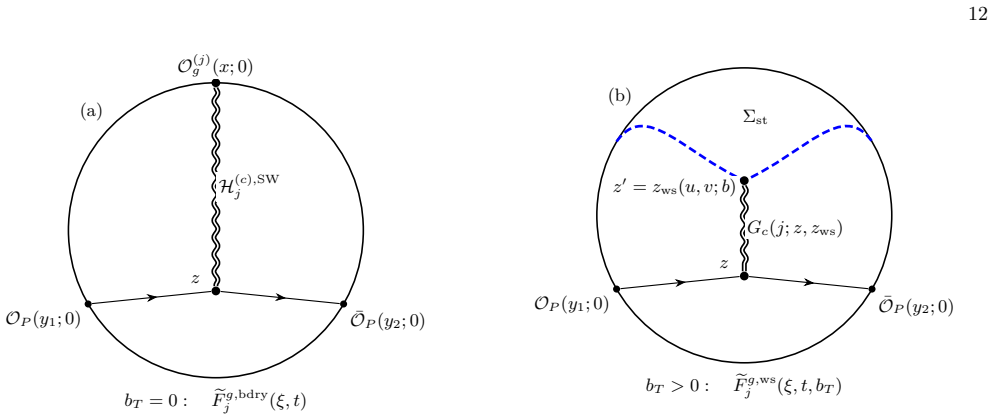
Finite-Separation Diagram and Cutoff Cancellation The stripped fixed-spin worldsheet Witten diagram takes the form ˜Fg,ws j (ξ,t,bT ;ϵ) =˜g2 5gj(λ) ∫ dudv( √ 2κczws)−(j−2) ∫ ∞ 0 dzρj(z;ξ)Gc(j,z,z ws;t).(D21) The worldsheet coordinatez ws specifies the radial posi- tion at which the exchanged spin-(j) field couples to the Wilson-line surface. Near the ultr...
-
[3]
Physically, the exchanged spin-jfield first cou- ples to the near-boundary worldsheet insertion and sub- sequently propagates into the bulk toward the hadronic vertex
Ultraviolet Endpoint Reduction We first consider the ultraviolet transverse limit bT→0+, ξ, tfixed.(D29) In this regime the worldsheet remains parametrically close to the AdS boundary, zws =bz b(u,v)≪z,(D30) for the values ofzthat dominate the hadronic radial integral. Physically, the exchanged spin-jfield first cou- ples to the near-boundary worldsheet i...
-
[4]
Physically, the exchanged spin- jexcitation is first created at the hadronic vertex near the boundary and subsequently propagates toward the deep worldsheet endpoint
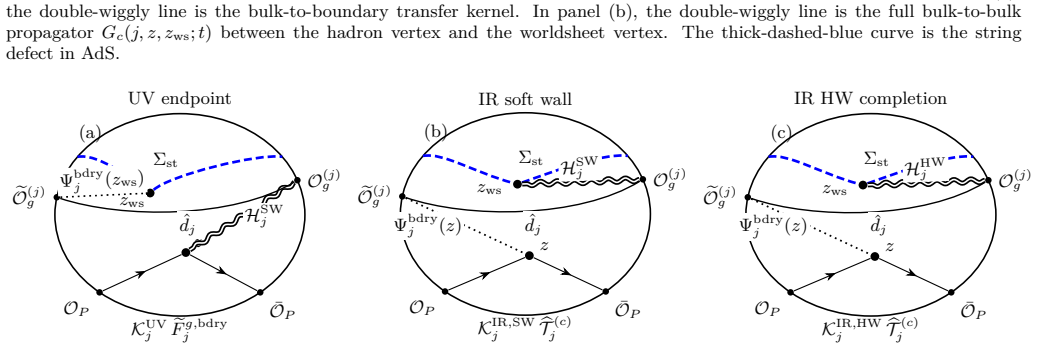
Soft-wall Infrared Endpoint Reduction We now consider the opposite radial ordering, z≪zws,(D44) which corresponds to a worldsheet insertion located deeper in the bulk than the region dominating the hadronic radial overlap. Physically, the exchanged spin- jexcitation is first created at the hadronic vertex near the boundary and subsequently propagates towa...
-
[5]
Normalizable modes satisfy a Neumann condition atz=z 0, corre- sponding to vanishing flux through the confining bound- ary
Hard-wall spin-jtransfer channel The hard-wall model occupies the AdS interval0< z <z0,wherez 0 denotes the infrared wall. Normalizable modes satisfy a Neumann condition atz=z 0, corre- sponding to vanishing flux through the confining bound- ary. The normalizable spin-jmodes are ψ(c),HW n (j,z) =c (c),HW n (j)z 2Jνj ( MHW c,n (j)z ) ,(E1) with νj = ∆ c(j)...
-
[6]
Exactly as in the soft-wall in- frared analysis, the propagator factorizes when one end- point remains close to the boundary, Gc(j,z,z ws;t)≃Ψ(c),bdry j (z;ϵ)H(c),HW j (K,z ws;ϵ)
Infrared Endpoint Factorization We now return to the infrared radial orderingz≪zws, for which the exchanged spin-jmode is created near the target and propagates toward a worldsheet insertion lo- cated deep in the bulk. Exactly as in the soft-wall in- frared analysis, the propagator factorizes when one end- point remains close to the boundary, Gc(j,z,z ws;...
-
[7]
For large argument, Iν(x)∼ex √ 2πx, K ν(x)∼ √ π 2xe−x, x→∞
Decaying-Branch Approximation The physical origin of confinement becomes apparent in the large-zbehavior of the modified Bessel functions. For large argument, Iν(x)∼ex √ 2πx, K ν(x)∼ √ π 2xe−x, x→∞. (E21) TheI νbranch grows exponentially toward the infrared, whereas theKνbranch decays exponentially. Confining propagation is therefore associated with theKν...
-
[8]
The natural scale controlling that prop- agation is therefore not the external momentum transfer but the confining mass gap
Gap Matching and Confining Exponential Tail The mixed construction is intended to model the deep infrared region. The natural scale controlling that prop- agation is therefore not the external momentum transfer but the confining mass gap. We first write KIR =M gap, η gap≡Mgap√ 2κc ,(E26) and apply this replacement only inside the infrared trans- fer funct...
-
[9]
Definitions and scheme parameters The repulsive-wall background is ds2 =e 2A(z)(dz2 +ηµνdxµdxν), e 2A(z) = (R z )2 eaκ2 cz2 , a>0.(F1) The dimensionless parameterafixes the strength of the repulsive wall. The soft-wall scale is related to a phe- nomenological QCD scale by a scheme choice, κc =δκΛ QCD, R −1=δRΛ QCD,(F2) and the constantsδκ,δR, andaare part...
-
[10]
The limiting behaviors are KRW M,j(z)∼x∆c(j)/2 (x→0), KRW U,j (z)∼e−x/2x∆c(j)/2−AR W j,t (x→∞).(F10) The second relation is the origin of the Gaussian infrared suppression
RW Green function The two independent radial branches are KRW M,j(z) =e−x/2x∆c(j)/2M ( ARW j,t ,Bj;x ) ,(F6) and KRW U,j (z) =e−x/2x∆c(j)/2U ( ARW j,t ,Bj;x ) .(F7) The ordered Green function is GRW c (j,z,z ′;t) =N RW j (t)K RW M,j(z<)K RW U,j (z>), z<≡min(z,z′), z >≡max(z,z′).(F8) with normalization N RW j (t) =−1 2 Γ(ARW j,t ) Γ(∆ c(j)−1) (3aκ2 c 2 )∆c...
-
[11]
Therefore ˜Fg,RW j,ws (ξ,t,bT )−−−−−→ bT→0+ KUV,RW j (λ,bT ) ˜Fg,RW j,bdry(ξ,t),K UV,RW j ∝¯b4+γc(j).(F12) Thus the ultraviolet power is independent of the infrared completion
Endpoint reductions The stripped finite-separation RW moment is ˜Fg,RW j,ws (ξ,t,bT ) =˜g2 5gj(λ) ∫ dudv( √ 2κczws)−(j−2) ∫ ∞ 0 dzρj(z;ξ)GRW c (j,z,z ws;t).(F11) 29 ForbT→0+,z ws =bz b(u,v)≪z, and the RW channel is asymptotically AdS. Therefore ˜Fg,RW j,ws (ξ,t,bT )−−−−−→ bT→0+ KUV,RW j (λ,bT ) ˜Fg,RW j,bdry(ξ,t),K UV,RW j ∝¯b4+γc(j).(F12) Thus the ultrav...
-
[12]
In Minkowski signature we write n2 A =n 2 B = 1, n A·nB = coshχ,(G1) whereχis the relative rapidity
Definition and geometric decomposition LetC b(nA,nB)be the regulated staple contour enter- ing the gluon GTMD operator, with transverse separa- tionb T and two non-lightlike eikonal directionsnA,nB. In Minkowski signature we write n2 A =n 2 B = 1, n A·nB = coshχ,(G1) whereχis the relative rapidity. The lightlike limit is obtained only after the soft facto...
-
[13]
Cusp contribution and Collins-Soper evolution Near a cusp the bulk geometry is asymptoticallyAdS5, ds2 = R2 z2 ( dz2 +dρ2 +ρ2dφ2 +dx 2 ⊥ ) ,(G4) and the leading cusp surface is scale invariant, z(ρ,φ) =ρf(φ), f(±θ/2) = 0.(G5) The Nambu-Goto density therefore containsdρ/ρ, and the renormalized cusp area takes the general form A(E) cusp(θ) =cE(θ) lnL ϵ+fini...
-
[14]
With boundary dataY(−θ/2) = 0,Y(θ/2) =bT, the minimiz- ing solution isρ-independent by scale invariance
Quadratic transverse mismatch The leading transverse correction near the cusp follows by expanding the Nambu-Goto action to quadratic order in a displacementYorthogonal to the cusp plane. With boundary dataY(−θ/2) = 0,Y(θ/2) =bT, the minimiz- ing solution isρ-independent by scale invariance. The quadratic action is ∆S (2) = √ λ 4π ∫ dρdφ√ggab∂aY∂bY.(G13) ...
-
[15]
Strip contribution and infrared sensitivity The smooth long segments of the staple define a sepa- rate minimal-surface problem: two long parallel bound- ary lines of lengthLseparated bybT. In pure AdS or in the short-distance region of a confining background, the connected saddle gives Aren strip L =−4π2 Γ(1/4)4 1 bT , b T≪zIR.(G17) In a hard-wall backgro...
-
[16]
The finite-angle functionscM andF (M) ws are regulator and scheme dependent
Final form used in the GTMD factorization Combining the pieces, the soft factor used in the fixed- spin GTMD moment can be written schematically as lnS(bT ;µ,ζ) =−2 { Γws cusp(λ)cM(χ) lnL ϵ+ √ λ 2π [b2 T 2F(M) ws (χ) lnρc ϵ+A ren strip(bT ;z IR) +A IR +··· ]} ,(G20) where the overall factor of two corresponds to the two staple factors in the vacuum soft f...
-
[17]
J. C. Collins and D. E. Soper, Back-To-Back Jets in QCD, Nucl. Phys. B193, 381 (1981), [Erratum: Nucl. Phys. B 213, 545 (1983)]
1981
-
[18]
J. C. Collins, D. E. Soper, and G. F. Sterman, Transverse Momentum Distribution in Drell-Yan Pair and W and Z Boson Production, Nucl. Phys. B250, 199 (1985)
1985
- [19]
-
[20]
Collins,Foundations of Perturbative QCD, Cambridge Monographs on Particle Physics, Nuclear Physics and Cosmology (Cambridge University Press, Cambridge, UK, 2011)
J. Collins,Foundations of Perturbative QCD, Cambridge Monographs on Particle Physics, Nuclear Physics and Cosmology (Cambridge University Press, Cambridge, UK, 2011)
2011
-
[21]
A. Bacchetta, M. Diehl, K. Goeke, A. Metz, P. J. Mul- ders, and M. Schlegel, Semi-inclusive deep inelastic scat- tering at small transverse momentum, JHEP02, 093, arXiv:hep-ph/0611265
-
[22]
Ji, Deeply virtual compton scattering, Phys
X. Ji, Deeply virtual compton scattering, Phys. Rev. D 55, 7114 (1997), arXiv:hep-ph/9609381 [hep-ph]
Pith/arXiv arXiv 1997
-
[23]
A. V. Radyushkin, Scaling limit of deeply virtual comp- ton scattering, Phys. Lett. B380, 417 (1996), arXiv:hep- ph/9604317 [hep-ph]
arXiv 1996
-
[24]
Diehl, Generalized parton distributions, Phys
M. Diehl, Generalized parton distributions, Phys. Rept. 388, 41 (2003), arXiv:hep-ph/0307382
Pith/arXiv arXiv 2003
-
[25]
A. V. Belitsky and A. V. Radyushkin, Unraveling hadron structure with generalized parton distributions, Phys. Rept.418, 1 (2005), arXiv:hep-ph/0504030
Pith/arXiv arXiv 2005
-
[26]
Ji, Viewing the proton through “color” filters, Phys
X. Ji, Viewing the proton through “color” filters, Phys. Rev. Lett.91, 062001 (2003), arXiv:hep-ph/0304037 [hep-ph]
Pith/arXiv arXiv 2003
-
[27]
A. V. Belitsky, X. Ji, and F. Yuan, Quark imaging in the proton via quantum phase-space distributions, Phys. Rev. D69, 074014 (2004), arXiv:hep-ph/0307383
Pith/arXiv arXiv 2004
-
[28]
S. Meissner, A. Metz, and K. Goeke, Relations between generalized and transverse momentum dependent parton distributions,Phys.Rev.D76,034002(2007),arXiv:hep- ph/0703176
arXiv 2007
-
[29]
S. Meissner, A. Metz, and M. Schlegel, Generalized par- ton correlation functions for a spin-1/2 hadron, JHEP 08, 056, arXiv:0906.5323 [hep-ph]
-
[30]
C. Lorcé, B. Pasquini, and M. Vanderhaeghen, Unified framework for generalized and transverse-momentum de- pendent parton distributions within a 3Q light-cone pic- ture of the nucleon, JHEP05, 041, arXiv:1102.4704 [hep- ph]
-
[31]
C. Lorcé and B. Pasquini, Quark Wigner Distributions and Orbital Angular Momentum, Phys. Rev. D84, 014015 (2011), arXiv:1106.0139 [hep-ph]
Pith/arXiv arXiv 2011
-
[32]
C. Lorcé and B. Pasquini, Structure analysis of the gener- alized correlator of quark and gluon for a spin-1/2 target, JHEP09, 138, arXiv:1307.4497 [hep-ph]
-
[33]
K. Kanazawa, C. Lorcé, A. Metz, B. Pasquini, and M. Schlegel, Twist-2 generalized transverse-momentum dependent parton distributions and the spin/orbital structure of the nucleon, Phys. Rev. D90, 014028 (2014), arXiv:1403.5226 [hep-ph]
Pith/arXiv arXiv 2014
-
[34]
M. G. Echevarria, A. Idilbi, and I. Scimemi, Soft and Collinear Factorization and Transverse Momentum De- pendent Parton Distribution Functions, Phys. Lett. B 726, 795 (2013), arXiv:1211.1947 [hep-ph]
Pith/arXiv arXiv 2013
-
[35]
M. G. Echevarria, A. Idilbi, K. Kanazawa, C. Lorcé, A. Metz, B. Pasquini, and M. Schlegel, Proper defini- tion and evolution of generalized transverse momentum dependent distributions, Phys. Lett. B759, 336 (2016), arXiv:1602.06953 [hep-ph]
Pith/arXiv arXiv 2016
-
[36]
V. Bertone, Matching generalised transverse-momentum- dependent distributions onto generalised parton distri- butions at one loop, Eur. Phys. J. C82, 941 (2022), arXiv:2207.09526 [hep-ph]
arXiv 2022
-
[37]
V. Bertone, M. G. Echevarria, Ó. del Rio, and S. Rodini, One-loop matching for leading-twist gen- eralised transverse-momentum-dependent distributions, JHEP05, 183, arXiv:2502.07576 [hep-ph]
-
[38]
J. M. Maldacena, The Large N limit of superconformal field theories and supergravity, Int. J. Theor. Phys.38, 1113 (1999), [Adv. Theor. Math. Phys. 2, 231 (1998)], arXiv:hep-th/9711200
Pith/arXiv arXiv 1999
-
[39]
S. S. Gubser, I. R. Klebanov, and A. M. Polyakov, Gauge theory correlators from noncritical string theory, Phys. Lett. B428, 105 (1998), arXiv:hep-th/9802109
Pith/arXiv arXiv 1998
-
[40]
Witten, Anti-de Sitter space and holography, Adv
E. Witten, Anti-de Sitter space and holography, Adv. Theor.Math.Phys.2,253(1998),arXiv:hep-th/9802150
Pith/arXiv arXiv 1998
-
[41]
D. Z. Freedman, S. D. Mathur, A. Matusis, and L. Rastelli, Correlation functions in the CFT(d) / AdS(d+1) correspondence, Nucl. Phys. B546, 96 (1999), arXiv:hep-th/9804058 [hep-th]
Pith/arXiv arXiv 1999
-
[42]
E. D’Hoker and D. Z. Freedman, Supersymmetric gauge theories and the AdS/CFT correspondence, TASI Lect. 1999 (1999), arXiv:hep-th/0201253 [hep-th]
Pith/arXiv arXiv 1999
-
[43]
J. M. Maldacena, Wilson loops in large N field theories, Phys. Rev. Lett.80, 4859 (1998), arXiv:hep-th/9803002
Pith/arXiv arXiv 1998
-
[44]
S.-J. Rey and J.-T. Yee, Macroscopic strings as heavy quarks in large N gauge theory and anti-de Sitter su- pergravity, Eur. Phys. J. C22, 379 (2001), arXiv:hep- th/9803001 [hep-th]
arXiv 2001
-
[45]
N. Drukker, D. J. Gross, and H. Ooguri, Wilson loops and minimal surfaces, Phys. Rev. D60, 125006 (1999), arXiv:hep-th/9904191 [hep-th]
Pith/arXiv arXiv 1999
-
[46]
A. Brandhuber, N. Itzhaki, J. Sonnenschein, and S. Yankielowicz, Wilson loops, confinement, and phase transitions in large N gauge theories from supergravity, JHEP06, 001, arXiv:hep-th/9803263
- [47]
-
[48]
G. P. Korchemsky and A. V. Radyushkin, Renormaliza- tion of the Wilson Loops Beyond the Leading Order, Nucl. Phys. B283, 342 (1987)
1987
-
[49]
M. Kruczenski, A note on twist two operators in n=4 sym and wilson loops in minkowski signature, JHEP12, 024, arXiv:hep-th/0210115
-
[50]
M. Kruczenski, R. Roiban, A. Tirziu, and A. A. Tseytlin, Strong-coupling expansion of cusp anomaly and gluon amplitudes from quantum open strings in AdS5×S5, Nucl. Phys. B791, 93 (2008), arXiv:0707.4254 [hep-th]
Pith/arXiv arXiv 2008
-
[51]
Y. Makeenko, Light-cone wilson loops and the string/gauge correspondence, JHEP01, 007, arXiv:hep- th/0611049
-
[52]
A. Rajan, M. Engelhardt, and S. Liuti, Parton transverse momentum and orbital angular momentum, Phys. Rev. D94, 034041 (2016), arXiv:1601.06117 [hep-ph]
Pith/arXiv arXiv 2016
-
[53]
B. Maynard and P. Schweitzer, GTMDs, orbital an- gular momentum, and pretzelosity, arXiv (2026), arXiv:2605.06412 [hep-ph]
Pith/arXiv arXiv 2026
-
[54]
Tan, Gluon GTMDs at nonzero skewness and im- pact parameter dependent parton distributions, Eur
C.-I. Tan, Gluon GTMDs at nonzero skewness and im- pact parameter dependent parton distributions, Eur. Phys. J. C84, 637 (2024), arXiv:2402.17162 [hep-ph]
arXiv 2024
-
[55]
D. Chakrabarti, B. Gurjar, A. Mukherjee, and K. Saha, Gluon generalized transverse momentum dependent par- ton distributions and Wigner functions of the proton, Phys. Rev. D112, 114031 (2025), arXiv:2509.14208 [hep- ph]
arXiv 2025
-
[56]
Y. Hagiwara, Y. Hatta, and T. Ueda, Wigner, Husimi, and generalized transverse momentum dependent distri- butions in the color glass condensate, Phys. Rev. D94, 33 094036 (2016), arXiv:1609.05773 [hep-ph]
Pith/arXiv arXiv 2016
-
[57]
J. Zhou, Elliptic gluon generalized transverse- momentum-dependent distribution inside a large nu- cleus, Phys. Rev. D94, 114017 (2016), arXiv:1611.02397 [hep-ph]
Pith/arXiv arXiv 2016
-
[58]
S. Bhattacharya, A. Metz, V. K. Ojha, J.-Y. Tsai, and J. Zhou, Exclusive double quarkonium production and generalized TMDs of gluons, Phys. Lett. B833, 137383 (2022), arXiv:1802.10550 [hep-ph]
Pith/arXiv arXiv 2022
-
[59]
S. Bhattacharya, D. Zheng, and J. Zhou, Access- ing the gluon GTMDF 1,4 in exclusiveπ0 production inepcollisions, Phys. Rev. D109, 096029 (2024), arXiv:2304.05784 [hep-ph]
arXiv 2024
- [60]
-
[61]
S. Bhattacharya, D. DeAngelo, L. Yang, D. Zheng, and J. Zhou, Gluon Generalized TMD signatures at the EIC from exclusive heavy (axial-)vector meson production, arXiv (2026), arXiv:2601.17506 [hep-ph]
arXiv 2026
-
[62]
R. C. Brower, J. Polchinski, M. J. Strassler, and C.-I. Tan, The Pomeron and gauge/string duality, JHEP12, 005, arXiv:hep-th/0603115 [hep-th]
-
[63]
R. C. Brower, M. Djuric, I. Sarcevic, and C.-I. Tan, String-Gauge Dual Description of Deep Inelastic Scatter- ing at Small-x, JHEP11, 051, arXiv:1007.2259 [hep-ph]
-
[64]
M. S. Costa, V. Goncalves, and J. Penedones, Conformal Regge theory, JHEP12, 091, arXiv:1209.4355 [hep-th]
-
[65]
R. C. Brower, M. S. Costa, M. Djuric, and C.-I. Tan, Conformal Pomeron and Odderon in Strong Coupling, JHEP12, 062, arXiv:1302.1419 [hep-th]
-
[66]
K. A. Mamo and I. Zahed, String-based parametriza- tion of nucleon GPDs at any skewness: A compari- son to lattice QCD, Phys. Rev. D110, 114016 (2024), arXiv:2404.13245 [hep-ph]
arXiv 2024
-
[67]
K. A. Mamo and I. Zahed, Parametrization of Gener- alized Parton Distributions from t-Channel String Ex- change in AdS Spaces, Phys. Rev. Lett.133, 241901 (2024), arXiv:2411.04162 [hep-ph]
arXiv 2024
-
[68]
D. Mueller and A. Schafer, Complex conformal spin par- tial wave expansion of generalized parton distributions anddistributionamplitudes,Nucl.Phys.B739,1(2006), arXiv:hep-ph/0509204
Pith/arXiv arXiv 2006
-
[69]
D. E. Berenstein, R. Corrado, W. Fischler, and J. M. Maldacena, Operator product expansion for Wilson loops andsurfacesinthelargeNlimit,Phys.Rev.D59,105023 (1999), arXiv:hep-th/9809188 [hep-th]
Pith/arXiv arXiv 1999
-
[70]
A. Miwa and T. Yoneya, Holography of Wilson-loop ex- pectation values with local operator insertions, JHEP12, 060, arXiv:hep-th/0609007 [hep-th]
-
[71]
L. F. Alday and A. A. Tseytlin, On strong-coupling cor- relation functions of circular Wilson loops and local op- erators, J. Phys. A44, 395401 (2011), arXiv:1105.1537 [hep-th]
Pith/arXiv arXiv 2011
-
[72]
L. F. Alday, E. I. Buchbinder, and A. A. Tseytlin, Corre- lation function of null polygonal Wilson loops with local operators, JHEP09, 034, arXiv:1107.5702 [hep-th]
-
[73]
E. I. Buchbinder and A. A. Tseytlin, Correlation func- tion of circular Wilson loop with two local operators and conformal invariance, Phys. Rev. D87, 026006 (2013), arXiv:1208.5138 [hep-th]
Pith/arXiv arXiv 2013
-
[74]
Gimenez-Grau, The Witten Diagram Bootstrap for Holographic Defects (2023), arXiv:2306.11896 [hep-th]
A. Gimenez-Grau, The Witten Diagram Bootstrap for Holographic Defects (2023), arXiv:2306.11896 [hep-th]
arXiv 2023
-
[75]
D.Carmi, S.Ghosh,andT.Sharma,Aspectsofwittendi- agrams for holographic defects (2026), arXiv:2606.17719 [hep-th]
Pith/arXiv arXiv 2026
-
[76]
L. F. Alday and J. M. Maldacena, Gluon scatter- ing amplitudes at strong coupling, JHEP06, 064, arXiv:0705.0303 [hep-th]
-
[77]
L. F. Alday and J. M. Maldacena, Null polygonal Wilson loopsandminimalsurfacesinAnti-de-Sitterspace,JHEP 11, 082, arXiv:0904.0663 [hep-th]
-
[78]
M. S. Costa, J. Penedones, D. Poland, and S. Rychkov, Spinning Conformal Correlators, JHEP11, 071, arXiv:1107.3554 [hep-th]
-
[79]
M. S. Costa, V. Goncalves, and J. Penedones, Spinning AdS Propagators, JHEP09, 064, arXiv:1404.5625 [hep- th]
-
[80]
E. Hijano, P. Kraus, E. Perlmutter, and R. Snively, Wit- ten Diagrams Revisited: The AdS Geometry of Confor- mal Blocks, JHEP01, 146, arXiv:1508.00501 [hep-th]
discussion (0)
Sign in with ORCID, Apple, or X to comment. Anyone can read and Pith papers without signing in.