Time-Bin BB84 QKD System Using Indium Phosphide and Silicon Nitride Photonic Integrated Circuits
Pith reviewed 2026-06-26 14:14 UTC · model grok-4.3
The pith
A dual-chip InP-SiN photonic system implements time-bin BB84 QKD with finite-key security and kbps rates over 150-250 km fiber.
A machine-rendered reading of the paper's core claim, the machinery that carries it, and where it could break.
Core claim
The authors demonstrate a dual-chip InP-SiN photonic QKD system with on-chip pulse generation and reconfigurable decoding that implements time-bin BB84, achieves finite-key security against coherent attacks, maintains QBER below 4 percent, and delivers secret keys at kbps rates over 150-250 km of fiber.
What carries the argument
Dual-chip InP-SiN photonic integrated circuit platform that performs on-chip pulse generation and reconfigurable decoding for time-bin BB84 encoding.
If this is right
- The same chip platform can support secret-key extraction at kbps rates while meeting finite-key security bounds against coherent attacks.
- Reconfigurable on-chip decoding allows the system to adapt the time-bin BB84 protocol without external bulk optics.
- Integration of pulse generation on the InP chip removes the need for off-chip laser sources in the transmitter.
- The reported distances and error rates indicate compatibility with standard telecom fiber spans.
Where Pith is reading between the lines
- Further integration of both chips into a single package could reduce alignment losses and improve long-term stability.
- The approach may extend to other time-bin protocols or to wavelength-multiplexed channels on the same SiN platform.
- Deployment tests on installed fiber links with active network traffic would reveal whether the measured QBER holds under real-world conditions.
Load-bearing premise
The on-chip pulse generation and reconfigurable decoding introduce no unaccounted losses, timing jitter, or errors beyond those captured in the reported QBER and security analysis.
What would settle it
A measurement in which the system produces QBER above 4 percent or zero positive secret key rate when operated over 150 km of fiber under the reported conditions would falsify the performance claim.
Figures

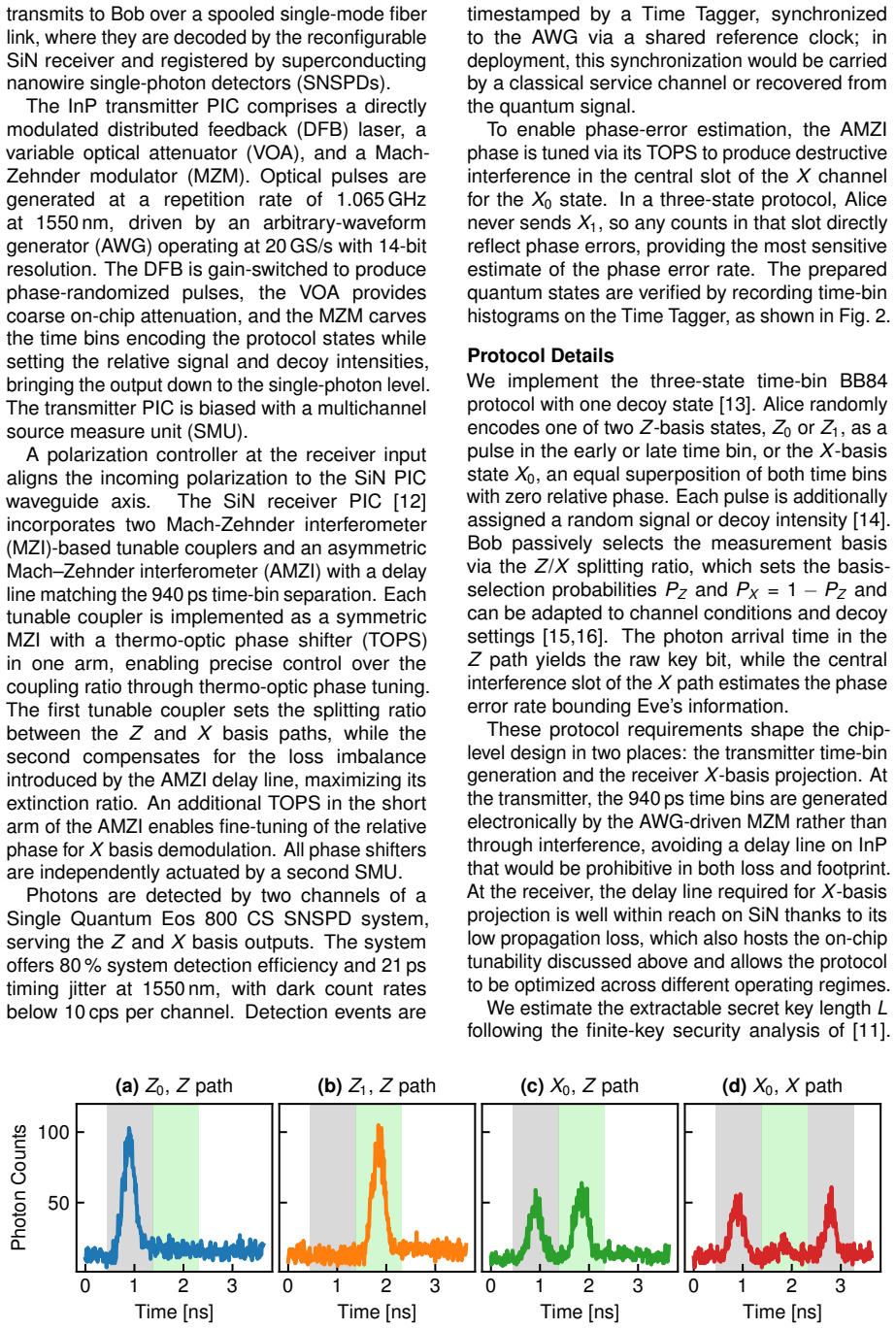

read the original abstract
We demonstrate a dual-chip InP-SiN photonic QKD system with on-chip pulse generation and reconfigurable decoding, implementing time-bin BB84 with finite-key security against coherent attacks. The system sustains a QBER below 4% and delivers secret keys at kbps rates over 150-250 km of fiber.
Editorial analysis
A structured set of objections, weighed in public.
Referee Report
Summary. The manuscript presents a dual-chip InP-SiN photonic integrated circuit implementation of time-bin BB84 QKD. It claims on-chip pulse generation and reconfigurable decoding, finite-key security against coherent attacks, QBER below 4%, and secret-key rates at kbps levels over 150-250 km of fiber.
Significance. If the experimental characterization and security analysis are complete and the on-chip elements introduce no unmodeled errors, the result would demonstrate a compact, foundry-compatible platform for time-bin QKD that could aid integration and scalability. The finite-key analysis against coherent attacks, if fully detailed, would strengthen the security claim relative to many prior PIC demonstrations.
major comments (2)
- [Abstract and §4] Abstract and §4 (Experimental Results): the reported QBER <4% and kbps rates are presented without an accompanying error budget or measured timing jitter/insertion-loss values for the InP pulse generator and SiN decoder; this directly bears on whether the central claim that on-chip components add no unaccounted phase instability or side-channels holds.
- [§5] §5 (Security Analysis): the finite-key security proof against coherent attacks is asserted but no outline of the phase-error estimation, decoy-state parameters, or how on-chip reconfigurability affects the single-photon source assumption is supplied; without this the weakest assumption in the stress-test cannot be checked.
minor comments (2)
- [Figures 2 and 3] Figure 2 and 3: axis labels and legend entries for the reconfigurable decoder states are difficult to read; add explicit annotations for the time-bin basis projections.
- Ensure the fiber lengths (150 km and 250 km) are stated with the corresponding loss values and detection efficiencies in the main text rather than only in supplementary material.
Simulated Author's Rebuttal
We thank the referee for the constructive feedback on our manuscript. We address each major comment below and indicate the revisions made to improve clarity and completeness.
read point-by-point responses
-
Referee: [Abstract and §4] Abstract and §4 (Experimental Results): the reported QBER <4% and kbps rates are presented without an accompanying error budget or measured timing jitter/insertion-loss values for the InP pulse generator and SiN decoder; this directly bears on whether the central claim that on-chip components add no unaccounted phase instability or side-channels holds.
Authors: We agree that an explicit error budget strengthens the central claim. In the revised manuscript we have added to §4 a tabulated error budget that includes the measured timing jitter of the InP pulse generator (sub-ps level) and the SiN decoder, together with the insertion-loss values for each on-chip element. These data are used to bound any residual phase instability and to confirm that no unaccounted side-channels are introduced beyond the modeled QBER. The abstract has been updated to reference the error-budget analysis. revision: yes
-
Referee: [§5] §5 (Security Analysis): the finite-key security proof against coherent attacks is asserted but no outline of the phase-error estimation, decoy-state parameters, or how on-chip reconfigurability affects the single-photon source assumption is supplied; without this the weakest assumption in the stress-test cannot be checked.
Authors: We acknowledge that the original §5 presented the finite-key result without sufficient intermediate steps. The revised section now supplies (i) the explicit phase-error estimation procedure based on the decoy-state method, (ii) the numerical decoy-state intensities and probabilities used in the experiment, and (iii) a short argument showing that the on-chip reconfigurability (basis selection via the SiN decoder) preserves the Poissonian photon-number statistics of the InP source and therefore does not invalidate the single-photon-source assumption under coherent attacks. revision: yes
Circularity Check
No derivation chain; experimental demonstration only.
full rationale
The paper is an experimental report of a dual-chip InP-SiN photonic QKD system implementing time-bin BB84. The abstract and provided text contain no equations, derivations, predictions, or theoretical claims that reduce to fitted parameters or self-referential definitions. Claims rest on measured QBER <4% and observed key rates over fiber spans, which are direct experimental outcomes rather than outputs of any internal derivation. No self-citation load-bearing steps or ansatzes are present in the visible content. This is a standard honest non-finding for a pure experimental paper.
Axiom & Free-Parameter Ledger
axioms (1)
- domain assumption Finite-key security analysis against coherent attacks applies directly to the implemented time-bin BB84 system.
Reference graph
Works this paper leans on
-
[1]
P . W. Shor, ‘Algorithms for quantum computation: Discrete logarithms and factoring’, inProceedings 35th annual symposium on foundations of computer science, 1994, pp. 124–134.DOI:10.1109/SFCS.1994.365700
-
[2]
Acharya et al., ‘Quantum error correction below the surface code threshold’,Nature, vol
R. Acharya et al., ‘Quantum error correction below the surface code threshold’,Nature, vol. 638, no. 8052, pp. 920–926, 2025.DOI: 10.1038/s41586-024-08449- y
-
[3]
Shor's algorithm is possible with as few as 10,000 reconfigurable atomic qubits
M. Cain et al., ‘Shor’s algorithm is possible with as few as 10,000 reconfigurable atomic qubits’,arXiv preprint arXiv:2603.28627, 2026.DOI: 10.48550/arXiv.2603. 28627
work page internal anchor Pith review Pith/arXiv arXiv doi:10.48550/arxiv.2603 2026
-
[4]
R. Babbush et al., ‘Securing elliptic curve cryptocurren- cies against quantum vulnerabilities: Resource estim- ates and mitigations’,arXiv preprint arXiv:2603.28846, 2026.DOI:10.48550/arXiv.2603.28846
work page internal anchor Pith review Pith/arXiv arXiv doi:10.48550/arxiv.2603.28846 2026
-
[5]
Labonté et al., ‘Integrated Photonics for Quantum Communications and Metrology’,PRX Quantum, vol
L. Labonté et al., ‘Integrated Photonics for Quantum Communications and Metrology’,PRX Quantum, vol. 5, no. 1, p. 010 101, 2024.DOI: 10.1103/PRXQuantum.5. 010101
-
[6]
W. Luo, L. Cao, H. Cai, M. F . Karim, L. C. Kwek and A. Q. Liu, ‘A Silicon Photonic Chip-based System for 2.5-GHz Quantum Key Distribution (QKD)’, inOptical Fiber Communication Conference (OFC), 2024, Th2A.9. DOI:10.1364/OFC.2024.Th2A.9
-
[7]
Sibson et al., ‘Chip-based quantum key distribution’, Nat
P . Sibson et al., ‘Chip-based quantum key distribution’, Nat. Commun., vol. 8, no. 1, p. 13 984, 2017.DOI: 10. 1038/ncomms13984
2017
-
[8]
T. K. Paraïso et al., ‘A photonic integrated quantum secure communication system’,Nat. Photonics, vol. 15, no. 11, pp. 850–856, 2021.DOI: 10.1038/s41566-021- 00873-0
-
[9]
Lin et al., ‘Integrated lithium niobate photonics for high-speed quantum key distribution’,Opt
Z. Lin et al., ‘Integrated lithium niobate photonics for high-speed quantum key distribution’,Opt. Quantum, vol. 3, no. 2, pp. 195–200, 2025.DOI: 10.1364/OPTICAQ. 551726
-
[10]
J. A. Dolphin, T. K. Paraïso, H. Du, R. I. Woodward, D. G. Marangon and A. J. Shields, ‘A hybrid integrated quantum key distribution transceiver chip’,npj Quantum Inf., vol. 9, no. 1, pp. 1–8, 2023.DOI: 10.1038/s41534- 023-00751-3
-
[11]
Wiesemann, J
J. Wiesemann, J. Krause, D. Tupkary, N. Lütkenhaus, D. Rusca and N. Walenta, ‘A consolidated and accessible security proof for finite-size decoy-state quantum key distribution’,Quantum, vol. 10, p. 2037, 2026.DOI: 10. 22331/q-2026-03-23-2037
2037
-
[12]
Fatkhiev et al., ‘A Reconfigurable Chip-Scale Quantum Key Distribution Receiver Based on Silicon Nitride’, inEuropean Conference on Optical Communic- ation (ECOC), 2024, Tu3A.4
D. Fatkhiev et al., ‘A Reconfigurable Chip-Scale Quantum Key Distribution Receiver Based on Silicon Nitride’, inEuropean Conference on Optical Communic- ation (ECOC), 2024, Tu3A.4
2024
-
[13]
Boaron et al., ‘Simple 2.5 GHz time-bin quantum key distribution’,Appl
A. Boaron et al., ‘Simple 2.5 GHz time-bin quantum key distribution’,Appl. Phys. Lett., vol. 112, no. 17, p. 171 108, 2018.DOI:10.1063/1.5027030
-
[14]
M. A. Pereira et al., ‘Quantum key distribution over a metropolitan network using an integrated photonics based prototype’,arXiv preprint arXiv:2602.17227, 2026. DOI:10.48550/arXiv.2602.17227
work page internal anchor Pith review Pith/arXiv arXiv doi:10.48550/arxiv.2602.17227 2026
-
[15]
D. Rusca, A. Boaron, F . Grünenfelder, A. Martin and H. Zbinden, ‘Finite-key analysis for the 1-decoy state QKD protocol’,Appl. Phys. Lett., vol. 112, no. 17, p. 171 104, 2018.DOI:10.1063/1.5023340
-
[16]
H. Liu et al., ‘Experimental 4-intensity decoy-state quantum key distribution with asymmetric basis-detector efficiency’,Phys. Rev. A, vol. 100, no. 4, p. 042 313, 2019.DOI:10.1103/PhysRevA.100.042313
-
[17]
R. J. Serfling, ‘Probability inequalities for the sum in sampling without replacement’,Ann. Stat., pp. 39–48, 1974.DOI:10.1214/aos/1176342611
-
[18]
H.-K. Lo, H. F . Chau and M. Ardehali, ‘Efficient quantum key distribution scheme and a proof of its unconditional security’,J. Cryptol., vol. 18, no. 2, pp. 133–165, 2005. DOI:10.1007/s00145-004-0142-y
-
[19]
F . Beutel, H. Gehring, M. A. Wolff, C. Schuck and W. Pernice, ‘Detector-integrated on-chip QKD receiver for GHz clock rates’,npj Quantum Inf., vol. 7, no. 1, p. 40, 2021.DOI:10.1038/s41534-021-00373-7
-
[20]
K.-i. Y oshino et al., ‘Quantum key distribution with an efficient countermeasure against correlated intensity fluctuations in optical pulses’,npj Quantum Inf., vol. 4, no. 1, p. 8, 2018.DOI:10.1038/s41534-017-0057-8
discussion (0)
Sign in with ORCID, Apple, or X to comment. Anyone can read and Pith papers without signing in.