REVIEW 1 major objections 2 minor 179 references
Importance of effective Coulomb interactions for $T_c$ in cuprates
T0 review · 1 major / 2 minor · reviewed 2026-06-26 · grok-4.3
Pith's one-line read In cuprates, Tc correlates most strongly with the effective Coulomb repulsion on oxygen p-orbitals in the three-band model.
desk verdict The paper's new angle is a dataset-wide correlation showing Tc tracks most strongly with U_p from the three-band model, but the automated downfolding leaves the result on shaky ground. read the letter →
The pith
A machine-rendered reading of the paper's core claim, the machinery that carries it, and where it could break.
The reading
What carries the argument
The fully automated MLWF + cRPA downfolding of DFT band structures to the single-band Hubbard and three-band Emery models, followed by statistical correlation analysis with experimental Tc.
What would settle it
A cuprate compound or set of compounds in which the computed p-orbital Coulomb coupling fails to correlate with measured Tc while some other parameter shows a stronger correlation when an alternative downfolding procedure is used.
Extended reading notes
Core claim
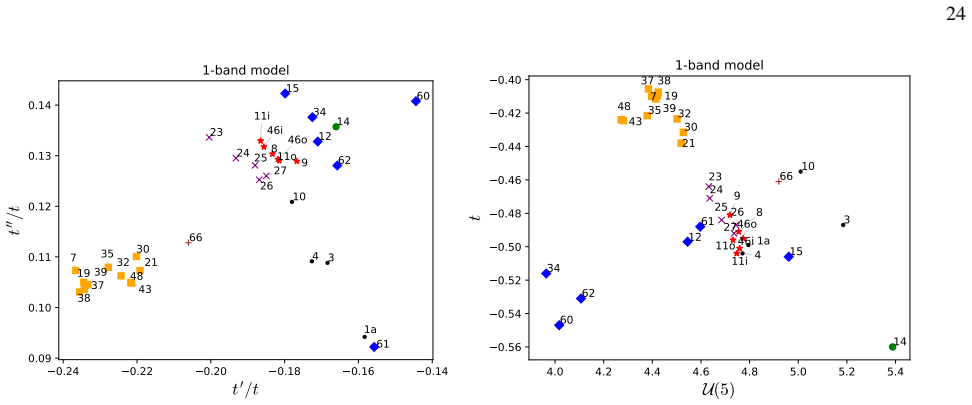
Through a large-scale systematic study that downfolds DFT band structures for dozens of cuprates to effective lattice models and applies unbiased statistical analysis, Tc scales well with simple functions of the model parameters; throughout the dataset Tc correlates the most with the Coulomb coupling on the p-orbitals in the three-band model, highlighting the importance of the oxygen sites in the copper-oxide planes, while also confirming the previously observed trend that t' in the single-band model correlates with experimental Tc and that Tc appears to vanish below a finite value of t'.
Load-bearing premise
The automated MLWF + cRPA downfolding procedure from DFT band structures produces effective model parameters whose variations across compounds faithfully reflect the microscopic interactions that control experimental Tc.
Editorial extensions
If this is right
- Tc correlates with t' in the single-band model and appears to vanish below a finite value of t'.
- The coupling strength plays a role in addition to the hopping parameters.
- More sophisticated models might be needed to describe all cuprates on the same footing.
- The oxygen p-orbitals are important for understanding variations in Tc.
Reading between the lines
- If p-orbital Coulomb terms dominate, then structural modifications that change oxygen coordination or environment could tune Tc more directly than changes focused on copper sites.
- The observed correlation implies that differences in screening of interactions at oxygen atoms vary enough across crystal structures to control Tc differences.
- Three-band model simulations that vary only the p-orbital U could be compared directly to experimental Tc trends for specific compounds to test predictive power.
- Extending the same downfolding and correlation procedure to pressure-dependent Tc data or additional compounds would provide a direct test of whether the p-orbital trend persists.
Editorial analysis
A structured set of objections, weighed in public.
Referee Report
Summary. The manuscript conducts a large-scale study of ~40 cuprate compounds by compiling experimental Tc and crystal structures, computing DFT band structures, and downfolding them via an automated MLWF+cRPA procedure to single-band Hubbard and three-band Emery models. Statistical analysis of the resulting effective parameters identifies the strongest correlation between experimental Tc and the Coulomb interaction U_p on oxygen p-orbitals in the three-band model, while also confirming a trend with t' in the single-band model and noting that Tc appears to vanish below a finite t' value.
Significance. If the downfolded parameters accurately reflect compound-to-compound variations in microscopic interactions, the result would indicate that oxygen-site Coulomb couplings are the dominant factor controlling Tc variations across cuprates, with implications for materials design. The alignment with recent Hubbard-model ground-state calculations on the t' threshold adds supporting context. The automated pipeline and statistical approach enable the scale of the study, but the significance hinges on validation of the downfolding procedure.
major comments (1)
- [Methods] Methods paragraph (and any associated supplementary details on the pipeline): The central claim that Tc correlates most strongly with U_p relies on the automated MLWF+cRPA downfolding producing parameters whose variations across compounds faithfully track the interactions controlling experimental Tc. No benchmarks against manual cRPA results, no sensitivity tests to DFT functional choice or energy windows on multiple cuprates, and no assessment of compound-dependent self-interaction errors are reported, despite known sensitivities that can shift screened interactions by several eV.
minor comments (2)
- [Abstract] Abstract: The phrase 'more sophisticated models might be needed to describe all cuprates on the same footing' is stated without specifying which discrepancies in the data support this conclusion.
- [Abstract] Abstract: The 'previously observed trend' for t' should include a citation to the relevant prior work.
Simulated Author's Rebuttal
We thank the referee for their careful review and constructive feedback on our manuscript. We address the major comment on the methods and validation of the automated downfolding procedure below.
read point-by-point responses
-
Referee: [Methods] Methods paragraph (and any associated supplementary details on the pipeline): The central claim that Tc correlates most strongly with U_p relies on the automated MLWF+cRPA downfolding producing parameters whose variations across compounds faithfully track the interactions controlling experimental Tc. No benchmarks against manual cRPA results, no sensitivity tests to DFT functional choice or energy windows on multiple cuprates, and no assessment of compound-dependent self-interaction errors are reported, despite known sensitivities that can shift screened interactions by several eV.
Authors: We agree that the absence of explicit benchmarks and sensitivity analyses represents a limitation, as the referee notes. A comprehensive set of manual cRPA validations or tests across all ~40 compounds would be computationally prohibitive for this large-scale study. We will revise the methods section and supplementary information to include (i) a discussion of known cRPA sensitivities to DFT functionals, energy windows, and self-interaction errors with references to the literature, and (ii) results from sensitivity tests performed on a representative subset of compounds. This will clarify that while absolute parameter values may carry systematic uncertainties, the automated and consistent treatment across the dataset supports the reliability of relative trends, including the observed correlation with U_p. revision: partial
Circularity Check
No circularity: parameters obtained from independent DFT+MLWF+cRPA downfolding; correlations with experimental Tc are statistical observations, not reductions by construction.
full rationale
The paper computes effective model parameters (U_p, t', etc.) via an automated first-principles pipeline applied to DFT band structures of each compound, then performs statistical correlation analysis against separately measured experimental Tc values. No step defines a parameter in terms of Tc, fits a model parameter to Tc data and then calls the result a prediction, or reduces the central correlation claim to a self-citation chain. The confirmation of the prior t' trend is presented as an external observation rather than a load-bearing uniqueness theorem. The derivation chain therefore remains self-contained against external benchmarks.
Assumptions & free parameters
assumptions (1)
- domain assumption DFT band structures plus MLWF+cRPA downfolding yield physically meaningful effective Hubbard and Emery parameters for cuprates
Cite this review
Pith. "Pith review of Importance of effective Coulomb interactions for $T_c$ in cuprates." pith.science (2026). https://pith.science/paper/V4Y4ISZM
@misc{pith2026260621323,
  author       = {Pith},
  title        = {Pith review of: Importance of effective Coulomb interactions for $T_c$ in cuprates},
  year         = {2026},
  howpublished = {\url{https://pith.science/paper/V4Y4ISZM}},
  note         = {Machine review of arXiv:2606.21323}
}
abstract
Cuprate superconductors exhibit the highest observed superconducting $T_c$ at atmospheric pressure. However, the magnitude of $T_c$ varies significantly between different cuprates. At present, it is unclear what properties of the crystal structure affect $T_c$ most strongly, yet such an understanding must underpin any efforts toward high-$T_c$ materials design. To address this issue, we perform a large scale systematic study, employing a combination of data collection, state-of-the-art numerical methods, and statistical analysis. We identify about 40 different cuprate compounds, and we compile detailed data about their $T_c$'s and crystal structures from literature and the available databases. Using a fully automated procedure, for each compound we compute the DFT bandstructure and downfold it to two of the most commonly studied low-energy lattice models, namely the single-band Hubbard and the three-band Emery models. The downfolding is based on the approach of MLWFs and cRPA. Finally, we apply a thorough and unbiased statistical analysis to investigate the correlations between the experimentally measured $T_c$'s and the computed parameters of our theoretical models. Our data indicates that more sophisticated models might be needed to describe all cuprates on the same footing. Nevertheless, we find that $T_c$ scales well with simple functions of model parameters. We confirm a previously observed trend that $t'$ in the single-band model correlates with the experimental $T_c$, and we find that $T_c$ appears to vanish below a finite value of $t'$, in agreement with recent ground-state calculations for the Hubbard model. However, we find that the coupling strength also plays a role: throughout our entire dataset, $T_c$ correlates the most with the Coulomb coupling on the $p$-orbitals in the 3-band model, highlighting the importance of the oxygen sites in the copper-oxide planes.
Figures


Figures from the paper (12 more)




Reference graph
Works this paper leans on
-
[1]
D. J. Scalapino, A common thread: The pairing interaction for unconventional superconductors, Reviews of Modern Physics 84, 1383 (2012)
2012
-
[2]
Keimer, S
B. Keimer, S. A. Kivelson, M. R. Norman, S. Uchida, and J. Zaanen, From quantum matter to high-temperature super- conductivity in copper oxides, Nature518, 179 (2015). 23 0 20 40 60 80 100 ν 0 5 10 15 20 25 30 35 40 (9) HgBa2CuO4 U(iν) U(0) U(5) V 0 20 40 60 80 100 ν 0 5 10 15 20 25 30 35 40 (9) HgBa2CuO4 Udd(iν) Udd(0) Udd(5) Vdd Upp(iν) Upp(0) Upp(5) Vp...
2015
-
[3]
C. M. Varma, Colloquium: Linear in temperature resistivity and associated mysteries including high temperature super- conductivity, Reviews of Modern Physics92, 031001 (2020)
2020
-
[4]
Maier, M
T. Maier, M. Jarrell, T. Pruschke, and J. Keller,d-wave super- conductivity in the Hubbard model, Phys. Rev. Lett.85, 1524 (2000)
2000
-
[5]
Kyung, S
B. Kyung, S. S. Kancharla, D. Sénéchal, A.-M. S. Tremblay, M. Civelli, and G. Kotliar, Pseudogap induced by short-range spin correlations in a doped Mott insulator, Phys. Rev. B73, 165114 (2006)
2006
-
[6]
Civelli, M
M. Civelli, M. Capone, A. Georges, K. Haule, O. Parcollet, T. D. Stanescu, and G. Kotliar, Nodal-antinodal dichotomy and the two gaps of a superconducting doped Mott insulator, Physical Review Letters100, 046402 (2008)
2008
-
[7]
S. S. Kancharla, B. Kyung, D. Sénéchal, M. Civelli, M. Capone, G. Kotliar, and A.-M. S. Tremblay, Anomalous su- perconductivity and its competition with antiferromagnetism in doped Mott insulators, Phys. Rev. B77, 184516 (2008)
2008
-
[8]
Ferrero, P
M. Ferrero, P. S. Cornaglia, L. De Leo, O. Parcollet, G. Kotliar, and A. Georges, Pseudogap opening and formation of Fermi arcs as an orbital-selective Mott transition in momen- tum space, Phys. Rev. B80, 064501 (2009)
2009
Show all 179 references
-
[9]
E. Gull, O. Parcollet, and A. J. Millis, Superconductivity and the pseudogap in the two-dimensional Hubbard model, Phys. Rev. Lett.110, 216405 (2013)
2013
-
[10]
W. Wu, M. Ferrero, A. Georges, and E. Kozik, Controlling Feynman diagrammatic expansions: Physical nature of the pseudogap in the two-dimensional Hubbard model, Phys. Rev. B96, 041105 (2017)
2017
-
[11]
W. Wu, M. S. Scheurer, S. Chatterjee, S. Sachdev, A. Georges, and M. Ferrero, Pseudogap and Fermi-surface topology in the two-dimensional Hubbard model, Phys. Rev. X8, 021048 (2018)
2018
-
[12]
Vu ˇciˇcevi´c, D
J. Vu ˇciˇcevi´c, D. Tanaskovi ´c, M. J. Rozenberg, and V . Do- brosavljevi´c, Bad-metal behavior reveals Mott quantum criti- cality in doped Hubbard models, Physical Review Letters114, 246402 (2015)
2015
-
[13]
Vu ˇciˇcevi´c and R
J. Vu ˇciˇcevi´c and R. Žitko, Universal magnetic oscillations of dc conductivity in the incoherent regime of correlated systems, Phys. Rev. Lett.127, 196601 (2021). 24 0.24 0.22 0.20 0.18 0.16 0.14 t ′/t 0.09 0.10 0.11 0.12 0.13 0.14 t ′′/t 1a 347 8 9 10 11o 11i 12 14 15 19 2...
2021
-
[14]
Vu ˇciˇcevi´c and R
J. Vu ˇciˇcevi´c and R. Žitko, Electrical conductivity in the Hub- bard model: orbital effects of magnetic field, Phys. Rev. B104, 205101 (2021)
2021
-
[15]
T. Li, S. Jiang, L. Li, Y . Zhang, K. Kang, J. Zhu, K. Watanabe, T. Taniguchi, D. Chowdhury, L. Fu, J. Shan, and K. F. Mak, Continuous Mott transition in semiconductor moiré superlat- tices, Nature597, 350 (2021)
2021
-
[16]
Limelette, P
P. Limelette, P. Wzietek, S. Florens, A. Georges, T. A. Costi, C. Pasquier, D. Jerome, C. Meziere, and P. Batail, Mott transition and transport crossovers in the organic com- pound (BEDT-TTF)2Cu[N(CN)2]Cl, Physical Review Letters 91, 016401 (2003)
2003
-
[17]
Terletska, J
H. Terletska, J. Vuˇciˇcevi´c, D. Tanaskovi´c, and V . Dobrosavlje- vi´c, Quantum critical transport near the Mott transition, Phys. Rev. Lett.107, 026401 (2011)
2011
-
[18]
Vu ˇciˇcevi´c, H
J. Vu ˇciˇcevi´c, H. Terletska, D. Tanaskovi ´c, and V . Dobrosavl- jevi´c, Finite-temperature crossover and the quantum Widom line near the Mott transition, Phys. Rev. B88, 075143 (2013)
2013
-
[19]
Furukawa, K
T. Furukawa, K. Miyagawa, H. Taniguchi, R. Kato, and K. Kanoda, Quantum criticality of Mott transition in organic materials, Nature Physics11, 221 (2015)
2015
-
[20]
Sorella, G
S. Sorella, G. B. Martins, F. Becca, C. Gazza, L. Capri- otti, A. Parola, and E. Dagotto, Superconductivity in the two- dimensionalt−Jmodel, Phys. Rev. Lett.88, 117002 (2002)
2002
-
[21]
Prelovšek and A
P. Prelovšek and A. Ramšak, Spin-fluctuation mechanism of superconductivity in cuprates, Phys. Rev. B72, 012510 (2005)
2005
-
[22]
Capone and G
M. Capone and G. Kotliar, Competition betweend- wave superconductivity and antiferromagnetism in the two- dimensional Hubbard model, Phys. Rev. B74, 054513 (2006)
2006
-
[23]
Onufrieva and P
F. Onufrieva and P. Pfeuty, Superconducting pairing through the spin resonance mode in high-temperature cuprate super- conductors, Phys. Rev. Lett.102, 207003 (2009)
2009
-
[24]
M. A. Metlitski and S. Sachdev, Quantum phase transitions of metals in two spatial dimensions. ii. spin density wave order, Phys. Rev. B82, 075128 (2010)
2010
-
[25]
Onufrieva and P
F. Onufrieva and P. Pfeuty, Low-doping anomalies in high- Tc cuprate superconductors as evidence of a spin-fluctuation- mediated superconducting state, Phys. Rev. Lett.109, 257001 (2012)
2012
-
[26]
Wang and A
Y . Wang and A. Chubukov, Charge-density-wave order with momentum(2q,0)and(0,2q)within the spin-fermion model: Continuous and discrete symmetry breaking, preemptive com- posite order, and relation to pseudogap in hole-doped cuprates, Phys. Rev. B90, 035149 (2014)
2014
-
[27]
Fratino, P
L. Fratino, P. Sémon, G. Sordi, and A.-M. S. Tremblay, An organizing principle for two-dimensional strongly correlated superconductivity, Scientific Reports6, 10.1038/srep22715 (2016)
2016 doi
-
[28]
Vu ˇciˇcevi´c, T
J. Vu ˇciˇcevi´c, T. Ayral, and O. Parcollet, TRILEX and GW+EDMFT approach tod-wave superconductivity in the Hubbard model, Phys. Rev. B96, 104504 (2017)
2017
-
[29]
Jiang, D
S. Jiang, D. J. Scalapino, and S. R. White, Ground-state phase diagram of thet−t ′ −jmodel, Proceedings of the National Academy of Sciences118, e2109978118 (2021)
2021
-
[30]
Kowalski, S
N. Kowalski, S. S. Dash, P. Sémon, D. Sénéchal, and A.-M. Tremblay, Oxygen hole content, charge-transfer gap, cova- lency, and cuprate superconductivity, Proceedings of the Na- tional Academy of Sciences118, e2106476118 (2021)
2021
-
[31]
X. Dong, L. Del Re, A. Toschi, and E. Gull, Mechanism of superconductivity in the Hubbard model at intermediate in- teraction strength, Proceedings of the National Academy of Sciences119, e2205048119 (2022)
2022
-
[32]
M. Roig, A. T. Rømer, P. J. Hirschfeld, and B. M. Andersen, Revisiting superconductivity in the extended one-band Hub- bard model: Pairing via spin and charge fluctuations, Phys. Rev. B106, 214530 (2022)
2022
-
[33]
F. Chen, F. D. M. Haldane, and D. N. Sheng, Global phase diagram of d-wave superconductivity in the square-latticet−j model, Proceedings of the National Academy of Sciences122, e2420963122 (2025)
2025
-
[34]
Bacq-Labreuil, B
B. Bacq-Labreuil, B. Lacasse, A.-M. S. Tremblay, D. Sénéchal, and K. Haule, Toward an ab initio theory of high-temperature superconductors: A study of multilayer cuprates, Phys. Rev. X15, 021071 (2025)
2025
-
[35]
S. M. O’Mahony, W. Ren, W. Chen, Y . X. Chong, X. Liu, H. Eisaki, S. Uchida, M. H. Hamidian, and J. C. S. Davis, On the electron pairing mechanism of copper-oxide high tempera- 25 tpp 0.600.610.620.630.640.650.66 0.67 tpd 1.10 1.15 1.20 1.25 1.30 1.35 t′pp 0.12 0.13 0.14 0.15 ...
2022
-
[36]
L. F. Feiner, M. Grilli, and C. Di Castro, Apical oxygen ions and the electronic structure of the high-Tc cuprates, Phys. Rev. B45, 10647 (1992)
1992
-
[37]
Raimondi, J
R. Raimondi, J. H. Jefferson, and L. F. Feiner, Effective single- band models for the high-Tc cuprates. ii. role of apical oxygen, Phys. Rev. B53, 8774 (1996)
1996
-
[38]
Pavarini, I
E. Pavarini, I. Dasgupta, T. Saha-Dasgupta, O. Jepsen, and O. K. Andersen, Band-structure trend in hole-doped cuprates and correlation withT cmax , Phys. Rev. Lett87, 047003 (2001)
2001
-
[39]
Weber, C
C. Weber, C. Yee, K. Haule, and G. Kotliar, Scaling of the transition temperature of hole-doped cuprate superconductors with the charge-transfer energy, EPL (Europhysics Letters) 100, 37001 (2012)
2012
-
[40]
S. Kim, X. Chen, W. Fitzhugh, and X. Li, Apical charge flux- modulated in-plane transport properties of cuprate supercon- ductors, Phys. Rev. Lett.121, 157001 (2018)
2018
-
[41]
Stanev, C
V . Stanev, C. Oses, A. G. Kusne, E. Rodriguez, J. Paglione, S. Curtarolo, and I. Takeuchi, Machine learning modeling of superconducting critical temperature, npj Computational Ma- terials4, 29 (2018)
2018
-
[42]
Hamidieh, A data-driven statistical model for predicting the critical temperature of a superconductor, Computational Ma- terials Science154, 346 (2018)
K. Hamidieh, A data-driven statistical model for predicting the critical temperature of a superconductor, Computational Ma- terials Science154, 346 (2018)
2018
-
[43]
D. Lee, D. You, D. Lee, X. Li, and S. Kim, Machine-learning- guided prediction models of critical temperature of cuprates, The Journal of Physical Chemistry Letters12, 6211 (2021)
2021
-
[44]
Y . Wang, T. Su, Y . Cui, X. Ma, X. Zhou, Y . Wang, S. Hu, and W. Ren, Cuprate superconducting materials above liquid nitrogen temperature from machine learning, RSC Advances 26 U(5) 4.04.24.44.64.85.05.25.4 U(0) 1.0 1.5 2.0 2.5 3.0 3.5 V 14.0 14.5 15.0 15.5 16.0 16.5 17.0 17....
2023
-
[45]
Vu ˇciˇcevi´c and M
J. Vu ˇciˇcevi´c and M. Ferrero, Simple predictors ofT c in super- conducting cuprates and the role of interactions between ef- fective Wannier orbitals in thed−pthree-band model, Phys. Rev. B109, L081115 (2024)
2024
-
[46]
Vadnais, R
S. Vadnais, R. Duchesne, K. Haule, A. M. S. Tremblay, D. Sénéchal, and B. Bacq-Labreuil, The role of the apical oxygen in cuprate high-temperature superconductors (2026), arXiv:2601.16017
2026
-
[47]
Sakakibara, K
H. Sakakibara, K. Suzuki, H. Usui, S. Miyao, I. Maruyama, K. Kusakabe, R. Arita, H. Aoki, and K. Kuroki, Orbital mix- ture effect on the Fermi-surface–T c correlation in the cuprate superconductors: Bilayer vs. single layer, Phys. Rev. B89, 224505 (2014)
2014
-
[48]
Nilsson, K
F. Nilsson, K. Karlsson, and F. Aryasetiawan, Dynamically screened Coulomb interaction in the parent compounds of hole-doped cuprates: Trends and exceptions, Phys. Rev. B99, 075135 (2019)
2019
-
[49]
Hirayama, Y
M. Hirayama, Y . Yamaji, T. Misawa, and M. Imada, Ab ini- tio effective Hamiltonians for cuprate superconductors, Phys. Rev. B98, 134501 (2018)
2018
-
[50]
Hirayama, T
M. Hirayama, T. Misawa, T. Ohgoe, Y . Yamaji, and M. Imada, Effective Hamiltonian for cuprate superconductors derived from multiscale ab initio scheme with level renormalization, Phys. Rev. B99, 245155 (2019)
2019
-
[51]
J. P. F. LeBlanc, A. E. Antipov, F. Becca, I. W. Bulik, G. K.- L. Chan, C.-M. Chung, Y . Deng, M. Ferrero, T. M. Hender- son, C. A. Jiménez-Hoyos, E. Kozik, X.-W. Liu, A. J. Millis, N. V . Prokof’ev, M. Qin, G. E. Scuseria, H. Shi, B. V . Svis- tunov, L. F. Tocchio, I. S. Tupi...
2015
-
[52]
Zheng, C.-M
B.-X. Zheng, C.-M. Chung, P. Corboz, G. Ehlers, M.-P. Qin, R. M. Noack, H. Shi, S. R. White, S. Zhang, and G. K.-L. Chan, Stripe order in the underdoped region of the three-band Hubbard model, Science358, 1155 (2017)
2017
-
[53]
A. A. Mostofi, J. R. Yates, G. Pizzi, Y .-S. Lee, I. Souza, D. Vanderbilt, and N. Marzari, An updated version of wan- nier90: A tool for obtaining maximally-localised wannier functions, Computer Physics Communications185, 2309 (2014)
2014
-
[54]
Schüler, M
M. Schüler, M. Rösner, T. O. Wehling, A. I. Lichtenstein, and M. I. Katsnelson, Optimal Hubbard models for materials with nonlocal Coulomb interactions: Graphene, silicene, and ben- zene, Phys. Rev. Lett.111, 036601 (2013)
2013
-
[55]
Aryasetiawan, M
F. Aryasetiawan, M. Imada, A. Georges, G. Kotliar, S. Bier- mann, and A. I. Lichtenstein, Frequency-dependent local in- teractions and low-energy effective models from electronic structure calculations, Phys. Rev. B70, 195104 (2004)
2004
-
[56]
Marzari, A
N. Marzari, A. A. Mostofi, J. R. Yates, I. Souza, and D. Van- derbilt, Maximally localized wannier functions: Theory and applications, Rev. Mod. Phys.84, 1419 (2012)
2012
-
[57]
Honerkamp, Effective interactions in multiband sys- tems from constrained summations, Physical Review B85, 10.1103/physrevb.85.195129 (2012)
C. Honerkamp, Effective interactions in multiband sys- tems from constrained summations, Physical Review B85, 10.1103/physrevb.85.195129 (2012)
2012 doi
-
[58]
J. B. Profe, J. Vuˇciˇcevi´c, P. P. Stavropoulos, M. Rösner, R. Va- lentí, and L. Klebl, Exact downfolding and its perturbative ap- proximation, Phys. Rev. Res.8, 023091 (2026)
2026
-
[59]
Aryasetiawan, K
F. Aryasetiawan, K. Karlsson, O. Jepsen, and U. Schönberger, Calculations of Hubbardufrom first-principles, Phys. Rev. B 74, 125106 (2006)
2006
-
[60]
Springer and F
M. Springer and F. Aryasetiawan, Frequency-dependent screened interaction in Ni within the random-phase approxi- mation, Phys. Rev. B57, 4364 (1998)
1998
-
[61]
Miyake and F
T. Miyake and F. Aryasetiawan, Screened Coulomb interaction in the maximally localized Wannier basis, Phys. Rev. B77, 085122 (2008)
2008
-
[62]
Vaugier, H
L. Vaugier, H. Jiang, and S. Biermann, HubbardUand Hund exchangeJin transition metal oxides: Screening versus local- ization trends from constrained random phase approximation, 27 Phys. Rev. B86, 165105 (2012)
2012
-
[63]
Shinaoka, M
H. Shinaoka, M. Troyer, and P. Werner, Accuracy of down- folding based on the constrained random-phase approxima- tion, Phys. Rev. B91, 245156 (2015)
2015
-
[64]
C. J. C. Scott and G. H. Booth, Rigorous screened interactions for realistic correlated electron systems, Phys. Rev. Lett.132, 076401 (2024)
2024
-
[65]
Chang, E
Y . Chang, E. G. van Loon, B. Eskridge, B. Busemeyer, M. A. Morales, C. E. Dreyer, A. J. Millis, S. Zhang, T. O. Wehling, L. K. Wagner, and M. Rösner, Downfolding from ab initio to interacting model Hamiltonians: comprehensive analysis and benchmarking of the DFT+cRPA approach...
2024
-
[66]
Jiang, T
Y .-F. Jiang, T. P. Devereaux, and H.-C. Jiang, Ground-state phase diagram and superconductivity of the doped Hubbard model on six-leg square cylinders, Phys. Rev. B109, 085121 (2024)
2024
-
[67]
Qin, C.-M
M. Qin, C.-M. Chung, H. Shi, E. Vitali, C. Hubig, U. Scholl- wöck, S. R. White, and S. Zhang (Simons Collaboration on the Many-Electron Problem), Absence of superconductivity in the pure two-dimensional hubbard model, Phys. Rev. X10, 031016 (2020)
2020
-
[68]
Xu, C.-M
H. Xu, C.-M. Chung, M. Qin, U. Schollwöck, S. R. White, and S. Zhang, Coexistence of superconductivity with partially filled stripes in the Hubbard model, Science384, eadh7691 (2024)
2024
-
[69]
Rybicki, M
D. Rybicki, M. Jurkutat, S. Reichardt, C. Kapusta, and J. Haase, Perspective on the phase diagram of cuprate high-temperature superconductors, Nature Communications 7, 11413 (2016)
2016
-
[70]
Hansmann, N
P. Hansmann, N. Parragh, A. Toschi, G. Sangiovanni, and K. Held, Importance ofd−pCoulomb interaction for highT C cuprates and other oxides, New Journal of Physics16, 033009 (2014)
2014
-
[71]
P. R. C. Kent, T. Saha-Dasgupta, O. Jepsen, O. K. Andersen, A. Macridin, T. A. Maier, M. Jarrell, and T. C. Schulthess, Combined density functional and dynamical cluster quantum Monte Carlo calculations of the three-band Hubbard model for hole-doped cuprate superconductors, Ph...
2008
-
[72]
Weber, K
C. Weber, K. Haule, and G. Kotliar, Optical weights and waterfalls in doped charge-transfer insulators: A local den- sity approximation and dynamical mean-field theory study of La2−xSrxCuO4, Phys. Rev. B78, 134519 (2008)
2008
-
[73]
de’ Medici, X
L. de’ Medici, X. Wang, M. Capone, and A. J. Millis, Cor- relation strength, gaps, and particle-hole asymmetry in high- Tc cuprates: A dynamical mean field study of the three-band copper-oxide model, Phys. Rev. B80, 054501 (2009)
2009
-
[74]
M. O. Malcolms, H. Menke, Y .-T. Tseng, E. Jacob, K. Held, P. Hansmann, and T. Schäfer, Rise and fall of the pseu- dogap in the emery model: Insights for cuprates (2024), arXiv:2412.14951
2024
-
[75]
Tseng, M
Y .-T. Tseng, M. Malcolms, H. Menke, M. Klett, T. Schäfer, and P. Hansmann, Single-particle spectra and magnetic sus- ceptibility in the Emery model: A dynamical mean-field per- spective, SciPost Physics18, 145 (2025)
2025
-
[76]
St-Cyr and D
L.-B. St-Cyr and D. Sénéchal, Effect of the coulomb repulsion and oxygen level on charge distribution and superconductiv- ity in the emery model for cuprates superconductors, SciPost Physics Core8, 043 (2025)
2025
-
[77]
Vu ˇciˇcevi´c and R
J. Vu ˇciˇcevi´c and R. Žitko, Hubbard vs. emery model: spectra, transport and relevance for cuprates (2026), arXiv:2604.08085
2026 arXiv
-
[78]
G. D. Mahan,Many-particle physics, 3rd ed., Physics of Solids and Liquids (Kluwer Academic/Plenum, New York, NY , 2000)
2000
-
[79]
Vu ˇciˇcevi´c, U
J. Vu ˇciˇcevi´c, U. Kumar, C.-N. Yeh, M. A. Morales, and M. Rösner, Supplemental material available as GitHub repos- itory,https://github.com/JaksaVucicevic/ cuprate_parametrization(2026)
2026
-
[80]
Trofimov, L
I. Trofimov, L. Johnson, K. Ramanujachary, S. Guha, M. Har- rison, M. Greenblatt, M. Cieplak, and P. Lindenfeld, Growth and properties of La2−xSrxCuO4 films, Applied Physics Let- ters65, 2481 (1994)
1994
-
[81]
Tarascon, L
J.-M. Tarascon, L. Greene, W. McKinnon, G. Hull, and T. Geballe, Superconductivity at 40 K in the oxygen-defect perovskites La2−xSrxCuO4−y, Science235, 1373 (1987)
1987
-
[82]
Chaillout, S
C. Chaillout, S. Cheong, Z. Fisk, M. Lehmann, M. Marezio, B. Morosin, and J. Schirber, The crystal structure of super- conducting La 2CuO4.032 by neutron diffraction, Physica C: Superconductivity158, 183 (1989)
1989
-
[83]
Guguchia, D
Z. Guguchia, D. Das, G. Simutis, T. Adachi, J. Küspert, N. Ki- tajima, M. Elender, V . Grinenko, O. Ivashko, M. v. Zimmer- mann, M. Müller, C. Mielke, F. Hotz, C. Mudry, C. Baines, M. Bartkowiak, T. Shiroka, Y . Koike, A. Amato, C. W. Hicks, G. D. Gu, J. M. Tranquada, H.-H. Kl...
2023
-
[84]
Naito and M
M. Naito and M. Hepp, Superconducting T ′-La2−xCexCuO4 films grown by molecular beam epitaxy, Japanese Journal of Applied Physics39, L485 (2000)
2000
-
[85]
M. K. Horton, P. Huck, R. X. Yang, J. M. Munro, S. Dwarak- nath, A. M. Ganose, R. S. Kingsbury, M. Wen, J. X. Shen, T. S. Mathis, A. D. Kaplan, K. Berket, J. Riebesell, J. George, A. S. Rosen, E. W. C. Spotte-Smith, M. J. McDermott, O. A. Cohen, A. Dunn, M. C. Kuner, G.-M. Rig...
2025
-
[86]
A. Jain, S. P. Ong, G. Hautier, W. Chen, W. D. Richards, S. Dacek, S. Cholia, D. Gunter, D. Skinner, G. Ceder, and K. A. Persson, Commentary: The Materials Project: A ma- terials genome approach to accelerating materials innovation, APL Materials1, 011002 (2013)
2013
-
[87]
Vaitkus, A
A. Vaitkus, A. Merkys, T. Sander, M. Quirós, P. A. Thiessen, E. E. Bolton, and S. Gražulis, A workflow for deriving chem- ical entities from crystallographic data and its application to the crystallography open database, Journal of Cheminformat- ics15, 123 (2023)
2023
-
[88]
Giannozzi, S
P. Giannozzi, S. Baroni, N. Bonini, M. Calandra, R. Car, C. Cavazzoni, D. Ceresoli, G. L. Chiarotti, M. Cococcioni, I. Dabo, A. Dal Corso, S. de Gironcoli, S. Fabris, G. Fratesi, R. Gebauer, U. Gerstmann, C. Gougoussis, A. Kokalj, M. Lazzeri, L. Martin-Samos, N. Marzari, F. Ma...
2009
-
[89]
Giannozzi, O
P. Giannozzi, O. Andreussi, T. Brumme, O. Bunau, M. Buon- giorno Nardelli, M. Calandra, R. Car, C. Cavazzoni, D. Ceresoli, M. Cococcioni, N. Colonna, I. Carnimeo, A. Dal Corso, S. de Gironcoli, P. Delugas, R. A. DiStasio, A. Ferretti, A. Floris, G. Fratesi, G. Fugallo, R. Geba...
2017
-
[90]
Prandini, A
G. Prandini, A. Marrazzo, I. E. Castelli, N. Mounet, and N. Marzari, Precision and efficiency in solid-state pseudopo- tential calculations, npj Computational Materials4, 72 (2018), http://materialscloud.org/sssp
2018
-
[91]
D. R. Hamann, Optimized norm-conserving Vanderbilt pseu- dopotentials, Phys. Rev. B88, 085117 (2013)
2013
-
[92]
van Setten, M
M. van Setten, M. Giantomassi, E. Bousquet, M. Verstraete, D. Hamann, X. Gonze, and G.-M. Rignanese, The pseu- dodojo: Training and grading a 85 element optimized norm- conserving pseudopotential table, Computer Physics Commu- nications226, 39 (2018)
2018
-
[93]
L. F. Mattheiss, Electronic band properties and superconduc- tivity in La 2−yXyCuO4, Physical Review Letters58, 1028 (1987)
1987
-
[94]
V . J. Emery, Theory of high-T c superconductivity in oxides, Phys. Rev. Lett.58, 2794 (1987)
1987
-
[95]
C. M. Varma, S. Schmitt-Rink, and E. Abrahams, Charge transfer excitations and superconductivity in “ionic” metals, Solid State Commun.62, 681 (1987)
1987
-
[96]
Nakamura, Y
K. Nakamura, Y . Nohara, Y . Yosimoto, and Y . Nomura, Ab initioGWplus cumulant calculation for isolated band systems: Application to organic conductor(TMTSF) 2PF6 and transition-metal oxideSrVO 3, Phys. Rev. B93, 085124 (2016)
2016
-
[97]
Nakamura, Y
K. Nakamura, Y . Yoshimoto, Y . Nomura, T. Tadano, M. Kawa- mura, T. Kosugi, K. Yoshimi, T. Misawa, and Y . Motoyama, RESPACK: An ab initio tool for derivation of effective low- energy model of material, Computer Physics Communications 261, 107781 (2021)
2021
-
[98]
Souza, N
I. Souza, N. Marzari, and D. Vanderbilt, Maximally localized wannier functions for entangled energy bands, Phys. Rev. B 65, 035109 (2001)
2001
-
[99]
Yeh and M
C.-N. Yeh and M. Morales, Coqui: Correlated quantum inter- face,https://github.com/AbInitioQHub/coqui (2025), ab initio electronic structure beyond density functional theory. GitHub repository. Accessed: 2025-12-05
2025
-
[100]
Yeh and M
C.-N. Yeh and M. A. Morales, Low-scaling algorithms for GW and constrained random phase approximation us- ing symmetry-adapted interpolative separable density fitting, Journal of Chemical Theory and Computation20, 3184 (2024)
2024
-
[101]
Casula, P
M. Casula, P. Werner, L. Vaugier, F. Aryasetiawan, T. Miyake, A. J. Millis, and S. Biermann, Low-energy models for corre- lated materials: Bandwidth renormalization from Coulombic screening, Phys. Rev. Lett.109, 126408 (2012)
2012
-
[102]
Pauli, A
A. Pauli, A. Mishra, M. Rösner, and E. G. C. P. van Loon, Static treatment of dynamic interactions in the single-orbital Anderson impurity model, Phys. Rev. B112, 195101 (2025)
2025
-
[103]
Miyake, F
T. Miyake, F. Aryasetiawan, and M. Imada, Ab initio proce- dure for constructing effective models of correlated materi- als with entangled band structure, Phys. Rev. B80, 155134 (2009)
2009
-
[104]
Honerkamp, H
C. Honerkamp, H. Shinaoka, F. F. Assaad, and P. Werner, Lim- itations of constrained random phase approximation down- folding, Phys. Rev. B98, 235151 (2018)
2018
-
[105]
Kaltak, A
M. Kaltak, A. Hampel, M. Schlipf, I. R. Reddy, B. Kim, and G. Kresse, Constrained random phase approximation: The spectral method, Phys. Rev. B112, 245102 (2025)
2025
-
[106]
Hanke, M
W. Hanke, M. Kiesel, M. Aichhorn, S. Brehm, and E. Ar- rigoni, The 3-band hubbard-model versus the 1-band model for the high-Tc cuprates: Pairing dynamics, superconductivity and the ground-state phase diagram, The European Physical Journal Special Topics188, 15 (2010)
2010
-
[107]
Zaanen, G
J. Zaanen, G. A. Sawatzky, and J. W. Allen, Band gaps and electronic structure of transition-metal compounds, Phys. Rev. Lett.55, 418 (1985)
1985
-
[108]
Haule, Exact double counting in combining the dynamical mean field theory and the density functional theory, Phys
K. Haule, Exact double counting in combining the dynamical mean field theory and the density functional theory, Phys. Rev. Lett.115, 196403 (2015)
2015
-
[109]
Sheng, C
N. Sheng, C. V orwerk, M. Govoni, and G. Galli, Green’s func- tion formulation of quantum defect embedding theory, Journal of Chemical Theory and Computation18, 3512 (2022)
2022
-
[110]
Jacob, M
E. Jacob, M. O. Malcolms, V . Christiansson, L. M. Verhoff, P. Worm, L. Si, P. Hansmann, T. Schäfer, and K. Held, Beyond the conventional Emery model: crucial role of long-range hop- ping for cuprate superconductivity (2026)
2026
-
[111]
Y . Ohta, T. Tohyama, and S. Maekawa, Apex oxygen and crit- ical temperature in copper oxide superconductors: Universal correlation with the stability of local singlets, Phys. Rev. B43, 2968 (1991)
1991
-
[112]
Das and T
H. Das and T. Saha-Dasgupta, Electronic structure of La2CuO4 in theTandT ′ crystal structures using dynamical mean field theory, Phys. Rev. B79, 134522 (2009)
2009
-
[113]
Biermann, F
S. Biermann, F. Aryasetiawan, and A. Georges, First- principles approach to the electronic structure of strongly cor- related systems: Combining theGWapproximation and dy- namical mean-field theory, Phys. Rev. Lett.90, 086402 (2003)
2003
-
[114]
Nilsson, L
F. Nilsson, L. Boehnke, P. Werner, and F. Aryasetiawan, Multitier self-consistentGW+EDMFT, Phys. Rev. Mater.1, 043803 (2017)
2017
-
[115]
Sakakibara, H
H. Sakakibara, H. Usui, K. Kuroki, R. Arita, and H. Aoki, Two-orbital model explains the higher transition temperature of the single-layer Hg-cuprate superconductor compared to that of the La-cuprate superconductor, Phys. Rev. Lett.105, 057003 (2010)
2010
-
[116]
Maier, M
T. Maier, M. Jarrell, T. Pruschke, and M. H. Hettler, Quantum cluster theories, Rev. Mod. Phys.77, 1027 (2005)
2005
-
[117]
Staar, T
P. Staar, T. Maier, and T. C. Schulthess, Two-particle cor- relations in a dynamic cluster approximation with continu- ous momentum dependence: Superconductivity in the two- dimensional Hubbard model, Phys. Rev. B89, 195133 (2014)
2014
-
[118]
T. A. Maier and D. J. Scalapino, Pairfield fluctuations of a 2D Hubbard model, npj Quantum Materials4, 30 (2019)
2019
-
[119]
Sakai, M
S. Sakai, M. Civelli, and M. Imada, Hidden-fermion repre- sentation of self-energy in pseudogap and superconducting states of the two-dimensional Hubbard model, Phys. Rev. B 94, 115130 (2016)
2016
-
[120]
Zhang and H
S. Zhang and H. Krakauer, Quantum monte carlo method us- ing phase-free random walks with slater determinants, Phys. Rev. Lett.90, 136401 (2003)
2003
-
[121]
D. N. Argyriou, J. D. Jorgensen, R. L. Hitterman, Z. Hiroi, N. Kobayashi, and M. Takano, Structure and superconductiv- ity without apical oxygens in (Ca,Na) 2CuO2Cl2, Phys. Rev. B51, 8434 (1995)
1995
-
[122]
Fuertes, X
A. Fuertes, X. Obradors, J. Navarro, P. Gomez-Romero, N. Casañ-Pastor, F. Perez, J. Fontcuberta, C. Miravitlles, J. Rodríguez-Carvajal, and B. Martinez, Oxygen excess and superconductivity at 45 K in La 2CaCu2O6+y, Physica C: Su- 29 perconductivity170, 153 (1990)
1990
-
[123]
Ishii, T
T. Ishii, T. Watanabe, K. Kinoshita, and A. Matsuda, Single crystal growth and superconductivity in La 1.87Ca1.13Cu2O6, Physica C: Superconductivity179, 39 (1991)
1991
-
[124]
Schneemeyer, J
L. Schneemeyer, J. V . Waszczak, T. Siegrist, R. B. van Dover, L. Rupp, B. Batlogg, R. J. Cava, and D. W. Murphy, Super- conductivity in YBa 2Cu3O7 single crystals, Nature328, 601 (1987)
1987
-
[125]
M. Beno, L. Soderholm, D. Capone, D. Hinks, J. Jor- gensen, J. Grace, I. K. Schuller, C. Segre, and K. Zhang, Structure of the single-phase high-temperature superconduc- tor YBa2Cu3O7−δ, Applied physics letters51, 57 (1987)
1987
-
[126]
Loureiro, E
S. Loureiro, E. Antipov, J. Tholence, J. Capponi, O. Chmais- sem, Q. Huang, and M. Marezio, Synthesis and structural characterization of the 127 K HgBa 2CaCu2O6.22 supercon- ductor:T c variations upon different atmosphere annealings, Physica C: Superconductivity217, 253 (1993)
1993
-
[127]
Y .-Y . Xie, J. Z. Wu, T. Aytug, A. A. Gapud, D. K. Christen, D. T. Verebelyi, and K. Song, Fabrication and physical proper- ties of large-area HgBa2CaCu2O6 superconducting films, Su- perconductor Science and Technology13, 225 (2000)
2000
-
[128]
Putilin, E
S. Putilin, E. Antipov, O. Chmaissem, and M. Marezio, Su- perconductivity at 94 K in HgBa 2CuO4+δ, Nature362, 226 (1993)
1993
-
[129]
P. K. Jha and S. P. Sanyal, Phonon spectrum and lattice spe- cific heat of the HgBa 2CuO4 high-temperature superconduc- tor, Physica C: Superconductivity271, 6 (1996)
1996
-
[130]
J. P. Hodges, I. Gameson, P. P. Edwards, A. P. Kharel, and A. Porch, Synthesis, structure, and properties of the high- temperature superconductorHgBa 2CuO4+δ, Phys. Rev. B 55, 12776 (1997)
1997
-
[131]
H. Yang, Q. Liu, F. Li, C. Jin, and R. Yu, Symmetry of unoccupied electronic states in the high-Tc superconduc- tor Sr 2CuO2+δCl2−y studied by electron energy-loss spec- troscopy, Applied Physics Letters88(2006)
2006
-
[132]
apical oxygen doping
Q. Liu, X. Qin, Y . Yu, F. Li, C. Dong, and C. Jin, High pressure synthesis of a new superconductor Sr2CuO2+δCl2−y induced by “apical oxygen doping”, Physica C: Superconductivity and its applications420, 23 (2005)
2005
-
[133]
Fukuoka, A
A. Fukuoka, A. Tokiwa-Yamamoto, M. Itoh, R. Usami, S. Adachi, and K. Tanabe, Dependence ofT c and transport properties on the Cu valence in HgBa 2 Can−1CunO2(n+1)+δ (n= 2, 3) superconductors, Physical Review B55, 6612 (1997)
1997
-
[134]
J. L. Wagner, B. A. Hunter, D. G. Hinks, and J. D. Jorgensen, Structure and superconductivity ofHgBa 2Ca2Cu3O8+δ, Phys. Rev. B51, 15407 (1995)
1995
-
[135]
P. K. Jha and S. P. Sanyal, Lattice dynamics of high-Tc super- conductor HgBa2Ca2Cu3O8 with Pb substitution, Physica C: Superconductivity330, 39 (2000)
2000
-
[136]
Hermann, H
A. Hermann, H. Duan, W. Kiehl, and M. Paranthaman, Single crystal studies of the pairing mechanism in Tl 2Ba2CuO6 su- perconductors, Physica C: Superconductivity209, 199 (1993)
1993
-
[137]
Strange and J
P. Strange and J. Gunn, Comparison of the electronic struc- ture of the high-temperature superconductors Bi 2Sr2CuO6 and Tl 2Ba2CuO6, Journal of Physics: Condensed Matter1, 6843 (1989)
1989
-
[138]
Tsvetkov, D
A. Tsvetkov, D. Van der Marel, K. Moler, J. Kirtley, J. De Boer, A. Meetsma, Z. Ren, N. Koleshnikov, D. Dulic, A. Damascelli,et al., Global and local measures of the intrin- sic Josephson coupling in Tl 2Ba2CuO6 as a test of the inter- layer tunnelling model, Nature395, 360 (1998)
1998
-
[139]
Q. Li, C. Li, K. Wu, and D. Yin, LaBa2Cu3O7−y with zero re- sistivity at 79K, Solid state communications64, 1133 (1987)
1987
-
[140]
T. Wada, N. Suzuki, T. Maeda, A. Maeda, S. Uchida, K. Uchi- nokura, and S. Tanaka, High transition temperature supercon- ductor LaBa2Cu3O7−y with zero resistance at 92 K, Applied physics letters52, 1989 (1988)
1989
-
[141]
Izumi, T
M. Izumi, T. Yabe, T. Wada, A. Maeda, K. Uchinokura, S. Tanaka, and H. Asano, Structural properties of the super- conductorLaBa 2Cu3−yO7−z in the solid solution system La1+x Ba2−x Cu3−y O7−z , Phys. Rev. B40, 6771 (1989)
1989
-
[142]
Hewat, M
E. Hewat, M. Dupuy, P. Bordet, J. Capponi, C. Chaillout, J. Hodeau, and M. Marezio, Superstructure of the super- conductor Bi 2Sr2CaCu2O8 by high-resolution electron mi- croscopy, Nature333, 53 (1988)
1988
-
[143]
Manzke, T
R. Manzke, T. Buslaps, R. Claessen, and J. Fink, On the su- perconducting energy gap in Bi2Sr2CaCu2O8 investigated by high-resolution angle-resolved photoemission, Europhysics Letters9, 477 (1989)
1989
-
[144]
Cooper, L
J. Cooper, L. Forro, and B. Keszeit, Direct evidence for a very large penetration depth in superconducting Bi 2Sr2CaCu2O8 single crystals, Nature343, 444 (1990)
1990
-
[145]
V . P. S. Awana, L. Menon, and S. K. Malik, Effect of substitut- ing Ce at the Ca site on the high-temperature superconductor Bi2Sr2CaCu2O8+δ, Phys. Rev. B53, 2245 (1996)
1996
-
[146]
He, S.-D
Y . He, S.-D. Chen, Z.-X. Li, D. Zhao, D. Song, Y . Yoshida, H. Eisaki, T. Wu, X.-H. Chen, D.-H. Lu, C. Meingast, T. P. Devereaux, R. J. Birgeneau, M. Hashimoto, D.-H. Lee, and Z.-X. Shen, Superconducting fluctuations in overdoped Bi2Sr2CaCu2O8+δ, Phys. Rev. X11, 031068 (2021)
2021
-
[147]
A. A. Martin, J. A. Sanjurjo, K. C. Hewitt, X.-Z. Wang, J. C. Irwin, and M. J. G. Lee, Phonon self-energy effects due to su- perconductivity inBi 2Sr2CaCu2O8+δ, Phys. Rev. B56, 8426 (1997)
1997
-
[148]
Hobou, S
H. Hobou, S. Ishida, K. Fujita, M. Ishikado, K. M. Ko- jima, H. Eisaki, and S. Uchida, Enhancement of the supercon- ducting critical temperature in Bi2Sr2CaCu2O8+δ by control- ling disorder outside CuO 2 planes, Phys. Rev. B79, 064507 (2009)
2009
-
[149]
Molchanov, R
V . Molchanov, R. Tamazyan, V . Simonov, M. Blomberg, M. Merisalo, and V . Mironov, Structure and superconductivity in Tl 2Ba2CaCu2O8, Physica C: Superconductivity229, 331 (1994)
1994
-
[150]
Lejay, P
P. Lejay, P. De Rango, A. Sulpice, B. Giordanengo, R. Tournier, R. Retoux, S. Deslandes, C. Michel, M. Hervieu, and B. Raveau, Superconductivity up to 110 K in Bi2Sr2Ca2Cu3O10 compounds, Revue de physique appliquée 24, 485 (1989)
1989
-
[151]
Giannini, V
E. Giannini, V . Garnier, R. Gladyshevskii, and R. Flükiger, Growth and characterization of Bi 2Sr2Ca2Cu3O10 and (Bi, Pb)2Sr2Ca2Cu3O10−δ single crystals, Superconductor Sci- ence and Technology17, 220 (2003)
2003
-
[152]
X. Zhu, S. Feng, J. Zhang, G. Lu, K. Chen, K. Wu, and Z. Gan, Structure modification of superconductors due to Pb- substitution., Modern Physics Letters B3(1989)
1989
-
[153]
Watanabe, T
T. Watanabe, T. Fujii, and A. Matsuda, Structural study of in- homogeneous charge distribution of inequivalent CuO2 planes in Bi 2.1Sr1.9Ca2Cu3O10+δ single crystals, Journal of the Physical Society of Japan72, 2924 (2003)
2003
-
[154]
Chattopadhyay, P
T. Chattopadhyay, P. Brown, D. Bonnenberg, S. Ewert, and H. Maletta, Evidence for three-dimensional magnetic order- ing in the high-Tc superconductor ErBa 2Cu3O7, Europhysics Letters6, 363 (1988)
1988
-
[155]
Lightfoot, S
P. Lightfoot, S. Pei, J. Jorgensen, Y . Yamada, T. Matsumoto, F. Izumi, and Y . Kodama, Redetermination of the structure of the 80 K superconductor YBa 2Cu4O8 by time-of-flight neu- tron powder diffraction, Acta Crystallographica Section C: 30 Crystal Structure Communications4...
1991
-
[156]
Matsumoto, A
O. Matsumoto, A. Utsuki, A. Tsukada, H. Yamamoto, T. Man- abe, and M. Naito, Synthesis and properties of superconduct- ingT ′ −R2CuO4 (R=Pr, Nd, Sm, Eu, Gd), Phys. Rev. B79, 100508 (2009)
2009
-
[157]
Wilhelm, C
H. Wilhelm, C. Cros, E. Reny, G. Demazeau, and M. Hanfland, Pressure-induced structural phase transitions in Ln2−xNdxCuO4 for Ln= La (0.6≤x≤2) and Ln= Pr (x= 0), Journal of Solid State Chemistry151, 231 (2000)
2000
-
[158]
J. M. Tarascon, W. R. McKinnon, L. H. Greene, G. W. Hull, and E. M. V ogel, Oxygen and rare-earth doping of the 90-K superconducting perovskiteYBa 2Cu3O7−x, Phys. Rev. B36, 226 (1987)
1987
-
[159]
D. E. Morris, J. H. Nickel, J. Y . T. Wei, N. G. Asmar, J. S. Scott, U. M. Scheven, C. T. Hultgren, A. G. Markelz, J. E. Post, P. J. Heaney, D. R. Veblen, and R. M. Hazen, Eight new high-temperature superconductors with the 1:2:4 struc- ture, Phys. Rev. B39, 7347 (1989)
1989
-
[160]
Nakajima, M
S. Nakajima, M. Kikuchi, Y . Syono, N. Kobayashi, and Y . Muto, Superconductivity of high-Tc TlBa2Ca1−xRExCu2O7 (RE= Nd, Gd or Y) system, Physica C: Superconductivity168, 57 (1990)
1990
-
[161]
Schaf, P
J. Schaf, P. Pureur, and J. V . Kunzler, Glass behavior and the H−Tphase diagram of the high-T c ceramic superconduc- torsYBa 2Cu3O7,EuBa 2Cu3O7, andGdBa 2Cu3O7, Phys. Rev. B40, 6948 (1989)
1989
-
[162]
Kołodziejczyk, A
A. Kołodziejczyk, A. Kozłowski, J. Chmist, R. Zalecki, T. ´Sci˛ e˙zor, Z. Tarnawski, and W. Woch, Electronic properties of high-temperature superconductor DyBa 2Cu3O7 from crit- ical fields and specific heat studies, Acta Physica Polonica A 84, 127 (1993)
1993
-
[163]
Solovjov, M
A. Solovjov, M. Tkachenko, R. V ovk, and A. Chroneos, Fluc- tuation conductivity and pseudogap in HoBa2Cu3O7−δ single crystals under pressure with transport current flowing under an angle 45° to the twin boundaries, Physica C: Superconductiv- ity501, 24 (2014)
2014
-
[164]
Ishigaki, H
T. Ishigaki, H. Asano, and K. Takita, Crystal structure of the high Tc superconductor TmBa2Cu3O7−δ, Japanese journal of applied physics26, L1226 (1987)
1987
-
[165]
Van Woerden, H
R. Van Woerden, H. Terpstra, C. van Bruggen, M. Kraan, and D. de Leeuw, Normal-state transport properties of the high- Tc superconductor ErBa2Cu4O8, Physica C: Superconductiv- ity170, 112 (1990)
1990
-
[166]
Attanasio, M
C. Attanasio, M. Salvato, R. Ciancio, M. Gombos, S. Pace, S. Uthayakumar, and A. Vecchione, Pinning energy and irre- versibility line in superconducting GdSr 2RuCu2O8, Physica C: Superconductivity and its applications411, 126 (2004)
2004
-
[167]
Kim and S.-I
M.-S. Kim and S.-I. Lee, Nature of superconductivity of four- layer HgBa 2Ca3Cu4O10+, inSuperconducting and Related Oxides: Physics and Nanoengineering IV, V ol. 4058 (SPIE,
-
[168]
Rubio Temprano, J
D. Rubio Temprano, J. Mesot, S. Janssen, K. Conder, A. Fur- rer, A. Sokolov, V . Trounov, S. Kazakov, J. Karpinski, and K. Müller, Large copper isotope effect on the pseudogap in the high-temperature superconductor HoBa 2Cu4O8, The Eu- ropean Physical Journal B-Condensed Matte...
2001
-
[169]
S. V . Samoylenkov, O. Y . Gorbenko, I. E. Graboy, A. R. Kaul, and Y . D. Tretyakov, LuBa2Cu3O7−x thin films prepared us- ing MOCVD, Journal of Materials Chemistry6, 623 (1996)
1996
-
[170]
Blackstead, D
H. Blackstead, D. Chrisey, J. D. Dow, J. Horwitz, A. Klun- zinger, and D. Pulling, Superconductivity in PrBa 2Cu3O7, Physics Letters A207, 109 (1995)
1995
-
[171]
Martin, M
C. Martin, M. Huvé, M. Hervieu, A. Maignan, C. Michel, and B. Raveau, A 116 K superconductor with “1223” structure: TlBaSrCa2Cu3O9−gd, Physica C: Superconductivity201, 362 (1992)
1992
-
[172]
Zhang, J
L. Zhang, J. Liu, I. Littlewood, and R. Shelton, Crystal growth and superconductivity of TlBa 2Ca3Cu4O11−δ, Jour- nal of crystal growth174, 342 (1997)
1997
-
[173]
J. Shi, M. Shieh, T. Lin, and H. Ku, Superconductivity en- hancement in the (Tl, Pb)(A, R)2CuO5 system (A= Sr, Ba; R= La, Pr, Nd), Physica C: Superconductivity and its Applications 162, 721 (1989)
1989
-
[174]
Nagashima, M
T. Nagashima, M. Watahiki, Y . Fukai, T. Mochiku, and H. Asano, Synthesis and crystal structure of a new family of superconductors (Tl, Pb)(R, Sr) 2CuO5 (R= La, Nd), inAd- vances in Superconductivity II: Proceedings of the 2nd Inter- national Symposium on Superconductivity (IS...
1989
-
[175]
Liu and P
R. Liu and P. Edwards, Enhancement of the superconducting transition temperature of TlSr2CaCu2O7 by yttrium and vana- dium substitutions, Journal of solid state chemistry91, 407 (1991)
1991
-
[176]
Rezlescu, C
N. Rezlescu, C. Buzea, and C. G. Buzea, A model for the su- perconducting critical temperature dependence on the oxygen content in YBa2Cu3O6+x, Physica C: Superconductivity247, 105 (1995)
1995
-
[177]
Momma and F
K. Momma and F. Izumi,VESTA3for three-dimensional visu- alization of crystal, volumetric and morphology data, Journal of Applied Crystallography44, 1272 (2011)
2011
-
[178]
S. W. Jang, H. Sakakibara, H. Kino, T. Kotani, K. Kuroki, and M. J. Han, Direct theoretical evidence for weaker correlations in electron-doped and Hg-based hole-doped cuprates, Scien- tific Reports6, 33397 (2016)
2016
-
[179]
¸ Sa¸ sıo˘glu, C
E. ¸ Sa¸ sıo˘glu, C. Friedrich, and S. Blügel, Effective Coulomb in- teraction in transition metals from constrained random-phase approximation, Phys. Rev. B83, 121101(R) (2011)
2011
Reviewed June 26, 2026 · model on record in the stance chip above.
Discussion (0). Continue with ORCID to comment.