Quasi-one-dimensional motion of an active MXene sheet driven by chemo-hydrodynamic waves
Pith reviewed 2026-06-26 12:47 UTC · model grok-4.3
The pith
Chemo-hydrodynamic waves from asymmetric catalase coating drive MXene sheet propulsion through surface shear stress.
A machine-rendered reading of the paper's core claim, the machinery that carries it, and where it could break.
Core claim
Active motion of the sheet is driven by chemo-hydrodynamic waves and the driving force is analyzed in terms of the shear stress on the sheet surface caused by chemo-hydrodynamic waves.
What carries the argument
Chemo-hydrodynamic waves generated by the asymmetric catalase coating, which produce shear stress that propels the sheet in direct-wave motion.
If this is right
- The propulsion takes the form of quasi-one-dimensional direct-wave motion aligned with wave propagation.
- Numerical simulations reproduce the experimental flow patterns and confirm the shear stress as the source of net force.
- The findings supply theoretical principles for designing and controlling other hydrodynamically driven active materials.
- The mechanism operates independently of external fields and relies on the spatial asymmetry of the catalytic coating.
Where Pith is reading between the lines
- The same wave-shear mechanism might be adapted to other 2D materials by varying the catalyst pattern to achieve different motion trajectories.
- Testing the system at varying peroxide concentrations could reveal how wave amplitude scales with reaction rate and thus with propulsion speed.
- If the waves dominate, similar asymmetric coatings on non-MXene sheets should produce comparable motion once flow fields are matched.
Load-bearing premise
The observed propulsion arises primarily from the chemo-hydrodynamic waves produced by the asymmetric catalase coating rather than from buoyancy, direct bubble attachment, or other unaccounted mechanical effects.
What would settle it
If dual-view particle image velocimetry measurements show no correlation between wave-induced flow fields and sheet velocity under conditions where the asymmetric coating is present, or if propulsion persists after symmetric coating removes the waves, the wave-driven shear stress claim would be falsified.
Figures

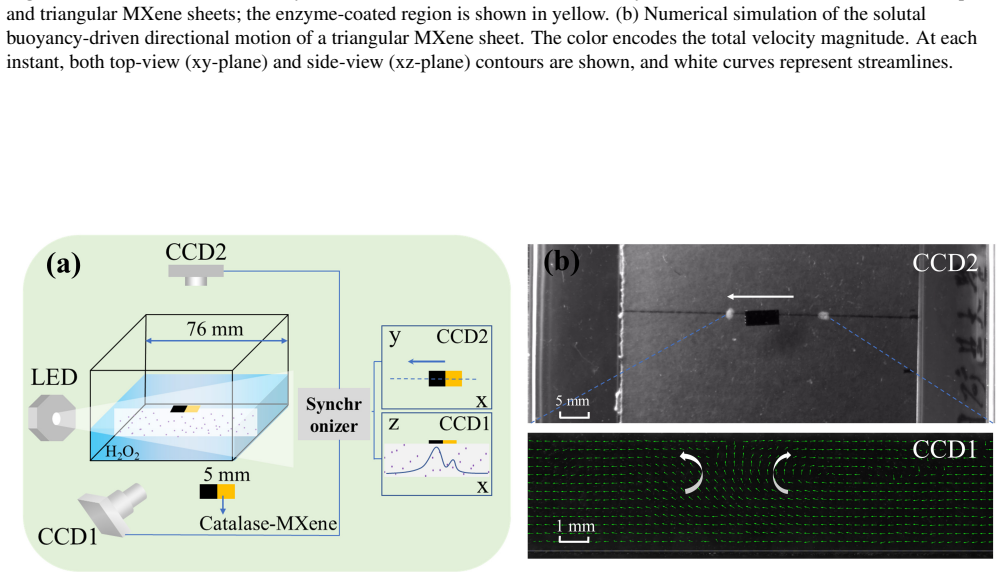


read the original abstract
Signal-driven motion is widespread in natural and artificial systems, yet quantitative characterization of how transient chemo-hydrodynamic waves are converted into mechanical driving forces remains limited. Here, we investigate the self-propulsion of a MXene sheet asymmetrically coated with catalase in hydrogen peroxide solution. By combining dual-view particle image velocimetry experiments and numerical simulations reveal that active motion of the sheet is driven by chemo-hydrodynamic waves and exhibits direct-wave motion, the driving force of which is analyzed in terms of the shear stress on the sheet surface caused by chemo-hydrodynamic waves. This work suggests theoretical principles for designing and controlling hydrodynamically driven active motion.
Editorial analysis
A structured set of objections, weighed in public.
Referee Report
Summary. The manuscript investigates the self-propulsion of an asymmetrically catalase-coated MXene sheet in hydrogen peroxide solution. It claims that the observed quasi-one-dimensional active motion is driven by chemo-hydrodynamic waves generated by the asymmetric coating, with the driving force quantified via analysis of surface shear stress; this is supported by dual-view particle image velocimetry (PIV) experiments and numerical simulations.
Significance. If the central claim holds, the work provides a quantitative characterization of how transient chemo-hydrodynamic waves are converted into mechanical propulsion forces in an active system. The combination of dual-view PIV for flow-field mapping and simulations for shear-stress computation is a methodological strength that directly tests the wave-driven mechanism against alternatives.
major comments (2)
- [Abstract] Abstract: The claim that propulsion arises primarily from chemo-hydrodynamic waves (rather than buoyancy, bubble recoil, or direct attachment) is load-bearing for the central result. While dual-view PIV and simulations are invoked to address this, the abstract provides no quantitative criteria (e.g., flow-field signatures or force-magnitude comparisons) used to exclude alternative mechanisms, leaving the shear-stress analysis's exclusivity unverified from the given summary.
- [Abstract] The manuscript states that PIV and simulations 'support the wave-driven claim,' but without reported details on data exclusion criteria, error propagation in shear-stress calculations, or simulation boundary conditions, it is difficult to assess whether the numerical-experimental agreement is robust enough to rule out confounding effects.
minor comments (2)
- [Abstract] The abstract uses both 'quasi-one-dimensional motion' (title) and 'direct-wave motion'; consistent terminology should be adopted and defined early in the text.
- Clarify whether the catalase coating asymmetry is quantified (e.g., via thickness or activity profile) and how this asymmetry directly maps to the observed wave propagation direction.
Simulated Author's Rebuttal
We thank the referee for their careful reading and constructive comments on our manuscript. We address each major comment below and have revised the abstract to incorporate the suggested quantitative details where appropriate.
read point-by-point responses
-
Referee: [Abstract] Abstract: The claim that propulsion arises primarily from chemo-hydrodynamic waves (rather than buoyancy, bubble recoil, or direct attachment) is load-bearing for the central result. While dual-view PIV and simulations are invoked to address this, the abstract provides no quantitative criteria (e.g., flow-field signatures or force-magnitude comparisons) used to exclude alternative mechanisms, leaving the shear-stress analysis's exclusivity unverified from the given summary.
Authors: We agree that the abstract would benefit from explicit mention of the quantitative criteria used to support the wave-driven mechanism. In the revised manuscript we will update the abstract to include brief references to the flow-field signatures (e.g., localized shear-stress peaks aligned with wave propagation) and force-magnitude comparisons (shear stress exceeding buoyancy and recoil contributions by more than an order of magnitude) that were obtained from the dual-view PIV data and simulations. revision: yes
-
Referee: [Abstract] The manuscript states that PIV and simulations 'support the wave-driven claim,' but without reported details on data exclusion criteria, error propagation in shear-stress calculations, or simulation boundary conditions, it is difficult to assess whether the numerical-experimental agreement is robust enough to rule out confounding effects.
Authors: The full manuscript reports these methodological details in the Methods section and Supplementary Information (data exclusion based on signal-to-noise thresholds, standard error propagation for wall-shear-stress integrals, and no-slip boundary conditions with periodic lateral boundaries in the simulations). To make this immediately clear from the abstract, we will add a concise clause directing readers to these sections while preserving the abstract's brevity. revision: yes
Circularity Check
No significant circularity detected
full rationale
The paper reports experimental dual-view PIV measurements combined with numerical simulations to map flow fields and compute surface shear stress from chemo-hydrodynamic waves. No derivation chain, equations, or fitted parameters are presented that reduce to self-definition, renamed predictions, or load-bearing self-citations. Claims rest on direct observation and independent simulation outputs rather than tautological constructions, making the analysis self-contained against external benchmarks.
Axiom & Free-Parameter Ledger
Reference graph
Works this paper leans on
-
[1]
Stuart, M. A. C.et al.Emerging applications of stimuli-responsive polymer materials.Nat. Mater.9, 101–113, DOI: https://doi.org/10.1038/nmat2614 (2010)
-
[2]
Brunetti, A. E.et al.An integrative omics perspective for the analysis of chemical signals in ecological interactions.Chem. Soc. Rev.47, 1574–1591, DOI: https://doi.org/10.1039/C7CS00368D (2018)
-
[3]
Kaspar, C., Ravoo, B. J., van der Wiel, W. G., Wegner, S. V . & Pernice, W. H. P. The rise of intelligent matter.Nature594, 345–355, DOI: 10.1038/s41586-021-03453-y (2021)
-
[4]
Walther, A. Viewpoint: From responsive to adaptive and interactive materials and materials systems: A roadmap.Adv. Mater.32, 1905111, DOI: https://doi.org/10.1002/adma.201905111 (2020)
-
[5]
Adv.6, DOI: https://doi.org/10.1126/sciadv.aaz9125 (2020)
Ren, L.et al.Chemomechanical origin of directed locomotion driven by internal chemical signals.Sci. Adv.6, DOI: https://doi.org/10.1126/sciadv.aaz9125 (2020)
-
[6]
Rev.124, 2553–2582, DOI: 10.1021/acs.chemrev.3c00681 (2024)
Ghosh, S.et al.Exploring emergent properties in enzymatic reaction networks: Design and control of dynamic functional systems.Chem. Rev.124, 2553–2582, DOI: 10.1021/acs.chemrev.3c00681 (2024)
-
[7]
Ren, L.et al.Autonomous reciprocating migration of an active material.Proc. Natl. Acad. Sci.114, 8704–8709, DOI: https://doi.org/10.1073/pnas.1704094114 (2017)
-
[8]
Yu, H.et al.Chiral locomotion transitions of an active gel and their chemomechanical origin.J. Am. Chem. Soc.147, 5182–5188, DOI: https://doi.org/10.1021/jacs.4c15550 (2025)
-
[9]
Palagi, S.et al.Structured light enables biomimetic swimming and versatile locomotion of photoresponsive soft microrobots. Nat. materials15, 647–653, DOI: https://doi.org/10.1038/nmat4569 (2016)
-
[10]
Small-scale soft- bodied robot with multimodal locomotion,
Hu, W., Lum, G. Z., Mastrangeli, M. & Sitti, M. Small-scale soft-bodied robot with multimodal locomotion.Nature554, 81–85, DOI: https://doi.org/10.1038/nature25443 (2018)
-
[11]
Lee, J. G., Brooks, A. M., Shelton, W. A., Bishop, K. J. M. & Bharti, B. Directed propulsion of spherical particles along three dimensional helical trajectories.Nat. Commun.10, 2575, DOI: https://doi.org/10.1038/s41467-019-10579-1 (2019)
-
[12]
Budroni, M. A. & Rossi, F. Transport-driven chemical oscillations: a review.Phys. Chem. Chem. Phys.26, 29185–29226, DOI: 10.1039/D4CP03466J (2024)
-
[14]
Suematsu, N. J. & Nakata, S. Evolution of self-propelled objects: From the viewpoint of nonlinear science.Chem. Eur. J. 24, 6308–6324, DOI: https://doi.org/10.1002/chem.201705171 (2018)
-
[15]
Nakata, S.et al.Periodic oscillatory motion of a self-propelled motor driven by decomposition of h2o2 by catalase. Angewandte Chemie Int. Ed.56, 861–864, DOI: https://doi.org/10.1002/anie.201609971 (2017)
-
[16]
Kumar, B. P., Patil, A. J. & Mann, S. Enzyme-powered motility in buoyant organoclay/dna protocells.Nat. chemistry10, 1154–1163, DOI: https://doi.org/10.1038/s42254-021-00395-2 (2018)
-
[17]
Pena-Francesch, A., Giltinan, J. & Sitti, M. Multifunctional and biodegradable self-propelled protein motors.Nat. communications10, 3188, DOI: https://doi.org/10.1038/s41467-019-11141-9 (2019)
-
[18]
V ., Agudo-Canalejo, J., Saha, S., Golestanian, R
Hokmabad, B. V ., Agudo-Canalejo, J., Saha, S., Golestanian, R. & Maass, C. C. Chemotactic self-caging in active emulsions.Proc. Natl. Acad. Sci.119, e2122269119, DOI: https://doi.org/10.1073/pnas.2122269119 (2022)
-
[19]
W.et al.Pen-drawn marangoni swimmer.Nat
Song, S. W.et al.Pen-drawn marangoni swimmer.Nat. Commun.14, 3597, DOI: https://doi.org/10.1038/ s41467-023-39186-x (2023)
2023
-
[20]
Kumar, M., Murali, A., Subramaniam, A. G., Singh, R. & Thutupalli, S. Emergent dynamics due to chemo-hydrodynamic self-interactions in active polymers.Nat. Commun.15, 4903, DOI: https://doi.org/10.1038/s41467-024-49155-7 (2024)
-
[21]
Holstein, L. R.et al.Reduction-induced self-propelled oscillatory motion of perylenediimides on water.Angewandte Chemie Int. Ed.63, e202410671, DOI: https://doi.org/10.1002/anie.202410671 (2024)
-
[22]
Nguindjel, A.-D. C., Franssen, S. C. M. & Korevaar, P. A. Reconfigurable droplet–droplet communication mediated by photochemical marangoni flows.J. Am. Chem. Soc.146, 6006–6015, DOI: https://doi.org/10.1021/jacs.3c12882 (2024)
-
[23]
Jamaluddin, S. J. S., Khaothong, K., Tinsley, M. R. & Showalter, K. Photochemical motion control of surface active belousov–zhabotinsky droplets.Chaos: An Interdiscip. J. Nonlinear Sci.30, 083143, DOI: https://doi.org/10.1063/5. 0016252 (2020). 7/25
work page doi:10.1063/5 2020
-
[24]
Ed.63, e202405287, DOI: https://doi.org/10.1002/anie.202405287 (2024)
Zhu, G.et al.On–off control of marangoni self-propulsion via a supra-amphiphile fuel and switch.Angewandte Chemie Int. Ed.63, e202405287, DOI: https://doi.org/10.1002/anie.202405287 (2024)
-
[25]
Adv.7, eabh3051, DOI: https://doi.org/10.1126/sciadv.abh3051 (2021)
Hou, K.et al.Programmable light-driven swimming actuators via wavelength signal switching.Sci. Adv.7, eabh3051, DOI: https://doi.org/10.1126/sciadv.abh3051 (2021)
-
[26]
Lin, H.et al.Electricity-driven strategies for bioinspired multifunctional swimming marangoni robots based on super- aligned carbon nanotube composites.Small20, 2400906, DOI: https://doi.org/10.1002/smll.202400906 (2024)
-
[27]
Tang, S.-Y .et al.Liquid metal actuator for inducing chaotic advection.Adv. Funct. Mater.24, 5851–5858, DOI: https://doi.org/10.1002/adfm.201400689 (2014)
-
[28]
Nakata, S.et al.Self-rotation of a camphor scraping on water: new insight into the old problem.Langmuir13, 4454–4458, DOI: https://doi.org/10.1021/la970196p (1997)
-
[29]
Dwivedi, P., Pillai, D. & Mangal, R. Self-propelled swimming droplets.Curr. Opin. Colloid Interface Sci.61, 101614, DOI: https://doi.org/10.1016/j.cocis.2022.101614 (2022)
-
[30]
Manna, R. K., Shklyaev, O. E. & Balazs, A. C. Chemical pumps and flexible sheets spontaneously form self-regulating oscillators in solution.Proc. Natl. Acad. Sci.118, e2022987118, DOI: https://doi.org/10.1073/pnas.2022987118 (2021)
-
[31]
Manna, R. K., Shklyaev, O. E. & Balazs, A. C. Chemically driven multimodal locomotion of active, flexible sheets. Langmuir39, 780–789, DOI: https://doi.org/10.1021/acs.langmuir.2c02666 (2023)
-
[32]
Song, J., Shklyaev, O. E., Sapre, A., Balazs, A. C. & Sen, A. Self-propelling macroscale sheets powered by enzyme pumps. Angewandte Chemie136, e202311556, DOI: https://doi.org/10.1002/anie.202311556 (2024)
-
[33]
Nakata, S.et al.Marangoni flow around a camphor disk regenerated by the interaction between camphor and sodium dodecyl sulfate molecules.Colloids Surfaces A: Physicochem. Eng. Aspects466, 40–44, DOI: https://doi.org/10.1016/j. colsurfa.2014.10.041 (2015)
work page doi:10.1016/j 2014
-
[34]
Patiño, T., Arqué, X., Mestre, R., Palacios, L. & Sánchez, S. Fundamental aspects of enzyme-powered micro- and nanoswimmers.Accounts Chem. Res.51, DOI: https://doi.org/10.1021/acs.accounts.8b00288 (2018)
-
[35]
Ma, X., Hortelão, A. C., Patiño, T. & Sánchez, S. Enzyme catalysis to power micro/nanomachines.ACS Nano10, 9111–9122, DOI: https://doi.org/10.1021/acsnano.6b04108 (2016)
-
[36]
Wang, X.et al.Mechanical nonreciprocity in a uniform composite material.Science380, 192–198, DOI: https: //doi.org/10.1126/science.adf1206 (2023)
-
[37]
Jiao, D., Zhu, Q. L., Li, C. Y ., Zheng, Q. & Wu, Z. L. Programmable morphing hydrogels for soft actuators and robots: from structure designs to active functions.Accounts Chem. Res.55, 1533–1545, DOI: https://doi.org/10.1021/acs.accounts. 2c00046 (2022)
-
[38]
Liu, T.et al.Controlled propulsion of micro/nanomotors: operational mechanisms, motion manipulation and potential biomedical applications.Chem. Soc. Rev.51, 10083–10119, DOI: 10.1039/D2CS00432A (2022)
-
[39]
Serra-Casablancas, M.et al.Catalase-powered nanobots for overcoming the mucus barrier.ACS Nano18, 16701–16714, DOI: 10.1021/acsnano.4c01760 (2024)
-
[40]
Mathesh, M., Sun, J. & Wilson, D. A. Enzyme catalysis powered micro/nanomotors for biomedical applications.J. Mater. Chem. B8, 7319–7334, DOI: 10.1039/D0TB01245A (2020)
-
[41]
Ghidiu, M., Lukatskaya, M. R., Zhao, M.-Q., Gogotsi, Y . & Barsoum, M. W. Conductive two-dimensional titanium carbide ‘clay’ with high volumetric capacitance.Nature516, 78–81, DOI: https://doi.org/10.1038/nature13970 (2014)
-
[42]
Reddy, N. K. & Clasen, C. Self-propelling micro-disks.Korea-Australia Rheol. J.26, 73–79, DOI: https://doi.org/10.1007/ s13367-014-0008-2 (2014)
2014
-
[43]
Valdez, L., Shum, H., Ortiz-Rivera, I., Balazs, A. C. & Sen, A. Solutal and thermal buoyancy effects in self-powered phosphatase micropumps.Soft Matter13, 2800–2807, DOI: https://doi.org/10.1039/C7SM00022G (2017)
-
[44]
Lai, J. H., del Alamo, J. C., Rodríguez-Rodríguez, J. & Lasheras, J. C. The mechanics of the adhesive locomotion of terrestrial gastropods.J. Exp. Biol.213, 3920–3933, DOI: https://doi.org/10.1242/jeb.046706 (2010)
-
[45]
Budroni, M., Upadhyay, V . & Rongy, L. Making a simple a+ b→ c reaction oscillate by coupling to hydrodynamic effect. Phys. review letters122, 244502, DOI: https://doi.org/10.1103/PhysRevLett.122.244502 (2019)
-
[46]
Deng, Z., Li, K., Priimagi, A. & Zeng, H. Light-steerable locomotion using zero-elastic-energy modes.Nat. Mater.23, 1728–1735, DOI: 10.1038/s41563-024-02026-4 (2024). 8/25
-
[47]
L.et al.Animating hydrogel knotbots with topology-invoked self-regulation.Nat
Zhu, Q. L.et al.Animating hydrogel knotbots with topology-invoked self-regulation.Nat. Commun.15, 300, DOI: 10.1038/s41467-023-44608-x (2024)
-
[48]
Lin, H., Wang, X., Yu, L., Chen, Y . & Shi, J. Two-dimensional ultrathin mxene ceramic nanosheets for photothermal conversion.Nano Lett.17, 384–391, DOI: 10.1021/acs.nanolett.6b04339 (2017). Doi: 10.1021/acs.nanolett.6b04339
-
[49]
Han, X.et al.2d ultrathin mxene-based drug-delivery nanoplatform for synergistic photothermal ablation and chemotherapy of cancer.Adv. Healthc. Mater.7, 1701394, DOI: https://doi.org/10.1002/adhm.201701394 (2018)
-
[50]
Caldarelli, P.et al.Self-organized tissue mechanics underlie embryonic regulation.Nature633, 887–894, DOI: 10.1038/ s41586-024-07934-8 (2024)
2024
-
[51]
Hannezo, E. & Heisenberg, C.-P. Mechanochemical feedback loops in development and disease.Cell178, 12–25, DOI: https://doi.org/10.1016/j.cell.2019.05.052 (2019)
-
[52]
Mater.29, 7633–7644, DOI: https://doi.org/10.1021/acs.chemmater.7b02847 (2017)
Alhabeb, M.et al.Guidelines for synthesis and processing of two-dimensional titanium carbide (ti3c2tx mxene).Chem. Mater.29, 7633–7644, DOI: https://doi.org/10.1021/acs.chemmater.7b02847 (2017)
-
[53]
Qiao, Q.et al.A cascaded enzyme system based on the catalase-like activity of ti3c2tx mxene nanosheets for the efficient combination cancer therapy.Nano Today54, 102059, DOI: https://doi.org/10.1016/j.nantod.2023.102059 (2024)
-
[54]
Ling, Z.et al.Flexible and conductive mxene films and nanocomposites with high capacitance.Proc. Natl. Acad. Sci.111, 16676–16681, DOI: https://doi.org/10.1073/pnas.1414215111 (2014)
-
[55]
Song, J.et al.Programming fluid motion using multi-enzyme micropump systems.ACS Appl. Mater. & Interfaces16, 45660–45670, DOI: 10.1021/acsami.4c07865 (2024). LaTeX formats citations and references automatically using the bibliography records in your .bib file, which you can edit via the project menu. Use the cite command for an inline citation, e.g.?. For...
discussion (0)
Sign in with ORCID, Apple, or X to comment. Anyone can read and Pith papers without signing in.