Machine learning metallic glass critical cooling rates through elemental and molecular simulation based featurization
Pith reviewed 2026-06-26 13:53 UTC · model grok-4.3
The pith
A machine learning model predicts critical cooling rates for metallic glasses using one elemental entropy feature and three simulation-derived features, achieving R² of 0.78.
A machine-rendered reading of the paper's core claim, the machinery that carries it, and where it could break.
Core claim
The best-performing model for critical cooling rates is learned from one elemental-property feature (ideal entropy from stoichiometry) and three features from molecular dynamics simulations (energy above the convex hull, heat-capacity change, and fraction of icosahedra-like Voronoi polyhedra), reaching R² = 0.78 and MAE = 0.76 log10(K/s) under repeated leave-one-chemical-system-out cross-validation across 34 alloys from 20 systems.
What carries the argument
Machine learning regression trained on ideal entropy together with three molecular-dynamics-derived descriptors (energy above convex hull, heat capacity change, icosahedra Voronoi fraction).
If this is right
- The same feature-extraction and modeling pipeline can be applied to high-throughput screening of other material properties for alloys of varying compositions.
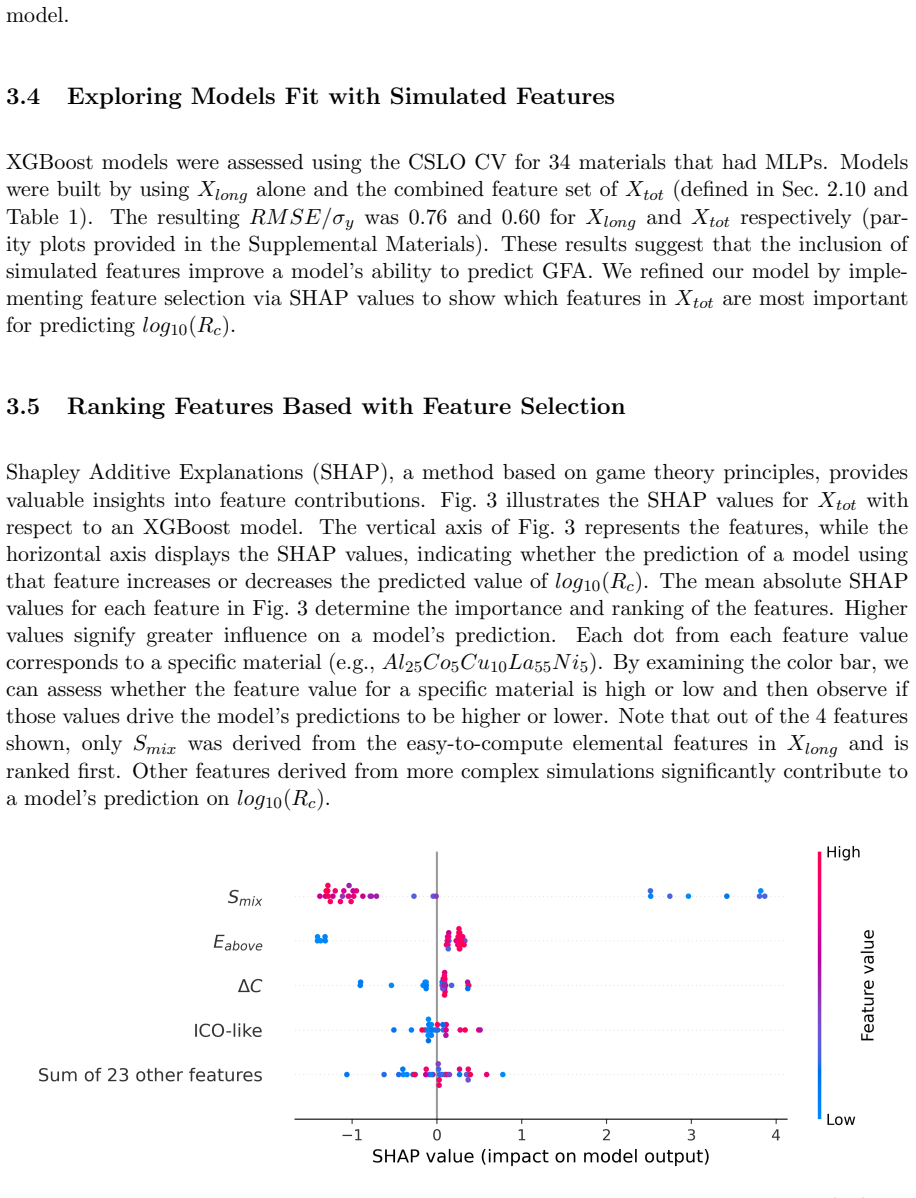
- Shapley additive explanations confirm that the selected features influence predictions in directions consistent with known physical roles in glass formation.
- The cross-validation protocol that excludes entire chemical systems provides a realistic estimate of performance on new alloy families.
- Combining one cheap elemental descriptor with a small number of simulation descriptors yields better accuracy than either class of features alone.
Where Pith is reading between the lines
- If the simulation features remain reliable, the model could be used to rank candidate alloys for glass-forming ability before any experiment is performed.
- The emphasis on icosahedral order and energy above the hull suggests that local structural motifs and thermodynamic stability are key drivers captured by the simulations.
- Extending the approach to additional simulation observables, such as diffusion constants or elastic moduli, might further reduce prediction error for new chemical systems.
Load-bearing premise
Features taken from ab initio, machine-learning-potential, and empirical-potential simulations are accurate enough and comparable to one another to serve as reliable inputs for experimental critical cooling rates across many chemical systems.
What would settle it
Measure the experimental critical cooling rate for an alloy outside the training chemical systems and check whether the model's prediction falls within 0.76 log10(K/s) of that measured value.
Figures



read the original abstract
We have developed a machine learning model for critical cooling rates for metallic glasses based on computational properties. We compare results for features derived from easy-to-compute functions of elemental properties to more complex physically motivated properties using ab initio, machine-learning potentials, and empirical potential molecular dynamics methods. The established approach enables property acquisition across a diverse range of alloys. Analysis of various features for 34 alloys from 20 chemical systems shows that the best model for critical cooling rates was learned from one elemental property-based feature and three simulated features. The elemental property-based feature is an ideal entropy value based on alloy stoichiometry. The simulated features were acquired from estimates of energies above the convex hull, changes in heat capacity, and the fraction of icosahedra-like Voronoi polyhedra. Models were assessed through a demanding cross validation test based on repeatedly leaving out full chemical systems as test sets and had an $R^2$ of 0.78 and a mean average error of 0.76 in units of $[log_{10}(K/s)]$. We demonstrate with Shapley additive explanation analysis that the most impactful features have physically reasonable influence on model predictions. The established methodology can be applied to other high-throughput studies of material properties of diverse compositions.
Editorial analysis
A structured set of objections, weighed in public.
Referee Report
Summary. The manuscript develops a machine learning model for predicting critical cooling rates of metallic glasses. It compares elemental-property features (including an ideal entropy based on alloy stoichiometry) against simulation-derived features obtained from ab initio calculations, machine-learning potentials, and empirical-potential molecular dynamics. The best model combines the entropy feature with three simulation quantities (energies above the convex hull, changes in heat capacity, and the fraction of icosahedra-like Voronoi polyhedra). On a set of 34 alloys spanning 20 chemical systems, a leave-one-chemical-system-out cross-validation yields R² = 0.78 and MAE = 0.76 in units of log10(K/s). SHAP analysis is used to confirm that the dominant features exert physically reasonable influence on the predictions.
Significance. If the reported performance holds under the grouped cross-validation protocol, the work supplies a practical route to estimate a technologically relevant but experimentally demanding quantity (critical cooling rate) from a small set of physically motivated computational descriptors. The leave-one-chemical-system-out validation is a clear methodological strength because it enforces generalization across distinct chemistries rather than within them. The explicit physical motivation of the chosen features together with the SHAP interpretability analysis further strengthens the contribution and supports extensibility to other high-throughput materials problems.
major comments (2)
- [Methods] Methods: The manuscript provides no description of how the three simulation-derived features (energies above the convex hull, heat-capacity changes, and icosahedra fractions) obtained from ab initio, machine-learning-potential, and empirical-potential molecular-dynamics runs were standardized or scaled to ensure numerical comparability before being combined in the regression model. This detail is load-bearing for the validity of the reported R² = 0.78 and MAE = 0.76.
- [Results] Results: The cross-validation performance metrics (R² = 0.78, MAE = 0.76) are reported without error bars, standard deviations across folds, or any uncertainty quantification, which limits assessment of the stability of the quoted figures under the leave-one-chemical-system-out protocol.
minor comments (2)
- [Abstract] Abstract: The phrase 'mean average error' should be replaced by the conventional term 'mean absolute error' for clarity.
- The manuscript would benefit from an explicit statement of the regression algorithm (e.g., random forest, gradient boosting) and any hyperparameter selection procedure used to obtain the final model.
Simulated Author's Rebuttal
We thank the referee for their positive assessment of the work's significance and for the constructive major comments. We address each point below and will revise the manuscript to incorporate the requested clarifications and additional reporting.
read point-by-point responses
-
Referee: [Methods] Methods: The manuscript provides no description of how the three simulation-derived features (energies above the convex hull, heat-capacity changes, and icosahedra fractions) obtained from ab initio, machine-learning-potential, and empirical-potential molecular-dynamics runs were standardized or scaled to ensure numerical comparability before being combined in the regression model. This detail is load-bearing for the validity of the reported R² = 0.78 and MAE = 0.76.
Authors: We agree that an explicit description of feature preprocessing is necessary. All features (elemental and simulation-derived) were standardized to zero mean and unit variance using statistics computed exclusively from the training portion of each leave-one-chemical-system-out fold. This was implemented to ensure numerical comparability without introducing leakage. We will add a dedicated paragraph in the Methods section detailing this procedure, including the exact scaling method and confirmation that it was applied fold-wise. revision: yes
-
Referee: [Results] Results: The cross-validation performance metrics (R² = 0.78, MAE = 0.76) are reported without error bars, standard deviations across folds, or any uncertainty quantification, which limits assessment of the stability of the quoted figures under the leave-one-chemical-system-out protocol.
Authors: We acknowledge that reporting variability across folds would improve the assessment of result stability. In the revised manuscript we will add the standard deviation of both R² and MAE computed across the 20 chemical-system folds, together with a brief discussion of the observed variability. This will be presented alongside the mean values already reported. revision: yes
Circularity Check
No significant circularity in derivation chain
full rationale
The paper applies standard supervised regression (R²=0.78, MAE=0.76 log10(K/s)) to predict experimental critical cooling rates from four externally computed features: one stoichiometry-derived ideal entropy and three simulation-derived quantities (energy above hull, heat capacity change, icosahedral fraction). Validation uses grouped cross-validation that holds out entire chemical systems. No equations, fitted parameters, or self-citations reduce the target to a constructed input; features are obtained independently via ab initio/ML/empirical MD and stoichiometry. The pipeline is self-contained against external benchmarks with no load-bearing self-referential steps.
Axiom & Free-Parameter Ledger
axioms (2)
- domain assumption Simulation-derived quantities (energies above hull, heat capacity changes, Voronoi polyhedra fractions) accurately capture the physics relevant to critical cooling rates
- domain assumption Leave-one-chemical-system-out cross-validation provides a sufficient test of generalization to unseen alloys
Reference graph
Works this paper leans on
-
[1]
Recent advances in bulk metallic glasses for biomedical appli- cations,
H. F. Li and Y. F. Zheng, “Recent advances in bulk metallic glasses for biomedical appli- cations,” 2016,issn: 18787568.doi:10.1016/j.actbio.2016.03.047
-
[2]
A Critical Review on Metallic Glasses as Structural Materials for Cardiovascular Stent Applications,
M. Jafary-Zadeh, G. Praveen Kumar, P. Branicio, M. Seifi, J. Lewandowski, and F. Cui, “A Critical Review on Metallic Glasses as Structural Materials for Cardiovascular Stent Applications,”Journal of Functional Biomaterials, vol. 9, no. 1, p. 19, 2018,issn: 2079- 4983.doi:10 . 3390 / jfb9010019[Online]. Available:http : / / www . mdpi . com / 2079 - 4983/9/1/19
2018
-
[3]
Modern soft magnets: Amorphous and nanocrystalline materials,
G. Herzer, “Modern soft magnets: Amorphous and nanocrystalline materials,”Acta Ma- terialia, vol. 61, no. 3, pp. 718–734, Feb. 2013,issn: 1359-6454.doi:10.1016/J.ACTAMAT. 2012.10.040[Online]. Available:https://www.sciencedirect.com/science/article/ pii/S1359645412007872?via%3Dihub
-
[4]
W. Wang, C. Dong, and C. Shek, “Bulk metallic glasses,”Materials Science and Engi- neering: R: Reports, vol. 44, no. 2, pp. 45–89, 2004,issn: 0927-796X.doi:https://doi. org/10.1016/j.mser.2004.03.001[Online]. Available:https://www.sciencedirect. com/science/article/pii/S0927796X04000300
-
[6]
Exploration of characteristic temperature contributions to metallic glass forming ability,
L. E. Schultz, B. Afflerbach, C. Francis, P. M. Voyles, I. Szlufarska, and D. Morgan, “Exploration of characteristic temperature contributions to metallic glass forming ability,” Computational Materials Science, vol. 196, p. 110 494, 2021,issn: 0927-0256.doi:https: //doi.org/10.1016/j.commatsci.2021.110494[Online]. Available:https://www. sciencedirect.com...
-
[7]
Quantifying the origin of metallic glass formation,
W. L. Johnson, J. H. Na, and M. D. Demetriou, “Quantifying the origin of metallic glass formation,”Nature Communications, vol. 7, no. 1, p. 10 313, Dec. 2016,issn: 20411723. doi:10.1038/ncomms10313[Online]. Available:http://www.nature.com/articles/ ncomms10313
-
[8]
Predicting metallic glass for- mation from properties of the high temperature liquid,
R. Dai, R. Ashcraft, A. K. Gangopadhyay, and K. F. Kelton, “Predicting metallic glass for- mation from properties of the high temperature liquid,”Journal of Non-Crystalline Solids, vol. 525, no. October, p. 119 673, 2019,issn: 00223093.doi:10.1016/j.jnoncrysol. 2019.119673[Online]. Available:https://doi.org/10.1016/j.jnoncrysol.2019. 119673
-
[9]
A. Jaiswal, T. Egami, K. F. Kelton, K. S. Schweizer, and Y. Zhang, “Correlation between Fragility and the Arrhenius Crossover Phenomenon in Metallic, Molecular, and Network Liquids,” 2016.doi:10 . 1103 / PhysRevLett . 117 . 205701[Online]. Available:https : //journals.aps.org/prl/pdf/10.1103/PhysRevLett.117.205701
-
[10]
Fragility and Vogel-Fulcher-Tammann parameters near glass tran- sition temperature,
Q. Gao and Z. Jian, “Fragility and Vogel-Fulcher-Tammann parameters near glass tran- sition temperature,”Materials Chemistry and Physics, vol. 252, no. May, p. 123 252, 2020,issn: 02540584.doi:10.1016/j.matchemphys.2020.123252[Online]. Available: https://doi.org/10.1016/j.matchemphys.2020.123252
-
[11]
Formation of Glasses from Liquids and Biopolymers,
A. C. Angell, “Formation of Glasses from Liquids and Biopolymers,”Science, vol. 267, no. 5206, pp. 1924–1935, 1995.doi:10.1126/science.267.5206.1924[Online]. Avail- able:papers2://publication/uuid/46ED95A9-CC48-4242-A7C5-9438976B8C42 21
-
[12]
A. Gangopadhyay and K. Kelton, “Recent progress in understanding high temperature dynamical properties and fragility in metallic liquids, and their connection with atomic structure,”Journal of Materials Research, vol. 32, pp. 2638–2657, 14 Jul. 2017,issn: 0884- 2914.doi:10.1557/jmr.2017.253[Online]. Available:https://www.cambridge.org/ core/product/identi...
-
[13]
Space and Space-Time Topologies in a Type-II Hyperbolic Lattice
S. A. Kube et al., “Compositional dependence of the fragility in metallic glass forming liquids,”Nature Communications, vol. 13, no. 1, p. 3708, Dec. 2022,issn: 2041-1723. doi:10.1038/s41467- 022- 31314- 3[Online]. Available:https://www.nature.com/ articles/s41467-022-31314-3
-
[14]
T. Long, Z. Long, and Z. Peng, “Rational design and glass-forming ability prediction of bulk metallic glasses via interpretable machine learning,”Journal of Materials Science, vol. 58, no. 21, pp. 8833–8844, May 2023,issn: 15734803.doi:10.1007/s10853- 023- 08528 - x[Online]. Available:https : / / link . springer . com / 10 . 1007 / s10853 - 023 - 08528-x
-
[15]
A machine learning approach for engineering bulk metallic glass alloys,
L. Ward, S. C. O’Keeffe, J. Stevick, G. R. Jelbert, M. Aykol, and C. Wolverton, “A machine learning approach for engineering bulk metallic glass alloys,”Acta Materialia, vol. 159, pp. 102–111, 2018,issn: 1359-6454.doi:https : / / doi . org / 10 . 1016 / j . actamat.2018.08.002[Online]. Available:https://www.sciencedirect.com/science/ article/pii/S1359645418306268
2018
-
[16]
Chemistry of Materials36(8), 3490–3495 (2024) https://doi.org/10.1021/acs.chemmater
B. T. Afflerbach et al., “Machine Learning Prediction of the Critical Cooling Rate for Metallic Glasses from Expanded Datasets and Elemental Features,”Chemistry of Materi- als, acs.chemmater.1c03542, Mar. 2022,issn: 0897-4756.doi:10.1021/acs.chemmater. 1c03542[Online]. Available:https://pubs.acs.org/doi/10.1021/acs.chemmater. 1c03542
-
[17]
Multi-modal contrastive learning of urban space representations from POI data
R. Jacobs et al., “The materials simulation toolkit for machine learning (mast-ml): An automated open source toolkit to accelerate data-driven materials research,”Computa- tional Materials Science, vol. 176, October 2019 2020,issn: 09270256.doi:10.1016/j. commatsci.2020.109544
work page doi:10.1016/j 2019
-
[18]
Machine learning versus human learning in predicting glass-forming ability of metallic glasses,
G. Liu et al., “Machine learning versus human learning in predicting glass-forming ability of metallic glasses,”Acta Materialia, vol. 243, Jan. 2023,issn: 13596454.doi:10.1016/ j.actamat.2022.118497
arXiv 2023
-
[19]
Are hints about glass forming ability hidden in the liquid structure?
J. Wang, A. Agrawal, and K. Flores, “Are hints about glass forming ability hidden in the liquid structure?”Acta Materialia, vol. 171, pp. 163–169, Jun. 2019,issn: 13596454.doi: 10.1016/j.actamat.2019.04.001
-
[20]
Using characteristic structural motifs in metallic liquids to predict glass forming ability,
W. P. Weeks and K. M. Flores, “Using characteristic structural motifs in metallic liquids to predict glass forming ability,”Intermetallics, vol. 145, Jun. 2022,issn: 09669795.doi: 10.1016/j.intermet.2022.107560
-
[21]
On the role of sm in solidifica- tion of al-sm metallic glasses,
G. B. Bokas, L. Zhao, J. H. Perepezko, and I. Szlufarska, “On the role of sm in solidifica- tion of al-sm metallic glasses,”Scripta Materialia, vol. 124, pp. 99–102, Nov. 2016,issn: 13596462.doi:10.1016/j.scriptamat.2016.06.045
-
[22]
Syn- thesis of sm–al metallic glasses designed by molecular dynamics simulations,
G. B. Bokas, Y. Shen, L. Zhao, H. W. Sheng, J. H. Perepezko, and I. Szlufarska, “Syn- thesis of sm–al metallic glasses designed by molecular dynamics simulations,”Journal of Materials Science, vol. 53, pp. 11 488–11 499, 16 Aug. 2018,issn: 15734803.doi:10.1007/ s10853-018-2393-2
2018
-
[23]
B. T. Afflerbach, L. Schultz, J. H. Perepezko, P. M. Voyles, I. Szlufarska, and D. Morgan, “Molecular simulation-derived features for machine learning predictions of metal glass forming ability,”Computational Materials Science, vol. 199, Nov. 2021,issn: 09270256. doi:10.1016/j.commatsci.2021.110728 22
-
[24]
Molecular dynamic character- istic temperatures for predicting metallic glass forming ability,
L. E. Schultz, B. Afflerbach, I. Szlufarska, and D. Morgan, “Molecular dynamic character- istic temperatures for predicting metallic glass forming ability,”Computational Materials Science, vol. 201, p. 110 877, 2022,issn: 0927-0256.doi:https://doi.org/10.1016/ j . commatsci . 2021 . 110877[Online]. Available:https : / / www . sciencedirect . com / science...
2022
-
[25]
Performance and cost assessment of machine learning interatomic poten- tials,
Y. Zuo et al., “Performance and cost assessment of machine learning interatomic poten- tials,”Journal of Physical Chemistry A, vol. 124, pp. 731–745, 4 2020,issn: 15205215. doi:10.1021/acs.jpca.9b08723
-
[26]
The mlip package: Moment tensor potentials with mpi and active learning,
I. S. Novikov, K. Gubaev, E. V. Podryabinkin, and A. V. Shapeev, “The mlip package: Moment tensor potentials with mpi and active learning,”Machine Learning: Science and Technology, vol. 2, p. 025 002, 2 2021,issn: 2632-2153.doi:10.1088/2632-2153/abc9fe
-
[27]
A unified approach to interpreting model predictions,
S. M. Lundberg and S.-I. Lee, “A unified approach to interpreting model predictions,” inAdvances in Neural Information Processing Systems 30, I. Guyon et al., Eds., Curran Associates, Inc., 2017, pp. 4765–4774. [Online]. Available:http : / / papers . nips . cc / paper/7062-a-unified-approach-to-interpreting-model-predictions.pdf
2017
-
[28]
Scikit-learn: Machine learning in Python,
F. Pedregosa et al., “Scikit-learn: Machine learning in Python,”Journal of Machine Learn- ing Research, vol. 12, pp. 2825–2830, 2011
2011
-
[29]
Ab initio molecular dynamics for liquid metals,
G. Kresse and J. Hafner, “Ab initio molecular dynamics for liquid metals,”Phys. Rev. B, vol. 47, pp. 558–561, 1 Jan. 1993.doi:10.1103/PhysRevB.47.558[Online]. Available: https://link.aps.org/doi/10.1103/PhysRevB.47.558
-
[30]
A. P. Thompson et al., “LAMMPS - a flexible simulation tool for particle-based materials modeling at the atomic, meso, and continuum scales,”Comp. Phys. Comm., vol. 271, p. 108 171, 2022.doi:10.1016/j.cpc.2021.108171
-
[31]
A. Stukowski, “Visualization and analysis of atomistic simulation data with ovito-the open visualization tool,”Modelling and Simulation in Materials Science and Engineering, vol. 18, 1 2010,issn: 09650393.doi:10.1088/0965-0393/18/1/015012
-
[32]
M. P. Polak and D. Morgan, “Extracting accurate materials data from research papers with conversational language models and prompt engineering,”Nature Communications, vol. 15, 1 Dec. 2024,issn: 20411723.doi:10.1038/s41467-024-45914-8
-
[33]
M. P. Polak et al., “Flexible, model-agnostic method for materials data extraction from text using general purpose language models,” 2023. arXiv:2302.04914 [cond-mat.mtrl-sci]
arXiv 2023
-
[34]
P. M. Voyles, L. E. Schultz, D. Morgan, C. Francis, B. Afflerbach, and A. Hakeem,Metallic glasses and their properties, Data set.doi:10 . 18126 / 7yg1 - osf2[Online]. Available: https://foundry-ml.org/#/datasets/10.18126%2F7yg1-osf2
-
[35]
H. Sheng. [Online]. Available:https://sites.google.com/site/eampotentials/
-
[36]
Relating dynamic properties to atomic structure in metallic glasses,
H. W. Sheng, E. Ma, and M. J. Kramer, “Relating dynamic properties to atomic structure in metallic glasses,”JOM, vol. 64, no. 7, pp. 856–881, Jul. 2012,issn: 1543-1851.doi: 10.1007/s11837-012-0360-y[Online]. Available:https://doi.org/10.1007/s11837- 012-0360-y
-
[37]
Highly opti- mized embedded-atom-method potentials for fourteen fcc metals,
H. W. Sheng, M. J. Kramer, A. Cadien, T. Fujita, and M. W. Chen, “Highly opti- mized embedded-atom-method potentials for fourteen fcc metals,”Phys. Rev. B, vol. 83, p. 134 118, 13 Apr. 2011.doi:10.1103/PhysRevB.83.134118[Online]. Available:https: //link.aps.org/doi/10.1103/PhysRevB.83.134118
-
[38]
Atomic level structure in multicomponent bulk metallic glass,
Y. Q. Cheng, E. Ma, and H. W. Sheng, “Atomic level structure in multicomponent bulk metallic glass,”Phys. Rev. Lett., vol. 102, p. 245 501, 24 Jun. 2009.doi:10 . 1103 / PhysRevLett.102.245501[Online]. Available:https://link.aps.org/doi/10.1103/ PhysRevLett.102.245501 23
2009
-
[39]
Coupling between chemical and dynamic heterogeneities in a multicomponent bulk metallic glass,
T. Fujita, P. F. Guan, H. W. Sheng, A. Inoue, T. Sakurai, and M. W. Chen, “Coupling between chemical and dynamic heterogeneities in a multicomponent bulk metallic glass,” Phys. Rev. B, vol. 81, p. 140 204, 14 Apr. 2010.doi:10 . 1103 / PhysRevB . 81 . 140204 [Online]. Available:https://link.aps.org/doi/10.1103/PhysRevB.81.140204
-
[40]
Y. Q. Cheng, H. W. Sheng, and E. Ma, “Relationship between structure, dynamics, and mechanical properties in metallic glass-forming alloys,”Phys. Rev. B, vol. 78, p. 014 207, 1 Jul. 2008.doi:10.1103/PhysRevB.78.014207[Online]. Available:https://link.aps. org/doi/10.1103/PhysRevB.78.014207
-
[41]
Q.-J. Li, H. Sheng, and E. Ma, “Strengthening in multi-principal element alloys with local-chemical-order roughened dislocation pathways,”Nature Communications, vol. 10, no. 1, p. 3563, Aug. 2019,issn: 2041-1723.doi:10.1038/s41467-019-11464-7[Online]. Available:https://doi.org/10.1038/s41467-019-11464-7
-
[42]
Sheng,Pdsi potential table,https : / / sites
H. Sheng,Pdsi potential table,https : / / sites . google . com / site / eampotentials / table/pdsi?authuser=0
-
[43]
C. F. Jekel and G. Venter,pwlf: a python library for fitting 1d continuous piecewise linear functions, 2019. [Online]. Available:https://github.com/cjekel/piecewise_linear_ fit_py
2019
-
[44]
The random first-order transition theory of glasses: A critical assessment,
G. Biroli and J. P. Bouchaud, “The random first-order transition theory of glasses: A critical assessment,” 2009. arXiv:0912.2542 [cond-mat.dis-nn]
Pith/arXiv arXiv 2009
-
[45]
Rapaport,The Art of Molecular Dynamics Simulation
D. Rapaport,The Art of Molecular Dynamics Simulation. Cambridge University Press, 2007,isbn: 9780521825689
2007
-
[46]
Dynamical, structural and chemical heterogeneities in a binary metallic glass-forming liquid,
F. Puosi, N. Jakse, and A. Pasturel, “Dynamical, structural and chemical heterogeneities in a binary metallic glass-forming liquid,”Journal of Physics Condensed Matter, vol. 30, no. 14, Mar. 2018,issn: 1361648X.doi:10.1088/1361-648X/aab110
-
[47]
Viscosity of glass- forming liquids,
J. C. Mauro, Y. Yue, A. J. Ellison, P. K. Gupta, and D. C. Allan, “Viscosity of glass- forming liquids,” 2009
2009
-
[48]
R. M. Reis et al., “Relationship between viscous dynamics and the configurational thermal expansion coefficient of glass-forming liquids,”Journal of Non-Crystalline Solids, vol. 358, pp. 648–651, 3 2012,issn: 00223093.doi:10.1016/j.jnoncrysol.2011.11.029[Online]. Available:http://dx.doi.org/10.1016/j.jnoncrysol.2011.11.029
-
[49]
Hydrogen Bonding Slows Down Surface Diffusion of Molecular Glasses,
Y. Chen, W. Zhang, and L. Yu, “Hydrogen Bonding Slows Down Surface Diffusion of Molecular Glasses,”Journal of Physical Chemistry B, vol. 120, no. 32, pp. 8007–8015, 2016,issn: 15205207.doi:10.1021/acs.jpcb.6b05658
-
[50]
A. Jain et al., “The Materials Project: A materials genome approach to accelerating materials innovation,”APL Materials, vol. 1, no. 1, p. 11 002, 2013,issn: 2166532X.doi: 10.1063/1.4812323[Online]. Available:http://link.aip.org/link/AMPADS/v1/i1/ p011002/s1%5C&Agg=doi
-
[51]
A general-purpose machine learning framework for predicting properties of inorganic materials,
L. Ward, A. Agrawal, A. Choudhary, and C. Wolverton, “A general-purpose machine learning framework for predicting properties of inorganic materials,”npj Computational Materials, vol. 2, no. 1, p. 16 028, 2016,issn: 2057-3960.doi:10.1038/npjcompumats. 2016.28[Online]. Available:https://doi.org/10.1038/npjcompumats.2016.28
-
[52]
T. Chen and C. Guestrin, “Xgboost: A scalable tree boosting system,” inProceedings of the 22nd ACM SIGKDD International Conference on Knowledge Discovery and Data Mining, ser. KDD ’16, ACM, Aug. 2016.doi:10 . 1145 / 2939672 . 2939785[Online]. Available:http://dx.doi.org/10.1145/2939672.2939785
-
[53]
Machine learning design of perovskite catalytic properties,
R. Jacobs, J. Liu, H. Abernathy, and D. Morgan, “Machine learning design of perovskite catalytic properties,”Advanced Energy Materials, 2024,issn: 16146840.doi:10.1002/ aenm.202303684 24
2024
-
[54]
Atomic-level structure and structure–property relationship in metallic glasses,
Y. Cheng and E. Ma, “Atomic-level structure and structure–property relationship in metallic glasses,”Progress in Materials Science, vol. 56, no. 4, pp. 379–473, 2011,issn: 0079-6425.doi:https://doi.org/10.1016/j.pmatsci.2010.12.002[Online]. Avail- able:https://www.sciencedirect.com/science/article/pii/S0079642510000691
-
[55]
A brief overview of bulk metallic glasses,
M. Chen, “A brief overview of bulk metallic glasses,”NPG Asia Materials, vol. 3, no. 9, pp. 82–90, Sep. 2011,issn: 1884-4057.doi:10.1038/asiamat.2011.30[Online]. Avail- able:https://doi.org/10.1038/asiamat.2011.30
-
[56]
J. Xi et al., “Microalloying effect in ternary al-sm-x (x=ag, au, cu) metallic glasses studied by ab initio molecular dynamics,”Computational Materials Science, vol. 185, p. 109 958, 2020,issn: 0927-0256.doi:https://doi.org/10.1016/j.commatsci.2020. 109958[Online]. Available:https://www.sciencedirect.com/science/article/pii/ S0927025620304493
-
[57]
Full icosahedra dominate local order in cu64zr34 metallic glass and supercooled liquid,
J. Ding, Y.-Q. Cheng, and E. Ma, “Full icosahedra dominate local order in cu64zr34 metallic glass and supercooled liquid,”Acta Materialia, vol. 69, pp. 343–354, 2014,issn: 1359-6454.doi:https://doi.org/10.1016/j.actamat.2014.02.005[Online]. Avail- able:https://www.sciencedirect.com/science/article/pii/S1359645414000858
-
[58]
M. I. Mendelev, Y. Sun, F. Zhang, C. Z. Wang, and K. M. Ho, “Development of a semi- empirical potential suitable for molecular dynamics simulation of vitrification in Cu-Zr alloys,”The Journal of Chemical Physics, vol. 151, no. 21, p. 214 502, Dec. 2019,issn: 0021-9606.doi:10.1063/1.5131500eprint:https://pubs.aip.org/aip/jcp/article- pdf/doi/10.1063/1.513...
work page doi:10.1063/1.5131500eprint:https://pubs.aip.org/aip/jcp/article- 2019
discussion (0)
Sign in with ORCID, Apple, or X to comment. Anyone can read and Pith papers without signing in.