Globally Charged Vacuum Decay
Pith reviewed 2026-06-26 13:38 UTC · model grok-4.3
The pith
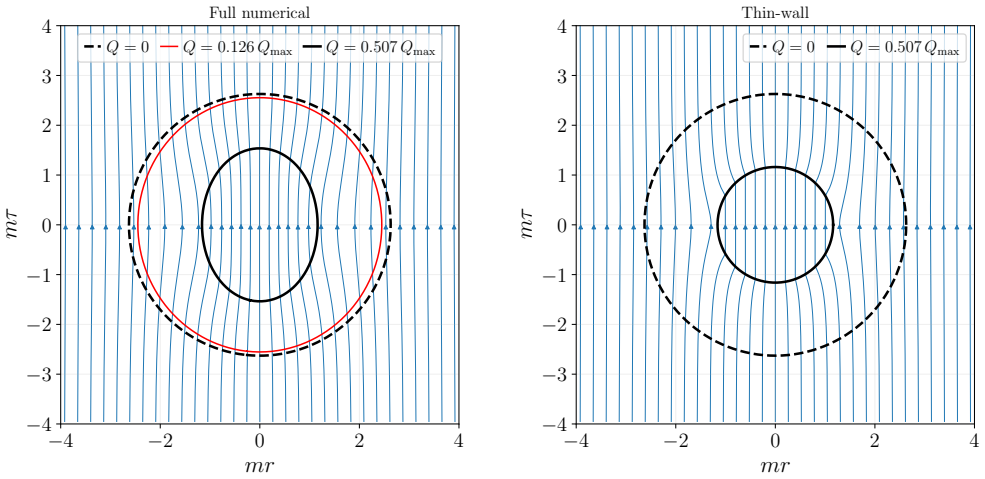
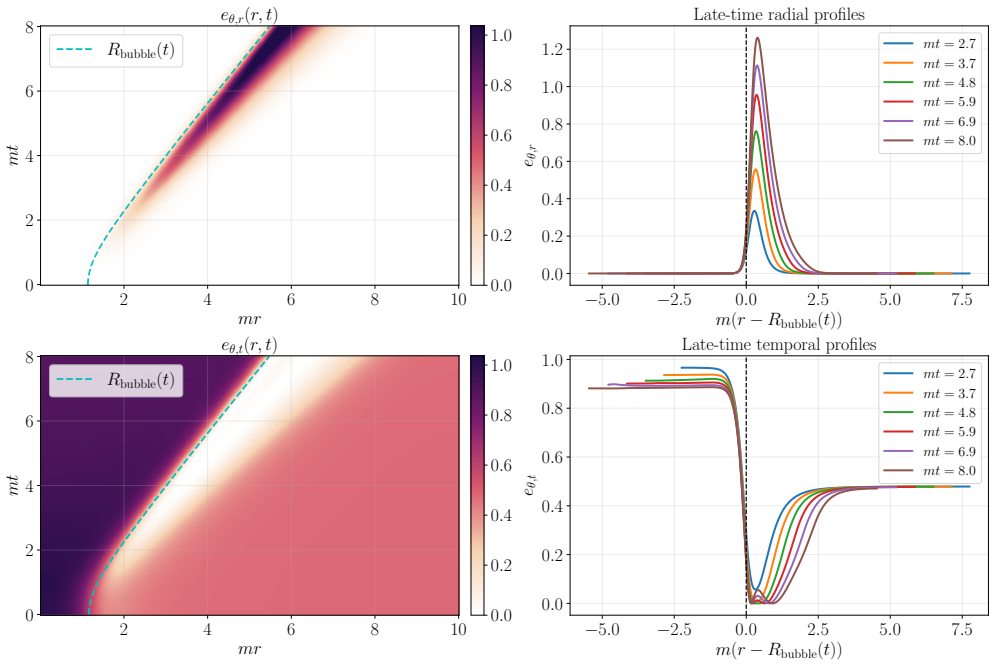
Finite global charge breaks O(4) symmetry of the vacuum decay bounce, lowers the barrier, raises the rate, and caps bubble expansion below light speed.
A machine-rendered reading of the paper's core claim, the machinery that carries it, and where it could break.
Core claim
For a U(1) global symmetry the decay of a homogeneous charged medium proceeds via a real two-dimensional PDE whose solution is a non-O(4)-symmetric bounce. This configuration reduces the barrier height relative to the neutral case and therefore increases the decay rate. Analytic continuation to Minkowski space shows that phase gradients required to rearrange charge around the expanding wall impose an energy cost that drives the bubble to a constant subluminal terminal velocity even in vacuum. The fixed-charge construction is shown to interface consistently with finite-temperature and finite-chemical-potential formulations.
What carries the argument
The real two-field Euclidean formulation obtained by rewriting the complex saddle that arises from twisted boundary conditions in the fixed-charge sector.
If this is right
- Decay rate increases with charge density.
- Bounce solutions lose O(4) symmetry.
- Bubbles reach a terminal velocity below the speed of light.
- The construction remains consistent with finite-temperature and finite-chemical-potential limits.
Where Pith is reading between the lines
- The mechanism implies that charged metastable vacua have shorter lifetimes than their neutral counterparts.
- Similar two-field reformulations may apply to other global symmetries when projecting onto fixed charge.
- The subluminal terminal velocity supplies an observable signature that could distinguish charged from neutral bubble nucleation in cosmological settings.
Load-bearing premise
The projection of the path integral onto a definite charge sector produces twisted boundary conditions whose Euclidean saddle can be faithfully recast as a real two-field problem whose solution gives the physical decay.
What would settle it
A numerical integration of the original complex saddle with twisted boundaries that produces a decay rate or terminal velocity differing from the real two-field solution would falsify the claimed equivalence.
Figures





read the original abstract
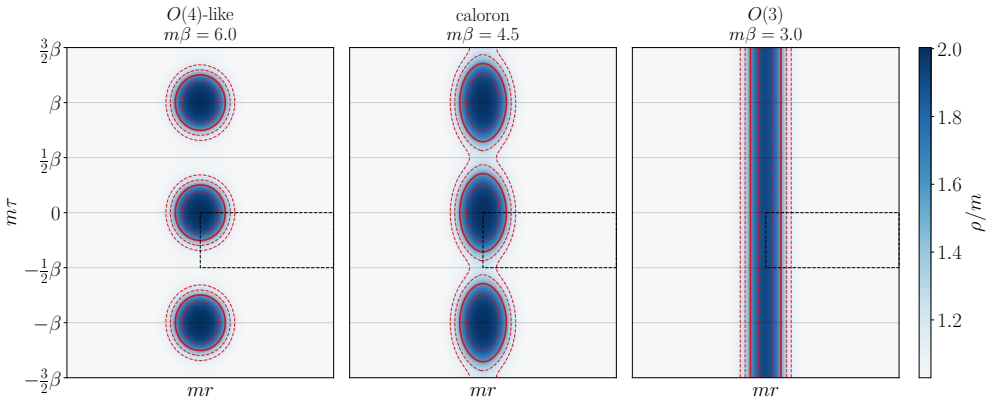
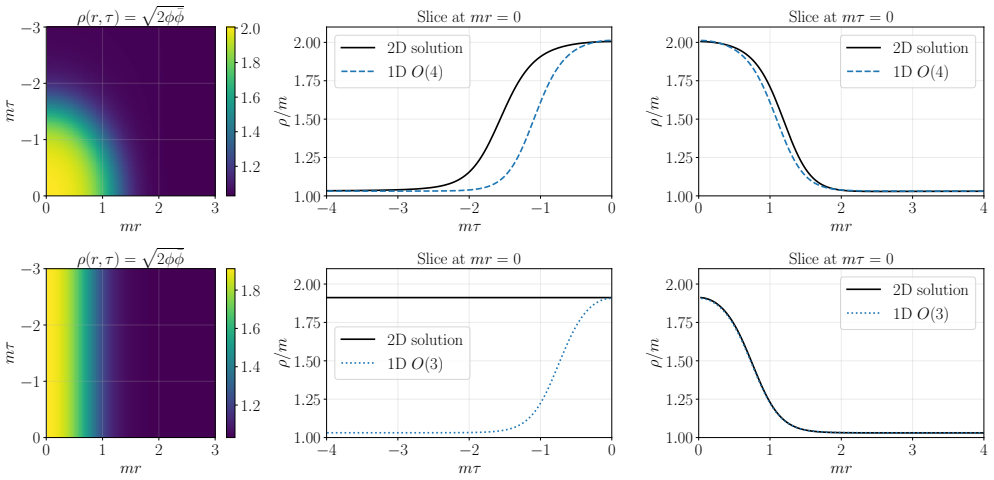
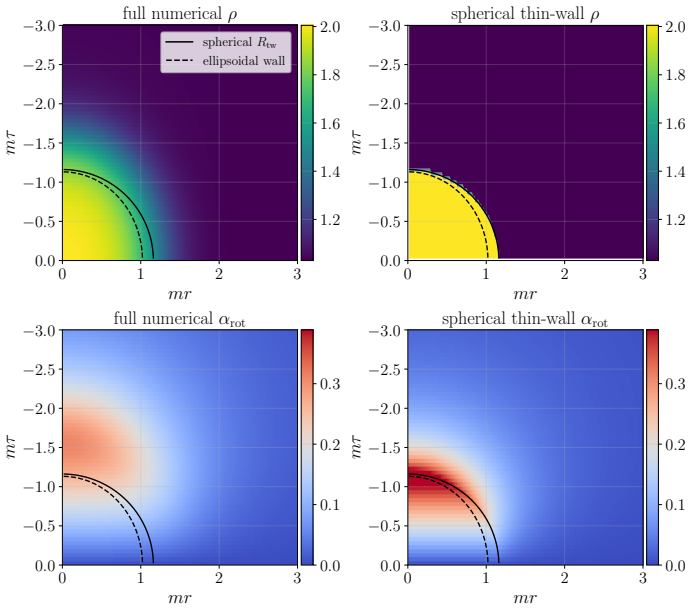
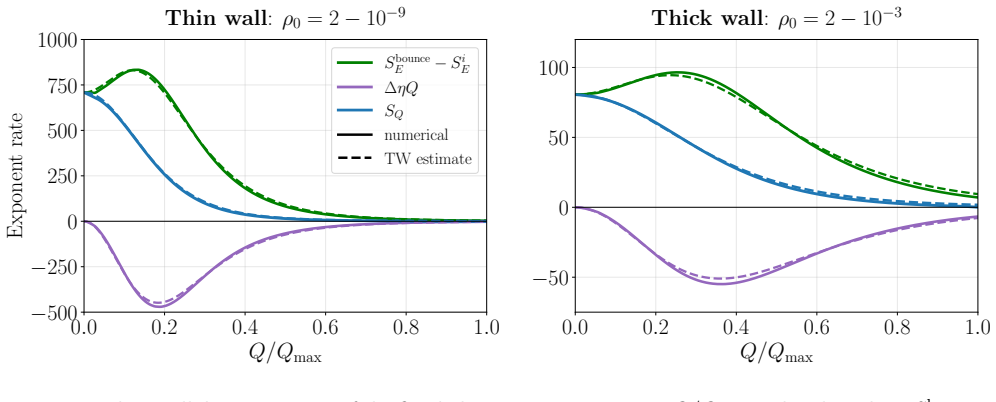
Vacuum decay at zero temperature is generically described by a real $O(4)$-symmetric Coleman bounce. When the scalar field driving the decay carries a conserved global charge, this picture changes qualitatively: the path integral must be projected onto a definite charge sector, the Euclidean field obeys twisted boundary conditions, and the saddle is complex. For the simplest case of a $U(1)$ global symmetry, we first reformulate this problem in a two-field real Euclidean description with a real saddle. We then solve the resulting two-dimensional partial differential equation problem describing the decay of a homogeneous charged medium to a deeper vacuum via bubble nucleation. At finite charge the bounce departs from $O(4)$ symmetry, the barrier between vacua is lowered, and the decay rate increases. Continuing the solution to real time, we find that charge rearrangement around the expanding wall costs phase-gradient energy and drives the bubble to a subluminal terminal velocity even in vacuum. We also clarify how the fixed-charge construction interfaces with finite-temperature and finite-chemical-potential descriptions.
Editorial analysis
A structured set of objections, weighed in public.
Referee Report
Summary. The paper claims that projecting the path integral for vacuum decay onto a fixed global U(1) charge sector imposes twisted boundary conditions, yielding a complex Euclidean saddle that can be recast as an equivalent real two-field problem. Numerical solution of the resulting 2D PDE shows that finite charge causes the bounce to depart from O(4) symmetry, lowers the potential barrier, and increases the decay rate. Analytic continuation to real time then demonstrates that charge rearrangement around the bubble wall incurs phase-gradient energy cost, driving the wall to a subluminal terminal velocity even in vacuum. The work also clarifies the relation between the fixed-charge construction and finite-temperature/finite-chemical-potential ensembles.
Significance. If the numerical results hold, the work establishes a qualitatively new picture of charged vacuum decay beyond the standard Coleman bounce, with direct implications for early-universe phase transitions in models with global symmetries. The reformulation to a real saddle and the real-time terminal-velocity result are technically noteworthy; the clarification of the fixed-charge versus finite-μ interface is also useful. The absence of any free parameters or ad-hoc assumptions in the core construction is a strength.
major comments (2)
- [Abstract] Abstract: the claim that a 2D PDE is solved and continued to real time is central to all quantitative results (O(4) departure, lowered barrier, increased rate, subluminal velocity), yet the text supplies no information on discretization scheme, grid convergence, residual tolerances, or validation against the known zero-charge O(4) limit. This information is load-bearing for the soundness of the headline claims.
- [Reformulation section] The reformulation of the twisted-boundary saddle into a real two-field Euclidean problem is asserted to be faithful, but the manuscript does not provide an explicit check (e.g., recovery of the standard Coleman bounce at zero charge or comparison of the action) that would confirm the mapping preserves the physical decay rate.
Simulated Author's Rebuttal
We thank the referee for the careful reading and for identifying the need for additional technical documentation on the numerics and reformulation validation. We address both major comments below and have revised the manuscript accordingly.
read point-by-point responses
-
Referee: [Abstract] Abstract: the claim that a 2D PDE is solved and continued to real time is central to all quantitative results (O(4) departure, lowered barrier, increased rate, subluminal velocity), yet the text supplies no information on discretization scheme, grid convergence, residual tolerances, or validation against the known zero-charge O(4) limit. This information is load-bearing for the soundness of the headline claims.
Authors: We agree that these numerical details are essential. In the revised manuscript we have added a dedicated subsection (Section 3.2) describing the finite-difference discretization on a 2D cylindrical grid with adaptive mesh refinement, the successive-over-relaxation solver, residual tolerance of 10^{-9}, and explicit grid-convergence tests showing the bounce action stable to 0.5% under doubling of resolution. We also include a direct validation plot and table demonstrating that the Q=0 solution recovers the known O(4) Coleman bounce action to within 0.2%. revision: yes
-
Referee: [Reformulation section] The reformulation of the twisted-boundary saddle into a real two-field Euclidean problem is asserted to be faithful, but the manuscript does not provide an explicit check (e.g., recovery of the standard Coleman bounce at zero charge or comparison of the action) that would confirm the mapping preserves the physical decay rate.
Authors: We acknowledge that an explicit numerical confirmation strengthens the claim. The revised version now contains a new paragraph and accompanying figure in Section 2.3 that explicitly sets the charge to zero in the two-field formulation and shows that both the field profile and the Euclidean action converge to those of the standard Coleman O(4) bounce (action difference <0.3% after accounting for numerical truncation). This check confirms that the mapping preserves the decay rate in the zero-charge limit. revision: yes
Circularity Check
No significant circularity
full rationale
The paper's central construction is a path-integral projection onto fixed charge yielding twisted boundary conditions, followed by an explicit reformulation of the complex saddle into an equivalent real two-field Euclidean problem whose 2D PDE is solved numerically. No equation or result is shown to be identical to its input by definition, no fitted parameter is relabeled as a prediction, and no load-bearing premise reduces to a self-citation chain. The derivation therefore remains self-contained against external benchmarks.
Axiom & Free-Parameter Ledger
axioms (2)
- domain assumption Vacuum decay is described by a Euclidean bounce solution
- domain assumption Projection onto fixed global charge requires twisted boundary conditions
Reference graph
Works this paper leans on
-
[1]
S. R. Coleman,The Fate of the False Vacuum. 1. Semiclassical Theory,Phys. Rev.D15(1977) 2929–2936. [Erratum: Phys. Rev.D16,1248(1977)]
1977
-
[2]
C. G. Callan and S. Coleman,Fate of the false vacuum. ii. first quantum corrections,Phys. Rev. D 16(Sep, 1977) 1762–1768
1977
-
[3]
S. R. Coleman and F. De Luccia,Gravitational effects on and of vacuum decay,Phys. Rev. D21 (1980) 3305
1980
-
[4]
A. D. Linde,Fate of the False Vacuum at Finite Temperature: Theory and Applications,Phys. Lett. 100B(1981) 37–40
1981
-
[5]
A. D. Linde,Decay of the False Vacuum at Finite Temperature,Nucl. Phys.B216(1983) 421. [Erratum: Nucl. Phys.B223,544(1983)]
1983
-
[6]
Affleck,Quantum-statistical metastability,Phys
I. Affleck,Quantum-statistical metastability,Phys. Rev. Lett.46(1981) 388–391
1981
-
[7]
Lee,Quantum tunneling with global charge,Phys
K. Lee,Quantum tunneling with global charge,Phys. Rev. D50(1994) 5333–5343
1994
-
[8]
N. K. Glendenning,First-order phase transitions with more than one conserved charge: Consequences for neutron stars,Phys. Rev. D46(1992) 1274–1287
1992
-
[9]
Iida and K
K. Iida and K. Sato,Quantum nucleation of two-flavor quark matter in neutron stars,Prog. Theor. Phys.98(1997), no. 1 277–282
1997
-
[10]
B. W. Mintz, E. S. Fraga, G. Pagliara, and J. Schaffner-Bielich,Nucleation of quark matter in protoneutron star matter,Phys. Rev. D81(2010) 123012
2010
-
[11]
V. Dexheimer, L. T. T. Soethe, J. Roark, R. O. Gomes, S. O. Kepler, and S. Schramm,Phase Transitions in Neutron Stars,Int. J. Mod. Phys. E27(2018), no. 11 1830008, [1901.03252]
Pith/arXiv arXiv 2018
-
[12]
A. Bauswein, N.-U. F. Bastian, D. B. Blaschke, K. Chatziioannou, J. A. Clark, T. Fischer, and M. Oertel,Identifying a first-order phase transition in neutron star mergers through gravitational waves,Phys. Rev. Lett.122(2019), no. 6 061102, [1809.01116]
Pith/arXiv arXiv 2019
-
[13]
G. Cao and S. Lin,Gravitational Wave from Phase Transition inside Neutron Stars,1810.00528
-
[14]
J. Casalderrey-Solana, D. Mateos, and M. Sanchez-Garitaonandia,Mega-Hertz Gravitational Waves from Neutron Star Mergers,2210.03171. 44
-
[15]
D. Levkov, E. Nugaev, and A. Popescu,The fate of small classically stable q-balls,JHEP12(2017) 131, [1711.05279]
Pith/arXiv arXiv 2017
-
[16]
Lee,Wormholes and goldstone bosons,Phys
K. Lee,Wormholes and goldstone bosons,Phys. Rev. Lett.61(1988) 263–266
1988
-
[17]
G. Barni and T. Steingasser,On quantum tunnelling in the presence of Noether charges, 2604.08660
-
[18]
S. R. Coleman and K. Lee,Wormholes made without massless matter fields,Nucl. Phys. B329 (1990) 387–409
1990
-
[19]
S. B. Giddings and A. Strominger,Axion-induced topology change in quantum gravity and string theory,Nucl. Phys. B306(1988) 890–907
1988
-
[20]
S. B. Giddings and A. Strominger,Loss of incoherence and determination of coupling constants in quantum gravity,Nucl. Phys. B307(1988) 854–866
1988
-
[21]
Grinstein,Charge Quantization of Wormholes and the Finiteness of Newton’s Constant,Nucl
B. Grinstein,Charge Quantization of Wormholes and the Finiteness of Newton’s Constant,Nucl. Phys. B321(1989) 439–464
1989
-
[22]
M. B. Voloshin and K. G. Selivanov,On Particle Induced Decay of Metastable Vacuum. (In Russian),Yad. Fiz.44(1986) 1336–1343
1986
-
[23]
M. B. Voloshin,On strong high-energy scattering in theories with weak coupling,Phys. Rev. D43 (1991) 1726–1734
1991
-
[24]
M. B. Voloshin,Catalyzed decay of false vacuum in four-dimensions,Phys. Rev. D49(1994) 2014–2018, [hep-ph/9309237]
Pith/arXiv arXiv 1994
-
[25]
A. S. Gorsky and M. B. Voloshin,Nonperturbative production of multiboson states and quantum bubbles,Phys. Rev. D48(1993) 3843–3851, [hep-ph/9305219]
Pith/arXiv arXiv 1993
-
[26]
A. Gorsky and M. B. Voloshin,Particle decay in false vacuum,Phys. Rev. D73(2006) 025015, [hep-th/0511095]
Pith/arXiv arXiv 2006
-
[27]
Dasgupta,Vacuum tunneling by cosmic strings,Nucl
I. Dasgupta,Vacuum tunneling by cosmic strings,Nucl. Phys. B506(1997) 421–435, [hep-th/9702041]
Pith/arXiv arXiv 1997
-
[28]
B.-H. Lee, W. Lee, R. MacKenzie, M. B. Paranjape, U. A. Yajnik, and D.-h. Yeom,Battle of the bulge: Decay of the thin, false cosmic string,Phys. Rev. D88(2013), no. 10 105008, [1310.3005]
Pith/arXiv arXiv 2013
-
[29]
S. Blasi and A. Mariotti,QCD axion strings or seeds?,SciPost Phys.18(2025), no. 1 016, [2405.08060]
arXiv 2025
-
[30]
A. Chatrchyan, F. Niedermann, and P. Richman-Taylor,String-induced vacuum decay and its gravitational wave signatures,Phys. Rev. D113(2026), no. 4 043535, [2510.27579]
arXiv 2026
-
[31]
P. J. Steinhardt,Monopole and Vortex Dissociation and Decay of the False Vacuum,Nucl. Phys. B 190(1981) 583–616
1981
-
[32]
U. A. Yajnik,PHASE TRANSITION INDUCED BY COSMIC STRINGS,Phys. Rev. D34(1986) 1237–1240
1986
-
[33]
U. A. Yajnik and T. Padmanabhan,ANALYTICAL APPROACH TO STRING INDUCED PHASE TRANSITION,Phys. Rev. D35(1987) 3100. 45
1987
-
[34]
S. Blasi and A. Mariotti,Domain Walls Seeding the Electroweak Phase Transition,Phys. Rev. Lett. 129(2022), no. 26 261303, [2203.16450]
arXiv 2022
-
[35]
P. Agrawal, S. Blasi, A. Mariotti, and M. Nee,Electroweak phase transition with a double well done doubly well,JHEP06(2024) 089, [2312.06749]
arXiv 2024
-
[36]
Y. Bai, Y. Xu, and Y. Yang,Heterogeneous cosmological phase transitions: seeded by domain walls and junctions,JCAP05(2026) 036, [2512.10917]
arXiv 2026
- [37]
-
[38]
Baratella,Supercooling exit from charge supersaturation,2512.16601
P. Baratella,Supercooling exit from charge supersaturation,2512.16601
-
[39]
A. Andreassen, D. Farhi, W. Frost, and M. D. Schwartz,Direct approach to quantum tunneling, Phys. Rev. Lett.117(2016), no. 23 231601, [1602.01102]
Pith/arXiv arXiv 2016
-
[40]
A. Andreassen, D. Farhi, W. Frost, and M. D. Schwartz,Precision decay rate calculations in quantum field theory,Phys. Rev. D95(2017), no. 8 085011, [1604.06090]
Pith/arXiv arXiv 2017
-
[41]
T. Steingasser, M. K¨ onig, and D. I. Kaiser,Finite-temperature instantons from first principles, Phys. Rev. D110(2024), no. 11 L111902, [2310.19865]
arXiv 2024
-
[42]
T. Steingasser and D. I. Kaiser,Toward quantum tunneling from excited states: Recovering imaginary-time instantons from a real-time analysis,Phys. Rev. D111(2025), no. 9 096009, [2402.00099]
arXiv 2025
-
[43]
J. Lin, B. Scheihing-Hitschfeld, and T. Steingasser,Quantum tunneling from excited states in the steadyon picture,2511.08670
-
[44]
J. Lin, B. Scheihing-Hitschfeld, and T. Steingasser,Path integral predictions for pre-asymptotic false vacuum decay,2511.08669
-
[45]
K. M. Bitar and S.-J. Chang,Vacuum Tunneling and Fluctuations Around a Most Probable Escape Path,Phys. Rev. D18(1978) 435
1978
-
[46]
K. M. Bitar and S.-J. Chang,Vacuum Tunneling of Gauge Theory in Minkowski Space,Phys. Rev. D17(1978) 486
1978
-
[47]
J. R. Espinosa, J. Heeck, and M. Sokhashvili,Tunneling potential approach to Q-balls,Phys. Rev. D 108(2023), no. 5 056019, [2307.05667]
arXiv 2023
-
[48]
J. R. Espinosa,A Fresh Look at the Calculation of Tunneling Actions,JCAP07(2018) 036, [1805.03680]
Pith/arXiv arXiv 2018
-
[49]
S. R. Coleman,Q-balls,Nucl. Phys. B262(1985) 263–283. [Erratum: Nucl. Phys. B269, 744 (1986)]
1985
-
[50]
T. D. Lee and Y. Pang,Nontopological solitons,Phys. Rept.221(1992) 251–350
1992
-
[51]
Friedberg, T
R. Friedberg, T. D. Lee, and A. Sirlin,A class of scalar-field soliton solutions in three space dimensions,Phys. Rev. D13(1976) 2739–2761
1976
-
[52]
Witten,Cosmic Separation of Phases,Phys
E. Witten,Cosmic Separation of Phases,Phys. Rev.D30(1984) 272–285
1984
-
[53]
S. Ge, K. Lawson, and A. Zhitnitsky,Axion quark nugget dark matter model: Size distribution and survival pattern,Phys. Rev. D99(2019) 116017, [1903.05090]. 46
Pith/arXiv arXiv 2019
-
[54]
Fukushima,Chiral effective model with the Polyakov loop,Phys
K. Fukushima,Chiral effective model with the Polyakov loop,Phys. Lett. B591(2004) 277–284, [hep-ph/0310121]
Pith/arXiv arXiv 2004
-
[55]
C. Ratti, M. A. Thaler, and W. Weise,Phases of QCD: Lattice thermodynamics and a field theoretical model,Phys. Rev. D73(2006) 014019, [hep-ph/0506234]
Pith/arXiv arXiv 2006
-
[56]
B.-J. Schaefer and J. Wambach,The Phase Diagram of the Quark-Meson Model,Nucl. Phys. A757 (2005) 479–492, [nucl-th/0403039]
Pith/arXiv arXiv 2005
-
[57]
M. Alford, K. Rajagopal, and F. Wilczek,Color-flavor locking and chiral symmetry breaking in high density QCD,Nucl. Phys. B537(1999) 443–458, [hep-ph/9804403]
Pith/arXiv arXiv 1999
-
[58]
M. G. Alford, A. Schmitt, K. Rajagopal, and T. Schaefer,Color superconductivity in dense quark matter,Rev. Mod. Phys.80(2008) 1455–1515, [0709.4635]
Pith/arXiv arXiv 2008
-
[59]
Buballa,NJL-model analysis of dense quark matter,Phys
M. Buballa,NJL-model analysis of dense quark matter,Phys. Rept.407(2005) 205–376, [hep-ph/0402234]. 47
Pith/arXiv arXiv 2005
discussion (0)
Sign in with ORCID, Apple, or X to comment. Anyone can read and Pith papers without signing in.