Observations Regarding the Construction of Multipoint Kinetics Models from Observational Data
Pith reviewed 2026-06-26 12:25 UTC · model grok-4.3
The pith
Recovering the coupling coefficient matrix K from transient flux data requires capturing nondominant eigenmodes without oversampling the dominant eigenmode.
A machine-rendered reading of the paper's core claim, the machinery that carries it, and where it could break.
Core claim
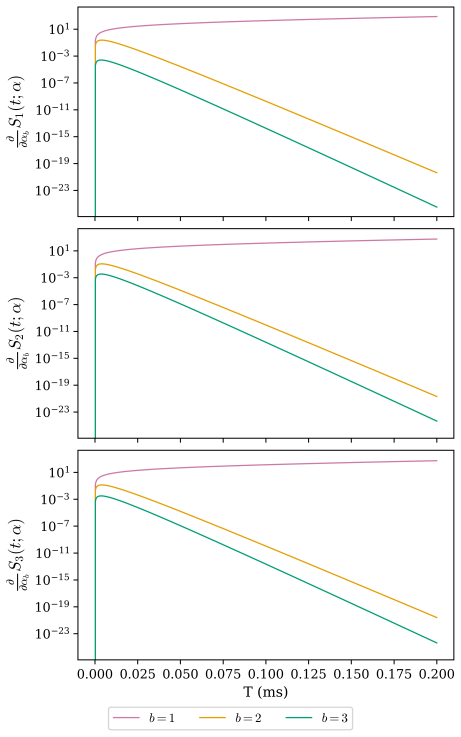
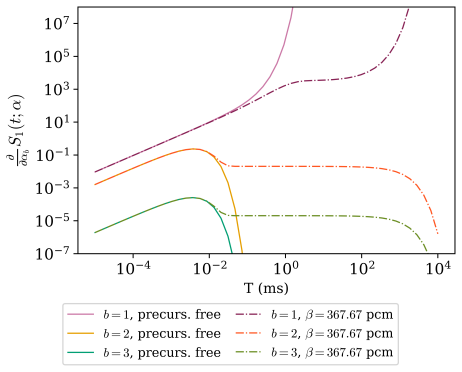
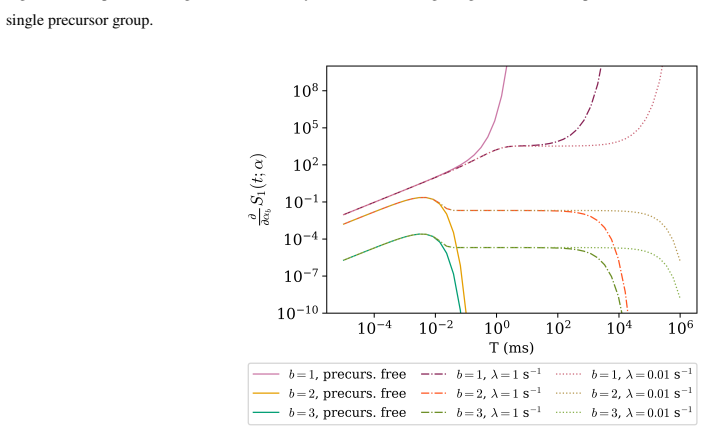
Analytical solutions to the Kobayashi MPK formulation in the case of no precursors and with a single precursor family are derived in spectral form. These enable investigation of eigenmode behavior and parameter observability. Coupling coefficient recoverability is shown to hinge on the ability to capture nondominant eigenmodes without oversampling the dominant eigenmode, as measured by modal sensitivity and the Hessian condition number of the spectral recovery problem. Inclusion of delayed neutron precursors delays eigenmode divergence but is often insufficient for practical recovery of K.
What carries the argument
The Hessian condition number of the spectral recovery problem, which measures how well the coupling coefficient matrix K can be recovered from observable forward flux data.
If this is right
- Delayed neutron precursors postpone the divergence of eigenmodes during a transient.
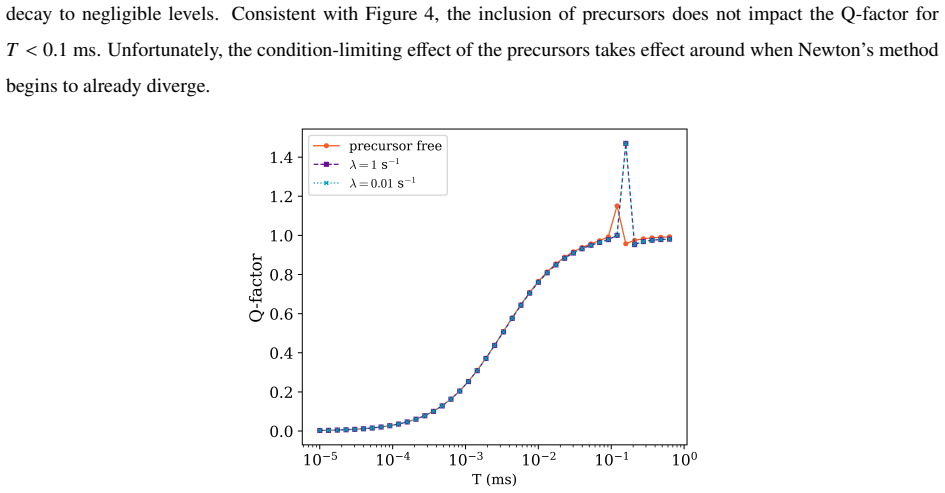
- This postponement is frequently insufficient to permit reliable recovery of K in realistic reactor scenarios.
- Modal sensitivity analysis supplies a diagnostic for whether a given transient dataset will support recovery before any fitting is attempted.
Where Pith is reading between the lines
- Transient experiments would need higher temporal or spatial resolution at early times to resolve the weaker modes.
- The same eigenmode-sampling requirement may limit recoverability in other lumped models of spatially distributed systems.
- Direct numerical integration of the MPK equations could be used to verify the predicted growth of the condition number under controlled undersampling.
Load-bearing premise
Transient data supplies observable information about the system's eigenmodes in the form given by the analytical solutions, so that the Hessian condition number can serve as a reliable indicator of recoverability.
What would settle it
Compute the Hessian condition number on a set of simulated transient flux traces in which nondominant modes are deliberately undersampled; the number should become large exactly when the sampling criterion is violated.
Figures

read the original abstract
The multipoint kinetics (MPK) equations extend point kinetics models by tracking neutron populations in lumped reactor regions, offering improved spatial resolution at modest computational cost. However, determining the coupling coefficient matrix $K$ from transient data remains an open problem without established experimental procedures. This work provides some commentary on the task of recovering $K$ from observable forward flux measurements during reactor transients. Analytical solutions to the Kobayashi MPK formulation in the case of no precursors and with a single precursor family are derived in spectral form, enabling a mathematically rigorous investigation of eigenmode behavior and parameter observability. Coupling coefficient recoverability is investigated using modal sensitivity analysis and the Hessian condition number of the spectral recovery problem. The inclusion of delayed neutron precursors delays this eigenmode divergence but may be insufficient for enabling practical recovery of $K$ in many scenarios. In conclusion, capturing the behavior of nondominant eigenmodes without oversampling the dominant eigenmode is critical to the recoverability of $K$ through transient data.
Editorial analysis
A structured set of objections, weighed in public.
Referee Report
Summary. The manuscript derives analytical spectral solutions to the Kobayashi multipoint kinetics equations for the no-precursor and single-precursor cases. It then applies modal sensitivity analysis and computes the condition number of the Hessian of the spectral recovery problem to investigate recoverability of the coupling matrix K from transient flux data. The central conclusion is that practical recovery of K requires capturing nondominant eigenmodes without oversampling the dominant eigenmode, and that inclusion of delayed neutron precursors may be insufficient to enable this in many scenarios.
Significance. The derivation of closed-form spectral solutions for the forward problem is a clear strength, as it permits exact eigenmode analysis without discretization artifacts and supports a mathematically rigorous treatment of observability. If the link between Hessian condition number and practical recoverability can be substantiated, the work would usefully constrain expectations for inverse procedures in reactor kinetics. At present the significance is limited by the absence of any numerical inversion tests on finite, noisy data.
major comments (1)
- [investigation of coupling coefficient recoverability and conclusion] The central claim that the Hessian condition number of the spectral recovery problem reliably indicates recoverability of K rests on a linearized forward map around the true parameters and the assumption that observed transients exactly match the analytical spectral form. No explicit numerical demonstration is provided that low condition numbers yield successful recovery once discretization, additive noise, and finite sampling are introduced (see the investigation of coupling coefficient recoverability and the conclusion).
minor comments (1)
- [Abstract] The abstract states that analytical solutions are derived but does not display any of the resulting expressions or the explicit form of the recovery problem; including at least the leading spectral solution and the definition of the Hessian would improve readability.
Simulated Author's Rebuttal
We thank the referee for the constructive comments and for recognizing the value of the closed-form spectral solutions. We address the single major comment below.
read point-by-point responses
-
Referee: [investigation of coupling coefficient recoverability and conclusion] The central claim that the Hessian condition number of the spectral recovery problem reliably indicates recoverability of K rests on a linearized forward map around the true parameters and the assumption that observed transients exactly match the analytical spectral form. No explicit numerical demonstration is provided that low condition numbers yield successful recovery once discretization, additive noise, and finite sampling are introduced (see the investigation of coupling coefficient recoverability and the conclusion).
Authors: We agree that the manuscript's investigation of recoverability relies on the exact analytical spectral representation and the condition number of the Hessian of the linearized inverse map. This approach isolates the intrinsic modal sensitivity without numerical artifacts, showing that dominant-mode dominance produces high condition numbers even with precursors. The analysis therefore supplies a necessary (though not sufficient) indicator of ill-posedness. We acknowledge that the paper does not yet contain numerical inversion trials on noisy, discretely sampled data. In the revised version we will add a dedicated subsection presenting Monte Carlo recovery experiments on synthetic transients that incorporate additive noise and finite sampling; these will quantify the empirical correlation between the reported condition numbers and successful recovery of K. revision: yes
Circularity Check
No significant circularity; derivation is self-contained forward analysis
full rationale
The paper derives closed-form analytical solutions to the Kobayashi MPK equations (no-precursor and single-precursor cases) in spectral form, then computes the Hessian of the resulting spectral recovery problem to obtain condition numbers. This constitutes a mathematical sensitivity analysis of an inverse problem defined by those same equations; the condition-number indicator is not obtained by fitting to data, is not renamed from a known empirical pattern, and does not rely on self-citations for its justification. The claim that nondominant eigenmodes must be captured without oversampling the dominant mode follows directly from the derived eigenmode expressions and the Hessian analysis rather than reducing to a tautology or to the input data itself.
Axiom & Free-Parameter Ledger
axioms (1)
- domain assumption The Kobayashi MPK formulation accurately models neutron dynamics in lumped reactor regions for the purpose of deriving analytical solutions.
Reference graph
Works this paper leans on
-
[1]
Tommasi, G
J. Tommasi, G. Palmiotti, Verification of iterative matrix solutions for multipoint kinetics equations, Annals of Nuclear Energy 124 (2019) 357–371
2019
-
[2]
Wakabayashi, T
G. Wakabayashi, T. Yamada, T. Endo, C. H. Pyeon, Introduction to nuclear reactor experiments, Springer, 2023
2023
-
[3]
R. M. Potenza, Quarterly technical report spert project, Tech. Rep. IDO-17206, National Reactor Testing Station, U.S. Atomic Energy Commission (1966)
1966
-
[4]
Jarrah, S
I. Jarrah, S. Malkawi, M. I. Radaideh, F. Aldebie, M. El-Mustafah, Experimental validation of the neutronic parameters in the jordan subcritical assembly, Progress in Nuclear Energy 108 (2018) 71–80
2018
-
[5]
V . M. Monteiro, Á. C. R. Lima, A. S. Martinez, A. C. Gonçalves, A differential equation for inverse point kinetics, Nuclear Engineering and Design 421 (2024) 113094
2024
-
[6]
P. A. Ferney, M. D. DeHart, Benchmarking of different inverse point kinetics implementations for an auto- corrected reactimeter algorithm, Tech. rep., Idaho National Laboratory (INL), Idaho Falls, ID (United States) (2024)
2024
-
[7]
Avery, Theory of coupled reactors, Tech
R. Avery, Theory of coupled reactors, Tech. rep., Argonne National Lab., Lemont, Ill. (1958)
1958
-
[8]
Kobayashi, Rigorous derivation of multi-point reactor kinetics equations with explicit dependence on pertur- bation, Journal of nuclear science and technology 29 (2) (1992) 110–120
K. Kobayashi, Rigorous derivation of multi-point reactor kinetics equations with explicit dependence on pertur- bation, Journal of nuclear science and technology 29 (2) (1992) 110–120
1992
-
[9]
Shimjith, A
S. Shimjith, A. Tiwari, M. Naskar, B. Bandyopadhyay, Space–time kinetics modeling of advanced heavy water reactor for control studies, Annals of nuclear energy 37 (3) (2010) 310–324. 13
2010
-
[10]
Dulla, P
S. Dulla, P. Ravetto, P. Saracco, Some new thoughts on the multipoint method for reactor physics applications, in: Proceedings of the International Conference on Mathematics & Computational Methods Applied to Nuclear Science & Engineering (M&C 2017), Jeju, Korea, 2017, on USB proceedings
2017
-
[11]
Valocchi, J
G. Valocchi, J. Tommasi, P. Ravetto, Reduced order models in reactor kinetics: A comparison between point kinetics and multipoint kinetics, Annals of nuclear energy 147 (2020) 107702
2020
-
[12]
J. Hui, Development of an extended state observer for monitoring of a pwr based on a two-point kinetic model, Nuclear Technology 211 (8) (2025) 1699–1722. doi:10.1080/00295450.2024.2426410
-
[13]
G. R. Keepin, Physics of nuclear kinetics, (No Title) (1965)
1965
-
[14]
Rudstam, P
G. Rudstam, P. Finck, A. Filip, A. D’angelo, R. McKnight, Delayed neutron data for the major actinides, A report by the Working Party on International Evaluation Co-operation of the OECD NEA Nuclear Science Committee 6 (2002)
2002
-
[15]
I. S. Gradshteyn, I. M. Ryzhik, Table of integrals, series, and products, Academic press, 2014
2014
-
[16]
J. J. Duderstadt, L. J. Hamilton, Nuclear reactor analysis (1975)
1975
-
[17]
S. Boyd, L. Vandenberghe, Convex Optimization, Cambridge University Press, 2004
2004
-
[18]
O. M. Shir, A. Yehudayoff, On the covariance-hessian relation in evolution strategies, Theoretical Computer Science 801 (2020) 157–174. doi:10.1016/j.tcs.2019.09.002. URLhttps://arxiv.org/abs/1806.03674
-
[19]
Mellier, J
F. Mellier, J. L. Kloosterman, R. Soule, et al., Muse final report d8: The muse experiments for sub-critical neutronics validation, Tech. Rep. D8, European Community, 5th Euratom Framework Programme, Cadarache, France, contract No. FIKW-CT-2000-00063 (June 2005)
2000
-
[20]
G. Valocchi, Modélisation neutronique de coeurs complexes en cinétique multidimensionnelle : application au coeur astrid faible vidange et à la préparation d’expériences de validation, Thèse de doctorat, Aix-Marseille Université, Marseille, France (May 2020). doi:10.70675/a9ef9361zd53ez466ez96dczf33f2486ef95. URLhttps://theses.fr/2020AIXM0101
work page doi:10.70675/a9ef9361zd53ez466ez96dczf33f2486ef95 2020
-
[21]
Nesterov, et al., Lectures on convex optimization, V ol
Y . Nesterov, et al., Lectures on convex optimization, V ol. 137, Springer, 2018
2018
-
[22]
R. L. Burden, D. J. Faires, Numerical analysis, PWS publishing company, 1985. 14 Appendix A. Loss Function Gradient and Hessian Derivation with no Precursors Appendix A.1. Gradient When deriving the gradient, first note that becauseWis symmetric ∂ ∂ˆαb E(t; ˆα)T W E(t; ˆα) = ∂ ∂ˆαb E(t; ˆα) !T W E(t; ˆα)+E(t; ˆα)T W ∂ ∂ˆαb E(t; ˆα) (A.1) ∂ ∂ˆαb E(t; ˆα)T ...
1985
discussion (0)
Sign in with ORCID, Apple, or X to comment. Anyone can read and Pith papers without signing in.