Demonstration of a Monolithic and Fully Telecom-Fiber-Compatible Tunable Source of Polarization Entangled Photon Pairs Based on a van der Waals Material
Pith reviewed 2026-06-26 12:14 UTC · model grok-4.3
The pith
A thin 3R-MoS2 film between fiber connectors generates tunable polarization-entangled photon pairs at telecom wavelengths via SPDC.
A machine-rendered reading of the paper's core claim, the machinery that carries it, and where it could break.
Core claim
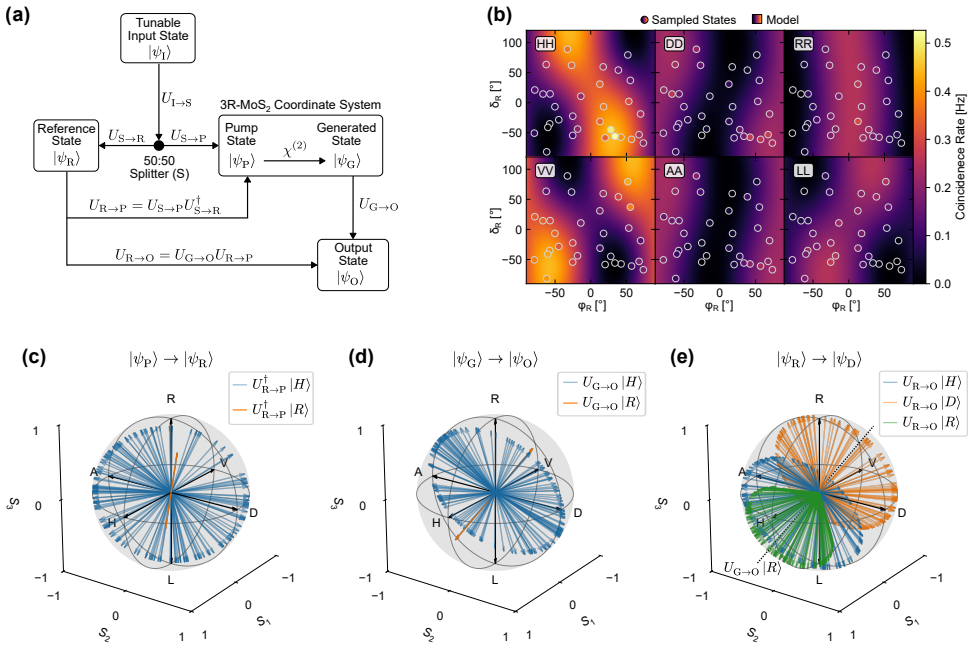
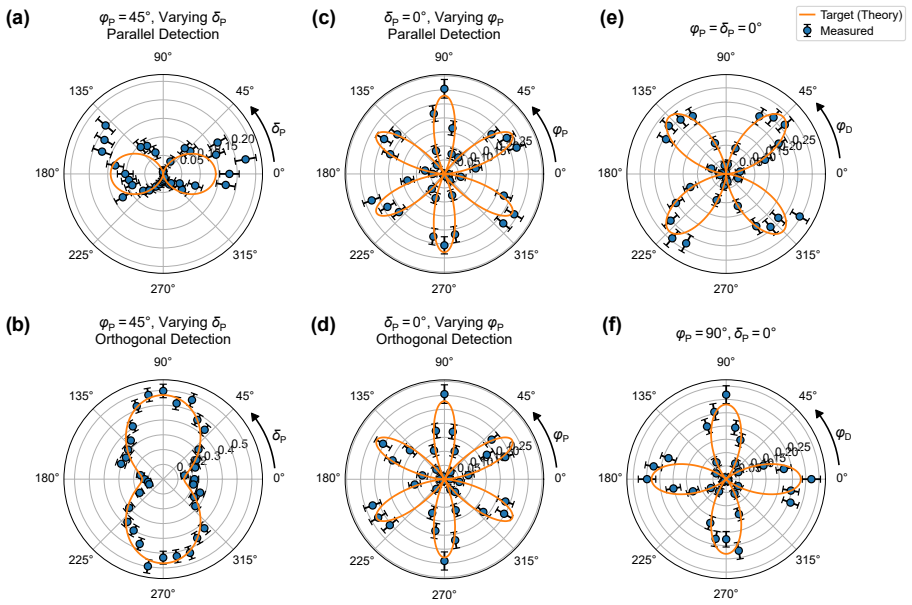
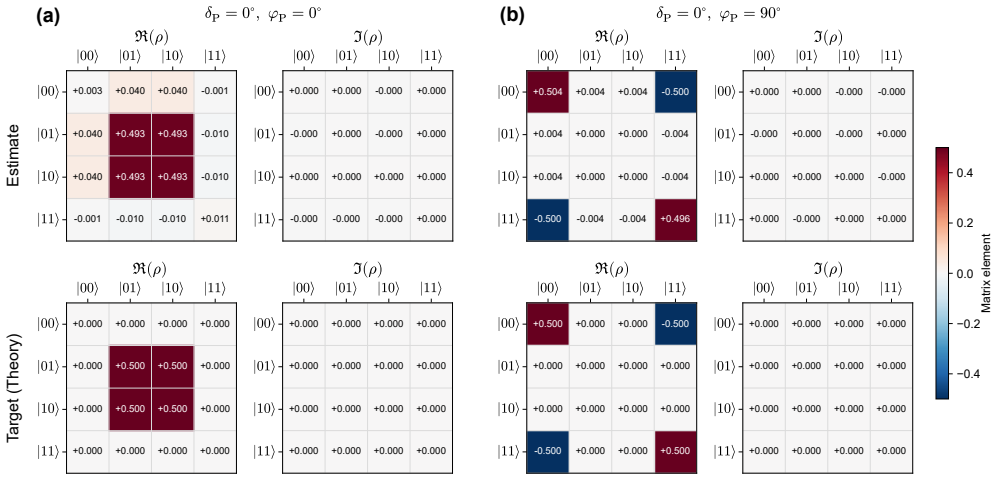
By placing a thin film of 3R-MoS2 between two fiber connectors, the authors show that the material's second-order nonlinear tensor symmetries enable direct control of the generated photon-pair polarization state through the incident pump polarization, producing two maximally entangled Bell states and co-polarized pairs on demand in a monolithic telecom-compatible device.
What carries the argument
The intrinsic symmetries of the second-order nonlinear susceptibility tensor of 3R-MoS2, which map the pump polarization to specific two-photon polarization correlations.
Load-bearing premise
The observed polarization control and coincidences arise solely from SPDC in the 3R-MoS2 film due to its tensor symmetries, without contributions from background effects or other optical elements.
What would settle it
Measuring no change in the two-photon polarization state when the pump polarization is rotated, or observing a CAR below 1000 even at low powers, would indicate the claim does not hold.
Figures

read the original abstract
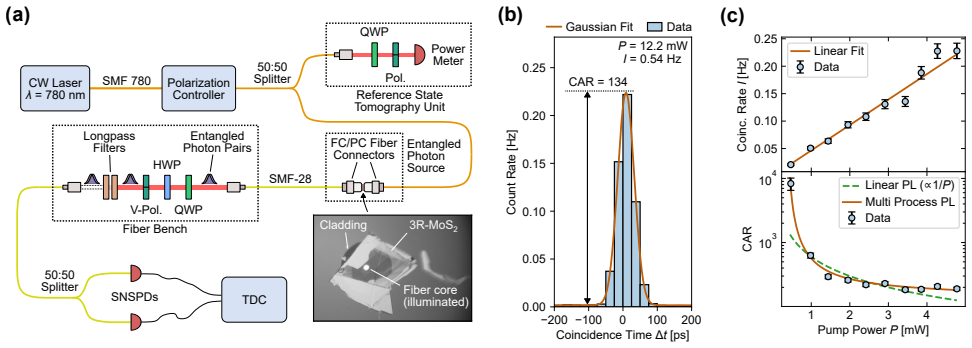
We present a tunable, single-mode-optical-fiber-based source of polarization entangled photon pairs for the near-infrared telecommunication band that is deployable in standard infrastructure. The photon pairs are generated via spontaneous parametric down-conversion (SPDC) in a submicron-scale thin film of the inversion-broken rhombohedral polytype of the transition metal dichalcogenide molybdenum disulfide (3R-MoS$_2$), located between two fiber connectors. By exploiting the intrinsic symmetries of the second-order nonlinear susceptibility tensor of 3R-MoS$_2$, this hybrid approach offers control over the generated two-photon polarization state through the incident pump polarization. Most notably, two of the four maximally entangled Bell states, as well as fully co-polarized pairs can be produced. This represents a substantial improvement in terms of tunability and simplicity over established fiber-integrated sources, which require additional optical elements, precise alignment, or careful engineering of design parameters. Additionally, a nonlinear drop in the background photoluminescence signal of 3R-MoS$_2$ is observed at low pump powers, allowing us to reach a coincidences-to-accidentals ratio (CAR) of $(8.3\pm1.8)\times10^{3}$, the highest value recorded for SPDC in van der Waals materials to date.
Editorial analysis
A structured set of objections, weighed in public.
Referee Report
Summary. The manuscript demonstrates a monolithic, fiber-connector-integrated source of polarization-entangled photon pairs in the telecom band generated by SPDC in a submicron 3R-MoS2 thin film. Pump-polarization control, enabled by the symmetries of the material's second-order nonlinear susceptibility tensor, is used to produce two of the four Bell states as well as co-polarized pairs. A coincidences-to-accidentals ratio of (8.3±1.8)×10^3 is reported, attributed in part to a nonlinear suppression of background photoluminescence at low pump powers.
Significance. If the central experimental claims are verified, the work would constitute a meaningful advance toward simple, deployable entangled-photon sources compatible with standard telecom fiber infrastructure. The monolithic geometry and pump-polarization tunability without auxiliary optics represent a practical improvement over many existing fiber-integrated designs. The reported CAR value, if robustly established as the highest for SPDC in van der Waals materials, would also be a useful benchmark.
major comments (2)
- [polarization control section] Abstract and the section on polarization control: the claim that the observed polarization-dependent coincidences and Bell-state generation arise exclusively from the d-tensor symmetries of 3R-MoS2 is load-bearing for the tunability result. No explicit null-test data (pump-off, film-absent, or non-nonlinear reference film) are described that would isolate the material contribution from possible polarization-dependent transmission or scattering at the fiber-connector interfaces.
- [CAR measurement section] The section reporting the CAR measurement: the quoted value (8.3±1.8)×10^3 is presented without accompanying raw coincidence histograms, a quantitative assessment of the spectral overlap between the nonlinear PL drop and the SPDC band, or a full propagation of systematic uncertainties. These details are required to substantiate both the numerical claim and the assertion that background suppression is the dominant reason for the high ratio.
minor comments (1)
- [figure captions] Figure captions and the methods paragraph should explicitly state the integration time, pump power range, and collection efficiency used for the polarization-correlation data.
Simulated Author's Rebuttal
We thank the referee for their careful reading and constructive comments. We address each major comment below and indicate revisions to strengthen the manuscript where appropriate.
read point-by-point responses
-
Referee: [polarization control section] Abstract and the section on polarization control: the claim that the observed polarization-dependent coincidences and Bell-state generation arise exclusively from the d-tensor symmetries of 3R-MoS2 is load-bearing for the tunability result. No explicit null-test data (pump-off, film-absent, or non-nonlinear reference film) are described that would isolate the material contribution from possible polarization-dependent transmission or scattering at the fiber-connector interfaces.
Authors: The specific polarization correlations, including generation of two distinct Bell states, follow directly from the symmetry properties of the second-order nonlinear susceptibility tensor of 3R-MoS2; linear interface effects at the connectors cannot produce photon pairs or the observed Bell-state projections. We agree, however, that the manuscript would benefit from an explicit discussion of why interface contributions are ruled out. We will revise the polarization-control section to include this argument and, if feasible, reference any available control measurements. revision: partial
-
Referee: [CAR measurement section] The section reporting the CAR measurement: the quoted value (8.3±1.8)×10^3 is presented without accompanying raw coincidence histograms, a quantitative assessment of the spectral overlap between the nonlinear PL drop and the SPDC band, or a full propagation of systematic uncertainties. These details are required to substantiate both the numerical claim and the assertion that background suppression is the dominant reason for the high ratio.
Authors: The CAR was extracted from time-tagged coincidence data, with the stated uncertainty dominated by counting statistics. We concur that raw histograms, a quantitative spectral-overlap analysis, and explicit propagation of systematic uncertainties would improve transparency and support the role of nonlinear PL suppression. We will revise the CAR section and supplementary material to include representative coincidence histograms, an assessment of spectral overlap, and an expanded uncertainty analysis. revision: yes
Circularity Check
No circularity: pure experimental demonstration with direct measurements
full rationale
This is an experimental paper reporting SPDC in a 3R-MoS2 thin film between fiber connectors, with direct measurements of coincidences, CAR=(8.3±1.8)×10^3, and polarization control via pump polarization. No derivations, equations, fitted parameters renamed as predictions, or self-citation chains appear in the provided text or abstract. The central claims rest on observed data rather than any reduction to inputs by construction. This matches the reader's assessment of score 1.0 and qualifies as self-contained against external benchmarks.
Axiom & Free-Parameter Ledger
Reference graph
Works this paper leans on
-
[1]
Quantum cryptography based on Bell’s theorem
A. K. Ekert. “Quantum cryptography based on Bell’s theorem” . In:Physical Review Letters 67.6 (Aug. 5, 1991), pp. 661–663. doi: 10 . 1103 / PhysRevLett.67.661
1991
-
[2]
High error-rate quantum key distribution for long-distance communication
M. Mubashir Khan, M. Murphy, and A. Beige. “High error-rate quantum key distribution for long-distance communication” . In:New Journal of Physics 11.6 (June 2009), p. 063043. issn: 1367-
2009
-
[3]
doi: 10.1088/1367-2630/11/6/063043
-
[4]
Experimental Entanglement Swap- ping: Entangling Photons That Never Interacted
J.-W. Pan, D. Bouwmeester, H. Weinfurter, and A. Zeilinger. “Experimental Entanglement Swap- ping: Entangling Photons That Never Interacted” . In: Physical Review Letters 80.18 (May 4, 1998), pp. 3891–3894. issn: 0031-9007, 1079-7114. doi: 10.1103/PhysRevLett.80.3891
-
[5]
Quantum Repeaters: The Role of Imperfect Lo- cal Operations in Quantum Communication
H.-J. Briegel, W. Dür, J. I. Cirac, and P. Zoller. “Quantum Repeaters: The Role of Imperfect Lo- cal Operations in Quantum Communication” . In: Physical Review Letters 81.26 (Dec. 28, 1998), pp. 5932–5935. issn: 0031-9007, 1079-7114. doi: 10.1103/PhysRevLett.81.5932
-
[6]
Optical imaging by means of two-photon quantum entanglement
T. B. Pittman, Y. H. Shih, D. V. Strekalov, and A. V. Sergienko. “Optical imaging by means of two-photon quantum entanglement” . In:Physical Review A 52.5 (Nov. 1, 1995), R3429–R3432. doi: 10.1103/PhysRevA.52.R3429
-
[7]
A. N. Boto, P. Kok, D. S. Abrams, S. L. Braun- stein, C. P. Williams, and J. P. Dowling. “Quan- tum Interferometric Optical Lithography: Exploit- ing Entanglement to Beat the Diffraction Limit” . In: Physical Review Letters 85.13 (Sept. 25, 2000), pp. 2733–2736. doi: 10.1103/PhysRevLett.85. 2733
-
[8]
Quantum- optical coherence tomography with dispersion cancellation
A. F. Abouraddy, M. B. Nasr, B. E. A. Saleh, A. V. Sergienko, and M. C. Teich. “Quantum- optical coherence tomography with dispersion cancellation” . In:Physical Review A 65.5 (May 8, 2002), p. 053817. doi: 10 . 1103 / PhysRevA . 65 . 053817
2002
-
[9]
Beating the Standard Quan- tum Limit with Four-Entangled Photons
T. Nagata, R. Okamoto, J. L. O’Brien, K. Sasaki, and S. Takeuchi. “Beating the Standard Quan- tum Limit with Four-Entangled Photons” . In:Sci- ence 316.5825 (May 4, 2007), pp. 726–729. doi: 10.1126/science.1138007
-
[10]
Enhanced Sensitivity of Photodetec- tion via Quantum Illumination
S. Lloyd. “Enhanced Sensitivity of Photodetec- tion via Quantum Illumination” . In: Science 321.5895 (Sept. 12, 2008), pp. 1463–1465. doi: 10. 1126/science.1160627
2008
-
[11]
Quantum fourier transform using dynamic cir- cuits
S. E. Harris, M. K. Oshman, and R. L. Byer. “Ob- servation of Tunable Optical Parametric Fluores- cence” . In:Physical Review Letters 18.18 (May 1, 1967), pp. 732–734. doi: 10.1103/PhysRevLett. 18.732
-
[12]
R. W. Boyd.Nonlinear optics. Fourth. London: El- sevier, AP Academic Press, Jan. 1, 2020. 609 pp. isbn: 978-0-12-811002-7
2020
-
[13]
New High-Intensity Source of Polarization-Entangled Photon Pairs
P. G. Kwiat, K. Mattle, H. Weinfurter, A. Zeilinger, A. V. Sergienko, and Y. Shih. “New High-Intensity Source of Polarization-Entangled Photon Pairs” . In:Physical Review Letters 75.24 (Dec. 11, 1995), pp. 4337–4341. doi: 10 . 1103 / PhysRevLett.75.4337
1995
-
[14]
Ultrabright source of polarization-entangled photons
P. G. Kwiat, E. Waks, A. G. White, I. Appel- baum, and P. H. Eberhard. “Ultrabright source of polarization-entangled photons” . In:Physical Review A 60.2 (Aug. 1, 1999), R773–R776. doi: 10.1103/PhysRevA.60.R773. 11
-
[15]
High-flux source of polarization-entangled photons from a periodically poled KTiOPO4 parametric down- converter
C. E. Kuklewicz, M. Fiorentino, G. Messin, F. N. C. Wong, and J. H. Shapiro. “High-flux source of polarization-entangled photons from a periodically poled KTiOPO4 parametric down- converter” . In:Physical Review A 69.1 (Jan. 15, 2004), p. 013807. doi: 10 . 1103 / PhysRevA . 69 . 013807
2004
-
[16]
Phase-stable source of polarization-entangled photons using a polarization Sagnac interferom- eter
T. Kim, M. Fiorentino, and F. N. C. Wong. “Phase-stable source of polarization-entangled photons using a polarization Sagnac interferom- eter” . In:Physical Review A 73.1 (Jan. 11, 2006), p. 012316. doi: 10.1103/PhysRevA.73.012316
-
[17]
Polarization-entangled photon pairs from a pe- riodically poled crystalline waveguide
Z. H. Levine, J. Fan, J. Chen, and A. L. Migdall. “Polarization-entangled photon pairs from a pe- riodically poled crystalline waveguide” . In:Optics Express 19.7 (Mar. 28, 2011), pp. 6724–6740. issn: 1094-4087. doi: 10.1364/OE.19.006724
-
[18]
In- herent polarization entanglement generated from a monolithic semiconductor chip
R. T. Horn, P. Kolenderski, D. Kang, et al. “In- herent polarization entanglement generated from a monolithic semiconductor chip” . In:Scientific Reports 3.1 (July 30, 2013), p. 2314. issn: 2045-
2013
-
[19]
doi: 10.1038/srep02314
-
[20]
Compact polarization-entangled photon-pair source based on a dual-periodically-poled Ti:LiNbO3 waveg- uide
C.-W. Sun, S.-H. Wu, J.-C. Duan, et al. “Compact polarization-entangled photon-pair source based on a dual-periodically-poled Ti:LiNbO3 waveg- uide” . In: Optics Letters 44.22 (Nov. 15, 2019), pp. 5598–5601. issn: 1539-4794. doi: 10 . 1364 / OL.44.005598
2019
-
[21]
Direct genera- tion of two-pair frequency entanglement via dual periodic poling in lithium niobate waveguides
A. Warke and K. Thyagarajan. “Direct genera- tion of two-pair frequency entanglement via dual periodic poling in lithium niobate waveguides” . In: The European Physical Journal Plus 137.6 (June 15, 2022), p. 697. issn: 2190-5444. doi: 10. 1140/epjp/s13360-022-02936-9
2022
-
[22]
Polarization- entangled photon pairs generation from a single lithium niobate waveguide with single poling pe- riod
X. Zhang, S. Pei, N. Yao, et al. “Polarization- entangled photon pairs generation from a single lithium niobate waveguide with single poling pe- riod” . In:Optics Express 33.12 (June 16, 2025), pp. 24193–24203. issn: 1094-4087. doi: 10.1364/ OE.550135
2025
-
[23]
Generation of maximally-polarization-entangled photons on a chip
S. V. Zhukovsky, L. G. Helt, D. Kang, P. Abol- ghasem, A. S. Helmy, and J. E. Sipe. “Generation of maximally-polarization-entangled photons on a chip” . In:Physical Review A 85.1 (Jan. 25, 2012), p. 013838. doi: 10.1103/PhysRevA.85.013838
-
[24]
Polarization En- gineering of Entangled Photons from a Lithium Niobate Nonlinear Metasurface
J. Ma, J. Zhang, Y. Jiang, et al. “Polarization En- gineering of Entangled Photons from a Lithium Niobate Nonlinear Metasurface” . In:Nano Letters 23.17 (Sept. 13, 2023), pp. 8091–8098. issn: 1530-
2023
-
[25]
doi: 10.1021/acs.nanolett.3c02055
-
[26]
Polarization-entangled Bell state generation from an epsilon-near-zero metasurface
W. Jia, G. Saerens, Ü.-L. Talts, et al. “Polarization-entangled Bell state generation from an epsilon-near-zero metasurface” . In: Science Advances 11.8 (Feb. 21, 2025), eads3576. doi: 10.1126/sciadv.ads3576
-
[27]
Polarization-entangled photon pairs from lithium niobate metasurfaces
Q. Mo, C. Shi, X. Zhang, J. Zhang, and J. Zhang. “Polarization-entangled photon pairs from lithium niobate metasurfaces” . In: Optics Letters 50.7 (Apr. 1, 2025), pp. 2294–2297. issn: 1539-4794. doi: 10.1364/OL.559126
-
[28]
Direct Gen- eration of Polarization-Entangled Photon Pairs in a Poled Fiber
E. Y. Zhu, Z. Tang, L. Qian, et al. “Direct Gen- eration of Polarization-Entangled Photon Pairs in a Poled Fiber” . In: Physical Review Letters 108.21 (May 21, 2012), p. 213902. doi: 10.1103/ PhysRevLett.108.213902
2012
-
[29]
Broadband fiber- based entangled photon-pair source at telecom O- band
C. Chen, C. Xu, A. Riazi, et al. “Broadband fiber- based entangled photon-pair source at telecom O- band” . In: Optics Letters 46.6 (Mar. 15, 2021), pp. 1261–1264. issn: 1539-4794. doi: 10 . 1364 / OL.415409
2021
-
[30]
Ultrathin quan- tum light source with van der Waals NbOCl2 crys- tal
Q. Guo, X.-Z. Qi, L. Zhang, et al. “Ultrathin quan- tum light source with van der Waals NbOCl2 crys- tal” . In:Nature 613.7942 (Jan. 5, 2023), pp. 53–
2023
-
[31]
issn: 0028-0836, 1476-4687. doi: 10 . 1038 / s41586-022-05393-7
-
[32]
A tunable transition metal dichalcogenide entangled photon-pair source
M. A. Weissflog, A. Fedotova, Y. Tang, et al. “A tunable transition metal dichalcogenide entangled photon-pair source” . In:Nature Communications 15.1 (Sept. 1, 2024), p. 7600. issn: 2041-1723. doi: 10.1038/s41467-024-51843-3
-
[33]
Polarization- entangled photon-pair source with van der Waals 3R-WS2 crystal
J. Feng, Y.-K. Wu, R. Duan, et al. “Polarization- entangled photon-pair source with van der Waals 3R-WS2 crystal” . In:eLight 4.1 (Aug. 23, 2024), p. 16. issn: 2662-8643. doi: 10 . 1186 / s43593 - 024-00074-6
2024
-
[34]
Polarization entanglement enabled by orthogonally stacked van der Waals NbOCl2 crystals
Q. Guo, Y.-K. Wu, D. Zhang, et al. “Polarization entanglement enabled by orthogonally stacked van der Waals NbOCl2 crystals” . In:Nature Com- munications 15.1 (Dec. 2, 2024), p. 10461. issn: 2041-1723. doi: 10.1038/s41467-024-54876-w
-
[35]
Quasi- phase-matched up- and down-conversion in peri- odically poled layered semiconductors
C. Trovatello, C. Ferrante, B. Yang, et al. “Quasi- phase-matched up- and down-conversion in peri- odically poled layered semiconductors” . In:Nature Photonics 19.3 (Mar. 2025), pp. 291–299. issn: 1749-4893. doi: 10.1038/s41566-024-01602-z
-
[36]
Tunable polar- ization entangled photon-pair source in rhombo- hedral boron nitride
H. Liang, T. Gu, Y. Lou, et al. “Tunable polar- ization entangled photon-pair source in rhombo- hedral boron nitride” . In:Science Advances 11.4 (Jan. 22, 2025), eadt3710. doi: 10.1126/sciadv. adt3710. 12
-
[37]
A tun- able entangled photon-pair source based on a Van der Waals insulator
X. Lyu, L. Kallioniemi, H. Hong, et al. “A tun- able entangled photon-pair source based on a Van der Waals insulator” . In:Nature Communications 16.1 (Feb. 23, 2025), p. 1899. issn: 2041-1723. doi: 10.1038/s41467-025-56436-2
-
[38]
Counter- propagating entangled photon pairs from mono- layer GaSe
Z. Lu, J. Janousek, S. M. Assad, et al. “Counter- propagating entangled photon pairs from mono- layer GaSe” . In: Nature Communications 16.1 (Oct. 30, 2025), p. 9616. issn: 2041-1723. doi: 10. 1038/s41467-025-64620-7
2025
-
[39]
Nonlinear phase- matched van der Waals crystals integrated on op- tical fibres
K. Lin, G. Yao, J. Shao, et al. “Nonlinear phase- matched van der Waals crystals integrated on op- tical fibres” . In:Nature Materials 25.4 (Apr. 2026), pp. 581–587. issn: 1476-4660. doi: 10 . 1038 / s41563-025-02461-x
2026
-
[40]
Joshi, T
M. Joshi, T. Pramanik, M. Jiang, et al. In-Line Fiber-Integrated Photon-Pair Generation from van der Waals Crystals . arXiv.org. Mar. 25, 2026. url: https : / / arxiv . org / abs / 2603 . 24070v1 (visited on 05/28/2026)
2026
-
[41]
Twist Phase Matching in Two-Dimensional Materials
H. Hong, C. Huang, C. Ma, et al. “Twist Phase Matching in Two-Dimensional Materials” . In: Physical Review Letters 131.23 (Dec. 4, 2023), p. 233801. issn: 0031-9007, 1079-7114. doi: 10 . 1103/PhysRevLett.131.233801
2023
-
[42]
S. Shinde, M. A. Weissflog, S. Lung, et al. Gen- eration of Tunable Entanglement from Thin-Film Lithium Niobate . Apr. 30, 2026. doi: 10.48550/ arXiv.2605.00214 . arXiv: 2605.00214 [quant- ph]. Pre-published
Pith/arXiv arXiv 2026
-
[43]
To- wards compact phase-matched and waveguided nonlinear optics in atomically layered semicon- ductors
X. Xu, C. Trovatello, F. Mooshammer, et al. “To- wards compact phase-matched and waveguided nonlinear optics in atomically layered semicon- ductors” . In:Nature Photonics 16.10 (Oct. 2022), pp. 698–706. issn: 1749-4885, 1749-4893. doi: 10. 1038/s41566-022-01053-4
2022
-
[44]
J. Hecht. Understanding Fiber Optics . SPIE, Apr. 29, 2015. isbn: 978-1-5114-4565-8. doi: 10. 1117/3.1445658
2015
-
[45]
Nogueira.Bayesian Optimization: Open source constrained global optimization tool for Python
F. Nogueira.Bayesian Optimization: Open source constrained global optimization tool for Python
-
[46]
com / bayesian - optimization/BayesianOptimization
url: https : / / github . com / bayesian - optimization/BayesianOptimization
-
[47]
Maximum-likelihood estima- tion of the density matrix
K. Banaszek, G. M. D’Ariano, M. G. A. Paris, and M. F. Sacchi. “Maximum-likelihood estima- tion of the density matrix” . In: Physical Review A 61.1 (Dec. 8, 1999), p. 010304. issn: 1050-2947, 1094-1622. doi: 10.1103/PhysRevA.61.010304
-
[48]
Thick- ness Dependence of Linear and Nonlinear Optical Properties of Multilayer 3R-MoS2
F. Abtahi, A. Shaji, G. Q. Ngo, et al. “Thick- ness Dependence of Linear and Nonlinear Optical Properties of Multilayer 3R-MoS2” . In:Advanced Optical Materials 14.7 (2026), e03498. issn: 2195-
2026
-
[49]
doi: 10.1002/adom.202503498
-
[50]
Parameteriza- tion of the optical functions of amorphous mate- rials in the interband region
G. E. Jellison and F. A. Modine. “Parameteriza- tion of the optical functions of amorphous mate- rials in the interband region” . In:Applied Physics Letters 69.3 (July 15, 1996), pp. 371–373. issn: 0003-6951, 1077-3118. doi: 10.1063/1.118064
-
[51]
A solution for the best rotation to relate two sets of vectors
W. Kabsch. “A solution for the best rotation to relate two sets of vectors” . In:Acta Crystallograph- ica Section A 32.5 (1976), pp. 922–923. issn: 1600-
1976
-
[52]
doi: 10.1107/S0567739476001873. 13 Supplementary S1 Ellipsometry of 3R-MoS 2 As described in the methods section of the main text, we have performed a variable-angle spectro- scopic ellipsometry (V ASE) measurement of a reference 3R-MoS2 flake on a flat, silicon dioxide substrate that was exfoliated from the same bulk crystal as our sample for SPDC. Figur...
discussion (0)
Sign in with ORCID, Apple, or X to comment. Anyone can read and Pith papers without signing in.