REVIEW 2 major objections 1 minor 53 references
CoSA: Correlation-Guided Change Attention with Learnable Residual Gating for Remote Sensing Change Detection
T0 review · 2 major / 1 minor · reviewed 2026-06-26 · grok-4.3
Pith's one-line read CoSA uses normalized cross-correlation between decoder features to generate change gates that boost changed-class F1 by 1.5-2.6% on four remote sensing benchmarks.
desk verdict CoSA adds a local correlation-to-gate module with learnable residuals at two decoder scales in Siamese CD, yielding small consistent F1 gains but leaving the signal's robustness to appearance drift unproven. read the letter →
The pith
A machine-rendered reading of the paper's core claim, the machinery that carries it, and where it could break.
The reading
What carries the argument
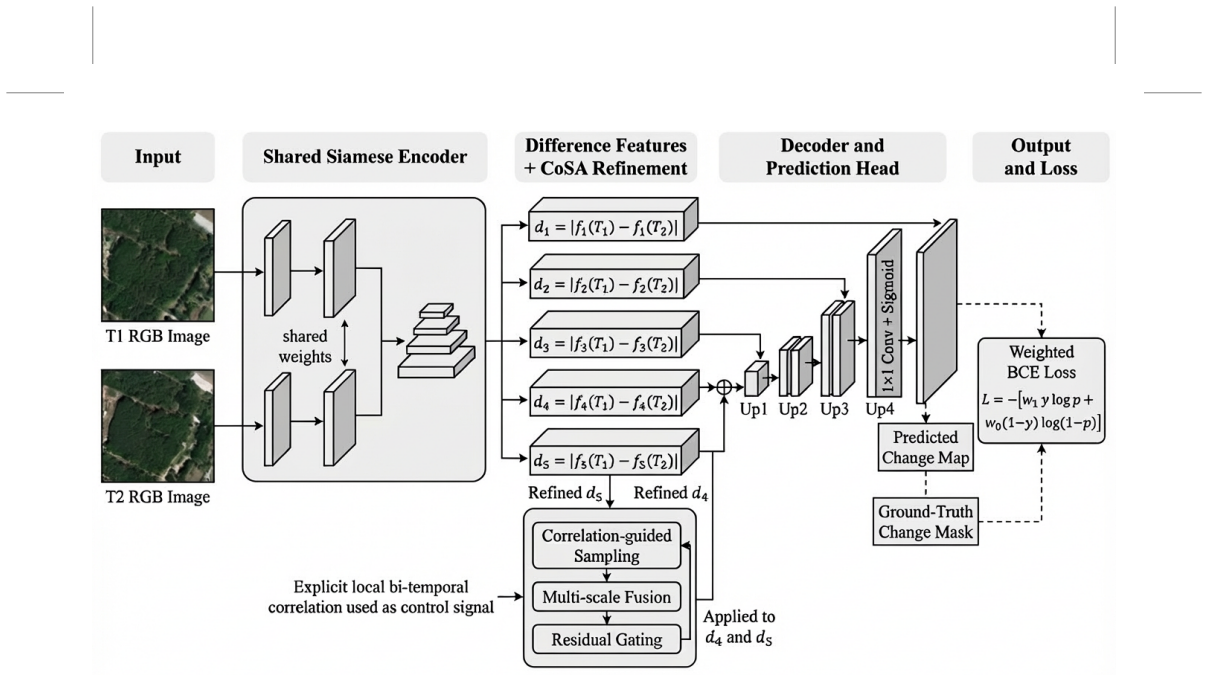
CoSA module, which converts bi-temporal decoder feature correlation into an explicit change gate for learnable residual injection at native feature scales.
What would settle it
On a held-out remote sensing dataset with strong appearance shifts or label noise, running the baseline Siamese model with and without CoSA and finding zero or negative F1 change would falsify the usefulness of the correlation gate.
Extended reading notes
Core claim
In the implemented FC-Siam setting, CoSA computes normalized same-location cross-correlation between paired decoder features, converts low correlation into a change gate, and injects the resulting gated residual at native 1/8 and 1/16 feature scales through learnable residual scaling, achieving 1.5-2.6% gains in changed-class F1 on four benchmarks.
Load-bearing premise
Normalized same-location cross-correlation between decoder features provides a reliable enough signal to separate changed from stable regions without global attention or extra labels.
Editorial extensions
If this is right
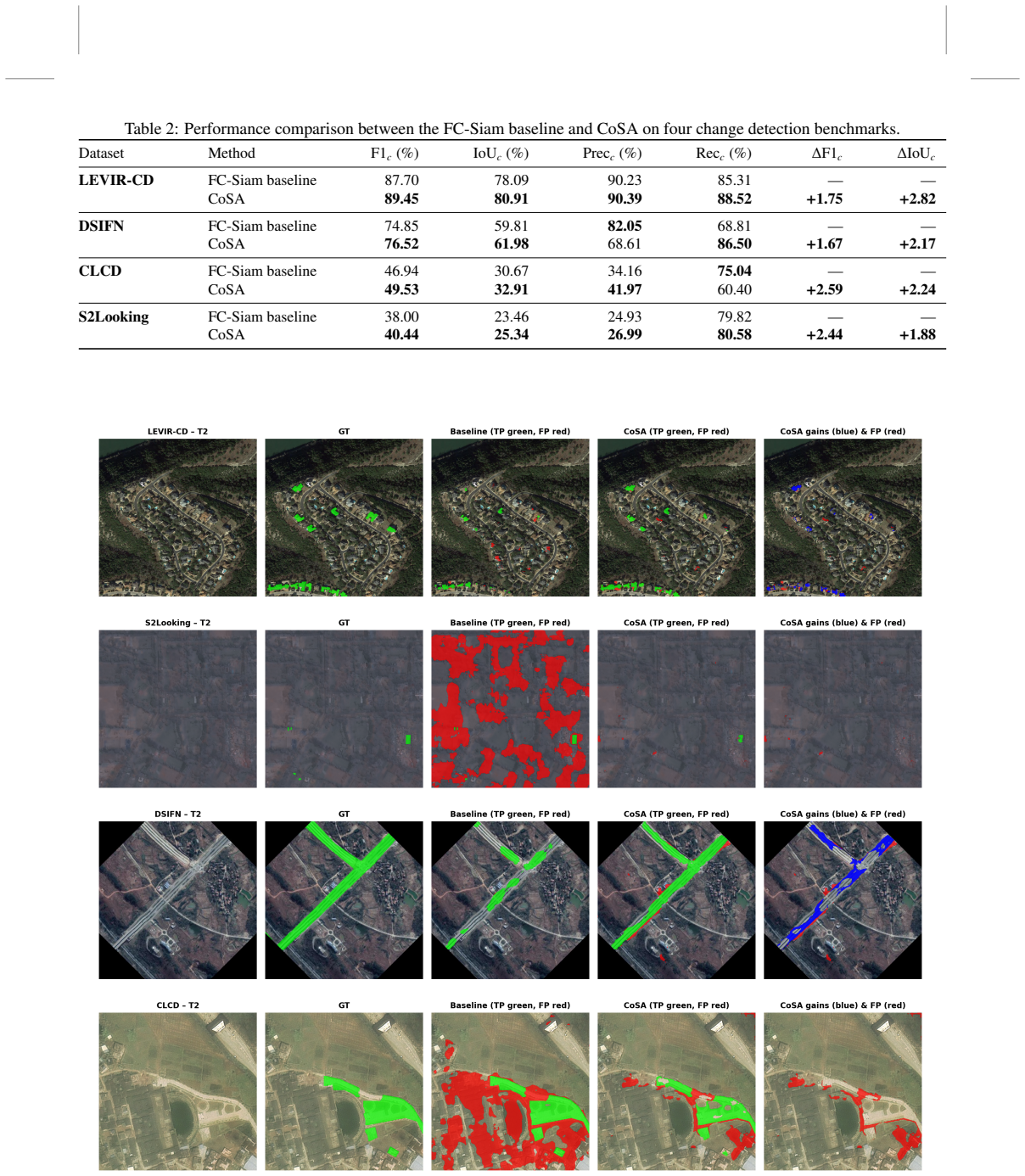
- Consistent 1.5-2.6% gains in changed-class F1 across LEVIR-CD, S2Looking, DSIFN, and CLCD.
- Negligible added parameters while operating at native 1/8 and 1/16 scales.
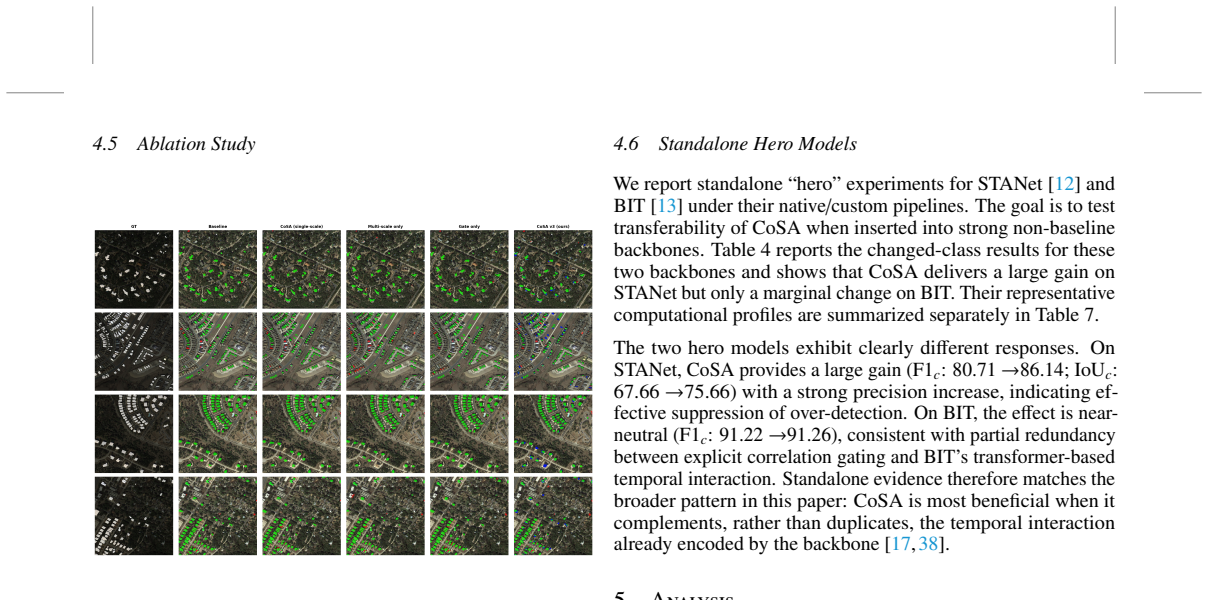
- Both multiscale placement and learnable residual scaling are required for peak results.
- Effective separation of stable and ambiguous regions occurs without global attention.
Reading between the lines
- The same correlation-to-gate pattern could be inserted into other Siamese change-detection backbones beyond the tested FC-Siam.
- Explicit temporal correlation might reduce the need for heavier attention in related tasks such as multi-date land-cover mapping.
- If the correlation signal proves stable under different sensor resolutions, it could support lightweight deployment on edge hardware for disaster monitoring.
Editorial analysis
A structured set of objections, weighed in public.
Referee Report
Summary. The paper proposes CoSA, a lightweight decoder-side refinement module for remote sensing change detection in a FC-Siam framework. CoSA computes normalized same-location cross-correlation between paired decoder features, converts low correlation into a change gate, and injects the gated residual at native 1/8 and 1/16 scales via learnable residual scaling. It reports consistent 1.5-2.6% gains in changed-class F1 on LEVIR-CD, S2Looking, DSIFN, and CLCD, with ablations indicating the importance of multiscale placement and learnable gating, while claiming negligible parameter overhead and explicit temporal control without global attention.
Significance. If the empirical gains hold under scrutiny and the correlation signal proves robust, the work offers a practical, low-overhead paradigm for incorporating explicit bi-temporal correlation as a control signal in Siamese change detection, providing an alternative to implicit attention for handling sparse changes and appearance variations.
major comments (2)
- [Abstract] Abstract (description of CoSA): The central claim that normalized same-location cross-correlation at identical spatial locations provides a reliable and sufficient proxy for distinguishing stable versus ambiguous regions (converted directly into a learnable-gated residual) is load-bearing, yet the construction includes no global aggregation, no auxiliary loss on the correlation map, and no robustness analysis against the appearance variations (illumination, seasonal, sensor-induced feature drift) explicitly flagged as core difficulties; this leaves the local unsupervised signal vulnerable to the exact failure mode noted in the stress-test concern.
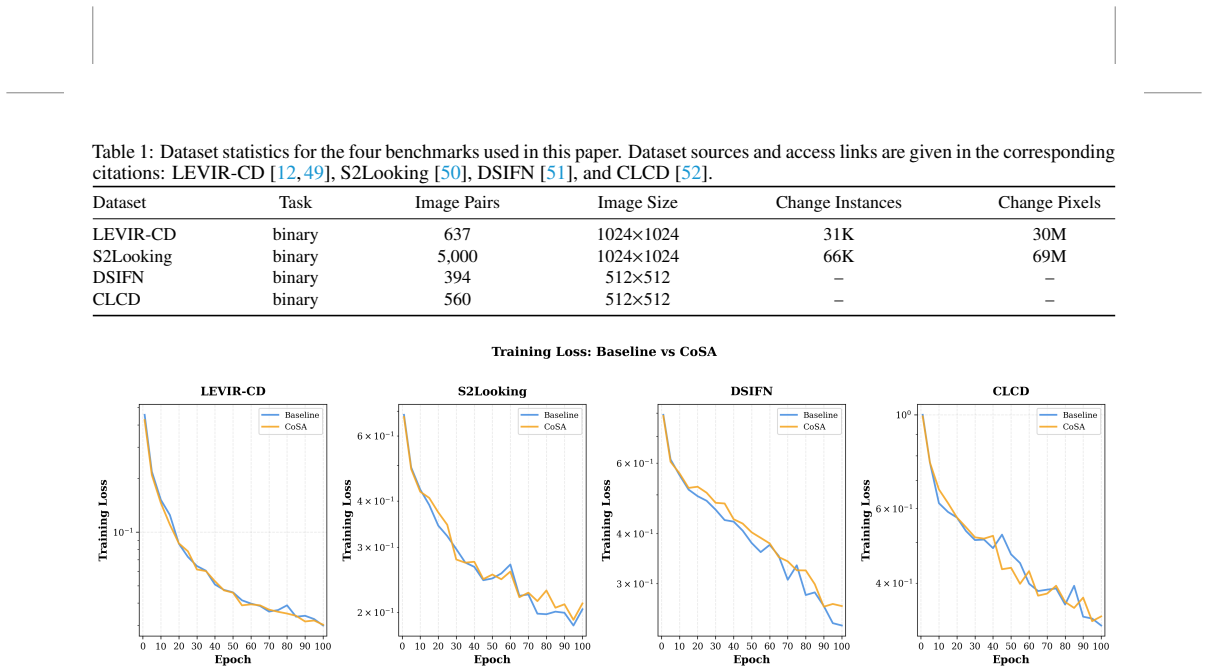
- [Abstract] Abstract (experiments and ablations): No equations, dataset statistics, error bars, implementation details (e.g., precise definition of the normalized cross-correlation, the gating function, or the learnable scaling parameters), or quantitative ablation tables are supplied, so the reported 1.5-2.6% F1 gains and the asserted importance of multiscale placement plus learnable residual gating cannot be assessed for statistical significance or reproducibility.
minor comments (1)
- The abstract states that 'extensive experiments' and 'ablation studies confirm' key design choices but provides no references to specific tables, figures, or sections where these results appear.
Simulated Author's Rebuttal
We thank the referee for the constructive feedback on our manuscript. We address each major comment point-by-point below, providing clarifications on the design rationale for the local correlation signal and confirming where additional details and analyses will be incorporated to improve the presentation.
read point-by-point responses
-
Referee: [Abstract] Abstract (description of CoSA): The central claim that normalized same-location cross-correlation at identical spatial locations provides a reliable and sufficient proxy for distinguishing stable versus ambiguous regions (converted directly into a learnable-gated residual) is load-bearing, yet the construction includes no global aggregation, no auxiliary loss on the correlation map, and no robustness analysis against the appearance variations (illumination, seasonal, sensor-induced feature drift) explicitly flagged as core difficulties; this leaves the local unsupervised signal vulnerable to the exact failure mode noted in the stress-test concern.
Authors: The local same-location normalized cross-correlation is intentionally chosen as a lightweight, explicit temporal control signal that avoids the overhead of global aggregation while directly highlighting stable versus changing regions at native scales. The learnable residual gating is trained end-to-end with the primary change detection loss, rendering an auxiliary loss on the correlation map unnecessary for the method's objectives. Robustness to appearance variations is supported by consistent 1.5-2.6% F1 gains across four benchmarks that include illumination, seasonal, and sensor differences. We acknowledge the benefit of explicit discussion and will add a subsection analyzing correlation map behavior under simulated feature drift and potential failure modes in the revised manuscript. revision: partial
-
Referee: [Abstract] Abstract (experiments and ablations): No equations, dataset statistics, error bars, implementation details (e.g., precise definition of the normalized cross-correlation, the gating function, or the learnable scaling parameters), or quantitative ablation tables are supplied, so the reported 1.5-2.6% F1 gains and the asserted importance of multiscale placement plus learnable residual gating cannot be assessed for statistical significance or reproducibility.
Authors: The abstract is a concise summary and therefore omits equations and tables. The full manuscript supplies the normalized cross-correlation definition (Equation 1 in Section 3.2), the gating function and learnable scaling parameters (Equations 2-3 and Section 3.3), dataset statistics (Section 4.1), error bars in the main results tables, implementation details (Section 3.4), and quantitative ablation tables (Table 3) demonstrating the contributions of multiscale placement and learnable gating. We will revise the abstract to include brief references to these elements and ensure all reported gains include statistical measures to facilitate assessment of significance and reproducibility. revision: yes
Circularity Check
No circularity; explicit architectural design with external validation
full rationale
The paper describes CoSA as an explicit decoder module that computes normalized same-location cross-correlation between paired bi-temporal features, converts low correlation to a change gate, and injects gated residuals via learnable scaling at 1/8 and 1/16 scales. This is framed as a proposed design choice differing from implicit attention, with performance gains demonstrated via experiments on four external benchmarks (LEVIR-CD, S2Looking, DSIFN, CLCD) and ablations confirming component importance. No equations, self-citations, or derivations are present that reduce the module or its claimed benefits to a fit or definition of its own outputs. The construction is self-contained against external data and does not rely on load-bearing self-referential steps.
Assumptions & free parameters
Cite this review
Pith. "Pith review of CoSA: Correlation-Guided Change Attention with Learnable Residual Gating for Remote Sensing Change Detection." pith.science (2026). https://pith.science/paper/WNSJHT66
@misc{pith2026260621932,
  author       = {Pith},
  title        = {Pith review of: CoSA: Correlation-Guided Change Attention with Learnable Residual Gating for Remote Sensing Change Detection},
  year         = {2026},
  howpublished = {\url{https://pith.science/paper/WNSJHT66}},
  note         = {Machine review of arXiv:2606.21932}
}
read the original abstract
Remote sensing change detection (CD) from bi-temporal imagery is critical for applications such as urban monitoring, disaster assessment, and environmental management, yet robust localization remains challenging under sparse changes, noisy labels, and appearance variations. In this paper, we propose Context Sampling Attention (CoSA), a lightweight decoder-side refinement module that explicitly leverages bi-temporal feature correlation as a control signal for adaptive change-aware feature enhancement. This differs from conventional attention mechanisms that rely on implicit feature weighting without explicit temporal control. In the implemented FC-Siam setting, CoSA computes normalized same-location cross-correlation between paired decoder features, converts low correlation into a change gate, and injects the resulting gated residual at native 1/8 and 1/16 feature scales through learnable residual scaling. This design enables effective discrimination between stable and ambiguous regions without relying on computationally expensive global attention. Extensive experiments on four benchmark datasets (LEVIR-CD, S2Looking, DSIFN, and CLCD) demonstrate consistent improvements over strong baselines, achieving 1.5-2.6% gains in changed-class F1 while introducing negligible parameter overhead. Ablation studies confirm that multiscale placement and learnable residual gating are both important for peak performance. These results indicate that CoSA establishes a practical and effective refinement paradigm for enhancing temporal discriminability in Siamese change detection frameworks.
Figures

Figures from the paper (2 more)
Reference graph
Works this paper leans on
-
[1]
Deep learning-based detection of urban forest cover change along with overall urban changes using very-high- resolution satellite images,
A. Javed, T. Kim, C. woo Lee, J. Oh, and Y . Han, “Deep learning-based detection of urban forest cover change along with overall urban changes using very-high- resolution satellite images,”Remote Sensing, 2023
2023
-
[2]
Deep learning-based detection and assessment of road damage caused by disaster with satellite imagery,
J. Cha, S. Lee, and H. Kim, “Deep learning-based detection and assessment of road damage caused by disaster with satellite imagery,”Applied Sciences, 2025
2025
-
[3]
Change detection of amazonian alluvial gold mining using deep learning and sentinel-2 imagery,
S. Camalan, K. Cui, V . P. Pauca, S. M. Alqahtani, M. Sil- man, R. Chan, R. Plemmons, E. N. Dethier, L. E. Fernan- dez, and D. Lutz, “Change detection of amazonian alluvial gold mining using deep learning and sentinel-2 imagery,” Remote Sensing, 2022
2022
-
[4]
The change detection of mangrove forests using deep learning with medium-resolution satel- lite imagery: A case study of wunbaik mangrove forest in myanmar,
K. Win and J. Sasaki, “The change detection of mangrove forests using deep learning with medium-resolution satel- lite imagery: A case study of wunbaik mangrove forest in myanmar,”Remote Sensing, 2024
2024
-
[5]
Vegetation change detection and recovery assessment based on post-fire satellite imagery using deep learning,
R. S. Priya and K. Vani, “Vegetation change detection and recovery assessment based on post-fire satellite imagery using deep learning,”Scientific Reports, 2024
2024
-
[6]
Tropical dry forest land use/land cover change detection using semi-supervised deep learning al- gorithms and remote sensing,
J. Gonzlez-Vlez, M. C. Torres-Madronero, J. D. Martnez- Vargas, P. Rodriguez-Marin, J. Perez-Guerra, and V . Herrera-Ruiz, “Tropical dry forest land use/land cover change detection using semi-supervised deep learning al- gorithms and remote sensing,”Environmental Monitoring &Assessment, 2026
2026
-
[7]
Siamese networks for change detection in remote sensing: A comprehen- sive review,
D. Patel, R. Bhattad, and V . Patel, “Siamese networks for change detection in remote sensing: A comprehen- sive review,”2025 International Conference on Artificial Intelligence and Machine Vision (AIMV), 2025
2025
-
[8]
Deep learning and transfer learning applied to sentinel-1 dinsar and sentinel-2 optical satellite imagery for change detection,
Z. Karim and T. L. van Zyl, “Deep learning and transfer learning applied to sentinel-1 dinsar and sentinel-2 optical satellite imagery for change detection,”2020 International SAUPEC/RobMech/PRASA Conference, 2020
2020
Show all 53 references
-
[9]
Sfscdnet: A deep learning model with spatial flow- 10 based semantic change detection from bi-temporal satellite images,
K. S. Basavaraju, N. Sravya, V . D. Kevala, S. Suresh, and S. Lal, “Sfscdnet: A deep learning model with spatial flow- 10 based semantic change detection from bi-temporal satellite images,”IEEE Access, 2024
2024
-
[10]
Metamorphnet: Deep shearlet and flux-based fusion for change detection in multi-source satellite imagery,
S. B. Kasetty and K. Rajakumar, “Metamorphnet: Deep shearlet and flux-based fusion for change detection in multi-source satellite imagery,”IEEE Access, 2026
2026
-
[11]
Fully convo- lutional siamese networks for change detection,
R. C. Daudt, B. Le Saux, and A. Boulch, “Fully convo- lutional siamese networks for change detection,” in2018 25th IEEE International Conference on Image Processing (ICIP), 2018, pp. 4063–4067
2018
-
[12]
A spatial-temporal attention method and dataset for remote sensing change detection,
H. Chen and Z. Shi, “A spatial-temporal attention method and dataset for remote sensing change detection,”Remote Sensing, vol. 12, no. 10, p. 1662, 2020
2020
-
[13]
Remote sensing image change detection with transformers,
H. Chen, Z. Qi, and Z. Shi, “Remote sensing image change detection with transformers,”IEEE Trans. Geosci. Remote Sens., vol. 60, pp. 1–14, 2022
2022
-
[14]
A transformer-based siamese network for change detection,
W. G. C. Bandara and V . M. Patel, “A transformer-based siamese network for change detection,” in2022 IEEE In- ternational Geoscience and Remote Sensing Symposium (IGARSS), 2022
2022
-
[15]
Multi- scale fusion siamese network based on three-branch atten- tion mechanism for high-resolution remote sensing image change detection,
Y . Li, L. Weng, M. Xia, K. Hu, and H. Lin, “Multi- scale fusion siamese network based on three-branch atten- tion mechanism for high-resolution remote sensing image change detection,”Remote Sensing, 2024
2024
-
[16]
Mdanet: A high-resolution city change detection network based on difference and attention mechanisms under multi- scale feature fusion,
S. Jiang, H. Lin, H. Ren, Z. Hu, L. Weng, and M. Xia, “Mdanet: A high-resolution city change detection network based on difference and attention mechanisms under multi- scale feature fusion,”Remote Sensing, 2024
2024
-
[17]
A multitask cnn-transformer network for semantic change detection from bitemporal remote sensing images,
W. Liu, Z. Kang, J. Liu, Y . Lin, Y . Yu, and J. Li, “A multitask cnn-transformer network for semantic change detection from bitemporal remote sensing images,”IEEE Transactions on Geoscience and Remote Sensing, 2024
2024
-
[18]
Digital change detection techniques using remotely-sensed data,
A. Singh, “Digital change detection techniques using remotely-sensed data,”International Journal of Remote Sensing, vol. 10, no. 6, pp. 989–1003, 1989
1989
-
[19]
Change detection techniques,
D. Lu, P. Mausel, E. Brondízio, and E. Moran, “Change detection techniques,”International Journal of Remote Sensing, vol. 25, no. 12, pp. 2365–2407, 2004
2004
-
[20]
Automatic analysis of the difference image for unsupervised change detection,
L. Bruzzone and D. Fernández Prieto, “Automatic analysis of the difference image for unsupervised change detection,” IEEE Transactions on Geoscience and Remote Sensing, vol. 38, no. 3, pp. 1171–1182, 2000
2000
-
[21]
U-Net: Convo- lutional networks for biomedical image segmentation,
O. Ronneberger, P. Fischer, and T. Brox, “U-Net: Convo- lutional networks for biomedical image segmentation,” in Medical Image Computing and Computer-Assisted Inter- vention (MICCAI), 2015, pp. 234–241
2015
-
[22]
Deep siamese multi-scale convolutional network for change detection in multi-temporal vhr images,
H. Chen, C. Wu, B. Du, and L. Zhang, “Deep siamese multi-scale convolutional network for change detection in multi-temporal vhr images,”International Workshop on the Analysis of Multitemporal Remote Sensing Images, 2019
2019
-
[23]
A deeply supervised image fu- sion network for change detection in high resolution bi- temporal remote sensing images,
C. Zhang, P. Yue, D. Tapete, L. Jiang, B. Shangguan, L. Huang, and G. Liu, “A deeply supervised image fu- sion network for change detection in high resolution bi- temporal remote sensing images,”ISPRS Journal of Pho- togrammetry and Remote Sensing, vol. 166, pp. 183–200, 2020
2020
-
[24]
Snunet-cd: A densely connected siamese network for change detection of VHR images,
S. Fang, K. Li, J. Shao, and Z. Li, “Snunet-cd: A densely connected siamese network for change detection of VHR images,”IEEE Geoscience and Remote Sensing Letters, pp. 1–5, 2021
2021
-
[25]
TINYCD: A (not so) deep learning model for change detection,
A. Codegoni, G. Lombardi, and A. Ferrari, “TINYCD: A (not so) deep learning model for change detection,”arXiv preprint arXiv:2207.13159, 2022
2022
-
[26]
Lightcdnet: Lightweight change detection network based on vhr images,
Y . Xing, J. Jiang, J. Xiang, E. Yan, Y . Song, and D. Mo, “Lightcdnet: Lightweight change detection network based on vhr images,”IEEE Geoscience and Remote Sensing Letters, vol. 20, pp. 1–5, 2023
2023
-
[27]
Dasnet: Dual attentive fully convo- lutional siamese networks for change detection in high- resolution satellite images,
J. Chen, Z. Yuan, J. Peng, L. Chen, H. Huang, J. Zhu, Y . Liu, and H. Li, “Dasnet: Dual attentive fully convo- lutional siamese networks for change detection in high- resolution satellite images,”IEEE Journal of Selected Top- ics in Applied Earth Observations and Remote Sensing, 2020
2020
-
[28]
Adap- tive differentiation siamese fusion network for remote sens- ing change detection,
Y . Zhang, J. Zhen, T. Liu, Y . Yang, and Y . Cheng, “Adap- tive differentiation siamese fusion network for remote sens- ing change detection,”IEEE Geoscience and Remote Sens- ing Letters, 2025
2025
-
[29]
Asymmetric siamese networks for semantic change detection in aerial images,
K. Yang, G.-S. Xia, Z. Liu, B. Du, W. Yang, M. Pelillo, and L. Zhang, “Asymmetric siamese networks for semantic change detection in aerial images,”IEEE Transactions on Geoscience and Remote Sensing, 2022
2022
-
[30]
Multitask siamese network guided by enhanced change information for semantic change detection in bitem- poral remote sensing images,
X. Zuo, F. Jin, L. Ding, S. Wang, Y . Lin, B. Liu, and Y . Ding, “Multitask siamese network guided by enhanced change information for semantic change detection in bitem- poral remote sensing images,”IEEE Journal of Selected Topics in Applied Earth Observations and Remote Sensing, 2025
2025
-
[31]
Hanet: A hierarchical attention network for change detection with bitemporal very-high-resolution remote sensing images,
C. Han, C. Wu, H. Guo, M. Hu, and H. Chen, “Hanet: A hierarchical attention network for change detection with bitemporal very-high-resolution remote sensing images,” IEEE Journal of Selected Topics in Applied Earth Observa- tions and Remote Sensing, vol. 16, pp. 3867–3878, 2023
2023
-
[32]
Semisanet: A semi- supervised high-resolution remote sensing image change detection model using siamese networks with graph atten- tion,
C. Sun, J. Wu, H. Chen, and C. Du, “Semisanet: A semi- supervised high-resolution remote sensing image change detection model using siamese networks with graph atten- tion,”Remote Sensing, 2022
2022
-
[33]
Afde-net: Building change detection using attention-based feature differential enhancement for satellite imagery,
S. Holail, T. Saleh, X. Xiao, and D. Li, “Afde-net: Building change detection using attention-based feature differential enhancement for satellite imagery,”IEEE Geoscience and Remote Sensing Letters, 2023
2023
-
[34]
Addednet: Remote sensing image change detection algorithm based on multiple attention mechanisms,
J. Wei and Y . Dang, “Addednet: Remote sensing image change detection algorithm based on multiple attention mechanisms,”International Conference Civil Engineering and Architecture, 2025
2025
-
[35]
M2f2net: Multi- stage mixed feature fusion network for remote sensing change detection,
B. Gu, L. Song, Y . Kong, and B. Gu, “M2f2net: Multi- stage mixed feature fusion network for remote sensing change detection,”Proc. IEEE ICASSP, 2025
2025
-
[36]
Wavelet-based bi-dimensional aggregation network for sar image change detection,
J. Xie, F. Gao, X. Zhou, and J. Dong, “Wavelet-based bi-dimensional aggregation network for sar image change detection,”IEEE Geoscience and Remote Sensing Letters, 2024
2024
-
[37]
Ddmsa-u-net: A lightweight deep learning framework for 11 multi-spectral change detection for agricultural land use monitoring,
L. H. Jasim, P. Girish, H. Deepanjali, S. D. V , and S. M. P, “Ddmsa-u-net: A lightweight deep learning framework for 11 multi-spectral change detection for agricultural land use monitoring,”ITM Web Conf., 2025
2025
-
[38]
A transformer-based siamese network for change detection,
W. G. C. Bandara and V . M. Patel, “A transformer-based siamese network for change detection,”IEEE International Geoscience and Remote Sensing Symposium, 2022
2022
-
[39]
Stransunet: A siamese transunet-based remote sensing image change detection network,
J. Yuan, L. Wang, and S. Cheng, “Stransunet: A siamese transunet-based remote sensing image change detection network,”IEEE Journal of Selected Topics in Applied Earth Observations and Remote Sensing, 2022
2022
-
[40]
Steinformer: Spatial-temporal interac- tion transformer architecture for remote sensing change detection,
X. Ma, Z. Wu, M.-Y . Ma, M. Zhao, F. Yang, Z. Du, and W. Zhang, “Steinformer: Spatial-temporal interac- tion transformer architecture for remote sensing change detection,”arXiv.org, 2024
2024
-
[41]
Time travelling pixels: Bitemporal features integration with foundation model for remote sensing im- age change detection,
K. Chen, C. Liu, W. Li, Z. Liu, H. Chen, H. Zhang, Z. Zou, and Z. Shi, “Time travelling pixels: Bitemporal features integration with foundation model for remote sensing im- age change detection,”arXiv preprint arXiv:2312.16202, 2023
2023
-
[42]
A new learning paradigm for foundation model-based remote sensing change detection,
K. Li, X. Cao, and D. Meng, “A new learning paradigm for foundation model-based remote sensing change detection,” IEEE Transactions on Geoscience and Remote Sensing, pp. 1–1, 2024
2024
-
[43]
Jl1-cd: A new benchmark for remote sensing change detection and a robust multi-teacher knowledge distillation framework,
Z. Liu, R. Zhu, L. Gao, Y . Zhou, J. Ma, and Y . Gu, “Jl1-cd: A new benchmark for remote sensing change detection and a robust multi-teacher knowledge distillation framework,” arXiv preprint arXiv:2502.13407, 2025
2025
-
[44]
Satellite-based infrastructure change detection using deep learning,
K. Ramineni, B. S. Rao, G. S. Chauhan, S. Mohmmad, U. Sadhana, and K. Sridhar, “Satellite-based infrastructure change detection using deep learning,”Proc. 5th Int. Conf. Soft Comput. Security Appl. (ICSCSA), 2025
2025
-
[45]
Changer: Feature interaction is what you need for change detection,
S. Fang, K. Li, and Z. Li, “Changer: Feature interaction is what you need for change detection,”arXiv preprint arXiv:2209.08290, 2022
2022
-
[46]
Change guiding network: Incorporating change prior to guide change detection in remote sensing imagery,
C. Han, C. Wu, H. Guo, M. Hu, J. Li, and H. Chen, “Change guiding network: Incorporating change prior to guide change detection in remote sensing imagery,”IEEE Journal of Selected Topics in Applied Earth Observations and Remote Sensing, vol. 16, pp. 8395–8407, 2023
2023
-
[47]
Change is everywhere: Single-temporal supervised object change detection in remote sensing imagery,
Z. Zheng, A. Ma, L. Zhang, and Y . Zhong, “Change is everywhere: Single-temporal supervised object change detection in remote sensing imagery,” inProceedings of the IEEE/CVF International Conference on Computer Vision (ICCV), 2021, pp. 15 193–15 202
2021
-
[48]
Siammask-icdnet: A hybrid algorithm of siamese neural network and mask r-cnn for island building change detection,
L. Yang, Y . Zhao, Y . Chen, W. Ma, Y . Ye, X. Ji, and Y . Chen, “Siammask-icdnet: A hybrid algorithm of siamese neural network and mask r-cnn for island building change detection,”2025 6th International Conference on Geology, Mapping and Remote Sensing (ICGMRS), 2025
2025
-
[49]
Levir-cd dataset project page,
“Levir-cd dataset project page,” [Online]. URL, accessed: 2026-05-05
2026
-
[50]
S2looking dataset repository,
“S2looking dataset repository,” [Online]. URL, accessed: 2026-03-05
2026
-
[51]
Dsifn dataset project page,
“Dsifn dataset project page,” [Online]. URL, accessed: 2026-03-05
2026
-
[52]
Cropland-cd dataset repository,
“Cropland-cd dataset repository,” [Online]. URL, accessed: 2026-03-05
2026
-
[53]
Deep residual learn- ing for image recognition,
K. He, X. Zhang, S. Ren, and J. Sun, “Deep residual learn- ing for image recognition,” inProceedings of the IEEE Conference on Computer Vision and Pattern Recognition (CVPR), 2016, pp. 770–778. 12
2016
Reviewed June 26, 2026 · model on record in the stance chip above.
Discussion (0). Continue with ORCID to comment.