Phantom-Divide Crossing in Exponentially Coupled Quintessence and the Role of Neutrino-Mass Freedom
Pith reviewed 2026-06-26 11:48 UTC · model grok-4.3
The pith
Fixing the neutrino mass sum at 0.06 eV makes data favor negative coupling in exponentially coupled quintessence, causing the effective dark energy equation of state to cross the phantom divide.
A machine-rendered reading of the paper's core claim, the machinery that carries it, and where it could break.
Core claim
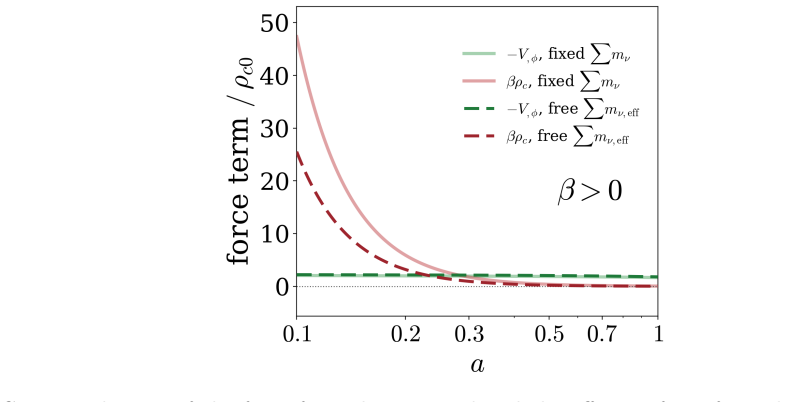
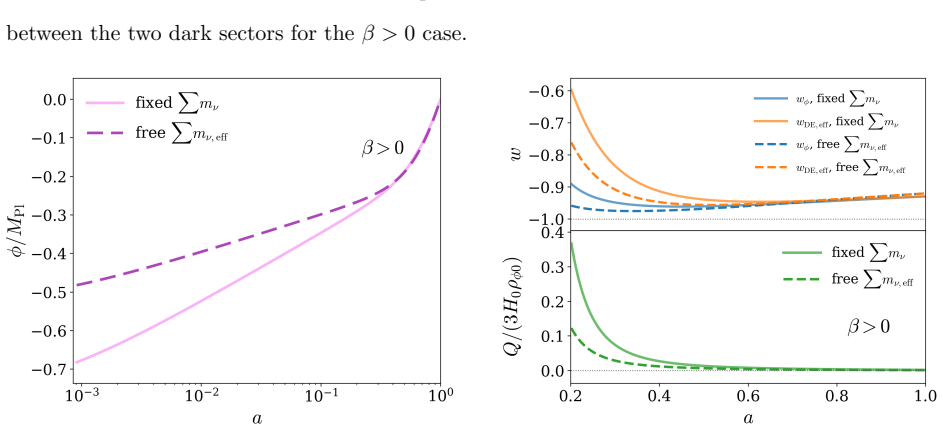
In the CQ-EXP model, fixing the neutrino mass sum at 0.06 eV produces a greater than 3 sigma preference for beta less than 0. This branch yields a sign change in the energy transfer rate and makes the effective equation of state of dark energy cross the phantom divide. Treating the effective neutrino mass as a free parameter weakens the preference for any nonzero coupling and yields comparable minimum chi-squared values for the beta greater than 0 and beta less than 0 branches, both slightly worse than the fit of the w0waCDM model.
What carries the argument
The coupling parameter beta in the exponential interaction between quintessence and cold dark matter; its negative sign reverses the energy transfer and produces phantom-divide crossing in the effective dark-energy equation of state.
If this is right
- With the neutrino mass sum fixed, current data favor the branch of the model that exhibits phantom-divide crossing.
- Allowing the effective neutrino mass to vary removes the statistical distinction between crossing and non-crossing branches.
- Both branches of the coupled model then fit the data about as well as the w0waCDM parametrization.
- Negative values of the effective neutrino mass parameter are preferred when that freedom is introduced.
Where Pith is reading between the lines
- The apparent evidence for phantom crossing is driven by the restrictive neutrino-mass prior rather than by the dark-energy data alone.
- Future tighter bounds on the neutrino mass sum could either restore or eliminate the statistical preference for crossing.
- The coupled quintessence model remains statistically competitive with simpler dark-energy parametrizations once neutrino-mass freedom is included.
Load-bearing premise
The neutrino mass sum can be fixed at exactly 0.06 eV without loss of generality for the inference on the coupling.
What would settle it
A direct measurement showing that the neutrino mass sum differs substantially from 0.06 eV while the same CMB, BAO, and supernova data are retained would test whether the greater than 3 sigma preference for beta less than 0 and phantom crossing remains.
Figures



read the original abstract
We investigate a quintessence dark-energy model with an exponential potential and an exponential coupling to cold dark matter (CDM), hereafter referred to as the CQ-EXP model, using Planck CMB, DESI BAO, and DES-Dovekie supernova observations. We also examine how variations in the neutrino mass sector affect the constraints. When the neutrino mass sum is fixed at $\sum m_\nu=0.06$ eV, the data favor a coupling between quintessence and CDM, with the coupling parameter $\beta$ deviating from zero at more than $3\sigma$. In particular, the observations favor the $\beta<0$ branch, where the energy transfer between the two dark sectors changes sign and the effective equation of state (EoS) of dark energy crosses the phantom divide, $w=-1$. When the effective neutrino mass parameter $\sum m_{\nu,\mathrm{eff}}$ is treated as a free parameter, the data show a preference for negative values of $\sum m_{\nu,\mathrm{eff}}$. This additional freedom weakens the preference for the coupling between quintessence and CDM and leads to nearly identical values of $\chi^2_{\rm min}$ for the CQ-EXP models with $\beta>0$ and $\beta<0$, corresponding respectively to models without and with phantom-divide crossing in the effective EoS. Both values are slightly larger than that obtained in the $w_0w_a$CDM model, indicating that the CQ-EXP model cannot be statistically distinguished from the $w_0w_a$CDM model with the data considered here. Therefore, when $\sum m_\nu$ is fixed, current observations favor the CQ-EXP model with phantom-divide crossing. In contrast, when negative values of $\sum m_{\nu,\mathrm{eff}}$ are allowed, a CQ-EXP dark energy without crossing $w=-1$ can also provide an effective explanation of the latest observations.
Editorial analysis
A structured set of objections, weighed in public.
Referee Report
Summary. The manuscript examines a coupled quintessence model with exponential potential and exponential CDM coupling (CQ-EXP) against Planck CMB, DESI BAO, and DES-Dovekie SN data. With ∑mν fixed at 0.06 eV, the data favor β < 0 at >3σ, implying phantom-divide crossing in the effective dark-energy EoS. When ∑mν,eff is promoted to a free parameter (data prefer negative values), the coupling preference weakens, χ² minima for the β > 0 and β < 0 branches become statistically indistinguishable, and both are slightly worse than w0waCDM, so the CQ-EXP model cannot be distinguished from w0waCDM.
Significance. The work provides a clear, explicit demonstration that constraints on coupled dark-energy models and conclusions about phantom crossing are sensitive to the treatment of the neutrino mass sum. By directly comparing the fixed-∑mν and free-∑mν,eff cases and reporting the resulting χ² values relative to w0waCDM, the paper supplies a useful cautionary result for the field without overclaiming overall model preference.
major comments (1)
- [Abstract] Abstract (and corresponding results): the reported >3σ deviation of β from zero (favoring phantom crossing) is obtained exclusively under the fixed ∑mν = 0.06 eV choice. The manuscript itself shows that freeing ∑mν,eff removes the distinction between the β > 0 and β < 0 branches and yields χ² minima only marginally worse than w0waCDM; this makes the headline statistical claim conditional on a specific neutrino-mass assumption whose relaxation eliminates the reported preference.
Simulated Author's Rebuttal
We thank the referee for their careful review and for highlighting the importance of neutrino-mass assumptions in our analysis. The manuscript already contrasts the fixed and free ∑mν,eff cases in the abstract and main text; we address the single major comment below.
read point-by-point responses
-
Referee: [Abstract] Abstract (and corresponding results): the reported >3σ deviation of β from zero (favoring phantom crossing) is obtained exclusively under the fixed ∑mν = 0.06 eV choice. The manuscript itself shows that freeing ∑mν,eff removes the distinction between the β > 0 and β < 0 branches and yields χ² minima only marginally worse than w0waCDM; this makes the headline statistical claim conditional on a specific neutrino-mass assumption whose relaxation eliminates the reported preference.
Authors: We agree that the >3σ preference for β < 0 (and phantom crossing) holds only for the fixed ∑mν = 0.06 eV case. The abstract already states this conditionality explicitly: it first reports the fixed-mass result, then describes how freeing ∑mν,eff weakens the coupling preference, yields statistically indistinguishable χ² minima for the two β branches, and produces values only marginally worse than w0waCDM. The same contrast is developed in the results section. Because the conditional nature of the claim is already presented without overstatement, we do not believe further revision to the abstract is required. revision: no
Circularity Check
No circularity: standard data-driven parameter constraints with explicit sensitivity analysis
full rationale
The paper reports results from fitting the CQ-EXP model parameters (including β) to Planck CMB, DESI BAO, and DES supernova data via standard likelihood methods. The preference for β<0 (and consequent w crossing) when ∑mν is fixed at 0.06 eV, and the loss of that preference when ∑mν,eff is freed, are direct outputs of the posterior distributions and χ² comparisons; the crossing behavior is a model definition consequence of the sign of β, not an independent claim derived from the fit. No self-citations, ansatzes, or uniqueness theorems are invoked to support the central statistical results. The analysis is fully self-contained as an observational constraint exercise and does not reduce any claimed result to its inputs by construction.
Axiom & Free-Parameter Ledger
free parameters (2)
- β (coupling strength)
- ∑mν,eff
axioms (2)
- standard math Standard flat FLRW background and linear perturbation equations for coupled quintessence
- domain assumption Planck, DESI, and DES-Dovekie likelihoods are correctly implemented and uncorrelated beyond stated covariances
Reference graph
Works this paper leans on
-
[1]
A. G. Adame, J. Aguilar, S. Ahlen, et al., J. Cosmol. Astropart. Phys.02, 021 (2025)
2025
-
[2]
Abdul-Karim, J
M. Abdul-Karim, J. Aguilar, S. Ahlen, et al., Phys. Rev. D112, 083515 (2025)
2025
-
[3]
Chevallier and D
M. Chevallier and D. Polarski, Int. J. Mod. Phys. D10, 213 (2001)
2001
-
[4]
E. V. Linder, Phys. Rev. Lett.90, 091301 (2003)
2003
-
[5]
Lodha, R
K. Lodha, R. Calderon, W. L. Matthewson, et al., Phys. Rev. D112, 083511 (2025)
2025
-
[6]
G. Gu, X. Wang, Y. Wang, et al., Nat. Astron.9, 1879 (2025)
2025
-
[7]
J. Wang, H. Yu, P. Wu, Eur. Phys. J. C85, 853 (2025)
2025
-
[8]
Wang, R.-G
J.-Q. Wang, R.-G. Cai, Z.-K. Guo, and S.-J. Wang, Phys. Rev. D (2026)
2026
-
[9]
Ratra and P
B. Ratra and P. J. E. Peebles, Phys. Rev. D37, 3406 (1988)
1988
-
[10]
R. R. Caldwell, R. Dave, and P. J. Steinhardt, Phys. Rev. Lett.80, 1582 (1998)
1998
-
[11]
Zlatev, L
I. Zlatev, L. Wang, and P. J. Steinhardt, Phys. Rev. Lett.82, 896 (1999)
1999
-
[12]
E. J. Copeland, M. Sami, and S. Tsujikawa, Int. J. Mod. Phys. D15, 1753 (2006)
2006
-
[13]
Vikman, Phys
A. Vikman, Phys. Rev. D71, 023515 (2005)
2005
-
[14]
R. R. Caldwell and M. Doran, Phys. Rev. D72, 043527 (2005). 17
2005
-
[15]
R. R. Caldwell, Phys. Lett. B545, 23 (2002)
2002
-
[16]
S. M. Carroll, M. Hoffman, and M. Trodden, Phys. Rev. D68, 023509 (2003)
2003
-
[17]
J. M. Cline, S. Jeon, and G. D. Moore, Phys. Rev. D70, 043543 (2004)
2004
-
[18]
B. Wang, E. Abdalla, F. Atrio-Barandela, and D. Pav´ on, Rep. Prog. Phys.87, 036901 (2024)
2024
-
[19]
Amendola, Phys
L. Amendola, Phys. Rev. D62, 043511 (2000)
2000
-
[20]
Pettorino and C
V. Pettorino and C. Baccigalupi, Phys. Rev. D77, 103003 (2008)
2008
-
[21]
T.-N. Li, W. Giar` e, G.-H. Du, Y.-H. Li, E. Di Valentino, J.-F. Zhang, and X. Zhang, arXiv:2601.07361
-
[22]
A. A. Samanta, A. Ajith, and S. Panda, arXiv:2509.09624
-
[23]
J. Beltr´ an Jim´ enez, K. Ichiki, X. Liu, F. A. Teppa Pannia, and S. Tsujikawa, arXiv:2603.15805
-
[24]
B. Wang, Y. Gong, and E. Abdalla, Phys. Lett. B624, 141 (2005)
2005
-
[25]
Petri, V
V. Petri, V. Marra, and R. von Marttens, Phys. Rev. D113(2026)
2026
-
[26]
Chakraborty, P
A. Chakraborty, P. K. Chanda, S. Das, and K. Dutta, J. Cosmol. Astropart. Phys.11, 047 (2025)
2025
-
[27]
Chakraborty, T
A. Chakraborty, T. Ray, S. Das, A. Banerjee, and V. Ganesan, Astrophys. J.998, 83 (2026)
2026
-
[28]
Silva, M
E. Silva, M. A. Sabogal, M. Scherer, R. C. Nunes, E. Di Valentino, and S. Kumar, Phys. Rev. D111, 123511 (2025)
2025
- [29]
- [30]
-
[31]
L. A. Anchordoqui and D. L¨ ust, arXiv:2605.10476
-
[32]
Wetterich, Nucl
C. Wetterich, Nucl. Phys. B302, 668 (1988)
1988
-
[33]
E. J. Copeland, A. R. Liddle, and D. Wands, Phys. Rev. D57, 4686 (1998)
1998
-
[34]
Bhattacharya, G
S. Bhattacharya, G. Borghetto, A. Malhotra, S. Parameswaran, G. Tasinato, and I. Zavala, J. Cosmol. Astropart. Phys.09, 073 (2024)
2024
-
[35]
Tocchini-Valentini and L
D. Tocchini-Valentini and L. Amendola, Phys. Rev. D65, 063508 (2002)
2002
-
[36]
Gumjudpai, T
B. Gumjudpai, T. Naskar, M. Sami, and S. Tsujikawa, J. Cosmol. Astropart. Phys.06, 007 (2005)
2005
-
[37]
X. Liu, S. Tsujikawa, and K. Ichiki, Phys. Rev. D109, 043533 (2024)
2024
-
[38]
Baldi, Mon
M. Baldi, Mon. Not. R. Astron. Soc.420, 430 (2012)
2012
-
[39]
J.-C Wang, H.-W Yu, P.-X Wu, arXiv:2605.17754
-
[40]
J.-Q. Wang, R.-G. Cai, Z.-K. Guo, Y.-H. Li, S.-J. Wang, and X. Zhang, arXiv:2604.02204. 18
-
[41]
Astrophys.641, A6 (2020)
Planck Collaboration, Astron. Astrophys.641, A6 (2020)
2020
-
[42]
Rosenberg, S
E. Rosenberg, S. Gratton, and G. Efstathiou, Mon. Not. R. Astron. Soc.517, 4620 (2022)
2022
-
[43]
Carron, M
J. Carron, M. Mirmelstein, and A. Lewis, J. Cosmol. Astropart. Phys.09, 039 (2022)
2022
-
[44]
Popovic, P
B. Popovic, P. Shah, W. D. Kenworthy, et al., Mon. Not. R. Astron. Soc.548, stag632 (2026)
2026
-
[45]
T. M. C. Abbott et al. (DES Collaboration), Astrophys. J. Lett.973, L14 (2024)
2024
-
[46]
Elbers, A
W. Elbers, A. Aviles, H. E. Noriega, et al. (DESI Collaboration), Phys. Rev. D112, 083513 (2025)
2025
-
[47]
Du, P.-J
G.-H. Du, P.-J. Wu, T.-N. Li, and X. Zhang, Eur. Phys. J. C85, 392 (2025)
2025
-
[48]
Jhaveri, T
T. Jhaveri, T. Karwal, and W. Hu, Phys. Rev. D112, 043541 (2025)
2025
-
[49]
Elbers, C
W. Elbers, C. S. Frenk, A. Jenkins, B. Li, and S. Pascoli, Phys. Rev. D111, 063534 (2025)
2025
- [50]
- [51]
-
[52]
Friedmann, Z
A. Friedmann, Z. Phys.10, 377 (1922)
1922
-
[53]
Lemaˆ ıtre, Ann
G. Lemaˆ ıtre, Ann. Soc. Sci. Bruxelles A47, 49 (1927)
1927
-
[54]
H. P. Robertson, Astrophys. J.82, 284 (1935)
1935
-
[55]
A. G. Walker, Proc. Lond. Math. Soc.s2-42, 90 (1937)
1937
-
[56]
O. F. Ramadan, J. Sakstein, and D. Rubin, Phys. Rev. D110, L041303 (2024)
2024
-
[57]
R. R. Caldwell and E. V. Linder, Phys. Rev. Lett.95, 141301 (2005)
2005
-
[58]
Esteban, M
I. Esteban, M. C. Gonzalez-Garcia, M. Maltoni, I. Martinez-Soler, J. P. Pinheiro, and T. Schwetz, J. High Energy Phys.12, 216 (2024)
2024
-
[59]
Lesgourgues and S
J. Lesgourgues and S. Pastor, Phys. Rep.429, 307 (2006)
2006
-
[60]
Torrado and A
J. Torrado and A. Lewis, J. Cosmol. Astropart. Phys.05, 057 (2021)
2021
-
[61]
Amendola, Mon
L. Amendola, Mon. Not. R. Astron. Soc.312, 521 (2000)
2000
-
[62]
Ma and E
C.-P. Ma and E. Bertschinger, Astrophys. J.455, 7 (1995)
1995
-
[63]
Lewis, A
A. Lewis, A. Challinor, and A. Lasenby, Astrophys. J.538, 473 (2000)
2000
-
[64]
Li, J.-F
Y.-H. Li, J.-F. Zhang, and X. Zhang, Phys. Rev. D90, 063005 (2014)
2014
-
[65]
Li and X
Y.-H. Li and X. Zhang, J. Cosmol. Astropart. Phys.09, 046 (2023)
2023
-
[66]
A. G. Riess, W. Yuan, L. M. Macri, et al., Astrophys. J. Lett.934, L7 (2022)
2022
-
[67]
T. M. C. Abbott et al. (DES Collaboration), Phys. Rev. D105, 023520 (2022)
2022
-
[68]
Asgari, C.-A
M. Asgari, C.-A. Lin, B. Joachimi, et al., Astron. Astrophys.645, A104 (2021)
2021
-
[69]
Pettorino, L
V. Pettorino, L. Amendola, and C. Wetterich, Phys. Rev. D86, 103507 (2012). 19
2012
-
[70]
Baldi, Mon
M. Baldi, Mon. Not. R. Astron. Soc.422, 1028 (2012)
2012
-
[71]
Verde, T
L. Verde, T. Treu, and A. G. Riess, Nat. Astron.3, 891 (2019)
2019
-
[72]
Knox and M
L. Knox and M. Millea, Phys. Rev. D101, 043533 (2020)
2020
-
[73]
Di Valentino, O
E. Di Valentino, O. Mena, S. Pan, et al., Class. Quantum Grav.38, 153001 (2021)
2021
-
[74]
Sch¨ oneberg, G
N. Sch¨ oneberg, G. F. Abell´ an, A. P´ erez S´ anchez, et al., Phys. Rep.984, 1 (2022)
2022
-
[75]
Perivolaropoulos and F
L. Perivolaropoulos and F. Skara, New Astron. Rev.95, 101659 (2022)
2022
-
[76]
Di Valentino, L
E. Di Valentino, L. A. Anchordoqui, O. Akarsu, et al., Astropart. Phys.131, 102604 (2021)
2021
-
[77]
Abdalla, G
E. Abdalla, G. F. Abell´ an, A. Aboubrahim, et al., J. High Energy Astrophys.34, 49 (2022). 20
2022
discussion (0)
Sign in with ORCID, Apple, or X to comment. Anyone can read and Pith papers without signing in.