Halide substitution effects on the photovoltaic properties of Ca₃PX₃ (X = F, Cl, Br, I) perovskites: advancing solar cell efficiency
Pith reviewed 2026-06-26 11:45 UTC · model grok-4.3
The pith
Halide substitution in Ca3PX3 perovskites yields direct bandgaps of 2.0-3.788 eV and up to 29.6% SLME efficiency for the iodide compound.
A machine-rendered reading of the paper's core claim, the machinery that carries it, and where it could break.
Core claim
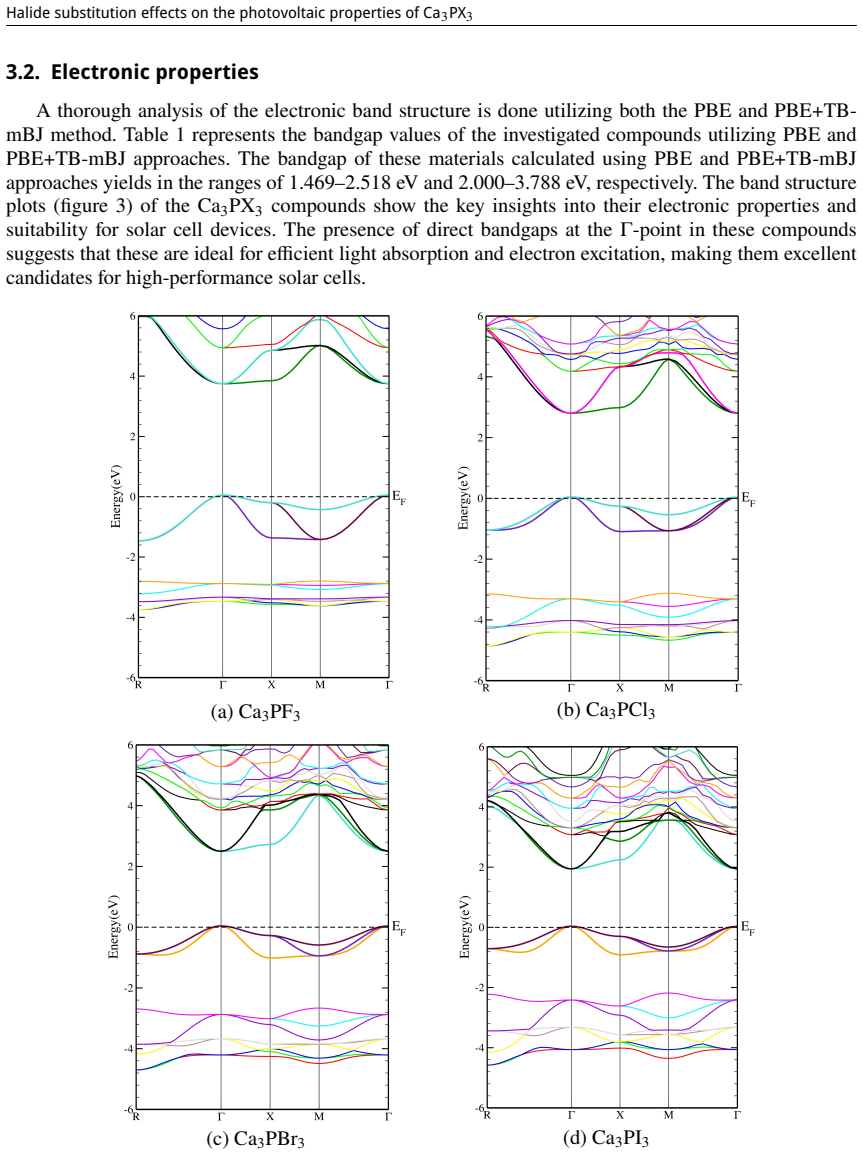
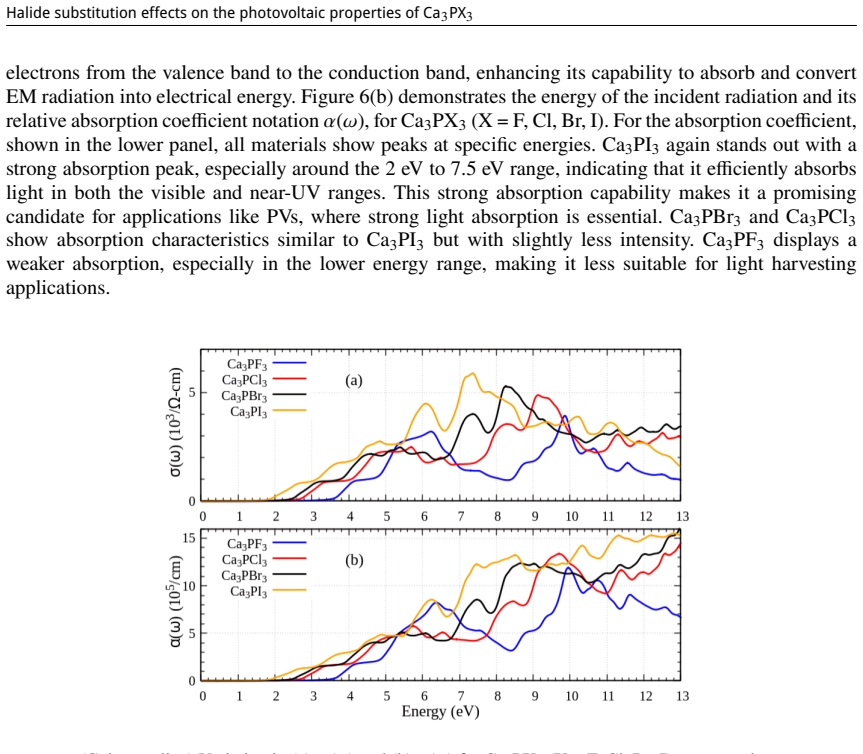
First-principles calculations show that Ca3PX3 (X = F, Cl, Br, I) perovskites possess direct bandgaps between 2.0 eV and 3.788 eV. Ca3PI3 exhibits the most stable configuration and reaches the highest spectroscopic screening limited maximum efficiency of 29.6%, while Ca3PF3 reaches only 0.6%, demonstrating that halide substitution tunes these materials for solar-cell suitability.
What carries the argument
The spectroscopic screening limited maximum efficiency (SLME) metric, computed from first-principles bandgaps and optical spectra to estimate maximum photovoltaic performance.
If this is right
- Ca3PI3 emerges as the strongest candidate in the series for solar-cell use on the basis of stability and calculated efficiency.
- Systematic replacement of the halogen allows controlled adjustment of bandgap and efficiency across the series.
- The direct bandgaps position all four compounds as candidates for light-absorbing layers in optoelectronic devices.
- The efficiency ordering favors larger halides, with iodine outperforming fluorine.
Where Pith is reading between the lines
- The observed trend of decreasing bandgap and rising efficiency with larger halides may extend to related perovskite families.
- Direct experimental synthesis and device testing of Ca3PI3 would provide a concrete check on the theoretical efficiency limit.
- Materials in this bandgap window could also support applications such as photodetectors if the photovoltaic prediction holds.
Load-bearing premise
The SLME values obtained from the calculated bandgaps and spectra accurately reflect the real upper limits of solar-cell efficiency for these compounds.
What would settle it
Fabricating and testing a Ca3PI3 solar cell whose measured power conversion efficiency falls well below the predicted 29.6% would challenge the efficiency claim.
Figures




read the original abstract
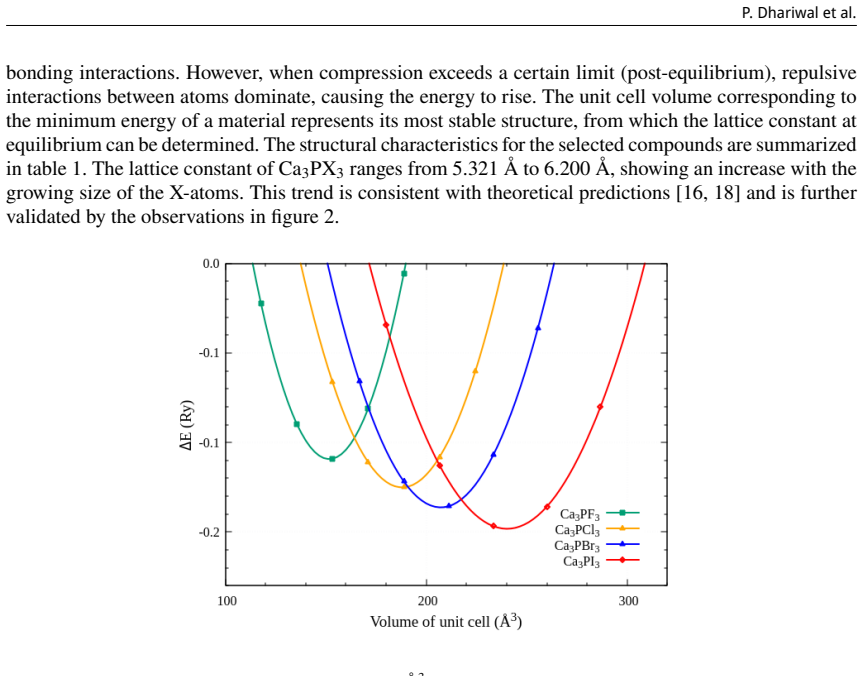
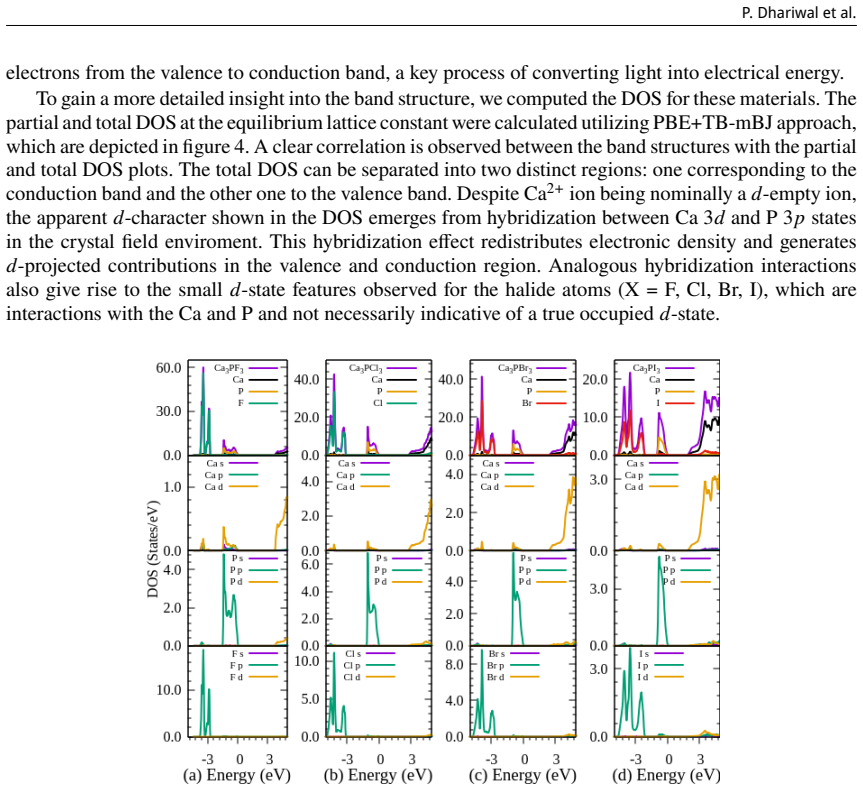
Herein, the fundamental physical characteristics like structural, electronic, optical parameters of the Ca$_3$PX$_3$ (X = F, Cl, Br, I) materials have been investigated for their potential optoelectronic applications, particularly for solar cells and related devices. To the crystallographic investigations, Ca$_3$PI$_3$ has the most stable configuration among all investigated materials. From the band structure analyses of these materials indicate that all materials have a direct bandgap in the range of 2.0 eV to 3.788 eV, which makes them ideal for light absorption. For the photovoltaic applications, we have analysed first-principles spectroscopic screening limited maximum efficiency (SLME) which confirms that the Ca$_3$PI$_3$ material exhibits the highest solar cell efficiency 29.6% and Ca$_3$PF$_3$ and shows lower efficiency for solar cell suitability 0.6%. Thus, these results demonstrate the real potential and abilities of halide substitution to tune the materials for particular optoelectronic devices.
Editorial analysis
A structured set of objections, weighed in public.
Referee Report
Summary. The manuscript reports first-principles calculations of the structural, electronic, and optical properties of Ca₃PX₃ (X = F, Cl, Br, I) perovskites. It finds all compounds to be direct-gap semiconductors with gaps from 2.0 eV to 3.788 eV, identifies Ca₃PI₃ as the most stable, and uses the spectroscopic limited maximum efficiency (SLME) metric to conclude that Ca₃PI₃ reaches 29.6 % solar-cell efficiency while Ca₃PF₃ is limited to 0.6 % suitability.
Significance. If the underlying DFT results and SLME values prove reproducible and the materials can be synthesized, the work would add a computational survey of halide-tuned Ca-based perovskites to the optoelectronics literature. The emphasis on SLME screening is a standard approach, but the absence of methodological transparency and experimental anchoring reduces the immediate significance of the efficiency claims.
major comments (2)
- [Abstract and photovoltaic applications section] Abstract and photovoltaic-applications section: the central claim equates computed SLME directly to 'solar cell efficiency' (29.6 % for Ca₃PI₃) and 'suitability' (0.6 % for Ca₃PF₃) without any experimental PV data, comparison to benchmark absorbers such as MAPbI₃, or discussion of SLME's idealizing assumptions (step-function absorption, infinite thickness, no non-radiative losses). This mapping is load-bearing for the paper's conclusion yet unsupported.
- [Results / methods] Results and methods (computational details): the reported band gaps and SLME values are given without any statement of the exchange-correlation functional, k-point sampling, plane-wave cutoff, or convergence criteria. These parameters control the electronic-structure inputs to SLME; their omission prevents evaluation or reproduction of the numerical results that underpin the efficiency ranking.
minor comments (1)
- [Abstract] Abstract: the sentence fragment 'Ca₃PF₃ and shows lower efficiency for solar cell suitability 0.6%' contains a grammatical or typographical error.
Simulated Author's Rebuttal
We thank the referee for the detailed and constructive report. We agree that both the presentation of the SLME results and the computational methodology require clarification and will revise the manuscript accordingly.
read point-by-point responses
-
Referee: [Abstract and photovoltaic applications section] Abstract and photovoltaic-applications section: the central claim equates computed SLME directly to 'solar cell efficiency' (29.6 % for Ca₃PI₃) and 'suitability' (0.6 % for Ca₃PF₃) without any experimental PV data, comparison to benchmark absorbers such as MAPbI₃, or discussion of SLME's idealizing assumptions (step-function absorption, infinite thickness, no non-radiative losses). This mapping is load-bearing for the paper's conclusion yet unsupported.
Authors: We accept the criticism. The abstract and photovoltaic-applications section will be revised to state explicitly that the reported values are SLME upper limits computed under ideal assumptions (step-function absorption, infinite thickness, radiative limit only). We will add a short paragraph discussing these idealizations and will include a comparison to the SLME of MAPbI₃ (typically 30–33 % in the literature) to place the 29.6 % value for Ca₃PI₃ in context. The wording will be changed from “solar cell efficiency” to “predicted maximum efficiency” throughout. These changes do not alter the underlying calculations but improve the accuracy of the claims. revision: yes
-
Referee: [Results / methods] Results and methods (computational details): the reported band gaps and SLME values are given without any statement of the exchange-correlation functional, k-point sampling, plane-wave cutoff, or convergence criteria. These parameters control the electronic-structure inputs to SLME; their omission prevents evaluation or reproduction of the numerical results that underpin the efficiency ranking.
Authors: We agree that the methodological parameters must be stated. The revised manuscript will include a dedicated Computational Details subsection specifying the exchange-correlation functional (PBE), k-point mesh (Monkhorst-Pack 8×8×8 for the primitive cell), plane-wave cutoff (500 eV), and convergence thresholds (10⁻⁶ eV for energy, 0.01 eV/Å for forces). These parameters were used in the original calculations; their omission was an oversight that will be corrected. revision: yes
Circularity Check
No significant circularity; SLME application follows standard first-principles workflow without reduction to inputs
full rationale
The paper reports DFT-derived bandgaps (2.0–3.788 eV) and optical spectra for Ca₃PX₃ compounds, then applies the established Yu-Zunger SLME formula to obtain efficiency estimates (29.6% for Ca₃PI₃, 0.6% for Ca₃PF₃). This is a conventional post-processing step, not a self-definitional loop, fitted-parameter renaming, or self-citation chain. No equations or text in the abstract demonstrate that the reported SLME values are equivalent to the input data by construction. The central photovoltaic claim rests on external method definitions rather than internal reduction. Self-contained against benchmarks per rules; honest non-finding.
Axiom & Free-Parameter Ledger
Reference graph
Works this paper leans on
-
[1]
Mubarak A. A., Mousa A. A., Comput. Mater. Sci., 2012,59, 6–13, doi:10.1016/j.commatsci.2012.02.020
-
[2]
RehmanJ.U.,RehmanM.A.,UsmanM.,TahirM.B.,HussainA.,ZulfiqarM.,AlzaidM.,AliA.M.,ShahzadK., Emergent Mater., 2023,6, 699–709, doi:10.1007/s42247-023-00475-2
-
[3]
Matter, 2023,36, e00835, doi:10.1016/j.cocom.2023.e00835
RaniU.,KamleshP.K.,JoshiT.K.,SinghR.,SharmaS.,GuptaR.,KumarT.,VermaA.S.,Comput.Condens. Matter, 2023,36, e00835, doi:10.1016/j.cocom.2023.e00835
-
[4]
MounaS.C.,RadjaiM.,BouhemadouA.,HouatisD.,AllaliD.,EssaoudS.S.,Bin-OmranS.,Phys.Scr.,2023, 98, 065949, doi:10.1088/1402-4896/acd3c4
-
[5]
Hamideddine I., Zitouni H., Tahiri N., El Bounagui O., Ez-Zahraouy H., Appl. Phys. A, 2021,127, 443, doi:10.1007/s00339-021-04600-y. 23701-12 Halide substitution effects on the photovoltaic properties of Ca 3PX3
-
[6]
Rani U., Kamlesh P. K., Shukla A., Verma A. S., J. Solid State Chem., 2021,300, 122246, doi:10.1016/j.jssc.2021.122246
-
[7]
Rahman M. F., Rahman M. A., Islam M. R., Ghosh A., Shanto M. A. B., Chowdhury M., Islam M. A. I., Rahman M. H., Hossain M. K., Islam M. A., AIP Adv., 2023,13, 085329, doi:10.1063/5.0156961
-
[8]
Rahman M. A., Rahman M. F., Marasamy L., Harun-Or-Rashid M., Ghosh A., Chaudhry A. R., Irfan A., Energy Fuels, 2024,38, 8199–8217, doi:10.1021/acs.energyfuels.4c00525
-
[9]
BelhamraS.,MasrourR.,JabarA.,HlilE.K.,Polyhedron,2021,193,114891,doi:10.1016/j.poly.2020.114891
-
[10]
Kaltzoglou A., Elsenety M. M., Koutselas I., Kontos A. G., Papadopoulos K., Psycharis V., Raptopoulou C. P., Perganti D., Stergiopoulos T., Falaras P., Polyhedron, 2018,140, 67–73, doi:10.1016/j.poly.2017.11.030
-
[11]
Photonics, 2019,13, 460–466, doi:10.1038/s41566-019-0398-2
Jiang Q., Zhao Y., Zhang X., Yang X., Chen Y., Chu Z., Ye Q., Li X., Yin Z., You J., Nat. Photonics, 2019,13, 460–466, doi:10.1038/s41566-019-0398-2
-
[12]
Mater., 2017,29, 1605005, doi:10.1002/adma.201605005
Shi Z., Guo J., Chen Y., Li Q., Pan Y., Zhang H., Xia Y., Huang W., Adv. Mater., 2017,29, 1605005, doi:10.1002/adma.201605005
-
[13]
J., ACS Energy Lett., 2016,1, 1233–1240, doi:10.1021/acsenergylett.6b00499
Giustino F., Snaith H. J., ACS Energy Lett., 2016,1, 1233–1240, doi:10.1021/acsenergylett.6b00499
-
[14]
Mahmud S., Hossain M. M., Uddin M., Ali M. A., J. Phys. Chem. Solids, 2025,196, 112298, doi:10.1016/j.jpcs.2024.112298
-
[15]
K., Sharma R., Optik, 2025,327, 172310, doi:10.1016/j.ijleo.2025.172310
Malan C., Mishra K. K., Sharma R., Optik, 2025,327, 172310, doi:10.1016/j.ijleo.2025.172310
-
[16]
Apurba I. K. G. G., Islam M. R., Rahman M. S., Rahman M. F., Park J., Heliyon, 2024,10, e29144, doi:10.1016/j.heliyon.2024.e29144
-
[17]
Shimul A. I., Haque M. M., Ghosh A., Awwad N. S., Ibrahium H. A., Opt. Commun., 2025,583, 131807, doi:10.1016/j.optcom.2025.131807
-
[18]
Alloys Compd., 2024,986, 174097, doi:10.1016/j.jallcom.2024.174097
GhoshA.,RahmanM.F.,KuddusA.,MohammedM.K.A.,IslamM.R.,BhattaraiS.,ChaudhryA.R.,IrfanA., J. Alloys Compd., 2024,986, 174097, doi:10.1016/j.jallcom.2024.174097
-
[19]
Journal of Systems and Soft- ware202, 111722 (2023).https://doi.org/10.1016/j.jss.2023.111722
Islam M. R., Zahid A., Rahman M. A., Rahman Md. F., Islam M. A., Hossain M. K., Ali M. A., Iqbal M. A., Bakhsh F. I., Ahmad S., J. Phys. Chem. Solids, 2024,184, 111722, doi:10.1016/j.jpcs.2023.111722
-
[20]
Feng H.-J., Zhang Q., Appl. Phys. Lett., 2021,118, 111902, doi:10.1063/5.0039936
-
[21]
Brogan M. A., Hughes R. W., Smith R. I., Gregory D. H., J. Solid State Chem., 2012,185, 213–218, doi:10.1016/j.jssc.2011.11.008
-
[22]
K., Nano Sel., 2023,4, 632–645, doi:10.1002/nano.202300066
RahmanMd.F.,IslamMd.A.I.,IslamMd.R.,AliMd.H.,BarmanP.,RahmanMd.A.,Harun-Or-RashidMd., Hasan M., Hossain M. K., Nano Sel., 2023,4, 632–645, doi:10.1002/nano.202300066
-
[23]
BlahaP.,SchwarzK.,TranF.,LaskowskiR.,MadsenG.K.H.,MarksL.D.,J.Chem.Phys.,2020,152,074101, doi:10.1063/1.5143061
-
[24]
PerdewJ.P.,BurkeK.,ErnzerhofM.,Phys.Rev.Lett.,1996,77,3865–3868,doi:10.1103/PhysRevLett.77.3865
-
[25]
Tran F., Blaha P., Phys. Rev. Lett., 2009,102, 226401, doi:10.1103/PhysRevLett.102.226401
-
[26]
Yu L., Zunger A., Phys. Rev. Lett., 2012,108, 068701, doi:10.1103/PhysRevLett.108.068701
-
[27]
Rev., 1947,71, 809–824, doi:10.1103/PhysRev.71.809
Birch F., Phys. Rev., 1947,71, 809–824, doi:10.1103/PhysRev.71.809
-
[28]
Murnaghan F. D., Proc. Natl. Acad. Sci. U.S.A., 1944,30, 244–247, doi:10.1073/pnas.30.9.244
-
[29]
Srivastava S., Rani U., Rani M., Toual Y., Dubey A., Pandit N., Verma A. S., Nehra S., Kamlesh P. K., Next Mater., 2025,8, 100724, doi:10.1016/j.nxmate.2025.100724
-
[30]
MeenaA.,BairwaJ.K.,KumariS.,RaniU.,KamleshP.K.,SinghA.P.,VermaA.S.,Phys.Chem.SolidState, 2025,26, 10–22, doi:10.15330/pcss.26.1.10-22
-
[31]
Hailouf H. E., Obodo K. O., Aourag H., Rani U., Kamlesh P. K., Reggab K., Verma M. L., Goumri-Said S., Mater. Sci. Semicond. Process., 2025,186, 109019, doi:10.1016/j.mssp.2024.109019
-
[32]
Kamlesh P. K., Advancements in Half-Heuslers: A Key to Clean Energy, Scholarly Publication, 2024, doi:10.5281/zenodo.16329759
-
[33]
March on the Occasion of his 90th Birthday, Springer International Publishing, Cham, 2018, 177–184
Bercx M., Saniz R., Partoens B., Lamoen D., In: Many-body Approaches at Different Scales: A Tribute to Norman H. March on the Occasion of his 90th Birthday, Springer International Publishing, Cham, 2018, 177–184
2018
-
[34]
Li Z., Wei B., Nano-Micro Lett., 2025,17, 330, doi:10.1007/s40820-025-01844-8. 23701-13 P . Dhariwal et al. Вплив галогенiдного замiщення на фотоелектричнi властивостi перовскiтiв Ca3PX3 (X = F, Cl, Br, I): пiдвищення ефективностi сонячних елементiв П. Дхарiвал 1, Д. Пракаш 2, К. Д. Верма 1, А. Кумарi 1, П. К. Камлеш 3, А. С. Верма 4,5 1 Науково-дослiдна ...
discussion (0)
Sign in with ORCID, Apple, or X to comment. Anyone can read and Pith papers without signing in.