Accelerating Discovery: Model-Agnostic Likelihoods for the Reinterpretation of Particle Physics Results and their Application to the Belle II B⁺to K⁺νbar{ν} Measurement
Pith reviewed 2026-06-26 10:44 UTC · model grok-4.3
The pith
Reweighting joint distributions by theory prediction ratios produces model-agnostic likelihoods from existing particle physics results.
A machine-rendered reading of the paper's core claim, the machinery that carries it, and where it could break.
Core claim
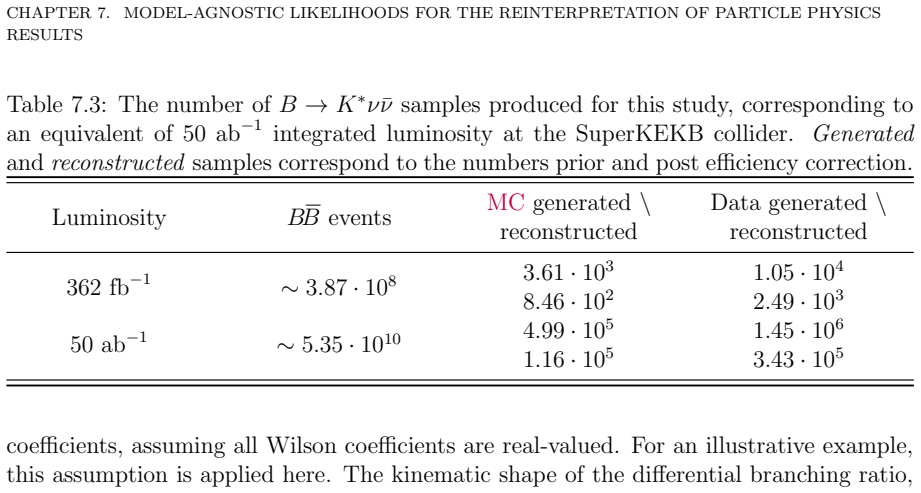
The central discovery is a reinterpretation technique that starts from a histogram-based likelihood and reweights the joint distribution of reconstruction and kinematic variables according to the ratio of theoretical predictions of alternative to null hypotheses, thereby generating updated templates for any theoretical model while preserving correlations and systematic uncertainties, as shown in its application to the Belle II B+ to K+ nu nubar measurement for both Weak Effective Theory constraints and light new physics searches.
What carries the argument
The reweighting of the joint distribution of reconstruction and kinematic variables according to the ratio of theoretical predictions of alternative to null hypotheses, which generates updated templates from an existing histogram-based likelihood.
If this is right
- Any theoretical model can have updated templates produced from the original data.
- Correlations between variables and systematic uncertainties remain preserved in the reweighted distributions.
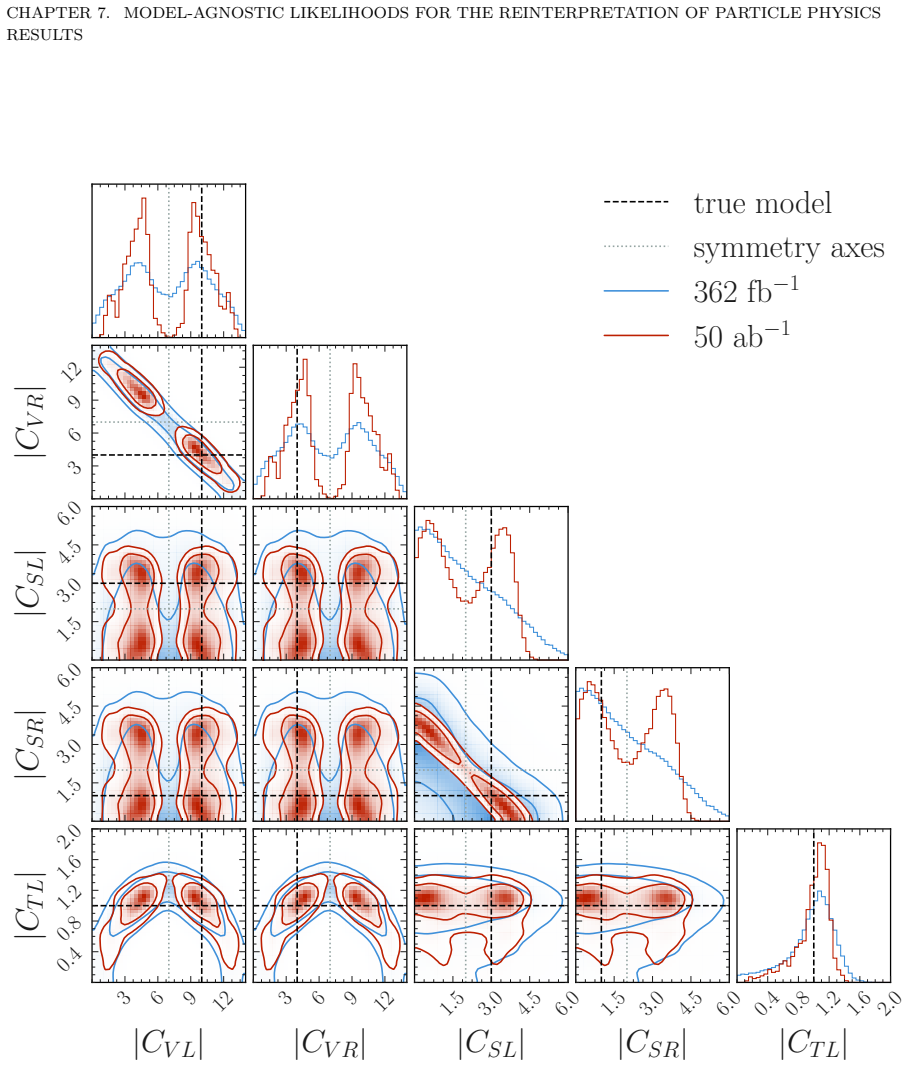
- The method enables constraints on Wilson coefficients in Weak Effective Theory from the Belle II result.
- A search for light new physics in two-body decays B+ to K+ X can be performed using the same likelihoods.
- Public release of the model-agnostic likelihoods makes experimental data more accessible for theoretical validation.
Where Pith is reading between the lines
- This approach could be extended to other collider experiments to speed up model testing across the field.
- The distributable likelihoods might encourage more experiments to release similar tools, increasing the reuse of data.
- By reducing computational demands, it allows exploration of a wider range of theoretical parameters than previously feasible.
- Potential applications include rapid checks of models against multiple datasets simultaneously.
Load-bearing premise
Reweighting the joint distribution by the ratio of theoretical predictions updates the likelihood accurately for alternative hypotheses without needing corrections for differences in acceptance or efficiency between models.
What would settle it
Performing a full reanalysis for an alternative model where efficiency or acceptance varies significantly from the original and comparing the resulting limits or templates to those from the reweighting method would falsify the claim if they disagree substantially.
Figures













read the original abstract
Experimental results in high-energy physics are inherently hypothesis-dependent, as collider analyses are designed to test specific theoretical frameworks. The proliferation of theoretical models creates a mismatch between the pace of theory development and experimental validation, motivating the reinterpretation of existing results in terms of alternative hypotheses. Existing strategies face limitations: full reanalysis requires enormous computational resources and experimental expertise, while simplified methods sacrifice accuracy by neglecting kinematic variations and systematic uncertainties. This thesis develops, validates, and applies a novel reinterpretation method that preserves statistical rigour while dramatically reducing computational requirements, enabling rapid inference on alternative theoretical parameters through distributable likelihoods. The method reweights the joint distribution of reconstruction and kinematic variables according to the ratio of theoretical predictions of alternative to null hypotheses. Starting from a histogram-based likelihood, this produces updated templates for any theoretical model while preserving correlations and systematic uncertainties. The method is validated through examples and applied to the Belle II $B^+ \to K^+ \nu\bar{\nu}$ measurement ($2.7\sigma$ tension with the Standard Model). Two analyses are presented: a Weak Effective Theory reinterpretation constraining Wilson coefficients, and a light new physics search via ${B^+ \to K^+ X}$ two-body decays. The public release of the resulting model-agnostic likelihoods establishes an important precedent for open science in experimental particle physics. By facilitating rapid theoretical validation, this approach democratizes experimental data access, enhances scientific return on investments, and advances FAIR Data principles in high-energy physics.
Editorial analysis
A structured set of objections, weighed in public.
Referee Report
Summary. The paper claims to develop a reinterpretation method that starts from a histogram-based likelihood and reweights the joint distribution of reconstruction and kinematic variables by the ratio of theoretical predictions (alternative to null hypothesis). This produces updated templates for arbitrary models while preserving correlations and systematic uncertainties. The method is validated on examples and applied to the Belle II B+ → K+ νν̄ measurement (2.7σ SM tension), yielding a Weak Effective Theory analysis constraining Wilson coefficients and a search for light new physics in B+ → K+ X two-body decays. The resulting model-agnostic likelihoods are released publicly to enable rapid theoretical reinterpretation.
Significance. If the central claim holds, the approach would substantially lower the barrier to reinterpretation of experimental results by avoiding full reanalyses, while maintaining statistical rigour. The public release of the likelihoods is a concrete strength that advances open science and FAIR principles in HEP. The application to an existing measurement with observed tension demonstrates immediate utility for both EFT and BSM searches.
major comments (1)
- [Abstract] Abstract and method description: the central claim that reweighting the joint distribution by the ratio of theoretical predictions produces accurate updated templates for any model rests on the assumption that these predictions already incorporate all model-dependent differences in acceptance, efficiency, and detector response. The manuscript does not specify whether the theoretical predictions are evaluated at generator level or with full, model-specific simulation; if the former, kinematics-dependent efficiency variations between models would remain uncorrected and the reweighting would be insufficient.
minor comments (2)
- The term 'distributable likelihoods' is used in the abstract but not defined or distinguished from standard histogram likelihoods; a brief clarification of the precise output format would aid readers.
- Validation examples are mentioned but no quantitative metrics (e.g., pull distributions or coverage tests) are referenced in the abstract; adding a short summary of these metrics in the main text would strengthen the validation section.
Simulated Author's Rebuttal
We thank the referee for their positive evaluation of the work's significance and for the constructive comment on the abstract and method. We address the point below and will revise the manuscript to improve clarity.
read point-by-point responses
-
Referee: [Abstract] Abstract and method description: the central claim that reweighting the joint distribution by the ratio of theoretical predictions produces accurate updated templates for any model rests on the assumption that these predictions already incorporate all model-dependent differences in acceptance, efficiency, and detector response. The manuscript does not specify whether the theoretical predictions are evaluated at generator level or with full, model-specific simulation; if the former, kinematics-dependent efficiency variations between models would remain uncorrected and the reweighting would be insufficient.
Authors: We agree that the manuscript does not explicitly state the level at which the theoretical predictions are evaluated. In the method, the ratio is formed from generator-level predictions for the alternative and null hypotheses, with reweighting applied directly to the joint distribution of reconstructed and kinematic variables obtained from the original analysis. This preserves the detector response encoded in the original templates but assumes that efficiency and acceptance variations between models are either negligible or already captured in the ratio for the observables considered. The referee is correct that this assumption requires clarification, particularly for models with substantially different kinematics. We will revise the abstract, method section, and discussion to explicitly note that predictions are generator-level, state the assumption regarding efficiency, and add a limitations paragraph describing the regime of validity (small efficiency variations) and when full simulation would be needed instead. revision: yes
Circularity Check
No circularity; method uses independent external theory inputs
full rationale
The paper's central procedure reweights joint distributions of reconstruction and kinematic variables by the ratio of theoretical predictions (alternative/null hypotheses) to produce updated templates. This step is defined in terms of external theoretical predictions, not quantities fitted from the Belle II data or self-referential definitions. No load-bearing steps reduce by construction to inputs via self-citation, fitted parameters renamed as predictions, or ansatz smuggling. The derivation chain remains independent of the target result and relies on external benchmarks for the theory ratios.
Axiom & Free-Parameter Ledger
Reference graph
Works this paper leans on
-
[1]
Minson, S. E. and Simons, M. and Beck, J. L. , title =. Geophysical Journal International , volume =. 2013 , month =. doi:10.1093/gji/ggt180 , url =
-
[2]
doi:10.1093/ptep/pts083 , journal =
Ohnishi, Yukiyoshi and others , title =. doi:10.1093/ptep/pts083 , journal =
-
[3]
Giordon Stark and Camila Aristimuno Ots and Mike Hance , journal =. 2024 , publisher =. doi:10.21468/SciPostPhysCodeb.27-r0.5 , url =
-
[4]
SciPy 1.0--Fundamental Algorithms for Scientific Computing in Python
Virtanen, Pauli and others , title =. doi:10.1038/s41592-019-0686-2 , journal =. 1907.10121 , archiveprefix =
work page internal anchor Pith review Pith/arXiv arXiv doi:10.1038/s41592-019-0686-2 1907
-
[5]
doi:10.1103/PhysRevD.110.055013 , journal =
Abdughani, Murat and Reyimuaji, Yakefu , title =. doi:10.1103/PhysRevD.110.055013 , journal =. 2309.03706 , archiveprefix =
-
[6]
Abe, T. and others , collaboration =. 1011.0352 , archiveprefix =
-
[7]
PeerJ Computer Science , year =
PyMC: a modern, and comprehensive probabilistic programming framework in Python , author =. PeerJ Computer Science , year =
-
[8]
doi:10.1088/1674-1137/44/2/021001 , journal =
Abudin. doi:10.1088/1674-1137/44/2/021001 , journal =. 1910.05365 , archiveprefix =
-
[9]
Adachi, I. and Browder, T. E. and Kri. doi:10.1016/j.nima.2018.03.068 , journal =
-
[10]
Aebischer, Jason and Fael, Matteo and Greub, Christoph and Virto, Javier , title =. doi:10.1007/JHEP09(2017)158 , journal =. 1704.06639 , archiveprefix =
work page internal anchor Pith review Pith/arXiv arXiv doi:10.1007/jhep09(2017)158 2017
-
[11]
WCxf: an exchange format for Wilson coefficients beyond the Standard Model
Aebischer, Jason and others , title =. doi:10.1016/j.cpc.2018.05.022 , journal =. 1712.05298 , archiveprefix =
work page internal anchor Pith review Pith/arXiv arXiv doi:10.1016/j.cpc.2018.05.022 2018
-
[12]
Agostinelli, S. and others , collaboration =. doi:10.1016/S0168-9002(03)01368-8 , journal =
-
[13]
doi:10.1016/j.cpc.2019.07.013 , journal =
Ambrogi, Federico and others , title =. doi:10.1016/j.cpc.2019.07.013 , journal =. 1811.10624 , archiveprefix =
-
[14]
doi:10.1103/PhysRevD.104.055017 , journal =
Angelescu, Andrei and Be. doi:10.1103/PhysRevD.104.055017 , journal =. 2103.12504 , archiveprefix =
- [15]
-
[16]
Observation of CP violation in the B^0 meson system
Aubert, Bernard and others , collaboration =. doi:10.1103/PhysRevLett.87.091801 , journal =. hep-ex/0107013 , archiveprefix =
work page internal anchor Pith review Pith/arXiv arXiv doi:10.1103/physrevlett.87.091801
-
[17]
doi:10.1016/j.nima.2025.170279 , journal =
B. doi:10.1016/j.nima.2025.170279 , journal =. 2402.14962 , archiveprefix =
-
[18]
Bailey, Stephen and others , title =. 2203.10057 , archiveprefix =
-
[19]
doi:10.1016/0010-4655(94)90074-4 , journal =
Barberio, Elisabetta and Was, Zbigniew , title =. doi:10.1016/0010-4655(94)90074-4 , journal =
-
[20]
Fitting using finite Monte Carlo samples
Barlow, Roger J. and Beeston, Christine , title =. doi:10.1016/0010-4655(93)90005-W , journal =
-
[21]
Kuhr, T. and Pulvermacher, C. and Ritter, M. and Hauth, T. and Braun, N. , collaboration =. doi:10.1007/s41781-018-0017-9 , journal =. 1809.04299 , archiveprefix =
work page internal anchor Pith review Pith/arXiv arXiv doi:10.1007/s41781-018-0017-9
-
[22]
doi:10.1140/epjc/s10052-023-11388-z , journal =
Be. doi:10.1140/epjc/s10052-023-11388-z , journal =. 2301.06990 , archiveprefix =
-
[23]
Altmannshofer, W. and others , editor =. 2019 , note =. doi:10.1093/ptep/ptz106 , journal =. 1808.10567 , archiveprefix =
-
[24]
doi:10.1103/PhysRevLett.127.181802 , journal =
Abudin. doi:10.1103/PhysRevLett.127.181802 , journal =. 2104.12624 , archiveprefix =
-
[25]
Adachi, I. and others , collaboration =. doi:10.1103/PhysRevD.109.112006 , journal =. 2311.14647 , archiveprefix =
-
[26]
Adachi, I. and others , collaboration =. doi:10.1088/1674-1137/ad806c , journal =. 2407.00965 , archiveprefix =
-
[27]
Observation of Large CP Violation in the Neutral B Meson System
Abe, Kazuo and others , collaboration =. doi:10.1103/PhysRevLett.87.091802 , journal =. hep-ex/0107061 , archiveprefix =
work page internal anchor Pith review Pith/arXiv arXiv doi:10.1103/physrevlett.87.091802
-
[28]
Lee, S. H. and others , editor =. doi:10.1103/PhysRevLett.91.261801 , journal =. hep-ex/0308040 , archiveprefix =
work page internal anchor Pith review Pith/arXiv arXiv doi:10.1103/physrevlett.91.261801
-
[29]
Search for $\boldsymbol{B\to h\nu\bar{\nu}}$ decays with semileptonic tagging at Belle
Grygier, J. and others , collaboration =. 2017 , note =. doi:10.1103/PhysRevD.96.091101 , journal =. 1702.03224 , archiveprefix =
work page internal anchor Pith review Pith/arXiv arXiv doi:10.1103/physrevd.96.091101 2017
-
[30]
Abumusabh, Merna and others , collaboration =. 2025 , journal =. 2507.12393 , archiveprefix =
arXiv 2025
-
[31]
2017 , month = jan, day =
Johannes Grygier and Michael Feindt and Martin Heck and Pablo Goldenzweig , title =. 2017 , month = jan, day =
2017
-
[32]
doi:10.1209/0295-5075/ad1d03 , journal =
Berezhnoy, Alexander and Melikhov, Dmitri , title =. doi:10.1209/0295-5075/ad1d03 , journal =. 2309.17191 , archiveprefix =
-
[33]
and Duell, Stephan and Ligeti, Zoltan and Papucci, Michele and Robinson, Dean J
Bernlochner, Florian U. and Duell, Stephan and Ligeti, Zoltan and Papucci, Michele and Robinson, Dean J. , title =. doi:10.1140/epjc/s10052-020-8304-0 , journal =. 2002.00020 , archiveprefix =
-
[34]
and Menary, Stephen Burns and Persson, Eric , title =
Bernlochner, Florian Urs and Fry, Daniel C. and Menary, Stephen Burns and Persson, Eric , title =. doi:10.21468/SciPostPhysCore.6.1.013 , journal =. 2207.01350 , archiveprefix =
-
[35]
doi:10.1016/j.cpc.2020.107610 , journal =
Bertacchi, Valerio and others , collaboration =. doi:10.1016/j.cpc.2020.107610 , journal =. 2003.12466 , archiveprefix =
-
[36]
$B\to V\ell^+\ell^-$ in the Standard Model from Light-Cone Sum Rules
Bharucha, Aoife and Straub, David M. and Zwicky, Roman , title =. doi:10.1007/JHEP08(2016)098 , journal =. 1503.05534 , archiveprefix =
work page internal anchor Pith review Pith/arXiv arXiv doi:10.1007/jhep08(2016)098 2016
-
[37]
Bierlich, Christian and others , title =. doi:10.21468/SciPostPhys.8.2.026 , journal =. 1912.05451 , archiveprefix =
-
[38]
Model-independent description of $B\to \pi l\nu$ decays and a determination of $|V_{ub}|$
Bourrely, Claude and Caprini, Irinel and Lellouch, Laurent , title =. 2009 , note =. doi:10.1103/PhysRevD.82.099902 , journal =. 0807.2722 , archiveprefix =
work page internal anchor Pith review Pith/arXiv arXiv doi:10.1103/physrevd.82.099902 2009
-
[39]
doi:10.1007/JHEP01(2024)092 , journal =
Bruggisser, Sebastian and Grabitz, Lara and Westhoff, Susanne , title =. doi:10.1007/JHEP01(2024)092 , journal =. 2308.11703 , archiveprefix =
-
[40]
Weak Decays Beyond Leading Logarithms
Buchalla, Gerhard and Buras, Andrzej J. and Lautenbacher, Markus E. , title =. doi:10.1103/RevModPhys.68.1125 , journal =. hep-ph/9512380 , archiveprefix =
work page internal anchor Pith review Pith/arXiv arXiv doi:10.1103/revmodphys.68.1125
-
[41]
Buchmuller, W. and Ludeling, C. , title =. hep-ph/0609174 , archiveprefix =
- [42]
-
[43]
The Anatomy of Z' and Z with Flavour Changing Neutral Currents in the Flavour Precision Era
Buras, Andrzej J. and De Fazio, Fulvia and Girrbach, Jennifer , title =. doi:10.1007/JHEP02(2013)116 , journal =. 1211.1896 , archiveprefix =
work page internal anchor Pith review Pith/arXiv arXiv doi:10.1007/jhep02(2013)116 2013
-
[44]
$B\to K^{(*)}\nu\bar\nu$ decays in the Standard Model and beyond
Buras, Andrzej J. and Girrbach-Noe, Jennifer and Niehoff, Christoph and Straub, David M. , title =. doi:10.1007/JHEP02(2015)184 , journal =. 1409.4557 , archiveprefix =
work page internal anchor Pith review Pith/arXiv arXiv doi:10.1007/jhep02(2015)184 2015
-
[45]
Constraining new physics with collider measurements of Standard Model signatures
Butterworth, Jonathan M. and Grellscheid, David and Kr. doi:10.1007/JHEP03(2017)078 , journal =. 1606.05296 , archiveprefix =
work page internal anchor Pith review Pith/arXiv arXiv doi:10.1007/jhep03(2017)078 2017
-
[46]
Butterworth, Jonathan and others , collaboration =. 2504.00256 , archiveprefix =
-
[47]
Interpretation of searches for supersymmetry with simplified models
Chatrchyan, Serguei and others , collaboration =. doi:10.1103/PhysRevD.88.052017 , journal =. 1301.2175 , archiveprefix =
work page internal anchor Pith review Pith/arXiv arXiv doi:10.1103/physrevd.88.052017
-
[48]
2017 , url =
The CMS Collaboration , collaboration =. 2017 , url =
2017
-
[49]
Redist, a Python Tool for Model-Agnostic Binned-Likelihood Fits in High Energy Physics , booktitle =
Marco Colonna and Johannes Albrecht and Florian Bernlochner and Lorenz G. Redist, a Python Tool for Model-Agnostic Binned-Likelihood Fits in High Energy Physics , booktitle =. 2025 , publisher =. doi:10.25080/ppgk2467 , url =
-
[50]
MadAnalysis 5, a user-friendly framework for collider phenomenology
Conte, Eric and Fuks, Benjamin and Serret, Guillaume , title =. doi:10.1016/j.cpc.2012.09.009 , journal =. 1206.1599 , archiveprefix =
work page internal anchor Pith review Pith/arXiv arXiv doi:10.1016/j.cpc.2012.09.009 2012
-
[51]
2013 , url =
Generalization of Chisquare Goodness-of-Fit Test for Binned Data Using Saturated Models, with Application to Histograms , author =. 2013 , url =
2013
-
[52]
Asymptotic formulae for likelihood-based tests of new physics
Cowan, Glen and Cranmer, Kyle and Gross, Eilam and Vitells, Ofer , title =. 2011 , note =. doi:10.1140/epjc/s10052-011-1554-0 , journal =. 1007.1727 , archiveprefix =
work page internal anchor Pith review Pith/arXiv arXiv doi:10.1140/epjc/s10052-011-1554-0 2011
-
[53]
Statistical Data Analysis , year =
Glen Cowan , city =. Statistical Data Analysis , year =
-
[54]
doi:10.5281/zenodo.1013926 , url =
Cranmer, Kyle and Heinrich, Lukas , title =. doi:10.5281/zenodo.1013926 , url =
-
[55]
RECAST: Extending the Impact of Existing Analyses
Cranmer, Kyle and Yavin, Itay , title =. doi:10.1007/JHEP04(2011)038 , journal =. 1010.2506 , archiveprefix =
work page internal anchor Pith review Pith/arXiv arXiv doi:10.1007/jhep04(2011)038 2011
-
[56]
Practical Statistics for the LHC
Cranmer, Kyle , title =. doi:10.5170/CERN-2014-003.267 , pages =. 1503.07622 , archiveprefix =
work page internal anchor Pith review Pith/arXiv arXiv doi:10.5170/cern-2014-003.267 2014
-
[57]
doi:10.21468/SciPostPhys.12.1.037 , journal =
Cranmer, Kyle and others , title =. doi:10.21468/SciPostPhys.12.1.037 , journal =. 2109.04981 , archiveprefix =
-
[58]
and Marfatia, Danny and Mukherjee, Lopamudra and Rashed, Ahmed , title =
Datta, Alakabha and Hammad, A. and Marfatia, Danny and Mukherjee, Lopamudra and Rashed, Ahmed , title =. doi:10.1007/JHEP03(2023)108 , journal =. 2210.15662 , archiveprefix =
-
[59]
CheckMATE 2: From the model to the limit
Dercks, Daniel and Desai, Nishita and Kim, Jong Soo and Rolbiecki, Krzysztof and Tattersall, Jamie and Weber, Torsten , title =. doi:10.1016/j.cpc.2017.08.021 , journal =. 1611.09856 , archiveprefix =
work page internal anchor Pith review Pith/arXiv arXiv doi:10.1016/j.cpc.2017.08.021 2017
-
[60]
Confronting new physics theories to LHC data with MadAnalysis 5
Conte, Eric and Fuks, Benjamin , title =. doi:10.1142/S0217751X18300272 , journal =. 1808.00480 , archiveprefix =
work page internal anchor Pith review Pith/arXiv arXiv doi:10.1142/s0217751x18300272
-
[61]
Physics of leptoquarks in precision experiments and at particle colliders
Dor. doi:10.1016/j.physrep.2016.06.001 , journal =. 1603.04993 , archiveprefix =
work page internal anchor Pith review Pith/arXiv arXiv doi:10.1016/j.physrep.2016.06.001 2016
-
[62]
CheckMATE: Confronting your Favourite New Physics Model with LHC Data
Drees, Manuel and Dreiner, Herbi and Schmeier, Daniel and Tattersall, Jamie and Kim, Jong Soo , title =. doi:10.1016/j.cpc.2014.10.018 , journal =. 1312.2591 , archiveprefix =
work page internal anchor Pith review Pith/arXiv arXiv doi:10.1016/j.cpc.2014.10.018 2014
-
[63]
doi:10.22323/1.282.1074 , journal =
Duell, Stephan and Bernlochner, Florian and Ligeti, Zoltan and Papucci, Michele and Robinson, Dean , title =. doi:10.22323/1.282.1074 , journal =
-
[64]
The Azimuthal $B \to D^{*} \tau^{-} \bar{\nu_\tau}$ Angular Distribution with Tensor Operators
Duraisamy, Murugeswaran and Sharma, Preet and Datta, Alakabha , title =. doi:10.1103/PhysRevD.90.074013 , journal =. 1405.3719 , archiveprefix =
work page internal anchor Pith review Pith/arXiv arXiv doi:10.1103/physrevd.90.074013
-
[65]
Keri Vos and Frederik Beaujean and Jonas Eschle and Muslem Rahimi and Romy O'Connor , title =
Danny van Dyk and Méril Reboud and Nico Gubernari and Philip Lüghausen and Domagoj Leljak and Stephan Kürten and Ahmet Kokulu and Matthew Kirk and Lorenz G\"artner and Filip Novak and Viktor Kuschke and Christoph Bobeth and Graverini, Elena and Carolina Bolognani and Martin Ritter and Thomas Blake and Marzia Bordone and Stefan Meiser and Eberhard, Eike an...
-
[66]
doi:10.5281/zenodo.15783309 , url =
Danny van Dyk and Méril Reboud and Matthew Kirk and Nico Gubernari and Philip Lüghausen and Florian Herren and Domagoj Leljak and Stephan Kürten and Ahmet Kokulu and Carolina Bolognani and others , title =. doi:10.5281/zenodo.15783309 , url =
-
[67]
doi:10.1140/epjc/s10052-022-10177-4 , journal =
van Dyk, Danny and others , collaboration =. doi:10.1140/epjc/s10052-022-10177-4 , journal =. 2111.15428 , archiveprefix =
-
[68]
doi:10.1016/j.softx.2020.100508 , month =
Eschle, Jonas and Puig Navarro, Albert and Silva Coutinho, Rafael and Serra, Nicola , title =. doi:10.1016/j.softx.2020.100508 , month =. 1910.13429 , archiveprefix =
-
[69]
Lange, D. J. , editor =. doi:10.1016/S0168-9002(01)00089-4 , journal =
-
[70]
doi:10.1051/epjconf/202429506004 , journal =
Feickert, Matthew and Heinrich, Lukas and Horstmann, Malin , title =. doi:10.1051/epjconf/202429506004 , journal =. 2309.17005 , archiveprefix =
-
[71]
Felkl, Tobias and Li, Sze Lok and Schmidt, Michael A. , title =. doi:10.1007/JHEP12(2021)118 , journal =. 2111.04327 , archiveprefix =
-
[72]
Filippo Dattola and Yulan Fan and Eldar Ganiev and Sasha Glazov and Yubo Han and Cyrille Praz and Claudia Cecchi and Elisa Manoni and Stefano Moneta and Roberta Volpe and Jacopo Cerasoli and Giulio Dujany and Lucas Martel and Isabelle Ripp-Baudot , title =
-
[73]
Aoki, Y. and others , collaboration =. doi:10.1140/epjc/s10052-022-10536-1 , journal =. 2111.09849 , archiveprefix =
-
[74]
doi:10.1103/PhysRevD.109.115006 , journal =
Fridell, K. doi:10.1103/PhysRevD.109.115006 , journal =. 2312.12507 , archiveprefix =
-
[75]
doi:10.1140/epjc/s10052-024-12818-2 , journal =
Gabrielli, Emidio and Marzola, Luca and M. doi:10.1140/epjc/s10052-024-12818-2 , journal =. 2402.05901 , archiveprefix =
-
[76]
doi:10.1140/epjc/s10052-017-5285-8 , journal =
Bal. doi:10.1140/epjc/s10052-017-5285-8 , journal =. 1705.07919 , archiveprefix =
-
[77]
doi:10.1088/1748-0221/17/04/T04006 , journal =
Garc. doi:10.1088/1748-0221/17/04/T04006 , journal =. 2007.12605 , archiveprefix =
-
[78]
doi:10.1140/epjc/s10052-024-13038-4 , journal =
G. doi:10.1140/epjc/s10052-024-13038-4 , journal =. 2402.08417 , archiveprefix =
-
[79]
and Stern, Hal S
Gelman, Andrew and Carlin, John B. and Stern, Hal S. and Dunson, David B. and Vehtari, Akti and Rubin, Donald B. , edition =. Bayesian Data Analysis , url =
-
[80]
Neutrino electromagnetic interactions: a window to new physics
Giunti, Carlo and Studenikin, Alexander , title =. doi:10.1103/RevModPhys.87.531 , journal =. 1403.6344 , archiveprefix =
work page internal anchor Pith review Pith/arXiv arXiv doi:10.1103/revmodphys.87.531
discussion (0)
Sign in with ORCID, Apple, or X to comment. Anyone can read and Pith papers without signing in.