Proton's isovector PDF with updated analysis of large-momentum lattice data
Pith reviewed 2026-06-26 10:29 UTC · model grok-4.3
The pith
Reanalysis of lattice data shows the proton's isovector PDF consistent with global fits within one sigma.
A machine-rendered reading of the paper's core claim, the machinery that carries it, and where it could break.
Core claim
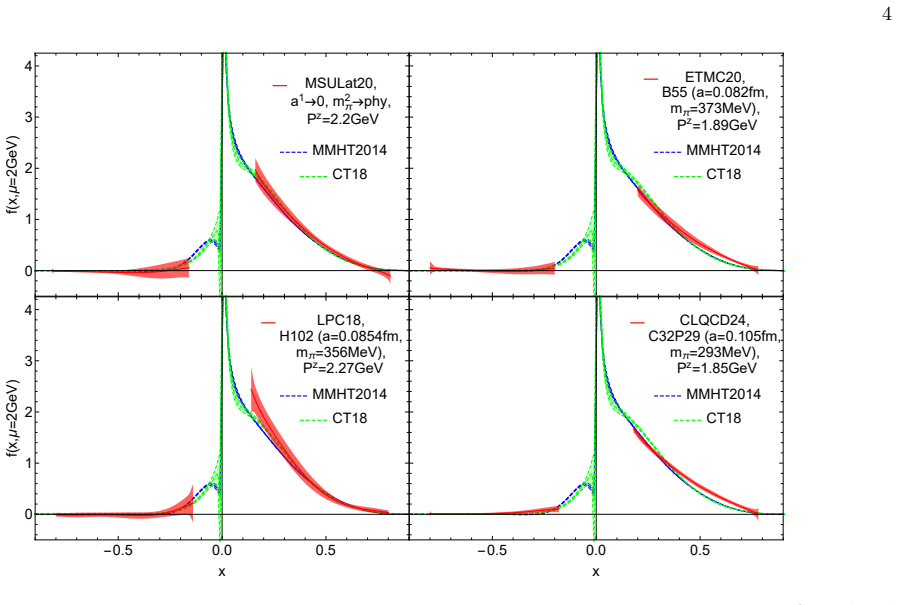
After applying state-of-the-art theoretical analysis and empirical artifact mitigation to existing lattice datasets, the resulting proton u(x)-d(x) PDF in physical limits is consistent with global fittings within ∼1σ. This demonstrates that the large momentum expansion is capable of accurately predicting the x-dependence of the PDFs when ideal lattice data become available.
What carries the argument
Large momentum expansion of lattice QCD matrix elements for parton distributions, combined with updated renormalizations, large-distance extrapolations, and large-log resummations.
If this is right
- With better lattice data the large-momentum expansion can accurately predict the x-dependence of PDFs.
- The consistency within 1σ supports the reliability of the method for future applications.
- Similar reanalyses can be performed on other lattice PDF calculations.
Where Pith is reading between the lines
- Prioritizing physical-mass lattice simulations could strengthen the method further.
- The approach may reduce dependence on phenomenological global fits for PDF determinations.
- Extensions to polarized PDFs or other hadrons could be tested similarly.
Load-bearing premise
Empirical mitigation of lattice artifacts such as excited states and unphysical pion masses does not alter the x-dependence in an uncontrolled manner.
What would settle it
New lattice data at physical pion mass and finer lattice spacing yielding a PDF outside the 1σ band of global fits would disprove the claim of consistency.
Figures

read the original abstract
The proton's unpolarized $u(x)-d(x)$ parton distribution function (PDF) has been studied by a number of lattice QCD groups through large momentum expansion. However, due to lattice artifacts (excited state contaminations, unphysical pion masses, and discretization effects) and less-advanced theoretical analysis (renormalizations, large-distance extrapolations, and large-log resummations), the resulting PDFs cannot be compared strictly with experimental data. By using the state-of-the-art theoretical tools and mitigating the lattice artifacts empirically, we reanalyze the available datasets in the literature and find that the new PDF in the physical limits is consistent with global fittings within $\sim1\sigma$. This provides compelling evidence that large momentum expansion is capable of accurately predicting the $x$-dependence of the PDFs when ideal lattice data become available.
Editorial analysis
A structured set of objections, weighed in public.
Referee Report
Summary. The manuscript reanalyzes existing lattice QCD datasets for the proton's isovector unpolarized PDF using state-of-the-art renormalization, large-distance extrapolation, and large-log resummation, together with empirical corrections for excited-state contamination, unphysical pion masses, and discretization effects. It reports that the resulting physical-limit PDF agrees with global phenomenological fits within ∼1σ and concludes that this demonstrates the capability of the large-momentum expansion to predict accurate x-dependence once ideal lattice data become available.
Significance. If the quantitative robustness of the empirical mitigations can be established, the result would provide supporting evidence that large-momentum lattice methods can reach the accuracy needed to confront phenomenology directly. The absence of residual-bias estimates for the mitigation steps, however, leaves the central claim of method validation dependent on unquantified choices.
major comments (2)
- [Abstract] Abstract: the statement that the new PDF 'is consistent with global fittings within ∼1σ' is presented without any description of how the 1σ band is defined, how the comparison is performed (e.g., pointwise, integrated moments, or χ²), or the size of the quoted uncertainty relative to the shifts induced by each empirical mitigation step.
- [Abstract] The central claim that 'empirical mitigation of lattice artifacts … is sufficient to reach the physical limit without introducing uncontrolled bias' requires a systematic variation or residual-error budget for the mitigation procedures themselves (excited-state subtraction form, pion-mass extrapolation ansatz, discretization corrections). No such budget is supplied, so the observed agreement cannot yet be interpreted as evidence that the large-momentum expansion will be accurate with ideal data.
Simulated Author's Rebuttal
We thank the referee for the careful reading of our manuscript and the constructive comments. We address each major comment below and will revise the manuscript to improve clarity and strengthen the presentation of our results.
read point-by-point responses
-
Referee: [Abstract] Abstract: the statement that the new PDF 'is consistent with global fittings within ∼1σ' is presented without any description of how the 1σ band is defined, how the comparison is performed (e.g., pointwise, integrated moments, or χ²), or the size of the quoted uncertainty relative to the shifts induced by each empirical mitigation step.
Authors: We agree that the abstract would benefit from additional detail on the comparison procedure. In the revised manuscript we will expand the abstract to state that the ∼1σ consistency refers to a pointwise comparison over the x range 0.1 < x < 0.7, where the combined statistical and systematic uncertainty band of the lattice PDF (obtained after all mitigations) overlaps the global-fit central value within one standard deviation at each x. We will also note that the magnitude of shifts induced by each individual mitigation step is quantified in the main text (Sections 3–5) and remains smaller than the final uncertainty band, thereby providing context for the robustness of the quoted agreement. revision: yes
-
Referee: [Abstract] The central claim that 'empirical mitigation of lattice artifacts … is sufficient to reach the physical limit without introducing uncontrolled bias' requires a systematic variation or residual-error budget for the mitigation procedures themselves (excited-state subtraction form, pion-mass extrapolation ansatz, discretization corrections). No such budget is supplied, so the observed agreement cannot yet be interpreted as evidence that the large-momentum expansion will be accurate with ideal data.
Authors: We acknowledge that an explicit residual-error budget for the empirical mitigation steps would strengthen the central claim. Although our analysis already includes variations of the excited-state subtraction form, pion-mass extrapolation ansatz, and discretization corrections as part of the systematic uncertainty (reported in Sections 3 and 4), we agree that a dedicated assessment of residual bias is warranted. In the revision we will add a new subsection that tabulates the results of these systematic variations, quantifies any remaining bias after the variations, and discusses how the final uncertainty budget incorporates these effects. This addition will allow the observed agreement to be interpreted more directly as supporting evidence for the large-momentum expansion once ideal lattice data are available. revision: yes
Circularity Check
No load-bearing circularity; central consistency check uses independent experimental fits
full rationale
The paper reanalyzes existing lattice datasets with updated theoretical tools and empirical artifact mitigations, then reports that the resulting physical-limit PDF agrees with global experimental fits within ~1σ. This comparison is to external data sources unrelated to the lattice inputs or the authors' prior fits. No derivation step reduces a claimed prediction to a fitted parameter or self-citation by construction, and the central claim remains falsifiable against independent phenomenology. Any self-citations to the large-momentum-expansion framework are not load-bearing for the consistency result itself.
Axiom & Free-Parameter Ledger
Reference graph
Works this paper leans on
-
[1]
Perturbative uncertainties inC 0 are propagated into the systematic uncertainty ofm 0
at next- to-next-to leading order (NNLO) [29, 30] with Dok- shitzer–Gribov–Lipatov–Altarelli–Parisi (DGLAP) log resummation (RGR) [31] and leading renormalon resum- mation (LRR) [27], within the windowa < z≪1/Λ QCD. Perturbative uncertainties inC 0 are propagated into the systematic uncertainty ofm 0. Lattice artifacts, such as excited-state contamination...
-
[2]
G. Aadet al.(ATLAS), Eur. Phys. J. C82, 438 (2022), arXiv:2112.11266 [hep-ex]
arXiv 2022
-
[3]
R. D. Ballet al.(NNPDF), Eur. Phys. J. C82, 428 (2022), arXiv:2109.02653 [hep-ph]
arXiv 2022
- [4]
-
[5]
T.-J. Houet al., Phys. Rev. D103, 014013 (2021), arXiv:1912.10053 [hep-ph]
Pith/arXiv arXiv 2021
-
[6]
S. Alekhin, J. Bl¨ umlein, S. Moch, and R. Placakyte, Phys. Rev. D96, 014011 (2017), arXiv:1701.05838 [hep- ph]
Pith/arXiv arXiv 2017
-
[7]
Abramowiczet al.(H1, ZEUS), Eur
H. Abramowiczet al.(H1, ZEUS), Eur. Phys. J. C75, 580 (2015), arXiv:1506.06042 [hep-ex]
Pith/arXiv arXiv 2015
-
[8]
P. Jimenez-Delgado and E. Reya, Phys. Rev. D89, 074049 (2014), arXiv:1403.1852 [hep-ph]
Pith/arXiv arXiv 2014
-
[9]
K. G. Wilson, Phys. Rev. D10, 2445 (1974)
1974
- [10]
-
[11]
X. Ji, Sci. China Phys. Mech. Astron.57, 1407 (2014), arXiv:1404.6680 [hep-ph]
Pith/arXiv arXiv 2014
-
[12]
Ji, AAPPS Bull.30, 5 (2020), arXiv:2007.06613 [hep- ph]
X. Ji, AAPPS Bull.30, 5 (2020), arXiv:2007.06613 [hep- ph]
arXiv 2020
-
[13]
Ji, Research8, 0695 (2025), arXiv:2209.09332 [hep- lat]
X. Ji, Research8, 0695 (2025), arXiv:2209.09332 [hep- lat]
arXiv 2025
- [14]
-
[15]
C. Alexandrou, K. Cichy, M. Constantinou, K. Jansen, A. Scapellato, and F. Steffens, Phys. Rev. Lett.121, 112001 (2018), arXiv:1803.02685 [hep-lat]
Pith/arXiv arXiv 2018
-
[16]
Liuet al.(Lattice Parton), Phys
Y.-S. Liuet al.(Lattice Parton), Phys. Rev. D101, 034020 (2020), arXiv:1807.06566 [hep-lat]
arXiv 2020
-
[17]
C. Alexandrou, K. Cichy, M. Constantinou, K. Had- jiyiannakou, K. Jansen, A. Scapellato, and F. Steffens, Phys. Rev. D99, 114504 (2019), arXiv:1902.00587 [hep- lat]
Pith/arXiv arXiv 2019
-
[18]
Z. Fan, X. Gao, R. Li, H.-W. Lin, N. Karthik, S. Mukher- jee, P. Petreczky, S. Syritsyn, Y.-B. Yang, and R. Zhang, Phys. Rev. D102, 074504 (2020), arXiv:2005.12015 [hep- lat]
arXiv 2020
-
[19]
C. Alexandrou, K. Cichy, M. Constantinou, J. R. Green, K. Hadjiyiannakou, K. Jansen, F. Manigrasso, A. Scapel- lato, and F. Steffens, Phys. Rev. D103, 094512 (2021), arXiv:2011.00964 [hep-lat]
arXiv 2021
- [20]
-
[21]
X. Gao, A. D. Hanlon, J. Holligan, N. Karthik, S. Mukherjee, P. Petreczky, S. Syritsyn, and Y. Zhao, Phys. Rev. D107, 074509 (2023), arXiv:2212.12569 [hep- lat]
arXiv 2023
-
[22]
C. Chen, Y. Geng, L. Liu, P. Sun, Y.-B. Yang, F. Yao, J.-H. Zhang, and K. Zhang (CLQCD, Lattice Parton), Phys. Rev. D111, 074506 (2025), arXiv:2408.12819 [hep- lat]
arXiv 2025
- [23]
-
[24]
D. Djukanovic, G. von Hippel, H. B. Meyer, K. Ot- tnad, and H. Wittig, Phys. Rev. D109, 074507 (2024), arXiv:2402.03024 [hep-lat]
arXiv 2024
-
[25]
X. Ji, Y. Liu, A. Sch¨ afer, W. Wang, Y.-B. Yang, J.-H. Zhang, and Y. Zhao, Nucl. Phys. B964, 115311 (2021), arXiv:2008.03886 [hep-ph]
arXiv 2021
-
[26]
Huoet al.(Lattice Parton (LPC)), Nucl
Y.-K. Huoet al.(Lattice Parton (LPC)), Nucl. Phys. B 969, 115443 (2021), arXiv:2103.02965 [hep-lat]
arXiv 2021
-
[27]
C.-Y. Chou and J.-W. Chen, Phys. Rev. D106, 014507 (2022), arXiv:2204.08343 [hep-lat]
arXiv 2022
- [28]
-
[29]
X. Ji, Y. Liu, and Y. Su, (2026), arXiv:2601.12189 [hep- lat]
arXiv 2026
- [30]
-
[31]
L.-B. Chen, W. Wang, and R. Zhu, Phys. Rev. Lett. 126, 072002 (2021), arXiv:2006.14825 [hep-ph]
arXiv 2021
-
[32]
Y. Su, J. Holligan, X. Ji, F. Yao, J.-H. Zhang, and R. Zhang, Nucl. Phys. B991, 116201 (2023), arXiv:2209.01236 [hep-ph]
arXiv 2023
-
[33]
X. Ji, Y. Liu, and Y. Su, JHEP08, 037 (2023), arXiv:2305.04416 [hep-ph]
arXiv 2023
- [34]
-
[35]
X. Ji, Y. Liu, Y. Su, and R. Zhang, JHEP03, 045 (2025), arXiv:2410.12910 [hep-ph]
arXiv 2025
-
[36]
L. A. Harland-Lang, A. D. Martin, P. Motylinski, and R. S. Thorne, Eur. Phys. J. C75, 204 (2015), arXiv:1412.3989 [hep-ph]
Pith/arXiv arXiv 2015
-
[37]
C. Alexandrou, K. Cichy, M. Constantinou, K. Had- jiyiannakou, K. Jansen, H. Panagopoulos, and F. Stef- fens, Nucl. Phys. B923, 394 (2017), arXiv:1706.00265 [hep-lat]
Pith/arXiv arXiv 2017
-
[38]
X. Ji and J.-H. Zhang, Phys. Rev. D92, 034006 (2015), arXiv:1505.07699 [hep-ph]
Pith/arXiv arXiv 2015
-
[39]
X. Ji, J.-H. Zhang, and Y. Zhao, Phys. Rev. Lett.120, 112001 (2018), arXiv:1706.08962 [hep-ph]
Pith/arXiv arXiv 2018
-
[40]
T. Ishikawa, Y.-Q. Ma, J.-W. Qiu, and S. Yoshida, Phys. Rev. D96, 094019 (2017), arXiv:1707.03107 [hep-ph]
Pith/arXiv arXiv 2017
-
[41]
J. Green, K. Jansen, and F. Steffens, Phys. Rev. Lett. 121, 022004 (2018), arXiv:1707.07152 [hep-lat]
Pith/arXiv arXiv 2018
-
[42]
Z.-Y. Li, Y.-Q. Ma, and J.-W. Qiu, Phys. Rev. Lett. 122, 062002 (2019), arXiv:1809.01836 [hep-ph]
Pith/arXiv arXiv 2019
-
[43]
J.-W. Chen, T. Ishikawa, L. Jin, H.-W. Lin, Y.-B. Yang, J.-H. Zhang, and Y. Zhao, Phys. Rev. D97, 014505 (2018), arXiv:1706.01295 [hep-lat]
Pith/arXiv arXiv 2018
-
[44]
T. Izubuchi, X. Ji, L. Jin, I. W. Stewart, and Y. Zhao, Phys. Rev. D98, 056004 (2018), arXiv:1801.03917 [hep- ph]. 6
Pith/arXiv arXiv 2018
-
[45]
A. Radyushkin, Phys. Rev. D98, 014019 (2018), arXiv:1801.02427 [hep-ph]
Pith/arXiv arXiv 2018
-
[46]
V. M. Braun, A. Vladimirov, and J.-H. Zhang, Phys. Rev. D99, 014013 (2019), arXiv:1810.00048 [hep-ph]
arXiv 2019
-
[47]
A. V. Radyushkin, Phys. Rev. D96, 034025 (2017), arXiv:1705.01488 [hep-ph]
Pith/arXiv arXiv 2017
-
[48]
K. Orginos, A. Radyushkin, J. Karpie, and S. Zafeiropoulos, Phys. Rev. D96, 094503 (2017), arXiv:1706.05373 [hep-ph]
Pith/arXiv arXiv 2017
-
[49]
V. Braun and D. M¨ uller, Eur. Phys. J. C55, 349 (2008), arXiv:0709.1348 [hep-ph]
Pith/arXiv arXiv 2008
-
[50]
X. Gao, A. D. Hanlon, S. Mukherjee, P. Petreczky, P. Scior, S. Syritsyn, and Y. Zhao, Phys. Rev. Lett. 128, 142003 (2022), arXiv:2112.02208 [hep-lat]
arXiv 2022
-
[51]
Chenet al., (2025), arXiv:2505.14619 [hep-lat]
J.-W. Chenet al., (2025), arXiv:2505.14619 [hep-lat]
arXiv 2025
-
[52]
X. Xiong, X. Ji, J.-H. Zhang, and Y. Zhao, Phys. Rev. D90, 014051 (2014), arXiv:1310.7471 [hep-ph]
Pith/arXiv arXiv 2014
-
[53]
Y.-Q. Ma and J.-W. Qiu, Phys. Rev. D98, 074021 (2018), arXiv:1404.6860 [hep-ph]
Pith/arXiv arXiv 2018
-
[54]
Y.-Q. Ma and J.-W. Qiu, Phys. Rev. Lett.120, 022003 (2018), arXiv:1709.03018 [hep-ph]
Pith/arXiv arXiv 2018
-
[55]
W. Wang, J.-H. Zhang, S. Zhao, and R. Zhu, Phys. Rev. D100, 074509 (2019), arXiv:1904.00978 [hep-ph]
arXiv 2019
- [56]
-
[57]
J. Holligan, H.-W. Lin, R. Zhang, and Y. Zhao, JHEP 207, 241 (2025), arXiv:2501.19225 [hep-ph]
arXiv 2025
discussion (0)
Sign in with ORCID, Apple, or X to comment. Anyone can read and Pith papers without signing in.