QeHDC: Hyperdimensional Computing based on Quantum-enhanced binding and SuperClass Construction
Pith reviewed 2026-06-26 11:00 UTC · model grok-4.3
The pith
A quantum hyperdimensional computing framework uses reference-state binding via circuits and density-matrix superclasses to claim better classification than classical or prior quantum methods.
A machine-rendered reading of the paper's core claim, the machinery that carries it, and where it could break.
Core claim
The central claim is that the reference-state-based quantum binding operation realized via quantum circuits together with density-matrix-based superclass generation via eigenvalue decomposition delivers superior performance, robustness to noise, and computational feasibility on standard benchmark datasets compared with traditional classical hyperdimensional computing and existing quantum-enhanced approaches.
What carries the argument
The reference-state-based quantum binding operation realized via quantum circuits and the density-matrix-based superclass generation via eigenvalue decomposition.
If this is right
- A one-pass training method projects classical data into quantum amplitude states using sinusoidal and quantum encoding.
- The superclass strategy extracts critical quantum state features for more accurate class representation.
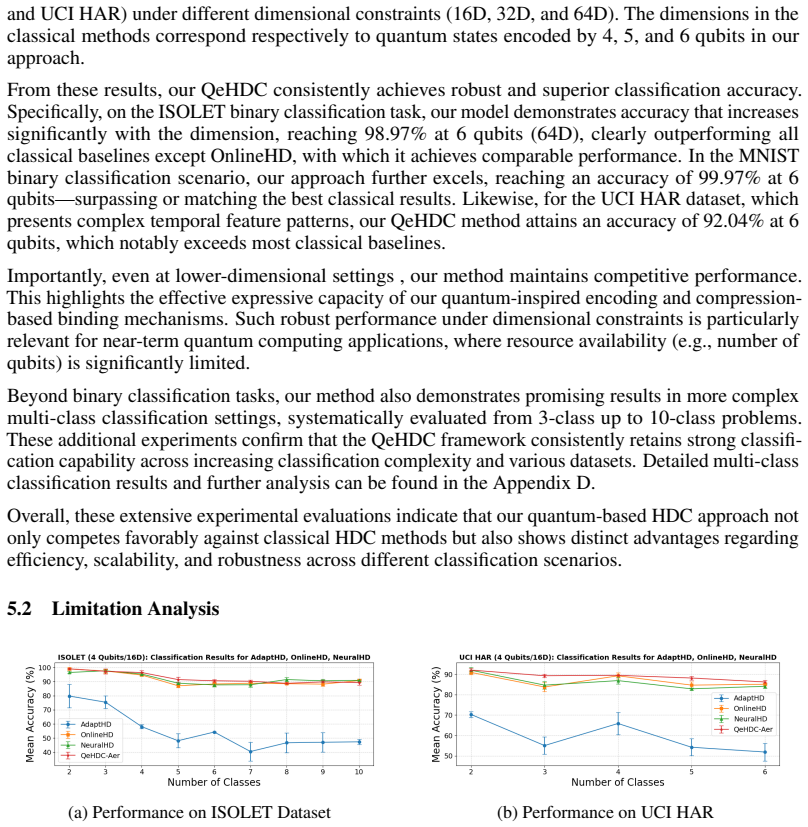
- Experimental results on standard benchmark datasets show superior performance and noise robustness.
- The overall approach demonstrates computational feasibility relative to classical and prior quantum methods.
Where Pith is reading between the lines
- If the quantum circuits prove efficient on near-term hardware, the binding step could allow hyperdimensional methods to exploit quantum parallelism for larger vector spaces.
- The eigenvalue decomposition on density matrices might surface latent features that classical binding misses, suggesting a path to hybrid classical-quantum feature extraction.
- The one-pass property could reduce training overhead in settings where repeated data passes are costly, extending naturally to streaming classification tasks.
Load-bearing premise
The proposed quantum binding operation and superclass generation will deliver measurable gains over classical methods when implemented.
What would settle it
Running the quantum circuits for binding on a simulator or device, then comparing classification accuracy and noise robustness on the same benchmark datasets against classical HDC; no improvement would falsify the superiority claim.
Figures
read the original abstract
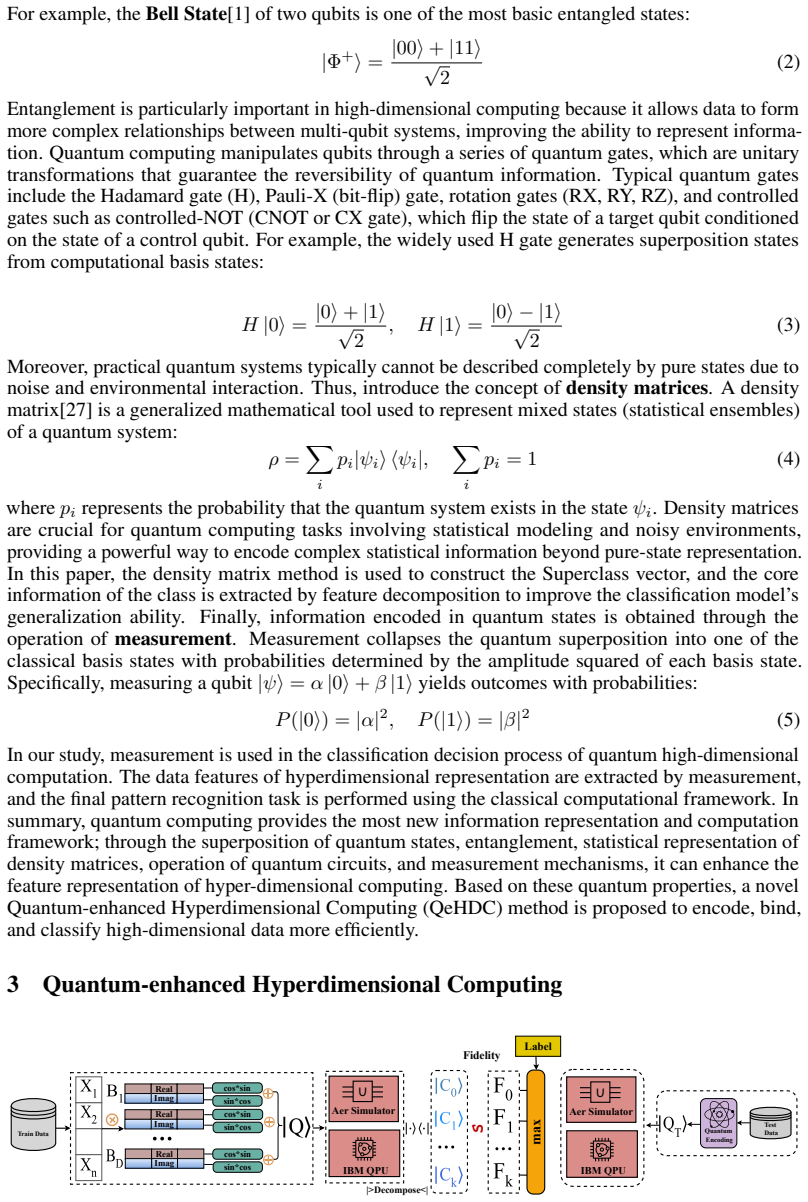
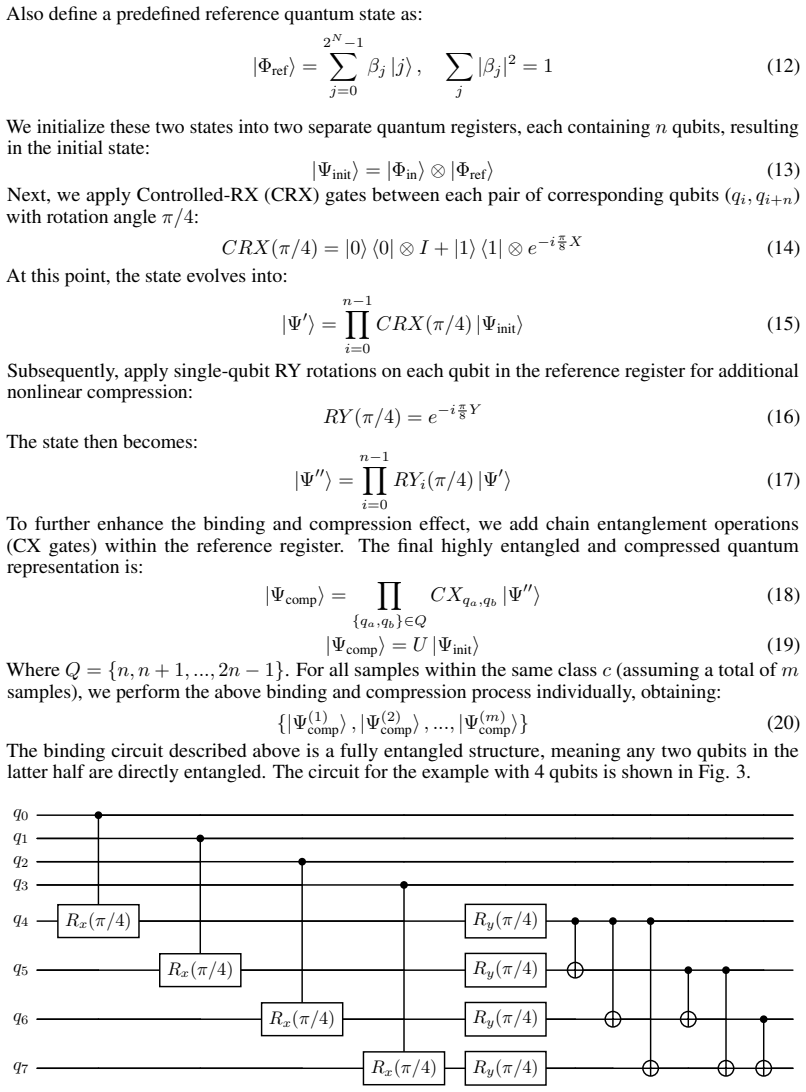
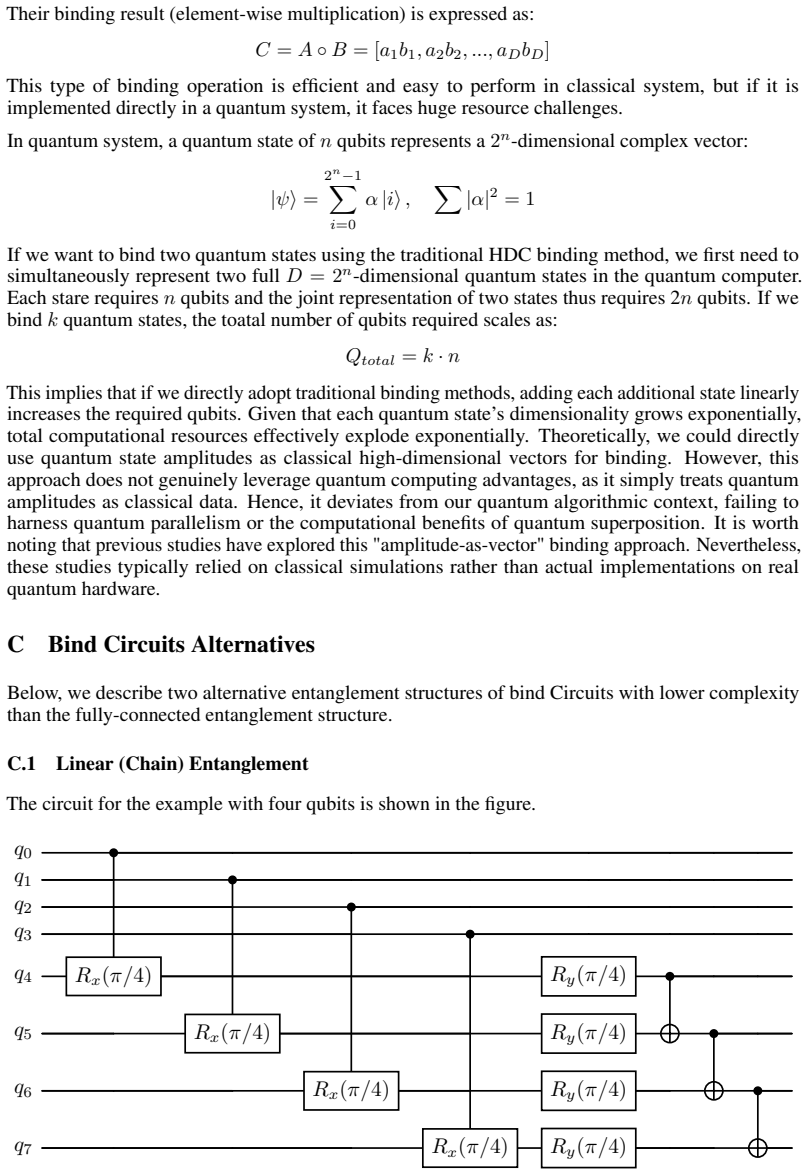
Hyperdimensional Computing (HDC) is a robust computational framework inspired by human cognition characterized by simple and efficient operations within high-dimensional vector spaces. Quantum-enhanced Hyperdimensional Computing (QeHDC) extends classical HDC by leveraging quantum mechanical properties to enhance computational efficiency. In this paper, we propose a novel Quantum HDC framework featuring a one-pass training method, leveraging sinusoidal and quantum encoding to project classical data into quantum amplitude states efficiently. Our framework introduces an innovative reference-state-based quantum binding operation realized via quantum circuits. Furthermore, we propose a density-matrix-based superclass generation strategy employing eigenvalue decomposition to extract critical quantum state features effectively, enabling a more accurate and robust class representation. Experimental evaluations conducted on standard benchmark datasets demonstrate our approach's superior performance, robustness to noise, and computational feasibility compared to traditional classical and existing quantum-enhanced approaches. The results highlight the practical benefits and potential of Quantum HDC for quantum-enhanced classification tasks and pave the way for future advancements in quantum-inspired computational paradigms.
Editorial analysis
A structured set of objections, weighed in public.
Referee Report
Summary. The paper proposes QeHDC, a quantum-enhanced hyperdimensional computing (HDC) framework. It uses one-pass training with sinusoidal and quantum amplitude encoding to map data into quantum states, introduces a reference-state-based quantum binding operation implemented via quantum circuits, and a density-matrix-based superclass generation via eigenvalue decomposition for class representations. The central claim is that this yields superior accuracy, noise robustness, and computational feasibility on standard benchmarks versus classical HDC and prior quantum-enhanced methods.
Significance. If the empirical claims are substantiated with verifiable experiments, ablations, and hardware or simulation details, the work could contribute to quantum-inspired paradigms by showing how specific quantum operations (binding and superclass extraction) improve HDC beyond classical baselines. The one-pass training and encoding steps are presented as efficiency advantages, but their interaction with the novel quantum components requires clear isolation to establish novelty.
major comments (2)
- [Abstract] Abstract and experimental claims: the manuscript asserts 'superior performance, robustness to noise, and computational feasibility' on benchmark datasets but provides no tables, error bars, implementation details (e.g., circuit depth, simulator vs. hardware), ablation studies isolating the reference-state binding or eigenvalue-decomposition superclass from the sinusoidal/quantum encoding, or direct comparisons to classical HDC and prior quantum baselines. This renders the headline empirical result unverifiable and load-bearing for the central claim.
- [Methods] § on quantum binding and superclass (methods): the reference-state-based binding via quantum circuits and density-matrix superclass via eigenvalue decomposition are presented as the key innovations, yet no complexity analysis, noise model, or scaling arguments demonstrate why these operations produce measurable gains over classical binding (XOR) or bundling; if gains arise only from the encoding step, the quantum-enhancement narrative is unsupported.
minor comments (2)
- [Introduction] Notation for quantum states and density matrices should be defined explicitly on first use to avoid ambiguity with classical HDC vectors.
- [Training] The one-pass training description lacks pseudocode or explicit update rules, making reproducibility difficult.
Simulated Author's Rebuttal
We thank the referee for their insightful comments, which help improve the clarity and rigor of our work. We provide point-by-point responses to the major comments and commit to revisions that address the concerns regarding empirical verification and methodological analysis.
read point-by-point responses
-
Referee: [Abstract] Abstract and experimental claims: the manuscript asserts 'superior performance, robustness to noise, and computational feasibility' on benchmark datasets but provides no tables, error bars, implementation details (e.g., circuit depth, simulator vs. hardware), ablation studies isolating the reference-state binding or eigenvalue-decomposition superclass from the sinusoidal/quantum encoding, or direct comparisons to classical HDC and prior quantum baselines. This renders the headline empirical result unverifiable and load-bearing for the central claim.
Authors: We agree that the current version of the manuscript would benefit from more detailed empirical presentation. In the revised manuscript, we will add tables reporting mean accuracies with standard error bars from multiple independent runs, explicit implementation details including circuit depths for the quantum binding operation and whether experiments were performed on simulators or actual quantum hardware, and ablation studies that isolate the contributions of the reference-state-based binding and the density-matrix superclass generation. We will also expand the comparisons to include classical HDC baselines and prior quantum-enhanced methods with these metrics. These additions will substantiate the claims made in the abstract. revision: yes
-
Referee: [Methods] § on quantum binding and superclass (methods): the reference-state-based binding via quantum circuits and density-matrix superclass via eigenvalue decomposition are presented as the key innovations, yet no complexity analysis, noise model, or scaling arguments demonstrate why these operations produce measurable gains over classical binding (XOR) or bundling; if gains arise only from the encoding step, the quantum-enhancement narrative is unsupported.
Authors: We acknowledge the need for a more rigorous analysis of the proposed operations. In the revision, we will include a complexity analysis section detailing the gate complexity of the quantum circuit for reference-state binding and the computational cost of eigenvalue decomposition for superclass generation. We will incorporate noise models (e.g., depolarizing noise) and present scaling arguments and additional experiments demonstrating the advantages of the quantum binding and superclass construction over classical counterparts, including cases where encoding is held constant to isolate the effect. This will clarify that the gains are attributable to the quantum-enhanced components. revision: yes
Circularity Check
No circularity; empirical claims with no derivation chain visible
full rationale
The provided abstract and context contain no equations, derivations, fitted parameters presented as predictions, or self-citation chains. The paper describes a proposed framework (sinusoidal/quantum encoding, reference-state quantum binding via circuits, density-matrix superclass via eigenvalue decomposition) and reports experimental results on benchmarks. Performance superiority is asserted as an empirical outcome rather than a first-principles result that reduces to its own inputs. No load-bearing steps match any of the enumerated circularity patterns.
Axiom & Free-Parameter Ledger
axioms (2)
- domain assumption Quantum circuits can implement the reference-state-based binding operation efficiently and with advantage over classical binding.
- domain assumption Eigenvalue decomposition of the density matrix extracts critical quantum state features that improve class representation.
Reference graph
Works this paper leans on
-
[1]
John-Mark A. Allen. Quantum superpositions cannot be epistemic.Quantum Studies: Mathe- matics and F oundations, 3:161–177, 2015
2015
-
[2]
Human activity recognition using smartphones
Erhan Bulbul, Aydin Cetin, and Ibrahim Alper Dogru. Human activity recognition using smartphones. InProceedings of 2018 2nd International Symposium on Multidisciplinary Studies and Innovative Technologies (ISMSIT), pages 1–6, 2018
2018
-
[3]
Recent progress and development of hyperdimensional computing (hdc) for edge intelligence.IEEE Journal on Emerging and Selected Topics in Circuits and Systems, 13(1):119–136, 2023
Cheng-Yang Chang, Yu-Chuan Chuang, Chi-Tse Huang, and An-Yeu Wu. Recent progress and development of hyperdimensional computing (hdc) for edge intelligence.IEEE Journal on Emerging and Selected Topics in Circuits and Systems, 13(1):119–136, 2023
2023
-
[4]
Securehd: Designing low-cost reliable and security aware hardware accelerators during high-level synthesis for computationally intensive applica- tion frameworks
Rahul Chaurasia and Anirban Sengupta. Securehd: Designing low-cost reliable and security aware hardware accelerators during high-level synthesis for computationally intensive applica- tion frameworks. In2024 IEEE International Symposium on Smart Electronic Systems (iSES), pages 380–383, 2024
2024
-
[5]
Ron Cole and Mark Fanty. ISOLET. UCI Machine Learning Repository, 1991. DOI: https://doi.org/10.24432/C51G69
-
[6]
LeHDC: Learning-based hyperdimensional computing classifier
Shijin Duan, Yejia Liu, Shaolei Ren, and Xiaolin Xu. LeHDC: Learning-based hyperdimensional computing classifier. InProceedings of the 59th ACM/IEEE Design Automation Conference, pages 1111–1116, 2022
2022
-
[7]
Manuel Eggimann, Abbas Rahimi, and Luca Benini. A 5 µw standard cell memory-based configurable hyperdimensional computing accelerator for always-on smart sensing.IEEE Transactions on Circuits and Systems I: Regular Papers, 68(10):4116–4128, 2021
2021
-
[8]
Ross W Gayler. Vector symbolic architectures answer jackendoff’s challenges for cognitive neuroscience.arXiv preprint cs/0412059, 2004
arXiv 2004
-
[9]
Torchhd: An open source python library to support research on hyperdimensional computing and vector symbolic architectures.Journal of Machine Learning Research, 24(255):1–10, 2023
Mike Heddes, Igor Nunes, Pere Vergés, Denis Kleyko, Danny Abraham, Tony Givargis, Alexan- dru Nicolau, and Alexander Veidenbaum. Torchhd: An open source python library to support research on hyperdimensional computing and vector symbolic architectures.Journal of Machine Learning Research, 24(255):1–10, 2023. 12
2023
-
[10]
Onlinehd: Ro- bust, efficient, and single-pass online learning using hyperdimensional system
Alejandro Hernández-Cano, Namiko Matsumoto, Eric Ping, and Mohsen Imani. Onlinehd: Ro- bust, efficient, and single-pass online learning using hyperdimensional system. InProceedings of 2021 Design, Automation & Test in Europe Conference & Exhibition (DATE), pages 56–61, 2021
2021
-
[11]
QuantHD: A quantization framework for hyperdimensional computing.IEEE Transactions on Computer-Aided Design of Integrated Circuits and Systems, pages 2268–2278, 2019
Mohsen Imani, Samuel Bosch, Sohum Datta, Sharadhi Ramakrishna, Sahand Salamat, Jan M Rabaey, and Tajana Rosing. QuantHD: A quantization framework for hyperdimensional computing.IEEE Transactions on Computer-Aided Design of Integrated Circuits and Systems, pages 2268–2278, 2019
2019
-
[12]
Adapthd: Adaptive efficient training for brain-inspired hyperdimensional computing
Mohsen Imani, Justin Morris, Samuel Bosch, Helen Shu, Giovanni De Micheli, and Tajana Rosing. Adapthd: Adaptive efficient training for brain-inspired hyperdimensional computing. InProceedings of 2019 IEEE Biomedical Circuits and Systems Conference (BioCAS), pages 1–4, 2019
2019
-
[13]
SparseHD: Algorithm-hardware co-optimization for efficient high- dimensional computing
Mohsen Imani, Sahand Salamat, Behnam Khaleghi, Mohammad Samragh, Farinaz Koushan- far, and Tajana Rosing. SparseHD: Algorithm-hardware co-optimization for efficient high- dimensional computing. InProceedings of 2019 IEEE 27th Annual International Symposium on Field-Programmable Custom Computing Machines (FCCM), pages 190–198, 2019
2019
-
[14]
Wood, Jake Lishman, Julien Gacon, Simon Martiel, Paul D
Ali Javadi-Abhari, Matthew Treinish, Kevin Krsulich, Christopher J. Wood, Jake Lishman, Julien Gacon, Simon Martiel, Paul D. Nation, Lev S. Bishop, Andrew W. Cross, Blake R. Johnson, and Jay M. Gambetta. Quantum computing with Qiskit, 2024
2024
-
[15]
P. Kanerva. Hyperdimensional computing: An introduction to computing in distributed repre- sentation with high-dimensional random vectors.Cognitive Computation, 1:139–159, 2009
2009
-
[16]
Karunaratne, M
G. Karunaratne, M. Le Gallo, G. Cherubini, L. Benini, Abbas Rahimi, and A. Sebastian. In-memory hyperdimensional computing.Nature Electronics, 3:327 – 337, 2019
2019
-
[17]
Hyukjun Kwon, Kangwon Kim, Junyoung Lee, Hyun-Soo Lee, Jiseung Kim, Jinhyung Kim, Taehyung Kim, Yongnyeon Kim, Yang Ni, Mohsen Imani, Ilhong Suh, and Yeseong Kim. Brain-inspired hyperdimensional computing in the wild: Lightweight symbolic learning for sensorimotor controls of wheeled robots.2024 IEEE International Conference on Robotics and Automation (IC...
2024
-
[18]
Lecun, L
Y . Lecun, L. Bottou, Y . Bengio, and P. Haffner. Gradient-based learning applied to document recognition.Proceedings of the IEEE, pages 2278–2324, 1998
1998
-
[19]
Benedict, and J
Alisha Menon, Anirudh Natarajan, Laura Isabel Galindez Olascoaga, Youbin Kim, Braeden C. Benedict, and J. Rabaey. On the role of hyperdimensional computing for behavioral prioritization in reactive robot navigation tasks.2022 International Conference on Robotics and Automation (ICRA), pages 7335–7341, 2022
2022
-
[20]
Mitrokhin, Peter Sutor, C
A. Mitrokhin, Peter Sutor, C. Fermüller, and Y . Aloimonos. Learning sensorimotor control with neuromorphic sensors: Toward hyperdimensional active perception.Science Robotics, 4, 2019
2019
-
[21]
CompHD: Efficient hyperdimensional computing using model compression
Justin Morris, Mohsen Imani, Samuel Bosch, Anthony Thomas, Helen Shu, and Tajana Rosing. CompHD: Efficient hyperdimensional computing using model compression. InProceedings of 2019 IEEE/ACM International Symposium on Low Power Electronics and Design (ISLPED), pages 1–6, 2019
2019
-
[22]
Hyperdimensional computing for text classification
Fateme Rasti Najafabadi, Abbas Rahimi, Pentti Kanerva, and Jan M Rabaey. Hyperdimensional computing for text classification. InDesign, automation test in Europe conference exhibition (DATE), University Booth, pages 1–1, 2016
2016
-
[23]
Graphhd: Efficient graph classification using hyperdimensional computing
Igor Nunes, Mike Heddes, Tony Givargis, Alexandru Nicolau, and Alex Veidenbaum. Graphhd: Efficient graph classification using hyperdimensional computing. In2022 Design, Automation & Test in Europe Conference & Exhibition (DATE), pages 1485–1490. IEEE, 2022
2022
-
[24]
U. Pale, T. Teijeiro, and David Atienza Alonso. Systematic assessment of hyperdimensional computing for epileptic seizure detection.2021 43rd Annual International Conference of the IEEE Engineering in Medicine & Biology Society (EMBC), pages 6361–6367, 2021. 13
2021
-
[25]
A primer on hyperdimensional computing for ieeg seizure detection.Frontiers in neurology, 12:701791, 2021
Kaspar A Schindler and Abbas Rahimi. A primer on hyperdimensional computing for ieeg seizure detection.Frontiers in neurology, 12:701791, 2021
2021
-
[26]
Theory and implementation of the quantum approximate optimization algorithm: A comprehensible introduction and case study using qiskit and ibm quantum computers
Andreas Sturm. Theory and implementation of the quantum approximate optimization algorithm: A comprehensible introduction and case study using qiskit and ibm quantum computers. 2023
2023
-
[27]
Thekkadath, L
G. Thekkadath, L. Giner, Y . Chalich, Matthew Horton, J. Banker, and Jeff S. Lundeen. Direct measurement of the density matrix of a quantum system.Physical review letters, 117 12:120401, 2016
2016
-
[28]
Junyao Wang, Sitao Huang, and M. Imani. DistHD: A learner-aware dynamic encoding method for hyperdimensional classification.2023 60th ACM/IEEE Design Automation Conference (DAC), pages 1–6, 2023
2023
-
[29]
Poduval, Yeseong Kim, Mahdi Imani, Elaheh Sadredini, Rosario Cammarota, and M
Zhuowen Zou, Hanning Chen, Prathyush P. Poduval, Yeseong Kim, Mahdi Imani, Elaheh Sadredini, Rosario Cammarota, and M. Imani. Biohd: an efficient genome sequence search platform using hyperdimensional memorization.Proceedings of the 49th Annual International Symposium on Computer Architecture, 2022
2022
-
[30]
amplitude-as-vector
Zhuowen Zou, Yeseong Kim, Farhad Imani, Haleh Alimohamadi, Rosario Cammarota, and Mohsen Imani. Scalable edge-based hyperdimensional learning system with brain-like neural adaptation. InProceedings of the International Conference for High Performance Computing, Networking, Storage and Analysis, pages 1–15, 2021. 14 A Parameter Usage Comparison In QeHDC, t...
2021
discussion (0)
Sign in with ORCID, Apple, or X to comment. Anyone can read and Pith papers without signing in.