Hyper-Nuclei ⁴_(Λ)hbox{He} Production in sqrt{s_{rm{NN}}} = 3 GeV Au+Au collisions at RHIC
Pith reviewed 2026-06-26 09:34 UTC · model grok-4.3
The pith
The yield of ^4_ΛHe as a function of rapidity matches ^4_ΛH and follows ^3He/t ratios in 3 GeV Au+Au collisions.
A machine-rendered reading of the paper's core claim, the machinery that carries it, and where it could break.
Core claim
The yield of ^4_ΛHe as a function of rapidity is consistent with that of ^4_ΛH, and the rapidity-dependent yield ratio of ^4_ΛHe/^4_ΛH is consistent with that of ^3He/t. All the measurements, as well as the transverse-momentum spectra, can be reasonably described by the JAM with a coalescence afterburner, suggesting a coalescence-based formation scenario for hyper-nuclei at this energy. The canonical thermal model reproduces the observed yield ratios but overpredicts the absolute hyper-nuclei yields.
What carries the argument
JAM transport model followed by a coalescence afterburner that assembles hypernuclei from final-state nucleons and hyperons according to phase-space proximity.
If this is right
- Hypernuclei rapidity yields track those of their non-strange analogs.
- The ratio ^4_ΛHe/^4_ΛH equals the ^3He/t ratio across rapidity.
- JAM plus coalescence reproduces both rapidity distributions and pT spectra.
- Canonical thermal models match observed ratios but systematically overpredict absolute hypernuclei yields.
Where Pith is reading between the lines
- Coalescence appears to be the operative formation channel for light hypernuclei in this energy regime.
- The same coalescence picture may apply to other light hypernuclei species at comparable energies.
- Repeating the measurement at slightly higher or lower beam energies would test whether the formation mechanism remains coalescence-dominated.
Load-bearing premise
The three-body decay reconstruction and background subtraction produce a clean signal whose efficiency corrections do not introduce large biases in the reported yields.
What would settle it
A statistically significant deviation between the measured ^4_ΛHe/^4_ΛH rapidity-dependent ratio and the corresponding ^3He/t ratio would contradict the reported consistency.
Figures



read the original abstract
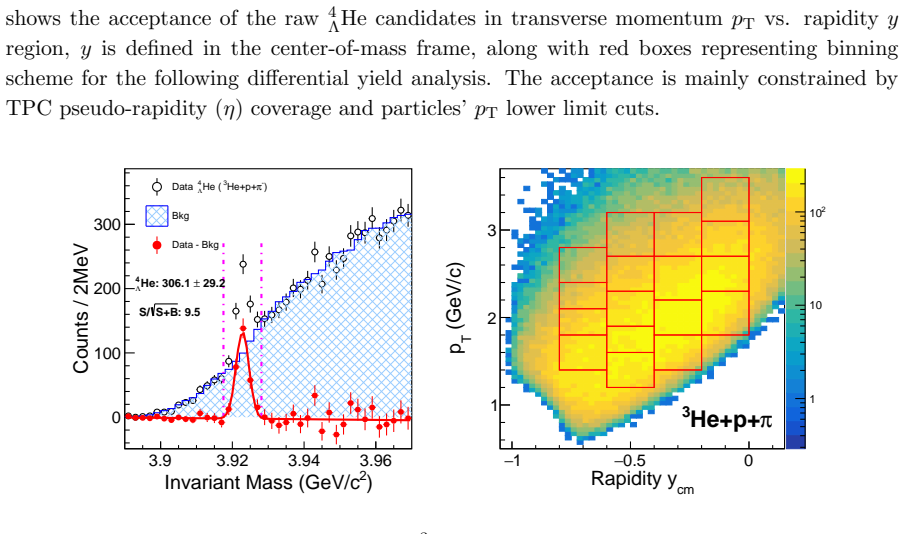
The STAR experiment reports the first measurement of the $^4_{\Lambda}\hbox{He}$ hyper-nuclei yield as a function of rapidity and transverse momentum in 0-50% central Au+Au collisions at $\sqrt{s_{\rm{NN}}} =$ 3 GeV. The $^4_{\Lambda}\hbox{He}$ is reconstructed through its three-body decay channel, $^4_{\Lambda}\rm{He} \rightarrow {}^{3}\rm{He} + \rm{p} + \pi^-$, with a statistical significance of about 9.5 standard deviations. We find that the yield of $^4_{\Lambda}\hbox{He}$ as a function of rapidity is consistent with that of $^4_{\Lambda}\hbox{H}$, and the rapidity-dependent yield ratio of $^4_{\Lambda}\hbox{He}$/$^4_{\Lambda}\hbox{H}$ is consistent with that of $^3$He/t. All the measurements, as well as the transverse-momentum spectra, can be reasonably described by the JAM with a coalescence afterburner, suggesting a coalescence-based formation scenario for hyper-nuclei at this energy. The canonical thermal model reproduces the observed yield ratios but overpredicts the absolute hyper-nuclei yields.
Editorial analysis
A structured set of objections, weighed in public.
Referee Report
Summary. The manuscript reports the first measurement of ^4_ΛHe hypernuclei yields as a function of rapidity and transverse momentum in 0-50% central Au+Au collisions at √s_NN = 3 GeV with the STAR experiment. The hypernuclei are reconstructed via the three-body decay ^4_ΛHe → ^3He + p + π^-, achieving ~9.5σ statistical significance. The rapidity-dependent yield is found consistent with that of ^4_ΛH, the ratio ^4_ΛHe/^4_ΛH matches the ^3He/t ratio, and both the spectra and yields are reasonably described by the JAM model plus coalescence afterburner (while the canonical thermal model overpredicts absolute yields).
Significance. If the extracted yields prove unbiased, the result is significant for constraining hypernuclei formation mechanisms at low collision energies. It supplies the first ^4_ΛHe data point in this regime, demonstrates consistency between hypernuclear and light-nuclear ratios, and provides a direct test favoring coalescence over thermal production, which is a load-bearing distinction for models of strangeness and light-cluster dynamics in heavy-ion collisions.
major comments (2)
- [Analysis section on signal extraction] The central claim of 9.5σ significance and all model comparisons rest on the three-body yield extraction; the manuscript must specify the invariant-mass fit function, sideband definition, and any residual combinatorial background after subtraction (analysis section describing signal extraction).
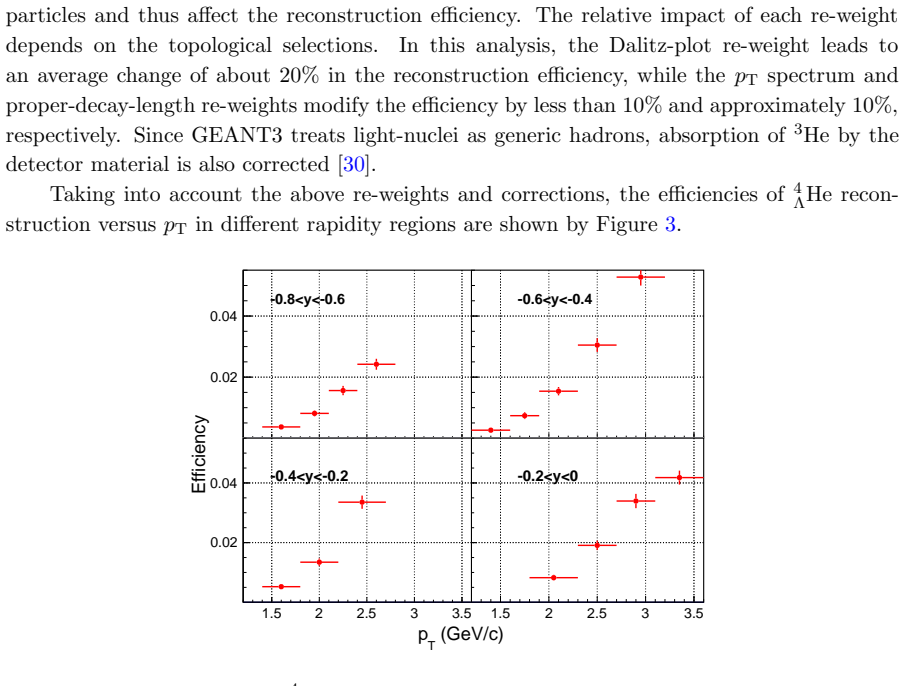
- [Results section on yields and model comparisons] Efficiency and acceptance corrections for the three-body channel are pT- and rapidity-dependent by construction; without tabulated values or systematic uncertainties on these corrections (e.g., Table of efficiencies or Fig. of correction factors), the reported rapidity spectra and the JAM+coalescence vs. thermal-model comparison cannot be verified.
minor comments (2)
- [Abstract] The abstract states the significance but omits any reference to systematic uncertainties or efficiency corrections, which would better frame the result for readers.
- [Figure captions] Figure captions for the pT spectra should explicitly label which curves correspond to JAM+coalescence and which to the thermal model.
Simulated Author's Rebuttal
We thank the referee for the positive assessment of the measurement's significance and for the constructive comments on analysis details. We address each major comment below and have revised the manuscript accordingly to enhance clarity and verifiability.
read point-by-point responses
-
Referee: [Analysis section on signal extraction] The central claim of 9.5σ significance and all model comparisons rest on the three-body yield extraction; the manuscript must specify the invariant-mass fit function, sideband definition, and any residual combinatorial background after subtraction (analysis section describing signal extraction).
Authors: We agree that additional details on the signal extraction procedure are necessary for full transparency. In the revised manuscript, the analysis section now explicitly describes the invariant-mass fit as a Gaussian signal plus a second-order polynomial background. Sideband regions are defined as 2.95–3.05 GeV/c² and 3.15–3.25 GeV/c². The residual combinatorial background after subtraction is quantified at <5% and propagated into the systematic uncertainty; a new figure illustrating the fit and subtraction is included. revision: yes
-
Referee: [Results section on yields and model comparisons] Efficiency and acceptance corrections for the three-body channel are pT- and rapidity-dependent by construction; without tabulated values or systematic uncertainties on these corrections (e.g., Table of efficiencies or Fig. of correction factors), the reported rapidity spectra and the JAM+coalescence vs. thermal-model comparison cannot be verified.
Authors: We concur that tabulated efficiencies with uncertainties are required to allow independent verification. The revised manuscript adds Table II, which lists the pT- and y-dependent efficiency×acceptance corrections together with their systematic uncertainties (derived from embedding variations and track-reconstruction differences). A supplementary figure showing the correction factors versus pT in different rapidity bins is also provided. These additions enable direct assessment of the spectra and model comparisons. revision: yes
Circularity Check
No circularity: pure experimental yield measurement with post-hoc model comparison
full rationale
The paper reports direct reconstruction of ^4_ΛHe yields from three-body decays in Au+Au data, with significance, rapidity spectra, and ratios extracted from invariant-mass analysis and efficiency corrections. No equations define a quantity in terms of itself, no fitted parameters are relabeled as predictions, and model comparisons (JAM+coalescence, thermal model) are presented as external benchmarks rather than inputs that force the reported results. Self-citations, if present, are not load-bearing for the central experimental claims.
Axiom & Free-Parameter Ledger
axioms (1)
- domain assumption The three-body decay ^4_ΛHe → ^3He + p + π^- can be cleanly reconstructed with quantifiable efficiency and background in the STAR detector at 3 GeV.
Reference graph
Works this paper leans on
-
[1]
Chiral effective field theory and nuclear forces
R. Machleidt and D. R. Entem. “Chiral effective field theory and nuclear forces”. In: Phys. Rept. 503 (2011), pp. 1–75. doi: 10 . 1016 / j . physrep . 2011 . 02 . 001. arXiv: 1105.2919 [nucl-th]
Pith/arXiv arXiv 2011
-
[2]
Hyperon–nucleon interaction within chiral effective field theory revisited
J. Haidenbauer, U. -G. Meißner, and A. Nogga. “Hyperon–nucleon interaction within chiral effective field theory revisited”. In: Eur. Phys. J. A 56.3 (2020), p. 91. doi: 10. 1140/epja/s10050-020-00100-4. arXiv: 1906.11681 [nucl-th]
arXiv 2020
-
[3]
Strangeness in nuclear physics
A. Gal, E. V. Hungerford, and D. J. Millener. “Strangeness in nuclear physics”. In: Rev. Mod. Phys. 88 (3 Aug. 2016), p. 035004. doi: 10.1103/RevModPhys.88.035004 . url: https://link.aps.org/doi/10.1103/RevModPhys.88.035004
-
[4]
Measurements of the lightest hypernucleus ( 3 ΛH): progress and per- spective
Jinhui Chen et al. “Measurements of the lightest hypernucleus ( 3 ΛH): progress and per- spective”. In: Sci. Bull. 68 (2023), pp. 3252–3260. doi: 10.1016/j.scib.2023.11.045. arXiv: 2311.09877 [nucl-ex]
-
[5]
Hypernuclear Physics for Neutron Stars
Jurgen Schaffner-Bielich. “Hypernuclear Physics for Neutron Stars”. In: Nucl. Phys. A 804 (2008), pp. 309–321. doi: 10.1016/j.nuclphysa.2008.01.005 . arXiv: 0801.3791 [astro-ph]
work page internal anchor Pith review Pith/arXiv arXiv doi:10.1016/j.nuclphysa.2008.01.005 2008
-
[6]
The Hyperon Puzzle in Neutron Stars
Ignazio Bombaci. “The Hyperon Puzzle in Neutron Stars”. In: JPS Conf. Proc. 17 (2017). Ed. by H. Tamura, p. 101002. doi: 10 . 7566 / JPSCP . 17 . 101002. arXiv: 1601 . 05339 [nucl-th]
2017
-
[8]
Hyperon Puzzle: Hints from Quantum Monte Carlo Calculations
Diego Lonardoni et al. “Hyperon Puzzle: Hints from Quantum Monte Carlo Calcula- tions”. In: Phys. Rev. Lett. 114.9 (2015), p. 092301. doi: 10.1103/PhysRevLett.114. 092301. arXiv: 1407.4448 [nucl-th]
work page internal anchor Pith review Pith/arXiv arXiv doi:10.1103/physrevlett.114 2015
-
[9]
Sorensen, et al., Dense nuclear matter equation of state from heavy-ion collisions, Prog
Agnieszka Sorensen et al. “Dense nuclear matter equation of state from heavy-ion col- lisions”. In: Progress in Particle and Nuclear Physics 134 (Sept. 2023), p. 104080. doi: 10.1016/j.ppnp.2023.104080. 13
-
[10]
Observation of Directed Flow of Hypernuclei 3 ΛH and 4 ΛH in √sNN = 3 GeV Au+Au Collisions at RHIC
B. E. Aboona et al. “Observation of Directed Flow of Hypernuclei 3 ΛH and 4 ΛH in √sNN = 3 GeV Au+Au Collisions at RHIC”. In: Phys. Rev. Lett. 130 (21 May 2023), p. 212301. doi: 10.1103/PhysRevLett.130.212301. url: https://link.aps.org/doi/10.1103/ PhysRevLett.130.212301
-
[11]
Jinhui Chen et al. “Properties of the QCD matter: review of selected results from the relativistic heavy ion collider beam energy scan (RHIC BES) program”. In: Nucl. Sci. Tech. 35.12 (2024), p. 214. doi: 10.1007/s41365- 024- 01591- 2 . arXiv: 2407.02935 [nucl-ex]
-
[12]
Hypernuclei, dibaryon and antinuclei production in high energy heavy ion collisions: Thermal production vs. coalescence
J. Steinheimer et al. “Hypernuclei, dibaryon and antinuclei production in high energy heavy ion collisions: Thermal production vs. coalescence”. In: Physics Letters B 714.1 (2012), pp. 85–91. issn: 0370-2693. doi: https : / / doi . org / 10 . 1016 / j . physletb . 2012 . 06 . 069. url: https : / / www . sciencedirect . com / science / article / pii / S037...
2012
-
[13]
J. Weil et al. “Particle production and equilibrium properties within a new hadron trans- port approach for heavy-ion collisions”. In: Phys. Rev. C 94 (5 Nov. 2016), p. 054905. doi: 10.1103/PhysRevC.94.054905 . url: https://link.aps.org/doi/10.1103/ PhysRevC.94.054905
-
[14]
Gabriele Coci et al. “Dynamical mechanisms for deuteron production at mid-rapidity in relativistic heavy-ion collisions from energies available at the GSI Schwerionensyn- chrotron to those at the BNL Relativistic Heavy Ion Collider”. In: Phys. Rev. C 108.1 (2023), p. 014902. doi: 10.1103/PhysRevC.108.014902. arXiv: 2303.02279 [nucl-th]
-
[15]
Unveiling the dynamics of little-bang nucleosynthesis
Kai-Jia Sun et al. “Unveiling the dynamics of little-bang nucleosynthesis”. In: Nature Commun. 15.1 (2024), p. 1074. doi: 10.1038/s41467-024-45474-x. arXiv: 2207.12532 [nucl-th]
-
[16]
Decoding the phase structure of QCD via particle production at high energy
Anton Andronic et al. “Decoding the phase structure of QCD via particle production at high energy”. In: Nature 561.7723 (2018), pp. 321–330. doi: 10.1038/s41586-018- 0491-6. arXiv: 1710.09425 [nucl-th]
work page internal anchor Pith review Pith/arXiv arXiv doi:10.1038/s41586-018- 2018
-
[17]
M. S. Abdallah et al. “Measurements of 3 ΛH and 4 ΛH Lifetimes and Yields in Au + Au Collisions in the High Baryon Density Region”. In: Phys. Rev. Lett. 128 (20 May 2022), p. 202301. doi: 10.1103/PhysRevLett.128.202301 . url: https://link.aps.org/ doi/10.1103/PhysRevLett.128.202301
-
[18]
STAR detector overview
K.H. Ackermann et al. “STAR detector overview”. In: Nuclear Instruments and Methods in Physics Research Section A: Accelerators, Spectrometers, Detectors and Associated Equipment 499.2 (2003). The Relativistic Heavy Ion Collider Project: RHIC and its Detectors, pp. 624–632. issn: 0168-9002. doi: https : / / doi . org / 10 . 1016 / S0168 - 9002(02)01960- 5...
2003
-
[19]
The Beam-Beam Counter: A Local Po- larimeter at STAR
Jr. Whitten C. A. and STAR Collaboration. “The Beam-Beam Counter: A Local Po- larimeter at STAR”. In: AIP Conference Proceedings 980.1 (Feb. 2008), pp. 390–396. issn: 0094-243X. doi: 10.1063/1.2888113 . eprint: https://pubs.aip.org/aip/acp/ article-pdf/980/1/390/11985098/390\_1\_online.pdf . url: https://doi.org/ 10.1063/1.2888113
-
[20]
Multigap RPCs in the STAR experiment at RHIC
W. J. Llope. “Multigap RPCs in the STAR experiment at RHIC”. In: Nucl. Instrum. Meth. A 661 (2012). Ed. by Norbert Herrmann, Rinaldo Santonico, and Sergio P. Ratti, S110–S113. doi: 10.1016/j.nima.2010.07.086
-
[21]
Glauber Modeling in High-Energy Nuclear Collisions
Michael L. Miller et al. “Glauber Modeling in High-Energy Nuclear Collisions”. In: An- nual Review of Nuclear and Particle Science 57.1 (Nov. 2007), pp. 205–243. issn: 1545-
2007
-
[22]
Glauber modeling in high energy nuclear collisions
doi: 10.1146/annurev.nucl.57.090506.123020. url: http://dx.doi.org/10. 1146/annurev.nucl.57.090506.123020
-
[23]
Flow and interferometry results from Au+Au collisions at √sN N = 4.5 GeV
M. S. Abdallah et al. “Flow and interferometry results from Au+Au collisions at √sN N = 4.5 GeV”. In: Phys. Rev. C 103 (3 Mar. 2021), p. 034908. doi: 10.1103/PhysRevC.103. 034908. url: https://link.aps.org/doi/10.1103/PhysRevC.103.034908
-
[24]
Standard Centrality Definition for √sNN = 3 GeV Au+Au Colli- sions
STAR Collaboration. Standard Centrality Definition for √sNN = 3 GeV Au+Au Colli- sions. STAR internal presentation. 2018. url: https://drupal.star.bnl.gov/STAR/ system/files/3p0GeV_Standard_0.pdf
2018
-
[25]
The STAR Time Projection Chamber: A Unique Tool for Studying High Multiplicity Events at RHIC
M. Anderson et al. “The Star time projection chamber: A Unique tool for studying high multiplicity events at RHIC”. In: Nucl. Instrum. Meth. A 499 (2003), pp. 659–678. doi: 10.1016/S0168-9002(02)01964-2. arXiv: nucl-ex/0301015
work page internal anchor Pith review Pith/arXiv arXiv doi:10.1016/s0168-9002(02)01964-2 2003
-
[26]
A method to improve tracking and particle identification in TPCs and silicon detectors
Hans Bichsel. “A method to improve tracking and particle identification in TPCs and silicon detectors”. In: Nuclear Instruments and Methods in Physics Research Section A: Accelerators, Spectrometers, Detectors and Associated Equipment 562.1 (2006), pp. 154–
2006
-
[27]
doi: https://doi.org/10.1016/j.nima.2006.03.009
issn: 0168-9002. doi: https://doi.org/10.1016/j.nima.2006.03.009 . url: https://www.sciencedirect.com/science/article/pii/S0168900206005353
-
[28]
Online selection of short-lived particles on many-core computer archi- tectures in the CBM experiment at FAIR
Maksym Zyzak. “Online selection of short-lived particles on many-core computer archi- tectures in the CBM experiment at FAIR”. doctoralthesis. Universit¨ atsbibliothek Johann Christian Senckenberg, 2016, p. 165
2016
-
[29]
Real-Time Event Reconstruction and Analysis in CBM and STAR Experiments
Ivan Kisel, for CBM, and STAR Collaborations. “Real-Time Event Reconstruction and Analysis in CBM and STAR Experiments”. In: Journal of Physics: Conference Series 1602.1 (July 2020), p. 012006. doi: 10.1088/1742-6596/1602/1/012006 . url: https: //dx.doi.org/10.1088/1742-6596/1602/1/012006
-
[30]
Brun et al
R. Brun et al. “GEANT3”. In: (Sept. 1987)
1987
-
[31]
J. D. Parker et al. “Weak decays of 4 ΛHe”. In: Phys. Rev. C 76 (3 Sept. 2007), p. 035501. doi: 10.1103/PhysRevC.76.035501 . url: https://link.aps.org/doi/10.1103/ PhysRevC.76.035501. 15
-
[32]
M. I. Abdulhamid et al. “Beam Energy Dependence of Triton Production and Yield Ratio (Nt × Np/N2 d ) in Au + Au Collisions at RHIC”. In: Phys. Rev. Lett. 130 (20 May 2023), p. 202301. doi: 10.1103/PhysRevLett.130.202301 . url: https://link.aps. org/doi/10.1103/PhysRevLett.130.202301
-
[33]
Thermal phenomenology of hadrons from 200AGeV S+S collisions
Ekkard Schnedermann, Josef Sollfrank, and Ulrich Heinz. “Thermal phenomenology of hadrons from 200AGeV S+S collisions”. In: Physical Review C 48.5 (Nov. 1993), pp. 2462–2475. issn: 1089-490X. doi: 10.1103/physrevc.48.2462 . url: http://dx. doi.org/10.1103/PhysRevC.48.2462
-
[34]
JAM: an event generator for high energy nuclear collisions
Yasushi Nara. “JAM: an event generator for high energy nuclear collisions”. In: EPJ Web Conf. 208 (2019), p. 11004. doi: 10.1051/epjconf/201920811004 . url: https: //doi.org/10.1051/epjconf/201920811004
-
[35]
https://gitlab.com/transportmodel/jam2
-
[36]
Bootstrap methods: Another look at the jackknife,
B. Efron. “Bootstrap Methods: Another Look at the Jackknife”. In: The Annals of Statis- tics 7.1 (1979), pp. 1–26. doi: 10.1214/aos/1176344552. url: https://doi.org/10. 1214/aos/1176344552
-
[37]
Mesonic and non-mesonic decay widths of 4 ΛH and 4 ΛHe
H. Outa et al. “Mesonic and non-mesonic decay widths of 4 ΛH and 4 ΛHe”. In: Nuclear Physics A 639.1 (1998). Proceedings of the International Conference on Hypernuclear and Strange Particle Physics, pp. 251c–260c. issn: 0375-9474. doi: https://doi.org/ 10.1016/S0375-9474(98)00281-4 . url: https://www.sciencedirect.com/science/ article/pii/S0375947498002814
-
[38]
Publisher’s Note: Weak decays of 4 ΛHe [Phys. Rev. C 76, 035501 (2007)]
J. D. Parker et al. “Publisher’s Note: Weak decays of 4 ΛHe [Phys. Rev. C 76, 035501 (2007)]”. In: Phys. Rev. C 76 (3 Sept. 2007), p. 039904. doi: 10.1103/PhysRevC.76. 039904. url: https://link.aps.org/doi/10.1103/PhysRevC.76.039904
-
[39]
Properties of 4 ΛHe
J. G. Fetkovich et al. “Properties of 4 ΛHe”. In: Phys. Rev. D 6 (11 Dec. 1972), pp. 3069–
1972
-
[40]
url: https://link.aps.org/doi/10.1103/ PhysRevD.6.3069
doi: 10.1103/PhysRevD.6.3069 . url: https://link.aps.org/doi/10.1103/ PhysRevD.6.3069
-
[41]
M. I. Abdulhamid et al. “Production of protons and light nuclei in Au + Au collisions at √sN N = 3 GeV with the STAR detector”. In: Phys. Rev. C 110 (5 Nov. 2024), p. 054911. doi: 10.1103/PhysRevC.110.054911 . url: https://link.aps.org/doi/ 10.1103/PhysRevC.110.054911
-
[42]
Thermal-FIST: A package for heavy-ion collisions and hadronic equation of state
Volodymyr Vovchenko and Horst Stoecker. “Thermal-FIST: A package for heavy-ion collisions and hadronic equation of state”. In: Computer Physics Communications 244 (2019), pp. 295–310. issn: 0010-4655. doi: 10.1016/j.cpc.2019.06.024
-
[43]
Hadron multiplicities and chemical freeze-out conditions in proton-proton and nucleus-nucleus collisions
V. Vovchenko, V. V. Begun, and M. I. Gorenstein. “Hadron multiplicities and chemical freeze-out conditions in proton-proton and nucleus-nucleus collisions”. In: Phys. Rev. C 93.6 (2016), p. 064906. doi: 10 . 1103 / PhysRevC . 93 . 064906. arXiv: 1512 . 08025 [nucl-th]. 16
2016
-
[44]
M.S. Abdallah et al. “Probing strangeness canonical ensemble with K−, ϕ(1020) and Ξ− production in Au+Au collisions at √sN N = 3 GeV”. In: Physics Letters B 831 (2022), p. 137152. issn: 0370-2693. doi: https://doi.org/10.1016/j.physletb.2022.137152. url: https://www.sciencedirect.com/science/article/pii/S0370269322002866
-
[45]
Strangeness production in √sN N = 3 GeV Au+Au collisions at RHIC
M. I. Abdulhamid et al. “Strangeness production in √sN N = 3 GeV Au+Au collisions at RHIC”. In: Journal of High Energy Physics 2024.10 (Oct. 2024), p. 139. issn: 1029-8479. doi: 10.1007/JHEP10(2024)139. url: https://doi.org/10.1007/JHEP10(2024)139
-
[46]
Hyperon–nucleon three-body forces and strangeness in neutron stars
Dominik Gerstung, Norbert Kaiser, and Wolfram Weise. “Hyperon–nucleon three-body forces and strangeness in neutron stars”. In: The European Physical Journal A 56.6 (2020), p. 175. issn: 1434-601X. doi: 10 . 1140 / epja / s10050 - 020 - 00180 - 2. url: https://doi.org/10.1140/epja/s10050-020-00180-2
-
[47]
Measurement of 4 ΛH and 4 ΛHe binding energy in Au+Au collisions at √sN N = 3 GeV
M.S. Abdallah et al. “Measurement of 4 ΛH and 4 ΛHe binding energy in Au+Au collisions at √sN N = 3 GeV”. In: Physics Letters B 834 (2022), p. 137449. issn: 0370-2693. doi: https : / / doi . org / 10 . 1016 / j . physletb . 2022 . 137449. url: https : / / www . sciencedirect.com/science/article/pii/S0370269322005834. 17
2022
discussion (0)
Sign in with ORCID, Apple, or X to comment. Anyone can read and Pith papers without signing in.