Holographic s+p superconductors with nonlinear electrodynamics
Pith reviewed 2026-06-26 10:03 UTC · model grok-4.3
The pith
Nonlinear electrodynamics causes spontaneous charge accumulation outside black hole horizons even without condensates, requiring a background-subtracted definition of superconducting charge density.
A machine-rendered reading of the paper's core claim, the machinery that carries it, and where it could break.
Core claim
Due to the nonlinear self-interaction of the electromagnetic field, charge accumulates spontaneously outside the event horizon even in the absence of scalar and vector condensates, thereby invalidating the conventional formula for the superconducting charge density. The improved definition is the background-subtracted value of the accumulated charge outside the horizon with respect to that in the normal phase. This modification also causes the imaginary part of the optical conductivity to develop a minimum at finite frequency in the normal phase, which persists near the critical point in the superconducting phase.
What carries the argument
The nonlinear self-interaction of the electromagnetic field (parameterized by b), which produces spontaneous charge accumulation outside the horizon that must be subtracted to obtain a corrected superconducting charge density.
If this is right
- Both pure s-wave and p-wave condensates are suppressed as the nonlinearity parameter b increases.
- The region of the pure s-wave phase shrinks while the s+p coexistent phase requires a smaller charge ratio qp/qs.
- The optical conductivity in the normal phase develops a minimum in its imaginary part at finite frequency.
- This minimum persists near the critical point when the system enters the superconducting phase.
Where Pith is reading between the lines
- The same background-subtraction procedure may be required in other holographic models that include nonlinear electromagnetic terms to avoid artifacts in charge-density readings.
- The finite-frequency minimum in conductivity could serve as an additional diagnostic of nonlinearity effects near phase transitions in analog condensed-matter systems.
- Extending the analysis beyond the probe limit would test whether the accumulated charge back-reacts on the geometry and alters the critical temperatures themselves.
Load-bearing premise
Subtracting the normal-phase accumulated charge isolates a physically meaningful superconducting charge density that correctly reflects the condensate contribution.
What would settle it
A numerical or analytic check showing that the subtracted charge density does not vanish at the critical temperature or fails to produce consistent grand-potential curves for the phase transitions.
Figures





read the original abstract
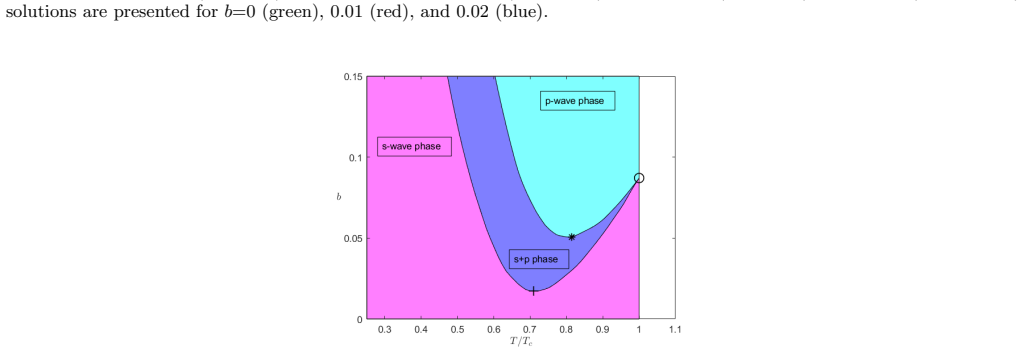
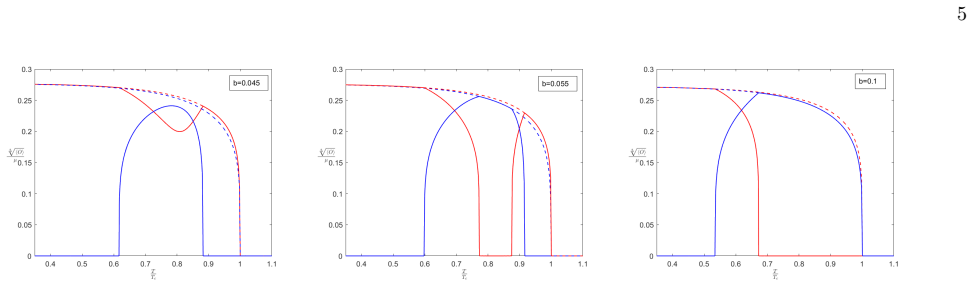
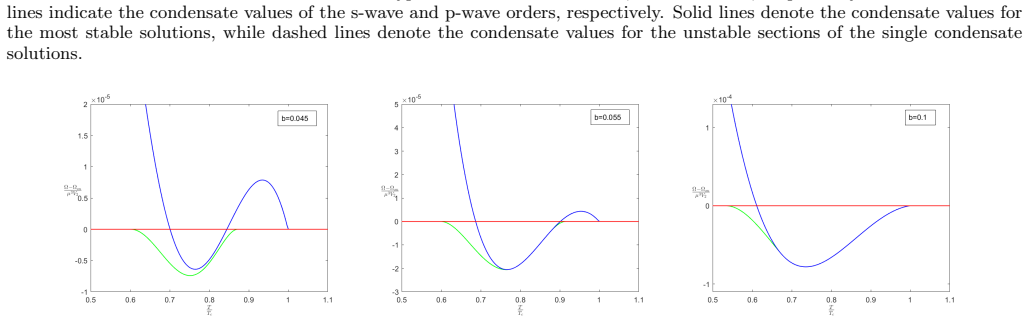
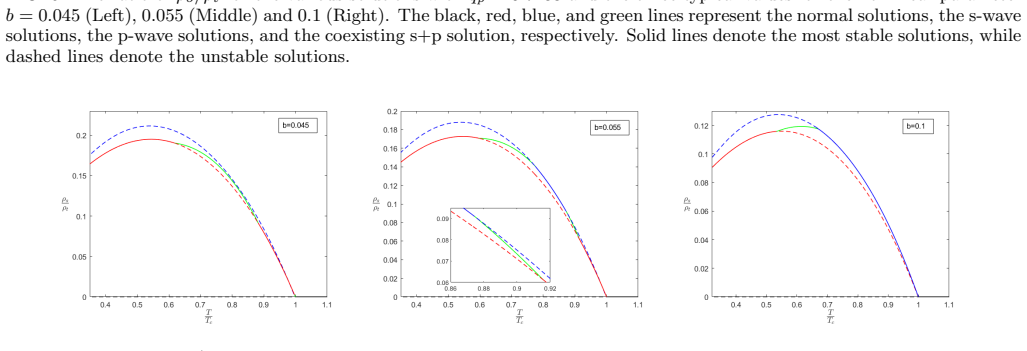
We investigate a holographic s+p superconductor model coupled to nonlinear electrodynamics in the probe limit. The equations of motion are solved numerically, and the condensates as well as the grand potential curves for phase transitions at different values of the nonlinear parameter $b$ are illustrated. It is found that as $b$ increases, both the pure s-wave and p-wave condensates are suppressed. From the $b-T$ phase diagram, we observe that the region of the pure s-wave phase gradually shrinks with increasing $b$, which is attributed to the stronger suppression on the s-wave condensate compared to the one on the p-wave. Moreover, a smaller charge ratio $q_p/q_s$ is needed for the s+p coexistent phase to appear as $b$ grows. A particularly interesting feature is that, due to the nonlinear self-interaction of the electromagnetic field, charge accumulates spontaneously outside the event horizon from the bulk perspective even in the absence of scalar and vector condensates, thereby invalidating the conventional formula for the superconducting charge density. We improve the definition of the superconducting charge density as the background-subtracted value of the accumulated charge outside the horizon with respect to that in the normal phase. Furthermore, the optical conductivity in the normal phase is also modified by this accumulated charge for finite $b$, and its imaginary part develops a minimum at a finite frequency. This minimum persists in the superconducting phase near the critical point, confusing the extraction of the gap frequency.
Editorial analysis
A structured set of objections, weighed in public.
Referee Report
Summary. The manuscript studies a holographic s+p superconductor model coupled to nonlinear electrodynamics in the probe limit. Numerical solutions yield phase diagrams in the b-T plane and as a function of the charge ratio q_p/q_s. The central observation is that nonlinear self-interactions cause spontaneous charge accumulation outside the horizon even in the normal phase (absent condensates), invalidating the conventional holographic charge density extracted from A_t asymptotics. The authors therefore redefine the superconducting charge density as the background-subtracted integrated charge relative to the normal-phase value. They report suppression of both s- and p-wave condensates with increasing b, a shrinking pure s-wave region, a lower critical q_p/q_s for the coexistent phase, and a minimum in the imaginary part of the optical conductivity that persists near the critical point.
Significance. If the redefinition of charge density can be derived from the bulk conserved current or the boundary dictionary, the results would usefully extend holographic superconductivity to nonlinear electrodynamics, clarifying how nonlinearity affects s-p competition and conductivity. The numerical phase diagrams and the reported conductivity minimum would then constitute concrete, falsifiable predictions for this class of models.
major comments (2)
- [Abstract / charge-density redefinition paragraph] Abstract and the paragraph introducing the redefinition: the claim that the conventional ρ is invalidated by spontaneous accumulation, followed by the background-subtracted definition, is presented without an explicit derivation showing that the subtracted quantity equals the boundary U(1) current expectation value or satisfies the modified Gauss law obtained by varying the nonlinear action. This redefinition is load-bearing for every subsequent result on condensates, phase boundaries, and conductivity.
- [Numerical results / phase-diagram figures] Numerical results section (phase diagrams and conductivity plots): no error bars, grid-convergence tests, or validation against the b=0 limit (standard holographic s+p model) are reported. The quantitative statements about the shrinking s-wave region and the critical q_p/q_s values therefore lack demonstrated numerical reliability.
minor comments (1)
- [Figures] Figure captions and legends should explicitly label the normal-phase reference curves used for subtraction and state the integration limits employed for the accumulated charge.
Simulated Author's Rebuttal
We thank the referee for the careful reading and constructive comments on our manuscript. We respond to each major comment below.
read point-by-point responses
-
Referee: [Abstract / charge-density redefinition paragraph] Abstract and the paragraph introducing the redefinition: the claim that the conventional ρ is invalidated by spontaneous accumulation, followed by the background-subtracted definition, is presented without an explicit derivation showing that the subtracted quantity equals the boundary U(1) current expectation value or satisfies the modified Gauss law obtained by varying the nonlinear action. This redefinition is load-bearing for every subsequent result on condensates, phase boundaries, and conductivity.
Authors: We agree that the manuscript lacks an explicit derivation connecting the background-subtracted charge to the boundary current or the modified Gauss law from the nonlinear action. In the revised version we will add a dedicated subsection deriving the conserved current from the action variation, showing how the nonlinear term modifies the relation between the bulk field and the boundary expectation value, and justifying why the subtracted integrated charge is the appropriate superconducting density. revision: yes
-
Referee: [Numerical results / phase-diagram figures] Numerical results section (phase diagrams and conductivity plots): no error bars, grid-convergence tests, or validation against the b=0 limit (standard holographic s+p model) are reported. The quantitative statements about the shrinking s-wave region and the critical q_p/q_s values therefore lack demonstrated numerical reliability.
Authors: We accept that additional numerical controls are needed. The revised manuscript will include (i) explicit reproduction of the b=0 phase diagram and critical charge ratio against the standard s+p literature, (ii) grid-convergence tests for representative values of b and q_p/q_s, and (iii) a statement of the integration tolerance and residual error used in the ODE solver. Because the solutions are deterministic, we will report numerical accuracy rather than statistical error bars. revision: yes
Circularity Check
Superconducting charge density redefined by normal-phase subtraction without derivation from conserved current
specific steps
-
self definitional
[Abstract]
"We improve the definition of the superconducting charge density as the background-subtracted value of the accumulated charge outside the horizon with respect to that in the normal phase."
The superconducting charge density is defined to be exactly the difference between the condensed-phase and normal-phase integrated charges. Any subsequent statement that this difference 'captures the condensate contribution' or 'invalidates the conventional formula' therefore holds by construction of the definition rather than by independent derivation from the boundary dictionary or the nonlinear equations of motion.
full rationale
The paper's central innovation is the observation that nonlinear electrodynamics causes spontaneous charge accumulation outside the horizon even in the normal phase (no condensates). This is a direct consequence of the bulk action and is not circular. However, the load-bearing step for all subsequent claims about 'superconducting charge density' is the redefinition of that quantity as the background-subtracted integrated charge. This step is introduced by fiat in the abstract and is not shown to equal the boundary current or satisfy a modified Gauss law derived from varying the action. Consequently the reported condensate contribution is tautological with the subtraction operation itself. No other circular steps (self-citation chains, ansatz smuggling, or uniqueness theorems) are present.
Axiom & Free-Parameter Ledger
free parameters (2)
- b
- q_p/q_s
axioms (2)
- domain assumption Probe limit (neglect of gravitational backreaction)
- standard math Asymptotic AdS boundary conditions with standard holographic dictionary
Reference graph
Works this paper leans on
-
[1]
J. M. Maldacena, Adv. Theor. Math. Phys.2, 231 (1998), arXiv:hep-th/9711200
Pith/arXiv arXiv 1998
-
[2]
S. S. Gubser, Phys. Rev. D78, 065034 (2008), arXiv:0801.2977 [hep-th]
Pith/arXiv arXiv 2008
-
[3]
S. A. Hartnoll, C. P. Herzog, and G. T. Horowitz, Phys. Rev. Lett.101, 031601 (2008), arXiv:0803.3295 [hep-th]
Pith/arXiv arXiv 2008
-
[4]
S. S. Gubser and S. S. Pufu, JHEP11, 033 (2008), arXiv:0805.2960 [hep-th]
Pith/arXiv arXiv 2008
-
[5]
J.-W. Chen, Y.-J. Kao, D. Maity, W.-Y. Wen, and C.-P. Yeh, Phys. Rev. D81, 106008 (2010), arXiv:1003.2991 [hep-th]
Pith/arXiv arXiv 2010
-
[6]
P. Basu, J. He, A. Mukherjee, M. Rozali, and H.-H. Shieh, JHEP10, 092 (2010), arXiv:1007.3480 [hep-th]
Pith/arXiv arXiv 2010
-
[7]
R.-G. Cai, L. Li, L.-F. Li, and Y.-Q. Wang, JHEP09, 074 (2013), arXiv:1307.2768 [hep-th]
Pith/arXiv arXiv 2013
-
[8]
Z.-H. Li, Y.-C. Fu, and Z.-Y. Nie, Phys. Lett. B776, 115 (2018), arXiv:1706.07893 [hep-th]
Pith/arXiv arXiv 2018
- [9]
-
[10]
Z.-Y. Nie, R.-G. Cai, X. Gao, and H. Zeng, JHEP11, 087 (2013), arXiv:1309.2204 [hep-th]
Pith/arXiv arXiv 2013
-
[11]
Z.-Y. Nie, R.-G. Cai, X. Gao, L. Li, and H. Zeng, Eur. Phys. J. C75, 559 (2015), arXiv:1501.00004 [hep-th]
Pith/arXiv arXiv 2015
-
[12]
I. Amado, D. Arean, A. Jimenez-Alba, L. Melgar, and I. Salazar Landea, Phys. Rev. D89, 026009 (2014), arXiv:1309.5086 [hep-th]
Pith/arXiv arXiv 2014
-
[13]
Z.-Y. Nie and H. Zeng, JHEP10, 047 (2015), arXiv:1505.02289 [hep-th]
Pith/arXiv arXiv 2015
-
[14]
R. Arias and I. Salazar Landea, Phys. Rev. D94, 126012 (2016), arXiv:1608.01687 [hep-th]
Pith/arXiv arXiv 2016
- [15]
-
[16]
X.-K. Zhang, Z.-Y. Nie, H. Zeng, and Q. Pan, Phys. Lett. B850, 138496 (2024), arXiv:2306.13308 [hep-th]
arXiv 2024
- [17]
-
[18]
R.-Q. Chen, X. Zhao, H. Zeng, and Z.-Y. Nie, Eur. Phys. J. C85, 1279 (2025), arXiv:2510.01922 [hep-th]
arXiv 2025
-
[19]
Nishida, JHEP09, 154 (2014), arXiv:1403.6070 [hep-th]
M. Nishida, JHEP09, 154 (2014), arXiv:1403.6070 [hep-th]
Pith/arXiv arXiv 2014
-
[20]
L.-F. Li, R.-G. Cai, L. Li, and Y.-Q. Wang, JHEP08, 164 (2014), arXiv:1405.0382 [hep-th]
Pith/arXiv arXiv 2014
-
[21]
T.-R. Liao, X. Zhao, H. Zeng, and Z.-Y. Nie, Commun. Theor. Phys.77, 095403 (2025), arXiv:2503.10223 [hep-th]
arXiv 2025
-
[22]
C.-Y. Huang, F.-L. Lin, and D. Maity, Phys. Lett. B703, 633 (2011), arXiv:1102.0977 [hep-th]
Pith/arXiv arXiv 2011
-
[23]
A. Krikun, V. P. Kirilin, and A. V. Sadofyev, JHEP07, 136 (2013), arXiv:1210.6074 [hep-th]
Pith/arXiv arXiv 2013
-
[24]
Musso, JHEP06, 083 (2013), arXiv:1302.7205 [hep-th]
D. Musso, JHEP06, 083 (2013), arXiv:1302.7205 [hep-th]
Pith/arXiv arXiv 2013
-
[25]
A. Donos, J. P. Gauntlett, J. Sonner, and B. Withers, JHEP03, 108 (2013), arXiv:1212.0871 [hep-th]
Pith/arXiv arXiv 2013
-
[26]
W.-Y. Wen, M.-S. Wu, and S.-Y. Wu, Phys. Rev. D89, 066005 (2014), arXiv:1309.0488 [hep-th]
Pith/arXiv arXiv 2014
-
[27]
C. P. Herzog, Phys. Rev. D81, 126009 (2010), arXiv:1003.3278 [hep-th]
Pith/arXiv arXiv 2010
-
[28]
Z.-Q. Zhao, X.-K. Zhang, and Z.-Y. Nie, JHEP02, 023 (2023), arXiv:2211.14762 [hep-th]
arXiv 2023
-
[29]
X. Zhao, Z.-Y. Nie, Z.-Q. Zhao, H.-B. Zeng, Y. Tian, and M. Baggioli, JHEP02, 184 (2024), arXiv:2311.08277 [hep-th]
arXiv 2024
-
[30]
Z.-Q. Zhao, Z.-Y. Nie, J.-F. Zhang, X. Zhang, and M. Baggioli, Eur. Phys. J. C85, 464 (2025), arXiv:2406.05345 [hep-th]
arXiv 2025
-
[31]
Y.-X. Cao, H. Zeng, and Z.-Y. Nie, Phys. Lett. B869, 139821 (2025), arXiv:2409.14407 [hep-th]
arXiv 2025
-
[32]
Z.-Q. Zhao, Z.-Y. Nie, J.-F. Zhang, and X. Zhang, Chin. Phys. Lett.42, 101102 (2025), arXiv:2504.04995 [gr-qc]
arXiv 2025
-
[33]
Y.-P. Wang, Z.-Q. Zhao, H. Zeng, and Z.-Y. Nie, Eur. Phys. J. C86, 138 (2026), arXiv:2512.05688 [hep-th]
arXiv 2026
-
[34]
Z.-Q. Zhao, Z.-Y. Nie, X.-K. Zhang, Y.-S. An, J.-F. Zhang, and X. Zhang, Eur. Phys. J. C86, 447 (2026), arXiv:2512.24893 [gr-qc]
Pith/arXiv arXiv 2026
-
[35]
Born and L
M. Born and L. Infeld, Proc. Roy. Soc. Lond. A144, 425 (1934)
1934
-
[36]
J. Jing and S. Chen, Phys. Lett. B686, 68 (2010), arXiv:1001.4227 [gr-qc]
Pith/arXiv arXiv 2010
-
[37]
H. H. Soleng, Phys. Rev. D52, 6178 (1995), arXiv:hep-th/9509033
Pith/arXiv arXiv 1995
-
[38]
S. H. Hendi, JHEP03, 065 (2012), arXiv:1405.4941 [hep-th]
Pith/arXiv arXiv 2012
-
[39]
M. Mohammadi and A. Sheykhi, Eur. Phys. J. C79, 743 (2019), arXiv:1908.07992 [hep-th]
arXiv 2019
-
[40]
E. Ayon-Beato and A. Garcia, Phys. Rev. Lett.80, 5056 (1998), arXiv:gr-qc/9911046
Pith/arXiv arXiv 1998
-
[41]
S. Gangopadhyay and D. Roychowdhury, JHEP05, 002 (2012), arXiv:1201.6520 [hep-th]
Pith/arXiv arXiv 2012
-
[42]
Z. Zhao, Q. Pan, S. Chen, and J. Jing, Nucl. Phys. B871, 98 (2013), arXiv:1212.6693 [hep-th]
Pith/arXiv arXiv 2013
-
[43]
Y. Liu, Y. Gong, and B. Wang, JHEP02, 116 (2016), arXiv:1505.03603 [hep-ph]
Pith/arXiv arXiv 2016
-
[44]
C. Lai, Q. Pan, J. Jing, and Y. Wang, Phys. Lett. B749, 437 (2015), arXiv:1508.05926 [hep-th]
Pith/arXiv arXiv 2015
-
[45]
A. Sheykhi and F. Shaker, Phys. Lett. B754, 281 (2016), arXiv:1601.04035 [hep-th]
Pith/arXiv arXiv 2016
-
[46]
A. Sheykhi and F. Shaker, Int. J. Mod. Phys. D26, 1750050 (2016), arXiv:1606.04364 [gr-qc]
Pith/arXiv arXiv 2016
-
[47]
A. Sheykhi, H. R. Salahi, and A. Montakhab, JHEP04, 058 (2016), arXiv:1603.00075 [gr-qc]
Pith/arXiv arXiv 2016
-
[48]
A. Sheykhi and F. Shaker, Can. J. Phys.94, 1372 (2016), arXiv:1601.05817 [hep-th]
Pith/arXiv arXiv 2016
-
[49]
A. Sheykhi, D. Hashemi Asl, and A. Dehyadegari, Phys. Lett. B781, 139 (2018), arXiv:1803.05724 [hep-th]
Pith/arXiv arXiv 2018
-
[50]
B. B. Ghotbabadi, M. Kord Zangeneh, and A. Sheykhi, Eur. Phys. J. C78, 381 (2018), arXiv:1804.05442 [hep-th]
Pith/arXiv arXiv 2018
-
[51]
M. Mohammadi and A. Sheykhi, Phys. Rev. D100, 086012 (2019), arXiv:1910.06082 [hep-th]
arXiv 2019
-
[52]
M. Mohammadi and A. Sheykhi, Eur. Phys. J. C80, 928 (2020), arXiv:2010.07105 [hep-th]
arXiv 2020
-
[53]
W. Yao, Q. Yang, X. Liu, and J. Jing, Eur. Phys. J. C81, 355 (2021)
2021
-
[54]
M. Mohammadi and A. Sheykhi, Eur. Phys. J. Plus137, 852 (2022), arXiv:2202.03048 [hep-th]
arXiv 2022
-
[55]
U. E. Calder´ on, E. Guzm´ an-Gonz´ alez, and M. Maceda, (2024), arXiv:2404.14787 [hep-th]
arXiv 2024
-
[56]
Wei, Y.-B
R.-T. Wei, Y.-B. Wu, T. Huang, J.-P. Wang, and C.-Y. Zhang, Phys. Lett. B861, 139250 (2025)
2025
discussion (0)
Sign in with ORCID, Apple, or X to comment. Anyone can read and Pith papers without signing in.