Taming Symbolic IBP Reduction with Intermediate Bases
Pith reviewed 2026-06-26 10:16 UTC · model grok-4.3
The pith
An algorithm using sequences of intermediate bases reconstructs IBP reduction coefficients as products of a few analytic matrices with simple rational polynomial entries.
A machine-rendered reading of the paper's core claim, the machinery that carries it, and where it could break.
Core claim
The central claim is that reduction coefficients for complicated Feynman integrals can be reconstructed through a sequence of intermediate bases, yielding analytic expressions that are products of a few analytic matrices whose non-zero entries are simple rational polynomials of the kinematic variables and space-time dimension. The approach is demonstrated explicitly on the massive box-triangle and pentagon-triangle families, where the required numerical evaluations remain orders of magnitude smaller than the dimension of the general ansatz.
What carries the argument
A sequence of intermediate bases that factors the full reduction into products of smaller analytic matrices with rational polynomial entries.
If this is right
- All reduction coefficients for the massive box-triangle are obtained from 3289 numerical samplings.
- All reduction coefficients for the massive pentagon-triangle are obtained from 13013 numerical samplings.
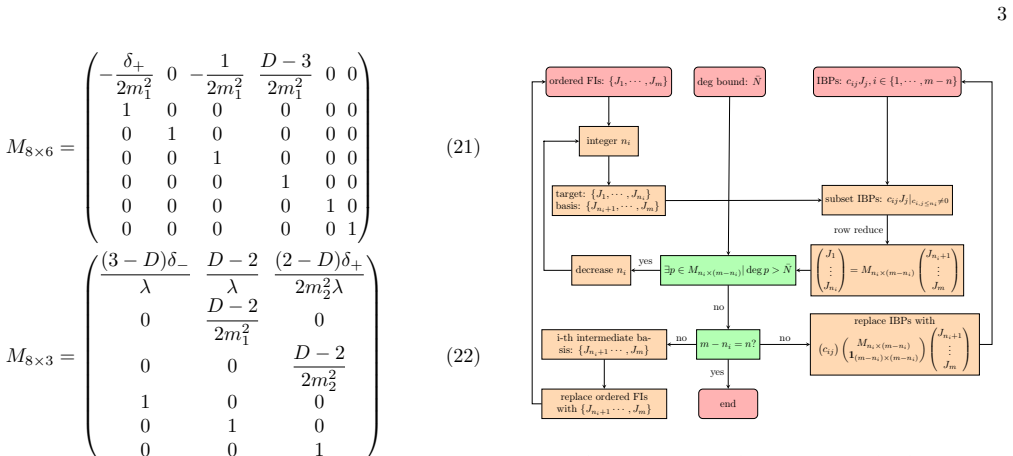
- The coefficients appear as products of a small number of analytic matrices rather than a single large solution vector.
- Non-zero entries in those matrices are simple rational polynomials of the external kinematics and dimension.
Where Pith is reading between the lines
- The same intermediate-base construction might extend to other integral families that currently exceed direct ansatz size limits.
- If the matrix entries stay simple across more families, the method could supply closed-form reduction rules for entire classes of multi-loop amplitudes.
- The factorization into sequential matrices offers a possible route to combine IBP reduction with other algebraic techniques that also produce sparse or factored expressions.
- Numerical stability of the final analytic matrices could be tested by comparing reconstructed coefficients against independent high-precision evaluations on specific kinematic points.
Load-bearing premise
Suitable intermediate bases exist for the target integrals and can be constructed systematically so that the coefficients factor into products of matrices whose entries remain simple rational polynomials.
What would settle it
An integral family for which no sequence of intermediate bases can be found that reduces the number of required numerical samplings below the number of unknowns in the general ansatz, or for which the resulting matrix entries are not simple rational polynomials.
Figures

read the original abstract
Despite many years of development in integration-by-parts reduction, reconstructing all reduction coefficients, which are rational polynomials of kinematic variables and the space-time dimension, remains a non-trivial problem. The main difficulty comes from the large number of unknowns in a general ansatz, which can lead to a linear system that is too large to solve. In this paper, we present an algorithm for reconstructing reduction coefficients through a sequence of intermediate bases. The resulting analytic reduction coefficients are products of a few analytic matrices, whose non-zero entries are simple rational polynomials. We demonstrate the efficiency of this algorithm with two cutting edge examples: a three-point massive box-triangle and a four-point massive pentagon-triangle. Reconstructing all reduction coefficients for the box-triangle (pentagon-triangle) requires 3289 (13013) numerical samplings, significantly fewer than the number of unknowns in the general ansatz, 1407406 (21638331).
Editorial analysis
A structured set of objections, weighed in public.
Referee Report
Summary. The paper presents an algorithm for reconstructing integration-by-parts (IBP) reduction coefficients for Feynman integrals via a sequence of intermediate bases. The resulting analytic coefficients are expressed as products of a small number of analytic matrices whose nonzero entries are simple rational polynomials. Efficiency is demonstrated on two topologies: a three-point massive box-triangle (3289 numerical samplings versus 1,407,406 unknowns in the general ansatz) and a four-point massive pentagon-triangle (13,013 samplings versus 21,638,331 unknowns).
Significance. If reproducible, the intermediate-bases approach offers a concrete route to factor large IBP linear systems into smaller, sequentially solvable ones, directly addressing the scaling barrier in symbolic reduction for multi-loop integrals. The explicit sampling counts, the factored matrix representation, and the demonstration on cutting-edge massive topologies constitute verifiable strengths that could be adopted in existing reduction pipelines.
major comments (1)
- [Algorithm description (likely §3) and example sections (§4–5)] The central efficiency claim rests on the existence of suitable intermediate bases that can be constructed systematically. The manuscript must supply an explicit, reproducible procedure (including any selection criteria or ordering) for generating these bases; without it, independent verification that the reported sampling counts were not obtained via post-hoc adjustment is impossible.
minor comments (2)
- Add a short error-analysis subsection or table quantifying the numerical stability and reconstruction accuracy of the sampled coefficients for both examples.
- Clarify the precise definition and dimension of each intermediate basis in the two worked examples so that the matrix-product factorization can be inspected directly.
Simulated Author's Rebuttal
We thank the referee for the constructive feedback and positive assessment of the significance of our work. We address the single major comment below.
read point-by-point responses
-
Referee: [Algorithm description (likely §3) and example sections (§4–5)] The central efficiency claim rests on the existence of suitable intermediate bases that can be constructed systematically. The manuscript must supply an explicit, reproducible procedure (including any selection criteria or ordering) for generating these bases; without it, independent verification that the reported sampling counts were not obtained via post-hoc adjustment is impossible.
Authors: We agree that an explicit, reproducible procedure for constructing the intermediate bases is required for independent verification. Section 3 of the manuscript presents the algorithm, including the sequential construction of intermediate bases and the resulting factored matrix representation. To strengthen reproducibility and directly address the concern about post-hoc adjustment, we will revise the manuscript to expand Section 3 with a fully detailed, step-by-step procedure. This will include the precise selection criteria, ordering rules, and decision logic used to generate the bases for both the box-triangle and pentagon-triangle examples, together with pseudocode or a flowchart if appropriate. The revised text will make clear how the reported sampling counts (3289 and 13013) follow deterministically from the algorithm. revision: yes
Circularity Check
No significant circularity; algorithmic procedure is self-contained
full rationale
The paper presents an explicit algorithmic procedure for IBP coefficient reconstruction via sequential intermediate bases and linear algebra on concrete topologies (box-triangle, pentagon-triangle). Reported sampling counts (3289, 13013) are directly compared to the size of the general ansatz (1407406, 21638331) and are verifiable without reference to fitted parameters or self-citations. No load-bearing self-citation, self-definitional loop, or ansatz smuggling appears; the central claim reduces to standard linear-system solving applied in stages, with the factored matrix form asserted as an output of the algorithm rather than an input assumption. The derivation chain is therefore independent of its own results.
Axiom & Free-Parameter Ledger
axioms (1)
- standard math Linear systems over the field of rational functions in kinematic variables and spacetime dimension D admit solutions that can be reconstructed from sufficiently many numerical samples.
Reference graph
Works this paper leans on
-
[1]
Integration by parts: The algorithm to calculateβ-functions in 4 loops,
K. G. Chetyrkin and F. V. Tkachov, “Integration by parts: The algorithm to calculateβ-functions in 4 loops,” Nucl. Phys. B192, 159–204 (1981)
1981
-
[2]
High-precision calculation of multiloop Feynman integrals by difference equations,
S. Laporta, “High-precision calculation of multiloop Feynman integrals by difference equations,” Int. J. Mod. Phys. A15, 5087–5159 (2000), arXiv:hep-ph/0102033
Pith/arXiv arXiv 2000
-
[3]
Au- tomatic integral reduction for higher order perturba- 5 tive calculations,
Charalampos Anastasiou and Achilleas Lazopoulos, “Au- tomatic integral reduction for higher order perturba- 5 tive calculations,” JHEP07, 046 (2004), arXiv:hep- ph/0404258
arXiv 2004
-
[4]
Presenting LiteRed: a tool for the Loop In- TEgrals REDuction,
R. N. Lee, “Presenting LiteRed: a tool for the Loop In- TEgrals REDuction,” (2012), arXiv:1212.2685 [hep-ph]
Pith/arXiv arXiv 2012
-
[5]
LiteRed 1.4: a powerful tool for re- duction of multiloop integrals,
Roman N. Lee, “LiteRed 1.4: a powerful tool for re- duction of multiloop integrals,” J. Phys. Conf. Ser.523, 012059 (2014), arXiv:1310.1145 [hep-ph]
Pith/arXiv arXiv 2014
-
[6]
Algorithm FIRE – Feynman Integral REduction,
A. V. Smirnov, “Algorithm FIRE – Feynman Integral REduction,” JHEP10, 107 (2008), arXiv:0807.3243 [hep- ph]
Pith/arXiv arXiv 2008
-
[7]
FIRE4, LiteRed and accompanying tools to solve integration by parts rela- tions,
A. V. Smirnov and V. A. Smirnov, “FIRE4, LiteRed and accompanying tools to solve integration by parts rela- tions,” Comput. Phys. Commun.184, 2820–2827 (2013), arXiv:1302.5885 [hep-ph]
Pith/arXiv arXiv 2013
-
[8]
FIRE5: A C++ implementation of Feynman Integral REduction,
Alexander V. Smirnov, “FIRE5: A C++ implementation of Feynman Integral REduction,” Comput. Phys. Com- mun.189, 182–191 (2015), arXiv:1408.2372 [hep-ph]
Pith/arXiv arXiv 2015
-
[9]
FIRE6: Feynman Integral REduction with modular arithmetic,
A. V. Smirnov and F. S. Chukharev, “FIRE6: Feynman Integral REduction with modular arithmetic,” Comput. Phys. Commun.247, 106877 (2020), arXiv:1901.07808 [hep-ph]
arXiv 2020
-
[10]
Reduze – Feynman integral reduction in C++,
C. Studerus, “Reduze – Feynman integral reduction in C++,” Comput. Phys. Commun.181, 1293–1300 (2010), arXiv:0912.2546 [physics.comp-ph]
Pith/arXiv arXiv 2010
-
[11]
Reduze 2 - Distributed Feynman Integral Reduction,
A. von Manteuffel and C. Studerus, “Reduze 2 - Distributed Feynman Integral Reduction,” (2012), arXiv:1201.4330 [hep-ph]
Pith/arXiv arXiv 2012
-
[12]
Kira—A Feynman integral reduction pro- gram,
Philipp Maierh¨ ofer, Johann Usovitsch, and Pe- ter Uwer, “Kira—A Feynman integral reduction pro- gram,” Comput. Phys. Commun.230, 99–112 (2018), arXiv:1705.05610 [hep-ph]
Pith/arXiv arXiv 2018
-
[13]
Integral reduction with Kira 2.0 and finite field methods,
Jonas Klappert, Fabian Lange, Philipp Maierh¨ ofer, and Johann Usovitsch, “Integral reduction with Kira 2.0 and finite field methods,” Comput. Phys. Commun.266, 108024 (2021), arXiv:2008.06494 [hep-ph]
Pith/arXiv arXiv 2021
-
[14]
NeatIBP 1.0, a package generating small-size integration-by-parts relations for Feynman in- tegrals,
Zihao Wu, Janko Boehm, Rourou Ma, Hefeng Xu, and Yang Zhang, “NeatIBP 1.0, a package generating small-size integration-by-parts relations for Feynman in- tegrals,” Comput. Phys. Commun.295, 108999 (2024), arXiv:2305.08783 [hep-ph]
arXiv 2024
-
[15]
Alexander V. Smirnov and Mao Zeng, “Feynman inte- gral reduction: balanced reconstruction of sparse rational functions and implementation on supercomputers in a co- design approach,” Numerical Methods and Programming 25, 30–45 (2024), arXiv:2409.19099 [hep-ph]
arXiv 2024
-
[16]
A novel approach to integration by parts reduction,
Andreas von Manteuffel and Robert M. Schabinger, “A novel approach to integration by parts reduction,” Phys. Lett. B744, 101–104 (2015), arXiv:1406.4513 [hep-ph]
Pith/arXiv arXiv 2015
-
[17]
Scattering amplitudes over finite fields and multivariate functional reconstruction,
Tiziano Peraro, “Scattering amplitudes over finite fields and multivariate functional reconstruction,” JHEP12, 030 (2016), arXiv:1608.01902 [hep-ph]
Pith/arXiv arXiv 2016
-
[18]
Reconstructing ra- tional functions with FireFly,
Jonas Klappert and Fabian Lange, “Reconstructing ra- tional functions with FireFly,” Comput. Phys. Commun. 247, 106951 (2020), arXiv:1904.00009 [cs.SC]
arXiv 2020
-
[19]
FiniteFlow: multivariate functional re- construction using finite fields and dataflow graphs,
Tiziano Peraro, “FiniteFlow: multivariate functional re- construction using finite fields and dataflow graphs,” JHEP07, 031 (2019), arXiv:1905.08019 [hep-ph]
Pith/arXiv arXiv 2019
-
[20]
Scaling up to multivariate rational function reconstruction,
Andreas Maier, “Scaling up to multivariate rational function reconstruction,” Comput. Phys. Commun.317, 109827 (2025), arXiv:2409.08757 [hep-ph]
arXiv 2025
-
[21]
Balancing act: Multivariate rational reconstruc- tion for IBP,
A. V. Belitsky, A. V. Smirnov, and R. V. Yakovlev, “Balancing act: Multivariate rational reconstruc- tion for IBP,” Nucl. Phys. B993, 116253 (2023), arXiv:2303.02511 [hep-ph]
arXiv 2023
-
[22]
Maximal quotient rational recon- struction: an almost optimal algorithm for rational re- construction,
Michael Monagan, “Maximal quotient rational recon- struction: an almost optimal algorithm for rational re- construction,” inProceedings of the 2004 International Symposium on Symbolic and Algebraic Computation, IS- SAC ’04 (Association for Computing Machinery, New York, NY, USA, 2004) p. 243–249
2004
-
[23]
A deterministic algorithm for sparse multivariate polynomial interpola- tion,
Michael Ben-Or and Prasoon Tiwari, “A deterministic algorithm for sparse multivariate polynomial interpola- tion,” inProceedings of the Twentieth Annual ACM Sym- posium on Theory of Computing, STOC ’88 (Association for Computing Machinery, New York, NY, USA, 1988) p. 301–309
1988
-
[24]
Interpolating polynomials from their values,
Richard Zippel, “Interpolating polynomials from their values,” (1989)
1989
-
[25]
Computational complexity of sparse rational inter- polation,
Dima Grigoriev, Marek Karpinski, and Michael Singer, “Computational complexity of sparse rational inter- polation,” SIAM Journal on Computing23(1997), 10.1137/S0097539791194069
-
[26]
Greatest common divisors of polynomi- als given by straight-line programs,
Erich Kaltofen, “Greatest common divisors of polynomi- als given by straight-line programs,” J. ACM35, 231–264 (1988)
1988
-
[27]
Computing with poly- nomials given by black boxes for their evaluation: Great- est common divisors, factorization, separation of numer- ators and denominators,
Erich Kaltofen and Barry Trager, “Computing with poly- nomials given by black boxes for their evaluation: Great- est common divisors, factorization, separation of numer- ators and denominators,” (1988) pp. 296–305
1988
-
[28]
On exact and ap- proximate interpolation of sparse rational functions,
Erich Kaltofen and Zhengfeng Yang, “On exact and ap- proximate interpolation of sparse rational functions,” inProceedings of the 2007 International Symposium on Symbolic and Algebraic Computation, ISSAC ’07 (Asso- ciation for Computing Machinery, New York, NY, USA,
2007
-
[29]
Algorithms for the non-monic case of the sparse modular gcd algorithm,
Jennifer de Kleine, Michael Monagan, and Allan Wit- tkopf, “Algorithms for the non-monic case of the sparse modular gcd algorithm,” inProceedings of the 2005 In- ternational Symposium on Symbolic and Algebraic Com- putation, ISSAC ’05 (Association for Computing Machin- ery, New York, NY, USA, 2005) p. 124–131
2005
-
[30]
Foxbox: a system for manipulating symbolic objects in black box representa- tion,
Angel D´ ıaz and Erich Kaltofen, “Foxbox: a system for manipulating symbolic objects in black box representa- tion,” inProceedings of the 1998 International Sympo- sium on Symbolic and Algebraic Computation, ISSAC ’98 (Association for Computing Machinery, New York, NY, USA, 1998) p. 30–37
1998
-
[31]
Early termination in ben-or/tiwari sparse interpolation and a hybrid of zippel’s algorithm,
Erich Kaltofen, Wen-shin Lee, and Austin A. Lobo, “Early termination in ben-or/tiwari sparse interpolation and a hybrid of zippel’s algorithm,” inProceedings of the 2000 International Symposium on Symbolic and Alge- braic Computation, ISSAC ’00 (Association for Comput- ing Machinery, New York, NY, USA, 2000) p. 192–201
2000
-
[32]
Sparse polyno- mial interpolation with finitely many values for the coef- ficients,
Qiao-Long Huang and Xiao-Shan Gao, “Sparse polyno- mial interpolation with finitely many values for the coef- ficients,” (2017), arXiv:1704.04359 [cs.SC]
Pith/arXiv arXiv 2017
-
[33]
Interpolation of dense and sparse rational functions and other improvements in FireFly,
Jonas Klappert, Sven Yannick Klein, and Fabian Lange, “Interpolation of dense and sparse rational functions and other improvements in FireFly,” Comput. Phys. Com- mun.264, 107968 (2021), arXiv:2004.01463 [cs.MS]
arXiv 2021
-
[34]
Barycentric ratio- nal interpolation with no poles and high rates of approx- imation,
Michael S. Floater and Kai Hormann, “Barycentric ratio- nal interpolation with no poles and high rates of approx- imation,” Numerische Mathematik107, 315–331 (2007)
2007
-
[35]
Multiloop integrals in dimensional regularization made simple,
Johannes M. Henn, “Multiloop integrals in dimensional regularization made simple,” Phys. Rev. Lett.110, 251601 (2013), arXiv:1304.1806 [hep-th]
Pith/arXiv arXiv 2013
-
[36]
Reducing differential equations for multiloop master integrals,
Roman N. Lee, “Reducing differential equations for multiloop master integrals,” JHEP04, 108 (2015), 6 arXiv:1411.0911 [hep-ph]
Pith/arXiv arXiv 2015
-
[37]
Reconstruction of rational functions made simple,
Xiao Liu, “Reconstruction of rational functions made simple,” Phys. Lett. B850, 138491 (2024), arXiv:2306.12262 [hep-ph]
arXiv 2024
-
[38]
How to choose master integrals,
A. V. Smirnov and V. A. Smirnov, “How to choose master integrals,” Nucl. Phys. B960, 115213 (2020), arXiv:2002.08042 [hep-ph]
arXiv 2020
-
[39]
Factorization of denomina- tors in integration-by-parts reductions,
Johann Usovitsch, “Factorization of denomina- tors in integration-by-parts reductions,” (2020), arXiv:2002.08173 [hep-ph]
arXiv 2020
-
[40]
Analytic Form of Planar Two-Loop Five-Gluon Scattering Amplitudes in QCD,
S. Abreu, J. Dormans, F. Febres Cordero, H. Ita, and B. Page, “Analytic Form of Planar Two-Loop Five-Gluon Scattering Amplitudes in QCD,” Phys. Rev. Lett.122, 082002 (2019), arXiv:1812.04586 [hep-ph]
Pith/arXiv arXiv 2019
-
[41]
Ans¨ atze for scat- tering amplitudes from p-adic numbers and algebraic ge- ometry,
Giuseppe De Laurentis and Ben Page, “Ans¨ atze for scat- tering amplitudes from p-adic numbers and algebraic ge- ometry,” JHEP12, 140 (2022), arXiv:2203.04269 [hep- th]
arXiv 2022
-
[42]
p-adic reconstruction of rational functions in multiloop amplitudes,
Herschel A. Chawdhry, “p-adic reconstruction of rational functions in multiloop amplitudes,” Phys. Rev. D110, 056028 (2024), arXiv:2312.03672 [hep-ph]
arXiv 2024
-
[43]
Factorization of denominators as a ‘fuel’ for Feynman integral reduction,
Alexander V. Smirnov, Vladislav. A. Fokin, and Egor Yu. Chuvashov, “Factorization of denominators as a ‘fuel’ for Feynman integral reduction,” (2026), arXiv:2605.13256 [hep-ph]
Pith/arXiv arXiv 2026
-
[44]
Critical points and syzy- gies for Feynman integrals,
Ben Page and Qian Song, “Critical points and syzy- gies for Feynman integrals,” JHEP02, 004 (2026), arXiv:2509.17681 [hep-th]
arXiv 2026
-
[45]
Feynman integral reduc- tion using syzygy-constrained symbolic reduction rules,
Sid Smith and Mao Zeng, “Feynman integral reduc- tion using syzygy-constrained symbolic reduction rules,” JHEP01, 102 (2026), arXiv:2507.11140 [hep-th]
arXiv 2026
-
[46]
Seed- less Reduction of Feynman Integrals,
Leonardo de la Cruz and David A. Kosower, “Seed- less Reduction of Feynman Integrals,” (2026), arXiv:2602.22111 [hep-ph]
arXiv 2026
-
[47]
Such an estimation is based on evaluation on 32-bit prime number with private linear solver
-
[48]
Philipp Maierh¨ ofer and Johann Usovitsch, “Kira 1.2 Re- lease Notes,” (2018), arXiv:1812.01491 [hep-ph]
Pith/arXiv arXiv 2018
-
[49]
Kira 3: integral reduction with efficient seeding and op- timized equation selection,
Fabian Lange, Johann Usovitsch, and Zihao Wu, “Kira 3: integral reduction with efficient seeding and op- timized equation selection,” Comput. Phys. Commun. 322, 109999 (2026), arXiv:2505.20197 [hep-ph]
arXiv 2026
-
[50]
For our interested part of physical amplitude,O(ϵ 2) is enough
discussion (0)
Sign in with ORCID, Apple, or X to comment. Anyone can read and Pith papers without signing in.