REVIEW 2 major objections 3 minor 23 references
Homographic Navigation: Geometry-Driven Camera Guidance for Deterministic Planar Capture
T0 review · 2 major / 3 minor · reviewed 2026-06-26 · grok-4.3
Pith's one-line read A model trained solely on synthetic homographic augmentations from one reference image can guide cameras to precise planar alignment via keypoint prediction and two-pass refinement.
desk verdict The paper gives a clean way to train keypoint models for planar alignment from one reference image using synthetic homographies, plus a two-pass scheme and Stable Warp trick, but real-world generalization is the weak link. read the letter →
The pith
A machine-rendered reading of the paper's core claim, the machinery that carries it, and where it could break.
The reading
What carries the argument
Homographic navigation, the geometry-centric framework that treats homography as the unifying variable across data generation, model training, and inference for planar alignment.
What would settle it
Test the trained model on a set of real camera captures of the target planar objects under lighting, distances, or angles outside the augmentation range; if average alignment error exceeds the claimed precision threshold, the approach does not generalize as stated.
Extended reading notes
Core claim
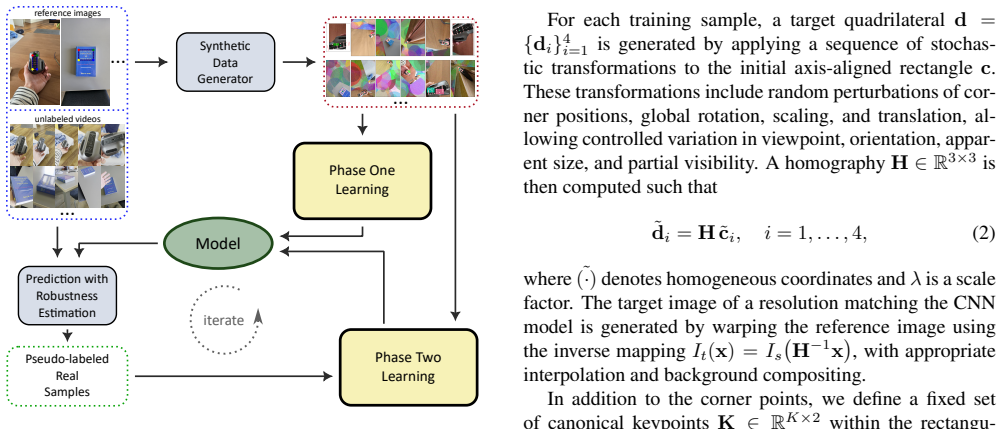
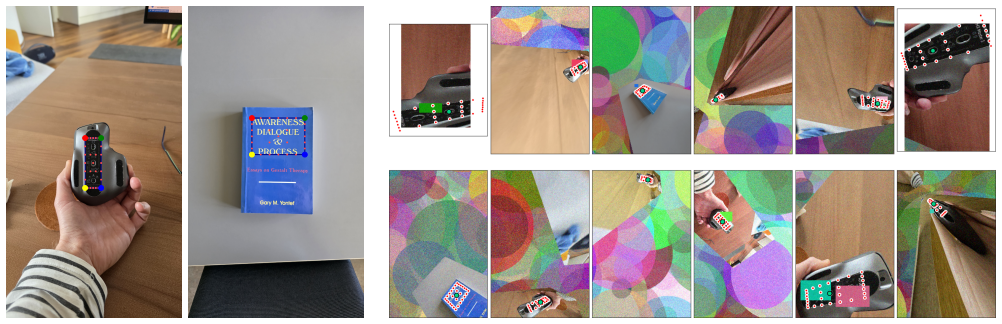
Homographic navigation unifies learning, alignment, and evaluation by using homography as the organizing variable. Synthetic homographic augmentations generated from one reference image train a model for sparse keypoint prediction on multiple planar artifacts. The two-pass inference scheme performs global detection followed by localized refinement, and the Stable Warp training strategy boosts accuracy in the high-precision regime, with the model also estimating confidence for each keypoint and the full sample.
Load-bearing premise
Synthetic homographic changes applied to one reference image create enough variety and realism for the trained model to work on actual camera images under different conditions.
Editorial extensions
If this is right
- Accurate planar alignment becomes feasible with only one annotated reference image instead of large real-world datasets.
- The two-pass scheme combined with Stable Warp training delivers measurable gains in high-precision keypoint localization.
- Per-keypoint and per-sample confidence predictions are produced alongside the alignment output.
- The method supplies a starting point for geometry-driven camera guidance systems.
- It opens a path to training directly from unlabeled in-the-wild video sequences.
Reading between the lines
- The same synthetic-augmentation idea could be tested on non-rectangular planar targets by adjusting the keypoint layout.
- Integrating the confidence scores into an active feedback loop might let a camera app automatically adjust position until alignment confidence exceeds a threshold.
- If the two-pass refinement step is replaced by a higher-resolution single pass, the accuracy gain from Stable Warp could be measured directly against that baseline.
- The approach may apply to other geometry-driven tasks such as document scanning or surface inspection where exact planar registration is required.
Editorial analysis
A structured set of objections, weighed in public.
Referee Report
Summary. The paper presents homographic navigation, a geometry-centric framework that treats homography as an organizing variable for guiding camera capture of planar regions. From a single annotated reference image, unlimited synthetic training data is generated via homographic augmentation to train a single-shot model for joint recognition and localization of rectangular planar artifacts via sparse keypoint prediction. A two-pass inference scheme (global detection followed by localized refinement) and Stable Warp training strategy are introduced to improve precision under limited input resolution, along with per-keypoint and per-sample confidence estimates. The central claim is that accurate planar alignment can be achieved from minimal supervision, providing a foundation for geometry-driven camera guidance and future in-the-wild learning.
Significance. If the generalization claim holds, the approach would be significant for enabling high-precision geometric tasks with extremely low supervision (one reference image), reducing reliance on large annotated datasets in computer vision. The unification of learning, alignment, and evaluation around homography is a conceptual strength, and the two-pass scheme plus Stable Warp strategy address a practical resolution-precision tradeoff. However, the significance is conditional on evidence that synthetic 2D projective augmentations suffice for real-world generalization.
major comments (2)
- [Experiments] Experiments section: all reported metrics and ablations (including improvements from Stable Warp) are confined to held-out synthetic homographic warps of the reference image; no quantitative results, baselines, or error analysis on real camera captures (varying illumination, lens distortion, partial occlusion, or non-rigid surfaces) are provided, which is load-bearing for the generalization premise stated in the abstract and §1.
- [§3.2 and §3.3] §3.2 (two-pass inference) and §3.3 (Stable Warp): the refinement pass operates on cropped regions from the first pass, but the training distribution remains purely synthetic; without a real-world test set or domain-adaptation experiment, the claim that this yields 'accurate planar alignment' on physical camera feeds is unsupported.
minor comments (3)
- [Abstract] Abstract: the phrase 'experimental results demonstrate' should be accompanied by at least one concrete metric or dataset descriptor to avoid overstatement.
- [§3] Notation: the per-keypoint and per-sample confidence outputs are mentioned but lack an explicit formulation or loss term; adding this in §3 would improve clarity.
- Figure captions: several figures showing keypoint predictions would benefit from explicit scale bars or pixel-error annotations to aid interpretation of the high-precision regime.
Simulated Author's Rebuttal
We thank the referee for the constructive feedback. We address each major comment below, acknowledging the synthetic scope of the current experiments and committing to revisions that clarify the claims without overstating generalization.
read point-by-point responses
-
Referee: [Experiments] Experiments section: all reported metrics and ablations (including improvements from Stable Warp) are confined to held-out synthetic homographic warps of the reference image; no quantitative results, baselines, or error analysis on real camera captures (varying illumination, lens distortion, partial occlusion, or non-rigid surfaces) are provided, which is load-bearing for the generalization premise stated in the abstract and §1.
Authors: We agree that all reported metrics and ablations are performed exclusively on synthetic homographic warps of the single reference image. This is intentional, as the framework's central contribution is the use of homography as an organizing variable to generate unlimited training data from minimal (one-image) supervision. The experiments rigorously validate the two-pass inference and Stable Warp strategy within this controlled synthetic regime, demonstrating precision gains. However, the abstract and §1 do imply broader applicability. We will revise the abstract, introduction, and conclusion to explicitly qualify that accurate planar alignment is shown in synthetic evaluations, and that extension to real camera captures (with factors such as illumination variation or occlusion) constitutes future work. A limitations section will be added to discuss the current synthetic-to-real gap. revision: yes
-
Referee: [§3.2 and §3.3] §3.2 (two-pass inference) and §3.3 (Stable Warp): the refinement pass operates on cropped regions from the first pass, but the training distribution remains purely synthetic; without a real-world test set or domain-adaptation experiment, the claim that this yields 'accurate planar alignment' on physical camera feeds is unsupported.
Authors: The training distribution is purely synthetic, as the method generates data via homographic augmentation from one annotated reference; no real images are used for training or the reported ablations. The two-pass scheme and Stable Warp are evaluated synthetically to isolate their effect on precision at limited resolution. We concur that unsupported claims about physical camera feeds should be avoided. We will revise §3.2, §3.3, the abstract, and related text to state that the components yield accurate alignment under synthetic conditions and provide a foundation for future real-world deployment, rather than asserting direct applicability to in-the-wild physical feeds. revision: yes
Circularity Check
No circularity detected in derivation chain
full rationale
The paper's core pipeline—generating synthetic training data via homographic augmentation from one annotated reference image, training a single-shot keypoint model, and applying two-pass inference with Stable Warp—relies on standard geometric augmentation and supervised learning rather than any self-definitional reduction, fitted-input-as-prediction, or load-bearing self-citation. No equations or claims in the provided text equate outputs to inputs by construction; the approach is externally falsifiable via real-world capture metrics and does not invoke uniqueness theorems or prior author work to force its own results.
Assumptions & free parameters
assumptions (1)
- domain assumption Homography can serve as the central organizing variable unifying learning, alignment, and evaluation for planar capture.
Cite this review
Pith. "Pith review of Homographic Navigation: Geometry-Driven Camera Guidance for Deterministic Planar Capture." pith.science (2026). https://pith.science/paper/B4U4XUME
@misc{pith2026260622834,
  author       = {Pith},
  title        = {Pith review of: Homographic Navigation: Geometry-Driven Camera Guidance for Deterministic Planar Capture},
  year         = {2026},
  howpublished = {\url{https://pith.science/paper/B4U4XUME}},
  note         = {Machine review of arXiv:2606.22834}
}
read the original abstract
We present homographic navigation, a geometry-centric framework for guiding camera acquisition toward precise capture of planar regions. Rather than treating homography as an output, we use it as an organizing variable that unifies learning, alignment, and evaluation. From a single annotated reference image, we generate unlimited synthetic training data via homographic augmentation and train a single-shot model for joint recognition and localization of multiple artifacts (physical objects with a rectangular planar target) through sparse keypoint prediction. To address precision under limited model input resolution, we introduce a two-pass inference scheme with global detection followed by localized refinement, and a Stable Warp training strategy that significantly improves accuracy, particularly in the high-precision regime. The model also predicts confidence estimates per predicted keypoint and per the whole sample. Experimental results demonstrate that accurate planar alignment can be achieved from minimal supervision, providing a foundation for geometry-driven camera guidance and future learning from in-the-wild video data.
Figures

Figures from the paper (4 more)


Reference graph
Works this paper leans on
-
[1]
Iterative deep homography estimation
Si-Yuan Cao, Jianxin Hu, Zehua Sheng, and Hui-Liang Shen. Iterative deep homography estimation. InIEEE/CVF Confer- ence on Computer Vision and Pattern Recognition (CVPR), 2022
2022
-
[2]
Recurrent homog- raphy estimation using homography-guided image warping and focus transformer
Si-Yuan Cao, Rui Zhang, Liang Luo, Benyuan Yu, Zehua Sheng, Jiangtao Li, and Hui-Liang Shen. Recurrent homog- raphy estimation using homography-guided image warping and focus transformer. InIEEE/CVF Conference on Com- puter Vision and Pattern Recognition (CVPR), 2023
2023
-
[3]
Curriculum labeling: Revisiting pseudo- labeling for semi-supervised learning
Paola Cascante-Bonilla, Fuwen Tan, Yongfeng Qi, and Vi- cente Ordonez. Curriculum labeling: Revisiting pseudo- labeling for semi-supervised learning. InAAAI Conference on Artificial Intelligence, 2021
2021
-
[4]
Lopes, Cristiano Preme- bida, and Urbano J
Pedro Conde, Tiago Barros, Rui L. Lopes, Cristiano Preme- bida, and Urbano J. Nunes. Approaching test-time augmen- tation in the context of uncertainty calibration for deep neural networks.arXiv preprint arXiv:2304.05104, 2023
-
[5]
Deep Image Homography Estimation
Daniel DeTone, Tomasz Malisiewicz, and Andrew Rabi- novich. Deep image homography estimation.arXiv preprint arXiv:1606.03798, 2016
work page Pith review arXiv 2016
-
[6]
RoMa v2: Harder better faster denser feature matching, 2025
Johan Edstedt, David Nordstr ¨om, Yushan Zhang, Georg B¨okman, Jonathan Astermark, Viktor Larsson, Anders Hey- den, Fredrik Kahl, M ˚arten Wadenb¨ack, and Michael Fels- berg. RoMa v2: Harder better faster denser feature matching, 2025
2025
-
[7]
Madrid-Cuevas, and Manuel J
Sergio Garrido-Jurado, Rafael Mu ˜noz-Salinas, Francisco J. Madrid-Cuevas, and Manuel J. Mar ´ın-Jim´enez. Automatic generation and detection of highly reliable fiducial markers under occlusion.Pattern Recognition, 2014
2014
-
[8]
Homofm: Deep homography estimation with flow matching.arXiv preprint arXiv:2601.18222, 2026
Mengfan He, Liangzheng Sun, Chunyu Li, and Ziyang Meng. Homofm: Deep homography estimation with flow matching.arXiv preprint arXiv:2601.18222, 2026
Show all 23 references
-
[9]
Supervised homography learning with realistic dataset generation
Hankyeol Jiang et al. Supervised homography learning with realistic dataset generation. InInternational Conference on Computer Vision (ICCV), 2023
2023
-
[10]
Posenet: A convolutional network for real-time 6-dof cam- era relocalization
Alex Kendall, Matthew Grimes, and Roberto Cipolla. Posenet: A convolutional network for real-time 6-dof cam- era relocalization. InInternational Conference on Computer Vision (ICCV), 2015
2015
-
[11]
Planar- track: A large-scale challenging benchmark for planar object tracking
Xinran Liu, Xiaoqiong Liu, Ziruo Yi, Xin Zhou, Thanh Le, Libo Zhang, Yan Huang, Qing Yang, and Heng Fan. Planar- track: A large-scale challenging benchmark for planar object tracking. InIEEE/CVF International Conference on Com- puter Vision (ICCV), 2023
2023
-
[12]
A review of homog- raphy estimation: Advances and challenges.Electronics, 12 (24):4977, 2023
Yinhui Luo, Xingyi Wang, Yanhao Liao, Qiang Fu, Chang Shu, Yuezhou Wu, and Yuanqing He. A review of homog- raphy estimation: Advances and challenges.Electronics, 12 (24):4977, 2023
2023
-
[13]
Muller and Toby Breckon
Bruce R. Muller and Toby Breckon. Self-supervised relative pose with homography model-fitting in the loop. InWin- ter Conference on Applications of Computer Vision (WACV), 2023
2023
-
[14]
Chen, Shreyas S
Ty Nguyen, Steven W. Chen, Shreyas S. Shivakumar, Camillo J. Taylor, and Vijay Kumar. Unsupervised deep ho- mography: A fast and robust homography estimation model. IEEE Robotics and Automation Letters, 2018
2018
-
[15]
You only look once: Unified, real-time object de- tection, 2016
Joseph Redmon, Santosh Divvala, Ross Girshick, and Ali Farhadi. You only look once: Unified, real-time object de- tection, 2016
2016
-
[16]
Understanding the limitations of cnn-based ab- solute camera pose regression
Torsten Sattler, Qunjie Zhou, Marc Pollefeys, and Laura Leal-Taixe. Understanding the limitations of cnn-based ab- solute camera pose regression. InIEEE/CVF Conference on Computer Vision and Pattern Recognition (CVPR), 2019
2019
-
[17]
Mondal, and Jyoti Prakash Sahoo
Yisheng Song, Ting Wang, Puyu Cai, Subrota K. Mondal, and Jyoti Prakash Sahoo. A comprehensive survey of few- shot learning: Evolution, applications, challenges, and op- portunities.ACM Computing Surveys, 55(13s):1–40, 2023
2023
-
[18]
Sinha, and Pascal Fua
Bugra Tekin, Sudipta N. Sinha, and Pascal Fua. Real-time seamless single shot 6d object pose prediction. InIEEE/CVF Conference on Computer Vision and Pattern Recognition, 2018
2018
-
[19]
Real-time detection and tracking for augmented reality on mobile phones.IEEE Transactions on Visualization and Computer Graphics, 16 (6):1404–1413, 2010
Daniel Wagner, Gerhard Reitmayr, Alessandro Mulloni, Tom Drummond, and Dieter Schmalstieg. Real-time detection and tracking for augmented reality on mobile phones.IEEE Transactions on Visualization and Computer Graphics, 16 (6):1404–1413, 2010
2010
-
[20]
Hvc-net: Unifying ho- mography, visibility, and confidence learning for planar ob- ject tracking
Haoxian Zhang and Yonggen Ling. Hvc-net: Unifying ho- mography, visibility, and confidence learning for planar ob- ject tracking. InEuropean Conference on Computer Vision (ECCV), 2022
2022
-
[21]
Content-aware un- supervised deep homography estimation
Jirong Zhang, Chang Wang, Shaodi Liu, Lehu Jia, Nanning Ye, Jiaqing Wang, Jie Zhou, and Jin Sun. Content-aware un- supervised deep homography estimation. InEuropean Con- ference on Computer Vision (ECCV), 2020
2020
-
[22]
Deep homography es- timation with feature correlation transformer
Haoyu Zhou, Wei Hu, Ying Li, et al. Deep homography es- timation with feature correlation transformer. InIEEE Inter- national Conference on Multimedia and Expo (ICME), 2023
2023
-
[23]
Mcnet: Rethink- ing the core ingredients for accurate and efficient homogra- phy estimation
Haokai Zhu, Si-Yuan Cao, Jianxin Hu, et al. Mcnet: Rethink- ing the core ingredients for accurate and efficient homogra- phy estimation. InIEEE/CVF Conference on Computer Vi- sion and Pattern Recognition (CVPR), 2024
2024
Reviewed June 26, 2026 · model on record in the stance chip above.
Discussion (0). Continue with ORCID to comment.