Twisting Small-x Gluon Tomography with Orbital Angular Momentum
Pith reviewed 2026-06-26 08:03 UTC · model grok-4.3
The pith
Replacing the lepton current with a twisted wave-packet current turns the elliptic gluon response into a tunable projection that can reach zero at finite diffractive rate.
A machine-rendered reading of the paper's core claim, the machinery that carries it, and where it could break.
Core claim
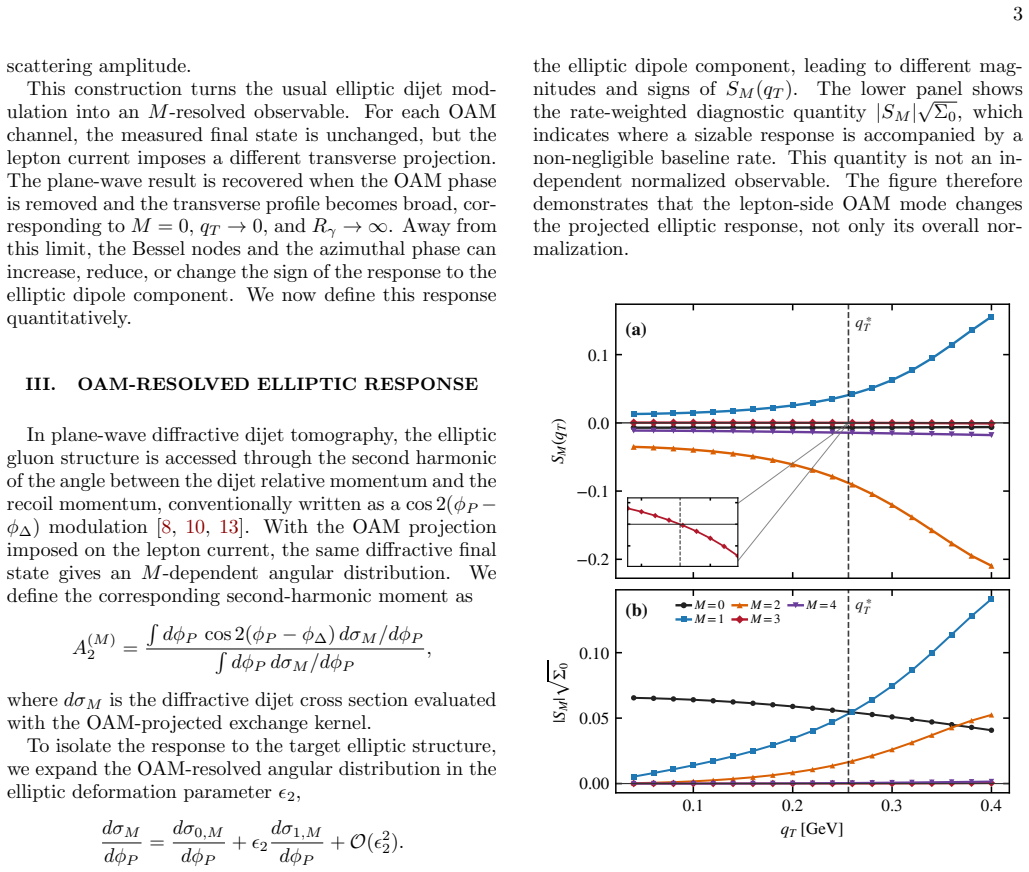
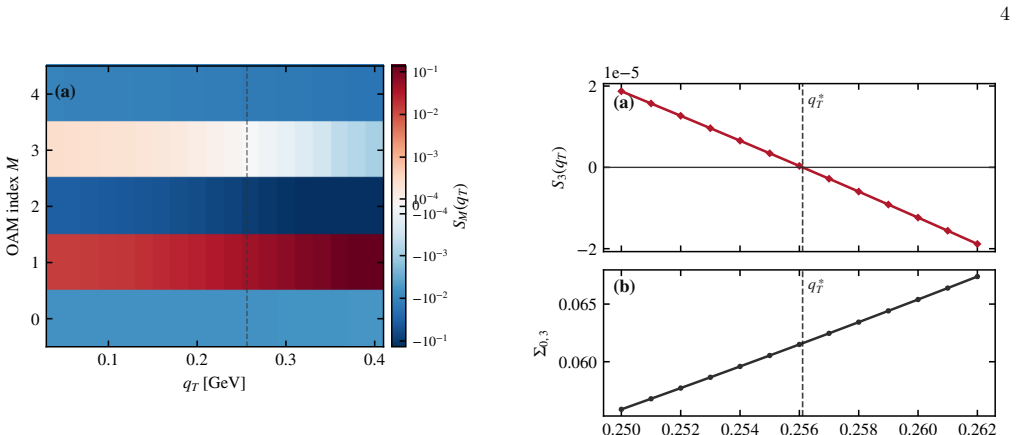
The elliptic response can vanish while the diffractive rate remains finite. This finite-rate null is a normalized projection zero of the response to the target elliptic gluon component, not a disappearance of diffraction. It arises because the OAM dependence enters through the transverse structure of the lepton electromagnetic current, promoting the readout into a tunable OAM-Bessel projection kernel that is absent from the standard single plane-wave case.
What carries the argument
OAM-Bessel projection kernel from the transverse lepton current structure, which converts the fixed elliptic correlation into M-resolved observables A2^(M)(qT, Rγ) containing a subtraction from total-rate deformation.
If this is right
- The observable becomes a family of M-resolved elliptic correlations parameterized by the Bessel scale qT.
- The elliptic response can be tuned through zero while the diffractive rate stays finite.
- This null point is a projection zero unavailable as a tunable mode in the standard plane-wave readout.
- The same small-x elliptic geometry can be probed with either sign or set to zero using the external projection basis.
Where Pith is reading between the lines
- Future experiments could scan M to isolate different angular components of the gluon Wigner distribution by driving selected responses through zero.
- The same current-twisting approach might be applied to other azimuthal observables in DIS to create tunable nulls for background subtraction.
- If beam-shaping techniques allow controlled OAM in lepton beams, the method supplies an independent cross-check on elliptic gluon tomography results obtained with plane waves.
Load-bearing premise
The orbital angular momentum dependence enters solely through the transverse structure of the lepton electromagnetic current, without treating the exchanged virtual photon as an asymptotic vortex particle.
What would settle it
Measurement of whether A2^(M)(qT, Rγ) reaches exactly zero at a specific finite value of the total diffractive dijet rate for chosen M and qT in data from an electron-ion collider.
Figures

read the original abstract
We propose an orbital-angular-momentum-resolved extension of small-$x$ gluon tomography in hard diffractive dijet deep inelastic scattering. In the standard plane-wave setup, the elliptic correlation between the dijet relative momentum and the target recoil probes the elliptic component of the small-$x$ gluon Wigner distribution through a fixed transverse readout. We show that replacing the plane-wave lepton current by a twisted wave-packet current promotes this readout into a tunable OAM--Bessel projection kernel. The exchanged virtual photon is not treated as an asymptotic vortex particle; the OAM dependence enters through the transverse structure of the lepton electromagnetic current. The resulting observable is a family of $M$-resolved elliptic correlations $A_2^{(M)}(q_T,R_\gamma)$, where $q_T$ denotes the transverse Bessel scale of the projection kernel, not the transverse momentum of the exchanged photon. We derive the normalized linear response and show that it contains a subtraction from the deformation of the total diffractive rate. Consequently, the elliptic response can vanish while the diffractive rate remains finite. This finite-rate null is a normalized projection zero of the response to the target elliptic gluon component, not a disappearance of diffraction. It is not available as a tunable mode zero in the standard single plane-wave readout, and provides an external projection basis in which the response to the same small-$x$ elliptic geometry can be probed with either sign or tuned to zero.
Editorial analysis
A structured set of objections, weighed in public.
Referee Report
Summary. The manuscript proposes an OAM-resolved extension of small-x gluon tomography in hard diffractive dijet DIS. Replacing the plane-wave lepton current with a twisted wave-packet current introduces tunable Bessel projection kernels A_2^{(M)}(q_T, R_γ) acting on the elliptic gluon Wigner component. The normalized linear response is derived to contain a subtraction term arising from deformation of the total diffractive rate, yielding finite-rate nulls that are projection zeros unavailable in the standard single plane-wave readout. The setup explicitly states that OAM dependence enters solely through the lepton electromagnetic current transverse structure and that the exchanged virtual photon is not treated as an asymptotic vortex particle.
Significance. If the derivation holds under the stated modeling choices, the work supplies an external projection basis that permits the elliptic response to be tuned through zero or sign change while the diffractive rate remains finite. This augments standard fixed-readout tomography and supplies concrete, falsifiable predictions for structured-beam experiments. The explicit separation of OAM effects from the virtual-photon wave function is a clear, parameter-free modeling choice that enables the subtraction construction.
major comments (1)
- [Setup paragraph (abstract and §2)] Setup paragraph (abstract and §2): The finite-rate null for the elliptic response is load-bearing on the assumption that the tunable kernel A_2^{(M)}(q_T, R_γ) acts only on the target elliptic Wigner component while the total rate remains independent of the projection. The manuscript states that OAM dependence enters exclusively through the lepton current and that the virtual photon is not treated as a vortex particle, but provides no explicit check or reference demonstrating that the virtual-photon wave function in the small-x limit does not inherit additional OAM-dependent phases or selection rules from the lepton current. If such mixing occurs, the subtraction term would no longer isolate an independent projection zero.
minor comments (1)
- [Derivation section] The definition of the normalized linear response and the explicit form of the subtraction term should be placed in the main text with equation numbers rather than left implicit after the abstract statement.
Simulated Author's Rebuttal
We thank the referee for the positive assessment and the recommendation for minor revision. We address the major comment below.
read point-by-point responses
-
Referee: [Setup paragraph (abstract and §2)] Setup paragraph (abstract and §2): The finite-rate null for the elliptic response is load-bearing on the assumption that the tunable kernel A_2^{(M)}(q_T, R_γ) acts only on the target elliptic Wigner component while the total rate remains independent of the projection. The manuscript states that OAM dependence enters exclusively through the lepton current and that the virtual photon is not treated as a vortex particle, but provides no explicit check or reference demonstrating that the virtual-photon wave function in the small-x limit does not inherit additional OAM-dependent phases or selection rules from the lepton current. If such mixing occurs, the subtraction term would no longer isolate an independent projection zero.
Authors: The separation is a deliberate modeling choice stated explicitly in the manuscript: OAM dependence enters exclusively through the lepton electromagnetic current, while the exchanged virtual photon is not treated as an asymptotic vortex particle. In the small-x eikonal regime the virtual-photon wave function follows from the standard QED lepton-photon vertex and the usual dipole or parton-model description; no additional OAM phases or selection rules are transferred to the photon field itself. The twisted lepton current modifies only the transverse overlap integral that defines the projection kernel A_2^{(M)}, leaving the total diffractive rate independent of M by construction. Because the setup excludes vortex structure for the photon, the kernel acts solely on the target elliptic Wigner component and the subtraction term isolates the desired projection zero. No further explicit check is required beyond the stated modeling assumptions, which are consistent with the standard treatment of structured beams in high-energy DIS. revision: no
Circularity Check
Derivation self-contained from modified lepton current; no reduction to inputs
full rationale
The paper extends standard small-x gluon tomography by replacing the plane-wave lepton current with a twisted wave-packet current (OAM dependence enters solely via lepton electromagnetic current transverse structure, photon not treated as vortex). The normalized linear response A_2^{(M)}(q_T,R_γ) and its subtraction term are derived directly from this replacement and the resulting tunable Bessel projection kernel acting on the elliptic Wigner component. No equations reduce a prediction to a fitted input by construction, no self-citations are invoked as load-bearing uniqueness theorems, and the finite-rate null follows mathematically from the projection without renaming known results or smuggling ansatze. The setup is externally falsifiable via the stated separation of current structure.
Axiom & Free-Parameter Ledger
axioms (2)
- domain assumption Small-x gluon Wigner distribution framework applies to hard diffractive dijet DIS
- domain assumption Lepton electromagnetic current can be replaced by twisted wave-packet without altering photon vortex treatment
Reference graph
Works this paper leans on
-
[1]
The cor- responding fixed-central-kinematics construction is sum- marized in Sec
and are separated from the OAM–Bessel projection. The cor- responding fixed-central-kinematics construction is sum- marized in Sec. SI of the Supplemental Material. The transverse projection is implemented by replac- ing the plane-wave transverse phase with a Bessel-type wave-packet weight [23, 24]. We useMto denote the OAM channel andq T to denote the tr...
- [2]
-
[3]
A. V. Belitsky, X.-d. Ji, and F. Yuan, Phys. Rev. D69, 074014 (2004), arXiv:hep-ph/0307383
Pith/arXiv arXiv 2004
-
[4]
C. Lorce and B. Pasquini, Phys. Rev. D84, 014015 (2011), arXiv:1106.0139 [hep-ph]
Pith/arXiv arXiv 2011
-
[5]
X. Ji, F. Yuan, and Y. Zhao, Phys. Rev. Lett.118, 192004 (2017), arXiv:1612.02438 [hep-ph]
Pith/arXiv arXiv 2017
-
[6]
Y. Hatta, Y. Nakagawa, F. Yuan, Y. Zhao, and B. Xiao, Phys. Rev. D95, 114032 (2017), arXiv:1612.02445 [hep- ph]
Pith/arXiv arXiv 2017
-
[7]
A. Accardiet al., Eur. Phys. J. A52, 268 (2016), arXiv:1212.1701 [nucl-ex]
Pith/arXiv arXiv 2016
-
[8]
R. Abdul Khaleket al., Nucl. Phys. A1026, 122447 (2022), arXiv:2103.05419 [physics.ins-det]
Pith/arXiv arXiv 2022
-
[9]
Y. Hatta, B.-W. Xiao, and F. Yuan, Phys. Rev. Lett. 116, 202301 (2016), arXiv:1601.01585 [hep-ph]
Pith/arXiv arXiv 2016
-
[10]
Y. Hatta, B.-W. Xiao, and F. Yuan, Phys. Rev. D95, 114026 (2017), arXiv:1703.02085 [hep-ph]
Pith/arXiv arXiv 2017
- [11]
-
[12]
Y. Hagiwara, Y. Hatta, R. Pasechnik, M. Tasevsky, and O. Teryaev, Phys. Rev. D96, 034009 (2017), arXiv:1706.01765 [hep-ph]
Pith/arXiv arXiv 2017
-
[13]
T. Altinoluk, N. Armesto, G. Beuf, and A. H. Rezaeian, Phys. Lett. B758, 373 (2016), arXiv:1511.07452 [hep- ph]
Pith/arXiv arXiv 2016
-
[14]
H. M¨ antysaari, N. Mueller, and B. Schenke, Phys. Rev. D99, 074004 (2019), arXiv:1902.05087 [hep-ph]
Pith/arXiv arXiv 2019
-
[15]
F. Salazar and B. Schenke, Phys. Rev. D100, 034007 (2019), arXiv:1905.03763 [hep-ph]
arXiv 2019
-
[16]
H. M¨ antysaari, N. Mueller, F. Salazar, and B. Schenke, Phys. Rev. Lett.124, 112301 (2020), arXiv:1912.05586 [nucl-th]
arXiv 2020
- [17]
-
[18]
D. Boer and C. Setyadi, Phys. Rev. D104, 074006 (2021), arXiv:2106.15148 [hep-ph]
arXiv 2021
- [19]
-
[20]
Y. Hatta, B.-W. Xiao, and F. Yuan, Phys. Rev. D106, 094015 (2022), arXiv:2205.08060 [hep-ph]
arXiv 2022
-
[21]
Y. Hatta and F. Yuan, Phys. Lett. B854, 138738 (2024), arXiv:2403.19609 [hep-ph]
arXiv 2024
-
[22]
D. Y. Shao, Y. Shi, C. Zhang, J. Zhou, and Y.-j. Zhou, JHEP07, 189, arXiv:2402.05465 [hep-ph]
-
[23]
U. D. Jentschura and V. G. Serbo, Phys. Rev. Lett.106, 013001 (2011), arXiv:1008.4788 [physics.acc-ph]
Pith/arXiv arXiv 2011
-
[24]
I. P. Ivanov, Phys. Rev. D83, 093001 (2011), arXiv:1101.5575 [hep-ph]
Pith/arXiv arXiv 2011
-
[25]
I. P. Ivanov and V. G. Serbo, Phys. Rev. A84, 033804 (2011), arXiv:1105.6244 [hep-ph]
Pith/arXiv arXiv 2011
-
[26]
I. P. Ivanov, D. Seipt, A. Surzhykov, and S. Fritzsche, Phys. Rev. D94, 076001 (2016), arXiv:1608.06551 [hep- ph]
Pith/arXiv arXiv 2016
-
[27]
K. Y. Bliokhet al., Phys. Rept.690, 1 (2017), arXiv:1703.06879 [quant-ph]
Pith/arXiv arXiv 2017
-
[28]
Lloyd, M
S. . Lloyd, M. Babiker, G. Thirunavukkarasu, and J. Yuan, Rev. Mod. Phys.89, 035004 (2017)
2017
-
[29]
I. P. Ivanov, Prog. Part. Nucl. Phys.127, 103987 (2022), arXiv:2205.00412 [hep-ph]
arXiv 2022
-
[30]
D. V. Karlovets, S. S. Baturin, G. Geloni, G. K. Sizykh, and V. G. Serbo, Eur. Phys. J. C83, 372 (2023), arXiv:2203.12012 [hep-ph]
arXiv 2023
- [31]
-
[32]
Z. Li, S. Liu, B. Liu, L. Ji, and I. P. Ivanov, Phys. Rev. Lett.133, 265001 (2024), arXiv:2406.06795 [hep-ph]
arXiv 2024
-
[33]
M. Ababekri, J.-L. Zhou, R.-T. Guo, Y.-Z. Ren, Y.-H. Kou, Q. Zhao, Z.-P. Li, and J.-X. Li, Phys. Rev. D110, 076024 (2024), arXiv:2404.11952 [hep-ph]
arXiv 2024
-
[34]
Karlovets, JHEP03, 049, arXiv:1611.08302 [hep-ph]
D. Karlovets, JHEP03, 049, arXiv:1611.08302 [hep-ph]
-
[35]
L. D. McLerran and R. Venugopalan, Phys. Rev. D49, 2233 (1994), arXiv:hep-ph/9309289
Pith/arXiv arXiv 1994
-
[36]
L. D. McLerran and R. Venugopalan, Phys. Rev. D49, 3352 (1994), arXiv:hep-ph/9311205
Pith/arXiv arXiv 1994
-
[37]
J. Jalilian-Marian, A. Kovner, A. Leonidov, and H. Weigert, Phys. Rev. D59, 014014 (1998), arXiv:hep- ph/9706377
arXiv 1998
- [38]
-
[39]
Y. V. Kovchegov, Phys. Rev. D60, 034008 (1999), arXiv:hep-ph/9901281
Pith/arXiv arXiv 1999
-
[40]
F. Dominguez, C. Marquet, B.-W. Xiao, and F. Yuan, Phys. Rev. D83, 105005 (2011), arXiv:1101.0715 [hep- ph]
Pith/arXiv arXiv 2011
-
[41]
K. J. Golec-Biernat and M. Wusthoff, Phys. Rev. D59, 014017 (1998), arXiv:hep-ph/9807513. 6 Supplemental Material Twisting Small-xGluon Tomography with Orbital Angular Momentum SI. OAM-PROJECTED LEPTON CURRENT AND FIXED KINEMATICS This section gives the minimal definitions used in the main text for the orbital-angular-momentum (OAM) projected electromagne...
Pith/arXiv arXiv 1998
discussion (0)
Sign in with ORCID, Apple, or X to comment. Anyone can read and Pith papers without signing in.