DJM: Compact Base Meshes for Displacement Mapping using Triangle Jacobians
Pith reviewed 2026-06-26 06:39 UTC · model grok-4.3
The pith
A Jacobian lower-bound constraint during QEM simplification produces smaller base meshes that still support bijective, low-distortion displacements.
A machine-rendered reading of the paper's core claim, the machinery that carries it, and where it could break.
Core claim
The central claim is that enforcing a lower bound on the pointwise Jacobian of the displacement mapping throughout the simplification process yields base meshes whose supported displacements remain bijective and low-distortion while using fewer triangles than meshes produced by unconstrained QEM or other existing schemes.
What carries the argument
The Displacement Jacobian Metric (DJM), which supplies a pointwise lower bound on the Jacobian determinant of the displacement function and is inserted directly into the QEM edge-collapse cost to reject collapses that would violate bijectivity or distortion limits.
If this is right
- Base meshes can be reduced in size while preserving reconstruction accuracy.
- Explicit input-to-base correspondences replace ray-mesh intersections for all subsequent displacement computations.
- The same base meshes support both traditional micromesh rasterization and neural displacement encoders with less error.
- The method inherits the linear complexity of QEM while adding only the Jacobian check and mapping bookkeeping.
Where Pith is reading between the lines
- The same Jacobian-tracking idea could be applied to other coarsening tasks that require guaranteed bijective mappings, such as progressive parameterization.
- Because the mapping is stored explicitly, the approach may extend to dynamic or animated base meshes without recomputing correspondences from scratch.
Load-bearing premise
Maintaining a lower bound on the Jacobian at every step of simplification is sufficient to ensure the final base mesh admits a bijective low-distortion displacement for the original detailed surface.
What would settle it
An input mesh for which the DJM-simplified base, after displacement encoding, produces visible folds, overlaps, or high local distortion in the reconstructed surface would show the Jacobian bound is insufficient.
Figures


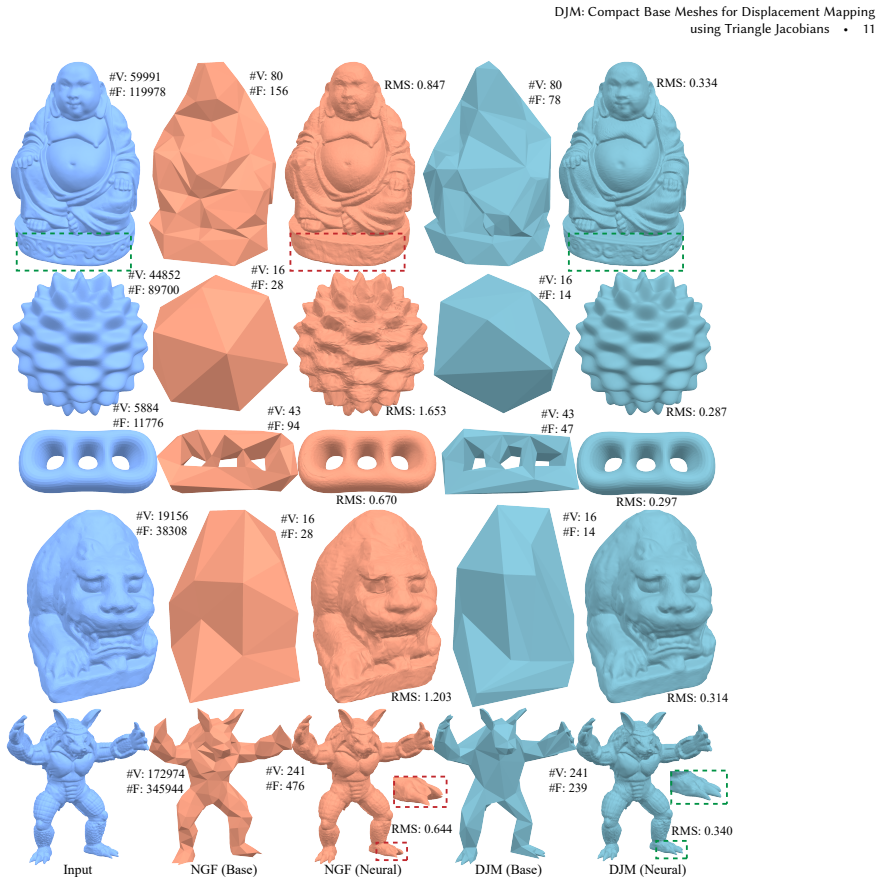

read the original abstract
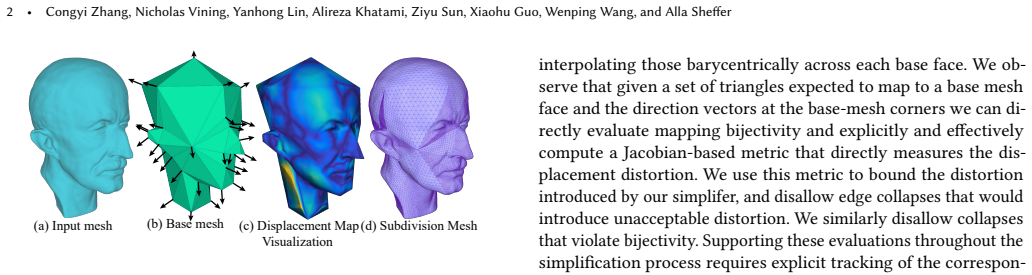
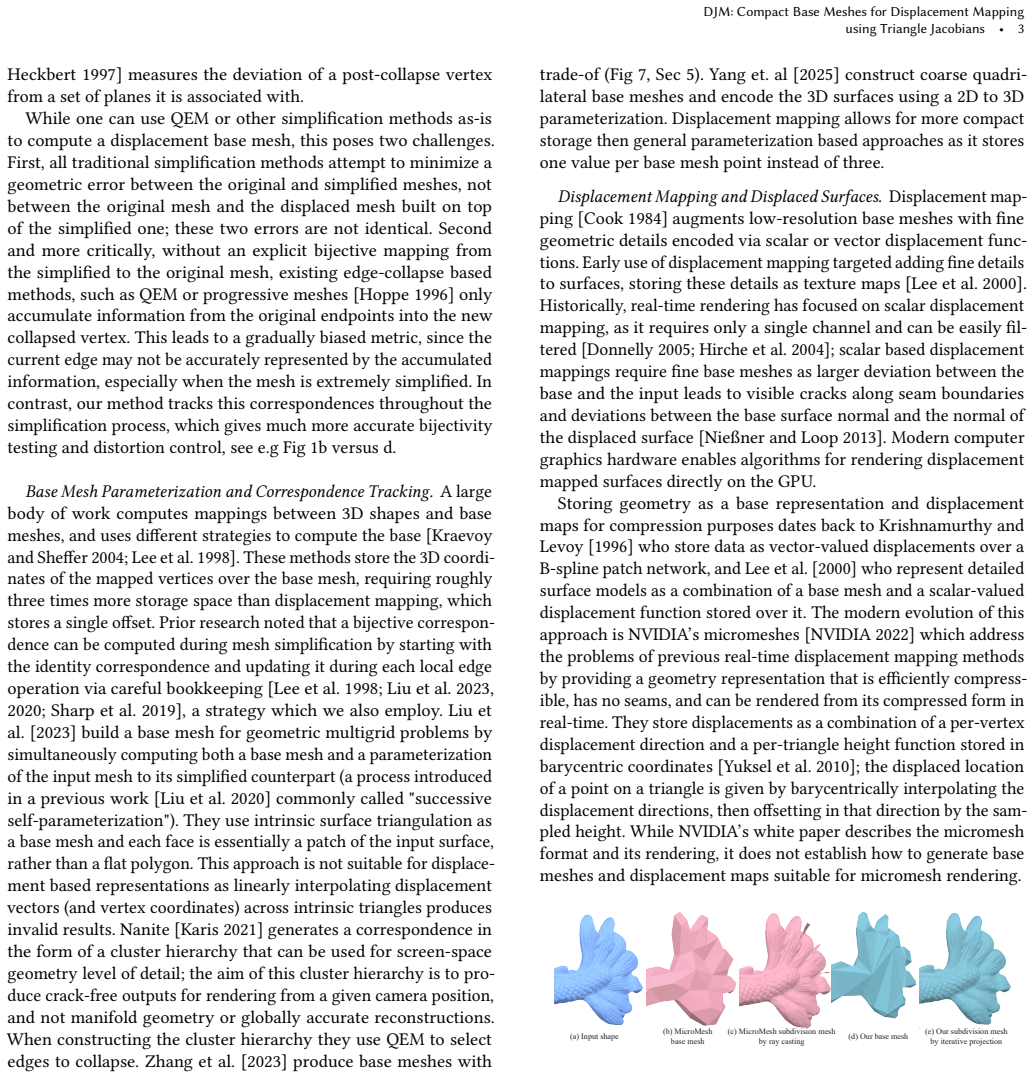
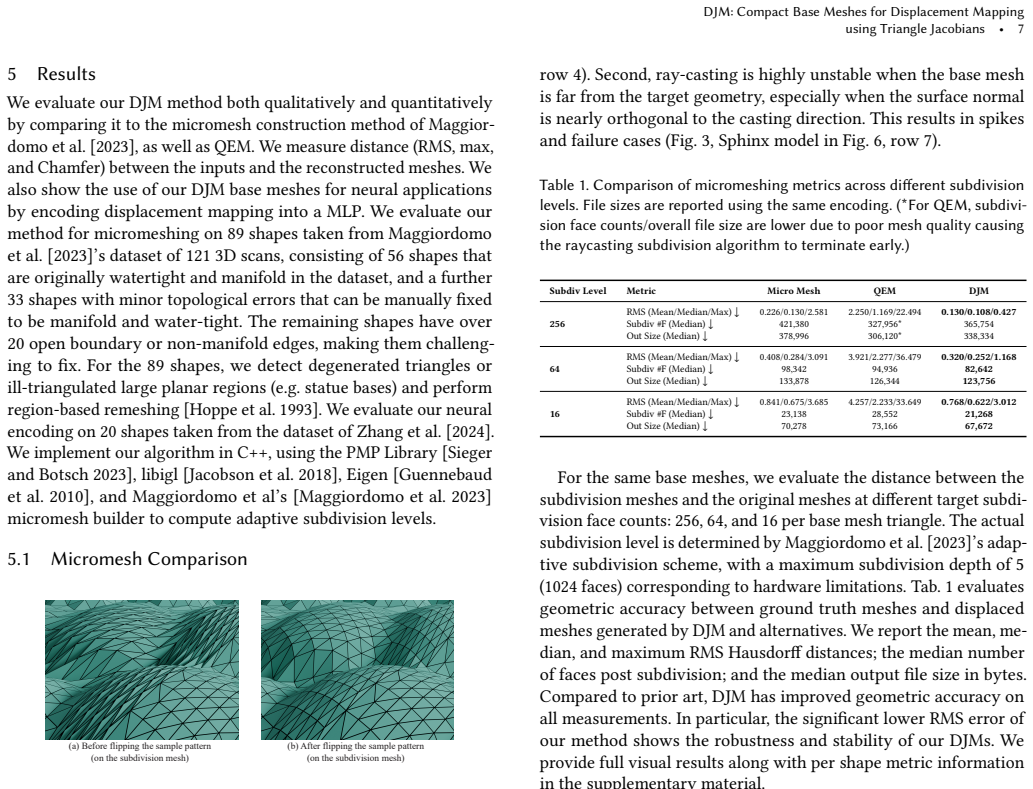
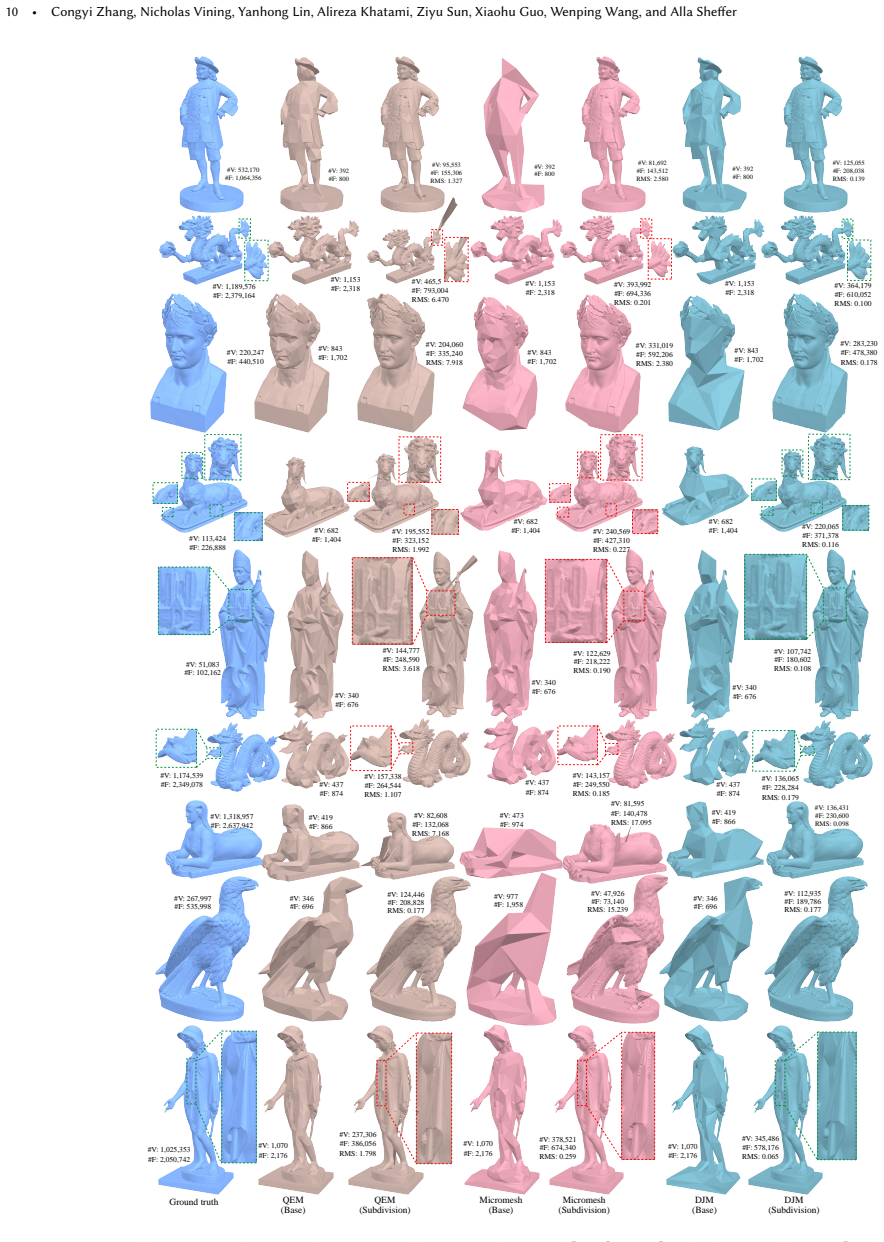
Representing complex geometry as a displacement function defined over a coarse base mesh enables compact storage and accelerated rendering. The core challenge in converting detailed triangle meshes into this representation is computing base meshes that have as few triangles as possible, while also supporting displacement functions that accurately approximate the input. Accurate approximation requires the supported displacement functions to bijectively map the input surface onto the base with low parametric distortion. We observe that this distortion can be measured by evaluating the pointwise Jacobian of the displacement functions. Our new DJM (Displacement Jacobian Metric)-based base-mesh construction method uses the Jacobian of the displacement functions to guide base mesh computation, enabling us to outperform prior approaches in terms of accuracy to size trade-off. We achieve this goal by proposing a variant of the QEM-based simplification scheme that constrains the displacement mapping between the input and the base to be bijective and low distortion (defined as satisfying a lower bound on the mapping Jacobian). When evaluating and encoding the displacement maps, we avoid unreliable ray-mesh intersections by explicitly storing the mapping between the input mesh and the base throughout the construction process, and use this mapping within a robust inverse barycentric displacement solver to obtain dense base-to-mesh correspondences to assist all computations. We demonstrate DJM to outperform alternative schemes in terms of reconstruction accuracy to size trade-off, and demonstrate its robustness and usability for micromesh-based rendering and neural encoding.
Editorial analysis
A structured set of objections, weighed in public.
Referee Report
Summary. The paper claims to introduce DJM, a Displacement Jacobian Metric for constructing compact base meshes supporting displacement maps. It modifies QEM simplification to enforce a lower bound on the pointwise Jacobian of the displacement function (defining this as ensuring bijectivity and low distortion), stores explicit input-to-base mappings to enable a robust inverse barycentric solver, and reports improved accuracy-to-size trade-offs over prior methods for micromesh rendering and neural encoding.
Significance. If the construction reliably yields globally bijective low-distortion displacements with superior trade-offs, the approach could improve compact geometry representations in graphics pipelines. The explicit mapping storage is a practical engineering contribution that sidesteps ray-intersection unreliability.
major comments (1)
- [Abstract] Abstract (paragraph on the QEM variant): the central claim defines bijectivity and low distortion solely via a lower bound on the mapping Jacobian enforced during edge collapses. However, det(J) > 0 only guarantees local invertibility; global injectivity on a closed surface requires additional conditions (properness, no global folds). The manuscript provides no invariant, propagation argument, or post-simplification injectivity check showing that the per-collapse constraint yields a globally bijective final displacement map.
Simulated Author's Rebuttal
We thank the referee for the careful reading and for identifying the distinction between local and global bijectivity. We respond to the single major comment below.
read point-by-point responses
-
Referee: [Abstract] Abstract (paragraph on the QEM variant): the central claim defines bijectivity and low distortion solely via a lower bound on the mapping Jacobian enforced during edge collapses. However, det(J) > 0 only guarantees local invertibility; global injectivity on a closed surface requires additional conditions (properness, no global folds). The manuscript provides no invariant, propagation argument, or post-simplification injectivity check showing that the per-collapse constraint yields a globally bijective final displacement map.
Authors: We agree that a strictly positive Jacobian determinant supplies only a local invertibility guarantee and does not by itself preclude global folds or non-injectivity on a closed surface. The manuscript defines the target property via the per-collapse Jacobian lower bound and relies on the incremental construction (starting from the identity map) together with explicit input-to-base correspondence storage to maintain usable mappings in practice. No formal propagation invariant or post-process global injectivity test is supplied. We will revise the abstract and the relevant method section to state explicitly that the Jacobian constraint enforces local bijectivity and low distortion, and we will add a short discussion of the distinction together with empirical checks (e.g., absence of foldovers detected via the inverse barycentric solver and visual inspection of rendered displacements) on the evaluated models. These changes will temper the claim while preserving the engineering contribution of the explicit mapping storage. revision: yes
Circularity Check
No circularity: algorithmic enforcement of Jacobian bound is independent construction
full rationale
The paper defines low-distortion as a lower bound on the pointwise Jacobian and enforces this bound inside a QEM variant. This is a direct algorithmic constraint rather than a self-definition, fitted prediction, or reduction to prior self-citation. No equations equate the final bijectivity claim to the input by construction, and the accuracy-to-size improvement is presented as an empirical outcome of the procedure. The derivation chain remains self-contained against external benchmarks.
Axiom & Free-Parameter Ledger
axioms (1)
- domain assumption The pointwise Jacobian of the displacement function measures parametric distortion of the mapping from input surface to base mesh.
invented entities (1)
-
DJM (Displacement Jacobian Metric)
no independent evidence
Reference graph
Works this paper leans on
-
[1]
2020 , issue_date =
Neural Subdivision , author =. 2020 , issue_date =
2020
-
[2]
ACM Transactions on Graphics (TOG) , volume=
Progressive shell quasistatics for unstructured meshes , author=. ACM Transactions on Graphics (TOG) , volume=. 2023 , publisher=
2023
-
[3]
and Snyder, John and Gortler, Steven J
Sander, Pedro V. and Snyder, John and Gortler, Steven J. and Hoppe, Hugues , title =. 2001 , booktitle =
2001
-
[4]
arXiv preprint arXiv:2409.06030 , year=
NESI: Shape Representation via Neural Explicit Surface Intersection , author=. arXiv preprint arXiv:2409.06030 , year=
-
[5]
Computer graphics forum , volume=
Metro: measuring error on simplified surfaces , author=. Computer graphics forum , volume=. 1998 , organization=
1998
-
[6]
GPU gems , volume=
Per-pixel displacement mapping with distance functions , author=. GPU gems , volume=
-
[7]
Progressive geometry compression , author=. Proc. CGIT , pages=
-
[8]
Proceedings of the 2003 Eurographics/ACM SIGGRAPH symposium on Geometry processing , pages=
Explicit surface remeshing , author=. Proceedings of the 2003 Eurographics/ACM SIGGRAPH symposium on Geometry processing , pages=
2003
-
[9]
Computer Aided Geometric Design , volume=
Polygonization of implicit surfaces , author=. Computer Aided Geometric Design , volume=. 1988 , publisher=
1988
-
[10]
Journal of Implicit Surfaces , volume=
The blob tree , author=. Journal of Implicit Surfaces , volume=
-
[11]
ACM Transactions on Graphics (TOG) , volume=
Fast winding numbers for soups and clouds , author=. ACM Transactions on Graphics (TOG) , volume=. 2018 , publisher=
2018
-
[12]
Proceedings of the 2004 Eurographics/ACM SIGGRAPH symposium on Geometry processing , pages=
Spectral surface reconstruction from noisy point clouds , author=. Proceedings of the 2004 Eurographics/ACM SIGGRAPH symposium on Geometry processing , pages=
2004
-
[13]
ACM Transactions on Graphics , volume=
NeuPPS: Neural Piecewise Parametric Surfaces , author=. ACM Transactions on Graphics , volume=. 2025 , publisher=
2025
-
[14]
Micro-Mesh - Basics
NVIDIA. Micro-Mesh - Basics. 2024
2024
-
[15]
, author=
Hardware Accelerated Per-Pixel Displacement Mapping. , author=. Graphics interface , volume=
-
[16]
Proceedings of the 20th annual conference on Computer graphics and interactive techniques , pages=
Mesh optimization , author=. Proceedings of the 20th annual conference on Computer graphics and interactive techniques , pages=
-
[17]
IEEE transactions on visualization and computer graphics , volume=
Edgebreaker: Connectivity compression for triangle meshes , author=. IEEE transactions on visualization and computer graphics , volume=. 1999 , publisher=
1999
-
[18]
Recent advances in compression of 3D meshes , author=. Proc. 13th European Signal Processing Conference , pages=. 2005 , organization=
2005
-
[19]
ACM Computing Surveys (CSUR) , volume=
3d mesh compression: Survey, comparisons, and emerging trends , author=. ACM Computing Surveys (CSUR) , volume=. 2015 , publisher=
2015
-
[20]
Proceedings of the 11th annual conference on Computer graphics and interactive techniques , pages=
Shade trees , author=. Proceedings of the 11th annual conference on Computer graphics and interactive techniques , pages=
-
[21]
Patterson, J.W. and Hoggar, S.G. and Logie, J.R. , title =. Computer Graphics Forum , volume =. doi:https://doi.org/10.1111/1467-8659.1020129 , url =. https://onlinelibrary.wiley.com/doi/pdf/10.1111/1467-8659.1020129 , year =
-
[22]
Logie, J. R. and Patterson, J. W. , title =. Computer Graphics Forum , volume =. doi:https://doi.org/10.1111/1467-8659.1450261 , url =. https://onlinelibrary.wiley.com/doi/pdf/10.1111/1467-8659.1450261 , year =
-
[23]
Hoppe, Hugues , title =. 1996 , isbn =. doi:10.1145/237170.237216 , booktitle =
-
[24]
Garland, Michael and Heckbert, Paul S. , title =. 1997 , isbn =. doi:10.1145/258734.258849 , booktitle =
-
[25]
, booktitle=
Hoppe, H. , booktitle=. New quadric metric for simplifying meshes with appearance attributes , year=
-
[26]
Guskov, Igor and Vidim. Normal meshes , year =. doi:10.1145/344779.344831 , booktitle =
-
[27]
Proceedings of the 23rd annual conference on Computer graphics and interactive techniques , pages=
Fitting smooth surfaces to dense polygon meshes , author=. Proceedings of the 23rd annual conference on Computer graphics and interactive techniques , pages=
-
[28]
Lindstrom, Peter , title =. 2000 , isbn =. doi:10.1145/344779.344912 , booktitle =
-
[29]
Lee, Aaron and Moreton, Henry and Hoppe, Hugues , title =. 2000 , isbn =. doi:10.1145/344779.344829 , booktitle =
-
[30]
and Eberly, David , title =
Schneider, Philip J. and Eberly, David , title =. 2002 , isbn =
2002
-
[31]
Cohen-Steiner, David and Alliez, Pierre and Desbrun, Mathieu , title =. 2004 , issue_date =. doi:10.1145/1015706.1015817 , journal =
-
[32]
Tarini, Marco and Hormann, Kai and Cignoni, Paolo and Montani, Claudio , title =. 2004 , issue_date =. doi:10.1145/1015706.1015810 , journal =
-
[33]
Kraevoy, Vladislav and Sheffer, Alla , title =. 2004 , issue_date =. doi:10.1145/1015706.1015811 , journal =
-
[34]
Rendering Techniques , editor =
Jeschke, Stefan and Mantler, Stephan and Wimmer, Michael , year =. Rendering Techniques , editor =
-
[35]
Trettner, P. and Kobbelt, L. , title =. Computer Graphics Forum , volume =. doi:https://doi.org/10.1111/cgf.13933 , url =. https://onlinelibrary.wiley.com/doi/pdf/10.1111/cgf.13933 , year =
-
[36]
and Neto, Armando A
Vieira, Antonio W. and Neto, Armando A. and Macharet, Douglas G. and Campos, Mario F. M. , booktitle=. Mesh Denoising Using Quadric Error Metric , year=
-
[37]
Variational mesh segmentation via quadric surface fitting , journal =
Dong-Ming Yan and Wenping Wang and Yang Liu and Zhouwang Yang , keywords =. Variational mesh segmentation via quadric surface fitting , journal =. 2012 , issn =. doi:https://doi.org/10.1016/j.cad.2012.04.005 , url =
-
[38]
Huang, Jin and Jiang, Tengfei and Shi, Zeyun and Tong, Yiying and Bao, Hujun and Desbrun, Mathieu , title =. 2014 , issue_date =. doi:10.1145/2602141 , journal =
-
[39]
Computer Graphics Forum , volume =
Zirr, Tobias and Ritschel, Tobias , title =. Computer Graphics Forum , volume =. doi:https://doi.org/10.1111/cgf.13760 , url =. https://onlinelibrary.wiley.com/doi/pdf/10.1111/cgf.13760 , year =
-
[40]
2025 , howpublished =
David Eberly , title =. 2025 , howpublished =
2025
-
[41]
Barbershop: GAN-based image compositing using segmentation masks , volume=
Thonat, Theo and Beaune, Francois and Sun, Xin and Carr, Nathan and Boubekeur, Tamy , title =. 2021 , issue_date =. doi:10.1145/3478513.3480535 , journal =
-
[42]
Graph.40, 4, Article 80 (jul 2021), 13 pages
Liu, Hsueh-Ti Derek and Zhang, Jiayi Eris and Ben-Chen, Mirela and Jacobson, Alec , title =. 2021 , issue_date =. doi:10.1145/3450626.3459768 , journal =
-
[43]
International Conference on Learning Representations , year=
Geometry-Consistent Neural Shape Representation with Implicit Displacement Fields , author=. International Conference on Learning Representations , year=
-
[44]
2021 , howpublished =
Brian Karis , title =. 2021 , howpublished =
2021
-
[45]
RMIP: Displacement ray tracing via inversion and oblong bounding , year =
Thonat, Theo and Georgiev, Iliyan and Beaune, Fran. RMIP: Displacement ray tracing via inversion and oblong bounding , year =. doi:10.1145/3610548.3618182 , booktitle =
-
[46]
Maggiordomo, Andrea and Moreton, Henry and Tarini, Marco , title =. 2023 , issue_date =. doi:10.1145/3592440 , journal =
-
[47]
ACM Trans
Liu, Hsueh-Ti Derek and Gillespie, Mark and Chislett, Benjamin and Sharp, Nicholas and Jacobson, Alec and Crane, Keenan , title =. ACM Trans. Graph. , articleno =. 2023 , volume =
2023
-
[48]
Maggiordomo, Andrea and Uralsky, Yury and Moreton, Henry and Tarini, Marco , title =. 2024 , journal=. doi:10.1007/s00371-023-02903-0 , pages=
-
[49]
Sivaram, Venkataram Edavamadathil and Li, Tzu-Mao and Ramamoorthi, Ravi , title =. 2024 , isbn =. doi:10.1145/3641519.3657399 , booktitle =
-
[50]
Differentiable Micro-Mesh Construction , year=
Dou, Yishun and Zheng, Zhong and Jin, Qiaoqiao and Shi, Rui and Li, Yuhan and Ni, Bingbing , booktitle=. Differentiable Micro-Mesh Construction , year=
-
[51]
Pentapati, Sai Karthikey and Phillips, Gregoire and Bovik, Alan C. , title =. Computer Graphics Forum , year=. doi:https://doi.org/10.1111/cgf.70074 , url =
-
[52]
Sieger, Daniel and Botsch, Mario , title =. 2023 , month = aug, version =. doi:10.5281/zenodo.10866532 , url =
-
[53]
Alec Jacobson and Daniele Panozzo and others , note =
-
[54]
Eigen , howpublished =
Ga\". Eigen , howpublished =
-
[55]
Lee, Aaron W. F. and Sweldens, Wim and Schr\". MAPS: multiresolution adaptive parameterization of surfaces , year =. doi:10.1145/280814.280828 , booktitle =
-
[56]
Sharp, Nicholas and Soliman, Yousuf and Crane, Keenan , title =. 2019 , issue_date =. doi:10.1145/3306346.3322979 , journal =
-
[57]
Yuksel, Cem and Keyser, John and House, Donald H. , title =. 2010 , issue_date =. doi:10.1145/1731047.1731053 , journal =
-
[58]
Analytic displacement mapping using hardware tessellation , year =
Nie. Analytic displacement mapping using hardware tessellation , year =. doi:10.1145/2487228.2487234 , journal =
discussion (0)
Sign in with ORCID, Apple, or X to comment. Anyone can read and Pith papers without signing in.