Understanding Squeezed States of Light Through Wigner's Phase-Space
Pith reviewed 2026-06-26 08:12 UTC · model grok-4.3
The pith
The Wigner phase-space distribution explains squeezed states of light using symmetry groups including Lorentz and symplectic transformations.
A machine-rendered reading of the paper's core claim, the machinery that carries it, and where it could break.
Core claim
The phase-space picture of quantum mechanics, using the Wigner function from the density matrix together with symmetry groups such as Lorentz groups, the symplectic group in two and four dimensions, and the Euclidean group, provides a sufficient framework for understanding coherent and squeezed states of light, the natural generation of entanglement in two-mode cases, coupled harmonic oscillators, and the decoherence of optical fields.
What carries the argument
The Wigner phase-space distribution function, arising from the density matrix and applied with symmetry groups to the harmonic oscillator.
If this is right
- Squeezed states naturally generate entanglement between the two modes.
- Coupled harmonic oscillators can be analyzed directly in the Wigner phase-space picture.
- Decoherence of an optical field can be examined through a reformulation of the Poincaré sphere using the density matrix.
Where Pith is reading between the lines
- The symmetry-based approach may extend to geometric descriptions of state evolution in other quantum optical systems.
- It could offer simplified calculations for quantum information tasks that rely on squeezed light.
Load-bearing premise
That the simplest form of the Wigner function combined with the listed symmetry groups provides a sufficient and insightful framework for understanding squeezed states without requiring additional quantum-optical assumptions.
What would settle it
A calculation or measurement showing that entanglement generation or decoherence in squeezed states cannot be reproduced using only the basic Wigner function and the symmetry groups, instead requiring further quantum-optical details.
Figures


read the original abstract
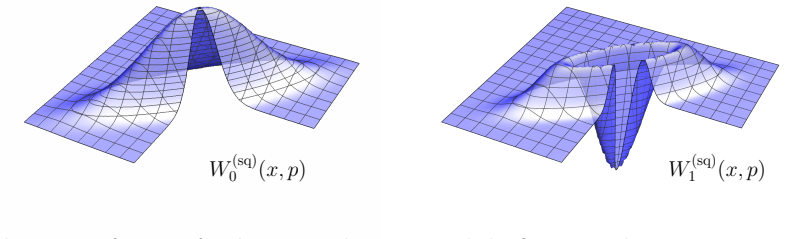
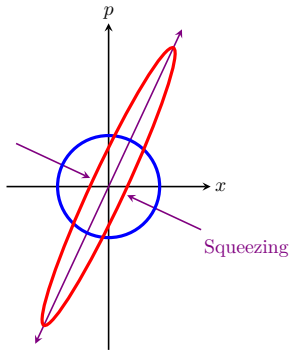
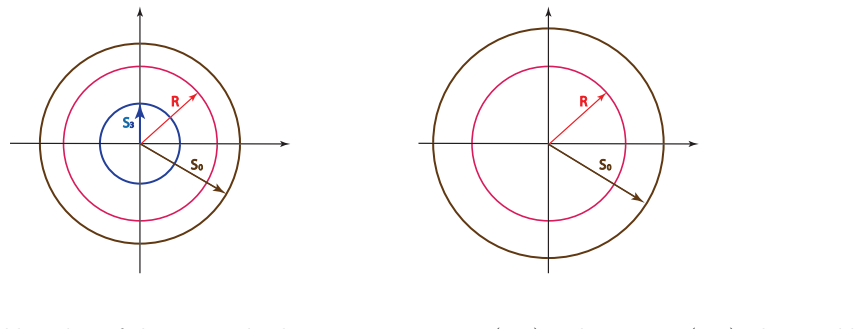
This paper starts with the transition from classical physics to quantum mechanics which was greatly aided by the concept of phase space. The role of canonical transformations in quantum mechanics is addressed. The Wigner phase-space distribution function is then defined which arises from the formulation of the density matrix, followed by the harmonic oscillator in phase space. Coherent and one- and two-mode squeezed states of light as well as the squeezed vacuum are discussed in the phase-space picture. Attention is also drawn to the fact that squeezed states naturally generate entanglement between the two-modes. Coupled harmonic oscillators are also elucidated in connection with the Wigner phase space. It will be noted that the phase-space picture of quantum mechanics has become an important scientific language for the rapidly expanding field of quantum optics. Here, we mainly focus on the simplest form of the Wigner function, which finds application in many branches of quantum mechanics. We make use of several symmetry groups such as Lorentz groups, the symplectic group in two and four dimensions, and the Euclidean group. The decoherence problem of an optical field is examined through a reformulation of the Poincar\'e sphere as a further illustration of the density matrix.
Editorial analysis
A structured set of objections, weighed in public.
Referee Report
Summary. The manuscript is a pedagogical review that introduces the Wigner phase-space distribution starting from the classical-to-quantum transition and canonical transformations, defines the Wigner function via the density matrix, treats the harmonic oscillator, and then applies the formalism to coherent states, one- and two-mode squeezed states, the squeezed vacuum, and the generation of entanglement. It further discusses coupled oscillators and employs symmetry groups (Lorentz, symplectic in 2D/4D, Euclidean) together with a Poincaré-sphere reformulation of the density matrix to address decoherence.
Significance. If the derivations and group-theoretic illustrations are accurate and clearly presented, the paper offers a compact, symmetry-based route to visualizing squeezed states and entanglement in phase space. Such expositions can strengthen intuition in quantum optics, especially for readers already familiar with the Wigner function but seeking explicit connections to the listed groups; however, the work contains no new derivations, parameter-free results, or falsifiable predictions.
minor comments (3)
- [Abstract] Abstract and closing paragraph both state that 'the phase-space picture of quantum mechanics has become an important scientific language'; the repetition is unnecessary and could be consolidated into a single, more precise sentence.
- The text repeatedly emphasizes use of 'the simplest form of the Wigner function'; a short paragraph or footnote clarifying when this form is insufficient (e.g., for non-Gaussian states or strong decoherence) would prevent readers from over-generalizing the framework.
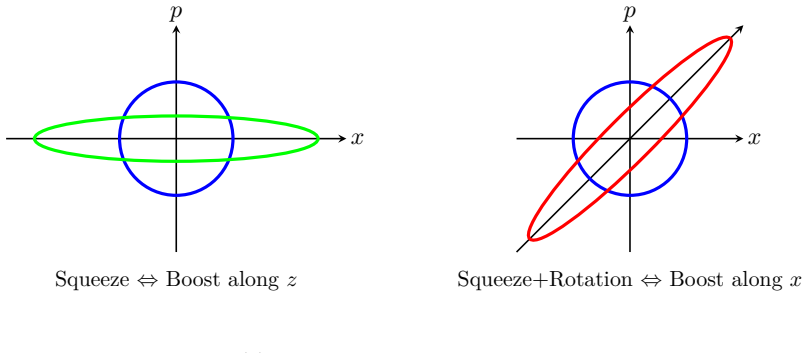
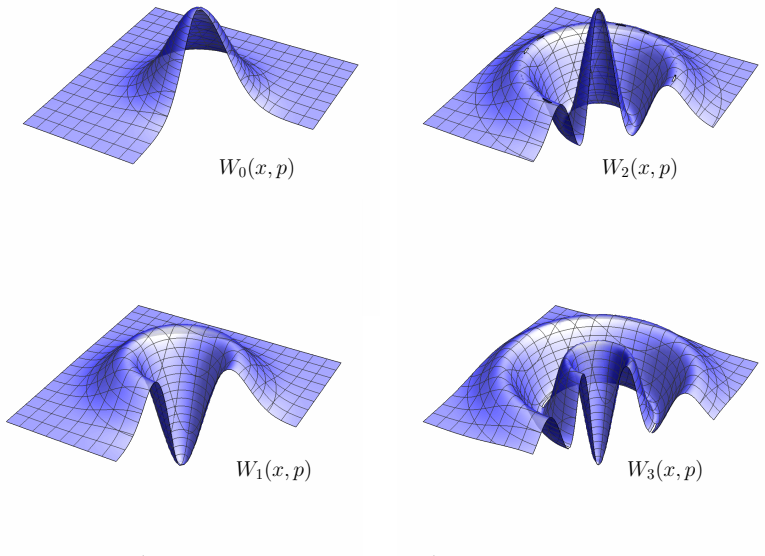
- Figure captions and axis labels for the phase-space plots of squeezed states should explicitly state the quadrature scaling and the value of the squeezing parameter r used in each panel.
Simulated Author's Rebuttal
We thank the referee for the positive assessment of our manuscript as a pedagogical review and for recommending minor revision. The work is explicitly framed as an expository treatment using the Wigner function and symmetry groups to build intuition for squeezed states, entanglement, and decoherence; it makes no claim to new derivations or predictions. No specific major comments appear in the report, so we provide no point-by-point responses below.
Circularity Check
No significant circularity
full rationale
This is a pedagogical review paper that presents the Wigner function, coherent and squeezed states, and symmetry groups (Lorentz, symplectic, Euclidean) as established tools for quantum optics. No novel derivations, predictions, or parameter fits are claimed; the text relies on prior literature for definitions and applications without any steps that reduce by construction to self-citations, fitted inputs renamed as outputs, or self-definitional loops. The central observation about phase space as a language for quantum optics is expository rather than deductive.
Axiom & Free-Parameter Ledger
Reference graph
Works this paper leans on
-
[1]
Goldstein, Classical Mechanics, 2nd edn
H. Goldstein, Classical Mechanics, 2nd edn. Addison-Wesley series in physics (Addison-Wesley Pub. Co, Reading, MA, USA, 1980). ISBN 978-0-201-02918-5. (Originally published 1952.)
1980
-
[2]
Arnold, Mathematical methods of classical mechanics , 2nd edn
V.I. Arnold, Mathematical methods of classical mechanics , 2nd edn. No. 60 in Graduate texts in mathematics (Springer, New York, NY, USA, 1997). ISBN 978-0-387-96890-2. (This is an English 37 translation by K. Vogtmann and A. Weinstein of the Russian original edition: Maremaricheskie Merody Klassicheskoi Mekhaniki, Nauka, Moscow, 1974.)
1997
-
[3]
Abraham, E
R. Abraham, E. Marsden, J, Foundations of mechanics , 2nd edn. (AMS Chelsea Pub./American Mathematical Society, Providence, RI, USA, 2008). ISBN 978-0-8218-4438-0. (Originally published 1978; OCLC: ocn191847156.)
2008
-
[4]
F. Xu, C.C. Martens, Y. Zheng, Entanglement dynamics with a trajectory-based formulation, Physical Review A 96(2), 022,138 (2017). DOI 10.1103/PhysRevA.96.022138. URL https://link.aps.org/ doi/10.1103/PhysRevA.96.022138
-
[5]
Y.S. Kim, M.E. Noz, Phase space picture of quantum mechanics: group theoretical approach . No. 40 in Lecture notes in physics series (World Scientific Publishing Co., Singapore; Hackensack, NJ, USA, 1991). ISBN 978-981-02-0360-3,978-981-02-0361-0. URL https://doi.org/10.1142/1197
-
[6]
C.K. Zachos, D.B. Fairlie, T.L. Curtright, Quantum Mechanics in Phase Space: An Overview with Se- lected Papers, World Scientific Series in 20th Century Physics , vol. 34 (WORLD SCIENTIFIC, 2005). DOI 10.1142/5287. ISBN 97898123838469789812703507. URL https://www.worldscientific.com/ worldscibooks/10.1142/5287
-
[7]
Weyl, The classical groups: their invariants and representations , 2nd edn
H. Weyl, The classical groups: their invariants and representations , 2nd edn. Princeton landmarks in mathematics and physics Mathematics (Princeton University Press, Princeton, N.J. USA, 1997). ISBN 978-0-691-07923-3;978-0-691-05756-9. (Originally published 1947.)
1997
-
[8]
Gilmore, Lie groups, Lie algebras, and some of their applications (Dover Publications, Mineola, NY, USA, 2005)
R. Gilmore, Lie groups, Lie algebras, and some of their applications (Dover Publications, Mineola, NY, USA, 2005). ISBN 978-0-486-44529-8. (Originally published: 1974, John Wiley and Sons, New York, NY, USA.)
2005
-
[9]
Guillemin, S
V. Guillemin, S. Sternberg, Symplectic techniques in physics , reprinted edn. (Cambridge Univ. Press, Cambridge, UK, 2001). ISBN 978-0-521-38990-7. (Originally published 1984; OCLC: 248721606.)
2001
-
[10]
E.P. Wigner, On the Quantum Correction For Thermodynamic Equilibrium, Physical Review 40(5), 749–759 (1932). DOI 10.1103/PhysRev.40.749. URL https://link.aps.org/doi/10.1103/ PhysRev.40.749
-
[11]
J.v. Neumann, Wahrscheinlichkeitstheoretischer aufbau der quantenmechanik, Nachrichten von der Gesellschaft der Wissenschaften zu Göttingen, Mathematisch-Physikalische Klasse 1927, 245–272 (1927). URL http://eudml.org/doc/59230
1927
-
[12]
Neumann, Thermodynamik quantenmechanischer gesamtheiten, Nachrichten von der Gesellschaft der Wissenschaften zu Göttingen, Mathematisch-Physikalische Klasse 1927, 273–291 (1927)
J.v. Neumann, Thermodynamik quantenmechanischer gesamtheiten, Nachrichten von der Gesellschaft der Wissenschaften zu Göttingen, Mathematisch-Physikalische Klasse 1927, 273–291 (1927). URL http://eudml.org/doc/59231
1927
-
[13]
Landau, Das Dämpfungsproblem in der Wellenmechanik, Zeitschrift für Physik 45(5-6), 430–441 (1927)
L.D. Landau, Das Dämpfungsproblem in der Wellenmechanik, Zeitschrift für Physik 45(5-6), 430–441 (1927). DOI 10.1007/BF01343064. URL http://link.springer.com/10.1007/BF01343064
-
[14]
P.A.M. Dirac, Note on Exchange Phenomena in the Thomas Atom, Mathematical Proceedings of the Cambridge Philosophical Society 26(3), 376–385 (1930). DOI 10.1017/S0305004100016108. URL https://www.cambridge.org/core/product/identifier/S0305004100016108/type/journal_ article
-
[15]
Blum, Density Matrix Theory and Applications , 3rd edn
K. Blum, Density Matrix Theory and Applications , 3rd edn. No. 64 in Springer Series on Atomic, Optical, and Plasma Physics (Springer Berlin Heidelberg, Berlin, Heidelberg, 2012). ISBN 97836422056069783642205613. (Originally published 1981.)
2012
-
[16]
U. Fano, A Stokes-Parameter Technique for the Treatment of Polarization in Quantum Mechanics, Physical Review 93(1), 121–123 (1954). DOI 10.1103/PhysRev.93.121. URL https://link.aps. org/doi/10.1103/PhysRev.93.121 38
-
[17]
Leonhardt, Measuring the quantum state of light
U. Leonhardt, Measuring the quantum state of light . Cambridge studies in modern optics (Cambridge University Press, Cambridge, UK ; New York, 1997). ISBN 9780521497305
1997
-
[18]
Schleich, Quantum Optics in Phase Space , 1st edn
W.P. Schleich, Quantum Optics in Phase Space , 1st edn. (Wiley, 2001). DOI 10.1002/3527602976. ISBN 97835272943509783527602971. URL https://onlinelibrary.wiley.com/doi/book/10.1002/ 3527602976
-
[19]
R. Simon, N. Mukunda, Optical phase space, wigner representation, and invariant quality parameters, J. Opt. Soc. Am. A 17(12), 2440–2463 (2000). DOI 10.1364/JOSAA.17.002440. URL https://opg. optica.org/josaa/abstract.cfm?URI=josaa-17-12-2440
-
[20]
Quasi-local photon surfaces in general spherically symmetric spacetimes.Eur
T. Colas, J. Grain, V. Vennin, Four-mode squeezed states: two-field quantum systems and the symplectic group Sp(4,R), The European Physical Journal C 82(1), 6 (2022). DOI 10.1140/epjc/ s10052-021-09922-y. URL https://link.springer.com/10.1140/epjc/s10052-021-09922-y
-
[21]
DOI 10.1140/epjc/s10052-023-12021-9
ATLAS Collaboration, Search for heavy Majorana or Dirac neutrinos and right-handed W gauge bosons in final states with charged leptons and jets in pp collisions at √s=13 TeV with the ATLAS detector, The European Physical Journal C 83(12), 1164 (2023). DOI 10.1140/epjc/s10052-023-12021-9. URL https://doi.org/10.1140/epjc/s10052-023-12021-9
-
[22]
A. Mari, J. Eisert, Positive Wigner Functions Render Classical Simulation of Quantum Computation Efficient, Physical Review Letters 109(23), 230,503 (2012). DOI 10.1103/PhysRevLett.109.230503. URL https://link.aps.org/doi/10.1103/PhysRevLett.109.230503
-
[23]
P. Bianucci, C. Miquel, J. Paz, M. Saraceno, Discrete Wigner functions and the phase space representa- tion of quantum computers, Physics Letters A 297(5-6), 353–358 (2002). DOI 10.1016/S0375-9601(02) 00391-2. URL https://linkinghub.elsevier.com/retrieve/pii/S0375960102003912
-
[24]
C. Miquel, J.P. Paz, M. Saraceno, Quantum computers in phase space, Physical Review A 65(6), 062,309 (2002). DOI 10.1103/PhysRevA.65.062309. URL https://link.aps.org/doi/10.1103/ PhysRevA.65.062309
-
[25]
L.L. Sánchez-Soto, A. Muñoz, P. De La Hoz, A.B. Klimov, G. Leuchs, Phase Space Insights: Wigner Functions for Qubits and Beyond, Applied Sciences 15(9), 5155 (2025). DOI 10.3390/app15095155. URL https://www.mdpi.com/2076-3417/15/9/5155
-
[26]
K.L. Ng, R. Polkinghorne, B. Opanchuk, P.D. Drummond, Phase-space representations of thermal Bose-–Einstein condensates, Journal of Physics A: Mathematical and Theoretical 52(3), 035,302 (2019). DOI 10.1088/1751-8121/aaeeb1. URL https://iopscience.iop.org/article/10.1088/ 1751-8121/aaeeb1
-
[27]
P. Liang, M. Marthaler, L. Guo, Floquet many-body engineering: topology and many-body physics in phase space lattices, New Journal of Physics 20(2), 023,043 (2018). DOI 10.1088/1367-2630/aaa7c3. URL https://iopscience.iop.org/article/10.1088/1367-2630/aaa7c3
-
[28]
Y. Yuan, K. Li, J.H. Wang, K. Ma, The Wigner Functions for a Spin-1/2 Relativistic Particle in the Presence of Magnetic Field, International Journal of Theoretical Physics 49(9), 1993–2001 (2010). DOI 10.1007/s10773-010-0262-0. URL http://link.springer.com/10.1007/s10773-010-0262-0
-
[29]
M. Mahlein, L. Barioglio, F. Bellini, L. Fabbietti, C. Pinto, B. Singh, S. Tripathy, A real- istic coalescence model for deuteron production, The European Physical Journal C 83(9), 804 (2023). DOI 10.1140/epjc/s10052-023-11972-3. URL https://link.springer.com/10.1140/epjc/ s10052-023-11972-3
-
[30]
G.A. Baker, I.E. McCarthy, C.E. Porter, Application of the Phase Space Quasi-Probability Distribu- tion to the Nuclear Shell Model, Physical Review 120(1), 254–264 (1960). DOI 10.1103/PhysRev.120
-
[31]
URL https://link.aps.org/doi/10.1103/PhysRev.120.254 39
-
[32]
H.W. Lee, Theory and application of the quantum phase-space distribution functions, Physics Reports 259(3), 147–211 (1995). DOI 10.1016/0370-1573(95)00007-4. URL https://linkinghub.elsevier. com/retrieve/pii/0370157395000074
-
[33]
C. Kurtsiefer, T. Pfau, J. Mlynek, Measurement of the Wigner function of an ensemble of helium atoms, Nature 386(6621), 150–153 (1997). DOI 10.1038/386150a0. URL https://www.nature.com/ articles/386150a0
-
[34]
D.C. Brody, E.M. Graefe, R. Melanathuru, Phase-Space Measurements, Decoherence, and Classicality, Physical Review Letters 134(12), 120,201 (2025). DOI 10.1103/PhysRevLett.134.120201. URL https: //link.aps.org/doi/10.1103/PhysRevLett.134.120201
-
[35]
R.F. O Connell, Wigner distribution function approach to dissipative problems in quantum me- chanics with emphasis on decoherence and measurement theory, Journal of Optics B: Quantum and Semiclassical Optics 5(3), S349–S359 (2003). DOI 10.1088/1464-4266/5/3/369. URL https: //iopscience.iop.org/article/10.1088/1464-4266/5/3/369
-
[36]
Y.J. Chun, H.W. Lee, Measurement-induced decoherence and Gaussian smoothing of the Wigner distribution function, Annals of Physics 307(2), 438–451 (2003). DOI 10.1016/S0003-4916(03)00116-7. URL https://linkinghub.elsevier.com/retrieve/pii/S0003491603001167
-
[37]
W.H. Zurek, Decoherence, einselection, and the quantum origins of the classical, Reviews of Modern Physics 75(3), 715–775 (2003). DOI 10.1103/RevModPhys.75.715. URL https://link.aps.org/ doi/10.1103/RevModPhys.75.715
-
[38]
W.H. Zurek, Sub-Planck structure in phase space and its relevance for quantum decoherence, Na- ture 412(6848), 712–717 (2001). DOI 10.1038/35089017. URL https://www.nature.com/articles/ 35089017
-
[39]
R.P. Rundle, M.J. Everitt, Overview of the Phase Space Formulation of Quantum Mechanics with Application to Quantum Technologies, Advanced Quantum Technologies 4(6), 2100,016 (2021). DOI 10.1002/qute.202100016. URL https://onlinelibrary.wiley.com/doi/10.1002/qute.202100016
-
[40]
U. Seyfarth, A.B. Klimov, H.D. Guise, G. Leuchs, L.L. Sanchez-Soto, Wigner function for SU(1,1), Quantum 4, 317 (2020). DOI 10.22331/q-2020-09-07-317. URL https://quantum-journal.org/ papers/q-2020-09-07-317/
-
[41]
K.E. Cahill, R.J. Glauber, Density Operators and Quasiprobability Distributions, Physical Review 177(5), 1882–1902 (1969). DOI 10.1103/PhysRev.177.1882. URL https://link.aps.org/doi/10. 1103/PhysRev.177.1882
-
[42]
Gerry, P
C.C. Gerry, P. Knight, Introductory quantum optics , second edition edn. (Cam- bridge University Press, Cambridge, United Kingdom New York, NY, 2024). ISBN 978100941529397811391512079781107653948
2024
-
[43]
T. Linowski, L. Rudnicki, Relating the Glauber-Sudarshan, Wigner, and Husimi quasiprobability distributions operationally through the quantum-limited amplifier and attenuator channels, Physical Review A 109(2), 023,715 (2024). DOI 10.1103/PhysRevA.109.023715. URL https://link.aps. org/doi/10.1103/PhysRevA.109.023715
-
[44]
V.A. Andreev, D.M. Davidović, L.D. Davidović, M.D. Davidović, V.I. Man’ko, M.A. Man’ko, A transformational property of the Husimi function and its relation to the wigner function and symplectic tomograms, Theoretical and Mathematical Physics 166(3), 356–368 (2011). DOI 10.1007/s11232-011-0028-8. URL http://link.springer.com/10.1007/s11232-011-0028-8
-
[45]
C. Weedbrook, S. Pirandola, R. García-Patrón, N.J. Cerf, T.C. Ralph, J.H. Shapiro, S. Lloyd, Gaussian quantum information, Reviews of Modern Physics 84(2), 621–669 (2012). DOI 10.1103/RevModPhys. 84.621. URL https://link.aps.org/doi/10.1103/RevModPhys.84.621 40
-
[46]
S.L. Braunstein, P. Van Loock, Quantum information with continuous variables, Reviews of Modern Physics 77(2), 513–577 (2005). DOI 10.1103/RevModPhys.77.513. URL https://link.aps.org/ doi/10.1103/RevModPhys.77.513
-
[47]
Braunstein, A.K
S.L. Braunstein, A.K. Pati (eds.), Quantum information with continuous variables (Kluwer Acad. Publ, Dordrecht, 2003). ISBN 9781402011955
2003
-
[48]
A.u. Rahman, A.x. Liu, M.Y. Abd-Rabbou, C.f. Qiao. From Local Nonclassicality to Entanglement: A Convexity Law for Single-Excitation Dynamics (2025). DOI 10.48550/arXiv.2511.10470. URL http://arxiv.org/abs/2511.10470. ArXiv:2511.10470 [quant-ph]
-
[49]
Flũhmann, T.L
C. Flũhmann, T.L. Nguyen, M. Marinelli, V. Negnevitsky, K. Mehta, J.P. Home, Encoding a qubit in a trapped-ion mechanical oscillator, Nature 566(7745), 513–517 (2019). DOI 10.1038/ s41586-019-0960-6. URL https://www.nature.com/articles/s41586-019-0960-6
2019
-
[50]
P. Campagne-Ibarcq, A. Eickbusch, S. Touzard, E. Zalys-Geller, N.E. Frattini, V.V. Sivak, P. Rein- hold, S. Puri, S. Shankar, R.J. Schoelkopf, L. Frunzio, M. Mirrahimi, M.H. Devoret, Quantum error correction of a qubit encoded in grid states of an oscillator, Nature 584(7821), 368–372 (2020). DOI 10.1038/s41586-020-2603-3. URL https://www.nature.com/artic...
-
[51]
B. Vlastakis, G. Kirchmair, Z. Leghtas, S.E. Nigg, L. Frunzio, S.M. Girvin, M. Mirrahimi, M.H. Devoret, R.J. Schoelkopf, Deterministically Encoding Quantum Information Using 100-Photon Schrödinger Cat States, Science 342(6158), 607–610 (2013). DOI 10.1126/science.1243289. URL https://www.science.org/doi/10.1126/science.1243289
-
[52]
M. Hofheinz, H. Wang, M. Ansmann, R.C. Bialczak, E. Lucero, M. Neeley, A.D. O’Connell, D. Sank, J. Wenner, J.M. Martinis, A.N. Cleland, Synthesizing arbitrary quantum states in a superconducting resonator, Nature 459(7246), 546–549 (2009). DOI 10.1038/nature08005. URL https://www.nature. com/articles/nature08005
-
[53]
C.F. Lo, R. Sollie, Generalized multimode squeezed states, Phys. Rev. A 47, 733–735 (1993). DOI 10.1103/PhysRevA.47.733. URL https://link.aps.org/doi/10.1103/PhysRevA.47.733
-
[54]
R. Simon, N. Mukunda, B. Dutta, Quantum-noise matrix for multimode systems: U(n) invariance, squeezing, and normal forms, Phys. Rev. A 49, 1567–1583 (1994). DOI 10.1103/PhysRevA.49.1567. URL https://link.aps.org/doi/10.1103/PhysRevA.49.1567
-
[55]
L. Ma, Y.D. Zhang, J.W. Pan, X.B. Wang, THE GENERAL EXPONENTIAL QUADRATIC MULTIMODE SQUEEZED STATES, Modern Physics Letters A 10(10), 837–840 (1995). DOI 10.1142/S0217732395000892. URL https://www.worldscientific.com/doi/abs/10.1142/ S0217732395000892
-
[56]
S. Dai, Q. Kang, L. Hu, C. Liu, T. Zhao, Entanglement Improvement of Three-mode Squeezed Vacuum State Via Number-conserving Operation, International Journal of Theoretical Physics 64(6), 158 (2025). DOI 10.1007/s10773-025-06025-2. URL https://link.springer.com/10.1007/ s10773-025-06025-2
-
[57]
Feynman, Statistical Mechanics: a set of lectures
R.P. Feynman, Statistical Mechanics: a set of lectures . Advanced book classics (Westview Press, Boul- der, CO, USA, 1998). ISBN 978-0-201-36076-9. (Originally published 1972 by Benjamin Cummings, Reading, MA, USA; OCLC: ocm60679997.)
1998
-
[58]
Y.S. Kim, E.P. Wigner, Canonical transformation in quantum mechanics, American Journal of Physics 58(5), 439–448 (1990). DOI 10.1119/1.16475. URL http://aapt.scitation.org/doi/10.1119/1. 16475
-
[59]
E.P. Wigner, On Unitary Representations of the Inhomogeneous Lorentz Group, The Annals of Mathematics 40(1), 149–204 (1939). DOI 10.2307/1968551. URL http://www.jstor.org/stable/ 1968551?origin=crossref 41
-
[60]
S. Başkal, Y.S. Kim, M.E. Noz, Theory and Applications of the Poincaré Group , 2nd edn. (Springer Nature Switzerland, Cham, 2024). DOI 10.1007/978-3-031-64376-7. ISBN 978-3-031-63488-8, 978-3-031-64376-7
-
[61]
Perelomov, Generalized Coherent States and Their Applications (Springer Berlin Heidelberg, Berlin, Heidelberg, 1986)
A. Perelomov, Generalized Coherent States and Their Applications (Springer Berlin Heidelberg, Berlin, Heidelberg, 1986). ISBN 978-3-642-61629-7. URL http://public.eblib.com/choice/ publicfullrecord.aspx?p=3094196. OCLC: 851731914
1986
-
[62]
D. Han, Y.S. Kim, D. Son, E(2)–like little group for massless particles and neutrino polarization as a consequence of gauge invariance, Physical Review D 26(12), 3717–3725 (1982). DOI 10.1103/ PhysRevD.26.3717. URL https://link.aps.org/doi/10.1103/PhysRevD.26.3717
-
[63]
Gerry, Remarks on the use of group theory in quantum optics, Opt
C.C. Gerry, Remarks on the use of group theory in quantum optics, Opt. Express 8(2), 76–85 (2001). DOI 10.1364/OE.8.000076. URL https://opg.optica.org/oe/abstract.cfm?URI=oe-8-2-76
-
[64]
A. Wünsche, Symplectic groups in quantum optics, Journal of Optics B: Quantum and Semiclassi- cal Optics 2(2), 73 (2000). DOI 10.1088/1464-4266/2/2/302. URL https://dx.doi.org/10.1088/ 1464-4266/2/2/302
-
[65]
P. Kramer, M. Saraceno, Semicoherent states and the group ISp(2, R), Physica A: Statistical Mechanics and its Applications 114(1-3), 448–453 (1982). DOI 10.1016/0378-4371(82)90330-2. URL https: //linkinghub.elsevier.com/retrieve/pii/0378437182903302
-
[66]
D. Ellinas, A.J. Bracken, Phase space regions operators and ISp(2) maps, Journal of Physics: Conference Series 1194, 012,033 (2019). DOI 10.1088/1742-6596/1194/1/012033. URL https: //iopscience.iop.org/article/10.1088/1742-6596/1194/1/012033
-
[67]
Von Neumann, R.T
J. Von Neumann, R.T. Beyer, N.A. Wheeler, Mathematical foundations of quantum me- chanics, new edn. (Princeton University Press, Princeton, NJ, USA, 2018). ISBN 978-0-691-17856-1~978-0-691-17857-8. (Originally published: Princeton University Press, 1996, 1955, and in German by Springer, Berlin, Germany 1932; OCLC: on1004934776.)
2018
-
[68]
Wigner, The general properties of the distribution function and remarks on its weakness, in First International Conference on the Physics of Phase Space , ed
E.P. Wigner, The general properties of the distribution function and remarks on its weakness, in First International Conference on the Physics of Phase Space , ed. by Y.S. Kim, W.W. Zachary (Springer-Verlag, Heidelberg, Univeristy of Maryland, College Park, MD USA, 1987), 161–170. ISBN 978-3-540-47901-7
1987
-
[69]
S. Başkal, Y. Kim, M. Noz, Mathematical Devices for Optical Sciences. (IOP Publishing, Bristol, UK, 2019). ISBN 978-0-7503-1612-5. URL https://dx.doi.org/10.1088/2053-2563/aafe78. (OCLC: 1034620988.)
-
[70]
M. Hillery, R.F. O’Connell, M.O. Scully, E.P. Wigner, Distribution functions in physics: Fun- damentals, Physics Reports 106(3), 121–167 (1984). DOI 10.1016/0370-1573(84)90160-1. URL http://linkinghub.elsevier.com/retrieve/pii/0370157384901601
-
[71]
W. Schleich, D.F. Walls, J.A. Wheeler, Area of overlap and interference in phase space versus Wigner pseudoprobabilities, Physical Review A 38(3), 1177–1186 (1988). DOI 10.1103/PhysRevA.38.1177. URL https://link.aps.org/doi/10.1103/PhysRevA.38.1177
-
[72]
Arfken, H.J
G.B. Arfken, H.J. Weber, F.E. Harris, Mathematical methods for physicists: a comprehensive guide , 7th edn. (Elsevier, Amsterdam NL; Boston, MA, USA, 2013). ISBN 978-0-12-384654-9. (Originally published in 1966.)
2013
-
[73]
J.S. Bell, Epr correlations and epw distributions, Annals of the New York Academy of Sciences 480(1), 263–266 (1986). DOI https://doi.org/10.1111/j.1749-6632.1986.tb12429.x. URL https://nyaspubs. onlinelibrary.wiley.com/doi/abs/10.1111/j.1749-6632.1986.tb12429.x 42
-
[74]
B. Mallick, S. Chakrabarty, S. Mukherjee, A.G. Maity, A.S. Majumdar, Efficient detection of non- classicality using moments of the Wigner function, Physical Review A 111(3), 032,406 (2025). DOI 10.1103/PhysRevA.111.032406. URL https://link.aps.org/doi/10.1103/PhysRevA.111.032406
-
[75]
Fock, Quanten Elecktrodynamik, Physikalische Zeitschrift der Sovietunion 6, 425–469 (1934)
V. Fock, Quanten Elecktrodynamik, Physikalische Zeitschrift der Sovietunion 6, 425–469 (1934)
1934
-
[76]
D. Stoler, Equivalence Classes of Minimum Uncertainty Packets, Physical Review D 1(12), 3217–3219 (1970). DOI 10.1103/PhysRevD.1.3217. URL https://link.aps.org/doi/10.1103/PhysRevD.1. 3217
-
[77]
R.J. Glauber, Coherent and Incoherent States of the Radiation Field, Physical Review 131(6), 2766– 2788 (1963). DOI 10.1103/PhysRev.131.2766. URL https://link.aps.org/doi/10.1103/PhysRev. 131.2766
-
[78]
E.C.G. Sudarshan, Equivalence of Semiclassical and Quantum Mechanical Descriptions of Statistical Light Beams, Physical Review Letters 10(7), 277–279 (1963). DOI 10.1103/PhysRevLett.10.277. URL https://link.aps.org/doi/10.1103/PhysRevLett.10.277
-
[79]
Klauder, B.S
J.R. Klauder, B.S. Skagerstam, Coherent States (World Scientific Publishing Co., Singapore; Hacken- sack, NJ, USA, 1985)
1985
-
[80]
F.T. Arecchi, Measurement of the Statistical Distribution of Gaussian and Laser Sources, Physical Review Letters 15(24), 912–916 (1965). DOI 10.1103/PhysRevLett.15.912. URL https://link.aps. org/doi/10.1103/PhysRevLett.15.912
discussion (0)
Sign in with ORCID, Apple, or X to comment. Anyone can read and Pith papers without signing in.