An Al^+ clock with 1.6times10⁻¹⁸ systematic uncertainty and its frequency ratios
Pith reviewed 2026-06-26 06:24 UTC · model grok-4.3
The pith
An aluminum-ion clock reaches 1.6×10^{-18} total systematic uncertainty through full shift evaluation.
A machine-rendered reading of the paper's core claim, the machinery that carries it, and where it could break.
Core claim
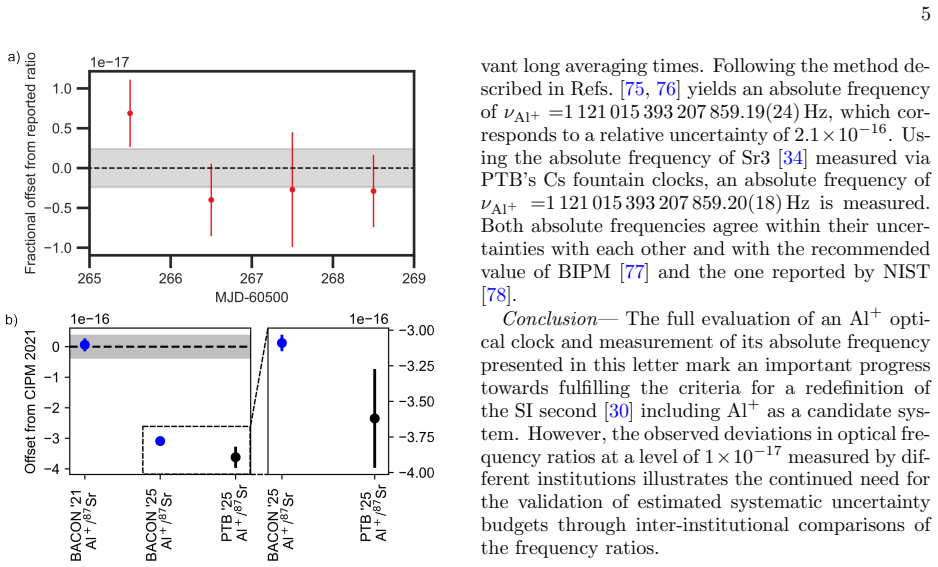
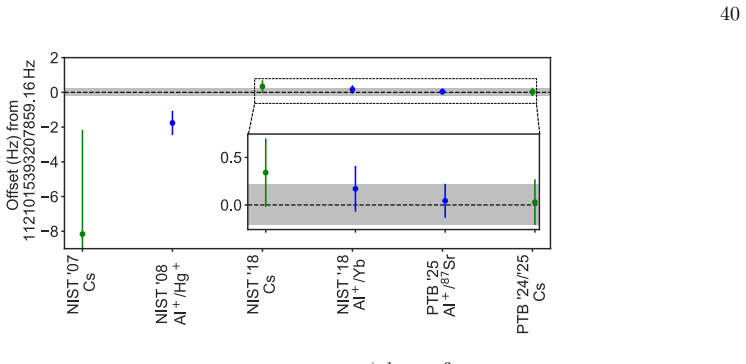
The evaluated total systematic fractional frequency uncertainty of the ^{27}Al^+ clock is 1.6×10^{-18}, with the absolute frequency determined as ν_{Al^+}=1 121 015 393 207 859.19(24) Hz by comparison to two caesium fountains and the frequency ratio to the ^{87}Sr clock measured as ν_{Al^+}/ν_{^{87}Sr}=2.611 701 431 781 462 668(36). The ratio differs by 8.6σ from the 2021 BACON value and 1.2σ from the 2025 value.
What carries the argument
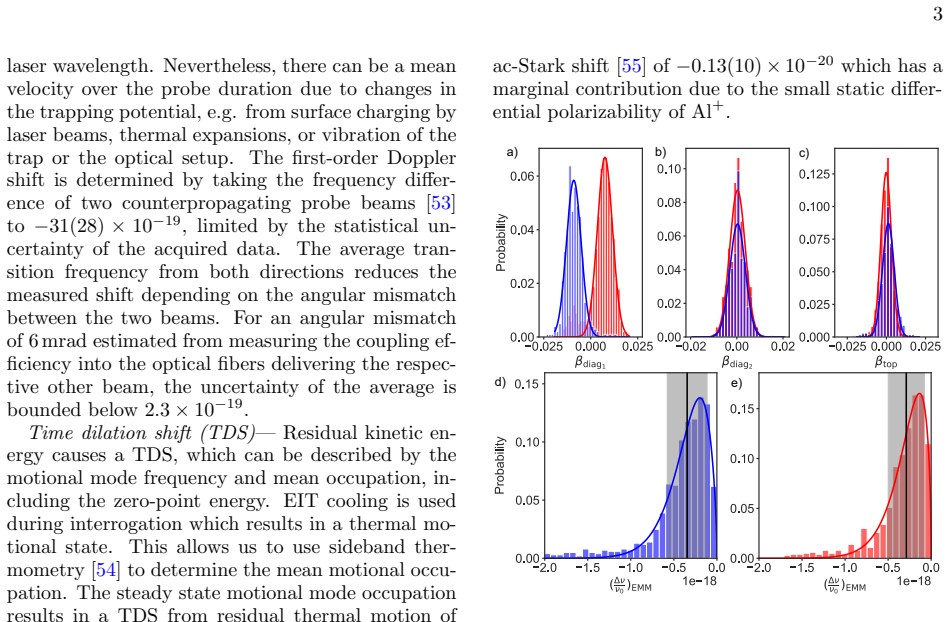
Full evaluation of systematic frequency shifts for the single-ion Al^+ clock, incorporating corrections from blackbody radiation, electric quadrupole shifts, and collision effects using measured or calculated atomic coefficients.
If this is right
- The reported uncertainty level allows the Al+ clock to serve as a reference in a future optical redefinition of the second.
- The measured frequency ratio provides an independent consistency check between single-ion and lattice optical clocks.
- Discrepancies with prior ratio values highlight the value of repeated measurements at separate institutions to identify unaccounted effects.
- Limits from atomic coefficient accuracy and gas collisions indicate the main technical barriers to reaching 10^{-19} uncertainty in this system.
Where Pith is reading between the lines
- If the observed ratio difference persists in future comparisons, it would point to a need for refined modeling of one or more shift mechanisms in the comparison chain.
- Improved theoretical calculations of the Al+ atomic coefficients could directly lower the dominant uncertainty term without changes to the experimental apparatus.
- The single-ion approach demonstrated here could be applied to other species with simpler level structures to test whether similar uncertainty budgets are reachable.
Load-bearing premise
The atomic coefficients needed to calculate the systematic shifts, such as polarizabilities and quadrupole moments, are known accurately enough that they do not push the total uncertainty above the reported 1.6×10^{-18}.
What would settle it
A new measurement of the Al+ to Sr frequency ratio that lies outside the stated uncertainty interval of the reported value while agreeing with one of the earlier BACON results within 3σ, or a direct test showing the background gas collision uncertainty exceeds its budgeted contribution.
Figures





read the original abstract
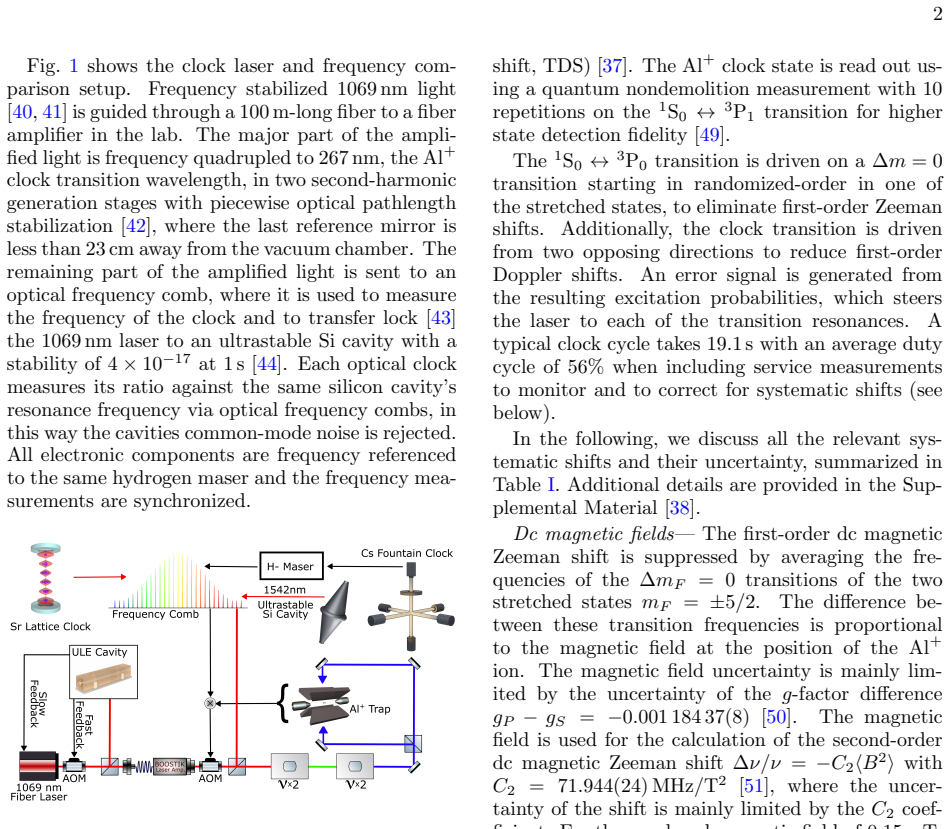
Advances in optical clocks motivate a redefinition of the second, requiring rigorous evaluations of systematic uncertainties and robust consistency among the clocks. Here, we report the full evaluation of the systematic frequency shifts of an $^{27}\mathrm{Al}^+$ single-ion clock, and the measurement of its absolute frequency and frequency ratio with a $^{87}$Sr optical lattice clock at PTB. The evaluated total systematic fractional frequency uncertainty is $1.6\times10^{-18}$, mainly limited by the accuracy of the relevant atomic coefficients and by background gas collisions. The absolute frequency of the clock has been measured to be $\nu_{\mathrm{Al}^+}=1 121 015 393 207 859.19(24)\,$Hz, obtained by comparison with two primary caesium fountain clocks at PTB. The frequency ratio between the Al and Sr optical clocks has been determined to be $\nu_{\mathrm{Al}^+}/\nu_{^{87}\mathrm{Sr}}=2.611 701 431 781 462 668(36)$, limited by the accuracy of the Sr clock. This ratio differs by $8.6\sigma$ and $1.2\sigma$ from the 2021 and 2025 frequency ratio published by the BACON collaboration, respectively. These results represent an important contribution toward a future redefinition of the second using optical clocks, and underscore the importance of independent measurements of clock-candidate frequency ratios across different institutions.
Editorial analysis
A structured set of objections, weighed in public.
Referee Report
Summary. The manuscript reports a complete evaluation of systematic frequency shifts for a single-ion ^{27}Al^+ optical clock, yielding a total fractional uncertainty of 1.6×10^{-18} (dominated by uncertainties in atomic coefficients such as polarizabilities and quadrupole moments, plus background gas collisions). It also presents the absolute frequency measured against two PTB Cs fountain clocks and the frequency ratio with a ^{87}Sr lattice clock, including noted discrepancies with prior BACON collaboration results.
Significance. If the uncertainty budget holds, the work supplies an independent, high-precision data point for optical-clock frequency ratios and absolute frequencies. This directly supports the consistency checks required for a future redefinition of the second and underscores the value of cross-institution comparisons.
major comments (1)
- The abstract states that the total systematic uncertainty is limited by the accuracy of atomic coefficients, but the manuscript must explicitly show (in the systematic evaluation section) how literature uncertainties on polarizabilities, quadrupole moments, and related coefficients are propagated into each shift term and combined in quadrature with the experimental contributions; without this propagation the 1.6×10^{-18} claim cannot be verified as load-bearing.
minor comments (2)
- Clarify the data-exclusion criteria and averaging intervals used for the ratio and absolute-frequency measurements to allow independent assessment of statistical robustness.
- Add a brief table or paragraph comparing the new ratio value and its uncertainty directly with the 2021 and 2025 BACON values, including the exact σ calculation method.
Simulated Author's Rebuttal
We thank the referee for the careful review and the recommendation of minor revision. The single major comment is addressed point-by-point below; we will incorporate the requested clarification in the revised manuscript.
read point-by-point responses
-
Referee: The abstract states that the total systematic uncertainty is limited by the accuracy of atomic coefficients, but the manuscript must explicitly show (in the systematic evaluation section) how literature uncertainties on polarizabilities, quadrupole moments, and related coefficients are propagated into each shift term and combined in quadrature with the experimental contributions; without this propagation the 1.6×10^{-18} claim cannot be verified as load-bearing.
Authors: We agree that the propagation of literature uncertainties must be shown explicitly to allow independent verification of the total budget. In the revised manuscript we will add a new subsection (or expanded table) in the systematic evaluation section that lists, for each relevant shift (quadratic Stark, quadrupole, etc.), the literature value and its uncertainty, the propagation formula applied to the operating conditions, the resulting contribution to the fractional frequency shift, and the quadrature combination with all experimental uncertainties. This addition will make the 1.6×10^{-18} total fully traceable. revision: yes
Circularity Check
No circularity; experimental comparisons are direct and self-contained
full rationale
The paper reports direct experimental measurements of the Al+ clock frequency against Cs fountains and the frequency ratio against an Sr lattice clock. The systematic uncertainty budget of 1.6e-18 is explicitly stated to be limited by external atomic coefficients (polarizabilities, quadrupole moments) and background gas collisions, without any internal derivation or fit that reduces to the same dataset by construction. No self-citation chains, ansatzes, or fitted inputs presented as predictions appear in the provided text. The central claims rest on laboratory comparisons and tabulated external coefficients, making the result independent of the paper's own inputs.
Axiom & Free-Parameter Ledger
axioms (1)
- domain assumption Standard models for electric quadrupole, magnetic dipole, and blackbody radiation shifts in trapped ions are sufficiently accurate for the stated uncertainty budget.
Reference graph
Works this paper leans on
-
[1]
Klose, Joshua and Stahl, Kilian and Schwarz, Roman and Rahm, Johannes and Poudel, N and Weyers, Stefan and Benkler, Erik and D
-
[2]
(Middlebury, VT, US), Kaplan, Harvey B
Monroe, Christopher (Ellicott City, US), Pagano, Guido (Washington, DC, US), Hess, Paul W. (Middlebury, VT, US), Kaplan, Harvey B. (College Park, MD, US), Tan, Wen Lin (College Park, MD, US), Richerme, Philip J. (Bloomington, IN, US),
-
[3]
and Chaitanya N., Apurv and Jabir, M
Aadhi, A. and Chaitanya N., Apurv and Jabir, M. V. and Singh, R. P. and Samanta, G. K. , year = 2015, journal =. All-Periodically Poled, High-Power, Continuous-Wave, Single-Frequency Tunable
2015
-
[4]
Blueprint for Fault-Tolerant Quantum Computation with Topological Qubit Arrays , author =. Phys. Rev. Res. , volume =
-
[5]
Aasi, J. and Abadie, J. and Abbott, B. P. and Abbott, R. and Abbott, T. D. and Abernathy, M. R. and Adams, C. and Adams, T. and Addesso, P. and Adhikari, R. X. and Affeldt, C. and Aguiar, O. D. and Ajith, P. and Allen, B. and Ceron, E. Amador and Amariutei, D. and Anderson, S. B. and Anderson, W. G. and Arai, K. and Araya, M. C. and Arceneaux, C. and Ast,...
-
[6]
Single Ion Heat Engine with Maximum Efficiency at Maximum Power , author =. arXiv:1205.1362 , eprint =
-
[7]
Observation of Constructive Interference at the Edge of Quantum Ergodicity , author =. Nature , volume =. doi:10.1038/s41586-025-09526-6 , copyright =
-
[8]
Abbasov, Timur and Makarenko, Konstantin and Sherstov, Ivan and Axenov, Mikhail and Zalivako, Ilya and Semerikov, Ilya and Khabarova, Ksenia and Kolachevsky, Nikolay and Chepurov, Sergey and Taichenachev, Alexei and Bagaev, Sergey and Tausenev, Anton , year = 2020, journal =. Compact Transportable. 2010.15244 , primaryclass =
arXiv 2020
-
[9]
and Zibrov, S
Abbasov, T. and Zibrov, S. and Sherstov, I. , year = 2023, journal =. Surface-
2023
-
[10]
ArXiv190611495 Phys
Guidelines for Developing Optical Clocks with 10. ArXiv190611495 Phys. , eprint =
-
[11]
Abdeldayem, H. A. and Dowdye, E. and Canham, J. and Jaeger, T. , year = 2005, volume =. Contamination and Radiation Effects on Spaceflight Laser Systems , booktitle =
2005
-
[12]
ArXiv161004927 Quant-Ph , eprint =
Local Probe of Single Phonon Dynamics in Warm Ion Crystals , author =. ArXiv161004927 Quant-Ph , eprint =
-
[13]
and Walser, A
Abdolvand, A. and Walser, A. M. and Ziemienczuk, M. and Nguyen, T. and Russell, P. Generation of a Phase-Locked. Opt. Lett. , volume =
-
[14]
and Argentin, C
Abdoulanziz, A. and Argentin, C. and Laporta, V. and Chakrabarti, K. and Bultel, A. and Tennyson, J. and Schneider, I. F. and Mezei, J. Low-Energy Electron Impact Dissociative Recombination and Vibrational Transitions of. J. Appl. Phys. , volume =
-
[15]
Abe, Minori and Kajita, Masatoshi and Hada, Masahiko and Moriwaki, Yoshiki , year = 2010, journal =
2010
-
[16]
Ab Initio Study on Potential Energy Curves of Electronic Ground and Excited States of
Abe, Minori and Moriwaki, Yoshiki and Hada, Masahiko and Kajita, Masatoshi , year = 2012, journal =. Ab Initio Study on Potential Energy Curves of Electronic Ground and Excited States of
2012
-
[17]
and Chattopadhyay, Swapan and Coleman, Jonathon and Curfman, Noah M
Abe, Mahiro and Adamson, Philip and Borcean, Marcel and Bortoletto, Daniela and Bridges, Kieran and Carman, Samuel P. and Chattopadhyay, Swapan and Coleman, Jonathon and Curfman, Noah M. and DeRose, Kenneth and Deshpande, Tejas and Dimopoulos, Savas and Foot, Christopher J. and Frisch, Josef C. and Garber, Benjamin E. and Geer, Steve and Gibson, Valerie a...
-
[18]
and Gebbe, M
Abend, S. and Gebbe, M. and Gersemann, M. and Ahlers, H. and M. Atom-. Phys. Rev. Lett. , volume =
-
[19]
Atomic Fountains and Optical Clocks at
Abgrall, Michel and Chupin, Baptiste and De Sarlo, Luigi and Gu. Atomic Fountains and Optical Clocks at. Comptes Rendus Physique , series =
-
[20]
Coherent. Phys. Rev. Lett. , volume =. doi:10.1103/PhysRevLett.94.040405 , lccn =
-
[21]
Science , volume =
Observation of Vortex Lattices in. Science , volume =
-
[22]
Fault-Tolerant Operation of a Logical Qubit in a Diamond Quantum Processor , author =. Nature , volume =. doi:10.1038/s41586-022-04819-6 , copyright =
-
[23]
Abraham, Eric R.I. and Cornell, Eric A. , year = 1998, journal =. Teflon. doi:10.1364/AO.37.001762 , lccn =
-
[24]
Abraham, E. R. I. and McAlexander, W. I. and Gerton, J. M. and Hulet, R. G. and C. Triplet S-Wave Resonance in. Phys. Rev. A , volume =
-
[25]
and Lloyd, Seth , year = 1999, journal =
Abrams, Daniel S. and Lloyd, Seth , year = 1999, journal =. Quantum
1999
-
[26]
Acampora, Giovanni and Ambainis, Andris and Ares, Natalia and Banchi, Leonardo and Bhardwaj, Pallavi and Binosi, Daniele and Briggs, G. Andrew D. and Calarco, Tommaso and Dunjko, Vedran and Eisert, Jens and Ezratty, Olivier and Erker, Paul and Fedele, Federico and. Quantum Computing and Artificial Intelligence: Status and Perspectives , shorttitle =. doi:...
-
[27]
Quantum Error Correction below the Surface Code Threshold , author =. Nature , volume =. doi:10.1038/s41586-024-08449-y , copyright =
-
[28]
Suppressing Quantum Errors by Scaling a Surface Code Logical Qubit , author =. Nature , volume =. doi:10.1038/s41586-022-05434-1 , copyright =
-
[29]
Achtenberg, Krzysztof and Miko. Low-. Electronics , volume =. doi:10.3390/electronics9081245 , copyright =
-
[30]
The Quantum Technologies Roadmap: A
Ac. The Quantum Technologies Roadmap: A. New J. Phys. , volume =
-
[31]
Ackerman, Z. E. D. and Quevedo, A. Cadarso and Maran, Ilango and Gallagher, L. P. H. and Spreeuw, R. J. C. and Berengut, J. C. and Gerritsma, R. , year = 2026, number =. Long-Lived Metastable States in the 4f. doi:10.48550/arXiv.2603.04250 , archiveprefix =. 2603.04250 , primaryclass =
work page internal anchor Pith review Pith/arXiv arXiv doi:10.48550/arxiv.2603.04250 2026
-
[32]
Detection and
Acton, Mark , year = 2008, school =. Detection and
2008
-
[33]
and Brickman, K.A
Acton, M. and Brickman, K.A. and Haljan, P.C. and Lee, P.J. and Deslauriers, L. and Monroe, C. , year = 2006, journal =. Near-
2006
-
[34]
Review of Scientific Instruments , volume =
Low Noise Near-Concentric Optical Cavity Design , author =. Review of Scientific Instruments , volume =
-
[35]
Optical Atomic Clocks:
Adam, David , year = 2003, journal =. Optical Atomic Clocks:
2003
-
[36]
Adams, Austin and Pinto, Elton and Young, Jeffrey and Herold, Creston and McCaskey, Alex and Dumitrescu, Eugene and Conte, Thomas M. , year = 2021, journal =. Enabling a. 2111.00146 , primaryclass =
arXiv 2021
-
[37]
Rydberg Atom Quantum Technologies , author =. J. Phys. B: At. Mol. Opt. Phys. , volume =
-
[38]
and Heckel, B.R
Adelberger, E.G. and Heckel, B.R. and Nelson, A.E. , year = 2003, journal =. Tests of the
2003
-
[39]
K , year = 2003, journal =
Adhikari, S. K , year = 2003, journal =. Resonance in
2003
-
[40]
and Fareed, Q
Adivarahan, V. and Fareed, Q. and Srivastava, S. and Katona, T. and Gaevski, M. and Khan, A. , year = 2007, journal =. Robust 285 Nm Deep
2007
-
[41]
Recoil Corrections in Highly Charged Ions , author =. Phys. Rev. A , volume =
-
[42]
Adler, F. and Mas. Mid-. Arxiv Prepr. ArXiv10070716 , eprint =
-
[43]
Adler, Daniel and Wei, David and Will, Melissa and Srakaew, Kritsana and Agrawal, Suchita and Weckesser, Pascal and Moessner, Roderich and Pollmann, Frank and Bloch, Immanuel and Zeiher, Johannes , year = 2024, journal =. Observation of. doi:10.1038/s41586-024-08188-0 , copyright =
-
[44]
Phase-Locked Two-Branch Erbium-Doped Fiber Laser System for Long-Term Precision Measurements of Optical Frequencies , author =. Opt. Express , volume =
-
[45]
Atomic Clock Frequency Ratios with Fractional Uncertainty
Aeppli, Alexander and. Atomic Clock Frequency Ratios with Fractional Uncertainty. doi:10.48550/arXiv.2512.21428 , archiveprefix =. 2512.21428 , primaryclass =
-
[46]
and Ye, Jun , year = 2024, journal =
Aeppli, Alexander and Kim, Kyungtae and Warfield, William and Safronova, Marianna S. and Ye, Jun , year = 2024, journal =. Clock with 8 10
2024
-
[47]
Clock with 8
Aeppli, Alexander , year = 2025, address =. Clock with 8
2025
-
[48]
and Kedar, Dhruv and He, Peiru and Rey, Ana Maria and Ye, Jun , year = 2022, journal =
Aeppli, Alexander and Chu, Anjun and Bothwell, Tobias and Kennedy, Colin J. and Kedar, Dhruv and He, Peiru and Rey, Ana Maria and Ye, Jun , year = 2022, journal =. Hamiltonian Engineering of Spin-Orbit--Coupled Fermions in a
2022
-
[49]
and Budker, D
Afach, S. and Budker, D. and DeCamp, G. and Dumont, V. and Gruji. Characterization of the. ArXiv180709391 Phys. Physicsquant-Ph , eprint =
-
[50]
and Ayres, N
Afach, S. and Ayres, N. J. and Baker, C. A. and Ban, G. and Bison, G. and Bodek, K. and Burghoff, M. and Geltenbort, P. and Green, K. and Griffith, W. C. and. A. ArXiv150904411 Hep-Ex Physicsphysics , eprint =
-
[51]
Search for Topological Defect Dark Matter with a Global Network of Optical Magnetometers , author =. Nat. Phys. , volume =. doi:10.1038/s41567-021-01393-y , copyright =
-
[52]
and Solyanik, Maria , year = 2018, journal =
Afanasev, Andrei and Carlson, Carl E. and Solyanik, Maria , year = 2018, journal =. Atomic. 1801.03227 , primaryclass =
Pith/arXiv arXiv 2018
-
[53]
and Ambar, O
Afek, I. and Ambar, O. and Silberberg, Y. , year = 2010, journal =. High-
2010
-
[54]
A Compact Laser Head with High-Frequency Stability for
Affolderbach, Christoph and Mileti, Gaetano , year = 2005, journal =. A Compact Laser Head with High-Frequency Stability for
2005
-
[55]
ArXiv200800035 Phys
Phase-Coherent Sensing of the Center-of-Mass Motion of Trapped-Ion Crystals , author =. ArXiv200800035 Phys. , eprint =
-
[56]
Toward Improved Quantum Simulations and Sensing with Trapped Two-Dimensional Ion Crystals via Parametric Amplification , author =. Phys. Rev. A , volume =
-
[57]
Afzal, Francis O. and Halimi, Sami I. and Weiss, Sharon M. , year = 2018, journal =. Design Approach for Side-Coupled Photonic Crystal Nanobeams:. 1805.09438 , primaryclass =
Pith/arXiv arXiv 2018
-
[58]
Agababaev, V. A. and Glazov, D. A. and Volotka, A. V. and Zinenko, D. V. and Shabaev, V. M. and Plunien, G. , year = 2019, journal =. G Factor of the [(1s). doi:10.1002/xrs.3074 , copyright =
-
[59]
Agababaev, V. A. and Glazov, D. A. and Volotka, A. V. and Zinenko, D. V. and Shabaev, V. M. and Plunien, G. , year = 2018, journal =. Ground-State g Factor of Middle-. 1812.06429 , primaryclass =
Pith/arXiv arXiv 2018
-
[60]
Agababaev, V. A. and Prokhorchuk, E. A. and Glazov, D. A. and Malyshev, A. V. and Shabaev, V. M. and Volotka, A. V. , year = 2025, number =. doi:10.48550/arXiv.2505.08929 , archiveprefix =. 2505.08929 , primaryclass =
-
[61]
Agababaev, V. A. and Volchkova, A. M. and Varentsova, A. S. and Glazov, D. A. and Volotka, A. V. and Shabaev, V. M. and Plunien, G. , year = 2017, journal =. Quadratic
2017
-
[62]
Atomic States with Spectroscopic Squeezing , author =. Phys. Rev. A , volume =
-
[63]
doi:10.48550/arXiv.2405.16101 , archiveprefix =
Entanglement Generation in Weakly-Driven Arrays of Multilevel Atoms via Dipolar Interactions , author =. doi:10.48550/arXiv.2405.16101 , archiveprefix =. 2405.16101 , primaryclass =
-
[64]
Agarwal, G. S. , year = 1976, journal =. Exact
1976
-
[65]
Quantum Statistical Theory of Optical-Resonance Phenomena in Fluctuating Laser Fields , author =. Phys. Rev. A , volume =
-
[66]
Agarwal, G. S , year = 2010, journal =. Quantum. 1009.4449 , archiveprefix =
Pith/arXiv arXiv 2010
-
[67]
and Rafailov, E
Agate, B. and Rafailov, E. U. and Sibbett, W. and Saltiel, S. M. and Battle, P. and Fry, T. and Noonan, E. , year = 2003, journal =. Highly Efficient Blue-Light Generation from a Compact, Diode-Pumped Femtosecond Laser by Use of a Periodically Poled
2003
-
[68]
and Bauswein, Andreas and Cella, Giancarlo and Clesse, Sebastian and Cruise, Adrian Michael and Domcke, Valerie and Figueroa, Daniel G
Aggarwal, Nancy and Aguiar, Odylio D. and Bauswein, Andreas and Cella, Giancarlo and Clesse, Sebastian and Cruise, Adrian Michael and Domcke, Valerie and Figueroa, Daniel G. and Geraci, Andrew and Goryachev, Maxim and Grote, Hartmut and Hindmarsh, Mark and Muia, Francesco and Mukund, Nikhil and Ottaway, David and Peloso, Marco and Quevedo, Fernando and Ri...
-
[69]
M and Keenan, F
Aggarwal, K. M and Keenan, F. P , year = 1998, journal =. Excitation Rate Coefficients for Fine-Structure Transitions in
1998
-
[70]
Room-Temperature Optomechanical Squeezing , author =. Nat. Phys. , volume =. doi:10.1038/s41567-020-0877-x , copyright =
-
[71]
Review of Scientific Instruments , volume =
A Supersonic Laser Ablation Beam Source with Narrow Velocity Spreads , author =. Review of Scientific Instruments , volume =
-
[72]
Scaling and Networking a Modular Photonic Quantum Computer , author =. Nature , volume =. doi:10.1038/s41586-024-08406-9 , copyright =
-
[73]
Laser Cooling of a Magnetically Guided Ultracold Atom Beam , author =. New J. Phys. , volume =
-
[74]
Lightwave
Agilent , year = 2000, number =. Lightwave
2000
-
[75]
Aguilera, D. N. and Ahlers, H. and Battelier, B. and Bawamia, A. and Bertoldi, A. and Bondarescu, R. and Bongs, K. and Bouyer, P. and Braxmaier, C. and. Class. Quantum Grav. , volume =
-
[76]
Fully Robust Qubit in Atomic and Molecular Three-Level Systems , author =. New J. Phys. , volume =
-
[77]
and Drewsen, M
Aharon, N. and Drewsen, M. and Retzker, A. , year = 2013, journal =. General
2013
-
[78]
Robust Optical Clock Transitions in Trapped Ions Using Dynamical Decoupling , author =. New J. Phys. , volume =
-
[79]
Aharonian, F. A. , year = 2003, journal =
2003
-
[80]
Aharonian, Felix and Akamatsu, Hiroki and Akimoto, Fumie and Allen, Steven W. and Anabuki, Naohisa and Angelini, Lorella and Arnaud, Keith and Audard, Marc and Awaki, Hisamitsu and Axelsson, Magnus and Bamba, Aya and Bautz, Marshall and Blandford, Roger and Brenneman, Laura and Brown, Gregory V. and Bulbul, Esra and Cackett, Edward and Chernyakova, Maria ...
discussion (0)
Sign in with ORCID, Apple, or X to comment. Anyone can read and Pith papers without signing in.