Stage-dependent integer-binary encoding in factorization-machine black-box optimization
Pith reviewed 2026-06-26 08:43 UTC · model grok-4.3
The pith
One-hot encoding during learning drives lower residual errors than domain-wall or binary in factorization-machine black-box optimization.
A machine-rendered reading of the paper's core claim, the machinery that carries it, and where it could break.
Core claim
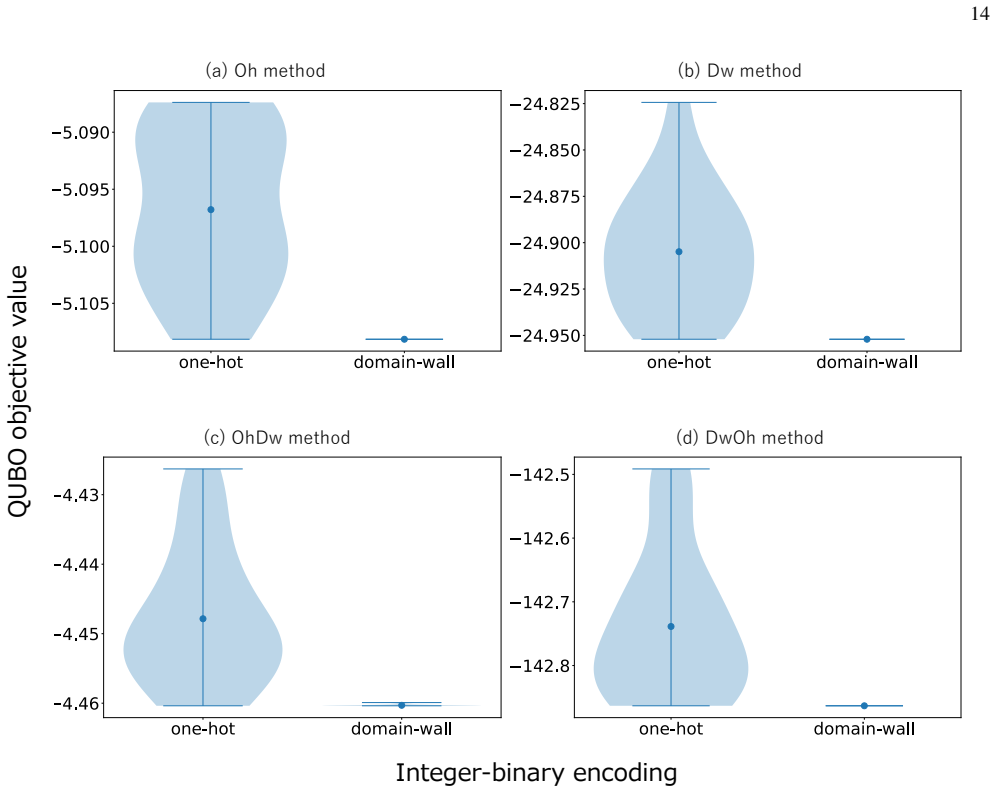
Across all tested conditions the encoding chosen for the learning stage is the dominant performance factor, and one-hot encoding in that stage produces lower residual errors than domain-wall or binary encodings. The OhDw variant that additionally switches to domain-wall encoding for the search stage reaches lower error and solutions closer to the global optimum than pure one-hot FMQA when the dimension is five and the discretization is 301, but the pure one-hot version is better when the discretization is 61.
What carries the argument
Conversion formulas between one-hot and domain-wall QUBO matrices that preserve the surrogate objective over feasible integer states up to an additive constant, allowing the OhDw stage-dependent framework.
Load-bearing premise
The assumption that performance differences seen on the Rastrigin function with the chosen dimensions and discretization levels will generalize to other black-box problems and that the conversion formulas stay numerically stable inside the Ising solver.
What would settle it
Running the OhDw variant on a different benchmark such as the Rosenbrock function with the same or altered discretization levels and checking whether one-hot encoding in the learning stage still produces the lowest residual errors.
Figures





read the original abstract
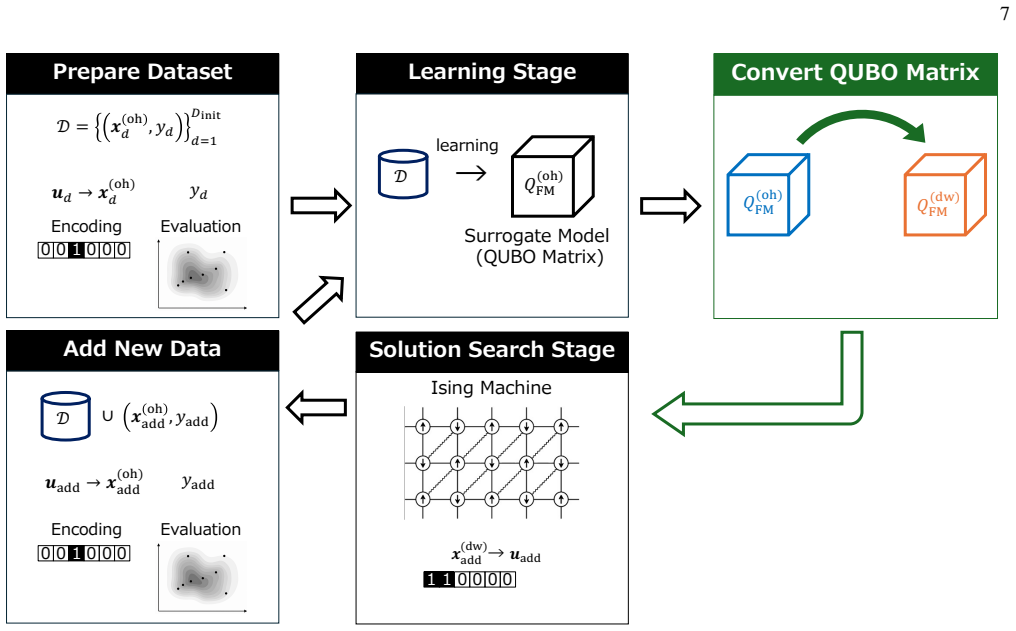
Black-box optimization (BBO) deals with problems where objective functions lack explicit analytical forms and are expensive to evaluate. Factorization machine with quadratic-optimization annealing (FMQA) constructs a surrogate model using a factorization machine (FM) and optimizes it with an Ising machine. Conventional FMQA applies a single integer-binary encoding throughout the optimization process, although the encoding best suited to surrogate learning may differ from the one best suited to Ising-machine solution search. We propose a stage-dependent FMQA framework and derive conversion formulas between one-hot and domain-wall QUBO matrices that preserve the surrogate objective over feasible integer states up to an additive constant. We evaluate the OhDw variant, which employs one-hot encoding for learning and domain-wall encoding for search, on the Rastrigin function with input dimensions N = 2 and 5 and discretization levels q = 61 and 301. Across all conditions, the dominant factor governing optimization performance is the encoding used in the learning stage, with one-hot encoding consistently yielding lower residual errors than domain-wall or binary encoding. The additional benefit of switching to domain-wall encoding for solution search is condition-dependent. For N = 5 and q = 301, OhDw achieves a lower residual error and solutions closer to the global optimum than one-hot-only FMQA, whereas for N = 5 and q = 61 the latter achieves a lower residual error. These results indicate that one-hot encoding in the learning stage is the primary performance driver and that stage-dependent encoding can provide further improvement under finer discretization.
Editorial analysis
A structured set of objections, weighed in public.
Referee Report
Summary. The manuscript proposes a stage-dependent FMQA framework for black-box optimization in which one-hot encoding is used to train the factorization-machine surrogate and domain-wall encoding is used for the subsequent Ising-machine search. Conversion formulas between the associated QUBO matrices are derived that preserve the surrogate objective over feasible integer states up to an additive constant. Experiments on the Rastrigin function at (N,q) = (2,61), (2,301), (5,61) and (5,301) show that the learning-stage encoding dominates performance, with one-hot consistently producing lower residual errors than domain-wall or binary encodings; the OhDw variant yields further improvement only under the finest discretization (N=5, q=301).
Significance. If the reported ordering holds, the work demonstrates that encoding choice for surrogate learning is the primary performance driver in FMQA and that stage-dependent encoding can provide additional gains under certain discretizations. The explicit derivation of objective-preserving conversion formulas is a concrete technical contribution that enables this separation without refitting. These elements could inform encoding strategies in other surrogate-based discrete optimization pipelines that rely on Ising solvers.
major comments (2)
- Abstract and experimental results: the claim that one-hot encoding in the learning stage “consistently yields lower residual errors” across the four (N,q) settings is presented without the number of independent runs, error bars, or any statistical test, leaving the dominance conclusion without a quantitative assessment of variability or significance.
- Conversion-formula section: although the formulas are stated to preserve the surrogate objective over feasible states up to an additive constant, the manuscript contains no explicit check that the transformed QUBO coefficients remain numerically stable when supplied to the Ising solver at q=301, which is required to confirm that the reported OhDw gains are not artifacts of solver behavior on the converted matrices.
minor comments (2)
- The notation “OhDw” is introduced without an early definition; a brief parenthetical on first use would improve readability.
- Figure captions or the results section should state the precise definition of residual error and how proximity to the global optimum is measured.
Simulated Author's Rebuttal
We thank the referee for the constructive feedback and the recommendation for minor revision. We address each major comment below.
read point-by-point responses
-
Referee: Abstract and experimental results: the claim that one-hot encoding in the learning stage “consistently yields lower residual errors” across the four (N,q) settings is presented without the number of independent runs, error bars, or any statistical test, leaving the dominance conclusion without a quantitative assessment of variability or significance.
Authors: We agree that the manuscript does not report the number of independent runs, error bars, or statistical tests supporting the claim. In the revised manuscript we will state the number of runs performed for each (N,q) setting, add error bars to the relevant figures or tables, and include a brief statistical comparison (e.g., paired t-tests or Wilcoxon tests) to quantify the significance of the observed differences. revision: yes
-
Referee: Conversion-formula section: although the formulas are stated to preserve the surrogate objective over feasible states up to an additive constant, the manuscript contains no explicit check that the transformed QUBO coefficients remain numerically stable when supplied to the Ising solver at q=301, which is required to confirm that the reported OhDw gains are not artifacts of solver behavior on the converted matrices.
Authors: We acknowledge the absence of an explicit numerical-stability verification for the converted matrices at q=301. In the revision we will add a short subsection or appendix that reports the range and condition number of the transformed QUBO coefficients for the q=301 cases and confirms that they remain within the numerical tolerance of the Ising solver used in the experiments. revision: yes
Circularity Check
No circularity: conversion formulas are independent derivations; performance claims are empirical evaluations on Rastrigin.
full rationale
The paper derives conversion formulas between one-hot and domain-wall QUBO matrices that preserve the surrogate objective over feasible states up to an additive constant; these are presented as mathematical derivations separate from the Rastrigin experiments. The central claim that one-hot encoding in the learning stage dominates performance is supported by direct experimental comparisons across N=2,5 and q=61,301, with no equations reducing reported residuals or ordering to quantities fitted from the same data or to self-citations. No self-definitional, fitted-input-as-prediction, or load-bearing self-citation patterns appear in the derivation chain or abstract. The results are self-contained against the stated benchmarks.
Axiom & Free-Parameter Ledger
axioms (1)
- domain assumption Conversion formulas between one-hot and domain-wall QUBO matrices preserve the surrogate objective over feasible integer states up to an additive constant.
Reference graph
Works this paper leans on
-
[1]
Mohseni, P
N. Mohseni, P. L. McMahon, and T. Byrnes, Ising machines as hardware solvers of combinatorial optimization problems, Na- ture Reviews Physics4, 363 (2022)
2022
-
[2]
L. P. Yulianti and K. Surendro, Implementation of quantum an- nealing: A systematic review, IEEE Access10, 73156 (2022)
2022
-
[3]
Jiang and C.-W
J.-R. Jiang and C.-W. Chu, Classifying and benchmarking quantum annealing algorithms based on quadratic uncon- strained binary optimization for solving NP-hard problems, IEEE Access11, 104165 (2023)
2023
-
[4]
S. Kikuchi, N. Togawa, and S. Tanaka, Effectiveness of hybrid optimization method for quantum annealing machines, arXiv preprint arXiv:2507.15544 (2025)
arXiv 2025
-
[5]
Kirkpatrick, C
S. Kirkpatrick, C. D. Gelatt Jr, and M. P. Vecchi, Optimization by simulated annealing, Science220, 671 (1983)
1983
-
[6]
D. S. Johnson, C. R. Aragon, L. A. McGeoch, and C. Schevon, Optimization by simulated annealing: An experimental evalu- ation; part I, graph partitioning, Operations Research37, 865 (1989)
1989
-
[7]
D. S. Johnson, C. R. Aragon, L. A. McGeoch, and C. Schevon, Optimization by simulated annealing: an experimental evalu- ation; part II, graph coloring and number partitioning, Opera- tions Research39, 378 (1991)
1991
-
[8]
Kadowaki and H
T. Kadowaki and H. Nishimori, Quantum annealing in the trans- verse Ising model, Physical Review E58, 5355 (1998)
1998
-
[9]
Das and B
A. Das and B. K. Chakrabarti, Colloquium: Quantum annealing and analog quantum computation, Reviews of Modern Physics 80, 1061 (2008)
2008
-
[10]
Tanaka, R
S. Tanaka, R. Tamura, and B. K. Chakrabarti,Quantum Spin Glasses, Annealing and Computation(Cambridge University Press, Cambridge, U.K., 2017)
2017
-
[11]
B. K. Chakrabarti, H. Leschke, P. Ray, T. Shirai, and S. Tanaka, Quantum annealing and computation: challenges and perspec- tives, Philosophical Transactions of the Royal Society A381, 20210419 (2023)
2023
-
[12]
Harris, Y
R. Harris, Y . Sato, A. J. Berkley, M. Reis, F. Altomare, M. H. Amin, K. Boothby, P. Bunyk, C. Deng, C. Enderud,et al., Phase transitions in a programmable quantum spin glass simulator, Science361, 162 (2018)
2018
-
[13]
A. D. King, J. Carrasquilla, J. Raymond, I. Ozfidan, E. An- driyash, A. Berkley, M. Reis, T. Lanting, R. Harris, F. Al- tomare,et al., Observation of topological phenomena in a pro- grammable lattice of 1,800 qubits, Nature560, 456 (2018). 16 10 4 10 2 100 102 104 (a) N = 2, q = 61 (b) N = 2, q = 301 0 500 1000 1500 2000 100 101 102 103 104 (c) N = 5, q =...
2018
-
[14]
Utimula, T
K. Utimula, T. Ichibha, G. I. Prayogo, K. Hongo, K. Nakano, and R. Maezono, A quantum annealing approach to ionic diffu- sion in solids, Scientific Reports11, 7261 (2021)
2021
-
[15]
Sampei, K
H. Sampei, K. Saegusa, K. Chishima, T. Higo, S. Tanaka, Y . Yayama, M. Nakamura, K. Kimura, and Y . Sekine, Quan- tum annealing boosts prediction of multimolecular adsorption on solid surfaces avoiding combinatorial explosion, JACS Au 3, 991 (2023)
2023
-
[16]
Neukart, G
F. Neukart, G. Compostella, C. Seidel, D. von Dollen, S. Yarkoni, and B. Parney, Traffic flow optimization using a quantum annealer, Frontiers in ICT4, 29 (2017)
2017
-
[17]
Stollenwerk, B
T. Stollenwerk, B. O’Gorman, D. Venturelli, S. Mandra, O. Ro- dionova, H. Ng, B. Sridhar, E. G. Rieffel, and R. Biswas, Quan- tum annealing applied to de-conflicting optimal trajectories for air traffic management, IEEE Transactions on Intelligent Trans- portation Systems21, 285 (2020)
2020
-
[18]
Inoue, A
D. Inoue, A. Okada, T. Matsumori, K. Aihara, and H. Yoshida, Traffic signal optimization on a square lattice with quantum an- nealing, Scientific Reports11, 3303 (2021)
2021
-
[19]
Mukasa, K
Y . Mukasa, K. Wakaizumi, S. Tanaka, and N. Togawa, An Ising machine-based solver for visiting-route recommendation prob- lems in amusement parks, IEICE Transactions on Information and Systems104, 1592 (2021)
2021
-
[20]
Marchesin, B
A. Marchesin, B. Montrucchio, M. Graziano, G. Boella, and G. Mondo, Improving urban traffic mobility via a versatile quantum annealing model, IEEE Transactions on Quantum En- gineering4, 1 (2023)
2023
-
[21]
Kanai, M
H. Kanai, M. Yamashita, K. Tanahashi, and S. Tanaka, Annealing-assisted column generation for inequality- constrained combinatorial optimization problems, IEEE Access12, 157669 (2024)
2024
-
[22]
Phillipson and H
F. Phillipson and H. Bhatia, Portfolio optimisation using the D-Wave quantum annealer, inProceedings of the International Conference on Computational Science(Krakow, Poland, 2021) pp. 45–59
2021
-
[23]
Sakuler, J
W. Sakuler, J. M. Oberreuter, R. Aiolfi, L. Asproni, B. Roman, and J. Schiefer, A real-world test of portfolio optimization with quantum annealing, Quantum Machine Intelligence7, 1 (2025)
2025
-
[24]
K. Takahashi, T. Abe, Y . Nakamura, R. Hidaka, S. Kikuchi, and S. Tanaka, Effectiveness of cardinality-return weighted maxi- mum independent set approach for financial portfolio optimiza- tion, arXiv preprint arXiv:2510.23310 (2025)
arXiv 2025
-
[25]
K. Endo, Y . Matsuda, S. Tanaka, and M. Muramatsu, A phase- field model by an Ising machine and its application to the phase- separation structure of a diblock polymer, Scientific Reports12, 10794 (2022)
2022
-
[26]
Honda, K
R. Honda, K. Endo, T. Kaji, Y . Suzuki, Y . Matsuda, S. Tanaka, and M. Muramatsu, Development of optimization method for 17 10 2 10 1 100 101 (a) N = 2, q = 61 (b) N = 2, q = 301 0 500 1000 1500 2000 10 1 100 101 (c) N = 5, q = 61 0 500 1000 1500 2000 (d) N = 5, q = 301 Iteration Norm BO Oh Dw Bi OhDw DwOh FIG. 9. The transition of norm values obtained du...
2000
-
[27]
Z. Xu, W. Shang, S. Kim, E. Lee, and T. Luo, Quantum annealing-assisted lattice optimization, npj Computational Ma- terials11, 4 (2025)
2025
-
[28]
P. I. Frazier, A tutorial on Bayesian optimization, arXiv preprint arXiv:1807.02811 (2018)
Pith/arXiv arXiv 2018
-
[29]
Lookman, P
T. Lookman, P. V . Balachandran, D. Xue, and R. Yuan, Active learning in materials science with emphasis on adaptive sam- pling using uncertainties for targeted design, npj Computational Materials5, 21 (2019)
2019
-
[30]
Golovin, B
D. Golovin, B. Solnik, S. Moitra, G. Kochanski, J. Karro, and D. Sculley, Google Vizier: A service for black-box optimiza- tion, inProceedings of the 23rd ACM SIGKDD international conference on knowledge discovery and data mining(2017) pp. 1487–1495
2017
-
[31]
Baptista and M
R. Baptista and M. Poloczek, Bayesian optimization of com- binatorial structures, inInternational conference on machine learning(PMLR, 2018) pp. 462–471
2018
-
[32]
C. Oh, J. Tomczak, E. Gavves, and M. Welling, Combinatorial Bayesian optimization using the graph Cartesian product, Ad- vances in Neural Information Processing Systems32(2019)
2019
-
[33]
Kitai, J
K. Kitai, J. Guo, S. Ju, S. Tanaka, K. Tsuda, J. Shiomi, and R. Tamura, Designing metamaterials with quantum anneal- ing and factorization machines, Physical Review Research2, 013319 (2020)
2020
-
[34]
Tamura, Y
R. Tamura, Y . Seki, Y . Minamoto, K. Kitai, Y . Matsuda, S. Tanaka, and K. Tsuda, Black-box optimization using fac- torization and Ising machines, Applied Physics Reviews13, 021307 (2026)
2026
-
[35]
Rendle, Factorization machines, in2010 IEEE International conference on data mining(IEEE, 2010) pp
S. Rendle, Factorization machines, in2010 IEEE International conference on data mining(IEEE, 2010) pp. 995–1000
2010
-
[36]
S. Kim, W. Shang, S. Moon, T. Pastega, E. Lee, and T. Luo, High-performance transparent radiative cooler designed by quantum computing, ACS Energy Letters7, 4134 (2022)
2022
-
[37]
S. Kim, S. Jung, A. Bobbitt, E. Lee, and T. Luo, Wide-angle spectral filter for energy-saving windows designed by quantum annealing-enhanced active learning, Cell Reports Physical Sci- ence5, 101891 (2024)
2024
-
[38]
J. Lin, T. Tada, A. Koizumi, M. Sumita, K. Tsuda, and R. Tamura, Determination of stable proton configurations by black-box optimization using an Ising machine, The Journal of Physical Chemistry C129, 2332 (2025)
2025
-
[39]
Urushihara, M
M. Urushihara, M. Karube, K. Yamaguchi, and R. Tamura, Op- 18 timization of core–shell nanoparticles using a combination of machine learning and Ising machine, Advanced Photonics Re- search4, 2300226 (2023)
2023
-
[40]
K. Nawa, T. Suzuki, K. Masuda, S. Tanaka, and Y . Miura, Quantum annealing optimization method for the design of bar- rier materials in magnetic tunnel junctions, Physical Review Applied20, 024044 (2023)
2023
-
[41]
M. Hida, H. Ikeda, A. Maruo, M. Sato, and T. Yamazaki, Topol- ogy optimization of analog circuit design via global optimiza- tion using factorization machines with digital annealer, Journal of Advanced Mechanical Design, Systems, and Manufacturing 18, JAMDSM0076 (2024)
2024
-
[42]
Tamura, K
R. Tamura, K. Nagata, K. Sodeyama, K. Nakamura, T. Tokuhira, S. Shibata, K. Hammura, H. Sugisawa, M. Kawa- mura, T. Tsurimoto,et al., Machine learning prediction of the mechanical properties of injection-molded polypropylene through X-ray diffraction analysis, Science and Technology of Advanced Materials25, 2388016 (2024)
2024
-
[43]
Matsumori, M
T. Matsumori, M. Taki, and T. Kadowaki, Application of QUBO solver using black-box optimization to structural design for resonance avoidance, Scientific Reports12, 12143 (2022)
2022
-
[44]
Takaki, Y
K. Takaki, Y . Asai, S. Katayama, K. Urano, T. Yonezawa, and N. Kawaguchi, Joint black-box optimization of warehouse lay- out and worker assignment using quantum annealing and fac- torization machines, in2025 IEEE International Conference on Systems, Man, and Cybernetics (SMC)(IEEE, 2025) pp. 4837– 4844
2025
-
[45]
S. Kikuchi and S. Tanaka, Factorization machine with quadratic-optimization annealing for RNA inverse folding and evaluation of binary-integer encoding and nucleotide assign- ment, arXiv preprint arXiv:2602.16643 (2026)
Pith/arXiv arXiv 2026
-
[46]
Y . Minamoto and Y . Sakamoto, A black-box optimiza- tion method with polynomial-based kernels and quadratic- optimization annealing, arXiv preprint arXiv:2501.04225 (2025)
arXiv 2025
-
[47]
Endo and K
K. Endo and K. Z. Takahashi, Function smoothing regulariza- tion for precision factorization machine annealing in continu- ous variable optimization problems, Physical Review Research 7, 013149 (2025)
2025
-
[48]
Nakano, Y
M. Nakano, Y . Seki, S. Kikuchi, and S. Tanaka, Swift-fmqa: Enhancing factorization machine with quadratic-optimization annealing via sliding window, IEEE Access14, 10977 (2026)
2026
-
[49]
T. Abe, M. Yamashita, and S. Tanaka, Effectiveness of binary autoencoders for qubo-based optimization problems, arXiv preprint arXiv:2602.10037 (2026)
arXiv 2026
-
[50]
T. Hayashi, Y . Seki, K. Terada, Y . Mukasa, S. Kikuchi, and S. Tanaka, Improving fmqa via initial training data design considering marginal bit coverage in one-hot encoding, arXiv preprint arXiv:2605.04825 (2026)
Pith/arXiv arXiv 2026
-
[51]
A. Tucs, R. Tamura, and K. Tsuda, Factorization machine with iterative quantum reverse annealing: A Python package for batch black-box optimization with reverse quantum annealing, Advanced Intelligent Discovery , e202500231 (2026)
2026
-
[52]
Hama and T
Y . Hama and T. Kadowaki, Subsampling factorization machine annealing, Physical Review Research8, 013187 (2026)
2026
-
[53]
Inoue, Y
T. Inoue, Y . Seki, S. Tanaka, N. Togawa, K. Ishizaki, and S. Noda, Towards optimization of photonic-crystal surface- emitting lasers via quantum annealing, Optics Express30, 43503 (2022)
2022
-
[54]
Kondo, T
T. Kondo, T. Kohira, and Y . Minamoto, Simultaneous struc- ture design optimization of multiple car models using FMQA, Transactions of the Society of Automotive Engineers of Japan 56, 229 (2025)
2025
-
[55]
S. Kikuchi, K. Takahashi, and S. Tanaka, Performance of Domain-Wall encoding in a digital Ising machine, arXiv preprint arXiv:2410.11198 (2024)
arXiv 2024
-
[56]
J. Chen, T. Stollenwerk, and N. Chancellor, Performance of Domain-Wall encoding for quantum annealing, IEEE Transac- tions on Quantum Engineering2, 1 (2021)
2021
-
[57]
Tamura, T
K. Tamura, T. Shirai, H. Katsura, S. Tanaka, and N. Togawa, Performance comparison of typical binary-integer encodings in an Ising machine, IEEE Access9, 81032 (2021)
2021
-
[58]
Y . Seki, R. Tamura, and S. Tanaka, Black-box optimization for integer-variable problems using Ising machines and factoriza- tion machines, arXiv preprint arXiv:2209.01016 (2022)
arXiv 2022
-
[59]
L. A. Rastrigin,Systems of Extremal Control(Mir, Moscow, 1974)
1974
-
[60]
Rudolph,Globale Optimierung mit parallelen Evolution- sstrategien, Diplomarbeit, Department of Computer Science, University of Dortmund (1990)
G. Rudolph,Globale Optimierung mit parallelen Evolution- sstrategien, Diplomarbeit, Department of Computer Science, University of Dortmund (1990)
1990
-
[61]
I. Loshchilov and F. Hutter, Decoupled weight decay regular- ization, arXiv preprint arXiv:1711.05101 (2017)
Pith/arXiv arXiv 2017
-
[62]
N. Demo, M. Tezzele, and G. Rozza, A supervised learning ap- proach involving active subspaces for an efficient genetic algo- rithm in high-dimensional optimization problems, SIAM Jour- nal on Scientific Computing43, B831 (2021)
2021
-
[63]
Fixstars Amplify, Fixstars Amplify Annealing Engine (2021), https://amplify.fixstars.com/en/
2021
-
[64]
Akiba, S
T. Akiba, S. Sano, T. Yanase, T. Ohta, and M. Koyama, Optuna: A next-generation hyperparameter optimization framework, in Proceedings of the 25th ACM SIGKDD international confer- ence on knowledge discovery&data mining(2019) pp. 2623– 2631
2019
-
[65]
H. H. Rosenbrock, An automatic method for finding the great- est or least value of a function, The Computer Journal3, 175 (1960)
1960
discussion (0)
Sign in with ORCID, Apple, or X to comment. Anyone can read and Pith papers without signing in.