Coupling Heterarchical Granular Dynamics and Computational Fluid Dynamics
Pith reviewed 2026-06-26 06:40 UTC · model grok-4.3
The pith
A coupled heterarchical granular-fluid dynamics model simulates fluid-coupled granular segregation by extending inertial particle velocities and using staggered coupling.
A machine-rendered reading of the paper's core claim, the machinery that carries it, and where it could break.
Core claim
The heterarchical granular-fluid dynamics (HGFD) model extends the HGD framework by introducing inertial, force-balance-driven particle velocities and consistent fluid-solid momentum exchange, coupled via a staggered explicit sequential scheme with co-located Eulerian fields, and is shown to be an efficient and consistent approach for simulating fluid-coupled granular segregation dynamics through experimental validations.
What carries the argument
The HGFD model, which couples inertial HGD particle velocities to a fluid solver via staggered explicit sequential scheme and co-located Eulerian fields for momentum exchange.
If this is right
- Reproduces inertial relaxation times from single-particle settling experiments.
- Captures concentration-dependent settling velocities and vertical size stratification in hindered settling.
- Demonstrates sensitivity across three reported segregation types in fluid-immersed granular flows.
- Enables efficient simulation of systems with more than a million grains.
Where Pith is reading between the lines
- The framework could apply to large-scale natural sediment transport where grain size sorting affects river or coastal morphology.
- It may support industrial modeling of particle-fluid mixtures such as in mineral separation or slurry pipelines.
- Additional physics like non-spherical particles or varying fluid viscosity could be incorporated without changing the core coupling structure.
Load-bearing premise
The staggered explicit sequential coupling scheme with co-located Eulerian fields maintains numerical stability and accurate momentum exchange when extending the prior HGD model to inertial, force-balance-driven particle velocities.
What would settle it
A significant mismatch between HGFD simulations and experimental settling velocities, size stratification, or segregation patterns in any of the three validation cases, or numerical instability during coupling at higher particle Reynolds numbers.
Figures



read the original abstract
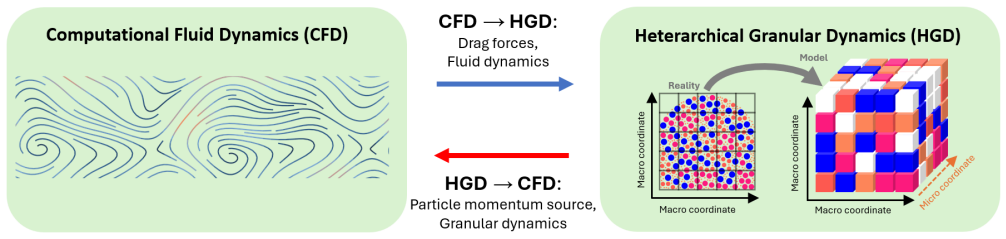
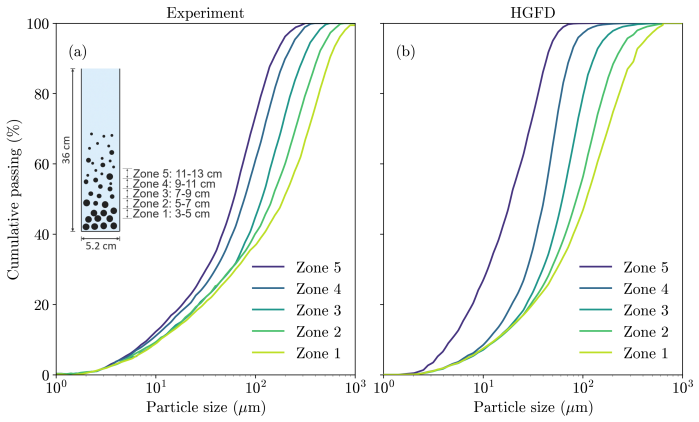
Granular flows in ambient fluids exhibit grain-size-dependent segregation, which is difficult to capture efficiently with existing models, especially in large-scale systems involving more than a million grains. We develop a two-way coupled framework that integrates heterarchical granular dynamics (HGD) with a fluid-fraction-weighted incompressible Navier-Stokes solver. This heterarchical granular-fluid dynamics (HGFD) model extends a previous HGD model for quasi-static deformations by introducing inertial, force-balance-driven particle velocities and consistent fluid-solid momentum exchange. The coupling between the inertial HGD and the fluid solver is performed using a staggered explicit sequential scheme and co-located Eulerian fields. The framework is evaluated against experimental data of (i) single-particle settling to verify inertial relaxation, (ii) hindered settling to reproduce concentration-dependent settling and vertical size stratification, and (iii) representative cases covering three reported segregation types to assess regime sensitivity. These results establish HGFD as an efficient and consistent approach for simulating fluid-coupled granular segregation dynamics.
Editorial analysis
A structured set of objections, weighed in public.
Referee Report
Summary. The manuscript develops a two-way coupled heterarchical granular-fluid dynamics (HGFD) framework that extends a prior quasi-static heterarchical granular dynamics (HGD) model to inertial, force-balance-driven particle velocities and couples it to a fluid-fraction-weighted incompressible Navier-Stokes solver via a staggered explicit sequential scheme with co-located Eulerian fields. The framework is evaluated on single-particle settling (to verify inertial relaxation), hindered settling (to reproduce concentration-dependent velocities and vertical stratification), and representative cases for three reported segregation types (to assess regime sensitivity), with the claim that these establish HGFD as an efficient and consistent approach for fluid-coupled granular segregation.
Significance. If the numerical coupling is demonstrated to be stable and to conserve momentum without artificial damping or time-step artifacts, the work would supply a scalable method for simulating segregation in systems with >10^6 grains, a regime where fully resolved or DEM-based approaches remain prohibitive.
major comments (2)
- [Coupling scheme description and validation sections] The central consistency claim rests on the staggered explicit coupling maintaining accurate two-way momentum exchange once the HGD model is extended to inertial velocities. No section, table, or figure reports global momentum balance, checks for oscillatory drift at sharp solid-fraction interfaces, or results under time-step refinement; without these, reproduction of experimental trends cannot be distinguished from possible numerical artifacts.
- [Abstract and § on numerical results] Abstract and results summary supply no quantitative error metrics, L2 norms, or parameter counts for the three segregation-type cases. This prevents assessment of whether the model reproduces the reported regime sensitivity in a parameter-free manner or relies on unstated tuning of relaxation times or fluid time steps.
minor comments (1)
- Notation for the fluid-fraction weighting and the precise definition of the inertial particle velocity update should be stated explicitly with equation numbers to allow direct comparison with the prior HGD formulation.
Simulated Author's Rebuttal
We thank the referee for their careful review and constructive comments on our manuscript. We address the two major comments point-by-point below, committing to revisions that strengthen the numerical validation of the coupling scheme.
read point-by-point responses
-
Referee: [Coupling scheme description and validation sections] The central consistency claim rests on the staggered explicit coupling maintaining accurate two-way momentum exchange once the HGD model is extended to inertial velocities. No section, table, or figure reports global momentum balance, checks for oscillatory drift at sharp solid-fraction interfaces, or results under time-step refinement; without these, reproduction of experimental trends cannot be distinguished from possible numerical artifacts.
Authors: We agree that explicit verification of global momentum conservation, interface stability, and time-step independence is required to rule out artifacts. In the revised manuscript we will add these diagnostics (global momentum residual plots, interface oscillation checks, and refinement studies) for the single-particle, hindered-settling, and segregation cases, thereby confirming that the reported experimental agreement arises from the physical model rather than numerical effects. revision: yes
-
Referee: [Abstract and § on numerical results] Abstract and results summary supply no quantitative error metrics, L2 norms, or parameter counts for the three segregation-type cases. This prevents assessment of whether the model reproduces the reported regime sensitivity in a parameter-free manner or relies on unstated tuning of relaxation times or fluid time steps.
Authors: We accept that quantitative metrics are needed for rigorous assessment. The revised abstract and results section will report L2 norms against available experimental data for the segregation cases, together with an explicit statement of the (small) number of physical parameters and the derivation of relaxation times from grain and fluid properties without case-by-case tuning. This will demonstrate that regime sensitivity is captured from the underlying equations. revision: yes
Circularity Check
No significant circularity; validations are external and independent
full rationale
The HGFD framework extends a prior HGD model via explicit introduction of inertial velocities and staggered coupling, but the central claims rest on direct comparison to three distinct experimental benchmarks (single-particle settling, hindered settling, and segregation regimes) rather than any self-referential fit, definition, or unverified self-citation chain. No equation or step reduces a prediction to its own input parameters by construction, and the experimental evaluations provide external falsifiability outside the model's fitted values.
Axiom & Free-Parameter Ledger
invented entities (1)
-
HGFD framework
no independent evidence
Reference graph
Works this paper leans on
-
[1]
FLUID MECHANICS AND RHEOLOGY OF DENSE SUSPENSIONS
Jonathan J. Stickel and Robert L. Powell. “FLUID MECHANICS AND RHEOLOGY OF DENSE SUSPENSIONS”. en. In:Annual Review of Fluid Mechanics37.1 (Jan. 2005), pp. 129–149.issn: 0066-4189, 1545-4479.doi:10 . 1146 / annurev . fluid.36.050802.122132
arXiv 2005
-
[2]
Cheng-Hsien Lee and Zhenhua Huang. “A two- phase flow model for submarine granular flows: With an application to collapse of deeply- submerged granular columns”. In:Advances in Wa- ter Resources115 (May 2018), pp. 286–300.issn: 0309-1708.doi:10.1016/j.advwatres.2017.12. 012
-
[3]
Clayton T. Crowe, John D. Schwarzkopf, Martin Sommerfeld, and Yutaka Tsuji.Multiphase Flows with Droplets and Particles. 2nd ed. Boca Raton: CRC Press, Aug. 2011.isbn: 978-0-429-10639-2. doi:10.1201/b11103
-
[4]
Elsevier, 2013
Daizo Kunii and Octave Levenspiel.Fluidization engineering. Elsevier, 2013
2013
-
[5]
The physics of debris flows
Richard M. Iverson. “The physics of debris flows”. en. In:Reviews of Geophysics35.3 (Aug. 1997), pp. 245–296.issn: 8755-1209, 1944-9208.doi:10. 1029/97RG00426. 16
1997
-
[6]
The sedimenta- tion of a suspension of uniform spheres under con- ditions of viscous flow
J. F. Richardson and W. N. Zaki. “The sedimenta- tion of a suspension of uniform spheres under con- ditions of viscous flow”. In:Chemical Engineering Science3.2 (1954), pp. 65–73
1954
-
[7]
Rheol- ogy of dense granular suspensions
Élisabeth Guazzelli and Olivier Pouliquen. “Rheol- ogy of dense granular suspensions”. In:Journal of Fluid Mechanics852 (2018), P1
2018
-
[8]
M.A. Van Der Hoef, M. Van Sint Annaland, N.G. Deen, and J.A.M. Kuipers. “Numerical Simulation of Dense Gas-Solid Fluidized Beds: A Multiscale Modeling Strategy”. en. In:Annual Review of Fluid Mechanics40.1 (Jan. 2008), pp. 47–70.issn: 0066- 4189, 1545-4479.doi:10.1146/annurev.fluid. 40.111406.102130
-
[9]
Fluid Mechan- ical Description of Fluidized Beds. Equations of Motion
T. B. Anderson and Roy Jackson. “Fluid Mechan- ical Description of Fluidized Beds. Equations of Motion”. en. In:Industrial & Engineering Chem- istry Fundamentals6.4 (Nov. 1967), pp. 527– 539.issn: 0196-4313, 1541-4833.doi:10 . 1021 / i160024a007
1967
-
[10]
Discrete particle simulation of particulate sys- tems: a review of major applications and findings
H. P. Zhu, Z. Y. Zhou, R. Y. Yang, and A. B. Yu. “Discrete particle simulation of particulate sys- tems: a review of major applications and findings”. In:Chemical Engineering Science63.23 (2008), pp. 5728–5770
2008
-
[11]
Kinetic theories for granular flow: inelastic particles in Couette flow and slightly inelasticparticlesinageneralflowfield
C. K. K Lun, Stuart B. Savage, D. J. Jeffrey, and Nicholas Chepurniy. “Kinetic theories for granular flow: inelastic particles in Couette flow and slightly inelasticparticlesinageneralflowfield”.In:Journal of fluid mechanics140 (1984), pp. 223–256
1984
-
[12]
Cambridge university press, 2000
Roy Jackson.The dynamics of fluidized particles. Cambridge university press, 2000
2000
-
[13]
The role of meso-scale structures in rapid gas–solid flows
Kapil Agrawal, Peter N. Loezos, Madhava Syamlal, and Sankaran Sundaresan. “The role of meso-scale structures in rapid gas–solid flows”. en. In:Jour- nal of Fluid Mechanics445 (Oct. 2001), pp. 151– 185.issn: 1469-7645, 0022-1120.doi:10 . 1017 / S0022112001005663
2001
-
[14]
Large-scale CFD–DEM simulations of fluidized granular systems
Dalibor Jajcevic, Eva Siegmann, Charles Radeke, and Johannes G. Khinast. “Large-scale CFD–DEM simulations of fluidized granular systems”. In: Chemical Engineering Science98 (2013), pp. 298– 310
2013
-
[15]
Heterarchical granular dynamics
Benjy Marks, Shivakumar Athani, and Itai Einav. “Heterarchical granular dynamics”. en. In:Granu- lar Matter27.3 (June 2025), p. 67.issn: 1434-7636. doi:10.1007/s10035-025-01541-8
-
[16]
A heterarchical mul- tiscale model for granular materials with evolving grainsize distribution
Benjy Marks and Itai Einav. “A heterarchical mul- tiscale model for granular materials with evolving grainsize distribution”. In:Granular Matter19.3 (2017), p. 61
2017
-
[17]
Mukesh Singh Bisht, François Guillard, Paul Shel- ley, Benjy Marks, and Itai Einav. “Heterarchi- cal modelling of comminution for rotary mills: part I—particle crushing along streamlines”. en. In:Granular Matter26.4 (Aug. 2024), p. 88.issn: 1434-7636.doi:10.1007/s10035-024-01446-y
-
[18]
Heterarchical modelling of comminution for rotary mills: part II—particle crushing with segregation and mixing
Mukesh Singh Bisht, François Guillard, Paul Shel- ley, Benjy Marks, and Itai Einav. “Heterarchical modelling of comminution for rotary mills: part II—particle crushing with segregation and mixing”. en. In:Granular Matter26.4 (Aug. 2024), p. 87. issn: 1434-7636.doi:10 . 1007 / s10035 - 024 - 01450-2
2024
-
[19]
Heterarchical comminution model for SAG mills
Mukesh Singh Bisht, François Guillard, Paul Shel- ley, Benjy Marks, and Itai Einav. “Heterarchical comminution model for SAG mills”. In:Minerals Engineering233(Nov.2025),p.109563.issn:0892- 6875.doi:10.1016/j.mineng.2025.109563
-
[20]
Academic press, 1994
Dimitri Gidaspow.Multiphase flow and fluidiza- tion: continuum and kinetic theory descriptions. Academic press, 1994
1994
-
[21]
Mechanics of fluidization
C. Yu Wen. “Mechanics of fluidization”. In:Fluid Particle Technology, Chem. Eng. Progress. Sympo- sium Series. Vol. 62. 1966, pp. 100–111
1966
-
[22]
Fluid Flow Through Packed Columns
S. ERGUN. “Fluid Flow Through Packed Columns”. In:Chemical Engineering Progress48.2 (1952), p. 89
1952
-
[23]
Uber die grundlegenden Berech- nungen bei der Schwerkraftaufbereitung
Von L. Schiller. “Uber die grundlegenden Berech- nungen bei der Schwerkraftaufbereitung”. In:Z. Vereines Deutscher Inge.77 (1933), pp. 318–321
1933
-
[24]
Fundamental aspects of modeling turbu- lent particle dispersion in dilute flows
J. S. Shirolkar, C. F. M. Coimbra, and M. Queiroz McQuay. “Fundamental aspects of modeling turbu- lent particle dispersion in dilute flows”. In:Progress in Energy and Combustion Science22.4 (Jan. 1996),pp.363–399.issn:0360-1285.doi:10.1016/ S0360-1285(96)00006-8
1996
-
[25]
Study of the numerical instabilities in Lagrangian track- ing of bubbles and particles in two-phase flow
M. F. Göz, S. Laín, and M. Sommerfeld. “Study of the numerical instabilities in Lagrangian track- ing of bubbles and particles in two-phase flow”. In: Computers & Chemical Engineering28.12 (Nov. 2004), pp. 2727–2733.issn: 0098-1354.doi:10 . 1016/j.compchemeng.2004.07.035
2004
-
[26]
Unifying sus- pension and granular shear-induced self-diffusion
Shivakumar Athani, Bloen Metzger, Romain Mari, Yoël Forterre, and Pierre Rognon. “Unifying sus- pension and granular shear-induced self-diffusion”. In:Journal of Fluid Mechanics998 (2024), A55
2024
-
[27]
preCICE v2: A sustainable and user-friendly cou- pling library [version 2; peer review: 2 approved]
G Chourdakis, K Davis, B Rodenberg, M Schulte, FSimonis,BUekermann,GAbrams,HJBungartz, LCheungYau,IDesai,KEder,RHertrich,FLind- ner, A Rusch, D Sashko, D Schneider, A Totoun- feroush, D Volland, P Vollmer, and OZ Koseomur. “preCICE v2: A sustainable and user-friendly cou- pling library [version 2; peer review: 2 approved]”. 17 In:Open Research Europe2.51 ...
2022
-
[28]
A tensorial approach to computational continuum mechanics using object-oriented techniques
H. G. Weller, G. Tabor, H. Jasak, and C. Fureby. “A tensorial approach to computational continuum mechanics using object-oriented techniques”. In: Computer in Physics12.6 (Nov. 1998), pp. 620– 631.issn: 0894-1866.doi:10.1063/1.168744
-
[29]
The European Physical Journal B , volume =
N. Mordant and J.-F. Pinton. “Velocity measure- ment of a settling sphere”. en. In:The European Physical Journal B - Condensed Matter and Com- plex Systems18.2 (Nov. 2000), pp. 343–352.issn: 1434-6036.doi:10.1007/PL00011074
-
[30]
Hindered settling of flocculated multi-sized particle suspension, part I: Segregation mechanism of non-flocculated parti- cles
Yuan Li and Dirk van Zyl. “Hindered settling of flocculated multi-sized particle suspension, part I: Segregation mechanism of non-flocculated parti- cles”. In:Powder Technology407 (2022), p. 117683
2022
-
[31]
Scale de- pendence of segregation patterns in the filling of silos
Shivakumar Athani, Benjy Marks, François Guil- lard, Alistair Gillespie, and Itai Einav. “Scale de- pendence of segregation patterns in the filling of silos”. In:Phys. Rev. Lett.(May 2026).doi:10 . 1103/x2mh-v8rs. 18
2026
discussion (0)
Sign in with ORCID, Apple, or X to comment. Anyone can read and Pith papers without signing in.