Parametrizing the projected wind fields of ultra-hot Jupiters in thermal emission: an application to GCM spectra of WASP-76b
Pith reviewed 2026-06-26 07:39 UTC · model grok-4.3
The pith
A four-parameter model of the projected velocity field accurately reproduces phase-dependent Doppler shifts and line profiles in ultra-hot Jupiter emission spectra.
A machine-rendered reading of the paper's core claim, the machinery that carries it, and where it could break.
Core claim
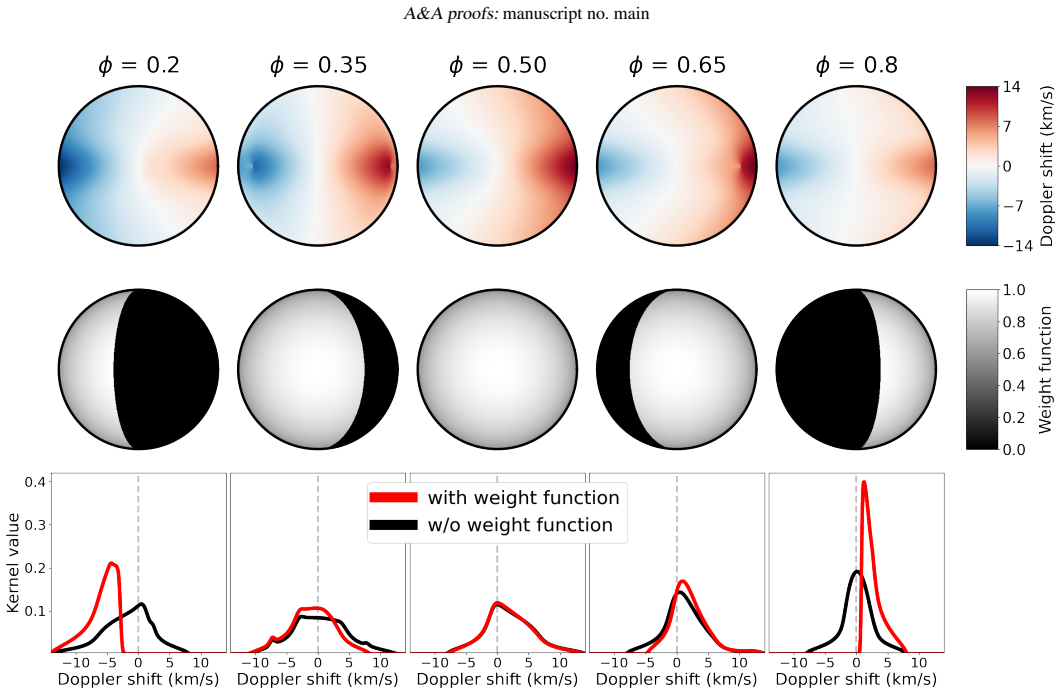
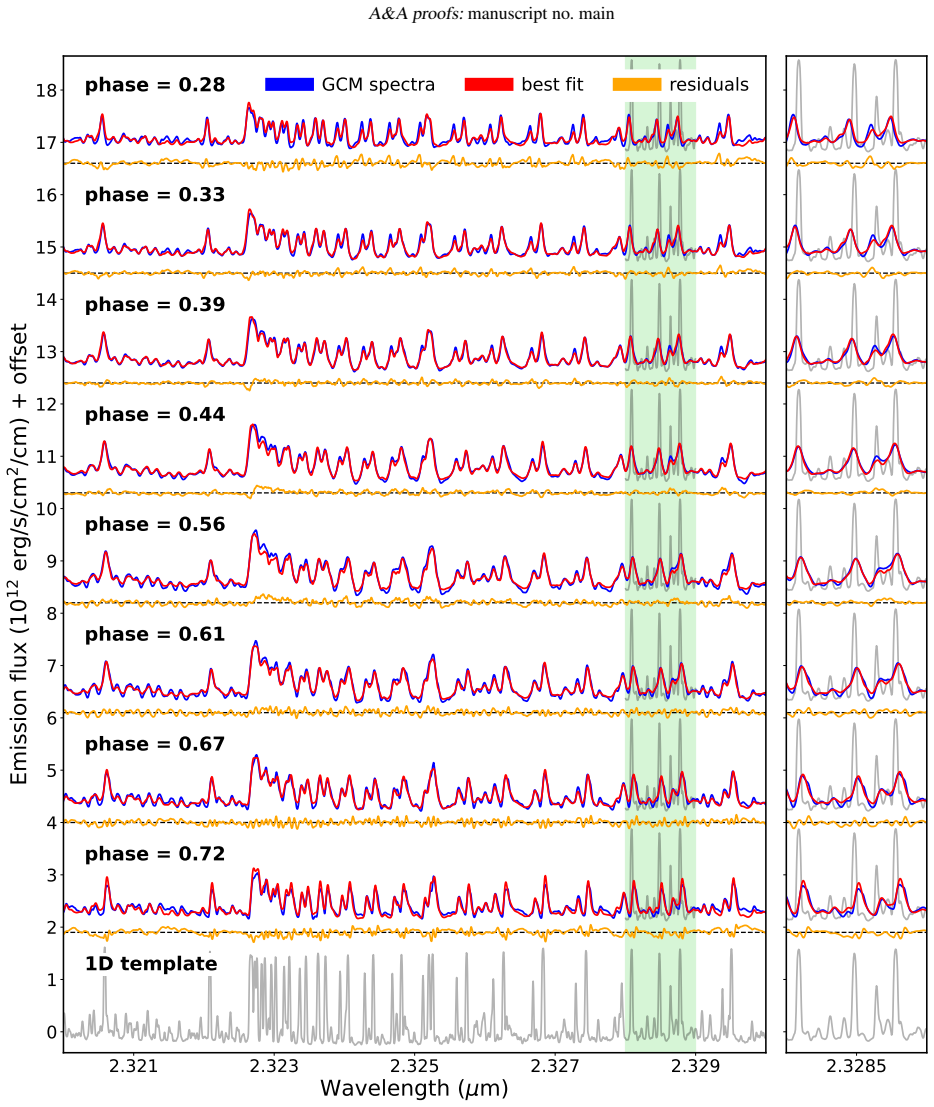
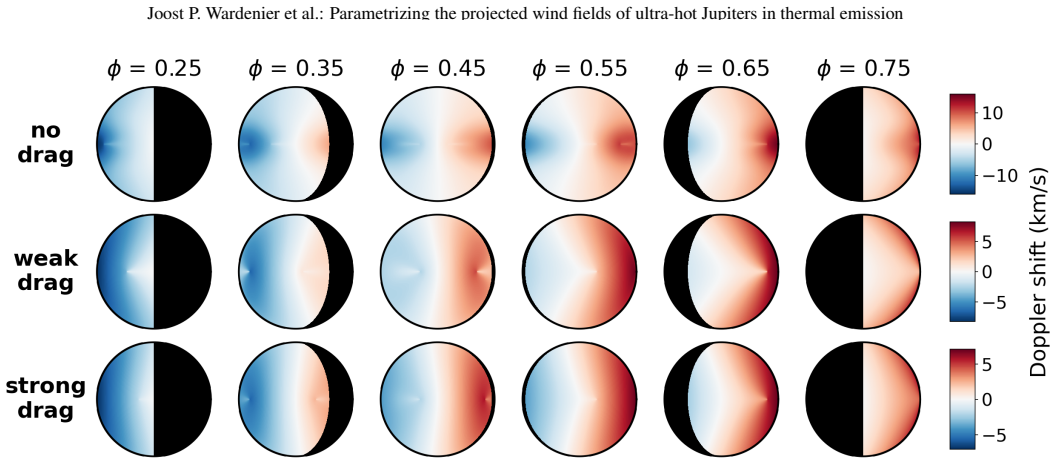
A parametric broadening-kernel model with four physically interpretable wind parameters can accurately reproduce the phase-dependent line shifts, shapes, and strengths in UHJ emission spectra, as shown by successful recovery of GCM-derived wind features when the model is applied in retrievals to synthetic spectra of WASP-76b.
What carries the argument
dopplerkernel, a forward model that parametrizes the projected line-of-sight velocity field on the planet disk with four wind parameters and builds a broadening kernel via weighted kernel-density estimation.
If this is right
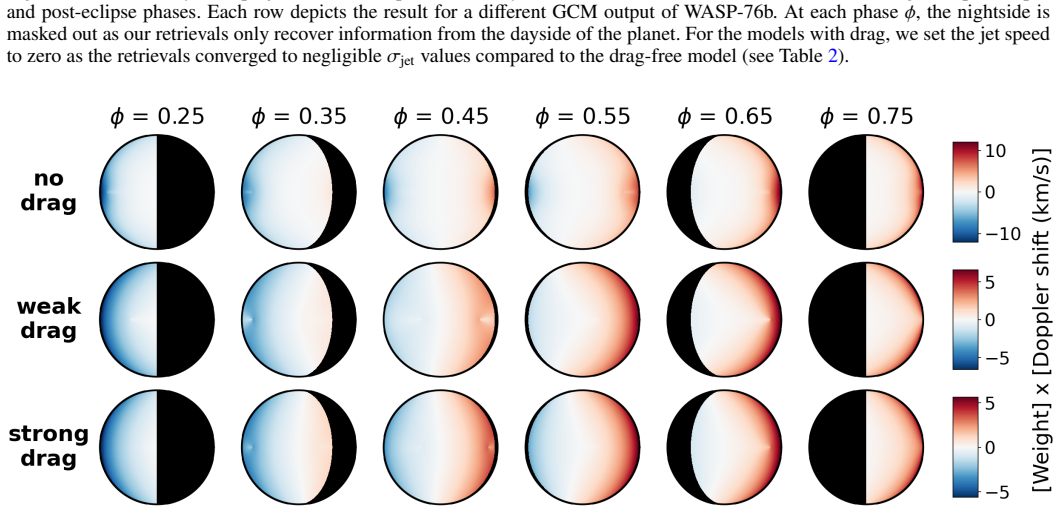
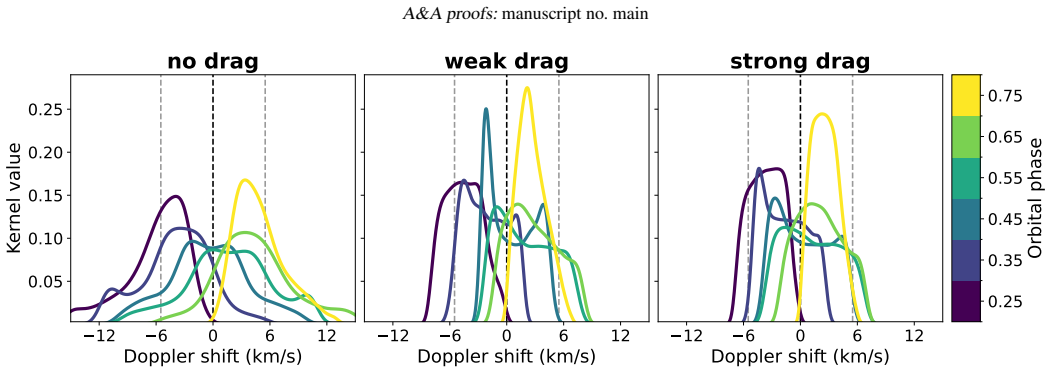
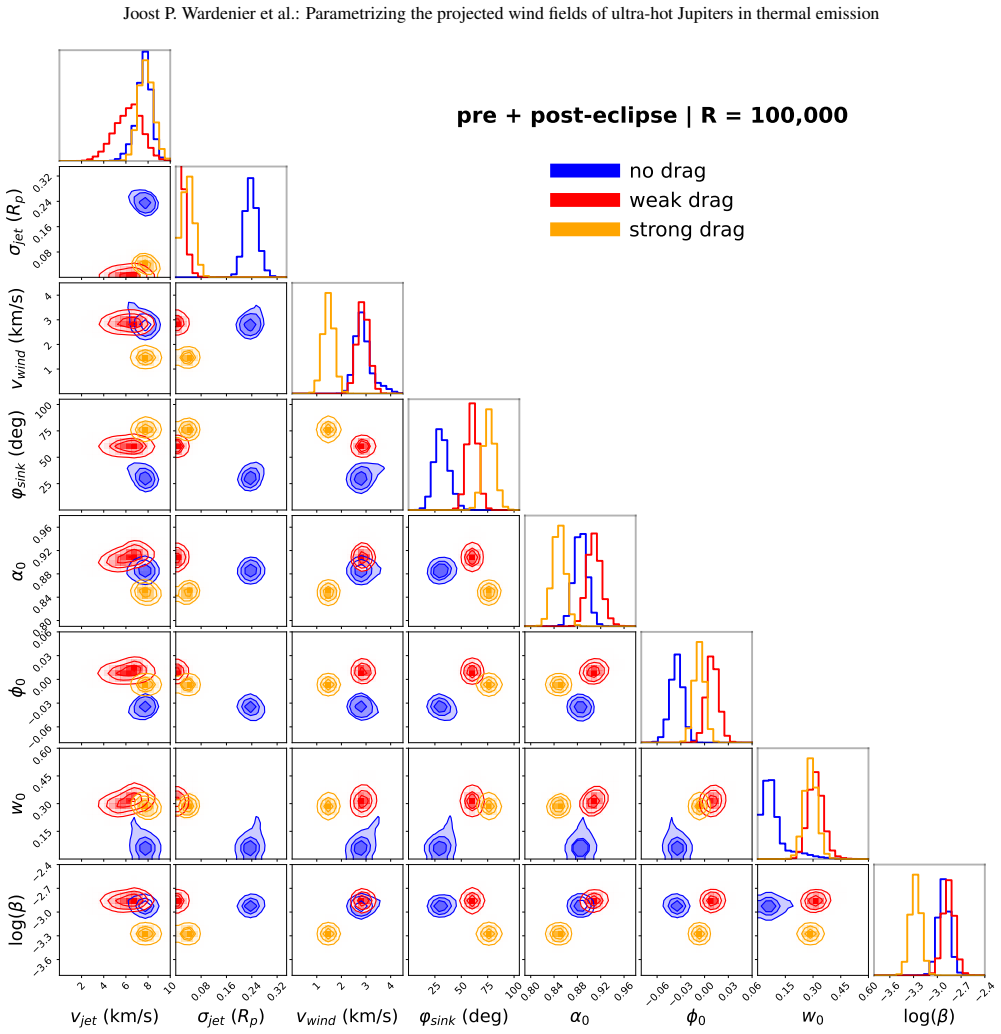
- Retrievals recover the equatorial jet to within roughly 1 km/s of the GCM zonal mean in the drag-free case.
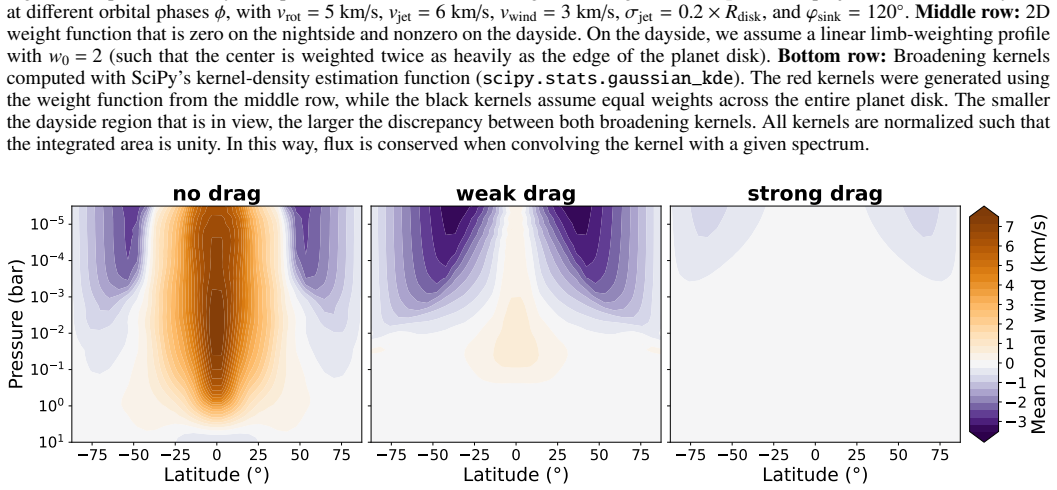
- Inferred day-to-night wind speeds agree with GCM averages at 1-10 mbar for all three drag regimes.
- Spectral resolution near R 100000 balances resolution of global winds against spurious detections from model-data mismatch.
- Combining pre- and post-eclipse phases improves constraints on the orientation of the source-to-sink flow.
- More complex weight functions introduce degeneracy between the velocity field and thermal weighting.
Where Pith is reading between the lines
- The same four-parameter form could be tested on emission spectra of other ultra-hot Jupiters to map their circulation without running full 3D models for each target.
- If real atmospheres contain strong vertical or latitudinal wind variations not captured by the four parameters, retrievals might systematically underestimate jet speeds or misplace convergence longitudes.
- Applying the model to lower-resolution data might still yield useful wind constraints while remaining computationally cheap for population studies.
Load-bearing premise
The line-of-sight velocity field projected on the planet disk can be captured by the chosen four-parameter form without missing important three-dimensional circulation features that would change the spectra.
What would settle it
A retrieval on actual high-resolution emission spectra of WASP-76b that returns jet speeds or flow directions inconsistent with independent measurements from transmission spectroscopy or fails to match observed line shapes at R around 100000 would falsify the claim.
Figures



read the original abstract
High-resolution thermal emission spectroscopy provides a powerful probe of atmospheric circulation in ultra-hot Jupiters (UHJs), with Doppler shifts encoding information about the 3D wind field across the planet disk. Retrieving these wind properties from phase-dependent emission spectra requires a forward model that is both physically motivated and computationally tractable. We present dopplerkernel, a new forward model that parametrizes the projected line-of-sight velocity field on the planet disk using four wind parameters (an equatorial jet speed $v_\mathrm{jet}$ and width $\sigma_\mathrm{jet}$, a source-to-sink flow speed $v_\mathrm{wind}$, and a flow convergence longitude $\varphi_\mathrm{sink}$) and constructs a broadening kernel via weighted kernel-density estimation. We apply this framework in a Bayesian retrieval to synthetic $K$-band emission spectra of WASP-76b generated from three 3D GCM outputs. Our retrievals successfully recover the equatorial jet in the drag-free GCM to within ${\sim}1$ km/s of the zonal mean and infer day-to-night wind speeds in good agreement with GCM averages at 1-10 mbar for all three drag regimes. We find that spectral resolutions of $R \sim 100{,}000$ offer an optimal trade-off: sufficient to resolve global wind features while avoiding spurious detections caused by model-data mismatches at higher resolution. Combining pre- and post-eclipse phases yields more reliable constraints than either alone, particularly on the orientation of the source-to-sink flow. Experiments with more complex weight functions reveal a degeneracy between the velocity field and the thermal weighting, cautioning against overparametrization. In conclusion, a parametric broadening-kernel model with a small number of physically interpretable parameters can accurately reproduce the phase-dependent line shifts, shapes, and strengths in UHJ emission spectra.
Editorial analysis
A structured set of objections, weighed in public.
Referee Report
Summary. The manuscript introduces dopplerkernel, a forward model parametrizing the projected line-of-sight velocity field on the planet disk with four parameters (equatorial jet speed v_jet and width sigma_jet, source-to-sink flow speed v_wind, and convergence longitude phi_sink) via weighted kernel-density estimation. It applies this in Bayesian retrievals to synthetic K-band emission spectra of WASP-76b generated from three 3D GCM outputs (drag-free, weak-drag, strong-drag), recovering the equatorial jet to within ~1 km/s of the zonal mean and day-to-night winds consistent with GCM averages at 1-10 mbar; it also identifies R~100,000 as optimal resolution and notes a degeneracy with thermal weighting.
Significance. If the four-parameter form holds across the tested cases, the method supplies a computationally tractable, physically interpretable alternative to full 3D radiative transfer for extracting wind properties from phase-resolved high-resolution emission spectra. The use of independent external GCM outputs for validation (rather than self-generated data) and the explicit identification of resolution/phase-coverage trade-offs are strengths that support its utility for UHJ studies.
major comments (2)
- [Abstract / Model description] Abstract and model description: The central claim that the specific four-parameter velocity parametrization (v_jet, sigma_jet, v_wind, phi_sink) produces a line-of-sight velocity distribution whose weighted KDE kernel matches the true disk-integrated Doppler shifts, shapes, and strengths relies on the assumption that this form captures all relevant 3D circulation features; however, the tested GCMs may not include vertical shear, non-axisymmetric eddies, or terminator asymmetries present in other UHJs or pressure levels, and this is load-bearing for general applicability beyond the three WASP-76b runs.
- [Abstract] Abstract: The reported degeneracy between velocity parameters and thermal weighting when more complex weight functions are used is noted, but the manuscript must demonstrate (via explicit tests or phase-coverage analysis) that this degeneracy does not allow velocity parameters to absorb thermal mismatches while still appearing to reproduce the spectra; without that, the physical interpretability of the retrieved winds is undermined.
minor comments (1)
- [Abstract] Abstract: Notation for spectral resolution (R ~ 100,000) and the exact pressure range (1-10 mbar) should be cross-checked for consistency with the main text figures and tables.
Simulated Author's Rebuttal
We thank the referee for the constructive report and the recommendation for major revision. We address each major comment below with proposed changes to the manuscript.
read point-by-point responses
-
Referee: [Abstract / Model description] Abstract and model description: The central claim that the specific four-parameter velocity parametrization (v_jet, sigma_jet, v_wind, phi_sink) produces a line-of-sight velocity distribution whose weighted KDE kernel matches the true disk-integrated Doppler shifts, shapes, and strengths relies on the assumption that this form captures all relevant 3D circulation features; however, the tested GCMs may not include vertical shear, non-axisymmetric eddies, or terminator asymmetries present in other UHJs or pressure levels, and this is load-bearing for general applicability beyond the three WASP-76b runs.
Authors: We agree that the validation is restricted to the three WASP-76b GCM runs and does not explicitly test features such as vertical shear or non-axisymmetric eddies that may appear in other UHJs. The manuscript frames the four-parameter model as a tractable approximation shown to reproduce the Doppler signatures in these specific cases rather than a universal representation of all 3D flows. We will revise the abstract and the model-description section to state the tested scope more explicitly and add a paragraph in the discussion acknowledging that additional circulation features would require model extensions. This change clarifies the load-bearing assumption without altering the reported results. revision: partial
-
Referee: [Abstract] Abstract: The reported degeneracy between velocity parameters and thermal weighting when more complex weight functions are used is noted, but the manuscript must demonstrate (via explicit tests or phase-coverage analysis) that this degeneracy does not allow velocity parameters to absorb thermal mismatches while still appearing to reproduce the spectra; without that, the physical interpretability of the retrieved winds is undermined.
Authors: The current manuscript notes the degeneracy but does not present dedicated experiments that isolate whether velocity parameters can compensate for thermal-structure mismatches. We will add a short set of retrieval tests (new figure or appendix) that deliberately introduce thermal-weight mismatches and quantify the resulting bias in the recovered wind parameters. These tests will be used to assess the robustness of the physical interpretation and will be described in the revised abstract and discussion. revision: yes
Circularity Check
No significant circularity; parametrization tested on independent GCM outputs
full rationale
The derivation introduces a four-parameter velocity parametrization (v_jet, sigma_jet, v_wind, phi_sink) and constructs a broadening kernel via weighted KDE. This forward model is then applied in retrievals to synthetic spectra generated from three separate 3D GCM runs (drag-free, weak-drag, strong-drag). The parameters are physically motivated quantities, not quantities defined in terms of the fit itself. Recovery of jet speeds and day-to-night flows is reported as a validation against external model outputs rather than a self-referential construction. No load-bearing self-citation, ansatz smuggling, or renaming of known results is present in the provided text; the central claim remains an empirical test of an independent parametrization.
Axiom & Free-Parameter Ledger
free parameters (4)
- v_jet
- sigma_jet
- v_wind
- phi_sink
axioms (2)
- domain assumption The line-of-sight velocity field on the planet disk can be parametrized using the four wind parameters v_jet, sigma_jet, v_wind, and phi_sink.
- domain assumption Synthetic spectra generated from the three 3D GCM outputs serve as realistic proxies for testing retrieval performance.
Reference graph
Works this paper leans on
-
[1]
Nature Astronomy , year = 2026, month = jun, doi =
Magnetic field strengths of hot giant exoplanets consistent with Solar System values. Nature Astronomy , year = 2026, month = jun, doi =
2026
-
[2]
Nature Communications , year = 2026, month = feb, volume =
A Stellar magnesium to silicon ratio in the atmosphere of an exoplanet. Nature Communications , year = 2026, month = feb, volume =. doi:10.1038/s41467-026-69610-x , adsurl =
-
[3]
High-resolution Dayside Spectroscopy of WASP-189 b: Detection of Iron during the GHOST/Gemini South System Verification Run. , keywords =. doi:10.3847/1538-3881/ad643f , archivePrefix =. 2407.11281 , primaryClass =
-
[4]
A Comparison of One-dimensional and Three-dimensional Exoplanet Atmosphere Model Grids: ScCHIMERA and the SPARC/MiTgcm. , keywords =. doi:10.3847/1538-4357/ae2b6c , archivePrefix =. 2512.14882 , primaryClass =
-
[5]
High-resolution Emission Spectroscopy of the Ultrahot Jupiter KELT-9b: Little Variation in Day- and Nightside Emission Line Contrasts. , keywords =. doi:10.3847/1538-3881/acc654 , archivePrefix =. 2304.03248 , primaryClass =
-
[6]
PEPSI Investigation, Retrieval, and Atlas of Numerous Giant Atmospheres (PIRANGA). II. Phase-resolved Cross-correlation Transmission Spectroscopy of KELT-20b. , keywords =. doi:10.3847/1538-3881/ae2252 , archivePrefix =. 2503.07719 , primaryClass =
-
[7]
Up, Up, and Away: Winds and Dynamical Structure as a Function of Altitude in the Ultrahot Jupiter WASP-76b. , keywords =. doi:10.3847/1538-4357/ad772f , archivePrefix =. 2409.03124 , primaryClass =
-
[8]
Retrieving day- and nightside atmospheric properties of the ultra-hot Jupiter TOI-2109b: Detection of Fe and CO emission lines and evidence for inefficient heat transport. , keywords =. doi:10.1051/0004-6361/202554572 , archivePrefix =. 2504.15757 , primaryClass =
-
[9]
Assessing Robustness and Bias in 1D Retrievals of 3D Global Circulation Models at High Spectral Resolution: A WASP-76 b Simulation Case Study in Emission. , keywords =. doi:10.3847/1538-4357/adf328 , archivePrefix =. 2507.16687 , primaryClass =
-
[10]
Extreme Winds on the Emerging Dayside of an Ultrahot Jupiter. , keywords =. doi:10.3847/2041-8213/ae36a1 , archivePrefix =. 2601.20849 , primaryClass =
-
[11]
CRIRES ^ + and ESPRESSO Reveal an Atmosphere Enriched in Volatiles Relative to Refractories on the Ultrahot Jupiter WASP-121b. , keywords =. doi:10.3847/1538-3881/ad8b28 , archivePrefix =. 2410.18183 , primaryClass =
-
[12]
New perspectives on MASCARA-1b: A combined analysis of pre- and post-eclipse emission data using CRIRES+. , keywords =. doi:10.1051/0004-6361/202453520 , archivePrefix =. 2502.11180 , primaryClass =
-
[13]
Atmospheric composition and circulation of the ultra-hot Jupiter WASP-121b with joint NIRPS, HARPS and CRIRES+ transit spectroscopy. , keywords =. doi:10.1051/0004-6361/202556257 , archivePrefix =. 2509.00151 , primaryClass =
-
[14]
Cloudy solutions for the clear skies of WASP-80b: 3D cloud feedback on the atmosphere and spectra of a warm Jupiter. , keywords =. doi:10.1051/0004-6361/202557411 , archivePrefix =. 2509.23406 , primaryClass =
-
[15]
doi:10.1017/CBO9781316036570 , adsurl =
The Observation and Analysis of Stellar Photospheres. doi:10.1017/CBO9781316036570 , adsurl =
-
[16]
Titanium chemistry of WASP-121 b with ESPRESSO in 4-UT mode. , keywords =. doi:10.1051/0004-6361/202452405 , archivePrefix =. 2502.12262 , primaryClass =
-
[17]
High resolution atmospheric retrievals of WASP-76b transmission spectroscopy with ESPRESSO: Monitoring limb asymmetries across multiple transits. , keywords =. doi:10.1051/0004-6361/202449449 , archivePrefix =. 2404.10463 , primaryClass =
-
[18]
A New Lever on Exoplanetary B Fields: Measuring Heavy Ion Velocities. , keywords =. doi:10.3847/2041-8213/ad5a0a , archivePrefix =. 2406.12512 , primaryClass =
-
[19]
The impact of atmospheric circulation on the chemistry of the hot Jupiter HD 209458b
The impact of atmospheric circulation on the chemistry of the hot Jupiter HD 209458b. , keywords =. doi:10.1051/0004-6361/201220365 , archivePrefix =. 1210.6627 , primaryClass =
work page internal anchor Pith review Pith/arXiv arXiv doi:10.1051/0004-6361/201220365
-
[20]
Doppler Signatures of the Atmospheric Circulation on Hot Jupiters
Doppler Signatures of the Atmospheric Circulation on Hot Jupiters. , keywords =. doi:10.1088/0004-637X/762/1/24 , archivePrefix =. 1207.5639 , primaryClass =
work page internal anchor Pith review Pith/arXiv arXiv doi:10.1088/0004-637x/762/1/24
-
[21]
From thermal dissociation to condensation in the atmospheres of ultra hot Jupiters: WASP-121b in context. , keywords =. doi:10.1051/0004-6361/201833059 , archivePrefix =. 1805.00096 , primaryClass =
work page internal anchor Pith review Pith/arXiv arXiv doi:10.1051/0004-6361/201833059
-
[22]
Exoplanet Atmospheres at High Spectral Resolution. , keywords =. doi:10.1146/annurev-astro-052622-031342 , archivePrefix =. 2505.08926 , primaryClass =
-
[23]
A case study of HCN on WASP-76 b
Photodissociation and induced chemical asymmetries on ultra-hot gas giants. A case study of HCN on WASP-76 b. , keywords =. doi:10.1051/0004-6361/202348022 , archivePrefix =. 2309.00573 , primaryClass =
-
[24]
From Pretransit to Posteclipse: Investigating the Impact of 3D Temperature, Chemistry, and Dynamics on High-resolution Emission Spectra of the Ultrahot Jupiter WASP-76b. , keywords =. doi:10.3847/1538-4357/add341 , archivePrefix =. 2502.01606 , primaryClass =
work page internal anchor Pith review Pith/arXiv arXiv doi:10.3847/1538-4357/add341
-
[25]
Vertical structure of an exoplanet's atmospheric jet stream. , keywords =. doi:10.1038/s41586-025-08664-1 , archivePrefix =. 2502.12261 , primaryClass =
-
[26]
Ground-breaking Exoplanet Science with the ANDES spectrograph at the ELT. arXiv e-prints , keywords =. doi:10.48550/arXiv.2311.17075 , archivePrefix =. 2311.17075 , primaryClass =
-
[27]
A Unified Theory for the Atmospheres of the Hot and Very Hot Jupiters: Two Classes of Irradiated Atmospheres. , keywords =. doi:10.1086/528370 , archivePrefix =. 0710.2558 , primaryClass =
work page internal anchor Pith review Pith/arXiv arXiv doi:10.1086/528370
-
[28]
An atlas of resolved spectral features in the transmission spectrum of WASP-189 b with MAROON-X. , keywords =. doi:10.1051/0004-6361/202349125 , archivePrefix =. 2403.08863 , primaryClass =
-
[29]
Retrieving wind properties from the ultra-hot dayside of WASP-189 b with CRIRES ^ +. , keywords =. doi:10.1051/0004-6361/202451391 , archivePrefix =. 2411.19662 , primaryClass =
-
[30]
Quantifying thermal water dissociation in the dayside photosphere of WASP-121 b using NIRPS. , keywords =. doi:10.1051/0004-6361/202553724 , archivePrefix =. 2508.06626 , primaryClass =
-
[31]
The atmospheric composition of the ultra-hot Jupiter WASP-178 b observed with ESPRESSO. , keywords =. doi:10.1051/0004-6361/202450119 , archivePrefix =. 2406.08348 , primaryClass =
-
[32]
, keywords =
New Grids of Stellar Models from 0.8-SOLAR-MASS to 120-SOLAR-MASSES at Z=0.020 and Z=0.001. , keywords =
-
[33]
The Yale-Potsdam Stellar Isochrones (YaPSI)
The Yale-Potsdam Stellar Isochrones. , keywords =. doi:10.3847/1538-4357/aa661d , archivePrefix =. 1703.03975 , primaryClass =
work page internal anchor Pith review Pith/arXiv arXiv doi:10.3847/1538-4357/aa661d
-
[34]
Accurate masses and radii of normal stars: modern results and applications
Accurate masses and radii of normal stars: modern results and applications. , keywords =. doi:10.1007/s00159-009-0025-1 , archivePrefix =. 0908.2624 , primaryClass =
work page internal anchor Pith review Pith/arXiv arXiv doi:10.1007/s00159-009-0025-1
-
[35]
The GAPS programme at TNG: LXII. Studies of atmospheric FeII winds in ultra-hot Jupiters KELT-9b and KELT-20b using the HARPS-N spectrograph. , keywords =. doi:10.1051/0004-6361/202451277 , archivePrefix =. 2410.11731 , primaryClass =
-
[36]
TOI-2109: An Ultrahot Gas Giant on a 16 hr Orbit. , keywords =. doi:10.3847/1538-3881/ac26bd , archivePrefix =. 2111.12074 , primaryClass =
-
[37]
High-resolution emission spectroscopy retrievals of MASCARA-1b with CRIRES+: strong detections of CO, H _ 2 O, and Fe emission lines and a C/O consistent with solar. , keywords =. doi:10.1093/mnras/stad2476 , archivePrefix =. 2308.07157 , primaryClass =
-
[38]
Time Resolved Absorption of Six Chemical Species With MAROON-X Points to Strong Drag in the Ultra Hot Jupiter TOI-1518 b. arXiv e-prints , keywords =. doi:10.48550/arXiv.2412.01472 , archivePrefix =. 2412.01472 , primaryClass =
-
[39]
Detection of Carbon Monoxide in the Atmosphere of WASP-39b Applying Standard Cross-correlation Techniques to JWST NIRSpec G395H Data. , keywords =. doi:10.3847/2041-8213/acf27b , archivePrefix =. 2309.00036 , primaryClass =
-
[40]
An Absolute Mass, Precise Age, and Hints of Planetary Winds for WASP-121A and b from a JWST NIRSpec Phase Curve. , keywords =. doi:10.3847/1538-3881/ad7fe7 , adsurl =
-
[41]
Detection of Ti and V emission lines and retrieval of a broadened line profile
Atmospheric characterization of the ultra-hot Jupiter WASP-33b. Detection of Ti and V emission lines and retrieval of a broadened line profile. , keywords =. doi:10.1051/0004-6361/202244277 , archivePrefix =. 2209.10618 , primaryClass =
-
[42]
METIS: The Mid-infrared ELT Imager and Spectrograph. The Messenger , keywords =. doi:10.18727/0722-6691/5218 , archivePrefix =. 2103.11208 , primaryClass =
-
[43]
Asymmetry in the atmosphere of the ultra-hot Jupiter WASP-76 b. , keywords =. doi:10.1051/0004-6361/202348270 , adsurl =
-
[44]
Evidence for Nightside Water Emission Found in Transit of Ultra-hot Jupiter WASP-33 b. , keywords =. doi:10.3847/2041-8213/ad65cf , archivePrefix =. 2407.13388 , primaryClass =
-
[45]
Hot Jupiter diversity and the onset of TiO/VO revealed by a large grid of non-grey global circulation models. , keywords =. doi:10.1093/mnras/stae984 , archivePrefix =. 2404.09626 , primaryClass =
-
[46]
Comparative Planetology of Magnetic Effects in Ultrahot Jupiters: Trends in High-resolution Spectroscopy. , keywords =. doi:10.3847/1538-4357/ad7ded , archivePrefix =. 2409.13840 , primaryClass =
-
[47]
Out of the Darkness: High-resolution Detection of CO Absorption on the Nightside of WASP-33b. , keywords =. doi:10.3847/2041-8213/ad8438 , archivePrefix =. 2410.11060 , primaryClass =
-
[48]
Keck Planet Imager and Characterizer Emission Spectroscopy of WASP-33b. , keywords =. doi:10.3847/1538-3881/acda91 , archivePrefix =. 2305.19389 , primaryClass =
-
[49]
The GAPS Programme at TNG. XLI. The climate of KELT-9b revealed with a new approach to high-spectral-resolution phase curves. , keywords =. doi:10.1051/0004-6361/202244593 , archivePrefix =. 2209.11735 , primaryClass =
-
[50]
The GAPS Programme at TNG. XXXIII. HARPS-N detects multiple atomic species in emission from the dayside of KELT-20b. , keywords =. doi:10.1051/0004-6361/202142768 , archivePrefix =. 2204.04948 , primaryClass =
-
[51]
Detection of CO emission lines in the dayside atmospheres of WASP-33b and WASP-189b with GIANO. , keywords =. doi:10.1051/0004-6361/202243503 , archivePrefix =. 2204.10158 , primaryClass =
-
[52]
The Roasting Marshmallows Program with IGRINS on Gemini South. II. WASP-121 b has Superstellar C/O and Refractory-to-volatile Ratios. , keywords =. doi:10.3847/1538-3881/ad8574 , archivePrefix =. 2410.19017 , primaryClass =
-
[53]
ESPRESSO reveals blueshifted neutral iron emission lines on the dayside of WASP-76 b. , keywords =. doi:10.1051/0004-6361/202449935 , archivePrefix =. 2409.13519 , primaryClass =
-
[54]
Phase-resolving the Absorption Signatures of Water and Carbon Monoxide in the Atmosphere of the Ultra-hot Jupiter WASP-121b with GEMINI-S/IGRINS. , keywords =. doi:10.1088/1538-3873/ad5c9f , archivePrefix =. 2406.09641 , primaryClass =
-
[55]
Gemini High-resolution Optical Spectrograph (GHOST) at Gemini South: Instrument Performance and Integration, First Science, and Next Steps. , keywords =. doi:10.3847/1538-3881/ad72ed , archivePrefix =. 2409.05855 , primaryClass =
-
[56]
Mawet and James Kent Wallace and Randall D
Jacques-Robert Delorme and Nemanja Jovanovic and Daniel Echeverri and Dimitri P. Mawet and James Kent Wallace and Randall D. Bartos and Sylvain Cetre and Peter L. Wizinowich and Sam Ragland and Scott J. Lilley and Edward Wetherell and Greg Doppmann and Jason J. Wang and Evan C. Morris and Jean-Baptiste Ruffio and Emily C. Martin and Michael P. Fitzgerald ...
2021
-
[57]
Ground-based and Airborne Instrumentation for Astronomy X , editor =
Heeyoung Oh and Chan Park and Sanghyuk Kim and Hwihyun Kim and Ueejeong Jeong and Hye-In Lee and Woojin Park and Young Sam Yu and Yunjong Kim and Moo-Young Chun and Jae Sok Oh and Jeong-Gyun Jang and Bi-Ho Jang and Hyeon Cheol Seong and Jae-Joon Lee and Hyun-Jeong Kim and Sungho Lee and Francisco Ramos and Pablo Prado and Brian Chinn and Ignacio Arriagada...
2024
-
[58]
2024 , doi =
Ground-based and Airborne Instrumentation for Astronomy X , editor =. 2024 , doi =
2024
-
[59]
On-sky performance and first results
ESPRESSO at VLT. On-sky performance and first results. , keywords =. doi:10.1051/0004-6361/202038306 , archivePrefix =. 2010.00316 , primaryClass =
-
[60]
Gaseous Mean Opacities for Giant Planet and Ultracool Dwarf Atmospheres over a Range of Metallicities and Temperatures. , keywords =. doi:10.1088/0067-0049/214/2/25 , archivePrefix =. 1409.0026 , primaryClass =
-
[61]
Time-resolved transmission spectroscopy of the ultra-hot Jupiter WASP-189 b. , keywords =. doi:10.1051/0004-6361/202347262 , archivePrefix =. 2308.04523 , primaryClass =
-
[62]
Ground-based and Airborne Instrumentation for Astronomy IX , year = 2022, editor =
First light of NIRPS, the near-infrared adaptive-optics assisted high resolution spectrograph for the ESO 3.6m. Ground-based and Airborne Instrumentation for Astronomy IX , year = 2022, editor =. doi:10.1117/12.2630016 , adsurl =
-
[63]
Atmospherix. III. Estimating the C/O ratio and molecular dynamics at the limbs of WASP-76 b with SPIRou. , keywords =. doi:10.1051/0004-6361/202348879 , archivePrefix =. 2403.19434 , primaryClass =
-
[64]
Robustness measures for molecular detections using high-resolution transmission spectroscopy of exoplanets. , keywords =. doi:10.1093/mnras/stad648 , archivePrefix =. 2303.01496 , primaryClass =
-
[65]
doi:10.5281/zenodo.11106414 , version =
-
[66]
The Metallicity and Carbon-to-oxygen Ratio of the Ultrahot Jupiter WASP-76b from Gemini-S/IGRINS. , keywords =. doi:10.3847/1538-3881/ad4a5f , archivePrefix =. 2405.09769 , primaryClass =
-
[67]
Magnetic winding and turbulence in ultra-hot Jupiters. , keywords =. doi:10.1093/mnras/stad2311 , archivePrefix =. 2304.07066 , primaryClass =
-
[68]
Nightside clouds and disequilibrium chemistry on the hot Jupiter WASP-43b. Nature Astronomy , keywords =. doi:10.1038/s41550-024-02230-x , archivePrefix =. 2401.13027 , primaryClass =
-
[69]
American Astronomical Society Meeting Abstracts , year = 2024, series =
An Analysis of Spitzer Phase Curves for WASP-77Ab and WASP-121b. American Astronomical Society Meeting Abstracts , year = 2024, series =
2024
-
[70]
Hot Exoplanet Atmospheres Resolved with Transit Spectroscopy (HEARTS). IV. A spectral inventory of atoms and molecules in the high-resolution transmission spectrum of WASP-121 b. , keywords =. doi:10.1051/0004-6361/202038365 , archivePrefix =. 2006.11308 , primaryClass =
-
[71]
The Mantis Network. IV. A titanium cold trap on the ultra-hot Jupiter WASP-121 b. , keywords =. doi:10.1051/0004-6361/202244968 , archivePrefix =. 2210.12847 , primaryClass =
-
[72]
Global Chemical Transport on Hot Jupiters: Insights from the 2D VULCAN Photochemical Model. , keywords =. doi:10.3847/1538-4357/ad1600 , archivePrefix =. 2310.17751 , primaryClass =
-
[73]
and Haberland, Matt and Reddy, Tyler and Cournapeau, David and Burovski, Evgeni and Peterson, Pearu and Weckesser, Warren and Bright, Jonathan and
Virtanen, Pauli and Gommers, Ralf and Oliphant, Travis E. and Haberland, Matt and Reddy, Tyler and Cournapeau, David and Burovski, Evgeni and Peterson, Pearu and Weckesser, Warren and Bright, Jonathan and. Nature Methods , year =
-
[74]
CRIRES ^ + transmission spectroscopy of WASP-127 b: Detection of the resolved signatures of a supersonic equatorial jet and cool poles in a hot planet. , keywords =. doi:10.1051/0004-6361/202450438 , archivePrefix =. 2404.12363 , primaryClass =
-
[75]
Where Is the Water? Jupiter-like C/H Ratio but Strong H _ 2 O Depletion Found on Bo \"o tis b Using SPIRou. , keywords =. doi:10.3847/1538-3881/ac0428 , archivePrefix =. 2105.10513 , primaryClass =
-
[76]
Charles R. Harris and K. Jarrod Millman and St. Array programming with. 2020 , month = sep, journal =. doi:10.1038/s41586-020-2649-2 , publisher =
-
[77]
Hunter, J. D. , Title =. Computing in Science & Engineering , Volume =
-
[78]
Three-dimensional Atmospheric Circulation Models of HD 189733b and HD 209458b with Consistent Magnetic Drag and Ohmic Dissipation. , keywords =. doi:10.1088/0004-637X/764/1/103 , archivePrefix =. 1208.2274 , primaryClass =
work page internal anchor Pith review Pith/arXiv arXiv doi:10.1088/0004-637x/764/1/103
-
[79]
Modelling the day-night temperature variations of ultra-hot Jupiters: confronting non-grey general circulation models and observations. , keywords =. doi:10.1093/mnras/stae050 , archivePrefix =. 2401.03859 , primaryClass =
-
[80]
CO or no CO? Narrowing the CO abundance constraint and recovering the H _ 2 O detection in the atmosphere of WASP-127 b using SPIRou. , keywords =. doi:10.1093/mnras/stad1247 , archivePrefix =. 2303.03232 , primaryClass =
discussion (0)
Sign in with ORCID, Apple, or X to comment. Anyone can read and Pith papers without signing in.