Hadronisation of in-medium cbar c pairs to the exotic X(3872)
Pith reviewed 2026-06-26 08:17 UTC · model grok-4.3
The pith
The separation of c cbar pairs inside the quark-gluon plasma fixes the relative production rates of J/ψ, ψ(2S) and X(3872) through overlaps of their vacuum and medium wave functions.
A machine-rendered reading of the paper's core claim, the machinery that carries it, and where it could break.
Core claim
The separation of c cbar quarks in the quark-gluon plasma and the characteristic size of the final state quarkonia lead to the observed hadron ratios in nuclear collisions. Such dependence manifests itself through the Fermi Golden rule, where hadron ratios are sensitive to the inner product between in-vacuum and in-medium wave functions. The exotic X(3872) is expected to have both a molecular and a compact component and thereby serves as a novel hard probe that links LHC measurements of J/ψ, ψ(2S) and X(3872) to the degree of separation and dissociation of in-medium hidden-charm systems.
What carries the argument
The Fermi Golden rule inner product between the vacuum wave functions of J/ψ, ψ(2S) and X(3872) and the spatially separated in-medium c cbar wave functions.
If this is right
- Yield ratios of states with different sizes become direct reporters of the typical c cbar separation distance reached in the plasma.
- The molecular component of the X(3872) experiences a different overlap suppression than its compact core, producing a characteristic change in the observed X(3872) yield.
- The same overlap mechanism applied to ψ(2S) versus J/ψ reproduces the stronger suppression of the radially excited state seen in data.
- Varying the collision centrality or beam energy changes the average separation and therefore changes the three-state ratio in a correlated way.
Where Pith is reading between the lines
- The framework supplies a concrete way to convert measured yield ratios into an effective in-medium separation length that can be compared across collision systems.
- If the two-component picture of the X(3872) holds, its yield ratio relative to J/ψ could be used to constrain the relative weight of the molecular versus compact configuration.
- The same overlap logic can be tested on bottomonium states once sufficient statistics for exotic bottom states become available.
Load-bearing premise
That the Fermi Golden rule directly supplies the hadronisation probabilities for in-medium c cbar pairs and that the X(3872) can be treated as having two distinct wave-function components whose overlaps with the medium state are separately measurable.
What would settle it
A measurement in which the X(3872) to J/ψ ratio in central heavy-ion collisions deviates from the ratio predicted solely by the change in the c cbar separation distance while holding all other parameters fixed.
Figures
read the original abstract
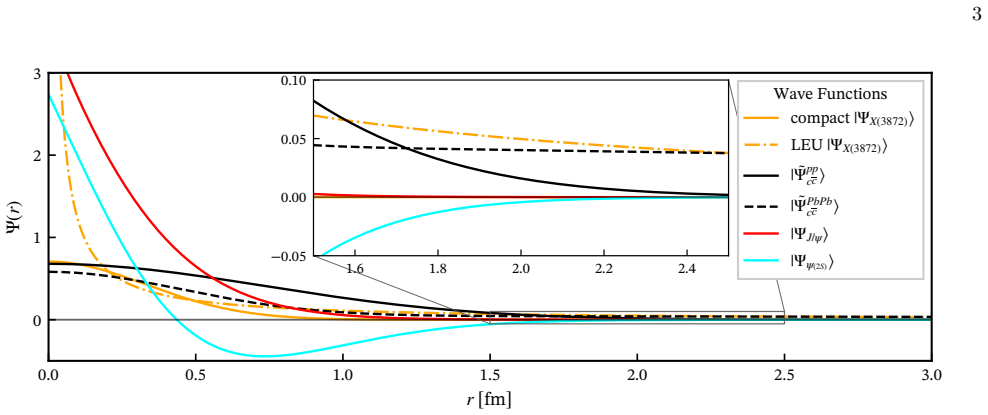
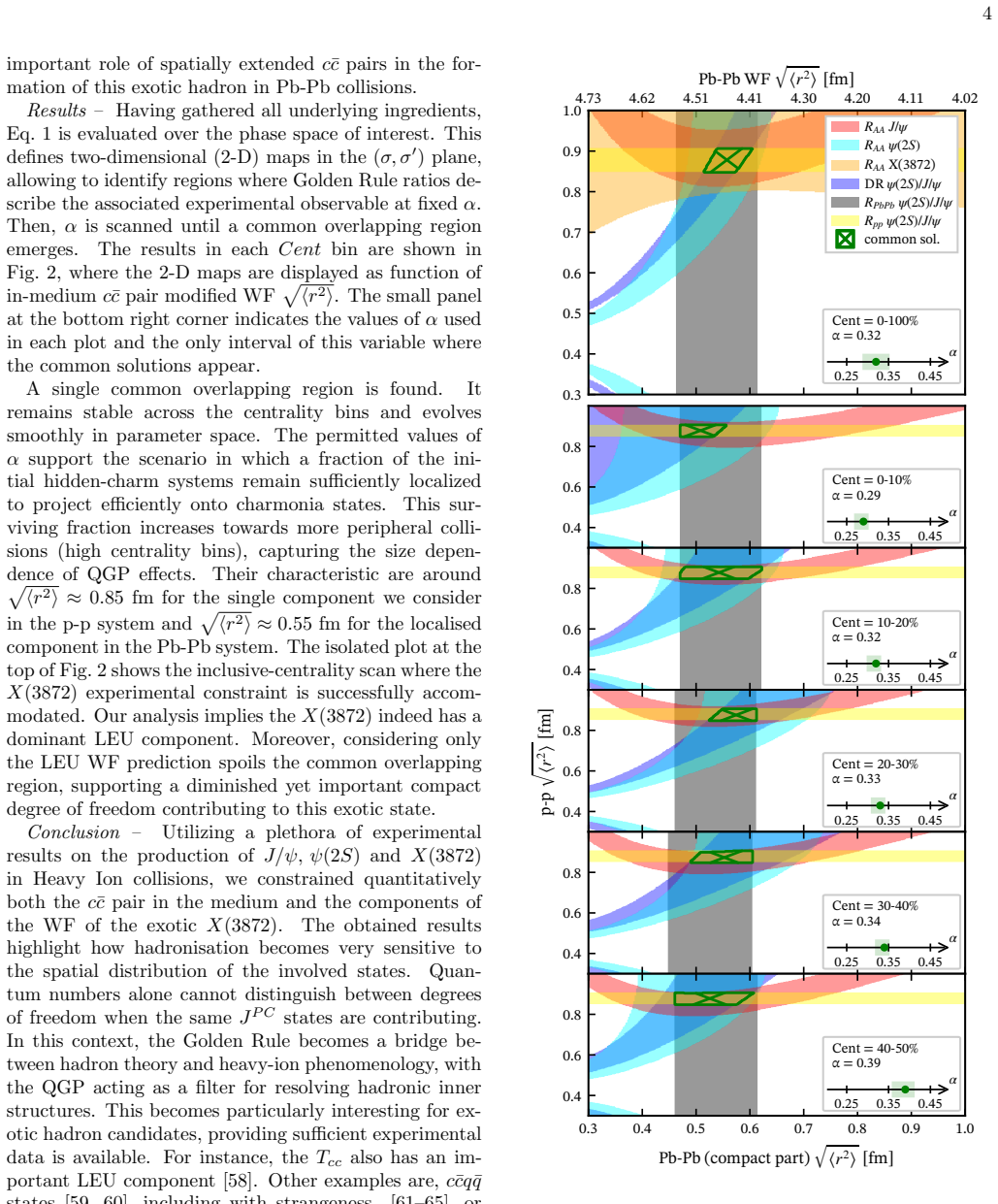
The separation of $c\bar c$ quarks in the quark-gluon plasma and the characteristic size of the final state quarkonia should lead to the observed hadron ratios in nuclear collisions. Such dependence manifests itself through the Fermi Golden rule, where hadron ratios are sensitive to the inner product between in-vacuum and in-medium wave functions. A novel hard probe is the exotic $X(3872)$, which is expected to have a molecular and a compact component. We bridge more than a decade of several LHC experimental results on hard probes, namely $J/\Psi$, $\Psi(2S)$ and $X(3872)$ hadrons, to the degree of separation and dissociation of in-medium hidden-charm systems.
Editorial analysis
A structured set of objections, weighed in public.
Referee Report
Summary. The paper claims that the separation of c cbar quarks in the quark-gluon plasma, together with the characteristic sizes of final-state quarkonia, determines the observed hadron ratios in nuclear collisions. This dependence is said to arise through the Fermi Golden rule via the inner product between in-vacuum and in-medium wave functions. The exotic X(3872) is introduced as a novel probe possessing both molecular and compact components, allowing the work to connect more than a decade of LHC data on J/Ψ, Ψ(2S) and X(3872) to the degree of in-medium separation and dissociation of hidden-charm systems.
Significance. If the central claim holds, the manuscript would supply a compact, wave-function-based interpretation of heavy-ion data that unifies conventional and exotic quarkonia through a single overlap mechanism. Such a framework could offer new sensitivity to QGP properties via the X(3872) and would be of interest to the heavy-ion and exotic-hadron communities. The significance is tempered by the absence of explicit derivations showing how the Golden-rule overlap dominates over established medium effects.
major comments (2)
- [Abstract] Abstract and introduction: the central assertion that hadron ratios follow from the Fermi Golden rule inner product between in-vacuum and in-medium wave functions is presented without derivation or justification for why this overlap sets the transition probabilities in a non-perturbative QGP where dissociation, regeneration and coalescence are known to operate. The manuscript does not demonstrate that the matrix element is proportional to the overlap while density-of-states and interaction-strength factors remain comparable across J/Ψ, Ψ(2S) and the two X(3872) components.
- [Abstract] Abstract: no explicit construction or comparison of the in-medium wave functions for the molecular versus compact components of the X(3872) is supplied, nor is it shown how these functions are obtained from the medium-modified c cbar separation. This step is load-bearing for the claim that the X(3872) provides a novel probe of the separation scale.
Simulated Author's Rebuttal
We thank the referee for the careful and constructive report. We address the two major comments point by point below, indicating the revisions we will make to strengthen the justification and explicit constructions in the manuscript.
read point-by-point responses
-
Referee: [Abstract] Abstract and introduction: the central assertion that hadron ratios follow from the Fermi Golden rule inner product between in-vacuum and in-medium wave functions is presented without derivation or justification for why this overlap sets the transition probabilities in a non-perturbative QGP where dissociation, regeneration and coalescence are known to operate. The manuscript does not demonstrate that the matrix element is proportional to the overlap while density-of-states and interaction-strength factors remain comparable across J/Ψ, Ψ(2S) and the two X(3872) components.
Authors: We agree that the abstract and introduction would benefit from an explicit derivation. In the revised manuscript we add a dedicated subsection deriving the application of the Fermi Golden rule to the hadronization step under the sudden approximation. We show that the transition amplitude is proportional to the wave-function overlap when the density-of-states and interaction-strength factors are comparable for the closely related hidden-charm states; we justify the comparability by noting that all states share the same heavy-quark content and are formed at similar momentum scales. While we acknowledge that a complete non-perturbative treatment of dissociation, regeneration and coalescence lies outside the present scope, the overlap mechanism is presented as a complementary, wave-function-based contribution that unifies the observed ratios. Supporting references on overlap integrals in heavy-ion phenomenology are added. revision: yes
-
Referee: [Abstract] Abstract: no explicit construction or comparison of the in-medium wave functions for the molecular versus compact components of the X(3872) is supplied, nor is it shown how these functions are obtained from the medium-modified c cbar separation. This step is load-bearing for the claim that the X(3872) provides a novel probe of the separation scale.
Authors: The original text introduces the dual nature of the X(3872) conceptually but does not supply explicit in-medium wave functions. We have revised the manuscript to include an explicit construction: the molecular component is modeled with a larger characteristic radius that increases with the in-medium c cbar separation, while the compact component retains a smaller radius less sensitive to the medium. The overlap integrals with the vacuum wave functions are then evaluated for each component, demonstrating quantitatively different suppression factors. A new figure and accompanying equations illustrate how these overlaps depend on the separation scale, thereby supporting the claim that the X(3872) ratios provide additional sensitivity to the in-medium separation. revision: yes
Circularity Check
No circularity: standard Fermi Golden rule overlap applied to wave functions without reduction to fitted inputs or self-citations
full rationale
The paper's central claim applies the Fermi Golden rule to inner products between in-vacuum and in-medium wave functions for J/Ψ, Ψ(2S) and X(3872) components to explain hadron ratios. No equations or sections are shown that define a parameter from data and then rename its output as a prediction, nor any self-citation chain that bears the load of a uniqueness theorem or ansatz. The derivation remains an independent application of standard quantum mechanics to medium-modified states and is therefore self-contained against external benchmarks.
Axiom & Free-Parameter Ledger
Reference graph
Works this paper leans on
-
[1]
J. Rafelski, Melting hadrons, boiling quarks, The Euro- pean Physical Journal A51, 10.1140/epja/i2015-15114-0 (2015)
-
[2]
W. Busza, K. Rajagopal, and W. van der Schee, Heavy ion collisions: The big picture and the big questions, Annual Review of Nuclear and Particle Sci- ence68, https://doi.org/10.1146/annurev-nucl-101917- 020852 (2018)
-
[3]
CMS Collaboration, Overview of high- density QCD studies with the CMS exper- iment at the LHC, Physics Reports1115, https://doi.org/10.1016/j.physrep.2024.11.007 (2025)
-
[4]
ALICE Collaboration, The ALICE experiment: a jour- ney through QCD, The European Physical Journal C84, 10.1140/epjc/s10052-024-12935-y (2024)
-
[5]
CMS Collaboration, System-size dependence of charged- particle suppression in ultrarelativistic nucleus-nucleus collisions (2026), arXiv:2602.21325
arXiv 2026
-
[6]
Liliana Apolin´ ario and Yen-Jie Lee and Michael Winn, Heavy quarks and jets as probes of the qgp, Progress in Particle and Nuclear Physics127, https://doi.org/10.1016/j.ppnp.2022.103990 (2022)
-
[7]
T. Matsui and H. Satz,J/ψSuppression by Quark-Gluon Plasma Formation, Phys. Lett. B178, 10.1016/0370- 2693(86)91404-8 (1986)
-
[8]
Belle Collaboration, Observation of a Narrow Charmoni- umlike State in ExclusiveB ± →K ±π+π−J/ψDecays, Phys. Rev. Lett.91, 10.1103/PhysRevLett.91.262001 (2003)
-
[9]
LHCb Collaboration, Determination of theX(3872) meson quantum numbers, Phys. Rev. Lett.110, 10.1103/PhysRevLett.110.222001 (2013)
-
[10]
E. Braaten and M. Kusunoki, Factorization in the pro- duction and decay of the X(3872), Phys. Rev. D72, 10.1103/PhysRevD.72.014012 (2005)
-
[11]
E. Braaten, L.-P. He, K. Ingles, and J. Jiang, Produc- tion ofX(3872) at High Multiplicity, Phys. Rev. D103, 10.1103/PhysRevD.103.L071901 (2021)
-
[12]
LHCb Collaboration, Probing the nature of theχ c1(3872) state using radiative decays, JHEP11
-
[13]
A. Esposito, A. Glioti, D. Germani, and A. D. Polosa, A short review on the compositeness of the X(3872), La Rivista del Nuovo Cimento48, 10.1007/s40766-025- 00066-3 (2025)
-
[14]
S. Coito, G. Rupp, and E. van Beveren, X(3872) is not a true molecule, Eur. Phys. J. C73, 10.1140/epjc/s10052- 013-2351-8 (2013)
-
[15]
C. Hanhart, Y. S. Kalashnikova, and A. V. Nefediev, Interplay of quark and meson degrees of freedom in a near-threshold resonance: Multi-channel case, The Euro- pean Physical Journal A47, 10.1140/epja/i2011-11101-9 (2011)
-
[16]
CMS Collaboration, Measurement of prompt and non- prompt charmonium suppression in PbPb collisions at 5.02 TeV, Eur. Phys. J. C78, 10.1140/epjc/s10052-018- 5950-6 (2018), [Erratum: Eur.Phys.J.C 83, 145 (2023)]
-
[17]
CMS Collaboration, Suppression and azimuthal anisotropy of prompt and nonpromptJ/ψproduc- tion in PbPb collisions at √sNN = 2.76 TeV, Eur. Phys. J. C77, 10.1140/epjc/s10052-017-4781-1 (2017)
-
[18]
ATLAS Collaboration, Prompt and non-promptJ/ψ andψ(2S) suppression at high transverse momen- tum in 5.02 TeV PbPb collisions with the ATLAS experiment, The European Physical Journal C78, 10.1140/epjc/s10052-018-6219-9 (2018)
-
[19]
ALICE Collaboration, Prompt and nonpromptJ/ψpro- duction at midrapidity in PbPb collisions at √sNN = 5.02 TeV, Journal of High Energy Physics2024, 10.1007/jhep02(2024)066 (2023)
-
[20]
STAR Collaboration, Measurement of inclu- siveJ/ψproduction in AuAu collisions at√sN N = 54.4 GeV at STAR, Physics Letters B 877, https://doi.org/10.1016/j.physletb.2026.140405 (2026)
-
[21]
STAR Collaboration, Measurement of inclusiveJ/ψsup- pression in AuAu collisions at √sN N = 200 GeV through the dimuon channel at STAR, Physics Letters B797, https://doi.org/10.1016/j.physletb.2019.134917 (2019)
-
[22]
PHENIX Collaboration,J/ψProduction versus central- ity, transverse momentum, and rapidity in AuAu col- lisions at √sN N = 200 GeV, Phys. Rev. Lett.98, 10.1103/PhysRevLett.98.232301 (2007)
-
[23]
ATLAS Collaboration, Measurement of the production cross-section ofJ/ψandψ(2S) mesons in pp collisions at√s= 13 TeV with the ATLAS detector, Eur. Phys. J. C 84, 10.1140/epjc/s10052-024-12439-9 (2024)
-
[24]
CMS Collaboration, Measurement ofJ/ψandψ(2S) Prompt Double-Differential Cross Sections inppCol- lisions at √s= 7 TeV, Phys. Rev. Lett.114, 10.1103/PhysRevLett.114.191802 (2015)
-
[25]
CMS Collaboration,J/ψandψ(2s) production in pp col- lisions at √s= 7 Tev, Journal of High Energy Physics 02, 10.1007/jhep02(2012)011 (2012)
-
[27]
LHCb Collaboration, Measurement of theψ(2S) toJ/ψ cross-section ratio as a function of centrality in PbPb collisions at √sNN = 5.02 TeV, Journal of High Energy 6 Physics2025, 10.1007/jhep07(2025)235 (2025)
-
[30]
ATLAS Collaboration, Measurements ofψ(2S) and X(3872)→J/ψ π + π− production in pp collisions at√s= 8 TeV with the ATLAS detector, JHEP01
-
[31]
CMS Collaboration, Measurement of theX(3872) pro- duction cross section via decays toJ/ψπ +π− in pp colli- sions at √s= 7 TeV, JHEP04
-
[34]
ALICE Collaboration, Measurements of inclusive J/ψ production at midrapidity and forward rapidity in Pb–Pb collisions at √sNN = 5.02 TeV, Physics Letters B849, 10.1016/j.physletb.2024.138451 (2024)
-
[35]
ALICE Collaboration, Inclusive quarkonium production in pp collisions at√s= 5.02 TeV, The European Physical Journal C83, 10.1140/epjc/s10052-022-10896-8 (2023)
-
[36]
L. K. Graczykowski (ALICE), Pion femtoscopy mea- surements in ALICE at the LHC, EPJ Web Conf.71, 10.1051/epjconf/20147100051 (2014)
-
[37]
Braun-Munzinger, K
P. Braun-Munzinger, K. Redlich, and J. Stachel, Parti- cle production in heavy ion collisions, inQuark–Gluon Plasma 3(WORLD SCIENTIFIC, 2004)
2004
-
[38]
Andronic, P
A. Andronic, P. Braun-Munzinger, K. Redlich, and J. Stachel, Statistical hadronization: successes and some open issues (2026)
2026
-
[39]
P. Braun-Munzinger, V. Koch, T. Sch¨ afer, and J. Stachel, Properties of hot and dense matter from relativistic heavy ion collisions, Physics Reports621, 10.1016/j.physrep.2015.12.003 (2016)
-
[41]
T. Barnes, S. Godfrey, and E. S. Swanson, Higher char- monia, Phys. Rev. D72, 10.1103/PhysRevD.72.054026 (2005)
-
[42]
S. Godfrey and N. Isgur, Mesons in a relativized quark model with chromodynamics, Phys. Rev. D32, 10.1103/PhysRevD.32.189 (1985)
-
[43]
Low-energy Universality and the New Charmonium Resonance at 3870 MeV
E. Braaten and M. Kusunoki, Low-energy universal- ity and the new charmonium resonance at 3870-mev, Phys. Rev. D69, 10.1103/PhysRevD.69.074005 (2004), arXiv:hep-ph/0311147
work page internal anchor Pith review Pith/arXiv arXiv doi:10.1103/physrevd.69.074005 2004
- [44]
-
[45]
G.-L. Yu, Z.-Y. Li, Z.-G. Wang, B. Wu, Z. Zhou, and J. Lu, The ground states of hidden-charm tetraquarks and their radial excitations, The European Physical Jour- nal C84, 10.1140/epjc/s10052-024-13514-x (2024)
-
[46]
R. H. Brown and R. Twiss, A new type of interferometer for use in radio astronomy, Philosophical Magazine45, 10.1080/14786440708520475 (1954)
-
[47]
H. Heiselberg and A.-M. Levy, Elliptic flow and hbt in noncentral nuclear collisions, Phys. Rev. C59, 10.1103/PhysRevC.59.2716 (1999)
-
[48]
ALICE Collaboration, Two-pion Bose-Einstein correla- tions in central PbPb collisions at √sN N = 2.76 TeV, Phys. Lett. B696, 10.1016/j.physletb.2010.12.053 (2011)
-
[49]
N. Armesto, M. ´A. Escobedo, E. G. Ferreiro, and V. L´ opez-Pardo, Lindblad-driven quarkonium produc- tion in heavy-ion collisions (2026), arXiv:2605.19985 [hep-ph]
Pith/arXiv arXiv 2026
-
[50]
M. Asakawa and T. Hatsuda, J/ψandη(c) in the de- confined plasma from lattice QCD, Phys. Rev. Lett.92, 10.1103/PhysRevLett.92.012001 (2004)
-
[51]
N. Brambilla, J. Ghiglieri, A. Vairo, and P. Petreczky, Static quark-antiquark pairs at finite temperature, Phys. Rev. D78, 10.1103/PhysRevD.78.014017 (2008)
-
[52]
R. N. Larsen, P. Petreczky, J. L. Dasilva Golan, and J. H. Weber, Charmonium properties at high temper- atures from lattice QCD (2026), arXiv:2605.20034 [hep- lat]
Pith/arXiv arXiv 2026
-
[53]
T. Umeda, K. Nomura, and H. Matsufuru, Charmo- nium at finite temperature in quenched lattice QCD, Eur. Phys. J. C39S1, 10.1140/epjcd/s2004-01-002-1 (2005)
-
[54]
S. Datta, F. Karsch, P. Petreczky, and I. Wetzorke, Behavior of charmonium systems after deconfinement, Phys. Rev. D69, 10.1103/PhysRevD.69.094507 (2004)
-
[55]
F. Karsch, S. Datta, E. Laermann, P. Petreczky, S. Stickan, and I. Wetzorke, Hadron correlators, spec- tral functions and thermal dilepton rates from lattice QCD, Nucl. Phys. A715, 10.1016/S0375-9474(02)01470- 7 (2003)
-
[56]
P. Bicudo, M. Cardoso, P. Santos, and J. Seixas, The charmonium (bottomonium) binding at finite t (2008), arXiv:0804.4225 [hep-ph]
Pith/arXiv arXiv 2008
-
[57]
Dong, Y.-J
X. Dong, Y.-J. Lee, and R. Rapp, Open heavy-flavor pro- duction in heavy-ion collisions, Annual Review of Nuclear and Particle Science69(2019)
2019
-
[58]
LHCb Collaboration, Observation of an exotic nar- row doubly charmed tetraquark, Nature Physics18, 10.1038/s41567-022-01614-y (2022)
-
[59]
LHCb, Evidence for anη c(1S)π − resonance inB 0 → ηc(1S)K +π− decays, Eur. Phys. J. C , 1019 (2018)
2018
-
[60]
LHCb Collaboration, Observation of the resonant char- acter of thez(4430) − state, Phys. Rev. Lett.112, 10.1103/PhysRevLett.112.222002 (2014)
-
[61]
LHCb Collaboration, Observation of New Resonances Decaying toJ/ψK + andJ/ψϕ, Phys. Rev. Lett.127, 10.1103/PhysRevLett.127.082001 (2021)
-
[62]
CMS Collaboration, Observation of a peaking structure in theJ/ψϕmass spectrum fromB ± →J/ψϕK ± decays, Physics Letters B 10.1016/j.physletb.2014.05.055 (2014)
-
[63]
LHCb Collaboration, Observation ofJ/ψϕstructures consistent with exotic states from amplitude analysis of B+ →J/ψϕK + decays, Physical Review Letters118, 10.1103/physrevlett.118.022003 (2017)
-
[64]
ALICE Collaboration, Enhanced production of multi- strange hadrons in high-multiplicity proton–proton colli- 7 sions, Nature Physics13, 10.1038/nphys4111 (2017)
-
[65]
STAR Collaboration, Enhanced strange baryon produc- tion in Au+Au collisions compared top+pat √sNN = 200 GeV, Phys. Rev. C77, 10.1103/PhysRevC.77.044908 (2008)
-
[67]
LHCb Collaboration, Observation of aJ/ψΛ reso- nance consistent with a strange pentaquark candidate inB − →J/ψΛ¯pdecays, Physical Review Letters131, 10.1103/physrevlett.131.031901 (2023)
-
[68]
LHCb Collaboration, Observation ofJ/ψpresonances consistent with pentaquark states in Λ 0 b →J/ψK −p decays, Physical Review Letters115, 10.1103/phys- revlett.115.072001 (2015)
-
[69]
LHCb Collaboration, Evidence for a new structure in the J/ψpandJ/ψ psystems inB 0 s →J/ψp pdecays, Phys. Rev. Lett.128, 10.1103/PhysRevLett.128.062001 (2022)
-
[70]
CMS Collaboration, Measurement of nuclear modifica- tion factors of Υ(1S), Υ(2S), and Υ(3S) mesons in PbPb collisions at √sNN = 5.02 TeV, Phys. Lett. B790, 10.1016/j.physletb.2019.01.006 (2019)
-
[71]
CMS Collaboration, Suppression of Υ(1S), Υ(2S), and Υ(3S) quarkonium states in PbPb collisions at √s= 2.76 TeV., Physics Letters B770, 10.1016/j.physletb.2017.04.031 (2017)
-
[72]
, Suppression of excitedυstates relative to the ground state in pbpb collisions at √sN N = 5.02 tev, Physi- cal Review Letters120, 10.1103/physrevlett.120.142301 (2018)
-
[73]
P. Bicudo, N. Cardoso, L. Mueller, and M. Wagner, Com- putation of the quarkonium and meson-meson composi- tion of the Υ(nS) states and of the new Υ(10753) Belle resonance from lattice QCD static potentials, Phys. Rev. D103, 10.1103/PhysRevD.103.074507 (2021)
-
[74]
V. Crede and C. Meyer, The experimental status of glueballs, Progress in Particle and Nuclear Physics63, https://doi.org/10.1016/j.ppnp.2009.03.001 (2009)
-
[75]
W. Ochs, The status of glueballs, Journal of Physics G: Nuclear and Particle Physics40, 10.1088/0954- 3899/40/4/043001 (2013)
-
[76]
V. Mathieu, N. Kochelev, and V. Vento, The physics of glueballs, International Journal of Modern Physics E18, 10.1142/s0218301309012124 (2009)
-
[77]
C. Meyer and E. Swanson, Hybrid mesons, Progress in Particle and Nuclear Physics82, https://doi.org/10.1016/j.ppnp.2015.03.001 (2015)
discussion (0)
Sign in with ORCID, Apple, or X to comment. Anyone can read and Pith papers without signing in.