Tuning Quantum MPS
Pith reviewed 2026-06-26 07:58 UTC · model grok-4.3
The pith
A circuit-aware hybrid ranking model recovers a meaningful fraction of the gains from offline CMA-ES optimization of MPS simulator hyperparameters.
A machine-rendered reading of the paper's core claim, the machinery that carries it, and where it could break.
Core claim
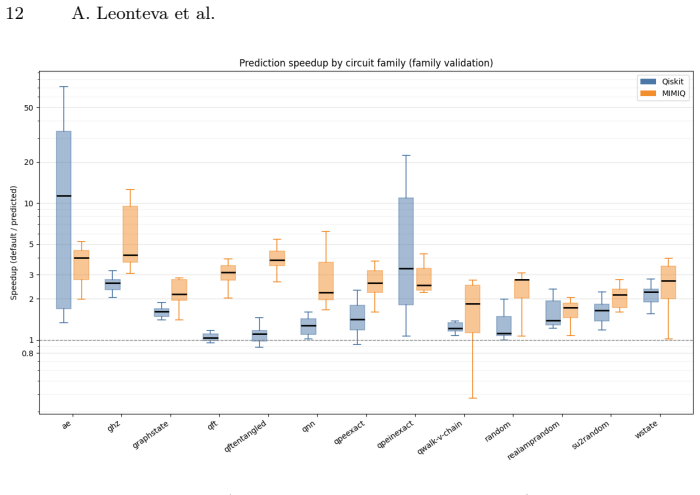
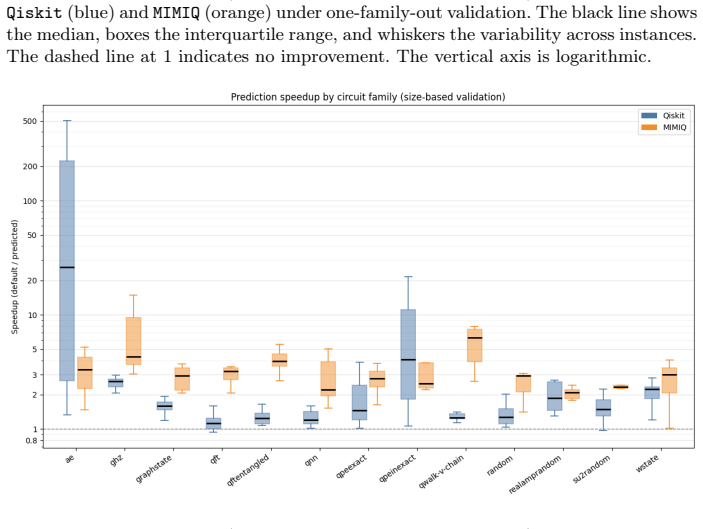
Offline single-objective CMA-ES optimization under a fidelity constraint produces configurations that improve over defaults, with the size of the improvement depending on backend, circuit family, and scale. A hybrid ranking model trained on static circuit features recovers a meaningful fraction of those gains, performing better under size-based validation than under leave-one-family-out transfer, yet still falls short of the offline optimum.
What carries the argument
The circuit-aware hybrid ranking model, trained on a set of static circuit features chosen to capture MPS-relevant structural properties, which ranks and recommends hyperparameter configurations for new circuits.
If this is right
- Offline CMA-ES optimization improves MPS performance over defaults, though the scale of improvement varies with backend, family, and circuit size.
- The learned predictor captures part of the offline gain when applied to new circuits.
- Size-based validation produces stronger predictor results than family-based transfer.
- The predictor still trails the offline optimum, leaving a performance gap.
Where Pith is reading between the lines
- The same feature-plus-ranking approach could be tested on other tensor-network simulators to see whether the static features transfer beyond MPS.
- Embedding the trained ranker directly inside a simulator package would let users obtain improved settings without running separate optimization.
- Closing the remaining gap to the offline optimum would require either richer circuit features or a shift from ranking to direct regression on expected performance.
Load-bearing premise
That the chosen static circuit features capture the MPS-relevant structural properties well enough for the hybrid ranking model to generalize across circuits.
What would settle it
If the ranking model recommends configurations whose simulated fidelities match or fall below those of default settings on a fresh set of circuits outside the training distribution, the claim that it recovers a meaningful fraction of the optimization gain would be refuted.
Figures
read the original abstract
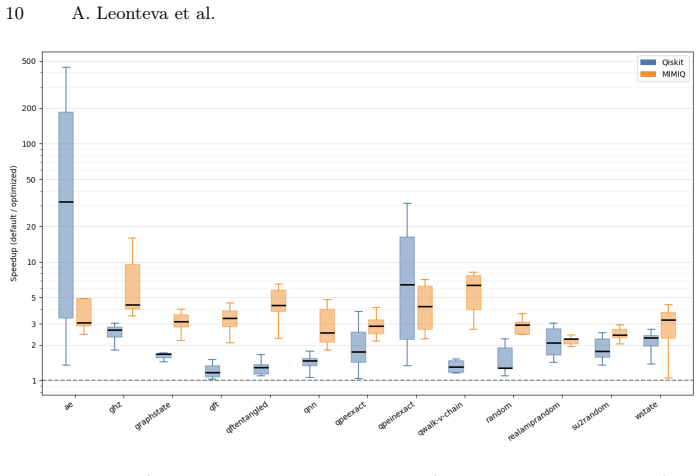
Matrix Product State (MPS) methods are among the most effective approaches for the classical simulation of quantum circuits, but their practical performance depends strongly on simulator hyperparameters, and default settings are often suboptimal. In this work, we propose a two-stage framework for automatic hyperparameter selection for quantum MPS simulation. In the first stage, we perform offline single-objective CMA-ES optimization under a fidelity constraint and construct a database of circuit--configuration--performance evaluations. In the second stage, we define a set of static circuit features designed to capture MPS-relevant structural properties and train a circuit-aware hybrid ranking model to recommend configurations for different quantum circuits. We evaluate the approach on multiple scalable circuit families using leave-one-family-out and size-based validation. The results show that offline optimization often improves over default settings, although the magnitude of the gain depends strongly on the backend, circuit family, and circuit scale. The learned predictor recovers a meaningful fraction of this gain, with better performance under size-based validation than under family-based transfer, but generally remains below the offline optimum.
Editorial analysis
A structured set of objections, weighed in public.
Referee Report
Summary. The paper proposes a two-stage framework for automatic hyperparameter tuning in Matrix Product State (MPS) simulation of quantum circuits. Stage one performs offline single-objective CMA-ES optimization under a fidelity constraint to build a database of circuit-configuration-performance triples. Stage two extracts static circuit features intended to capture MPS-relevant structure and trains a circuit-aware hybrid ranking model to recommend configurations. Evaluation on multiple scalable circuit families uses leave-one-family-out and size-based validation splits; the abstract states that offline optimization improves over defaults (with gains varying by backend, family, and scale) and that the learned predictor recovers a meaningful fraction of this gain, performing better under size-based validation than family-based transfer but remaining below the offline optimum.
Significance. If the central claim holds, the work offers a practical, data-driven method to reduce manual hyperparameter tuning in a widely used classical simulation technique for quantum circuits. The two-stage separation of expensive offline optimization from fast online prediction is a reasonable engineering contribution, and the use of both family-based and size-based validation provides some evidence on generalization. Reproducible code or an open database would strengthen the result, but none is mentioned in the provided material.
major comments (2)
- [Abstract] Abstract: the claim that 'the learned predictor recovers a meaningful fraction of this gain' is stated without any numerical values, confidence intervals, or description of how the fraction is computed; this absence makes it impossible to judge whether the recovery is practically useful or statistically reliable.
- [Evaluation] Evaluation (implied by validation description): the stronger performance under size-based validation versus leave-one-family-out is consistent with the risk that static circuit features primarily encode coarse size or family correlations rather than the dynamic entanglement or contraction properties that actually determine optimal MPS hyperparameters; without an ablation that isolates feature predictive power or reports per-circuit error analysis, the central generalization claim rests on an untested assumption.
minor comments (2)
- [Abstract] The abstract would be clearer if it listed the specific circuit families, the range of circuit sizes, and the backends used.
- Notation for the hybrid ranking model and the precise definition of the static circuit features should be introduced earlier and with explicit formulas.
Simulated Author's Rebuttal
We thank the referee for the detailed review and constructive suggestions. We address the major comments below, indicating planned revisions to strengthen the manuscript.
read point-by-point responses
-
Referee: [Abstract] Abstract: the claim that 'the learned predictor recovers a meaningful fraction of this gain' is stated without any numerical values, confidence intervals, or description of how the fraction is computed; this absence makes it impossible to judge whether the recovery is practically useful or statistically reliable.
Authors: We agree with this observation. The abstract will be revised to include quantitative results: specifically, the average fraction of the offline gain recovered by the predictor (computed as (predictor gain / offline gain)), with values and ranges across families and scales, plus reference to standard deviations reported in the results section. This will allow readers to assess practical utility directly. revision: yes
-
Referee: [Evaluation] Evaluation (implied by validation description): the stronger performance under size-based validation versus leave-one-family-out is consistent with the risk that static circuit features primarily encode coarse size or family correlations rather than the dynamic entanglement or contraction properties that actually determine optimal MPS hyperparameters; without an ablation that isolates feature predictive power or reports per-circuit error analysis, the central generalization claim rests on an untested assumption.
Authors: We acknowledge the potential limitation in feature analysis. Our static features include several designed to proxy dynamic properties, such as estimated entanglement entropy and contraction cost metrics. The superior size-based validation performance is expected as it tests within-family scaling. To address the concern, we will include an ablation study removing size-correlated features and report the resulting drop in ranking accuracy. We will also add per-circuit performance breakdowns in the supplementary material to provide finer-grained analysis of generalization. revision: yes
Circularity Check
No circularity: two-stage framework uses independent optimization data to train a separate predictor
full rationale
The derivation consists of an offline CMA-ES stage that populates an external database of circuit-configuration-performance triples, followed by training a hybrid ranking model on independently defined static circuit features. Neither stage reduces to the other by construction: the model's recommendations are learned from the database rather than being a renaming or direct reuse of the optimization outputs, and no self-citation, uniqueness theorem, or ansatz is invoked to force the result. The reported recovery of a fraction of the offline gain is therefore an empirical outcome of the learned mapping, not a definitional identity. This is the most common honest finding for a method that separates data generation from model training and evaluates via cross-validation splits.
Axiom & Free-Parameter Ledger
Reference graph
Works this paper leans on
-
[1]
X., Van Den Berg, E., Rosenblatt, S.,
Kim, Y., Eddins, A., Anand, S., Wei, K. X., Van Den Berg, E., Rosenblatt, S., ... ,Kandala, A. Evidence for the utility of quantum computing before fault tolerance. Nature, 618(7965), 500-505, (2023)
2023
-
[2]
A., Azhar, M
Cicero, A., Maleki, M. A., Azhar, M. W., Kockum, A. F., Trancoso, P. Simulation of quantum computers: Review and acceleration opportunities. ACM Transactions on Quantum Computing, 7(1), 1-35, (2025)
2025
-
[3]
Efficient classical simulation of slightly entangled quantum computations
Vidal, G. Efficient classical simulation of slightly entangled quantum computations. Physical review letters, 91(14), 147902, (2003)
2003
-
[4]
L., Shi, Y
Markov, I. L., Shi, Y. Simulating quantum computation by contracting tensor net- works. SIAM Journal on Computing, 38(3), 963-981, (2008)
2008
-
[5]
A practical introduction to tensor networks: Matrix product states and projected entangled pair states
Orús, R. A practical introduction to tensor networks: Matrix product states and projected entangled pair states. Annals of physics, 349, 117-158, (2014)
2014
-
[6]
ACM Transactions on Quantum Computing, 7(2), 1-29, (2026)
Leonteva,A.,Masella,G.,Outteryck,M.,PeiroOrioli,A.,Whitlock,S.Comparative benchmarking of utility-scale quantum emulators. ACM Transactions on Quantum Computing, 7(2), 1-29, (2026)
2026
-
[7]
S., Hill, C
Wang, D. S., Hill, C. D., Hollenberg, L. C. Simulations of Shor’s algorithm using matrix product states. Quantum Information Processing, 16(7), 176, (2017)
2017
-
[8]
D., Hollenberg, L
Dang, A., Hill, C. D., Hollenberg, L. C. Optimising matrix product state simulations of Shor’s algorithm. Quantum, 3, 116, (2019)
2019
-
[9]
Hyper-optimized tensor network contraction
Gray, J., Kourtis, S. Hyper-optimized tensor network contraction. Quantum, 5, 410, (2021)
2021
-
[10]
Riemannian optimization of isometric tensor networks
Hauru, M., Van Damme, M., Haegeman, J. Riemannian optimization of isometric tensor networks. Scipost physics, 10(2), 040, (2021)
2021
-
[11]
The CMA evolution strategy: a comparing review
Hansen, N. The CMA evolution strategy: a comparing review. Towards a new evolutionary computation: Advances in the estimation of distribution algorithms, 75-102, (2006). Tuning Quantum MPS 15
2006
-
[12]
CMA-ES for dis- crete and mixed-variable optimization on sets of points
Uchida, K., Hamano, R., Nomura, M., Saito, S., Shirakawa, S. CMA-ES for dis- crete and mixed-variable optimization on sets of points. In International Conference on Parallel Problem Solving from Nature (pp. 236-251). Cham: Springer Nature Switzerland, (2024, September)
2024
-
[13]
Quantum amplitude amplification and estimation
Brassard, G., Hoyer, P., Mosca, M., Tapp, A. Quantum amplitude amplification and estimation. arXiv preprint quant-ph/0005055, (2000)
Pith/arXiv arXiv 2000
-
[14]
A., Chuang, I
Nielsen, M. A., Chuang, I. L. Quantum computation and quantum information. Cambridge university press, (2010)
2010
-
[15]
Kitaev, A. Y. Quantum measurements and the Abelian stabilizer problem. arXiv preprint quant-ph/9511026, (1995)
Pith/arXiv arXiv 1995
-
[16]
M., Horne, M
Greenberger, D. M., Horne, M. A., Zeilinger, A. Going beyond Bell’s theorem. In Bell’s theorem, quantum theory and conceptions of the universe (pp. 69-72). Dordrecht: Springer Netherlands, (1989)
1989
-
[17]
Dür, W., Vidal, G., Cirac, J. I. Three qubits can be entangled in two inequivalent ways. Physical Review A, 62(6), 062314, (2000)
2000
-
[18]
H., Zhou, X
Peruzzo, A., McClean, J., Shadbolt, P., Yung, M. H., Zhou, X. Q., Love, P. J., ... & O’brien, J. L. A variational eigenvalue solver on a photonic quantum processor. Nature communications, 5(1), 4213, (2014)
2014
-
[19]
M., Cleve, R., Deotto, E., Farhi, E., Gutmann, S., Spielman, D
Childs, A. M., Cleve, R., Deotto, E., Farhi, E., Gutmann, S., Spielman, D. A. Exponential algorithmic speedup by a quantum walk. In Proceedings of the thirty- fifth annual ACM symposium on Theory of computing (pp. 59-68), (2003)
2003
-
[20]
C., Barends, R.,
Arute, F., Arya, K., Babbush, R., Bacon, D., Bardin, J. C., Barends, R., ... & Mar- tinis, J. M. Quantum supremacy using a programmable superconducting processor. nature, 574(7779), 505-510, (2019)
2019
-
[21]
The quest for a quantum neural network
Schuld, M., Sinayskiy, I., Petruccione, F. The quest for a quantum neural network. Quantum Information Processing, 13(11), 2567-2586, (2014)
2014
-
[22]
Quantum Emulator Benchmarking Made Easy
Leonteva, A., Outteryck, M., Masella, G. Quantum Emulator Benchmarking Made Easy. In International Conference on Quantum Engineering Sciences and Technolo- gies for Industry and Services (pp. 280-288). Cham: Springer Nature Switzerland, (2025, December)
2025
-
[23]
MQT Bench: Benchmarking software and design automation tools for quantum computing
Quetschlich, N., Burgholzer, L., Wille, R. MQT Bench: Benchmarking software and design automation tools for quantum computing. Quantum, 7, 1062, (2023)
2023
-
[24]
J., Lishman, J., Gacon, J., ..., Gambetta, J
Javadi-Abhari, A., Treinish, M., Krsulich, K., Wood, C. J., Lishman, J., Gacon, J., ..., Gambetta, J. M. Quantum computing with Qiskit. arXiv preprint arXiv:2405.08810, (2024)
Pith/arXiv arXiv 2024
-
[25]
Open quantum assembly language
Cross, Andrew W., et al. "Open quantum assembly language." arXiv preprint arXiv:1707.03429, (2017)
Pith/arXiv arXiv 2017
-
[26]
Measuring the capabilities of quantum computers
Proctor, T., Rudinger, K., Young, K., Nielsen, E.,Blume-Kohout, R. Measuring the capabilities of quantum computers. Nature Physics, 18(1), 75-79, (2022)
2022
-
[27]
Liu, T. Y. Learning to rank for information retrieval. Foundations and Trends® in Information Retrieval, 3(3), 225-331, (2009)
2009
-
[28]
Random forests
Breiman, L. Random forests. Machine learning, 45(1), 5-32, (2001)
2001
-
[29]
Extremely randomized trees
Geurts, P., Ernst, D., Wehenkel, L. Extremely randomized trees. Machine learning, 63(1), 3-42, (2006)
2006
discussion (0)
Sign in with ORCID, Apple, or X to comment. Anyone can read and Pith papers without signing in.