Primordial Black Holes from Vector-Induced Curvature Perturbations Sourced by Primordial Magnetic Fields
Pith reviewed 2026-06-26 07:55 UTC · model grok-4.3
The pith
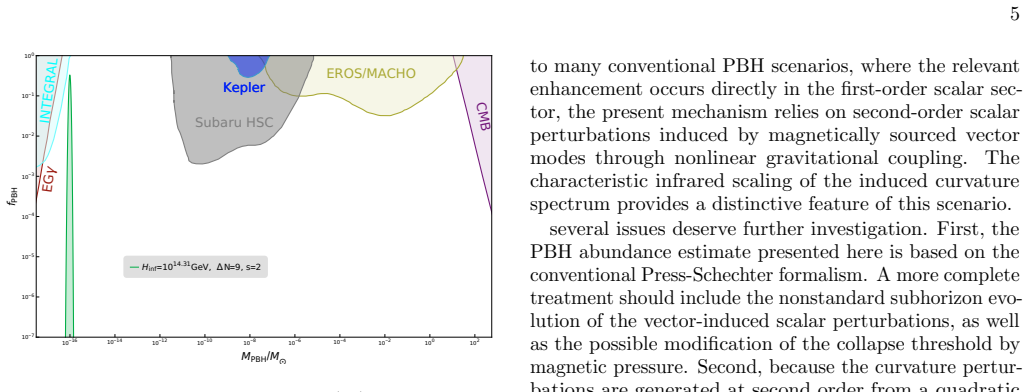
Primordial magnetic fields source curvature perturbations during kination that can produce primordial black holes as a substantial fraction of dark matter.
A machine-rendered reading of the paper's core claim, the machinery that carries it, and where it could break.
Core claim
First-order vector modes sourced by the vector component of the electromagnetic stress-energy tensor associated with primordial magnetic fields remain approximately constant during the kination epoch and therefore act as persistent nonlinear sources for second-order scalar perturbations, yielding vector-induced curvature perturbations with the characteristic scaling P_R(k) proportional to k^{-5} that can produce primordial black holes in sufficient abundance to constitute a substantial fraction of dark matter.
What carries the argument
First-order vector metric perturbations sourced by the vector part of the electromagnetic stress-energy tensor of primordial magnetic fields, which stay constant during kination and drive second-order scalar curvature perturbations.
If this is right
- The induced curvature perturbations are amplified toward the infrared cutoff of the kination band.
- The mechanism produces primordial black holes with an abundance large enough to form a substantial fraction of dark matter.
- The vector-induced spectrum exhibits the specific scaling P_R(k) proportional to k^{-5}.
- This constitutes a new post-inflationary channel for primordial black hole formation tied to primordial magnetic fields.
Where Pith is reading between the lines
- The same vector sourcing could operate in other early-universe epochs with a stiff equation of state and might leave imprints in the stochastic gravitational wave background.
- Limits on primordial black hole abundance could be used to constrain the duration or properties of the kination epoch in this scenario.
- The mechanism links specific magnetogenesis models directly to testable predictions for primordial black hole mass distributions.
Load-bearing premise
The first-order vector modes sourced by the electromagnetic stress-energy tensor remain approximately constant during the kination epoch.
What would settle it
A measurement of the small-scale curvature perturbation spectrum that lacks the k^{-5} scaling, or an observed primordial black hole abundance inconsistent with the values predicted from this vector-sourcing process in the Ratra-type scenario.
Figures

read the original abstract
Generating an appreciable abundance of primordial black holes (PBHs) requires a substantial enhancement of primordial curvature perturbations on small scales. In this work, we propose a new post-inflationary mechanism in which such an enhancement arises during a stiff, or kination, epoch. The mechanism is driven by metric vector perturbations sourced by the vector component of the electromagnetic stress-energy tensor associated with primordial magnetic fields (PMFs). Since these first-order vector modes remain approximately constant during kination, they act as persistent nonlinear sources for second-order scalar perturbations. We show that the resulting vector-induced curvature perturbations are amplified toward the infrared cutoff of the kination band and exhibit the characteristic scaling $\mathcal P_{\mathcal R}(k)\propto k^{-5}$. As a concrete realization, we consider PMFs generated in a Ratra-type magnetogenesis scenario and find that the induced curvature perturbations can produce PBHs with an abundance large enough to constitute a substantial fraction of the dark matter.
Editorial analysis
A structured set of objections, weighed in public.
Referee Report
Summary. The paper proposes a post-inflationary mechanism in which primordial magnetic fields source first-order vector metric perturbations that remain approximately constant during a kination epoch. These vectors act as persistent sources for second-order scalar curvature perturbations, yielding a power spectrum scaling as P_R(k) ∝ k^{-5} that is amplified toward the infrared cutoff. In a concrete Ratra-type magnetogenesis realization, the resulting perturbations are claimed to produce a PBH abundance large enough to constitute a substantial fraction of dark matter.
Significance. If the vector-mode constancy assumption and the resulting k^{-5} scaling hold under the stated conditions, the work identifies a new channel linking PMFs to small-scale curvature enhancement without relying on inflationary features. The distinctive infrared amplification and the explicit connection to a magnetogenesis scenario provide a falsifiable signature that could be confronted with PBH constraints or future gravitational-wave data.
major comments (2)
- [Derivation of vector-mode evolution (near Eq. for sourced vector perturbations)] The central dynamical assumption—that first-order vector modes sourced by the electromagnetic anisotropic stress remain approximately constant throughout the kination epoch—requires explicit derivation. Standard vector-mode evolution in a w=1 background yields decay ∝ a^{-2} in the absence of sources; the manuscript must demonstrate how the specific time dependence of the Ratra-generated PMF stress-energy tensor cancels this decay (e.g., via the sourced vector Einstein equation and its solution). Without this step, the claimed P_R(k) ∝ k^{-5} scaling and the subsequent PBH abundance cannot be verified.
- [Concrete realization section (Ratra-type PMF)] The PBH abundance result is obtained by adopting a specific Ratra-type magnetogenesis scenario whose amplitude is chosen to reach the required curvature-perturbation level. The manuscript should clarify whether this amplitude is independently fixed by magnetogenesis constraints or adjusted post hoc to achieve the quoted DM fraction; if the latter, the claim that the mechanism “can produce PBHs with an abundance large enough” reduces to a tuned realization rather than a robust prediction.
minor comments (2)
- Notation for the vector metric perturbation (h_i) and its relation to the electromagnetic stress-energy tensor should be defined at first use with an explicit equation reference.
- The abstract states the k^{-5} scaling as a derived result; a one-sentence indication of the origin of this scaling (e.g., “from the constant vector source integrated against the Green function during kination”) would improve readability.
Simulated Author's Rebuttal
We thank the referee for the careful reading of our manuscript and the constructive comments. We address each major point below and will revise the manuscript to incorporate the requested clarifications and derivations.
read point-by-point responses
-
Referee: The central dynamical assumption—that first-order vector modes sourced by the electromagnetic anisotropic stress remain approximately constant throughout the kination epoch—requires explicit derivation. Standard vector-mode evolution in a w=1 background yields decay ∝ a^{-2} in the absence of sources; the manuscript must demonstrate how the specific time dependence of the Ratra-generated PMF stress-energy tensor cancels this decay (e.g., via the sourced vector Einstein equation and its solution). Without this step, the claimed P_R(k) ∝ k^{-5} scaling and the subsequent PBH abundance cannot be verified.
Authors: We agree that the constancy of the vector modes requires explicit demonstration. In the revised manuscript we will add a dedicated subsection deriving the solution to the sourced vector Einstein equation during kination. We will show that the specific time dependence of the anisotropic stress tensor from the Ratra-generated PMFs exactly cancels the a^{-2} decay, yielding approximately constant vector modes on superhorizon scales. This derivation will directly support the subsequent P_R(k) ∝ k^{-5} scaling. revision: yes
-
Referee: The PBH abundance result is obtained by adopting a specific Ratra-type magnetogenesis scenario whose amplitude is chosen to reach the required curvature-perturbation level. The manuscript should clarify whether this amplitude is independently fixed by magnetogenesis constraints or adjusted post hoc to achieve the quoted DM fraction; if the latter, the claim that the mechanism “can produce PBHs with an abundance large enough” reduces to a tuned realization rather than a robust prediction.
Authors: We will revise the concrete realization section to explicitly state the magnetogenesis constraints (e.g., from CMB and BBN bounds on PMF amplitude) and show that the required amplitude lies within the allowed parameter range of the Ratra model. The mechanism is presented as one that can produce substantial PBH abundance for viable choices of model parameters; we will add a brief discussion clarifying that no additional post-hoc tuning beyond the magnetogenesis framework is introduced. revision: yes
Axiom & Free-Parameter Ledger
free parameters (2)
- PMF amplitude
- kination duration / infrared cutoff
axioms (2)
- domain assumption First-order vector modes sourced by the electromagnetic stress-energy tensor remain approximately constant throughout the kination epoch.
- standard math Standard second-order cosmological perturbation theory applies without higher-order back-reaction during kination.
Reference graph
Works this paper leans on
-
[1]
Gravitationally collapsed objects of very low mass,
Stephen Hawking, “Gravitationally collapsed objects of very low mass,” Mon. Not. Roy. Astron. Soc.152, 75 (1971)
1971
-
[2]
Black holes in the early Universe,
Bernard J. Carr and S. W. Hawking, “Black holes in the early Universe,” Mon. Not. Roy. Astron. Soc.168, 399–415 (1974)
1974
-
[3]
Simeon Bird, Ilias Cholis, Julian B. Mu˜ noz, Yacine Ali-Ha¨ ımoud, Marc Kamionkowski, Ely D. Kovetz, Alvise Raccanelli, and Adam G. Riess, “Did LIGO detect dark matter?” Phys. Rev. Lett.116, 201301 (2016), arXiv:1603.00464 [astro-ph.CO]
Pith/arXiv arXiv 2016
-
[4]
Primordial Black Hole Scenario for the Gravitational-Wave Event GW150914,
Misao Sasaki, Teruaki Suyama, Takahiro Tanaka, and Shuichiro Yokoyama, “Primordial Black Hole Scenario for the Gravitational-Wave Event GW150914,” Phys. Rev. Lett.117, 061101 (2016), [Erratum: Phys.Rev.Lett. 121, 059901 (2018)], arXiv:1603.08338 [astro-ph.CO]
Pith/arXiv arXiv 2016
-
[5]
Zu-Cheng Chen, Chen Yuan, and Qing-Guo Huang, “Confronting the primordial black hole scenario with the gravitational- wave events detected by LIGO-Virgo,” Phys. Lett. B829, 137040 (2022), arXiv:2108.11740 [astro-ph.CO]
arXiv 2022
-
[6]
Accelerating Early Massive Galaxy Formation with Primordial Black Holes,
Boyuan Liu and Volker Bromm, “Accelerating Early Massive Galaxy Formation with Primordial Black Holes,” Astrophys. J. Lett.937, L30 (2022), arXiv:2208.13178 [astro-ph.CO]
arXiv 2022
-
[7]
Ligong Bianet al., “Gravitational wave cosmology,” Sci. China Phys. Mech. Astron.69, 210401 (2026), arXiv:2505.19747 [gr-qc]. 11
arXiv 2026
-
[8]
Constraints on primordial black holes,
Bernard Carr, Kazunori Kohri, Yuuiti Sendouda, and Jun’ichi Yokoyama, “Constraints on primordial black holes,” Rept. Prog. Phys.84, 116902 (2021), arXiv:2002.12778 [astro-ph.CO]
Pith/arXiv arXiv 2021
-
[9]
New constraints on primordial black holes abundance from femtolensing of gamma-ray bursts,
A. Barnacka, J. F. Glicenstein, and R. Moderski, “New constraints on primordial black holes abundance from femtolensing of gamma-ray bursts,” Phys. Rev. D86, 043001 (2012), arXiv:1204.2056 [astro-ph.CO]
Pith/arXiv arXiv 2012
-
[10]
Revisiting constraints on asteroid-mass primordial black holes as dark matter candidates,
Paulo Montero-Camacho, Xiao Fang, Gabriel Vasquez, Makana Silva, and Christopher M. Hirata, “Revisiting constraints on asteroid-mass primordial black holes as dark matter candidates,” JCAP08, 031 (2019), arXiv:1906.05950 [astro-ph.CO]
arXiv 2019
-
[11]
Femtolensing by Dark Matter Revisited,
Andrey Katz, Joachim Kopp, Sergey Sibiryakov, and Wei Xue, “Femtolensing by Dark Matter Revisited,” JCAP12, 005 (2018), arXiv:1807.11495 [astro-ph.CO]
Pith/arXiv arXiv 2018
-
[12]
Microlensing constraints on primordial black holes with Subaru/HSC Andromeda observations,
Hiroko Niikuraet al., “Microlensing constraints on primordial black holes with Subaru/HSC Andromeda observations,” Nature Astron.3, 524–534 (2019), arXiv:1701.02151 [astro-ph.CO]
Pith/arXiv arXiv 2019
-
[13]
Primordial black holes—perspectives in gravitational wave astronomy,
Misao Sasaki, Teruaki Suyama, Takahiro Tanaka, and Shuichiro Yokoyama, “Primordial black holes—perspectives in gravitational wave astronomy,” Class. Quant. Grav.35, 063001 (2018), arXiv:1801.05235 [astro-ph.CO]
Pith/arXiv arXiv 2018
-
[14]
Planck 2018 results. VI. Cosmological parameters,
N. Aghanimet al.(Planck), “Planck 2018 results. VI. Cosmological parameters,” Astron. Astrophys.641, A6 (2020), [Erratum: Astron.Astrophys. 652, C4 (2021)], arXiv:1807.06209 [astro-ph.CO]
Pith/arXiv arXiv 2018
-
[15]
A Hamilton-Jacobi approach to nonslow roll inflation,
William H. Kinney, “A Hamilton-Jacobi approach to nonslow roll inflation,” Phys. Rev. D56, 2002–2009 (1997), arXiv:hep- ph/9702427
arXiv 2002
-
[16]
Curvature perturbation at the local extremum of the inflaton’s potential,
Shogo Inoue and Jun’ichi Yokoyama, “Curvature perturbation at the local extremum of the inflaton’s potential,” Phys. Lett. B524, 15–20 (2002), arXiv:hep-ph/0104083
Pith/arXiv arXiv 2002
-
[17]
Horizon crossing and inflation with large eta,
William H. Kinney, “Horizon crossing and inflation with large eta,” Phys. Rev. D72, 023515 (2005), arXiv:gr-qc/0503017
Pith/arXiv arXiv 2005
-
[18]
Primordial Black Holes from Inflation with Nonminimal Derivative Coupling,
Chengjie Fu, Puxun Wu, and Hongwei Yu, “Primordial Black Holes from Inflation with Nonminimal Derivative Coupling,” Phys. Rev. D100, 063532 (2019), arXiv:1907.05042 [astro-ph.CO]
arXiv 2019
-
[19]
Chengjie Fu, Puxun Wu, and Hongwei Yu, “Primordial black holes and oscillating gravitational waves in slow-roll and slow-climb inflation with an intermediate noninflationary phase,” Phys. Rev. D102, 043527 (2020), arXiv:2006.03768 [astro-ph.CO]
arXiv 2020
-
[20]
Non-Canonical Inflation and Primordial Black Holes Production,
Alexander Y. Kamenshchik, Alessandro Tronconi, Tereza Vardanyan, and Giovanni Venturi, “Non-Canonical Inflation and Primordial Black Holes Production,” Phys. Lett. B791, 201–205 (2019), arXiv:1812.02547 [gr-qc]
Pith/arXiv arXiv 2019
-
[21]
Black hole formation from a general quadratic action for inflationary primordial fluctuations,
Guillermo Ballesteros, Jose Beltran Jimenez, and Mauro Pieroni, “Black hole formation from a general quadratic action for inflationary primordial fluctuations,” JCAP06, 016 (2019), arXiv:1811.03065 [astro-ph.CO]
Pith/arXiv arXiv 2019
-
[22]
Growth of power spectrum due to decrease of sound speed during inflation,
Rongrong Zhai, Hongwei Yu, and Puxun Wu, “Growth of power spectrum due to decrease of sound speed during inflation,” Phys. Rev. D106, 023517 (2022), arXiv:2207.12745 [gr-qc]
arXiv 2022
-
[23]
Power spectrum with k6 growth for primordial black holes,
Rongrong Zhai, Hongwei Yu, and Puxun Wu, “Power spectrum with k6 growth for primordial black holes,” Phys. Rev. D 108, 043529 (2023), arXiv:2308.09286 [gr-qc]
arXiv 2023
-
[24]
Primordial Black Holes from Sound Speed Resonance during Inflation,
Yi-Fu Cai, Xi Tong, Dong-Gang Wang, and Sheng-Feng Yan, “Primordial Black Holes from Sound Speed Resonance during Inflation,” Phys. Rev. Lett.121, 081306 (2018), arXiv:1805.03639 [astro-ph.CO]
Pith/arXiv arXiv 2018
-
[25]
Primordial black holes from sound speed resonance in the inflaton-curvaton mixed scenario,
Chao Chen and Yi-Fu Cai, “Primordial black holes from sound speed resonance in the inflaton-curvaton mixed scenario,” JCAP10, 068 (2019), arXiv:1908.03942 [astro-ph.CO]
arXiv 2019
-
[26]
Primordial black holes and gravitational waves from resonant amplification during inflation,
Zihan Zhou, Jie Jiang, Yi-Fu Cai, Misao Sasaki, and Shi Pi, “Primordial black holes and gravitational waves from resonant amplification during inflation,” Phys. Rev. D102, 103527 (2020), arXiv:2010.03537 [astro-ph.CO]
arXiv 2020
-
[27]
Li-Yang Chen, Hongwei Yu, and Puxun Wu, “Resonant amplification of curvature perturbations in inflation model with periodical derivative coupling,” Phys. Lett. B849, 138457 (2024), arXiv:2401.07523 [gr-qc]
arXiv 2024
-
[28]
Primordial Black Holes from Null Energy Condition Violation during Inflation,
Yong Cai, Mian Zhu, and Yun-Song Piao, “Primordial Black Holes from Null Energy Condition Violation during Inflation,” Phys. Rev. Lett.133, 021001 (2024), arXiv:2305.10933 [gr-qc]
arXiv 2024
-
[29]
Seeding primordial black holes in multifield inflation,
Gonzalo A. Palma, Spyros Sypsas, and Cristobal Zenteno, “Seeding primordial black holes in multifield inflation,” Phys. Rev. Lett.125, 121301 (2020), arXiv:2004.06106 [astro-ph.CO]
arXiv 2020
-
[30]
Lev Kofman, Andrei D. Linde, and Alexei A. Starobinsky, “Reheating after inflation,” Phys. Rev. Lett.73, 3195–3198 (1994), arXiv:hep-th/9405187
Pith/arXiv arXiv 1994
-
[31]
Towards the theory of reheating after inflation,
Lev Kofman, Andrei D. Linde, and Alexei A. Starobinsky, “Towards the theory of reheating after inflation,” Phys. Rev. D 56, 3258–3295 (1997), arXiv:hep-ph/9704452
Pith/arXiv arXiv 1997
-
[32]
Primordial black hole production due to preheating,
Anne M. Green and Karim A. Malik, “Primordial black hole production due to preheating,” Phys. Rev. D64, 021301 (2001), arXiv:hep-ph/0008113
Pith/arXiv arXiv 2001
-
[33]
Black Holes and Gravitational Waves from Slow First-Order Phase Transitions,
Marek Lewicki, Piotr Toczek, and Ville Vaskonen, “Black Holes and Gravitational Waves from Slow First-Order Phase Transitions,” Phys. Rev. Lett.133, 221003 (2024), arXiv:2402.04158 [astro-ph.CO]
arXiv 2024
-
[34]
Abundance of Primordial Holes Produced by Cosmological First Order Phase Transition,
Hideo Kodama, Misao Sasaki, and Katsuhiko Sato, “Abundance of Primordial Holes Produced by Cosmological First Order Phase Transition,” Prog. Theor. Phys.68, 1979 (1982)
1979
-
[35]
Constraining First-Order Phase Transitions with Curvature Perturbations,
Jing Liu, Ligong Bian, Rong-Gen Cai, Zong-Kuan Guo, and Shao-Jiang Wang, “Constraining First-Order Phase Transitions with Curvature Perturbations,” Phys. Rev. Lett.130, 051001 (2023), arXiv:2208.14086 [astro-ph.CO]
arXiv 2023
-
[36]
Magnetohydrodynamic Effects of a First-Order Cosmological Phase Transition,
Craig J. Hogan, “Magnetohydrodynamic Effects of a First-Order Cosmological Phase Transition,” Phys. Rev. Lett.51, 1488–1491 (1983)
1983
-
[37]
Magnetic fields from cosmological phase transitions,
T. Vachaspati, “Magnetic fields from cosmological phase transitions,” Phys. Lett. B265, 258–261 (1991)
1991
-
[38]
Cosmological ’seed’ magnetic field from inflation,
Bharat Ratra, “Cosmological ’seed’ magnetic field from inflation,” Astrophys. J. Lett.391, L1–L4 (1992)
1992
-
[39]
Early Cosmological Evolution of Primordial Electromagnetic Fields,
Takeshi Kobayashi and Martin S. Sloth, “Early Cosmological Evolution of Primordial Electromagnetic Fields,” Phys. Rev. D100, 023524 (2019), arXiv:1903.02561 [astro-ph.CO]
Pith/arXiv arXiv 2019
-
[40]
Generation of large-scale magnetic fields in single-field inflation,
Jerome Martin and Jun’ichi Yokoyama, “Generation of large-scale magnetic fields in single-field inflation,” JCAP01, 025 (2008), arXiv:0711.4307 [astro-ph]. 12
Pith/arXiv arXiv 2008
-
[41]
The origin, evolution and signatures of primordial magnetic fields,
Kandaswamy Subramanian, “The origin, evolution and signatures of primordial magnetic fields,” Rept. Prog. Phys.79, 076901 (2016), arXiv:1504.02311 [astro-ph.CO]
Pith/arXiv arXiv 2016
-
[42]
Issues on the inflationary magnetogenesis,
Jun’ichi Yokoyama, “Issues on the inflationary magnetogenesis,” Comptes Rendus Physique16, 1018–1026 (2015)
2015
-
[43]
Origin of galactic and extragalactic magnetic fields,
Lawrence M. Widrow, “Origin of galactic and extragalactic magnetic fields,” Rev. Mod. Phys.74, 775–823 (2002), arXiv:astro-ph/0207240
Pith/arXiv arXiv 2002
-
[44]
Cosmic magnetic fields – as observed in the Universe, in galactic dynamos, and in the Milky Way,
Jacques P. Vall´ ee, “Cosmic magnetic fields – as observed in the Universe, in galactic dynamos, and in the Milky Way,” New Astron. Rev.48, 763–841 (2004)
2004
-
[45]
Evidence for strong extragalactic magnetic fields from Fermi observations of TeV blazars,
A. Neronov and I. Vovk, “Evidence for strong extragalactic magnetic fields from Fermi observations of TeV blazars,” Science 328, 73–75 (2010), arXiv:1006.3504 [astro-ph.HE]
Pith/arXiv arXiv 2010
-
[46]
Shohei Saga, Hiroyuki Tashiro, and Shuichiro Yokoyama, “Limits on primordial magnetic fields from direct detection experiments of gravitational wave background,” Phys. Rev. D98, 083518 (2018), arXiv:1807.00561 [astro-ph.CO]
Pith/arXiv arXiv 2018
-
[47]
Shohei Saga, Hiroyuki Tashiro, and Shuichiro Yokoyama, “Magnetic reheating,” Mon. Not. Roy. Astron. Soc.474, L52–L55 (2018), arXiv:1708.08225 [astro-ph.CO]
Pith/arXiv arXiv 2018
-
[48]
Masahiro Kawasaki and Motohiko Kusakabe, “Updated constraint on a primordial magnetic field during big bang nucleosynthesis and a formulation of field effects,” Phys. Rev. D86, 063003 (2012), arXiv:1204.6164 [astro-ph.CO]
Pith/arXiv arXiv 2012
-
[49]
A limit on primordial small scale magnetic fields from cmb distortions,
K. Jedamzik, V. Katalinic, and A. V. Olinto, “A limit on primordial small scale magnetic fields from cmb distortions,” Phys. Rev. Lett.85, 700–703 (2000), arXiv:astro-ph/9911100
Pith/arXiv arXiv 2000
-
[50]
Planck 2015 results. XIX. Constraints on primordial magnetic fields,
P. A. R. Adeet al.(Planck), “Planck 2015 results. XIX. Constraints on primordial magnetic fields,” Astron. Astrophys. 594, A19 (2016), arXiv:1502.01594 [astro-ph.CO]
Pith/arXiv arXiv 2015
-
[51]
Yao-Yu Li, Chi Zhang, Ziwei Wang, Ming-Yang Cui, Yue-Lin Sming Tsai, Qiang Yuan, and Yi-Zhong Fan, “Primordial magnetic field as a common solution of nanohertz gravitational waves and the Hubble tension,” Phys. Rev. D109, 043538 (2024), arXiv:2306.17124 [astro-ph.HE]
arXiv 2024
-
[52]
Gauge Invariant Cosmological Perturbations,
James M. Bardeen, “Gauge Invariant Cosmological Perturbations,” Phys. Rev. D22, 1882–1905 (1980)
1905
-
[53]
Cosmological perturbation theory,
Hideo Kodama and Misao Sasaki, “Cosmological perturbation theory,” Prog. Theor. Phys. Suppl.78, 1–166 (1984)
1984
-
[54]
Microwave background signatures of a primordial stochastic magnetic field,
Andrew Mack, Tina Kahniashvili, and Arthur Kosowsky, “Microwave background signatures of a primordial stochastic magnetic field,” Phys. Rev. D65, 123004 (2002), arXiv:astro-ph/0105504
Pith/arXiv arXiv 2002
-
[55]
The full contribution of a stochastic background of magnetic fields to CMB anisotropies,
Daniela Paoletti, Fabio Finelli, and Francesco Paci, “The full contribution of a stochastic background of magnetic fields to CMB anisotropies,” Mon. Not. Roy. Astron. Soc.396, 523–534 (2009), arXiv:0811.0230 [astro-ph]
Pith/arXiv arXiv 2009
-
[56]
Limits on primordial magnetic fields from primordial black hole abundance,
Shohei Saga, Hiroyuki Tashiro, and Shuichiro Yokoyama, “Limits on primordial magnetic fields from primordial black hole abundance,” JCAP05, 039 (2020), arXiv:2002.01286 [astro-ph.CO]
arXiv 2020
-
[57]
Constraining small-scale primordial magnetic fields from the abundance of primordial black holes,
Ashu Kushwaha and Teruaki Suyama, “Constraining small-scale primordial magnetic fields from the abundance of primordial black holes,” JCAP12, 012 (2024), arXiv:2405.19693 [astro-ph.CO]
arXiv 2024
-
[58]
Tensor microwave anisotropies from a stochastic magnetic field,
R. Durrer, P. G. Ferreira, and T. Kahniashvili, “Tensor microwave anisotropies from a stochastic magnetic field,” Phys. Rev. D61, 043001 (2000), arXiv:astro-ph/9911040
Pith/arXiv arXiv 2000
-
[59]
P. J. E. Peebles and A. Vilenkin, “Quintessential inflation,” Phys. Rev. D59, 063505 (1999), arXiv:astro-ph/9810509
Pith/arXiv arXiv 1999
-
[60]
Quintessential Inflation: A Tale of Emergent and Broken Symmetries,
Dario Bettoni and Javier Rubio, “Quintessential Inflation: A Tale of Emergent and Broken Symmetries,” Galaxies10, 22 (2022), arXiv:2112.11948 [astro-ph.CO]
arXiv 2022
-
[61]
Inflation and preheating in NO models,
Gary N. Felder, Lev Kofman, and Andrei D. Linde, “Inflation and preheating in NO models,” Phys. Rev. D60, 103505 (1999), arXiv:hep-ph/9903350
Pith/arXiv arXiv 1999
-
[62]
Non-Oscillatory No-Scale Inflation,
John Ellis, Dimitri V. Nanopoulos, Keith A. Olive, and Sarunas Verner, “Non-Oscillatory No-Scale Inflation,” JCAP03, 052 (2021), arXiv:2008.09099 [hep-ph]
arXiv 2021
-
[63]
Vector induced gravitational waves sourced by primordial magnetic fields,
Arko Bhaumik, Theodoros Papanikolaou, and Anish Ghoshal, “Vector induced gravitational waves sourced by primordial magnetic fields,” JCAP08, 054 (2025), arXiv:2504.10477 [astro-ph.CO]
arXiv 2025
-
[64]
Cmb signatures of a primordial magnetic field,
Tina Kahniashvili, Arthur Kosowsky, Andrew Mack, and Ruth Durrer, “Cmb signatures of a primordial magnetic field,” AIP Conf. Proc.555, 451 (2001), arXiv:astro-ph/0011095
Pith/arXiv arXiv 2001
-
[65]
xPand: An algorithm for perturbing homogeneous cosmologies,
Cyril Pitrou, Xavier Roy, and Obinna Umeh, “xPand: An algorithm for perturbing homogeneous cosmologies,” Class. Quant. Grav.30, 165002 (2013), arXiv:1302.6174 [astro-ph.CO]
Pith/arXiv arXiv 2013
-
[66]
NIST Digital Library of Mathematical Functions,
NIST Digital Library of Mathematical Functions, “NIST Digital Library of Mathematical Functions,” https://dlmf.nist.gov/ (2026)
2026
-
[67]
Theory of cosmological perturbations,
Viatcheslav F. Mukhanov, H. A. Feldman, and Robert H. Brandenberger, “Theory of cosmological perturbations,” Phys. Rept.215, 203–333 (1992)
1992
-
[68]
Primordial magnetic field effects on the cmb and large scale structure,
Dai G. Yamazaki, Kiyotomo Ichiki, Toshitaka Kajino, and Grant J. Mathews, “Primordial magnetic field effects on the cmb and large scale structure,” Adv. Astron.2010, 586590 (2010), arXiv:1112.4922 [astro-ph.CO]
Pith/arXiv arXiv 2010
-
[69]
Gravitational radiation from cosmological turbulence,
Arthur Kosowsky, Andrew Mack, and Tinatin Kahniashvili, “Gravitational radiation from cosmological turbulence,” Phys. Rev. D66, 024030 (2002), arXiv:astro-ph/0111483
Pith/arXiv arXiv 2002
-
[70]
Cmb constraints on a stochastic background of primordial magnetic fields,
Daniela Paoletti and Fabio Finelli, “Cmb constraints on a stochastic background of primordial magnetic fields,” Phys. Rev. D83, 123533 (2011), arXiv:1005.0148 [astro-ph.CO]
Pith/arXiv arXiv 2011
-
[71]
Unit conversions and collected numbers in cosmology,
Eemeli Tomberg, “Unit conversions and collected numbers in cosmology,” (2021), arXiv:2110.12251 [astro-ph.CO]
arXiv 2021
-
[72]
Revisiting constraints on small scale perturbations from big-bang nucleosynthesis,
Keisuke Inomata, Masahiro Kawasaki, and Yuichiro Tada, “Revisiting constraints on small scale perturbations from big-bang nucleosynthesis,” Phys. Rev. D94, 043527 (2016), arXiv:1605.04646 [astro-ph.CO]
Pith/arXiv arXiv 2016
-
[73]
Keisuke Inomata and Tomohiro Nakama, “Gravitational waves induced by scalar perturbations as probes of the small-scale primordial spectrum,” Phys. Rev. D99, 043511 (2019), arXiv:1812.00674 [astro-ph.CO]
Pith/arXiv arXiv 2019
-
[74]
The Cosmic Microwave Background spectrum from the full COBE FIRAS data set,
D. J. Fixsen, E. S. Cheng, J. M. Gales, John C. Mather, R. A. Shafer, and E. L. Wright, “The Cosmic Microwave Background spectrum from the full COBE FIRAS data set,” Astrophys. J.473, 576–587 (1996), arXiv:astro-ph/9605054. 13
Pith/arXiv arXiv 1996
-
[75]
Calculating the mass fraction of primordial black holes,
Sam Young, Christian T. Byrnes, and Misao Sasaki, “Calculating the mass fraction of primordial black holes,” JCAP07, 045 (2014), arXiv:1405.7023 [gr-qc]
Pith/arXiv arXiv 2014
-
[76]
The Primordial black hole mass spectrum,
Bernard J. Carr, “The Primordial black hole mass spectrum,” Astrophys. J.201, 1–19 (1975)
1975
-
[77]
Primordial Black Hole Formation in Non-Standard Post-Inflationary Epochs,
Sukannya Bhattacharya, “Primordial Black Hole Formation in Non-Standard Post-Inflationary Epochs,” Galaxies11, 35 (2023), arXiv:2302.12690 [astro-ph.CO]
arXiv 2023
-
[78]
Formation of Galaxies and Clusters of Galaxies by Self-Similar Gravitational Condensation,
William H. Press and Paul Schechter, “Formation of Galaxies and Clusters of Galaxies by Self-Similar Gravitational Condensation,” Astrophys. J.187, 425–438 (1974)
1974
-
[79]
Constraints on the Density Perturbation Spectrum from Primordial Black Holes,
Anne M. Green and Andrew R. Liddle, “Constraints on the Density Perturbation Spectrum from Primordial Black Holes,” Phys. Rev. D56, 6166–6174 (1997), arXiv:astro-ph/9704251
Pith/arXiv arXiv 1997
-
[80]
A New Calculation of the Mass Fraction of Primordial Black Holes,
Anne M. Green, Andrew R. Liddle, Karim A. Malik, and Misao Sasaki, “A New Calculation of the Mass Fraction of Primordial Black Holes,” Phys. Rev. D70, 041502 (2004), arXiv:astro-ph/0403181
Pith/arXiv arXiv 2004
discussion (0)
Sign in with ORCID, Apple, or X to comment. Anyone can read and Pith papers without signing in.