Scattering Observables from Few-Body Densities and Application in Light Nuclei
Pith reviewed 2026-06-26 06:15 UTC · model grok-4.3
The pith
Nuclear densities computed once from chiral potentials can be reused for multiple scattering processes on light nuclei.
A machine-rendered reading of the paper's core claim, the machinery that carries it, and where it could break.
Core claim
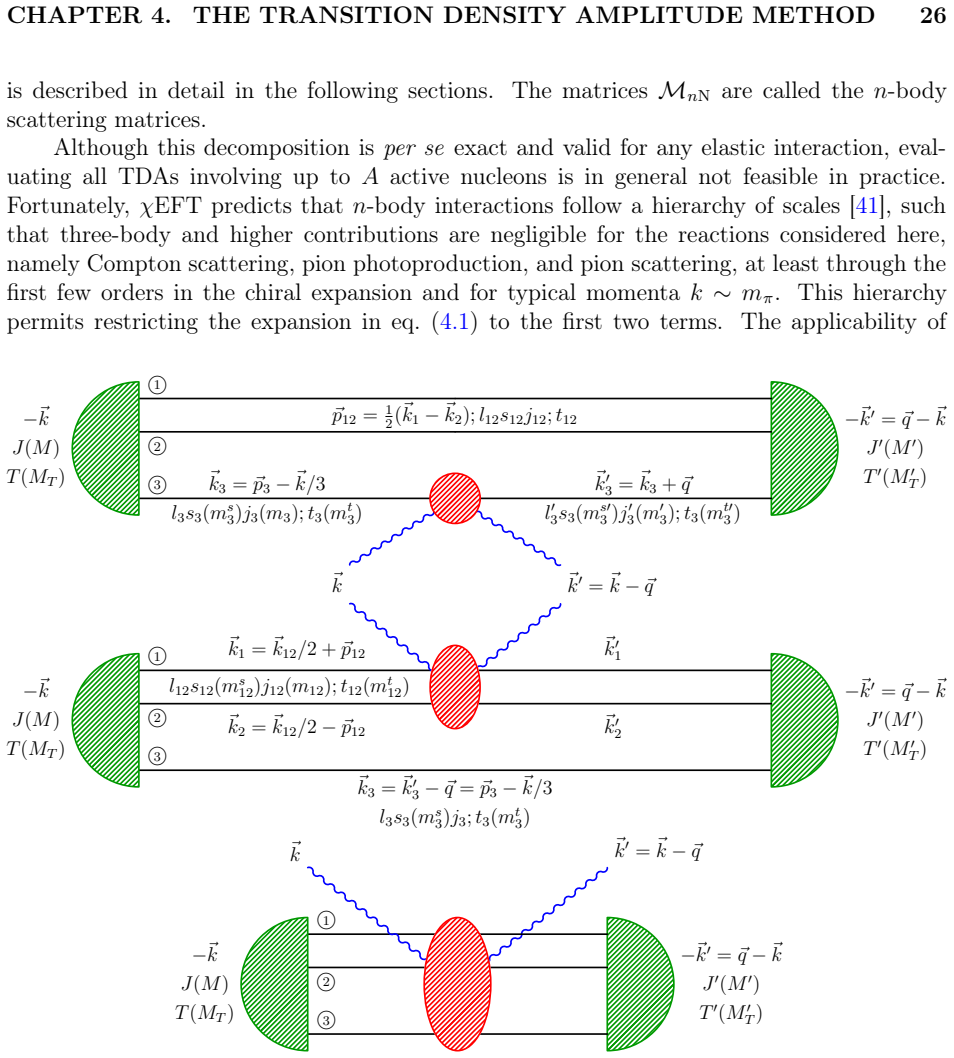
The TDA method factorizes the scattering amplitude into an irreducible few-body kernel, which encodes the interaction of the probe with the active nucleons, and a transition density amplitude, which carries the nuclear structure information. Because the densities are computed once per nucleus and momentum transfer and then convolved with any process-specific kernel, the same nuclear input is reused across reactions. For Lithium 6, the SRG-And-Back scheme returns the densities to the physical momentum scale and thereby preserves the original chiral ordering, with the induced uncertainty validated against exact Helium 4 results at the 2 percent level and convergence studies bounding the residu
What carries the argument
Transition Density Amplitude (TDA) factorization separating the irreducible few-body kernel from the transition density amplitude that carries nuclear structure.
If this is right
- The same densities apply to any new reaction by supplying only the corresponding kernel.
- Computational effort for wave functions is incurred once per nucleus rather than per process.
- The DensityScattering code supplies infrastructure for integration and summation so new kernels can be added without reimplementing density handling.
Where Pith is reading between the lines
- The method may scale to additional nuclei if the back-transformation scheme is validated beyond the 2 percent level shown for 4He.
- Efficient reuse of densities could support systematic surveys of multiple probe reactions on the same set of light nuclei.
Load-bearing premise
The SRG back-transformation accurately restores densities to the physical momentum scale without uncontrolled errors when applied to 6Li.
What would settle it
Direct comparison of 6Li transition densities or Compton observables computed with exact non-SRG wave functions against the SRG-And-Back results at the same chiral cutoff.
Figures

read the original abstract
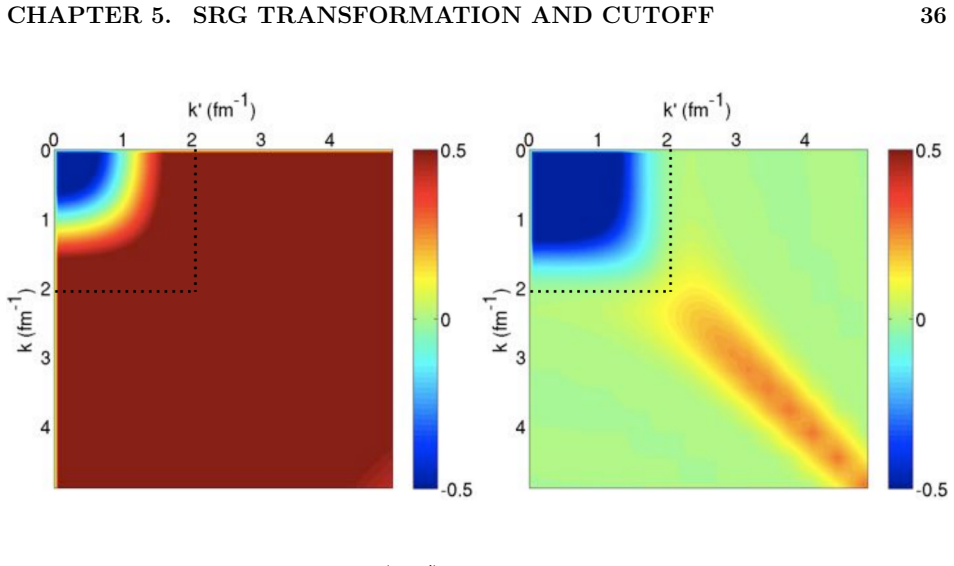
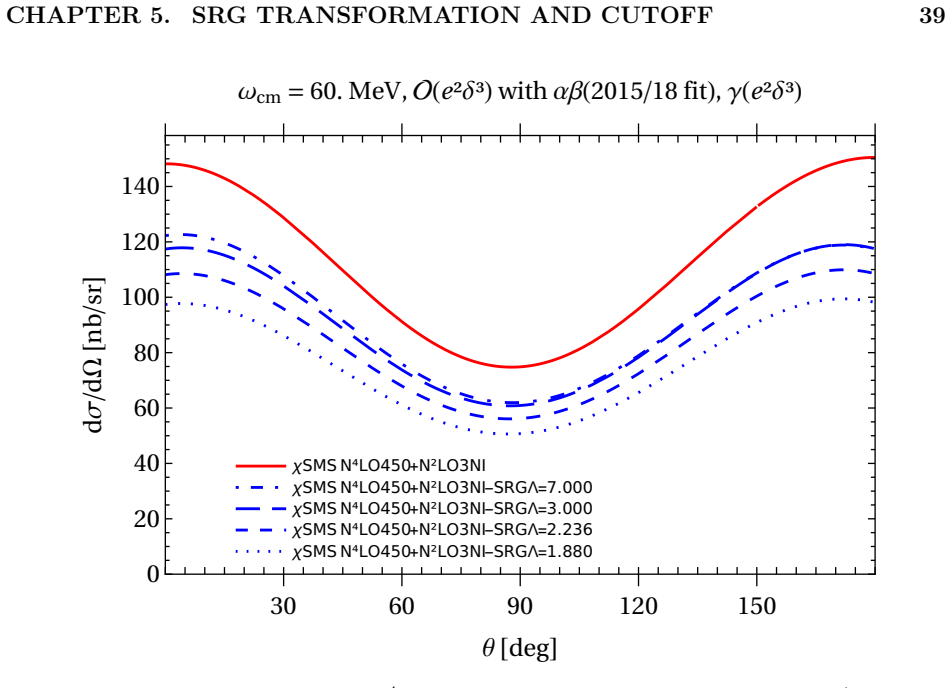
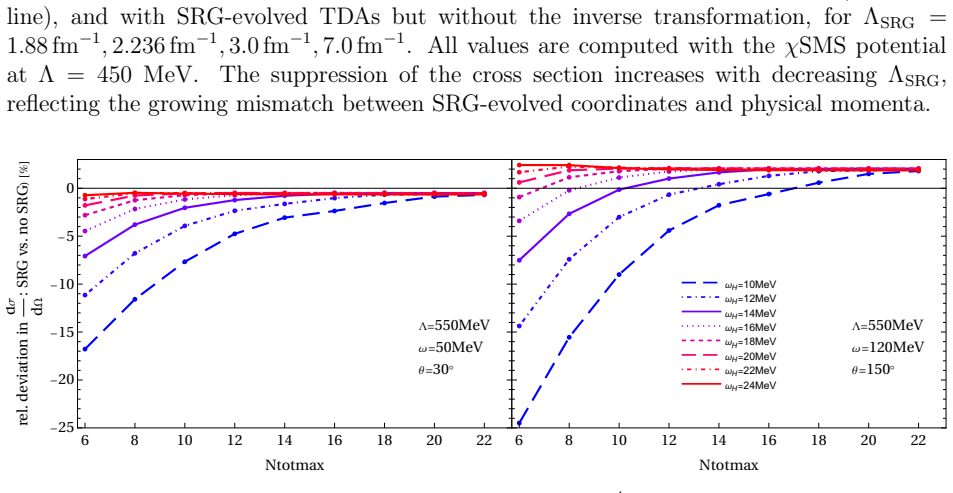
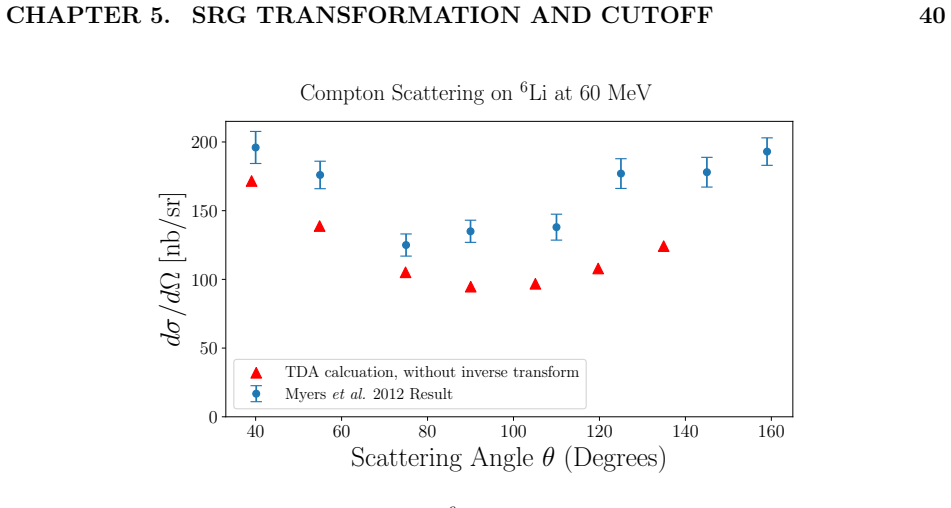
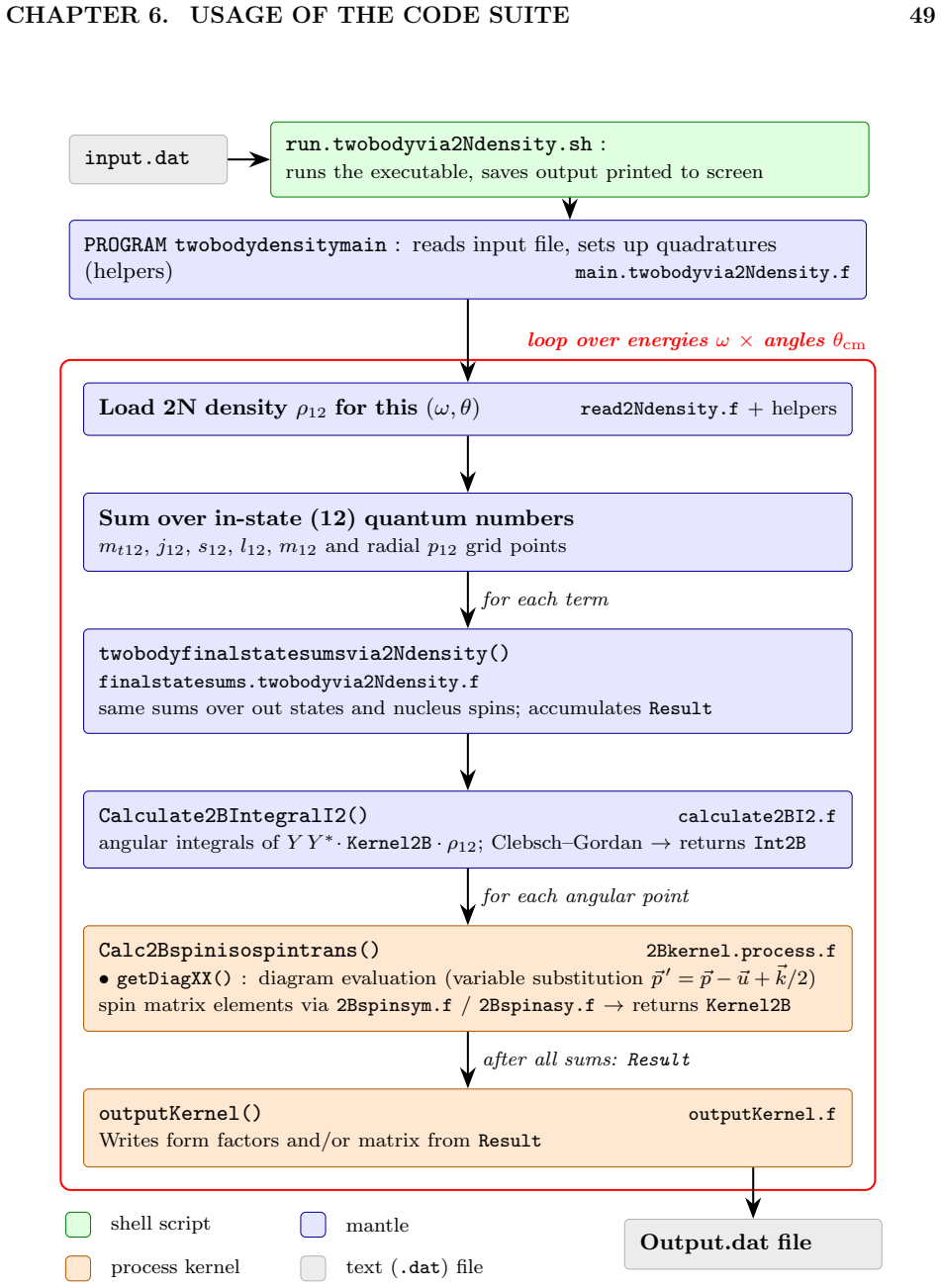
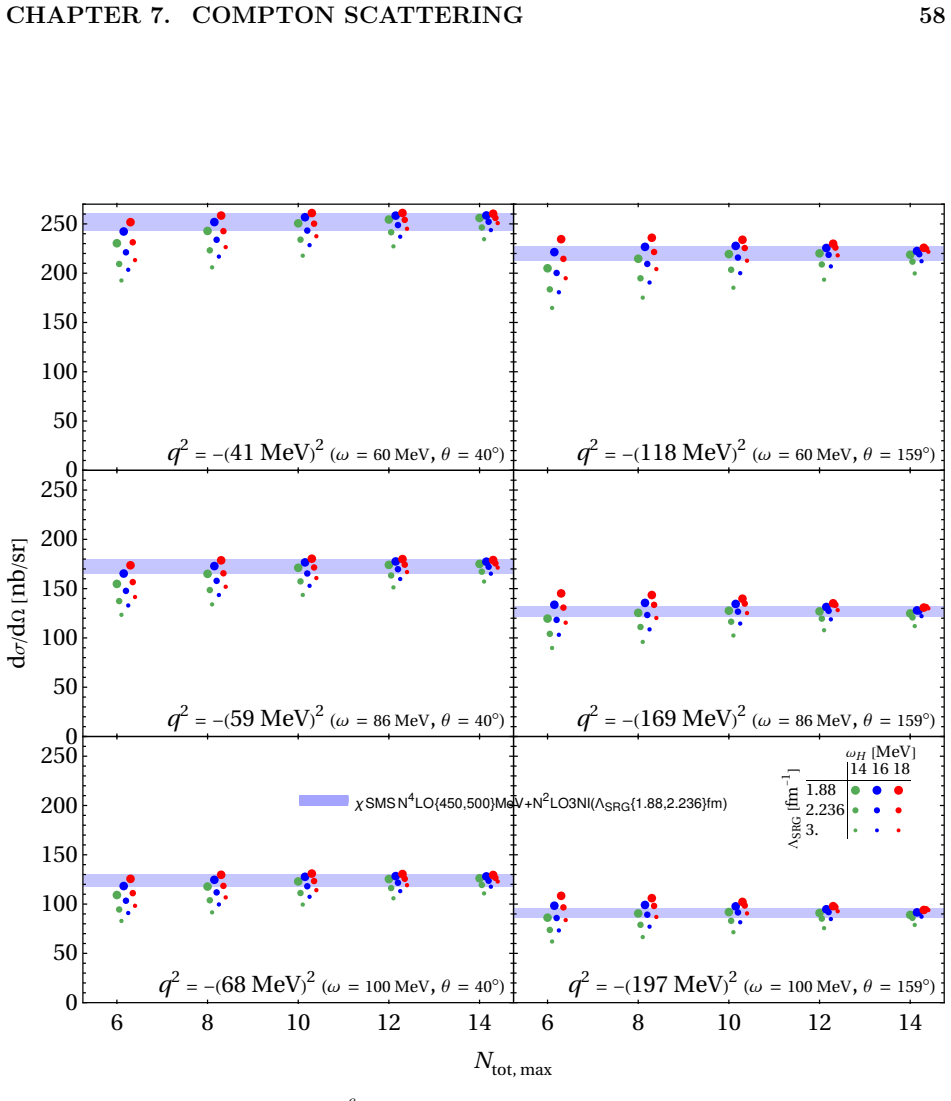
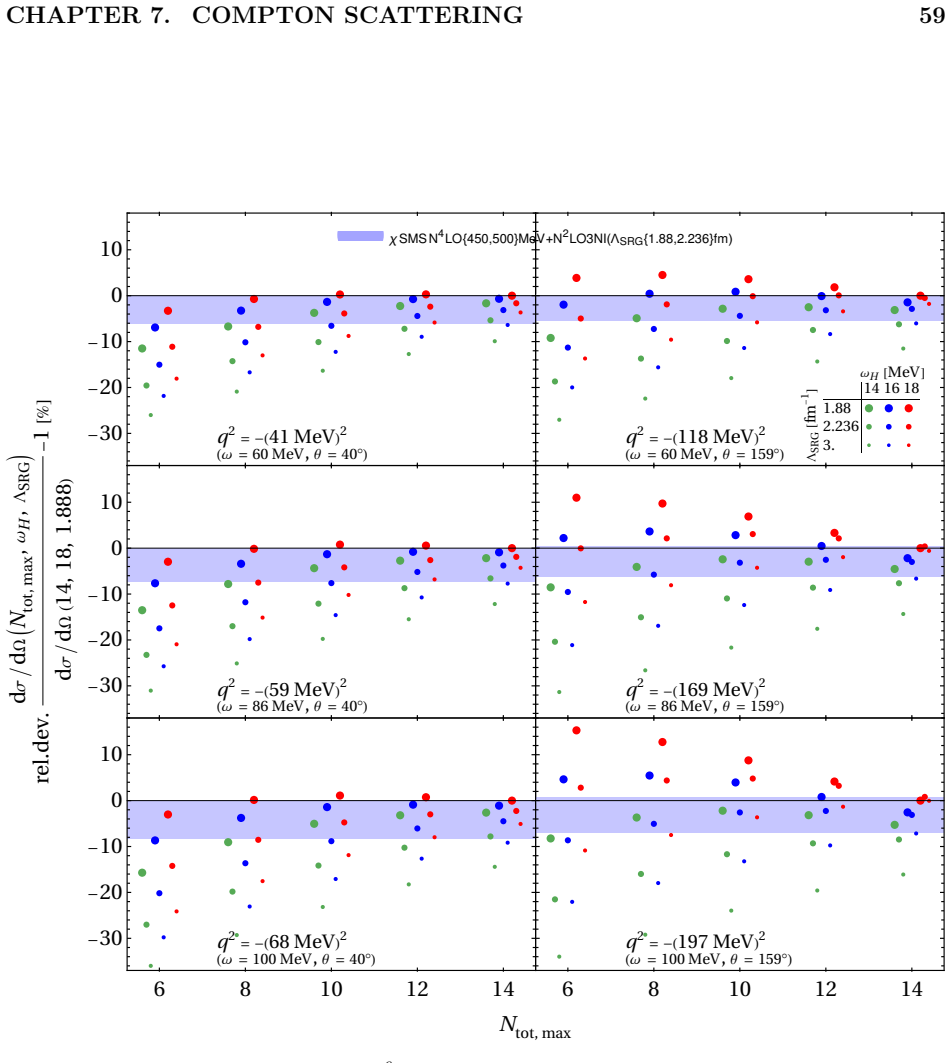
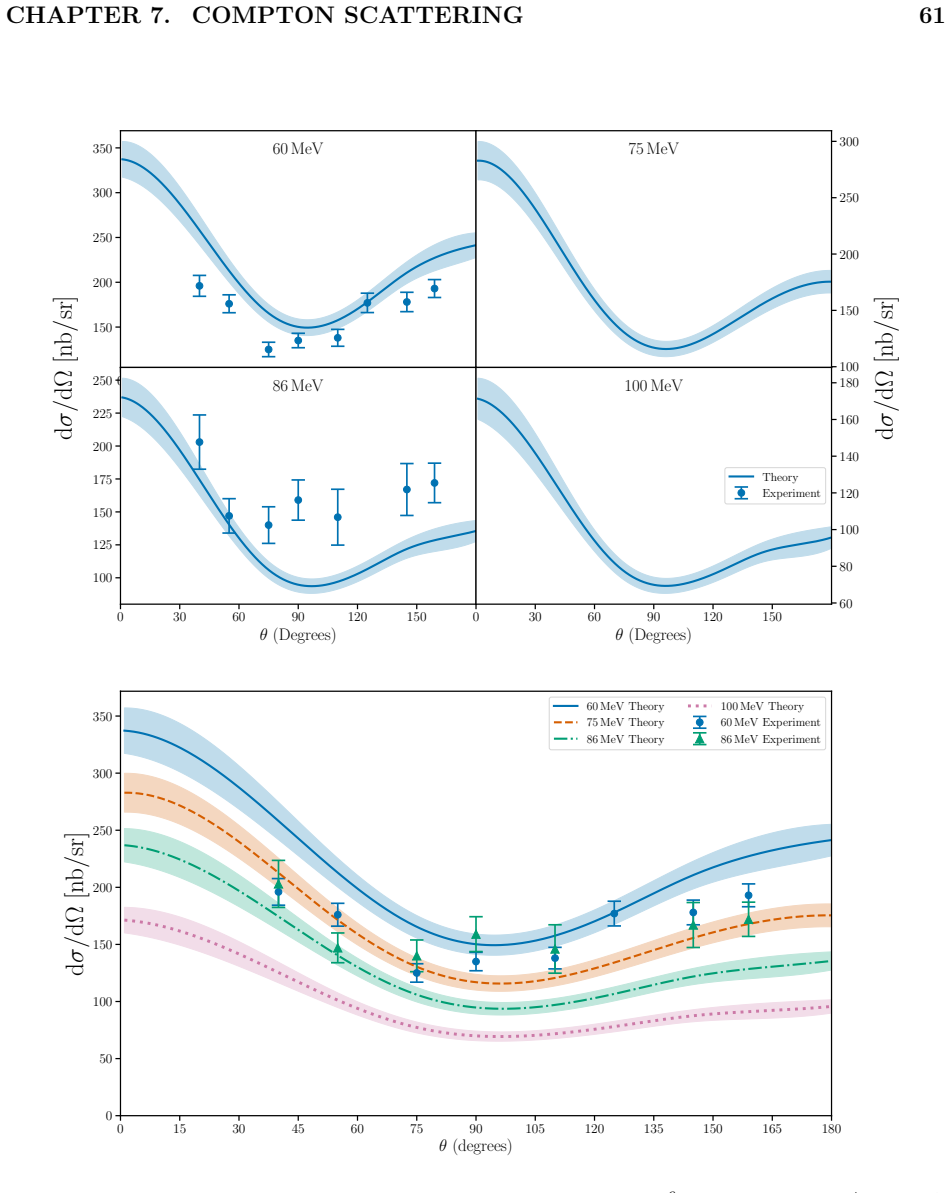
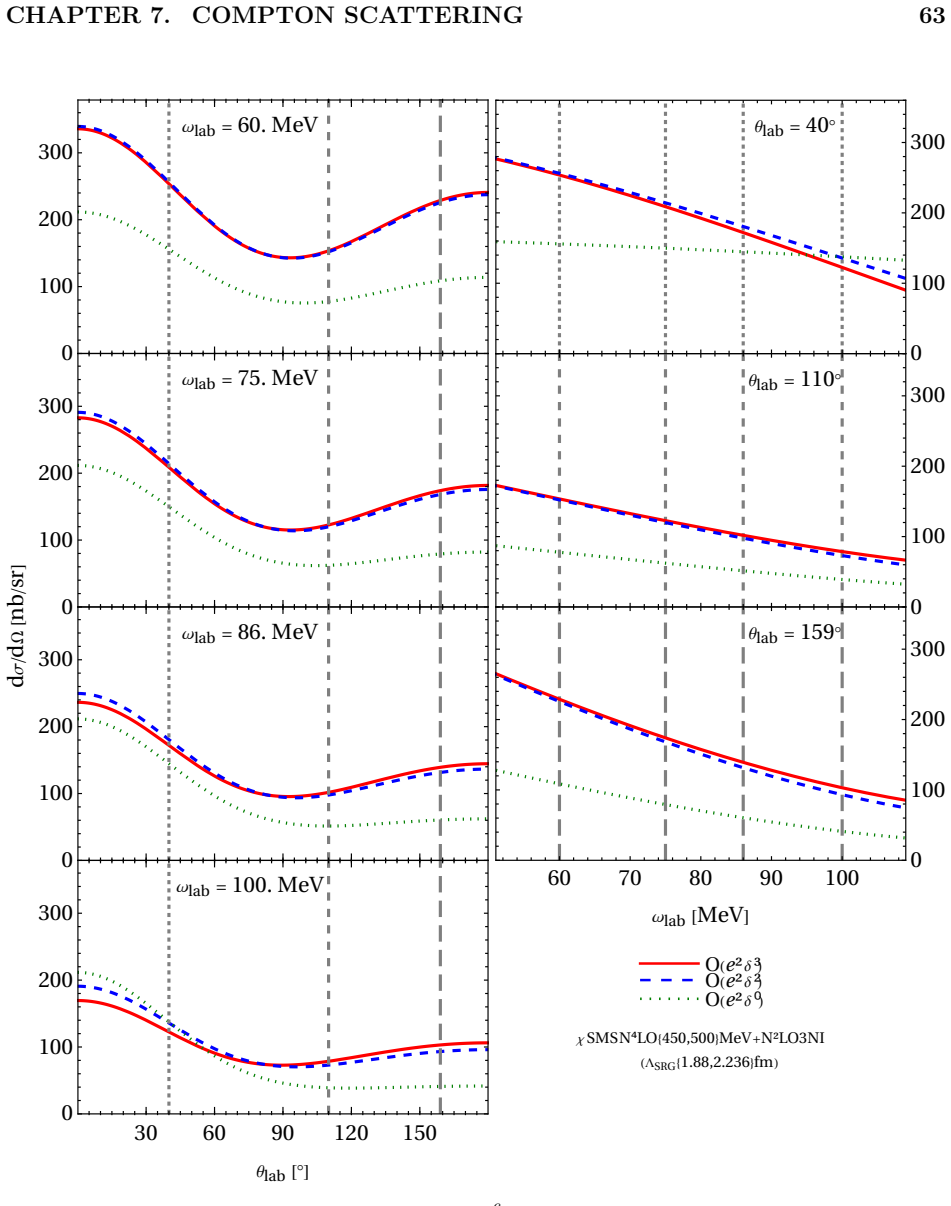
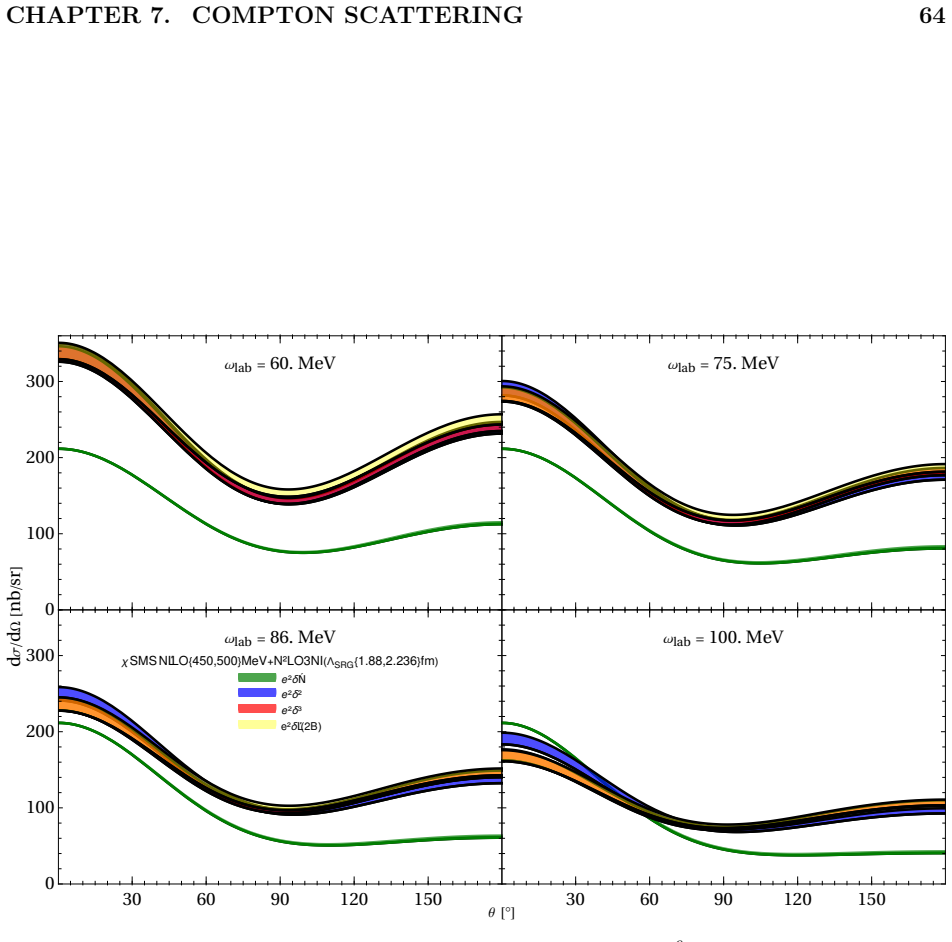
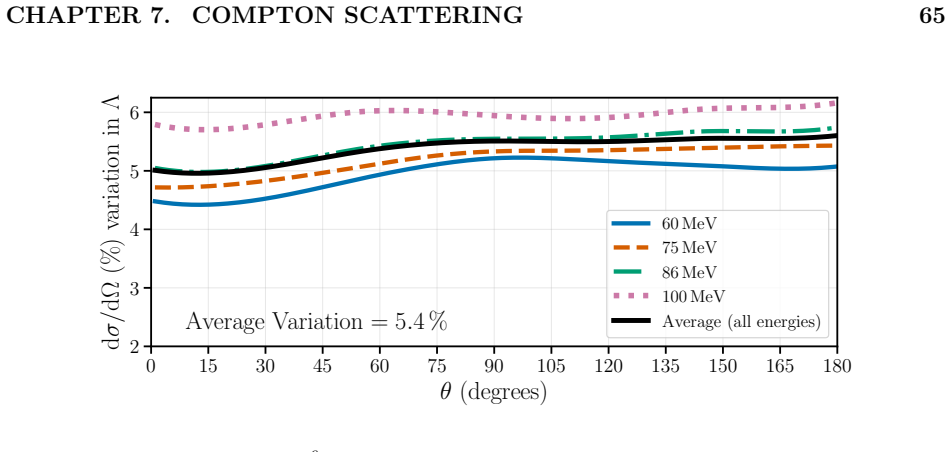
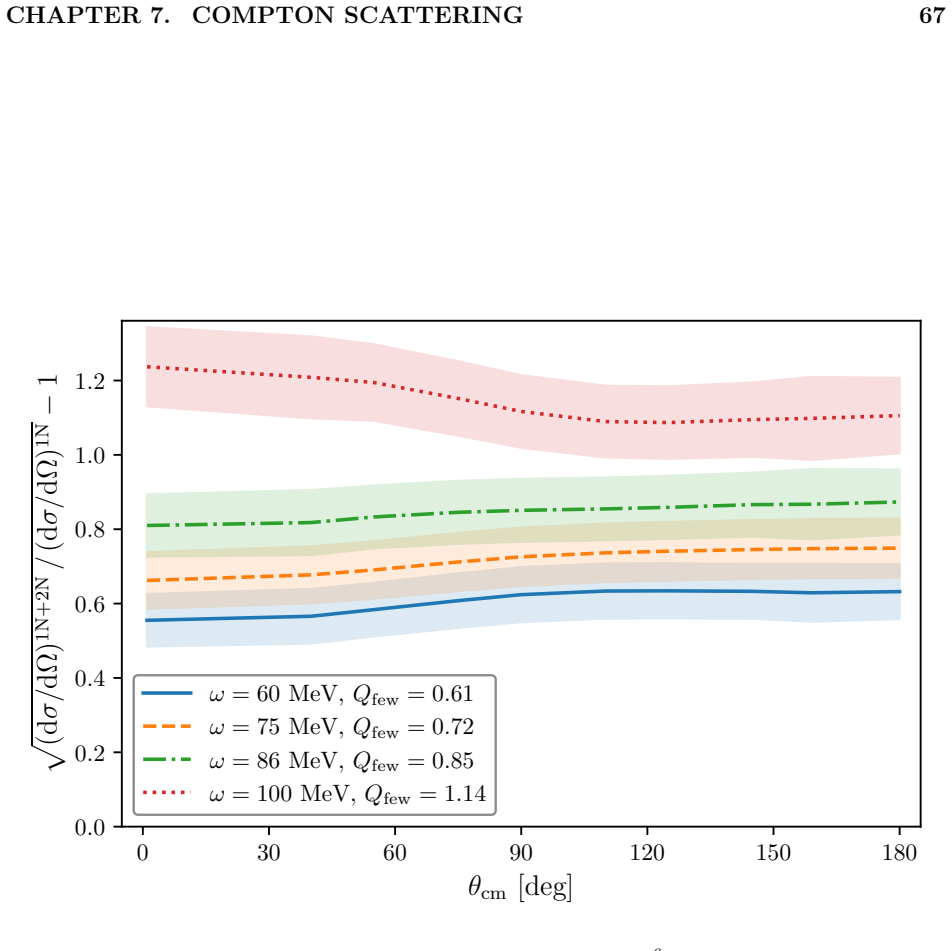
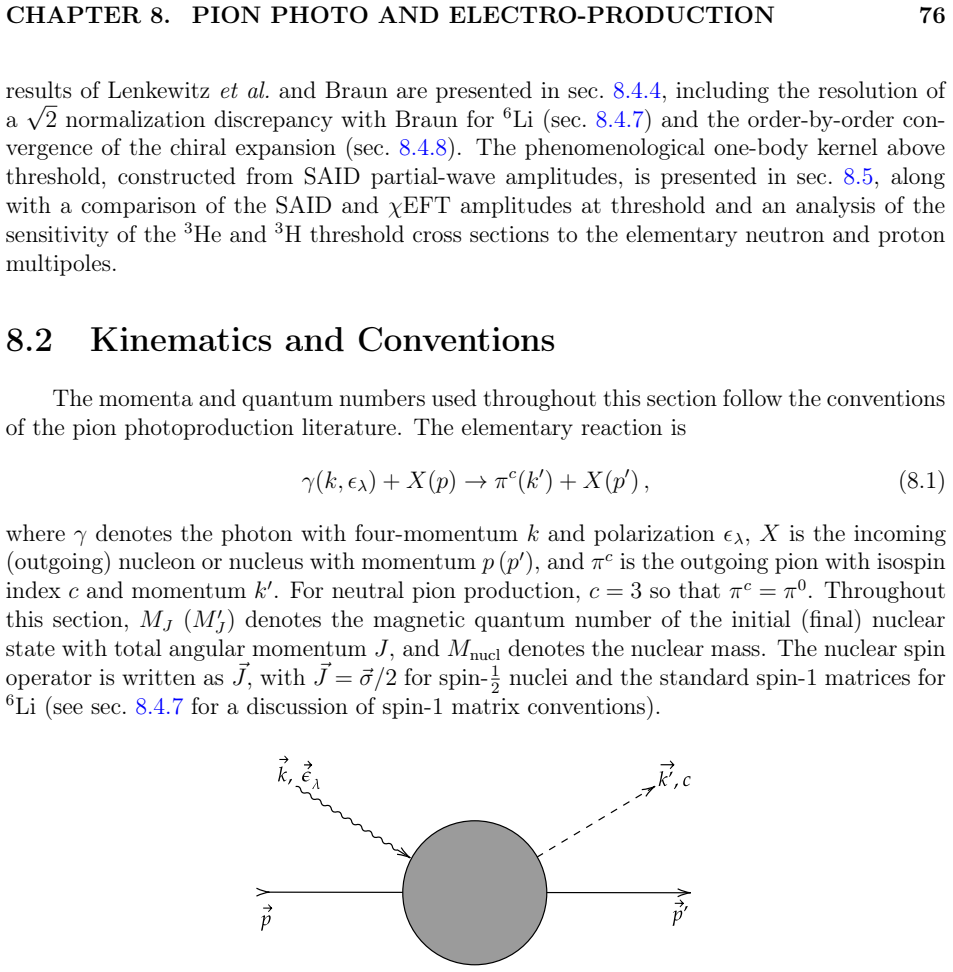
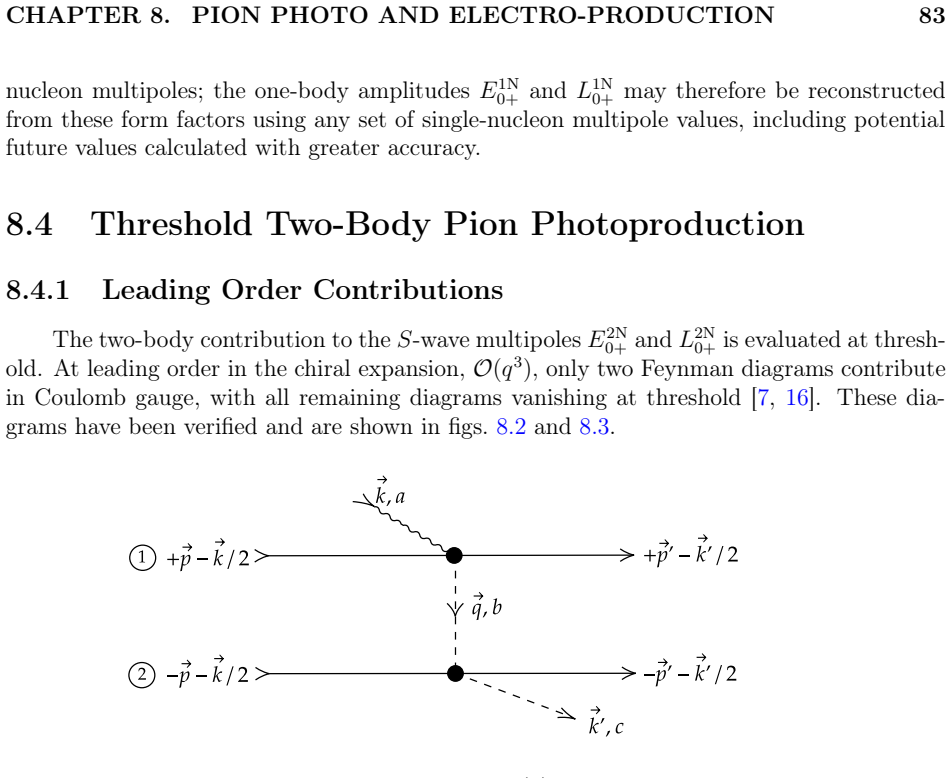
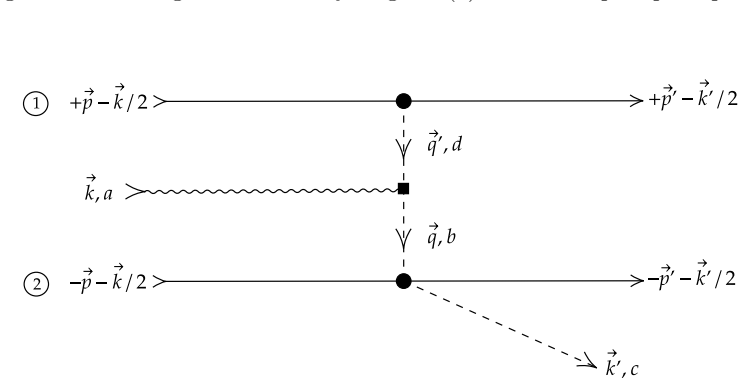
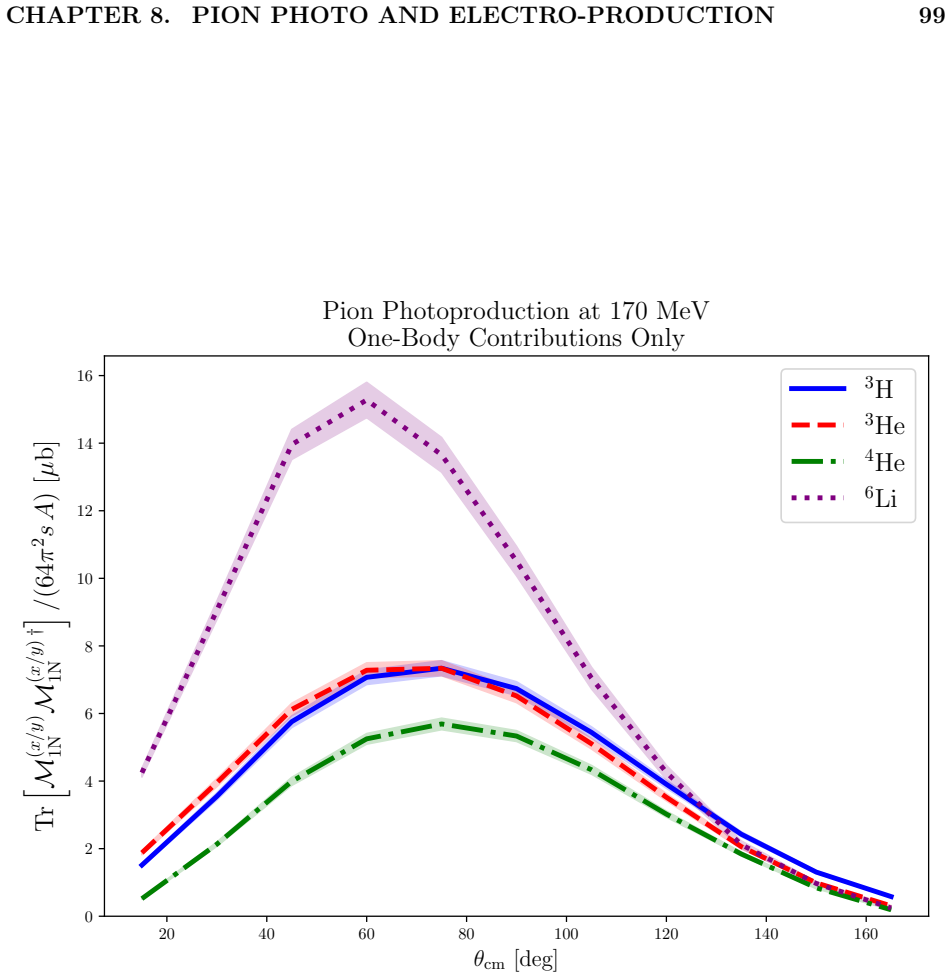
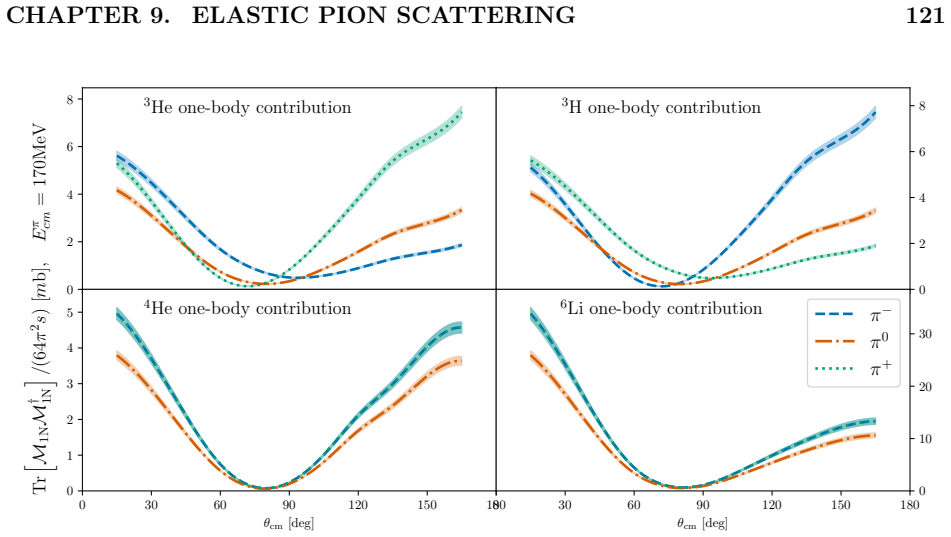
The Transition Density Amplitude (TDA) method of Griesshammer et al. is applied to compute scattering observables for Compton scattering, threshold neutral pion photoproduction, and elastic pion scattering on the light nuclei Hydrogen 3, Helium 3, Helium 4, and Lithium 6. In this formalism the amplitude factorizes into an irreducible few-body kernel, which encodes the interaction of the probe with the active nucleons, and a transition density amplitude, which carries the nuclear structure information. Because the densities are computed once per nucleus and momentum transfer and then convolved with any process-specific kernel, the same nuclear input is reused across reactions, yielding substantial computational savings over direct evaluation. This factorization is realized in the publicly available Fortran suite DensityScattering, developed as part of the present work; a researcher implementing a new reaction need only supply the corresponding kernel in a prescribed format, with infrastructure for density handling, integration, quantum-number summation, and output already provided. The TDAs are constructed from nuclear wave functions using the semilocal momentum-space regularized chiral potential of Reinert, Krebs, and Epelbaum at cutoffs of 450 and 500 MeV. For Lithium 6, no-core shell model wave functions are evolved under a Similarity Renormalization Group (SRG) transformation; a back-transformation scheme ("SRG-And-Back"), co-developed for the present work, returns the densities to the physical momentum scale and thereby preserves the original chiral ordering. The induced uncertainty is validated against exact Helium 4 results at the 2% level, and convergence studies for Lithium 6 Compton scattering bound the residual uncertainty below 6%.
Editorial analysis
A structured set of objections, weighed in public.
Referee Report
Summary. The manuscript applies the Transition Density Amplitude (TDA) factorization to compute Compton scattering, threshold neutral pion photoproduction, and elastic pion scattering observables on ³H, ³He, ⁴He, and ⁶Li. Nuclear transition densities are obtained from semilocal chiral EFT wave functions (Reinert-Krebs-Epelbaum potential at 450/500 MeV cutoffs); for ⁶Li, NCSM wave functions are SRG-evolved and restored via a new “SRG-And-Back” scheme. The same densities are convolved with process-specific kernels, and the Fortran suite DensityScattering is provided to facilitate reuse across reactions.
Significance. If the uncertainty quantification holds, the work supplies a reusable, publicly available infrastructure that decouples nuclear-structure input from reaction kernels, yielding computational savings and enabling systematic studies across multiple probes on the same nuclei. The SRG-And-Back construction and its 2 % validation on ⁴He are concrete technical contributions that could be adopted more broadly.
major comments (1)
- [⁶Li results / SRG-And-Back section] § on ⁶Li SRG-And-Back scheme and uncertainty quantification: the statement that convergence studies bound residual uncertainty below 6 % for ⁶Li Compton scattering rests on NCSM truncation in the evolved basis; the only explicit cross-check isolating back-transformation error is the 2 % agreement reported for exact ⁴He results. No additional test (e.g., variation of SRG flow parameter or comparison with unevolved ⁶Li densities where feasible) is described that would demonstrate the back-transformation contribution shrinks under the same variations used to control the 6 % figure.
minor comments (2)
- [Abstract] The abstract and introduction refer to “Hydrogen 3” and “Helium 3/4”; standard notation ³H, ³He, ⁴He should be used consistently for clarity.
- [Figures] Figure captions for the ⁶Li observables should explicitly state which cutoff (450 or 500 MeV) and which SRG flow parameter are shown, and whether the plotted bands include the quoted 6 % residual uncertainty.
Simulated Author's Rebuttal
We thank the referee for the careful reading of the manuscript and the positive assessment of its significance and the public infrastructure provided. We address the single major comment below.
read point-by-point responses
-
Referee: [⁶Li results / SRG-And-Back section] § on ⁶Li SRG-And-Back scheme and uncertainty quantification: the statement that convergence studies bound residual uncertainty below 6 % for ⁶Li Compton scattering rests on NCSM truncation in the evolved basis; the only explicit cross-check isolating back-transformation error is the 2 % agreement reported for exact ⁴He results. No additional test (e.g., variation of SRG flow parameter or comparison with unevolved ⁶Li densities where feasible) is described that would demonstrate the back-transformation contribution shrinks under the same variations used to control the 6 % figure.
Authors: We agree with the observation that the manuscript provides no explicit additional cross-checks for the back-transformation error on ⁶Li itself (such as SRG flow-parameter variation or direct comparison to unevolved densities). The 2 % validation is performed only on exact ⁴He results, while the <6 % bound for ⁶Li Compton scattering is obtained from NCSM convergence studies performed entirely in the SRG-evolved basis. The SRG-And-Back procedure was constructed precisely to return the densities to the physical momentum scale while preserving the original chiral ordering; the ⁴He benchmark supports that the residual error remains small. Additional ⁶Li-specific tests of the back-transformation step are computationally demanding and were not performed. We will revise the relevant section to state this reliance on the ⁴He benchmark more explicitly and to note the assumption that the error behaves comparably for ⁶Li, thereby improving transparency of the uncertainty estimate. revision: partial
Circularity Check
No circularity: TDA factorization and SRG-And-Back densities are direct convolutions from independent wave functions
full rationale
The paper applies the TDA factorization (cited to Griesshammer et al.) to convolve precomputed nuclear densities with process kernels; densities for A=3,4 come from chiral EFT wave functions at fixed cutoffs, while 6Li uses NCSM wave functions evolved and back-transformed via the new SRG-And-Back scheme whose 2% validation on 4He is external to the 6Li observables. No equation reduces a target observable to a fit of itself, no parameter is tuned to the reported Compton or photoproduction data, and the cited TDA method is not authored by the present writer. The derivation chain therefore consists of independent inputs fed through explicit integrals rather than self-referential definitions or load-bearing self-citations.
Axiom & Free-Parameter Ledger
free parameters (1)
- cutoff =
450 MeV and 500 MeV
axioms (2)
- domain assumption Chiral effective field theory supplies reliable nuclear wave functions at the chosen cutoffs
- domain assumption TDA factorization separates kernel and density without process-dependent corrections beyond the stated approximation
Reference graph
Works this paper leans on
-
[1]
A. Long,Densityscattering, Mar. 2026,10.5281/zenodo.18893804,https://doi. org/10.5281/zenodo.18893804
-
[2]
P. J. Millican, R. J. Furnstahl, J. A. Melendez, and D. R. Phillips,Assessing conver- gence patterns across modern nucleon-nucleon potentials, 2025,https://arxiv.org/ abs/2508.17558
arXiv 2025
-
[4]
Neutral pion pho- toproduction off 3h and 3he in chiral perturbation theory
M. Lenkewitz, E. Epelbaum, H.-W. Hammer, and U.-G. Meißner, “Neutral pion pho- toproduction off 3h and 3he in chiral perturbation theory”, Physics Letters B700, 365–368 (2011)10.1016/j.physletb.2011.05.036,http://dx.doi.org/10.1016/ j.physletb.2011.05.036
-
[5]
Neutral Pion Electroproduction off Light Nuclei in Chiral Perturbation Theory
M. Lenkewitz, “Neutral Pion Electroproduction off Light Nuclei in Chiral Perturbation Theory”, PhD thesis (U. Bonn (main), 2013)
2013
-
[6]
Measurement of the6li(γ, π0)reaction near threshold
J. C. Bergstrom, R. Igarashi, and J. M. Vogt, “Measurement of the6li(γ, π0)reaction near threshold”, Phys. Rev. C59, 2588 (1999)10.1103/PhysRevC.59.2588
-
[7]
Neutral pion photoproduction on deuterium in baryon chiral perturbation theory to order q4
S. Beane, V. Bernard, T.-S. Lee, U.-G. Meißner, and U. van Kolck, “Neutral pion photoproduction on deuterium in baryon chiral perturbation theory to order q4”, Nu- clear Physics A618, 381–401 (1997)10 . 1016 / s0375 - 9474(97 ) 00133 - 4,http : //dx.doi.org/10.1016/S0375-9474(97)00133-4
-
[8]
Measurement of the4he(γ, π0)reaction near threshold
J. C. Bergstrom, R. Igarashi, J. M. Vogt, N. Kolb, R. E. Pywell, D. M. Skopik, and E. J. Korkmaz, “Measurement of the4he(γ, π0)reaction near threshold”, Phys. Rev. C57, 3203 (1998)10.1103/PhysRevC.57.3203
-
[9]
Effective Field Theories and Electromagnetic Properties of Light Nuclei
J. Braun, “Effective Field Theories and Electromagnetic Properties of Light Nuclei”, PhD thesis (Darmstadt, Tech. U., 2019),10.15120/GSI-2020-00375
-
[10]
Towards a high-precision calculation for the pion-nucleus scattering lengths
S. Liebig, V. Baru, F. Ballout, C. Hanhart, and A. Nogga, “Towards a high-precision calculation for the pion-nucleus scattering lengths”, The European Physical Journal A47(2011)10.1140/epja/i2011-11069-4,http://dx.doi.org/10.1140/epja/ i2011-11069-4
-
[12]
Explicit degrees of freedom in compton scattering off the deuteron
R. P. Hildebrandt, H. W. Grießhammer, T. R. Hemmert, and D. R. Phillips, “Explicit degrees of freedom in compton scattering off the deuteron”, Nuclear Physics A748, 573–595 (2005)10.1016/j.nuclphysa.2004.11.017,http://dx.doi.org/10. 1016/j.nuclphysa.2004.11.017
-
[13]
L.S.Myers,J.R.M.Annand,J.Brudvik,G.Feldman,K.G.Fissum,H.W.Grießham- mer, K. Hansen, S. S. Henshaw, L. Isaksson, R. Jebali, M. A. Kovash, M. Lundin, J. A. McGovern, D. G. Middleton, A. M. Nathan, D. R. Phillips, B. Schröder, and S. C. Stave (COMPTON@MAX-lab Collaboration), “Measurement of compton scattering from the deuteron and an improved extraction of t...
-
[14]
Comp- ton scattering on 4he with nuclear one- and two-body densities
H. W. Griesshammer, J. Liao, J. A. McGovern, A. Nogga, and D. R. Phillips, “Comp- ton scattering on 4he with nuclear one- and two-body densities”, (2024),https:// arxiv.org/abs/2401.16995
arXiv 2024
-
[15]
Scattering observables from few-body densities and compton scattering on 6li
A. Long and H. W. Griesshammer, “Scattering observables from few-body densities and compton scattering on 6li”, (2025),https://arxiv.org/abs/2504.00989
arXiv 2025
-
[16]
Neutral pion photoproduction on nuclei in baryon chiral perturbation theory
S. R. Beane, C. Y. Lee, and U. van Kolck, “Neutral pion photoproduction on nuclei in baryon chiral perturbation theory”, Phys. Rev. C52, 2914–2924 (1995)10.1103/ PhysRevC.52.2914,https://link.aps.org/doi/10.1103/PhysRevC.52.2914
-
[17]
V. Bernard, N. Kaiser, and U.-G. Meißner,Neutral pion photoproduction off nucleons revisited, 1994,https://arxiv.org/abs/hep-ph/9411287
Pith/arXiv arXiv 1994
-
[18]
Aspects of near-threshold neutral pion photoproduction off protons
V. Bernard, N. Kaiser, and U.-G. Meißner, “Aspects of near-threshold neutral pion photoproduction off protons”, The European Physical Journal A11, 209–216 (2001) 10.1007/s100500170085,http://dx.doi.org/10.1007/s100500170085
-
[19]
Thresholdπ0 photoproduction on 3he
P. Argan et al., “Thresholdπ0 photoproduction on 3he”, Phys. Rev. C21, 1416 (1980) 10.1103/PhysRevC.21.1416
-
[20]
Thresholdπ0 photoproduction on 3he and 4he
P. Argan et al., “Thresholdπ0 photoproduction on 3he and 4he”, Phys. Lett. B206, 4 (1988)10.1016/0370-2693(88)91252-1
-
[21]
Neutral pion pho- toproduction from 4he in the∆region
M. G. Barnett, R. Igarashi, R. E. Pywell, and J. C. Bergstrom, “Neutral pion pho- toproduction from 4he in the∆region”, Phys. Rev. C77, 064601 (2008)10.1103/ PhysRevC.77.064601
2008
-
[22]
S. Weinberg, “Pion scattering lengths”, Phys. Rev. Lett.17, 616–621 (1966)10.1103/ PhysRevLett.17.616,https://link.aps.org/doi/10.1103/PhysRevLett.17.616
-
[23]
Axial vector coupling renormalization and the meson baryon scattering lengths
Y. Tomozawa, “Axial vector coupling renormalization and the meson baryon scattering lengths”, Nuovo Cim. A46, 707–717 (1966)10.1007/BF02857517
-
[24]
The s-wave pion–nucleon scattering lengths from pionic atoms using effective field theory
S. Beane, V. Bernard, E. Epelbaum, U.-G. Meißner, and D. Phillips, “The s-wave pion–nucleon scattering lengths from pionic atoms using effective field theory”, Nuclear Physics A720, 399–415 (2003)10.1016/s0375-9474(03)01008-x,http://dx.doi. org/10.1016/S0375-9474(03)01008-X. BIBLIOGRAPHY 134
-
[25]
Semilocal momentum-space regularized chiral two-nucleon potentials up to fifth order
P. Reinert, H. Krebs, and E. Epelbaum, “Semilocal momentum-space regularized chiral two-nucleon potentials up to fifth order”, The European Physical Journal A54(2018) 10.1140/epja/i2018-12516-4,http://dx.doi.org/10.1140/epja/i2018-12516- 4
-
[26]
M. E. Peskin and D. V. Schroeder,An introduction to quantum field theory(Addison- Wesley, Reading, MA, 1995)
1995
-
[27]
Chiral effective field theory and nuclear forces
R. Machleidt and D. Entem, “Chiral effective field theory and nuclear forces”, Physics Reports503, 1–75 (2011)10.1016/j.physrep.2011.02.001,http://dx.doi.org/ 10.1016/j.physrep.2011.02.001
-
[28]
S. Weinberg, “Phenomenological Lagrangians”, Physica A96, edited by S. Deser, 327– 340 (1979)10.1016/0378-4371(79)90223-1
-
[29]
S. Weinberg,What is quantum field theory, and what did we think it is?, 1997,https: //arxiv.org/abs/hep-th/9702027
Pith/arXiv arXiv 1997
-
[30]
H. W. Grießhammer, “What can possibly go wrong?”, Few-Body Systems63(2022) 10.1007/s00601-022-01739-z,http://dx.doi.org/10.1007/s00601-022-01739- z
-
[31]
Two interacting scalar fields: practical renormalization
S. R. J. Wysozka, P. Kielanowski, E. U. Longoria, and L. V. Mercado, “Two interacting scalar fields: practical renormalization”, (2021)10.48550/ARXIV.2104.09681,https: //arxiv.org/abs/2104.09681
-
[32]
Chiral dynamics in nucleons and nuclei
V. BERNARD, N. KAISER, and U.-G. MEIßNER, “Chiral dynamics in nucleons and nuclei”, International Journal of Modern Physics E04, 193–344 (1995)10 . 1142 / s0218301395000092,http://dx.doi.org/10.1142/S0218301395000092
-
[33]
Pion photoproduction in chiral effective field theory with explicit delta degrees of freedom
N. M. Rijneveen and B. U. ( ( F. für Physik und Astronomie, “Pion photoproduction in chiral effective field theory with explicit delta degrees of freedom”, (2021)10.13154/ 294-8311
2021
-
[34]
S. Navas et al. (Particle Data Group), “Review of particle physics”, Phys. Rev. D110, 030001 (2024)10.1103/PhysRevD.110.030001
-
[35]
Axial-vector vertex in spinor electrodynamics,
S. L. Adler, “Axial-vector vertex in spinor electrodynamics”, Phys. Rev.177, 2426– 2438 (1969)10.1103/PhysRev.177.2426,https://link.aps.org/doi/10.1103/ PhysRev.177.2426
-
[36]
Field theories with “superconductor
J. Goldstone, “Field theories with “superconductor” solutions”, Nuovo Cim.19, 154– 164 (1961)10.1007/BF02812722
-
[37]
J. Goldstone, A. Salam, and S. Weinberg, “Broken symmetries”, Phys. Rev.127, 965– 970 (1962)10.1103/PhysRev.127.965,https://link.aps.org/doi/10.1103/ PhysRev.127.965
-
[38]
J. Gasser, M. Sainio, and A. Švarc, “Nucleons with chiral loops”, Nuclear Physics B 307, 779–853 (1988)https://doi.org/10.1016/0550-3213(88)90108-3,https: //www.sciencedirect.com/science/article/pii/0550321388901083
-
[39]
Quantifying correlated truncation errors in effective field theory
J. A. Melendez, R. J. Furnstahl, D. R. Phillips, M. T. Pratola, and S. Wesolowski, “Quantifying correlated truncation errors in effective field theory”, Physical Review C 100, 044001 (2019)10.1103/PhysRevC.100.044001. BIBLIOGRAPHY 135
-
[40]
Effective chiral lagrangians for nucleon-pion interactions and nuclear forces
S. Weinberg, “Effective chiral lagrangians for nucleon-pion interactions and nuclear forces”, Nuclear Physics B363, 3–18 (1991)https : / / doi . org / 10 . 1016 / 0550 - 3213(91 ) 90231 - L,https : / / www . sciencedirect . com / science / article / pii / 055032139190231L
1991
-
[42]
A new expansion for nucleon-nucleon interactions
D. B. Kaplan, M. J. Savage, and M. B. Wise, “A new expansion for nucleon-nucleon interactions”, Physics Letters B380, 332–338 (1996)10.1016/0370-2693(96)00516- 1
-
[43]
Renormalization of one-pion exchange and power counting
A. Nogga, R. G. E. Timmermans, and U. v. Kolck, “Renormalization of one-pion exchange and power counting”, Physical Review C72(2005)10.1103/physrevc.72. 054006,http://dx.doi.org/10.1103/PhysRevC.72.054006
-
[44]
Bayesian analysis of chiral effective field theory at leading order in the two-nucleon sector
P. J. Millican, R. J. Furnstahl, J. A. Melendez, D. R. Phillips, and M. T. Pratola, “Bayesian analysis of chiral effective field theory at leading order in the two-nucleon sector”, Physical Review C110, 044002 (2024)10.1103/PhysRevC.110.044002
-
[45]
H. W. Grießhammer, J. A. McGovern, A. Nogga, and D. R. Phillips, “Scattering observables from one- and two-body densities: formalism and application toγ 3He scattering”, Few-Body Systems61(2020)10 . 1007 / s00601 - 020 - 01578 - w,http : //dx.doi.org/10.1007/s00601-020-01578-w
-
[46]
The European Physical Journal C84(2024) https://doi.org/10.1140/epjc/ s10052-024-12422-4
J. d. Vries, C. Körber, A. Nogga, and S. Shain, “Dark matter scattering off4Hein chiral effective field theory”, The European Physical Journal C84(2024)10.1140/epjc/ s10052-024-13477-z,http://dx.doi.org/10.1140/epjc/s10052-024-13477-z
-
[47]
Spectator expansion in multiple scattering theory
E. R. Siciliano and R. M. Thaler, “Spectator expansion in multiple scattering theory”, Phys. Rev. C16, 1322–1332 (1977)10.1103/PhysRevC.16.1322
-
[48]
Light nuclei with semilocal momentum- space regularized chiral interactions up to third order
P. Maris et al. (LENPIC Collaboration), “Light nuclei with semilocal momentum- space regularized chiral interactions up to third order”, Physical Review C103, 054001 (2021)10.1103/PhysRevC.103.054001
-
[49]
Nuclear properties with semilocal momentum-space regularized chiral interactions beyond N2LO
P. Maris et al. (LENPIC Collaboration), “Nuclear properties with semilocal momentum-space regularized chiral interactions beyond N2LO”, Physical Review C 106, 064002 (2022)10.1103/PhysRevC.106.064002
-
[50]
X.-X. Sun, H. Le, U.-G. Meißner, and A. Nogga,Universality of nucleon short-range behavior with chiral forces, 2025,https://arxiv.org/abs/2512.15454
arXiv 2025
-
[51]
S. Szpigel and R. J. Perry,The similarity renormalization group, 2000,https : / / arxiv.org/abs/hep-ph/0009071
Pith/arXiv arXiv 2000
-
[52]
ApplicationsofB-splinesin atomic and molecular physics
R. J. Furnstahl and K. Hebeler, “New applications of renormalization group methods in nuclear physics”, Reports on Progress in Physics76, 126301 (2013)10.1088/0034- 4885/76/12/126301,https://dx.doi.org/10.1088/0034-4885/76/12/126301
-
[53]
Renormalization of hamiltonians
S. D. Głazek and K. G. Wilson, “Renormalization of hamiltonians”, Phys. Rev. D48, 5863–5872 (1993)10.1103/PhysRevD.48.5863,https://link.aps.org/doi/10. 1103/PhysRevD.48.5863. BIBLIOGRAPHY 136
-
[54]
Flow equations for hamiltonians
F. J. Wegner, “Flow equations for hamiltonians”, Nuclear Physics B - Proceedings Sup- plements90, 141–146 (2000)https://doi.org/10.1016/S0920-5632(00)00911-7, https://www.sciencedirect.com/science/article/pii/S0920563200009117
-
[55]
Heinz,Similarity renormalization group for nuclear forces, 2026,https://arxiv
M. Heinz,Similarity renormalization group for nuclear forces, 2026,https://arxiv. org/abs/2603.04311
arXiv 2026
-
[56]
Hebeler,Talent school at mitp,https://indico.mitp.uni- mainz.de/event/ 279/, 2022
K. Hebeler,Talent school at mitp,https://indico.mitp.uni- mainz.de/event/ 279/, 2022
2022
-
[57]
Extrapolation method for the no-core shell model
H. Zhan, A. Nogga, B. R. Barrett, J. P. Vary, and P. Navrátil, “Extrapolation method for the no-core shell model”, Phys. Rev. C69, 034302 (2004)10.1103/PhysRevC.69. 034302,https://link.aps.org/doi/10.1103/PhysRevC.69.034302
-
[58]
Free Software Foundation,GNU Fortran (GFortran),https : / / gcc . gnu . org / fortran/, 2024
2024
-
[59]
The HDF Group,Hierarchical Data Format, version 5,https://www.hdfgroup.org/ HDF5/, 2024
2024
-
[60]
H. Grießhammer, J. McGovern, D. Phillips, and G. Feldman, “Using effective field theory to analyse low-energy compton scattering data from protons and light nuclei”, Progress in Particle and Nuclear Physics67, 841–897 (2012)10.1016/j.ppnp.2012. 04.003,http://dx.doi.org/10.1016/j.ppnp.2012.04.003
-
[61]
Effective theory of the delta(1232) in compton scattering off the nucleon
V. Pascalutsa and D. R. Phillips, “Effective theory of the delta(1232) in compton scattering off the nucleon”, Physical Review C67(2003)10 . 1103 / physrevc . 67 . 055202,http://dx.doi.org/10.1103/PhysRevC.67.055202
-
[62]
Compton scattering on the deuteronin baryonchiralperturbation theory
S. Beane, M. Malheiro, D. Phillips, and U. van Kolck, “Compton scattering on the deuteronin baryonchiralperturbation theory”, NuclearPhysicsA656, 367–399(1999) 10.1016/s0375-9474(99)00312-7,http://dx.doi.org/10.1016/S0375-9474(99) 00312-7
-
[63]
Chiral expansion of the nucleon’s electromagnetic polarizabilities
V. Bernard, N. Kaiser, and U.-G. Meissner, “Chiral expansion of the nucleon’s electromagnetic polarizabilities”, Phys. Rev. Lett.67, 1515–1518 (1991)10 . 1103 / PhysRevLett.67.1515,https://link.aps.org/doi/10.1103/PhysRevLett.67. 1515
-
[64]
R. P. Hildebrandt,Elastic compton scattering from the nucleon and deuteron, 2005, https://arxiv.org/abs/nucl-th/0512064
Pith/arXiv arXiv 2005
-
[65]
Nucleon polarizabilities from deuteron compton scattering within a green’s function hybrid approach
R. P. Hildebrandt, H. W. Grießhammer, and T. R. Hemmert, “Nucleon polarizabilities from deuteron compton scattering within a green’s function hybrid approach”, The European Physical Journal A46, 111–137 (2010)10.1140/epja/i2010- 11024- y, http://dx.doi.org/10.1140/epja/i2010-11024-y
-
[66]
Signatures of chiral dynamics in low-energy compton scattering off the nucleon
R. P. Hildebrandt, H. W. Grießhammer, T. R. Hemmert, and B. Pasquini, “Signatures of chiral dynamics in low-energy compton scattering off the nucleon”, The European Physical Journal A20, 293–315 (2004)10 . 1140 / epja / i2003 - 10144 - 9,http : //dx.doi.org/10.1140/epja/i2003-10144-9. BIBLIOGRAPHY 137
-
[67]
Compton scat- tering on the proton, neutron, and deuteron in chiral perturbation theory to
S. Beane, M. Malheiro, J. McGovern, D. Phillips, and U. van Kolck, “Compton scat- tering on the proton, neutron, and deuteron in chiral perturbation theory to”, Nu- clear Physics A747, 311–361 (2005)10.1016/j.nuclphysa.2004.09.068,http: //dx.doi.org/10.1016/j.nuclphysa.2004.09.068
-
[68]
Low-energy compton scattering of polarized photons on polarized nucleons
D. Babusci, G. Giordano, A. I. L’vov, G. Matone, and A. M. Nathan, “Low-energy compton scattering of polarized photons on polarized nucleons”, Physical Review C 58, 1013–1041 (1998)10.1103/physrevc.58.1013,http://dx.doi.org/10.1103/ PhysRevC.58.1013
-
[69]
H. W. Grießhammer, J. A. McGovern, and D. R. Phillips, “News on Compton Scatter- ingγX→γX in Chiral EFT”, EPJ Web Conf.113, edited by C. Elster, D. R. Phillips, and C. D. Roberts, 04006 (2016)10.1051/epjconf/201611304006
-
[70]
Dissecting Deuteron Compton Scattering I: The Observables with Polarised Initial States
H. W. Griesshammer, “Dissecting Deuteron Compton Scattering I: The Observables with Polarised Initial States”, Eur. Phys. J. A49, 100 (2013)10.1140/epja/i2013- 13100-2
-
[71]
Compton scattering from6li at 60 mev
L. S. Myers, M. W. Ahmed, G. Feldman, S. S. Henshaw, M. A. Kovash, J. M. Mueller, and H. R. Weller, “Compton scattering from6li at 60 mev”, Phys. Rev. C86, 044614 (2012)10 . 1103 / PhysRevC . 86 . 044614,https : / / link . aps . org / doi / 10 . 1103 / PhysRevC.86.044614
2012
-
[72]
Comptonscattering from 6Liat 86 mev
L. S. Myers, M. W. Ahmed, G. Feldman, A. Kafkarkou, D. P. Kendellen, I. Mazumdar, J.M.Mueller,M.H.Sikora,H.R.Weller,andW.R.Zimmerman,“Comptonscattering from 6Liat 86 mev”, Phys. Rev. C90, 027603 (2014)10.1103/PhysRevC.90.027603, https://link.aps.org/doi/10.1103/PhysRevC.90.027603
-
[73]
Godagama, G
D. Godagama, G. Feldman, E. Downie, and C. Howell,Compton scattering from6li, Proposal to the HIγS Program Advisory Committee, Dec. 2025
2025
-
[74]
Chiral perturbation theory and baryon properties
V. Bernard, “Chiral perturbation theory and baryon properties”, Prog. Part. Nucl. Phys.60, 82–160 (2008)10.1016/j.ppnp.2007.07.001
-
[75]
N. M. Kroll and M. A. Ruderman, “A theorem on photomeson production near thresh- old and the suppression of pairs in pseudoscalar meson theory”, Phys. Rev.93, 233– 238 (1954)10.1103/PhysRev.93.233
-
[76]
Improvingtheconvergence of thechiral expansion for nuclear forces - i: peripheral phases
E. Epelbaum,W. Glöckle,andU.-G. Meißner,“Improvingtheconvergence of thechiral expansion for nuclear forces - i: peripheral phases”, The European Physical Journal A 19, 125–137 (2004)10.1140/epja/i2003-10096-0,http://dx.doi.org/10.1140/ epja/i2003-10096-0
-
[77]
Investigating neutron polarizabilities through compton scattering on3He
D. Choudhury, A. Nogga, and D. R. Phillips, “Investigating neutron polarizabilities through compton scattering on3He”, Phys. Rev. Lett.98, 232303 (2007)10.1103/ PhysRevLett.98.232303,https://link.aps.org/doi/10.1103/PhysRevLett.98. 232303
-
[78]
Accurate charge-dependent nucleon-nucleon potential at fourth order of chiral perturbation theory
D. R. Entem and R. Machleidt, “Accurate charge-dependent nucleon-nucleon potential at fourth order of chiral perturbation theory”, Physical Review C68(2003)10.1103/ physrevc.68.041001,http://dx.doi.org/10.1103/PhysRevC.68.041001. BIBLIOGRAPHY 138
-
[79]
Unified chew- mandelstam said analysis of pion photoproduction data
R. L. Workman, M. W. Paris, W. J. Briscoe, and I. I. Strakovsky, “Unified chew- mandelstam said analysis of pion photoproduction data”, Phys. Rev. C86, 015202 (2012)10 . 1103 / PhysRevC . 86 . 015202,https : / / link . aps . org / doi / 10 . 1103 / PhysRevC.86.015202
2012
-
[80]
Extended said partial-wave analysis of pion photoproduction
W. J. Briscoe, A. Schmidt, I. Strakovsky, R. L. Workman, and A. Švarc (SAID Group), “Extended said partial-wave analysis of pion photoproduction”, Phys. Rev. C108, 065205 (2023)10.1103/PhysRevC.108.065205,https://link.aps.org/doi/10. 1103/PhysRevC.108.065205
-
[81]
H. Krebs, V. Bernard, and U. .-. Meißner, “Improved analysis of coherent neutral pion electroproduction on deuterium in chiral perturbation theory”, The European Physical Journal A22, 503–514 (2004)10 . 1140 / epja / i2004 - 10052 - 6,http : //dx.doi.org/10.1140/epja/i2004-10052-6
-
[82]
L. D. Pearlstein and A. Klein, “Transition amplitudes for photoproduction of mesons from nucleons and photodisintegration of the deuteron”, Phys. Rev.107, 836–842 (1957)10.1103/PhysRev.107.836,https://link.aps.org/doi/10.1103/PhysRev. 107.836
-
[83]
Threshold neutral pion electroproduction in heavy baryon chiral perturbation theory
V. Bernard, N. Kaiser, and U.-G. Meißner, “Threshold neutral pion electroproduction in heavy baryon chiral perturbation theory”, Nuclear Physics A607, 379–401 (1996) 10.1016/0375-9474(96)00184-4,http://dx.doi.org/10.1016/0375-9474(96) 00184-4
discussion (0)
Sign in with ORCID, Apple, or X to comment. Anyone can read and Pith papers without signing in.