One-loop contributions in Lorentz-violating scalar QED with nonminimal coupling
Pith reviewed 2026-06-26 07:16 UTC · model grok-4.3
The pith
Mass-dependent terms from bubble graphs cancel with seagulls to keep the photon two-point function transverse in Lorentz-violating scalar QED.
A machine-rendered reading of the paper's core claim, the machinery that carries it, and where it could break.
Core claim
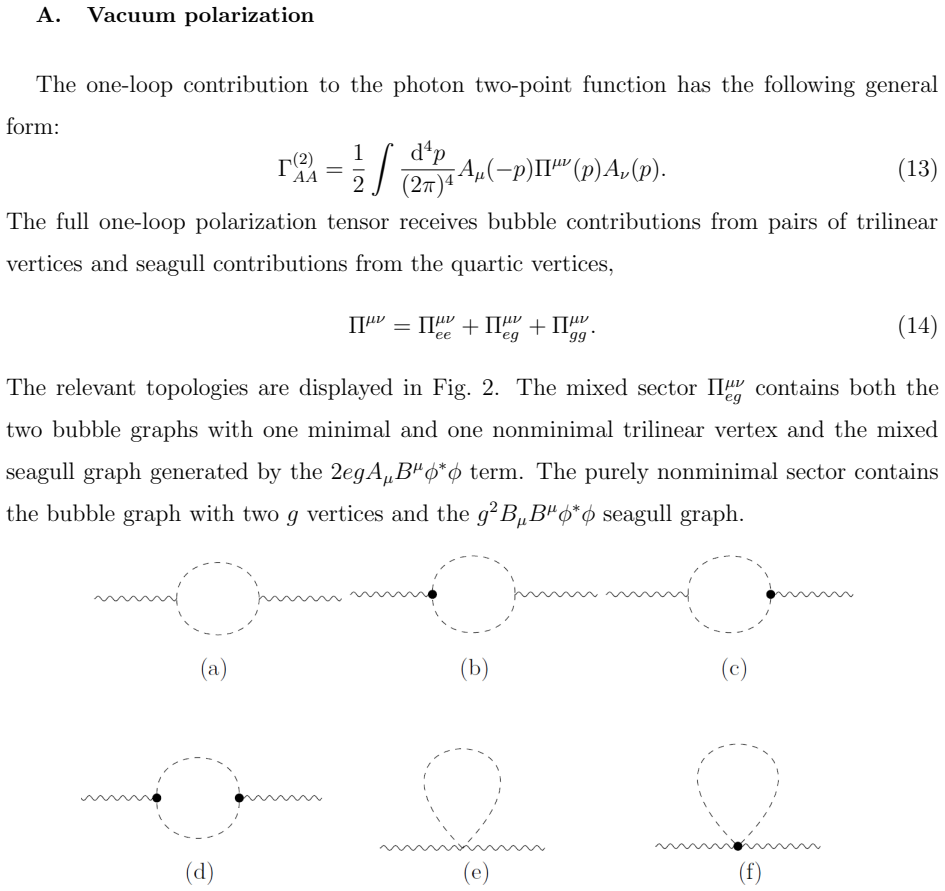
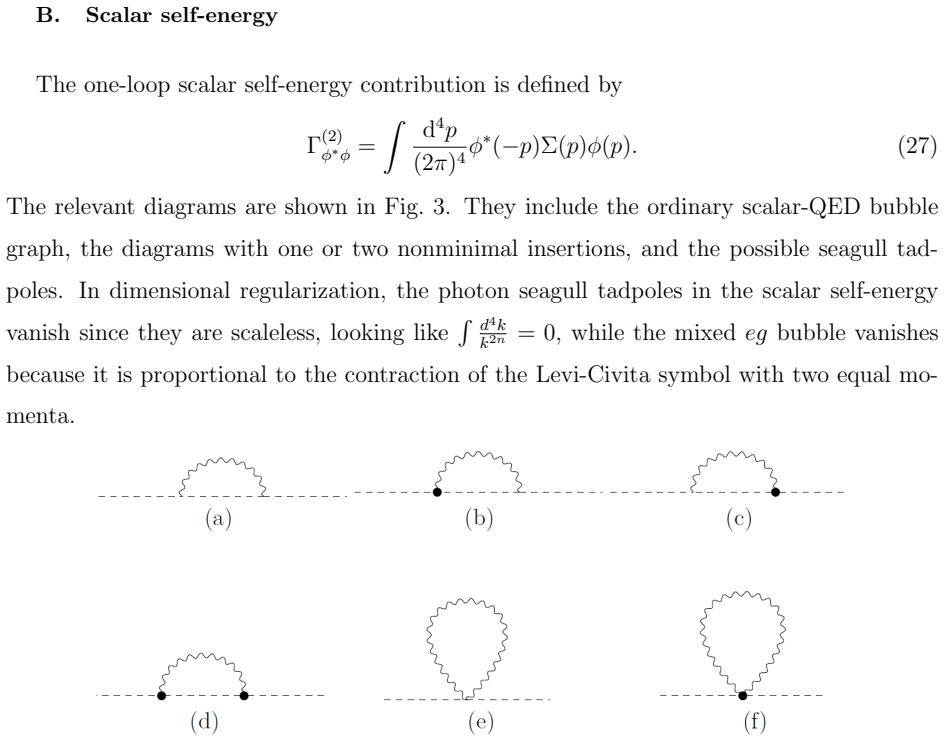
The complete photon two-point function remains transverse because the mass-dependent pieces generated by the mixed and purely nonminimal bubble graphs cancel against the corresponding seagull graphs, leaving higher-derivative CPT-odd and CPT-even LV gauge counterterms. The scalar self-energy generates LV kinetic and higher-derivative counterterms. Gauge invariance is preserved at one loop, with the nonminimal interaction understood within an effective-field-theory expansion.
What carries the argument
The generalized covariant derivative involving a constant background vector and the dual electromagnetic field strength, which generates the nonminimal vertices whose contributions cancel in the photon self-energy to enforce transversality.
If this is right
- Gauge invariance holds for the photon two-point function at one loop.
- Renormalization requires higher-derivative CPT-odd and CPT-even Lorentz-violating counterterms for the gauge field.
- The scalar self-energy requires additional Lorentz-violating kinetic and higher-derivative counterterms.
- The nonminimal coupling remains consistent inside an effective-field-theory framework.
Where Pith is reading between the lines
- Similar diagram cancellations may protect gauge invariance in other Lorentz-violating models that include nonminimal couplings of this type.
- The results suggest the theory remains renormalizable order by order within the effective expansion.
- Extending the calculation to include fermions or going to two loops would test whether the transversality mechanism persists.
Load-bearing premise
The nonminimal interaction is treated as part of an effective-field-theory expansion in which higher-order terms can be neglected.
What would settle it
An explicit one-loop calculation of the photon two-point function that yields a non-zero longitudinal component after all diagrams are summed would show the cancellation does not occur.
Figures

read the original abstract
In the context of pertubative aspects of Lorentz-violating theories, we study the divergent one-loop two-point functions of a Lorentz-violating (LV) extension of scalar QED containing a dimension-five CPT-odd nonminimal coupling. The model is defined through a generalized covariant derivative involving a constant background vector and the dual electromagnetic field strength. After expanding the action, we derive the full set of vertices relevant for the photon and scalar self-energies, including the mixed minimal-nonminimal seagull interaction diagram required by the gauge invariance. Using dimensional regularization, we compute the divergent parts of the vacuum polarization and scalar self-energy. The complete photon two-point function is shown to be transverse since the mass-dependent pieces generated by the mixed and purely nonminimal bubble graphs cancel against the corresponding seagull graphs, leaving higher-derivative CPT-odd and CPT-even LV gauge counterterms. The scalar self-energy generates LV kinetic and higher-derivative counterterms. The calculation confirms that gauge invariance is preserved, while the nonminimal interaction should be understood within an effective-field-theory expansion.
Editorial analysis
A structured set of objections, weighed in public.
Referee Report
Summary. The paper computes the divergent one-loop contributions to the photon and scalar two-point functions in a Lorentz-violating extension of scalar QED that incorporates a dimension-five CPT-odd nonminimal coupling through a generalized covariant derivative involving a constant background vector and the dual electromagnetic field strength. After deriving the full set of vertices (including the mixed minimal-nonminimal seagull term), the authors evaluate the diagrams in dimensional regularization. They report that mass-dependent pieces from the mixed and nonminimal bubble graphs cancel against the corresponding seagull contributions, rendering the photon self-energy transverse and leaving only higher-derivative CPT-odd and CPT-even LV gauge counterterms; the scalar self-energy yields LV kinetic and higher-derivative counterterms. The calculation is presented as confirming preservation of gauge invariance within an effective-field-theory framework.
Significance. If the reported diagram cancellations are verified, the work establishes that gauge invariance remains intact at one loop in this nonminimal LV model, providing explicit counterterm structures for higher-derivative operators. This is useful for consistency checks in perturbative LV extensions and for guiding EFT treatments of dimension-five operators. The explicit inclusion of all vertices required by the generalized derivative and the focus on transversality constitute concrete technical contributions.
minor comments (2)
- [Abstract] Abstract, line 1: 'pertubative' is a typographical error and should read 'perturbative'.
- The manuscript would benefit from an explicit listing or appendix tabulating all Feynman rules/vertices derived from the generalized covariant derivative, to facilitate independent verification of the diagram set.
Simulated Author's Rebuttal
We thank the referee for the positive summary, significance assessment, and recommendation of minor revision. The report correctly identifies the key technical result concerning diagram cancellations that preserve transversality of the photon self-energy.
Circularity Check
No significant circularity; explicit diagram computation
full rationale
The paper derives vertices from the generalized covariant derivative, computes one-loop integrals in dimensional regularization, and demonstrates explicit cancellations between bubble and seagull diagrams that enforce transversality of the photon two-point function. These cancellations are obtained directly from the Feynman rules and integral evaluations rather than imposed by definition or by fitting. No load-bearing self-citations, ansatze smuggled via prior work, or renaming of known results appear in the provided text. The central result is a standard perturbative verification of gauge invariance preservation, self-contained against external benchmarks.
Axiom & Free-Parameter Ledger
axioms (1)
- standard math Standard assumptions of perturbative quantum field theory and dimensional regularization
invented entities (1)
-
dimension-five CPT-odd nonminimal coupling
no independent evidence
Reference graph
Works this paper leans on
-
[1]
Within this paper, we formulate the CPT-odd scalar QED with nonminimal coupling and calculate the one-loop radiative correc- tions in it
for a review of perturbative impacts of such operators), no studies of higher-dimension LV operators in scalar QED were performed up to now. Within this paper, we formulate the CPT-odd scalar QED with nonminimal coupling and calculate the one-loop radiative correc- tions in it. Our main goal will be to calculate the one-loop contributions to the self-ener...
2025
-
[2]
V. A. Kosteleck´ y and N. Russell, Rev. Mod. Phys.83, 11 (2011) [arXiv:0801.0287 [hep-ph]]. 15
arXiv 2011
-
[3]
D. Colladay and V. A. Kosteleck´ y, Phys. Rev. D55, 6760 (1997) [arXiv:hep-ph/9703464]
Pith/arXiv arXiv 1997
-
[4]
D. Colladay and V. A. Kosteleck´ y, Phys. Rev. D58, 116002 (1998) [arXiv:hep-ph/9809521]
Pith/arXiv arXiv 1998
-
[5]
R. Jackiw and V. A. Kosteleck´ y, Phys. Rev. Lett.82, 3572 (1999) [arXiv:hep-ph/9901358]
Pith/arXiv arXiv 1999
-
[6]
S. M. Carroll, G. B. Field and R. Jackiw, Phys. Rev. D41, 1231 (1990)
1990
-
[7]
J. M. Chung and P. Oh, Phys. Rev. D60(1999), 067702 [arXiv:hep-th/9812132 [hep-th]]
Pith/arXiv arXiv 1999
-
[8]
J. M. Chung, Phys. Lett. B461(1999), 138-141 [arXiv:hep-th/9905095 [hep-th]]
Pith/arXiv arXiv 1999
-
[9]
V. A. Kostelecky and R. Lehnert, Phys. Rev. D63(2001), 065008 [arXiv:hep-th/0012060 [hep-th]]
Pith/arXiv arXiv 2001
-
[10]
V. A. Kostelecky, C. D. Lane and A. G. M. Pickering, Phys. Rev. D65(2002), 056006 [arXiv:hep-th/0111123 [hep-th]]
Pith/arXiv arXiv 2002
-
[11]
V. A. Kostelecky and A. G. M. Pickering, Phys. Rev. Lett.91(2003), 031801 [arXiv:hep- ph/0212382 [hep-ph]]
arXiv 2003
-
[12]
M. Cambiaso, R. Lehnert and R. Potting, Phys. Rev. D85(2012), 085023 [arXiv:1201.3045 [hep-th]]
Pith/arXiv arXiv 2012
-
[13]
Y. Ding and V. A. Kosteleck´ y, Phys. Rev. D94(2016) no.5, 056008 [arXiv:1608.07868 [hep- ph]]
Pith/arXiv arXiv 2016
-
[14]
A. P. Baeta Scarpelli, H. Belich, J. L. Boldo and J. A. Helayel-Neto, Phys. Rev. D67(2003), 085021
2003
-
[15]
L. C. T. Brito, H. G. Fargnoli and A. P. Baˆ eta Scarpelli, Phys. Rev. D87(2013) no.12, 125023 [arXiv:1304.6016 [hep-th]]
Pith/arXiv arXiv 2013
-
[16]
R. Casana, M. M. Ferreira, Jr., E. da Hora and A. B. F. Neves, Eur. Phys. J. C74(2014) no.9, 3064 [arXiv:1404.4678 [hep-th]]
Pith/arXiv arXiv 2014
-
[17]
R. Casana and G. Lazar, Phys. Rev. D90(2014) no.6, 065007 [arXiv:1408.5168 [hep-th]]
Pith/arXiv arXiv 2014
-
[18]
R. Casana, M. M. Ferreira and A. Lucena Mota, Annals Phys.375(2016), 179-192 [arXiv:1509.04989 [hep-th]]
Pith/arXiv arXiv 2016
-
[19]
A. P. Baˆ eta Scarpelli, J. C. C. Felipe, L. C. T. Brito and A. Y. Petrov, Mod. Phys. Lett. A 37, 2250100 (2022) [arXiv:2111.14257 [hep-th]]
arXiv 2022
-
[20]
B. Altschul, L. C. T. Brito, J. C. C. Felipe, S. Karki, A. C. Lehum and A. Y. Petrov, Phys. Rev. D107, 045005 (2023) [arXiv:2211.11399 [hep-th]]
arXiv 2023
-
[21]
L. C. T. Brito, J. C. C. Felipe, A. C. Lehum and A. Y. Petrov, Eur. Phys. J. Plus139, 90 (2024) [arXiv:2306.08488 [hep-th]]. 16
arXiv 2024
-
[22]
A. C. Lehum, J. R. Nascimento and A. Y. Petrov, Phys. Lett. B850, 138519 (2024) [arXiv:2310.15715 [hep-th]]
arXiv 2024
-
[23]
C. W. Murphy, JHEP10(2020), 174 [arXiv:2005.00059 [hep-ph]]
arXiv 2020
-
[24]
V. A. Kostelecky and M. Mewes, Phys. Rev. D80(2009), 015020 [arXiv:0905.0031 [hep-ph]]
Pith/arXiv arXiv 2009
-
[25]
V. A. Kosteleck´ y and Z. Li, Phys. Rev. D99(2019) no.5, 056016 [arXiv:1812.11672 [hep-ph]]
Pith/arXiv arXiv 2019
-
[26]
A. F. Ferrari, J. R. Nascimento and A. Y. Petrov, Eur. Phys. J. C80, 459 (2020) [arXiv:1812.01702 [hep-th]]
arXiv 2020
-
[27]
M. Gomes, J. R. Nascimento, A. Y. Petrov and A. J. da Silva, Phys. Rev. D81(2010), 045018 [arXiv:0911.3548 [hep-th]]
Pith/arXiv arXiv 2010
-
[28]
R. Casana, M. M. Ferreira, Jr., R. V. Maluf and F. E. P. dos Santos, Phys. Lett. B726, 815 (2013) [arXiv:1302.2375 [hep-th]]
Pith/arXiv arXiv 2013
-
[29]
R. Casana, M. M. Ferreira, Jr. and F. E. P. dos Santos, Phys. Rev. D90, 105025 (2014) [arXiv:1408.4829 [hep-th]]
Pith/arXiv arXiv 2014
-
[30]
R. Casana, M. M. Ferreira, L. Lisboa-Santos, F. E. P. dos Santos and M. Schreck, Phys. Rev. D97(2018) no.11, 115043 [arXiv:1802.07890 [hep-th]]
Pith/arXiv arXiv 2018
-
[31]
T. Mariz, Phys. Rev. D83(2011), 045018 [arXiv:1010.5013 [hep-th]]. 17
Pith/arXiv arXiv 2011
discussion (0)
Sign in with ORCID, Apple, or X to comment. Anyone can read and Pith papers without signing in.