Affine quantization of the dynamical Reissner--Nordstr\"om region
Pith reviewed 2026-06-26 07:24 UTC · model grok-4.3
The pith
Affine quantization of the Reissner-Nordström dynamical region produces a separable Wheeler-DeWitt equation with Hermite-polynomial and Gaussian solutions.
A machine-rendered reading of the paper's core claim, the machinery that carries it, and where it could break.
Core claim
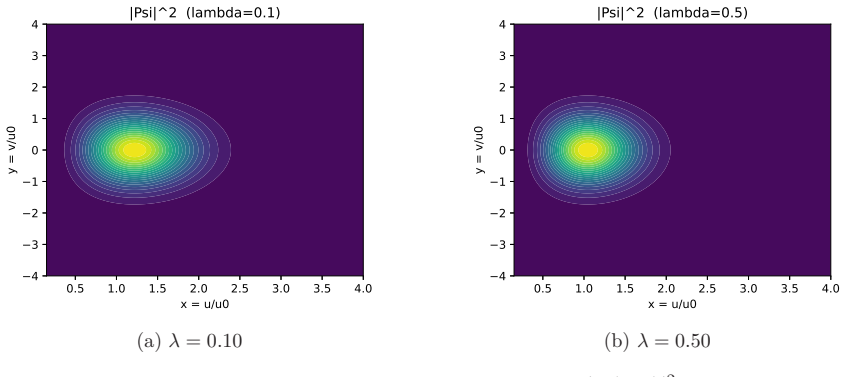
In the minisuperspace reduction of the dynamical Reissner-Nordström geometry, affine quantization converts the Wheeler-DeWitt equation into a separable form whose solutions are Hermite polynomials in one coordinate sector and Gaussian-like radial functions in the other; the affine terms supply additional short-distance contributions that modify the small-radius behavior of the wave function relative to canonical quantization, while normalizable semiclassical packets reveal how electric charge influences the resulting probability distributions.
What carries the argument
Affine quantization applied to positive-definite minisuperspace variables, which supplies a specific operator representation and short-distance corrections to the Wheeler-DeWitt operator.
If this is right
- The wave function acquires extra short-distance support that alters its behavior at vanishing radius.
- Semiclassical wave packets remain normalizable and permit explicit computation of probability distributions in minisuperspace.
- Electric charge enters the quantum dynamics through the radial sector and modifies the packet evolution.
- The same affine procedure extends directly from the neutral Schwarzschild case to the charged geometry.
Where Pith is reading between the lines
- The same separation technique may apply to other charged or rotating black-hole interiors once their minisuperspace reductions are written.
- The short-distance modification could be tested by comparing the affine wave function against numerical solutions of the full Wheeler-DeWitt equation on a lattice.
- If the affine corrections survive in a more complete theory, they would generically soften the classical singularity at r=0.
Load-bearing premise
The minisuperspace reduction captures the essential quantum dynamics of the dynamical region of the Reissner-Nordström geometry.
What would settle it
A full (non-minisuperspace) quantization of the same geometry that produces a non-separable Wheeler-DeWitt equation or wave functions lacking the reported small-radius modification would falsify the central claim.
Figures
read the original abstract
We study the quantum dynamics of the dynamical region of the Reissner--Nordstr\"om geometry using a minisuperspace reduction and affine quantization, which is naturally suited for positive-definite geometrical variables. The resulting Wheeler--DeWitt equation becomes separable, yielding Hermite-polynomial modes in one sector and Gaussian-like radial solutions in the other. Affine quantization introduces additional short-distance contributions that modify the small-radius behaviour of the wave function. By constructing normalizable semiclassical wave packets, we analyze the resulting probability distributions in minisuperspace and the role played by the electric charge in the quantum dynamics. Our results extend previous affine-quantization studies of the Schwarzschild case to the charged Reissner--Nordstr\"om geometry.
Editorial analysis
A structured set of objections, weighed in public.
Referee Report
Summary. The paper applies affine quantization to a minisuperspace reduction of the dynamical region of the Reissner-Nordström geometry. It shows that the resulting Wheeler-DeWitt equation is separable, with solutions consisting of Hermite-polynomial modes in one sector and Gaussian-like radial functions in the other; affine quantization adds short-distance corrections that alter the small-radius wave-function behavior. Normalizable semiclassical wave packets are constructed to study probability distributions in minisuperspace and the influence of the electric charge, extending prior Schwarzschild results.
Significance. If the derivations hold, the work supplies an explicit, separable quantization of the charged dynamical region with concrete solution forms and wave-packet analysis. The extension from the Schwarzschild case demonstrates that affine quantization remains tractable for the RN geometry and yields charge-dependent modifications at short distances, which may serve as a benchmark for further minisuperspace studies in quantum gravity.
minor comments (2)
- [§3] §3 (or equivalent derivation section): the separation constants and the precise form of the affine-quantized potential term should be written explicitly so that the Hermite and Gaussian solutions can be verified by direct substitution.
- The normalization integrals for the semiclassical wave packets are stated to converge but the explicit parameter ranges (especially the charge dependence) are not tabulated; adding a short table or plot of the allowed parameter window would improve reproducibility.
Simulated Author's Rebuttal
We thank the referee for the positive assessment of our work on affine quantization of the dynamical Reissner-Nordström region and for recommending minor revision. No specific major comments appear in the report.
Circularity Check
No significant circularity; derivation is self-contained
full rationale
The paper performs a direct minisuperspace reduction of the Reissner-Nordström dynamical region, applies affine quantization to obtain a separable Wheeler-DeWitt equation, and derives explicit Hermite-polynomial and Gaussian-like solutions plus short-distance modifications. These steps are presented as explicit calculations within the chosen model, with the extension from prior Schwarzschild work serving only as context rather than a load-bearing premise that reduces the new results to fitted inputs or self-citations by construction. No self-definitional loops, fitted predictions, or ansatz smuggling are exhibited in the stated claims.
Axiom & Free-Parameter Ledger
Reference graph
Works this paper leans on
-
[1]
C. W. Misner, K. S. Thorne and J. A. Wheeler, Gravitation (W. H. Freeman, 1973)
1973
-
[2]
Internal structure of black ho les
E. Poisson and W. Israel, “Internal structure of black ho les”, Phys. Rev. D 41 (1990) 1796
1990
-
[3]
Black hole singularities: a n umerical approach
P. R. Brady and J. D. Smith, “Black hole singularities: a n umerical approach”, Phys. Rev. Lett. 75 (1995) 1256
1995
-
[4]
Geometrodynamics of Schwarzschild blac k holes
K. V. Kuchaˇ r, “Geometrodynamics of Schwarzschild blac k holes”, Phys. Rev. D 50 (1994) 3961 (arXiv: gr-qc/9403003)
Pith/arXiv arXiv 1994
-
[5]
Nonsingular black holes and degrees of fre edom in quantum gravity
M. Bojowald, “Nonsingular black holes and degrees of fre edom in quantum gravity”, Phys. Rev. Lett. 95 (2005) 061301 (arXiv: gr-qc/0506128)
Pith/arXiv arXiv 2005
-
[6]
Black holes in loop quantum gravity
A. Perez, “Black holes in loop quantum gravity”, Rep. Prog. Phys. 80 (2017) 126901 (arXiv: 1703.09149 [gr-qc])
Pith/arXiv arXiv 2017
-
[7]
Vakili, ”Quantization of the Schwarzschild black hol e: a Noether symmetry ap- proach”, Int
B. Vakili, ”Quantization of the Schwarzschild black hol e: a Noether symmetry ap- proach”, Int. J. Theor. Phys. 51 (2012) 133 (arXiv: 1102.1682 [gr-qc])
Pith/arXiv arXiv 2012
-
[8]
M. Amirfakhrian and B. Vakili, ”Polymer deformation and particle tunneling from Schwarzschild black hole”, Int. J. Geom. Methods Mod. Phys. 16 (2019) 1950038 (arXiv: 1812.10301 [gr-qc])
Pith/arXiv arXiv 2019
-
[9]
S. Jalalzadeh and B. Vakili, ”Quantization of the interi or Schwarzschild black hole”, Int. J. Theor. Phys. 51 (2012) 263 (arXiv: 1108.1337 [gr-qc])
Pith/arXiv arXiv 2012
-
[10]
Modesto, ”Loop quantum black hole”, Class
L. Modesto, ”Loop quantum black hole”, Class. Quantum Grav. 23 (2006) 5587 (arXiv: gr-qc/0509078)
Pith/arXiv arXiv 2006
-
[11]
Vakili, ”Classical polymerization of the Schwarzsc hild metric”, Adv
B. Vakili, ”Classical polymerization of the Schwarzsc hild metric”, Adv. High Energy Phys. (2018) 3610543 (arXiv: 1806.01837 [hep-th])
Pith/arXiv arXiv 2018
-
[12]
G. S. Djordjevic, L. Nesic and D. Radovancevic, ”Two-os cillator Kantowski-Sachs model of the Schwarzschild black hole interior”, Gen. Relativ. Gravit. 48 (2016) 1 (arXiv: 1510.00887 [gr-qc])
Pith/arXiv arXiv 2016
-
[13]
A. Corichi and P. Singh, ”Loop quantization of the Schwa rzschild interior revisited”, Class. Quantum Grav. 33 (2016) 055006 (arXiv: 1506.08015 [gr-qc])
Pith/arXiv arXiv 2016
-
[14]
E. W. Aslaksen and J. R. Klauder, ”Unitary Representati ons of the Affine Group”, J. Math. Phys. 9 (1968) 206 16
1968
-
[15]
E. W. Aslaksen and J. R. Klauder, ”Continuous Represent ation Theory Using the Affine Group”, J. Math. Phys. 10 (1969) 2267
1969
-
[16]
Enhanced quantization: A primer
J. R. Klauder, “Enhanced quantization: A primer”, J. Phys. A 45 (2012) 285304
2012
-
[17]
M. Bajand and B. Vakili, ”Affine Quantization of the Inter ior Schwarzschild Black Hole”, Int. J. Mod. Phys. D 34 (2025) 2550068 (arXiv: 2507.23288 [gr-qc])
arXiv 2025
-
[18]
S. Twareque Ali and M. Engliˇ s, ”Quantization Methods: A Guide for Physicists and Analysts”, Rev. Math. Phys. 17 (2005) 391 (arXiv: math-ph/0405065)
Pith/arXiv arXiv 2005
-
[19]
C. K. Zachos, D. B. Fairlie and T. L. Curtright, Quantum Mechanics in Phase Space (Word Scientific, Singapore, 2005)
2005
-
[20]
T. L. Curtright, D. B. Fairlie and C. K. Zachos, A Concise Treatise on Quantum Mechanics in Phase Space (Word Scientific, Singapore, 2016)
2016
-
[21]
H. Bergeron, A. Dapor, J. P. Gazeau and P. Malkiewicz, ”S mooth big bounce from affine quantization”, Phys. Rev. D 89 (2014) 083522 (arXiv: 1305.0653 [gr-qc])
Pith/arXiv arXiv 2014
-
[22]
H. Bergeron, E. Gazuchry, J. P. Gazeau, P. Malkiewicz an d W. Piechocki, ”Smooth quantum dynamics of the mixmaster universe”, Phys. Rev. D 92 (2015) 061302 (arXiv: 1501.02174 [gr-qc])
Pith/arXiv arXiv 2015
-
[23]
E. Frion and C. R. Almeida, ”Affine quantization of the Bra ns-Dicke theory: Smooth bouncing and the equivalence between the Einstein and Jorda n frames”, Phys. Rev. D 99 (2019) 023524 (arXiv: 1810.00707 [gr-qc])
Pith/arXiv arXiv 2019
-
[24]
S. Zonetti, ”Affine quantization of black holes: Thermod ynamics, singularity removal, and displaced horizons”, Phys. Rev. D 90 (2014) 064046 (arXiv: 1409.1761 [hep-th])
Pith/arXiv arXiv 2014
-
[25]
C. R. Almeida and D. C. Rodrigues, ”Quantization of a Bla ck-Hole Gravity: ge- ometrodynamics and the quantum phase-space formalism”, Class. Quantum Grav. 40 (2023) 035004 (arXiv: 2111.13575 [gr-qc])
arXiv 2023
-
[26]
J. P. Gazeau, Coherent States in Quantum Physics (Wiley-VCH, Weinheim, Germany, 2009) 17
2009
discussion (0)
Sign in with ORCID, Apple, or X to comment. Anyone can read and Pith papers without signing in.