Reentrant superconductivity enabled by spin-orbit coupling: Application to UTe₂
Pith reviewed 2026-06-26 06:08 UTC · model grok-4.3
The pith
Spin-orbit coupling combined with sublattice structure enhances opposite-spin pairing to produce reentrant superconductivity in UTe2.
A machine-rendered reading of the paper's core claim, the machinery that carries it, and where it could break.
Core claim
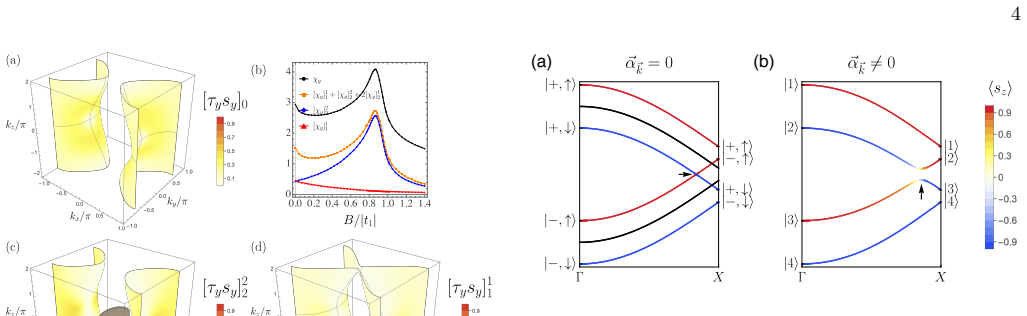
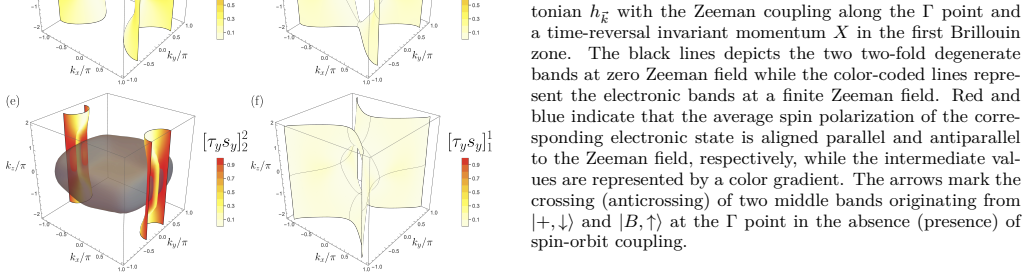
Our analytical treatment shows that the reentrance has its origin in the interplay of the sublattice degrees of freedom and spin-orbit coupling, which can strikingly enhance opposite-spin Cooper pairings at strong Zeeman fields. Based on these results, we show that a pairing state with B3u symmetry can reproduce the highly anisotropic phase diagram of the reentrant superconducting state of UTe2.
What carries the argument
The interplay of sublattice degrees of freedom and spin-orbit coupling that enhances opposite-spin Cooper pairings at strong Zeeman fields.
If this is right
- Reentrant superconductivity follows generically from sublattice-SOC interplay and does not require magnetism or a quantum critical point.
- A B3u pairing state accounts for the strong anisotropy seen in UTe2's reentrant phase diagram.
- The field enhancement of opposite-spin pairings occurs at strong Zeeman fields through the sublattice-SOC mechanism.
Where Pith is reading between the lines
- The same sublattice-SOC route could produce reentrance in other compounds that possess comparable crystal structures even if they lack heavy-fermion character.
- Pressure or doping experiments that tune the strength of spin-orbit coupling relative to Zeeman energy could isolate this mechanism from competing explanations.
- Spectroscopic probes that resolve sublattice-projected bands would provide a direct test of whether the predicted pairing enhancement is active.
Load-bearing premise
B3u pairing symmetry is the order parameter in UTe2 and sublattice-spin-orbit coupling dominates the field dependence without major contributions from other mechanisms such as magnetic fluctuations.
What would settle it
A calculation showing no enhancement of opposite-spin pairing at high Zeeman fields when both sublattice degrees of freedom and spin-orbit coupling are included would falsify the proposed origin of reentrance.
Figures

read the original abstract
Reentrant superconductivity has been understood primarily in terms of the Jaccarino-Peter field-compensation effect or from a change of the strength in the pairing interaction. However, neither mechanism appears able to entirely explain the remarkable phase diagram of UTe$_2$. Here we propose a generic theory of the field-enhancement of opposite-spin Cooper pairings which does not necessitate the coexistence of magnetism or the vicinity of a magnetic quantum critical point. Our analytical treatment shows that the reentrance has its origin in the interplay of the sublattice degrees of freedom and spin-orbit coupling, which can can strikingly enhance opposite-spin Cooper pairings at strong Zeeman fields. Based on these results, we show that a pairing state with B$_{3u}$ symmetry can reproduce the highly anisotropic phase diagram of the reentrant superconducting state of UTe$_2$.
Editorial analysis
A structured set of objections, weighed in public.
Referee Report
Summary. The manuscript develops an analytical theory of reentrant superconductivity arising from the interplay between sublattice degrees of freedom and spin-orbit coupling. This mechanism is shown to enhance opposite-spin Cooper pairings at strong Zeeman fields without requiring magnetic order or a nearby quantum critical point. The authors then demonstrate that a B3u pairing state reproduces the highly anisotropic reentrant phase diagram observed in UTe2.
Significance. If the derivations hold, the work supplies a generic, magnetism-independent route to field-enhanced superconductivity that could apply beyond UTe2. The analytical treatment is a positive feature when it yields explicit, testable expressions for the field dependence.
major comments (2)
- [§4, Eq. (18)] §4, Eq. (18): the enhancement of opposite-spin pairing is derived after projection onto the B3u irreducible representation; the text does not show that the same enhancement occurs for other candidate symmetries or without presupposing B3u is realized in UTe2. This assumption is load-bearing for the claim that the mechanism is generic.
- [§5.2, Fig. 4] §5.2, Fig. 4: the reproduction of the experimental phase diagram anisotropy is presented as a direct consequence of the B3u state, yet the comparison appears to require a specific choice of the SOC strength and Zeeman-field orientation; it is unclear whether the anisotropy emerges parameter-free or after tuning.
minor comments (2)
- The abstract states that the treatment is 'analytical' but the main text should explicitly list the microscopic Hamiltonian (including the precise form of the sublattice-SOC term) in an early section so that the derivation can be followed without reference to prior works.
- Notation for the Zeeman field direction and the sublattice index should be unified between the model definition and the phase-diagram plots.
Simulated Author's Rebuttal
We thank the referee for the careful reading and constructive comments. We respond point by point to the major comments below.
read point-by-point responses
-
Referee: [§4, Eq. (18)] the enhancement of opposite-spin pairing is derived after projection onto the B3u irreducible representation; the text does not show that the same enhancement occurs for other candidate symmetries or without presupposing B3u is realized in UTe2. This assumption is load-bearing for the claim that the mechanism is generic.
Authors: The explicit calculation in Eq. (18) is performed after projection onto the B3u channel because that symmetry is the one relevant for reproducing the UTe2 phase diagram. The underlying enhancement, however, originates in the normal-state Hamiltonian from the interplay of sublattice and spin-orbit degrees of freedom and is therefore independent of the pairing symmetry at the level of the Zeeman response. The projection merely selects which pairing channels receive the benefit. We will add a brief general discussion (without presupposing B3u) showing that the same field-induced increase appears for any pairing symmetry permitting opposite-spin components, thereby clarifying the generic character of the mechanism. revision: yes
-
Referee: [§5.2, Fig. 4] the reproduction of the experimental phase diagram anisotropy is presented as a direct consequence of the B3u state, yet the comparison appears to require a specific choice of the SOC strength and Zeeman-field orientation; it is unclear whether the anisotropy emerges parameter-free or after tuning.
Authors: The directional selectivity of the reentrant superconductivity (reentrance only for fields along particular axes) is fixed by the B3u representation and the symmetry-allowed SOC terms; no additional parameters beyond the overall SOC scale are introduced to produce this anisotropy. The SOC magnitude itself is chosen to set the absolute field scale, as is standard when comparing to experiment. We will revise the text and figure caption to separate the symmetry-protected anisotropy from the single overall scale factor. revision: partial
Circularity Check
No circularity: analytical derivation stands on model equations without reduction to inputs
full rationale
The paper's central claim rests on an analytical treatment showing reentrance from sublattice-SOC interplay enhancing opposite-spin pairings, with a B3u state reproducing the UTe2 phase diagram. The provided abstract and description contain no quoted equations or steps that reduce by construction to fitted parameters, self-definitions, or self-citation chains. No load-bearing self-citations or ansatzes smuggled via prior work are indicated. The derivation is presented as independent of the target result, consistent with a self-contained model analysis.
Axiom & Free-Parameter Ledger
axioms (2)
- domain assumption Mean-field treatment of superconducting pairing
- domain assumption B3u symmetry is realized in UTe2
Reference graph
Works this paper leans on
-
[1]
D. Aoki, K. Ishida, and J. Flouquet, Review of U- based ferromagnetic superconductors: Comparison be- tween UGe2, URhGe, and UCoGe, J. Phys. Soc. Jpn. 88, 1 (2019)
2019
-
[2]
Llanos, V
A. Llanos, V. Show, R. Dorrian, and J. Falson, Field- induced superconductivity in a magnetically doped two- dimensional crystal, Nat. Phys.22, 856 (2026)
2026
-
[3]
S. Uji, H. Shinagawa, T. Terashima, T. Yakabe, Y. Terai, M. Tokumoto, A. Kobayashi, H. Tanaka, and H. Kobayashi, Magnetic-field-induced superconductivity in a two-dimensional organic conductor, Nature410, 908 (2001)
2001
-
[4]
Konoike, S
T. Konoike, S. Uji, T. Terashima, M. Nishimura, S. Yasuzuka, K. Enomoto, H. Fujiwara, B. Zhang, and H. Kobayashi, Magnetic-field-induced superconduc- tivity in the antiferromagnetic organic superconductor κ−(BETS)2FeBr4, Phys. Rev. B70, 094514 (2004)
2004
-
[5]
F. Levy, I. Sheikin, B. Grenier, and A. D. Huxley, Mag- netic field-induced superconductivity in the ferromagnet URhGe, Science309, 1343 (2005)
2005
-
[6]
S. K. Lewin, C. E. Frank, S. Ran, J. Paglione, and N. P. Butch, A review of UTe2 at high magnetic fields, Rep. Prog. Phys.86, 114501 (2023)
2023
-
[7]
M. Yang, J. Tang, X. Wu, H. Wang, W. Xu, H. Huang, Z. Pei, W. Meng, G. Kuang, M. Yang, J. Xu, S. Hu, 6 J. Wang, L. Li, Z. Wang, C. Xi, L. Pi, Q. Lu, Z. Wang, Q.-K. Xue, Z. Chen, and D. Li, Field re-entrant super- conductivityinEu-dopedinfinite-layernickelates,Nature 653, 1052 (2026)
2026
-
[8]
Jaccarino and M
V. Jaccarino and M. Peter, Ultra-high-field superconduc- tivity, Phys. Rev. Lett.9, 290 (1962)
1962
-
[9]
Z. Wu, T. I. Weinberger, A. J. Hickey, D. V. Chichinadze, D. Shaffer, A. Cabala, H. Chen, M. Long, T. J. Brumm, W. Xie, Y. Ling, Z. Zhu, Y. Skourski, D. E. Graf, V. Se- chovský, M. Vališka, G. G. Lonzarich, F. M. Grosche, and A. G. Eaton, A Quantum Critical Line Bounds the High Field Metamagnetic Transition Surface inUTe2, Phys. Rev. X15, 021019 (2025)
2025
-
[10]
Hattori and H
K. Hattori and H. Tsunetsugu,p-wave superconductiv- ity near a transverse saturation field, Phys. Rev. B87, 064501 (2013)
2013
-
[11]
S. Ran, C. Eckberg, Q. P. Ding, Y. Furukawa, T. Metz, S. R. Saha, I. L. Liu, M. Zic, H. Kim, J. Paglione, and N. P. Butch, Nearly ferromagnetic spin-triplet supercon- ductivity, Science365, 684 (2019)
2019
-
[12]
Zambra, A
V. Zambra, A. Nathwani, M. Nauman, S. K. Lewin, C. E. Frank, N. P. Butch, A. Shekhter, B. J. Ramshaw, and K. A. Modic, Giant transverse magnetic fluctuations at the edge of re-entrant superconductivity in UTe2, Nat. Commun.17, 3742 (2026)
2026
-
[13]
Vasina, D
T. Vasina, D. Aoki, A. Miyake, G. Seyfarth, A. Pourret, C. Marcenat, M. Amano Patino, G. Lapertot, J. Flou- quet, J.-P. Brison, D. Braithwaite, and G. Knebel, Con- necting High-Field and High-Pressure Superconductivity inUTe 2, Phys. Rev. Lett.134, 096501 (2025)
2025
-
[14]
Shishidou, H
T. Shishidou, H. G. Suh, P. M. R. Brydon, M. Weinert, and D. F. Agterberg, Topological band and superconduc- tivity inUTe2, Phys. Rev. B103, 104504 (2021)
2021
- [15]
-
[16]
J.J.Yu, Y.Yu, D.F.Agterberg,andS.Raghu,Theoryof the low- and high-field superconducting phases ofUTe2, Phys. Rev. B107, 214510 (2023)
2023
-
[17]
J. Tei, T. Mizushima, and S. Fujimoto, Pairing symme- triesofmultiplesuperconductingphasesinUTe 2: compe- tition between ferromagnetic and antiferromagnetic fluc- tuations, Phys. Rev. B109, 064516 (2024)
2024
-
[18]
S. Ando, S. Kobayashi, A. P. Schnyder, Y. Asano, and S. Ikegaya, Oscillating-charged Andreev bound states and their appearance inUTe2, Phys. Rev. B112, 094506 (2025)
2025
-
[19]
Y.Xu, Y.Sheng,andY.-f.Yang,Quasi-Two-Dimensional Fermi Surfaces and Unitary Spin-Triplet Pairing in the Heavy Fermion SuperconductorUTe2, Phys. Rev. Lett. 123, 217002 (2019)
2019
-
[20]
Knafo, T
W. Knafo, T. Thebault, S. Raymond, P. Manuel, D. D. Khalyavin, F. Orlandi, E. Ressouche, K. Beauvois, G. Lapertot, K. Kaneko, D. Aoki, D. Braithwaite, and G.Knebel,IncommensurateAntiferromagnetisminUTe 2 under Pressure, Phys. Rev. X15, 021075 (2025)
2025
-
[21]
Miyake, Y
A. Miyake, Y. Shimizu, Y. J. Sato, D. Li, A. Nakamura, Y. Homma, F. Honda, J. Flouquet, M. Tokunaga, and D. Aoki, Metamagnetic Transition in Heavy Fermion Su- perconductorUTe 2,J.Phys.Soc.Jpn.88,063706(2019)
2019
-
[22]
Ramires, D
A. Ramires, D. F. Agterberg, and M. Sigrist, TailoringTc by symmetry principles: The concept of superconducting fitness, Phys. Rev. B98, 024501 (2018)
2018
-
[23]
D. C. Cavanagh, D. F. Agterberg, and P. M. R. Brydon, Pair breaking in superconductors with strong spin-orbit coupling, Phys. Rev. B107, L060504 (2023)
2023
-
[24]
See the Supplemental Material at [URL will be inserted by publisher] providing block diagonalization of the4×4 Hamiltonian, intraband component of the superconduct- ing fitness from the other pairing channels, and the phase diagrams obtained with different parameters
-
[25]
Ishizuka, S
J. Ishizuka, S. Sumita, A. Daido, and Y. Yanase, Insulator-Metal Transition and Topological Supercon- ductivity inUTe 2 from a First-Principles Calculation, Phys. Rev. Lett.123, 217001 (2019)
2019
-
[26]
D. Aoki, I. Sheikin, A. McCollam, J. Ishizuka, Y. Yanase, G. Lapertot, J. Flouquet, and G. Knebel, de Haas-van Alphen Oscillations for the Field Along c-axis in UTe2, J. Phys. Soc. Jpn.92, 065002 (2023)
2023
-
[27]
A. G. Eaton, T. I. Weinberger, N. J. M. Popiel, Z. Wu, A. J. Hickey, A. Cabala, J. Pospíšil, J. Prokleška, T. Haidamak, G. Bastien, P. Opletal, H. Sakai, Y. Haga, R. Nowell, S. M. Benjamin, V. Sechovský, G. G. Lon- zarich, F. M. Grosche, and M. Vališka, Quasi-2D Fermi surface in the anomalous superconductor UTe 2, Nat. Commun.15, 223 (2024)
2024
-
[28]
L. Miao, S. Liu, Y. Xu, E. C. Kotta, C.-J. Kang, S. Ran, J. Paglione, G. Kotliar, N. P. Butch, J. D. Denlinger, and L. A. Wray, Low Energy Band Structure and Symme- tries ofUTe 2 from Angle-Resolved Photoemission Spec- troscopy, Phys. Rev. Lett.124, 076401 (2020)
2020
-
[29]
H. C. Choi, S. H. Lee, and B.-J. Yang, Correlated nor- mal state fermiology and topological superconductivity in UTe2, Commun. Phys.7, 273 (2024)
2024
-
[30]
Sundermann, T
M. Sundermann, T. Okauchi, N. Ito, D. S. Christovam, A. Marino, D. Takegami, A. Gloskovskii, P. F. S. Rosa, J. Kuneš, S.-i. Fujimori, L. H. Tjeng, A. Severing, and A. Hariki,UTe 2: A narrow-band superconductor, Phys. Rev. Res.7, 043195 (2025)
2025
-
[31]
L. Jiao, S. Howard, S. Ran, Z. Wang, J. O. Rodriguez, M. Sigrist, Z. Wang, N. P. Butch, and V. Madhavan, Chiral superconductivity in heavy-fermion metal UTe2, Nature (London)579, 523 (2020)
2020
-
[32]
Y. S. Eo, S. Liu, S. R. Saha, H. Kim, S. Ran, J. A. Horn, H. Hodovanets, J. Collini, T. Metz, W. T. Fuhrman, A. H. Nevidomskyy, J. D. Denlinger, N. P. Butch, M. S. Fuhrer, L. A. Wray, and J. Paglione, c-axis transport in UTe2: Evidence of three-dimensional conductivity com- ponent, Phys. Rev. B106, L060505 (2022)
2022
-
[33]
N. Azari, M. Yakovlev, S. R. Dunsiger, O. P. Uzoh, E. Mun, B. M. Huddart, S. J. Blundell, M. M. Borde- lon, S. M. Thomas, J. D. Thompson, P. F. S. Rosa, and J. E. Sonier, Coexistence of Kondo Coherence and Local- ized Magnetic Moments in the Normal State of Molten Salt-Flux Grown UTe2 (2025), arXiv:2501.13178
arXiv 2025
-
[34]
M. Vališka, T. Haidamak, A. Cabala, P. Proschek, A. Hausprug, S. Zherlitsyn, and V. Sechovský, Ther- modynamic Identification of the Internal Superconduct- ing Phase Boundary in UTe 2 forH∥b(2026), arXiv:2604.25896
Pith/arXiv arXiv 2026
-
[35]
Sakai, Y
H. Sakai, Y. Tokiwa, P. Opletal, M. Kimata, S. Awaji, T. Sasaki, D. Aoki, S. Kambe, Y. Tokunaga, and Y.Haga,FieldInducedMultipleSuperconductingPhases inUTe 2 along Hard Magnetic Axis, Phys. Rev. Lett.130, 196002 (2023)
2023
-
[36]
Kinjo, H
K. Kinjo, H. Fujibayashi, S. Kitagawa, K. Ishida, Y. Tokunaga, H. Sakai, S. Kambe, A. Nakamura, 7 Y. Shimizu, Y. Homma, D. X. Li, F. Honda, D. Aoki, K. Hiraki, M. Kimata, and T. Sasaki, Change of super- conducting character in UTe2 induced by magnetic field, Phys. Rev. B107, L060502 (2023)
2023
-
[37]
Matsumura, H
H. Matsumura, H. Fujibayashi, K. Kinjo, S. Kitagawa, K. Ishida, Y. Tokunaga, H. Sakai, S. Kambe, A. Naka- mura, Y. Shimizu, Y. Homma, D. Li, F. Honda, and D. Aoki, Large Reduction in the a-axis Knight Shift on UTe2 with Tc = 2.1 K, J. Phys. Soc. Jpn.92, 063701 (2023)
2023
-
[38]
Suetsugu, M
S. Suetsugu, M. Shimomura, M. Kamimura, T. Asaba, H. Asaeda, Y. Kosuge, Y. Sekino, S. Ikemori, Y. Kasa- hara, Y. Kohsaka, M. Lee, Y. Yanase, H. Sakai, P. Ople- tal, Y. Tokiwa, Y. Haga, and Y. Matsuda, Fully gapped pairing state in spin-triplet superconductor ute2, Science Advances10, eadk3772 (2024)
2024
-
[39]
Theuss, A
F. Theuss, A. Shragai, G. Grissonnanche, I. M. Hayes, S. R. Saha, Y. S. Eo, A. Suarez, T. Shishidou, N. P. Butch, J. Paglione, and B. J. Ramshaw, Single- component superconductivity in UTe2 at ambient pres- sure, Nat. Phys.20, 1124 (2024)
2024
-
[40]
S. Lee, A. J. Woods, P. F. S. Rosa, S. M. Thomas, E. D. Bauer, S.-Z. Lin, and R. Movshovich, Anisotropic field- induced changes in the superconducting order parameter ofUTe 2, Phys. Rev. Res.7, L022053 (2025)
2025
-
[41]
H. G. Suh, Y. Yu, T. Shishidou, M. Weinert, P. M. R. Brydon, and D. F. Agterberg, Superconductivity of anomalous pseudospin in nonsymmorphic materials, Phys. Rev. Research5, 033204 (2023). 8 END MA TTER
2023
-
[42]
Eigenvectors of the Hamiltonian in Eq.(1) The eigenenergies of the Hamiltonian in Eq. (1) with the Zeeman fieldBalong they-axis are given by ξ1,⃗k =ε0,⃗k + √ (ε∥,⃗k +B) 2 +α2 ⊥,⃗k,(12) ξ2,⃗k =ε0,⃗k + √ (ε∥,⃗k−B)2 +α2 ⊥,⃗k,(13) ξ3,⃗k =ε0,⃗k− √ (ε∥,⃗k−B)2 +α2 ⊥,⃗k,(14) ξ4,⃗k =ε0,⃗k− √ (ε∥,⃗k +B) 2 +α2 ⊥,⃗k,(15) withε∥,⃗k = √ t2 x,⃗k +t 2 y,⃗k +α2 y,⃗k,α⊥,⃗k...
-
[43]
As an illustrative example, we consider a model forUTe 2 with localized J= 5/2f-electron states on theUatoms (Wyckoff po- sition4iof the space group No
Spin-orbit coupling generated by hybridization with the conduction bands Here, we show that the hybridization of localizedf- electrons with the conduction electrons is sufficient to generate significant spin-orbit coupling, and as such, can- not be neglected in minimal models. As an illustrative example, we consider a model forUTe 2 with localized J= 5/2f...
discussion (0)
Sign in with ORCID, Apple, or X to comment. Anyone can read and Pith papers without signing in.