Genuine certification of incompatible quantum instruments through sequential communication tasks
Pith reviewed 2026-06-26 08:08 UTC · model grok-4.3
The pith
Violation of a classical bound in three-party tasks certifies incompatible quantum instruments at the relayer.
A machine-rendered reading of the paper's core claim, the machinery that carries it, and where it could break.
Core claim
In a class of three-party sequential communication tasks, the maximum value of the figure of merit attainable by any pair of compatible quantum instruments equals the optimum achievable in classical communication subject to the same dimensional constraints; any observed violation of this bound certifies that the pair of instruments implemented by the relayer is incompatible, and the certification holds for pairs whose induced measurements and channels are pairwise compatible.
What carries the argument
Three-party communication tasks with a relayer that applies two quantum instruments in sequence, where the figure of merit is bounded exactly by the classical optimum for all compatible instrument pairs.
Load-bearing premise
The derived upper bound on performance for every pair of compatible instruments coincides exactly with the best classical communication performance under the same constraints.
What would settle it
An explicit pair of compatible instruments that achieves a figure of merit strictly above the stated classical bound, or an incompatible pair that never exceeds the bound, would show the certification criterion fails to hold.
Figures

read the original abstract
Quantum instruments constitute the general description of quantum dynamics, encompassing both quantum measurements and quantum channels as special cases. Consequently, the incompatibility of quantum instruments represents a fundamental manifestation of nonclassicality in quantum theory. Here, we establish the operational significance of this notion by demonstrating communication tasks with classical inputs and outputs that enable the semi-device-independent certification of incompatible quantum instruments. We introduce a class of three-party communication tasks involving a sender, a relayer, and a receiver, and derive the tight upper bound of the figure of merits of these tasks achievable by all compatible instruments implemented by the relayer and this bound coincides with the optimal performance attainable in a classical communication subject to the same dimensional constraints. Violation of this bound certifies the incompatibility of the pair of quantum instruments implemented by the relayer. This identifies certification of incompatible instruments as a manifestation of quantum advantage in communication. This certification protocol is genuine as it is able to certify the incompatibility of a pair of instruments where the measurements and channels induced by the instruments are pairwise compatible and, therefore it does not depend on the incompability of measurements and channels induced by the instruments. Finally, we identify the simplest instances of our communication scenario that enable the certification of incompatible quantum instruments.
Editorial analysis
A structured set of objections, weighed in public.
Referee Report
Summary. The manuscript introduces a class of three-party sequential communication tasks (sender-relayer-receiver) with classical inputs/outputs. It derives a tight upper bound on a figure of merit achievable when the relayer implements a pair of compatible quantum instruments; this bound is shown to coincide exactly with the optimum attainable by classical communication under identical dimensional constraints. Violation of the bound certifies incompatibility of the instruments. The certification is claimed to be genuine because it succeeds even when the induced POVMs and channels are pairwise compatible. The simplest instances of the scenario are identified.
Significance. If the claimed tight bound and its exact coincidence with the classical optimum hold, the work supplies a concrete operational meaning to instrument incompatibility as a resource for quantum advantage in communication. The genuine-certification property (independent of measurement or channel incompatibility) is a notable strengthening. The parameter-free character of the bound and the identification of minimal scenarios are strengths that could support follow-up experimental work in semi-device-independent settings.
major comments (2)
- [Introduction / main theorem statement] The abstract and introduction assert that the derived upper bound for compatible instruments coincides exactly with the classical optimum, yet the manuscript must explicitly exhibit the classical strategy achieving equality and the quantum strategy saturating the bound for at least one non-trivial dimension pair (e.g., the simplest instances mentioned). Without this explicit matching, the certification criterion rests on an unverified equality.
- [Section on genuine certification] The claim that the certification remains valid when induced POVMs and channels are compatible is central; the manuscript should provide an explicit pair of instruments realizing this case together with the numerical value of the figure of merit that violates the bound. This example is load-bearing for the “genuine” qualifier.
minor comments (2)
- [Abstract] Notation for the figure of merit and the dimensional constraints should be introduced once and used consistently; currently the abstract refers to “the figure of merits” (plural) without a defining equation.
- [Classical bound derivation] The manuscript should clarify whether the classical bound is obtained by exhaustive optimization over deterministic strategies or by a closed-form argument; a short appendix deriving the classical maximum would improve readability.
Simulated Author's Rebuttal
We thank the referee for the careful reading, positive assessment, and constructive comments. We address the two major points below and will revise the manuscript accordingly to strengthen the presentation.
read point-by-point responses
-
Referee: [Introduction / main theorem statement] The abstract and introduction assert that the derived upper bound for compatible instruments coincides exactly with the classical optimum, yet the manuscript must explicitly exhibit the classical strategy achieving equality and the quantum strategy saturating the bound for at least one non-trivial dimension pair (e.g., the simplest instances mentioned). Without this explicit matching, the certification criterion rests on an unverified equality.
Authors: We agree that an explicit exhibition of both the classical strategy attaining the bound and a saturating quantum strategy for at least one simplest instance would render the equality more transparent and self-contained. The existing proof already establishes the coincidence via the dimensional constraints and the convex structure of compatible instruments, but we will add, in the revised manuscript, an explicit description of the classical strategy (deterministic forwarding of the sender's input subject to the output-dimension limit) together with a concrete quantum strategy for one of the minimal dimension pairs that saturates the bound. This addition does not alter the theorem but directly addresses the request for explicit matching. revision: yes
-
Referee: [Section on genuine certification] The claim that the certification remains valid when induced POVMs and channels are compatible is central; the manuscript should provide an explicit pair of instruments realizing this case together with the numerical value of the figure of merit that violates the bound. This example is load-bearing for the “genuine” qualifier.
Authors: We acknowledge that an explicit, load-bearing example is necessary to fully substantiate the genuine-certification claim. While the manuscript demonstrates that the certification protocol is independent of measurement or channel incompatibility in general, we will include in the revised version a concrete pair of instruments for which the induced POVMs and channels are pairwise compatible, together with the explicit numerical value of the figure of merit that exceeds the classical/compatible bound. This example will be placed in the genuine-certification section. revision: yes
Circularity Check
No significant circularity; bound derived independently
full rationale
The paper derives a tight upper bound for the figure of merit achievable by all compatible instruments and shows it coincides with the classical optimum under the same dimensional constraints. This bound is presented as obtained from the communication task constraints without reference to fitted parameters or self-referential definitions. Violation then serves as a certification criterion. No load-bearing self-citations, ansatz smuggling, or renaming of known results appear in the derivation chain. The construction remains self-contained against external benchmarks (classical communication performance) and is falsifiable by observed task outcomes.
Axiom & Free-Parameter Ledger
axioms (1)
- standard math Standard framework of quantum instruments, channels, and measurements in finite-dimensional Hilbert spaces.
Reference graph
Works this paper leans on
-
[1]
Proof.LetI 0 ={Φ 0 b0 }andI 1 ={Φ 1 b1 }be the binary qubit instruments of Bob, andM={M(c)}is the binary measurement of Charlie
Furthermore, it is achieved by the intrinsically incompatible pair of qubit instruments(J 0,J 1)implemented by Bob and therefore, the incompatibility of(J 0,J 1)is certified. Proof.LetI 0 ={Φ 0 b0 }andI 1 ={Φ 1 b1 }be the binary qubit instruments of Bob, andM={M(c)}is the binary measurement of Charlie. Given the strategy, from Eq. (15), the quantum figure...
-
[2]
We calculate highest eigenvalues of each quantity on the right hand side of Eq. (21). SQ(2,2) ≤1 8[(α0 +α 1+| ⃗c0 + ⃗c1 |)+(α 0 +1−α 1+| ⃗c0 − ⃗c1 |) +(1−α 0 +α 1+| ⃗c0 − ⃗c1 |)+(1−α 0 +1−α 1+| ⃗c0 + ⃗c1 |)] =1 4(2+| ⃗c0 + ⃗c1 |+| ⃗c0 − ⃗c1 |) ≤1 4(2+2 p |c 0 |2 +|c 1 |2) ≤1 2(1+ 1√ 2 ).(22) 7 Now, we show that it is achieved by the intrinsically incompat...
-
[3]
Hence, the incompatibility of ˆJ0, and ˆJ1 is certified
We prove in Appendix A, that the figure of merit 1 2(1+ 1√ d ) can be achieved by this pair of instruments. Hence, the incompatibility of ˆJ0, and ˆJ1 is certified. D. Certification in minimal scenario In the previous section, we have presented a specific sequential communication tasks that certifies the incompatibility of any pair ofd-dimensional quantum...
2023
-
[4]
Heinosaari, T
T. Heinosaari, T. Miyadera, and M. Ziman, An invitation to quantum incompatibility, Journal of Physics A: Mathematical and Theoretical49, 123001 (2016)
2016
-
[5]
G ¨uhne, E
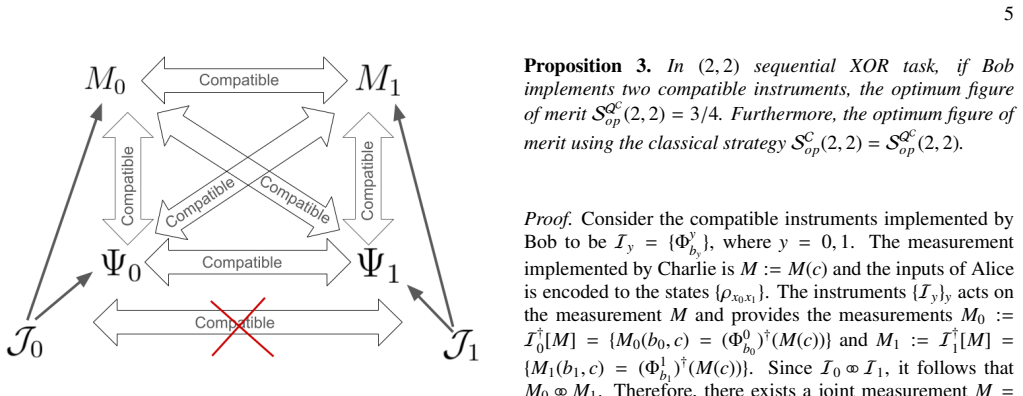
O. G ¨uhne, E. Haapasalo, T. Kraft, J.-P. Pellonp ¨a¨a, and R. Uola, Colloquium: Incompatible measurements in quantum information science, Rev. Mod. Phys.95, 011003 (2023)
2023
-
[6]
Haapasalo, Robustness of incompatibility for quantum devices, Journal of Physics A: Mathematical and Theoretical 48, 255303 (2015)
E. Haapasalo, Robustness of incompatibility for quantum devices, Journal of Physics A: Mathematical and Theoretical 48, 255303 (2015)
2015
-
[7]
Heinosaari and T
T. Heinosaari and T. Miyadera, Incompatibility of quantum channels, Journal of Physics A: Mathematical and Theoretical 50, 135302 (2017)
2017
-
[8]
Mori, Operational characterization of incompatibility of quantum channels with quantum state discrimination, Phys
J. Mori, Operational characterization of incompatibility of quantum channels with quantum state discrimination, Phys. Rev. A101, 032331 (2020)
2020
-
[9]
Girard, M
M. Girard, M. Pl ´avala, and J. Sikora, Jordan products of quantum channels and their compatibility, Nature communications12, 2129 (2021)
2021
-
[10]
Mitra, D
A. Mitra, D. Saha, S. Bhattacharya, and A. S. Majumdar, Relating completely positive divisibility of dynamical maps with compatibility of channels, Phys. Rev. A109, 062213 (2024)
2024
-
[11]
Yamada and T
M. Yamada and T. Miyadera, Incompatibility of quantum channels in general probabilistic theories, Phys. Rev. A110, 062210 (2024)
2024
-
[12]
Carmeli, T
C. Carmeli, T. Heinosaari, T. Miyadera, and A. Toigo, Witnessing incompatibility of quantum channels, Journal of Mathematical Physics60(2019)
2019
-
[13]
Zhang and I
Q.-H. Zhang and I. Nechita, A fisher information-based incompatibility criterion for quantum channels, Entropy24, 805 (2022)
2022
-
[14]
Guo and S
Y . Guo and S. Luo, Irreversibility versus incompatibility of quantum channels, Communications in Theoretical Physics78, 045102 (2026)
2026
-
[15]
G. M. D’Ariano, P. Perinotti, and A. Tosini, Incompatibility of observables, channels and instruments in information theories, Journal of Physics A: Mathematical and Theoretical55, 394006 (2022)
2022
-
[16]
Mitra and M
A. Mitra and M. Farkas, Compatibility of quantum instruments, Phys. Rev. A105, 052202 (2022)
2022
-
[17]
Mitra and M
A. Mitra and M. Farkas, Characterizing and quantifying the incompatibility of quantum instruments, Physical Review A 107, 032217 (2023)
2023
-
[18]
Lepp ¨aj¨arvi and M
L. Lepp ¨aj¨arvi and M. Sedl ´ak, Incompatibility of quantum instruments, Quantum8, 1246 (2024)
2024
-
[19]
J. Ghai and A. Mitra, Instrument-based quantum resources: quantification, hierarchies and towards constructing resource theories, arXiv:2508.09134 (2025)
-
[20]
Heinosaari, T
T. Heinosaari, T. Miyadera, and D. Reitzner, Strongly incompatible quantum devices, Foundations of Physics44, 34 (2014)
2014
-
[21]
Ji and E
K. Ji and E. Chitambar, Incompatibility as a resource for programmable quantum instruments, PRX Quantum5, 010340 (2024)
2024
-
[22]
R. Uola, T. Kraft, and A. A. Abbott, Quantification of quantum dynamics with input-output games, Phys. Rev. A101, 052306 (2020)
2020
-
[23]
Lever, O
F. Lever, O. G ¨uhne, I. Carusotto, and R. Uola, Measurement incompatibility: a resource for quantum steering, Master’s degree Thesis, physik. uni-siegen. de (2016)
2016
-
[24]
Gudder, Finite quantum instruments, arXiv preprint arXiv:2005.13642 10.48550/arXiv.2005.13642 (2020)
S. Gudder, Finite quantum instruments, arXiv preprint arXiv:2005.13642 10.48550/arXiv.2005.13642 (2020)
-
[25]
Hsieh and S.-L
C.-Y . Hsieh and S.-L. Chen, Thermodynamic approach to quantifying incompatible instruments, Phys. Rev. Lett.133, 170401 (2024)
2024
-
[26]
S. Sau, A. Jen ˇcov´a, and T. Guha, Demultiplexing generalized information via quantum transmission lines, arXiv preprint arXiv:2606.17894 (2026)
work page internal anchor Pith review Pith/arXiv arXiv 2026
-
[27]
Sedl ´ak, D
M. Sedl ´ak, D. Reitzner, G. Chiribella, and M. Ziman, Incompatible measurements on quantum causal networks, Phys. Rev. A93, 052323 (2016). 9
2016
-
[28]
Buscemi, E
F. Buscemi, E. Chitambar, and W. Zhou, Complete resource theory of quantum incompatibility as quantum programmability, Phys. Rev. Lett.124, 120401 (2020)
2020
-
[29]
Fine, Joint distributions, quantum correlations, and commuting observables, Journal of Mathematical Physics23, 1306 (1982)
A. Fine, Joint distributions, quantum correlations, and commuting observables, Journal of Mathematical Physics23, 1306 (1982)
1982
-
[30]
M. M. Wolf, D. Perez-Garcia, and C. Fernandez, Measurements incompatible in quantum theory cannot be measured jointly in any other no-signaling theory, Phys. Rev. Lett.103, 230402 (2009)
2009
-
[31]
Skrzypczyk, I
P. Skrzypczyk, I. ˇSupi´c, and D. Cavalcanti, All sets of incompatible measurements give an advantage in quantum state discrimination, Phys. Rev. Lett.122, 130403 (2019)
2019
-
[32]
R. Uola, T. Bullock, T. Kraft, J.-P. Pellonp ¨a¨a, and N. Brunner, All quantum resources provide an advantage in exclusion tasks, Phys. Rev. Lett.125, 110402 (2020)
2020
-
[33]
Carmeli, T
C. Carmeli, T. Heinosaari, and A. Toigo, Quantum random access codes and incompatibility of measurements, Europhysics Letters130, 50001 (2020)
2020
-
[34]
D. Saha, M. Oszmaniec, L. Czekaj, M. Horodecki, and R. Horodecki, Operational foundations for complementarity and uncertainty relations, Phys. Rev. A101, 052104 (2020)
2020
-
[35]
D. Saha, D. Das, A. K. Das, B. Bhattacharya, and A. S. Majumdar, Measurement incompatibility and quantum advantage in communication, Phys. Rev. A107, 062210 (2023)
2023
-
[36]
Banik, M
M. Banik, M. R. Gazi, S. Ghosh, and G. Kar, Degree of complementarity determines the nonlocality in quantum mechanics, Phys. Rev. A87, 052125 (2013)
2013
-
[37]
Pl ´avala, O
M. Pl ´avala, O. G ¨uhne, and M. T. Quintino, All incompatible measurements on qubits lead to multiparticle bell nonlocality, Phys. Rev. Lett.134, 200201 (2025)
2025
-
[38]
Y . Zhu, X. Zhang, and X. Ma, Interplay among entanglement, measurement incompatibility, and nonlocality, Quantum Science and Technology9, 045008 (2024)
2024
-
[39]
R. Uola, T. Moroder, and O. G ¨uhne, Joint measurability of generalized measurements implies classicality, Phys. Rev. Lett. 113, 160403 (2014)
2014
-
[40]
M. T. Quintino, T. V´ertesi, and N. Brunner, Joint measurability, einstein-podolsky-rosen steering, and bell nonlocality, Phys. Rev. Lett.113, 160402 (2014)
2014
-
[41]
Sarkar, D
S. Sarkar, D. Saha, and R. Augusiak, Certification of incompatible measurements using quantum steering, Phys. Rev. A106, L040402 (2022)
2022
-
[42]
S.-L. Chen, C. Budroni, Y .-C. Liang, and Y .-N. Chen, Natural framework for device-independent quantification of quantum steerability, measurement incompatibility, and self-testing, Phys. Rev. Lett.116, 240401 (2016)
2016
-
[43]
Banik, Measurement incompatibility and schr ¨odinger- einstein-podolsky-rosen steering in a class of probabilistic theories, Journal of Mathematical Physics56, 052101 (2015)
M. Banik, Measurement incompatibility and schr ¨odinger- einstein-podolsky-rosen steering in a class of probabilistic theories, Journal of Mathematical Physics56, 052101 (2015)
2015
-
[44]
Bavaresco, M
J. Bavaresco, M. T. Quintino, L. Guerini, T. O. Maciel, D. Cavalcanti, and M. T. Cunha, Most incompatible measurements for robust steering tests, Phys. Rev. A96, 022110 (2017)
2017
-
[45]
Carmeli, T
C. Carmeli, T. Heinosaari, and A. Toigo, State discrimination with postmeasurement information and incompatibility of quantum measurements, Phys. Rev. A98, 012126 (2018)
2018
-
[46]
Carmeli, T
C. Carmeli, T. Heinosaari, and A. Toigo, Quantum incompatibility witnesses, Phys. Rev. Lett.122, 130402 (2019)
2019
-
[47]
Guerini, M
L. Guerini, M. T. Quintino, and L. Aolita, Distributed sampling, quantum communication witnesses, and measurement incompatibility, Phys. Rev. A100, 042308 (2019)
2019
-
[48]
Ioannou, P
M. Ioannou, P. Sekatski, S. Designolle, B. D. M. Jones, R. Uola, and N. Brunner, Simulability of high-dimensional quantum measurements, Phys. Rev. Lett.129, 190401 (2022)
2022
-
[49]
A. K. Das, S. Mukherjee, D. Saha, D. Das, and A. S. Majumdar, Classifying measurement incompatibility under classical pre- and post-processing operations, Proceedings of the Royal Society A: Mathematical, Physical and Engineering Sciences 482, 20250045 (2026)
2026
-
[50]
Designolle, M
S. Designolle, M. Farkas, and J. Kaniewski, Incompatibility robustness of quantum measurements: a unified framework, New Journal of Physics21, 113053 (2019)
2019
-
[51]
R. Uola, T. Kraft, S. Designolle, N. Miklin, A. Tavakoli, J.-P. Pellonp¨a¨a, O. G ¨uhne, and N. Brunner, Quantum measurement incompatibility in subspaces, Phys. Rev. A103, 022203 (2021)
2021
-
[52]
M. T. Quintino, C. Budroni, E. Woodhead, A. Cabello, and D. Cavalcanti, Device-independent tests of structures of measurement incompatibility, Phys. Rev. Lett.123, 180401 (2019)
2019
-
[53]
de Gois, G
C. de Gois, G. Moreno, R. Nery, S. Brito, R. Chaves, and R. Rabelo, General method for classicality certification in the prepare and measure scenario, PRX Quantum2, 030311 (2021)
2021
-
[54]
Vieira, C
C. Vieira, C. de Gois, L. Pollyceno, and R. Rabelo, Interplays between classical and quantum entanglement- assisted communication scenarios, New Journal of Physics25, 113004 (2023)
2023
-
[55]
Heinosaari and M
T. Heinosaari and M. Ziman,The Mathematical Language of Quantum Theory: From Uncertainty to Entanglement (Cambridge University Press, 2011)
2011
-
[56]
Masahito,Quantum Information: An Introduction(Springer,
H. Masahito,Quantum Information: An Introduction(Springer,
-
[57]
[translated from the 2003 Japanese original]
2003
-
[58]
Heinosaari, D
T. Heinosaari, D. Reitzner, T. c. v. Ryb ´ar, and M. Ziman, Incompatibility of unbiased qubit observables and pauli channels, Phys. Rev. A97, 022112 (2018)
2018
-
[59]
Miklin, J
N. Miklin, J. J. Borkała, and M. Pawłowski, Semi-device- independent self-testing of unsharp measurements, Phys. Rev. Res.2, 033014 (2020)
2020
-
[60]
Mohan, A
K. Mohan, A. Tavakoli, and N. Brunner, Sequential random access codes and self-testing of quantum measurement instruments, New Journal of Physics21, 083034 (2019)
2019
-
[61]
Bowles, N
J. Bowles, N. Brunner, and M. Pawłowski, Testing dimension and nonclassicality in communication networks, Phys. Rev. A 92, 022351 (2015)
2015
-
[62]
Hameedi, D
A. Hameedi, D. Saha, P. Mironowicz, M. Pawłowski, and M. Bourennane, Complementarity between entanglement- assisted and quantum distributed random access code, Phys. Rev. A95, 052345 (2017)
2017
-
[63]
P. Roy, S. Bera, A. S. Majumdar, and S. Mal, Robust certification of quantum instruments through a sequential communication game, Phys. Rev. A113, 022611 (2026)
2026
-
[64]
Unbounded Communication Power of a Qubit
S. Sasmal, S. Kanjilal, and D. Das, Unbounded communication power of a qubit, arXiv preprint arXiv:2605.16093 (2026). Appendix A: Proof of Theorem 2 and the certification of instrinsically incompatible instruments in(d,d)-sequential XOR task
work page internal anchor Pith review Pith/arXiv arXiv 2026
-
[65]
The measurement for Charlie isM:={M(c)}
Proof of Theorem 2 Consider the compatible instruments implemented by Bob to beI y ={Φ y by }, wherey=0,1. The measurement for Charlie isM:={M(c)}. After action of instruments 10 on measurementM, it provides the measurementsM 0 := I† 0[M]={M 0(b0,c)=(Φ 0 b0 )†(M(c))}andM 1 :=I † 1[M]= {M1(b1,c)=(Φ 1 b1 )†(M(c))}. AsI 1 ◦ ◦ I2, we haveM 1 ◦ ◦M2. Hence, the...
-
[66]
Now, consider a projective measurement M={M(c)=|f d c ⟩ ⟨f d c |}where{|f d c ⟩= 1√ d Pd−1 m=0 ωmc d |m⟩}d−1 c=0 is an orthonormal basis ofH
The certification of instrinsically incompatible instruments in(d,d)-sequential XOR task Recall that we are given two quantum instruments ˆJ 0 := { ˆΨ0 b0 :=|b 0⟩ ⟨b0|ρ|b 0⟩ ⟨b0|} ∈I(H,H) and ˆJ 1 :={ ˆΨ1 b1 := 1 d Zb1 d ρ(Zb1 d )†} ∈I(H,H) where dim(H)=d,{|b 0⟩}d−1 b0=0 is an orthonormal basis ofH, andZ d = Pd−1 m=0(ωd)m |m⟩ ⟨m|where ωd isdth root of 1. ...
-
[67]
The measurement for Charlie isM:=M(c)
Proof of Proposition 5 Consider the compatible instruments implemented by Bob to beI y ={Φ y by }, wherey=0,1. The measurement for Charlie isM:=M(c). The instruments{I y}y acts on the measurementMand provide the measurementsM 0 := I† 0[M]={M 0(b0,c)=(Φ 0 b0 )†(M(c))}andM 1 :=I † 1[M]= {M1(b1,c)=(Φ 1 b1 )†(M(c))}. SinceI 0 ◦ ◦ I1, it follows that M0 ◦ ◦M1....
-
[68]
The quantum figure of merit corresponding to this strategy can be written from Eq
Proof of Proposition 6 Given an inputx, letρ x be the state prepared by Alice, I0 ={Φ 0 x}andI 1 ={Φ 1 x}be binary qubit instruments implemented by Bob, andM={M(c)}be the dichotomic measurement implemented by Charlie. The quantum figure of merit corresponding to this strategy can be written from Eq. (24) as follows: ¯SQ =Tr h ρ0 (Φ0 0)†M(0)+(Φ 0 0)†M(1)+(...
-
[69]
This indicates P i |ci|2 ≤1/2. Now, we can write the above quantity as, ¯SQ ≤(α 0 +α 1 +| ⃗c0 + ⃗c1|+α 1 +1−α 0 +|⃗c1 − ⃗c0|+1−α 1 +| ⃗c1|) =(2+α 1 +| ⃗c1|+| ⃗c0 + ⃗c1|+| ⃗c1 − ⃗c0|) ≤(2+α 1 +| ⃗c1|+2 p |c0|2 +|c 1|2) ≤2+ √ 2+α 1 +| ⃗c1| ≤3+ √ 2.(B5) Last line comes from the fact that|⃗c1| ≤min{α 1,1−α 1},which impliesα 1 +| ⃗c1| ≤1. Now, we show that the...
-
[70]
This completes the proof
discussion (0)
Sign in with ORCID, Apple, or X to comment. Anyone can read and Pith papers without signing in.