Notes on remanent magnetization measurements in superconductors and hard ferromagnets
Pith reviewed 2026-06-26 09:57 UTC · model grok-4.3
The pith
Remanent magnetization measurements in a superconductor and hard ferromagnets show apparent similarities and differences that may guide interpretation of data from diamond anvil cells.
A machine-rendered reading of the paper's core claim, the machinery that carries it, and where it could break.
Core claim
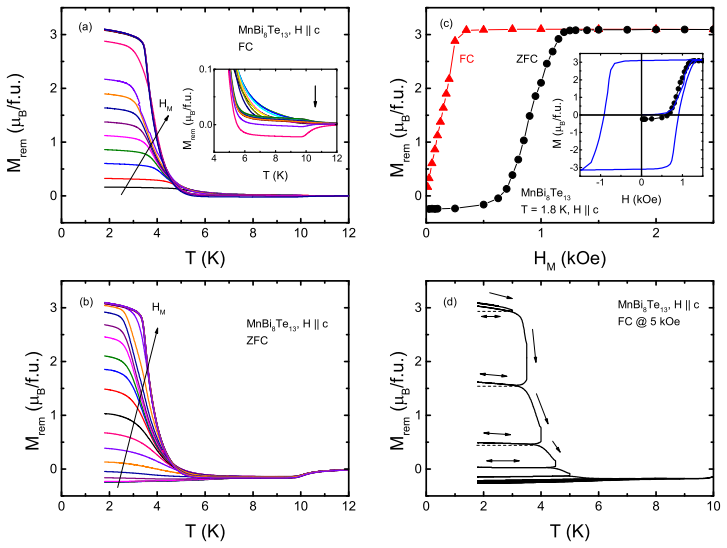
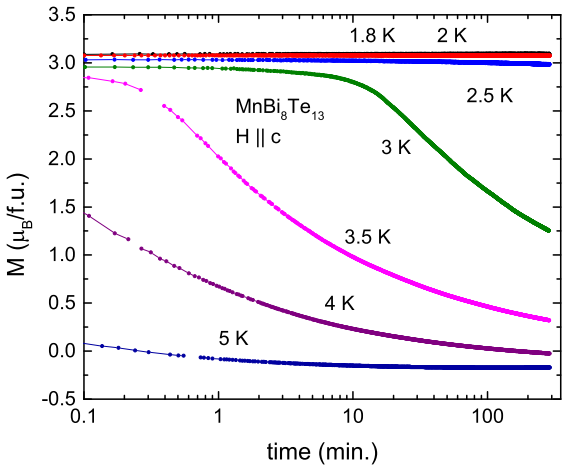
Data on zero applied field measurements of remanent magnetization and magnetic relaxation in a BCS superconductor LuNi2B2C and several hard ferromagnets are presented and compared. Apparent similarities and differences, in particular in Thermoremanent Magnetization (TRM)-like, Isothermal Remanent Magnetization (IRM)-like, and remanent magnetization measurements with zigzag temperature sweep measurements are outlined. It is discussed how these results could be relevant for the magnetization measurements in diamond anvil cells.
What carries the argument
Comparison of TRM-like, IRM-like, and zigzag temperature-sweep remanent magnetization protocols between a superconductor and hard ferromagnets, used to identify patterns that may transfer to diamond anvil cell geometries.
If this is right
- The outlined similarities between the superconductor and ferromagnets may indicate shared measurement artifacts or relaxation mechanisms that appear across different material classes.
- Differences identified in the zigzag temperature sweep data could serve as material-specific signatures for distinguishing superconducting from ferromagnetic responses in low-signal environments.
- Relevance to diamond anvil cells follows directly from the authors' discussion that bulk patterns offer a reference for disentangling intrinsic remanent signals from cell background contributions.
- Magnetic relaxation rates measured in zero field may help quantify time-dependent effects that become prominent when sample volume is restricted.
Where Pith is reading between the lines
- If the bulk patterns hold in confined geometries, similar measurement protocols could be applied to other high-pressure studies of magnetism without requiring new theoretical models for each material.
- The comparison raises the possibility that certain remanent magnetization features are geometry-independent enough to act as calibration standards for cell background subtraction across multiple experiments.
- Extending the zigzag sweep approach to additional superconductors or ferromagnets could test whether the reported similarities generalize beyond the specific compounds studied here.
Load-bearing premise
Behaviors seen in bulk samples will provide useful interpretive guidance for measurements performed inside the confined space and with the background signals present in diamond anvil cells.
What would settle it
Perform the same zero-field remanent magnetization and zigzag-sweep protocols on LuNi2B2C or a hard ferromagnet inside a diamond anvil cell and check whether the observed similarities and differences match those reported for bulk samples.
Figures



read the original abstract
Data on zero applied field measurements of remanent magnetization and magnetic relaxation in a BCS superconductor LuNi2B2C and several hard ferromagnets are presented and compared. Apparent similarities and differences, in particular in Thermoremanent Magnetization (TRM) - like, Isothermal Remanent Magnetization (IRM) - like, and remanent magnetization measurements with zigzag temperature sweep measurements are outlined. It is discussed how these results could be relevant for the magnetization measurements in diamond anvil cells.
Editorial analysis
A structured set of objections, weighed in public.
Referee Report
Summary. The manuscript presents experimental data on zero-field remanent magnetization and magnetic relaxation in bulk samples of the BCS superconductor LuNi2B2C and several hard ferromagnets. It compares TRM-like, IRM-like, and zigzag temperature-sweep measurements, outlines apparent similarities and differences, and discusses potential relevance of these bulk observations for magnetization measurements performed in diamond anvil cells.
Significance. If the reported bulk behaviors are reproducible, the comparisons provide qualitative observational notes on remanent magnetization protocols. However, the asserted relevance to diamond-anvil-cell experiments rests on an untested extrapolation; without DAC data, confined-geometry modeling, or quantitative metrics (error bars, relaxation rates, or background subtraction protocols), the work offers limited new interpretive guidance for the high-pressure community.
major comments (1)
- [Abstract / Discussion] Abstract and concluding discussion: the claim that the bulk TRM/IRM/zigzag observations 'could be relevant' for DAC measurements is unsupported. The manuscript contains neither DAC data nor any quantitative model of how anvil background, pressure-induced domain/vortex changes, or confined geometry would alter the reported relaxation or sweep signatures.
minor comments (2)
- No quantitative metrics, error bars, or statistical measures of the observed similarities/differences are provided, making it difficult to assess the robustness of the claimed patterns.
- The manuscript would benefit from explicit statements of sample dimensions, field-cooling protocols, and background subtraction methods to allow reproducibility assessment.
Simulated Author's Rebuttal
We thank the referee for their careful review and constructive feedback on our manuscript. We address the major comment point by point below.
read point-by-point responses
-
Referee: [Abstract / Discussion] Abstract and concluding discussion: the claim that the bulk TRM/IRM/zigzag observations 'could be relevant' for DAC measurements is unsupported. The manuscript contains neither DAC data nor any quantitative model of how anvil background, pressure-induced domain/vortex changes, or confined geometry would alter the reported relaxation or sweep signatures.
Authors: We agree that the manuscript presents no DAC data, confined-geometry modeling, or quantitative metrics such as error bars or relaxation rates specific to high-pressure conditions. The work is explicitly framed as observational notes on bulk samples, and the discussion uses phrasing such as 'could be relevant' to indicate potential qualitative analogies for consideration in DAC contexts rather than asserting direct applicability or interpretive guidance. To address the concern, we will revise the abstract and concluding discussion to clarify that these bulk observations are presented as tentative notes only, with any connection to DAC experiments remaining speculative and requiring separate high-pressure studies. The language will be adjusted to remove implications of quantitative relevance. revision: yes
Circularity Check
No circularity; purely observational comparison with no derivations
full rationale
The manuscript contains no equations, derivations, predictions, fitted parameters, or mathematical models. It reports experimental remanent magnetization data on bulk samples and offers qualitative discussion of possible relevance to DAC measurements. No load-bearing step reduces to a self-definition, fitted input renamed as prediction, or self-citation chain. The central content is direct comparison of measured curves; the DAC relevance is presented as an unquantified suggestion rather than a derived result. This is the expected non-finding for an observational note.
Axiom & Free-Parameter Ledger
Reference graph
Works this paper leans on
-
[1]
https://pubs.usgs.gov/bul/1083e/report.pdf
Allan Cox, Anomalous Remanent Magnetization of Basalt, Geophysical Survey Bulletin 1083-E, 131 (1961). https://pubs.usgs.gov/bul/1083e/report.pdf
1961
-
[2]
J. A. Mydosh, Spin glasses: an experimental introductio n (Taylor & Francis, London, 1993)
1993
-
[3]
A. B. Pippard, Trapped flux in superconductors, Phil. Tra ns. Royal Soc. London A 248, 97 (1955). https://doi.org/10.1098/rsta.19 55.0011
-
[4]
https://doi.org/10.1038/nature0 1350
Masaru Tomita and Masato Murakami, High-temperature su perconduc- tor bulk magnets that can trap magnetic fields of over 17 tesla at 29 K, Nature 421, 517 (2003). https://doi.org/10.1038/nature0 1350
-
[5]
G. Fuchs, W. Häßler, K. Nenkov, J. Scheiter, O. Perner, A. Hand- stein, T. Kanai, L. Schultz and B. Holzapfel, High trapped fie lds in bulk MgB2 prepared by hot-pressing of ball-milled precursor powder, Su- percond. Sci. Technol. 26, 122002 (2013). https://doi.org /10.1088/0953- 2048/26/12/122002
-
[6]
K. A. Müller, M. Takashige, and J. G. Bednorz, Flux trappi ng and superconductive glass state in La 2CuO4− y:Ba, Phys. Rev. Lett. 58, 1143 (1987). https://doi.org/10.1103/PhysRevLett.58.1143
-
[7]
V. V. Moshchalkov, J. Y. Henry, C. Marin, J. Rossat-Migno d, and J. F. Jacquot, Anisotropy of the first critical field and criti cal cur- rent in YBa 2Cu3O6.9 single crystals, Physica C 175, 407 (1991). https://doi.org/10.1016/0921-4534(91)90616-7
-
[8]
J. E. Hirsch, F. Marsiglio, Flux trapping in superconduc ting hydrides under high pressure, Physica C 589, 1353916 (2021) . https://doi.org/10.1016/j.physc.2021.1353916
-
[9]
V. S. Minkov, V. Ksenofontov, S. L. Bud’ko, E. F. Talant- sev, and M. I. Eremets, Magnetic flux trapping in hydrogen- rich high-temperature superconductors. Nat. Phys. 19, 129 3 (2023). https://doi.org/10.1038/s41567-023-02089-1 10
-
[10]
J. E. Hirsch, F. Marsiglio, Evidence Against Supercond uctivity in Flux Trapping Experiments on Hydrides Under High Pressure, J. Su percond. Nov. Magn. 35, 3141 (2022). https://doi.org/10.1007/s109 48-022-06365- 8
-
[11]
Shuyuan Huyan, Nestor Haberkorn, Mingyu Xu, Paul C. Can field, and Sergey L. Bud’ko, Effects of Pressure on Superconducting Pro perties and Vortex Pinning of CaKFe 4As4 Single Crystals. J. Phys. Soc. Jpn. 94, 024708 (2025). https://doi.org/10.7566/JPSJ.94.024 708
-
[12]
Ruslan Prozorov, On the trapped magnetic moment in type - II superconductors. Supercond. Sci. Technol. 37, 115032 (2 024). https://doi.org/10.1088/1361-6668/ad86f0
-
[13]
Ming Xu, P. C. Canfield, J. E. Ostenson, D. K Finnemore, B. K. Cho, Z. R. Wang, and D.C. Johnston, Superconducting state magnet ization and critical fields of single - crystal YNi 2B2C. Physica C 227, 321 (1994). https://doi.org/10.1016/0921-4534(94)90088-4
-
[14]
Paul C. Canfield and Ian R. Fisher, High-temperature sol ution growth of intermetallic single crystals and quasicrystals. J. Cry st. Growth 225, 155 (2001). https://doi.org/10.1016/S0022-0248(01)008 27-2
-
[15]
Xiao Lin, Valentin Taufour, Sergey L. Bud’ko, and Paul C . Canfield, Suppression of ferromagnetism in the LaV xCr1− xGe3 system. Phys. Rev. B 88, 094405 (2013). https://doi.org/10.1103/PhysRevB.8 8.094405
-
[16]
M. Xu, S. L. Bud’ko, R. Prozorov, and P. C. Canfield, Unusu al coercivity and zero-field stabilization of fully saturated magnetiza- tion in single crystals of LaCrGe 3. Phys. Rev. B 107, 134437 (2023). https://doi.org/10.1103/PhysRevB.107.134437
-
[17]
Bud’ko, Lin Zhou, Liqin Ke, Mingda Li, Pau l C
Mingyu Xu, Yongbin Lee, Xianglin Ke, Min-Chul Kang, Mat t Boswell, Sergey L. Bud’ko, Lin Zhou, Liqin Ke, Mingda Li, Pau l C. Canfield, and Weiwei Xie, Giant Uniaxial Magnetocrystall ine Anisotropy in SmCrGe 3. J. Am. Chem. Soc. 146 30294 (2024). https://doi.org/10.1021/jacs.4c10056
-
[18]
Chaowei Hu, Tiema Qian and Ni Ni, Recent progress in MnBi 2nTe3n+1 intrinsic magnetic topological insulators: crystal growt h, mag- 11 netism and chemical disorder. Natl. Sci. Rev. 11, nwad282 (2 024). https://doi.org/10.1093/nsr/nwad282
-
[19]
Lamichhane, Valentin Taufour, Andriy Palasyuk, Qisheng Lin, Sergey L
Tej N. Lamichhane, Valentin Taufour, Andriy Palasyuk, Qisheng Lin, Sergey L. Bud’ko, and Paul C. Canfield, Ce 3− xMgxCo9: Transformation of a Pauli Paramagnet into a Strong Per- manent Magnet. Phys. Rev. Applied 9, 024023 (2018). https://doi.org/10.1103/PhysRevApplied.9.024023
-
[20]
Lamichhane, Valentin Taufour, Andriy Palasyuk, Sergey L
Tej N. Lamichhane, Valentin Taufour, Andriy Palasyuk, Sergey L. Bud’ko, and Paul C. Canfield, Study of the ferromagnetic quan - tum phase transition in Ce 3− xMgxCo9. Phil. Mag. 100, 1607 (2020). https://doi.org/10.1080/14786435.2020.1727973
-
[21]
Sergey L. Bud’ko, Mingyu Xu, and Paul C. Canfield, Trappe d flux in pure and Mn-substituted CaKFe 4As4 and MgB 2 supercon- ducting single crystals, Supercond. Sci. Technol. 36, 1150 01 (2023). https://doi.org/10.1088/1361-6668/acf413
-
[22]
R. J. Cava, H. Takagi, H. W. Zandbergen, J. J. Krajewski, W. F. Peck Jr, T. Siegrist, B. Batlogg, R. B. van Dover, R. J. Felder, K. M izuhashi, J. O. Lee, H. Eisaki, and S. Uchida, Superconductivity in the qua- ternary intermetallic compounds LnNi 2B2C. Nature 367, 252 (1994). https://doi.org/10.1038/367252a0
-
[23]
H. Takagi, R. J. Cava, H. Eisaki, J. O. Lee, K. Mizuhashi, B. Batlogg, S. Uchida, J. J. Krajewski, and W. F. Peck Jr., Superconducting properties of the new boride-carbide superconductors. Physica C 228, 3 89 (1994). https://doi.org/10.1016/0921-4534(94)90431-6
-
[24]
K. O. Cheon, I. R. Fisher, and P. C. Canfield, Boron isotop e effect in single-crystal YNi 2B2C and LuNi 2B2C superconductors. Physica C 312, 35 (1999). https://doi.org/10.1016/S0921-4534(98)0066 7-4
-
[25]
G. M. Schmiedeshoff, J. A. Detwiler, W. P. Beyermann, A. H . Lacerda, P. C. Canfield, and J. L. Smith, Critical fields and specific heat of LuNi 2B2C. Phys. Rev. B 63, 134519 (2001). https://doi.org/10.1103/PhysRevB.63.134519 12
-
[26]
Riad Kasem, and Hiroto Arima, Large self-heating by trapped-flux reduction in Sn-P b solders
Yoshikazu Mizuguchi, Takumi Murakami, Md. Riad Kasem, and Hiroto Arima, Large self-heating by trapped-flux reduction in Sn-P b solders. EPL 147, 36003 (2024). https://doi.org/10.1209/0295-507 5/ad6802
-
[27]
Sergey L. Bud’ko, Mingyu Xu, and Paul C. Canfield, On cree p of trapped flux near Tc in MgB 2 and CaKFe 4As4. Physica C 620, 1354487 (2024). https://doi.org/10.1016/j.physc.2024.1354487
-
[28]
Chaowei Hu, Makariy A. Tanatar, Ruslan Prozorov, and Ni Ni, Un- usual dynamic susceptibility arising from soft ferromagne tic domains in MnBi8Te13 and Sb-doped MnBi 2nTe3n+1 (n = 2, 3). J. Phys. D: Appl. Phys. 55, 054003 (2022). https://doi.org/10.1088/1361-6 463/ac3032
-
[29]
Ralph Skomski, J. P. Liu, and D. J. Sellmyer, Quasicoher ent nucle- ation mode in two-phase nanomagnets. Phys. Rev. B 60, 7359 (1 999). https://doi.org/10.1103/PhysRevB.60.7359
-
[30]
C. P. Bean, Magnetization of Hard Superconductors. Phy s. Rev. Lett. 8, 250 (1962). https://doi.org/10.1103/PhysRevLett.8.2 50
-
[31]
Bean, Magnetization of High-Field Supercon ductors
Charles P. Bean, Magnetization of High-Field Supercon ductors. Rev. Mod. Phys. 36, 31 (1964). https://doi.org/10.1103/RevMod Phys.36.31
-
[32]
Pablo D. Esquinazi, Christian E. Precker, Markus Still er, Tiago R. S. Cordeiro, José Barzola-Quiquia, Annette Setzer, and W in- fried Böhlmann, Evidence for room temperature superconduc tivity at graphite interfaces. Quantum Stud.: Math. Found. 5, 41 (2 018). https://doi.org/10.1007/s40509-017-0131-0
-
[33]
Guy Deutscher, Granular Superconductivity: a Playgro und for Joseph- son, Anderson, Kondo, and Mott. J. Supercond. Nov. Magn. 34, 1699 (2021). https://doi.org/10.1007/s10948-020-05773-y
-
[34]
D.M. Gokhfeld, M.R. Koblischka, A. Koblischka-Veneva , Highly porous superconductors: synthesis, research, and prospects. Phy s. Met. Metal- logr. 121 936 (2020). https://doi.org/10.1134/S0031918× 20100051
-
[35]
Sergey L. Bud’ko, Shuyuan Huyan, Mingyu Xu and Paul C Can field, Trapped flux in a small crystal of CaKFe 4As4 at ambient pressure and in a diamond anvil pressure cell. Supercond. Sci. Technol. 3 7, 065010 (2024). https://doi.org/10.1088/1361-6668/ad45c7 13
-
[36]
Xinglong Chen, E. H. T. Poldi, Shuyuan Huyan, R. Chapai, H. Zheng, S. L. Bud’ko, U. Welp, P. C. Canfield, Russell J. Hemley, J. F. M itchell, and D. Phelan, Low fractional volume superconductivity in s ingle crys- tals of Pr 4Ni3O10 under pressure. Phys. Rev. B 111, 094525 (2025). https://doi.org/10.1103/PhysRevB.111.094525
-
[37]
Huyan, J
S. Huyan, J. Schmidt, A. Valadkhani, H. Wang, Z. Li, A. Sa pkota, J. L. Petri, T. J. Slade, R. A. Ribeiro, W. Bi, W. Xie, I. I. Mazin, R. Valenti, S. L. Bud’ko, and P. C. Canfield, Near-room-temperature ferr omagnetic ordering in the pressure-induced collapsed-tetragonal ph ase in SrCo 2P2. Phys. Rev. B 112, L041102 (2025). https://doi.org/10.1103 /vl33-53qm
2025
-
[38]
Bud’ko, Mingyu Xu, Weiwei Xie, Chaowei Hu, Ni N i, and Paul C
Sergey L. Bud’ko, Mingyu Xu, Weiwei Xie, Chaowei Hu, Ni N i, and Paul C. Canfield, Dataset - Notes on remanent magnetization m ea- surements in superconductors and hard ferromagnets, Zenod o (2026). https://doi.org/10.5281/zenodo.20784815. 14 /s48 /s50 /s52 /s54 /s56 /s49/s48 /s49/s50 /s49/s52 /s49/s54 /s49/s56 /s48 /s53/s48 /s49/s48/s48 /s49/s53/s48 /s50/...
discussion (0)
Sign in with ORCID, Apple, or X to comment. Anyone can read and Pith papers without signing in.