C, N, O, S, and photochemistry in a temperate giant planet orbiting a late M dwarf
Pith reviewed 2026-06-26 07:07 UTC · model grok-4.3
The pith
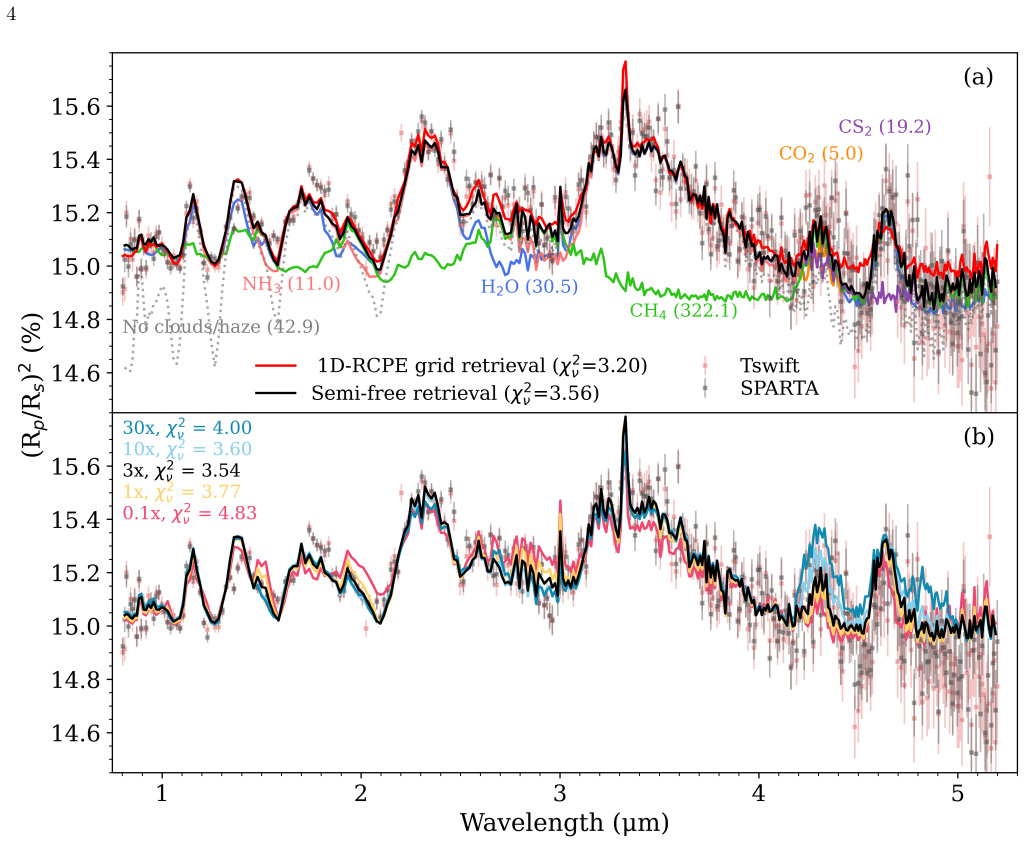
The atmosphere of TOI-6894b shows metallicity of 3-10 times solar and solar C/O, N/O, S/O ratios, matching Jupiter and Saturn despite orbiting a late M dwarf.
A machine-rendered reading of the paper's core claim, the machinery that carries it, and where it could break.
Core claim
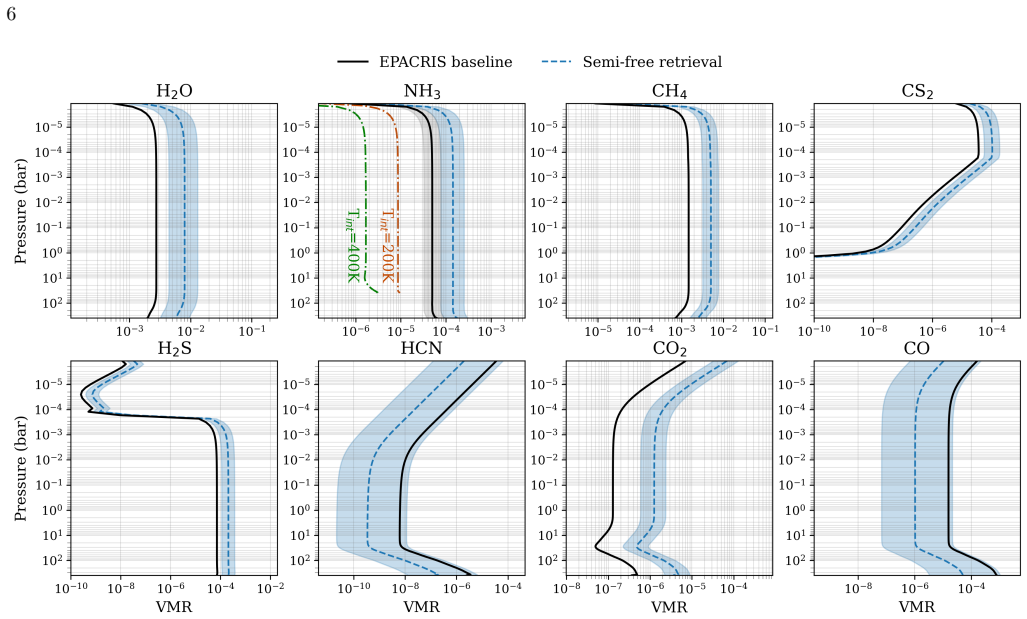
The transit spectrum of TOI-6894b is most consistent with a metallicity of 3-10 times solar and C/O = 0.69 plus or minus 0.06, with C/O, N/O, and S/O ratios broadly consistent with solar values, as shown by photochemical equilibrium models and both semi-free and grid retrievals. The planet's atmospheric metallicity, abundance ratios, and bulk metal fraction are all strikingly similar to that of Jupiter, Saturn, and other gas giant exoplanets.
What carries the argument
The improved photochemical reaction network incorporated into 1D radiative-convective photochemical equilibrium models, which predict how the relative sizes of NH3 and CO2 features versus CH4 and H2O change with metallicity.
If this is right
- The planet's C/O, N/O, and S/O ratios are consistent with solar values.
- The bulk metal fraction matches that of Jupiter and Saturn.
- Photochemical production of CS2 is required to explain the dominant absorption feature.
- NH3 absorption is detectable in transmission for the first time.
Where Pith is reading between the lines
- If this compositional similarity holds for other planets around low-mass stars, core-accretion models may need to produce similar metal enrichment regardless of disk mass or stellar type.
- Late M-dwarf systems could offer a larger sample of temperate giants with clean spectra for testing how photochemistry scales with lower UV flux.
- The absence of detectable stellar contamination makes TOI-6894b a benchmark for validating photochemical networks against future multi-epoch observations.
Load-bearing premise
The improved photochemical reaction network and 1D radiative-convective models correctly predict the relative feature sizes of NH3 and CO2 versus CH4 and H2O across metallicities, with the observed spectrum arising purely from planetary absorption.
What would settle it
A re-reduction or re-analysis of the JWST spectrum that shows NH3 or CO2 feature depths inconsistent with 3-10 times solar metallicity predictions, or direct evidence of stellar contamination altering the relative absorption depths.
Figures



read the original abstract
We report the JWST NIRSpec/PRISM transit spectrum of TOI-6894b, an exceptional 420 K sub-Saturn that is the only known giant planet transiting a late M dwarf. Remarkably, both the light curve and the transit spectrum exhibit almost no stellar contamination. The spectrum is dominated by prominent absorption features from CH$_4$ and the photochemical product CS$_2$. For the first time in a transit spectrum, NH$_3$ is visually evident, while subtler features from H$_2$O, and CO$_2$ can also be seen. We significantly improve upon state-of-the-art photochemical reaction networks, and use our new network to run radiative-convective photochemical models at different metallicities. These models show that the spectrum--in particular the size of the NH$_3$ and CO$_2$ features relative to the CH$_4$ and H$_2$O features--is most consistent with a metallicity of 3--10$\times$ solar. Using a semi-free retrieval framework that perturbs the self-consistent model's abundance and temperature profiles to fit the data, we find that the planet's C/O, N/O, and S/O ratios are broadly consistent with solar values. A grid retrieval on 1D radiative-convective photochemical equilibrium (RCPE) models reveals a similar result: $[M/H]=0.46 \pm 0.08$ and C/O=$0.69 \pm 0.06$. The planet's atmospheric metallicity, abundance ratios, and bulk metal fraction are all strikingly similar to that of Jupiter, Saturn, and other gas giant exoplanets, despite orbiting a very low-mass star.
Editorial analysis
A structured set of objections, weighed in public.
Referee Report
Summary. The paper reports the JWST NIRSpec/PRISM transit spectrum of TOI-6894b, a 420 K sub-Saturn orbiting a late M dwarf, with prominent CH4 and CS2 absorption features, visually evident NH3, and subtler H2O and CO2 features, and claims almost no stellar contamination. An improved photochemical reaction network is used to run 1D radiative-convective photochemical equilibrium (RCPE) models at varying metallicities; these show the relative NH3/CO2 versus CH4/H2O feature sizes are most consistent with 3–10× solar metallicity. A grid retrieval on the RCPE models yields [M/H]=0.46±0.08 and C/O=0.69±0.06, while a semi-free retrieval finds C/O, N/O, and S/O ratios broadly solar; the atmospheric metallicity, abundance ratios, and bulk metal fraction are concluded to be strikingly similar to Jupiter, Saturn, and other gas giants despite the low-mass host.
Significance. If the RCPE models and their mapping of relative feature sizes to metallicity hold, the result constrains formation pathways by showing that solar-like C/O, N/O, S/O and bulk metal fractions can arise in giant planets around late M dwarfs. The improved photochemical network and first visual NH3 detection in a transit spectrum are clear strengths.
major comments (2)
- [§3] §3 (RCPE models and grid): the claim that the spectrum is most consistent with 3–10× solar rests on the updated network correctly predicting relative NH3/CO2 vs. CH4/H2O feature sizes across metallicities; no quantitative fit metrics, solar-system benchmark comparisons, or sensitivity tests to Kzz, M-dwarf UV spectrum shape, or vertical mixing are shown, leaving the load-bearing mapping unvalidated.
- [§4.2] §4.2 (grid retrieval): the reported [M/H]=0.46±0.08 and similarity to Jupiter/Saturn follow directly from the RCPE grid; without explicit tests that the 1D assumption and network reproduce known solar-system giant-planet spectra, the central compositional claim risks being model-dependent rather than data-driven.
minor comments (2)
- [Abstract] Abstract and §2: the phrase 'almost no stellar contamination' is presented as observed but lacks a quantitative metric (e.g., spot-crossing amplitude or contamination fraction) that should be shown in the main text or a dedicated figure.
- [§3] Figure captions and §3: notation for the photochemical network updates (new reactions, rate coefficients) is not summarized in a table; a concise comparison table to prior networks would improve clarity.
Simulated Author's Rebuttal
We thank the referee for their constructive comments, which highlight important aspects of model validation. We address each major comment below, providing the strongest honest defense of the manuscript while acknowledging where additional work strengthens the presentation. We have revised the manuscript accordingly in several areas.
read point-by-point responses
-
Referee: [§3] §3 (RCPE models and grid): the claim that the spectrum is most consistent with 3–10× solar rests on the updated network correctly predicting relative NH3/CO2 vs. CH4/H2O feature sizes across metallicities; no quantitative fit metrics, solar-system benchmark comparisons, or sensitivity tests to Kzz, M-dwarf UV spectrum shape, or vertical mixing are shown, leaving the load-bearing mapping unvalidated.
Authors: We agree that quantitative validation metrics and sensitivity tests would make the mapping more robust. In revision we have added chi-squared values for the RCPE model spectra versus the data across the metallicity grid, which confirm the minimum at 3–10× solar. We also include sensitivity tests varying Kzz by a factor of 10 and adopting two literature M-dwarf UV spectra; the relative NH3/CO2 versus CH4/H2O feature contrast remains diagnostic of 3–10× solar in all cases. A short comparison to Jupiter is now included, noting that the network reproduces observed CS2 and NH3 features under Jovian conditions. These additions directly address the validation concern while preserving the original visual comparison in the figures. revision: partial
-
Referee: [§4.2] §4.2 (grid retrieval): the reported [M/H]=0.46±0.08 and similarity to Jupiter/Saturn follow directly from the RCPE grid; without explicit tests that the 1D assumption and network reproduce known solar-system giant-planet spectra, the central compositional claim risks being model-dependent rather than data-driven.
Authors: The grid retrieval is tied to the RCPE models, so the concern about model dependence is valid. We have expanded the semi-free retrieval discussion to demonstrate that even when abundances and temperatures are allowed to deviate from the RCPE profiles, the retrieved C/O, N/O, and S/O ratios remain solar-like and the metallicity stays within 3–10× solar. We now explicitly note the limitations of the 1D assumption and the fact that our network is optimized for the 420 K regime rather than solar-system conditions. The similarity to Jupiter and Saturn is presented as a comparative statement based on the retrieved parameters matching published values, not as a direct model reproduction. These clarifications reduce the risk of over-interpretation. revision: partial
Circularity Check
No circularity: forward RCPE models and retrievals remain independent of fitted inputs
full rationale
The derivation uses an improved photochemical network to generate self-consistent RCPE models at discrete metallicities, then compares relative NH3/CO2 vs CH4/H2O feature sizes to the observed spectrum to identify the 3-10x solar range. A semi-free retrieval perturbs the resulting profiles to fit data, and a grid retrieval directly searches the RCPE grid. No quoted equations or steps reduce the reported [M/H], C/O, N/O or S/O values to the input data or fitted parameters by construction. No self-citations, uniqueness theorems, or ansatzes from prior author work are invoked as load-bearing. The central mapping is a forward physical prediction tested against external data, satisfying the criteria for a self-contained result.
Axiom & Free-Parameter Ledger
free parameters (2)
- [M/H] =
0.46 ± 0.08
- C/O =
0.69 ± 0.06
axioms (1)
- domain assumption 1D radiative-convective photochemical equilibrium models with the improved reaction network accurately reproduce relative molecular feature depths at 3-10x solar metallicity.
Reference graph
Works this paper leans on
-
[1]
Arcangeli, J., D´ esert, J.-M., Line, M. R., et al. 2018, The Astrophysical Journal Letters, 855, L30, doi: 10.3847/2041-8213/aab272
-
[2]
Ashtari, R., Lustig-Yaeger, J., Libby-Roberts, J., et al. 2026, The Astronomical Journal, 171, 294, doi: 10.3847/1538-3881/ae552c Astropy Collaboration, Robitaille, T. P., Tollerud, E. J., et al. 2013, A&A, 558, A33, doi: 10.1051/0004-6361/201322068 Astropy Collaboration, Price-Whelan, A. M., Sip˝ ocz, B. M., et al. 2018, AJ, 156, 123, doi: 10.3847/1538-3...
-
[3]
J., Welbanks, L., Schlawin, E., et al
Bell, T. J., Welbanks, L., Schlawin, E., et al. 2023, Nature, 623, 709
2023
-
[4]
Bjoraker, G. L., Larson, H. P., & Kunde, V. G. 1986, Icarus, 66, 579, doi: https://doi.org/10.1016/0019-1035(86)90093-X
-
[5]
Briggs, F. H., & Sackett, P. D. 1989, Icarus, 80, 77, doi: 10.1016/0019-1035(89)90162-0
-
[6]
M., Bayliss, D., & Van Eylen, V
Bryant, E. M., Bayliss, D., & Van Eylen, V. 2023, MNRAS, 521, 3663, doi: 10.1093/mnras/stad626
-
[7]
Bryant, E. M., Jord´ an, A., Hartman, J. D., et al. 2025, Nature Astronomy, 9, 1031, doi: 10.1038/s41550-025-02552-4
-
[8]
2014, A&A, 564, A125, doi: 10.1051/0004-6361/201322971
Buchner, J., Georgakakis, A., Nandra, K., et al. 2014, A&A, 564, A125, doi: 10.1051/0004-6361/201322971
work page internal anchor Pith review doi:10.1051/0004-6361/201322971 2014
-
[9]
2025, JWST Calibration Pipeline, 1.19.1 Zenodo, doi: 10.5281/zenodo.16280965 Ca˜ nas, C
Bushouse, H., Eisenhamer, J., Dencheva, N., et al. 2025, JWST Calibration Pipeline, 1.19.1 Zenodo, doi: 10.5281/zenodo.16280965 Ca˜ nas, C. I., Lustig-Yaeger, J., Tsai, S.-M., et al. 2026, AJ, 171, 260, doi: 10.3847/1538-3881/ae4976
-
[10]
2024, 168, 227, doi: 10.3847/1538-3881/ad7aef
Coulombe, L.-P., Roy, P.-A., & Benneke, B. 2024, 168, 227, doi: 10.3847/1538-3881/ad7aef
-
[11]
Photochemical CS$_2$ Gas Detected on a 20-Myr-old Exoplanet
Dai, F., Petigura, E., Livingston, J., et al. 2026, Photochemical CS$ 2$Gas Detected on a 20-Myr-old Exoplanet, arXiv, doi: 10.48550/arXiv.2606.00974
work page internal anchor Pith review Pith/arXiv arXiv doi:10.48550/arxiv.2606.00974 2026
-
[12]
Feinstein, A. D., Noonan, J. W., & Seligman, D. Z. 2025, The Astrophysical Journal Letters, 991, L2, doi: 10.3847/2041-8213/adfd4d
-
[13]
Feroz, F., Hobson, M. P., & Bridges, M. 2009, Monthly Notices of the Royal Astronomical Society, 398, 1601, doi: 10.1111/j.1365-2966.2009.14548.x
-
[14]
2009, Icarus, 199, 351, doi: https://doi.org/10.1016/j.icarus.2008.09.019
Fletcher, L., Orton, G., Teanby, N., Irwin, P., & Bjoraker, G. 2009, Icarus, 199, 351, doi: https://doi.org/10.1016/j.icarus.2008.09.019
-
[15]
Foreman-Mackey, D., Hogg, D. W., Lang, D., & Goodman, J. 2013, Publications of the Astronomical Society of the Pacific, 125, 306, doi: 10.1086/670067
-
[16]
Fortney, J. J., Visscher, C., Marley, M. S., et al. 2020, The Astronomical Journal, 160, 288, doi: 10.3847/1538-3881/abc5bd 15 f = 1.22+0.02 0.04 0.4 0.8 1.2 1.6 2.0 [M/H] [M/H] = 0.46+0.08 0.08 0.15 0.30 0.45 0.60 0.75 C/O C/O = 0.69+0.06 0.06 33 30 27 24 21 log10 cld log10 cld = 33.03+1.41 1.35 0.2 0.4 0.6 0.8 1.0 fcld, t fcld, t = 0.92+0.05 0.05 0.6 0....
-
[17]
Gordon, I., Rothman, L., Hargreaves, R., et al. 2026, Journal of Quantitative Spectroscopy and Radiative Transfer, 353, 109807, doi: https://doi.org/10.1016/j.jqsrt.2026.109807
-
[18]
Grant, D., & Wakeford, H. R. 2024, Journal of Open Source Software, 9, 6816, doi: 10.21105/joss.06816
-
[19]
Guillot, T., Fletcher, L. N., Helled, R., et al. 2023, in Astronomical Society of the Pacific Conference Series, Vol. 534, Protostars and Planets VII, ed. S. Inutsuka, Y. Aikawa, T. Muto, K. Tomida, & M. Tamura, 947, doi: 10.48550/arXiv.2205.04100
-
[20]
Harris, C. R., Millman, K. J., van der Walt, S. J., et al. 2020, Nature, 585, 357, doi: 10.1038/s41586-020-2649-2
-
[21]
2024, 683, L2, doi: 10.1051/0004-6361/202348238 16
Holmberg, M., & Madhusudhan, N. 2024, 683, L2, doi: 10.1051/0004-6361/202348238 16
-
[22]
1986, 98, 609, doi: 10.1086/131801
Horne, K. 1986, 98, 609, doi: 10.1086/131801
-
[23]
Hunter, J. D. 2007, Computing in Science & Engineering, 9, 90, doi: 10.1109/MCSE.2007.55
-
[24]
2013, Astronomy & Astrophysics, 553
Husser, T.-O., Wende-von Berg, S., Dreizler, S., et al. 2013, Astronomy & Astrophysics, 553
2013
-
[25]
2022, A&A, 661, A80, doi: 10.1051/0004-6361/202142663
Jakobsen, P., Ferruit, P., Alves De Oliveira, C., et al. 2022, 661, A80, doi: 10.1051/0004-6361/202142663
work page internal anchor Pith review doi:10.1051/0004-6361/202142663 2022
-
[26]
Kanodia, S., Ca˜ nas, C. I., Lustig-Yaeger, J., et al. 2026, arXiv e-prints, arXiv:2603.16464, doi: 10.48550/arXiv.2603.16464
-
[27]
Kempton, E. M.-R., Bean, J. L., Louie, D. R., et al. 2018, PASP, 130, 114401, doi: 10.1088/1538-3873/aadf6f
-
[28]
Kempton, E. M.-R., Zhang, M., Bean, J. L., et al. 2023, doi: 10.1038/s41586-023-06159-5
-
[29]
Kipping, D. M. 2013, 435, 2152, doi: 10.1093/mnras/stt1435
-
[30]
Kirk, J., Stevenson, K. B., Fu, G., et al. 2024, 167, 90, doi: 10.3847/1538-3881/ad19df
-
[31]
2015, 127, 1161, doi: 10.1086/683602 Lecavelier Des Etangs, A., Pont, F., Vidal-Madjar, A., &
Kreidberg, L. 2015, 127, 1161, doi: 10.1086/683602 Lecavelier Des Etangs, A., Pont, F., Vidal-Madjar, A., &
work page internal anchor Pith review doi:10.1086/683602 2015
-
[32]
2008, A&A, 481, L83, doi: 10.1051/0004-6361:200809388
Sing, D. 2008, A&A, 481, L83, doi: 10.1051/0004-6361:200809388
-
[33]
H., Smith, M
Li, L., Baines, K. H., Smith, M. A., et al. 2012, Journal of Geophysical Research: Planets, 117
2012
-
[34]
Lin, J. W., Lee, E. J., & Chiang, E. 2018, MNRAS, 480, 4338, doi: 10.1093/mnras/sty2159
-
[35]
Line, M. R., & Parmentier, V. 2016, ApJ, 820, 78, doi: 10.3847/0004-637X/820/1/78
-
[36]
Lodders, K. 2020, Solar elemental abundances (Oxford Research Encyclopedia of Planetary Science), doi: 10.1093/acrefore/9780190647926.013.145
-
[37]
Loyd, R. O. P., France, K., Youngblood, A., et al. 2016, ApJ, 824, 102, doi: 10.3847/0004-637X/824/2/102
-
[38]
E., Morley, C
Mang, J., Batalha, N. E., Morley, C. V., et al. 2026, The Astrophysical Journal, 1000, 98
2026
-
[39]
Mansfield, M., Line, M. R., Bean, J. L., et al. 2021, Nature Astronomy, 5, 1224, doi: 10.1038/s41550-021-01455-4
-
[40]
2020, A&A, 633, A116, doi: 10.1051/0004-6361/201936954
Mercer, A., & Stamatellos, D. 2020, A&A, 633, A116, doi: 10.1051/0004-6361/201936954
-
[42]
Morello, G., Tsiaras, A., Howarth, I. D., & Homeier, D. 2017, 154, 111, doi: 10.3847/1538-3881/aa8405
-
[43]
Moses, J. I., Line, M. R., Visscher, C., et al. 2013, The Astrophysical Journal, 777, 34, doi: 10.1088/0004-637X/777/1/34
-
[44]
Mukherjee, S., Batalha, N. E., Fortney, J. J., & Marley, M. S. 2023, ApJ, 942, 71, doi: 10.3847/1538-4357/ac9f48
-
[45]
Nixon, M. C., & Madhusudhan, N. 2021, MNRAS, 505, 3414, doi: 10.1093/mnras/stab1500
-
[46]
Nixon, M. C., Piette, A. A. A., Kempton, E. M.-R., et al. 2024, ApJL, 970, L28, doi: 10.3847/2041-8213/ad615b ¨Oberg, K. I., Murray-Clay, R., & Bergin, E. A. 2011, ApJL, 743, L16, doi: 10.1088/2041-8205/743/1/L16
-
[47]
Ohno, K., & Fortney, J. J. 2023a, 946, 18, doi: 10.3847/1538-4357/acafed
-
[48]
Ohno, K., & Fortney, J. J. 2023b, Nitrogen as a Tracer of Giant Planet Formation. II.: Comprehensive Study of Nitrogen Photochemistry and Implications for Observing NH3 and HCN in Transmission and Emission Spectra, arXiv, doi: 10.48550/arXiv.2211.16877
-
[49]
2015, MNRAS, 453, 3821, doi: 10.1093/mnras/stv1857
Parviainen, H., & Aigrain, S. 2015, MNRAS, 453, 3821, doi: 10.1093/mnras/stv1857
-
[50]
Piskorz, D., Buzard, C., Line, M. R., et al. 2018, AJ, 156, 133, doi: 10.3847/1538-3881/aad781
-
[51]
Rackham, B. V., Apai, D., & Giampapa, M. S. 2018, The Astrophysical Journal, 853, 122, doi: 10.3847/1538-4357/aaa08c
-
[52]
2023, Remote Sensing, 15, doi: 10.3390/rs15030841
Rensen, F., Miguel , Y., Zilinskas, M., et al. 2023, Remote Sensing, 15, doi: 10.3390/rs15030841
-
[53]
2024, 977, 52, doi: 10.3847/1538-4357/ad891f
Soni, V., & Acharyya, K. 2024, 977, 52, doi: 10.3847/1538-4357/ad891f
-
[54]
Triantafillides, A., Beatty, T. G., Nixon, M. C., et al. 2026, The Identification of CS2 and Evidence for Carbon-Sulfur Chemical Coupling in a Warm Giant Exoplanet Atmosphere, arXiv, doi: 10.48550/ARXIV.2604.13168
work page internal anchor Pith review Pith/arXiv arXiv doi:10.48550/arxiv.2604.13168 2026
-
[55]
2008, Contemporary Physics, 49, 71, doi: 10.1080/00107510802066753
Trotta, R. 2008, Contemporary Physics, 49, 71, doi: 10.1080/00107510802066753
-
[56]
2025, SNCHO photo network 2025.txt,, https://github.com/shami-EEG/VULCAN/blob/master/ thermo/SNCHO photo network 2025.txt
Tsai, S.-M. 2025, SNCHO photo network 2025.txt,, https://github.com/shami-EEG/VULCAN/blob/master/ thermo/SNCHO photo network 2025.txt
2025
-
[57]
2021, ApJ, 909, 40, doi: 10.3847/1538-4357/abd6e5
Turrini, D., Schisano, E., Fonte, S., et al. 2021, 909, 40, doi: 10.3847/1538-4357/abd6e5
-
[58]
Virtanen, P., Gommers, R., Oliphant, T. E., et al. 2020, Nature Methods, 17, 261, doi: 10.1038/s41592-019-0686-2
-
[59]
Welbanks, L., Bell, T. J., Beatty, T. G., et al. 2024, Nature, 630, 836, doi: https://doi.org/10.1038/s41586-024-07514-w
-
[60]
Wiser, L. S., Bell, T. J., Line, M. R., et al. 2025, Proceedings of the National Academy of Science, 122, e2416193122, doi: 10.1073/pnas.2416193122
-
[61]
F., Batalha, N
Wogan, N. F., Batalha, N. E., Zahnle, K., et al. 2025, The Planetary Science Journal, 6, 256
2025
-
[62]
W., Ruffio, J.-B., Chachan, Y., et al
Xuan, J. W., Ruffio, J.-B., Chachan, Y., et al. 2026, ApJ, 1000, 27, doi: 10.3847/1538-4357/ae448f
-
[63]
Xue, Q., Zhang, M., Coy, B. P., et al. 2025, 995, L52, doi: 10.3847/2041-8213/ae2098
-
[64]
2024a, The Astrophysical Journal, 966, 189, doi: 10.3847/1538-4357/ad35c8 17
Yang, J., & Hu, R. 2024a, The Astrophysical Journal, 966, 189, doi: 10.3847/1538-4357/ad35c8 17
-
[65]
2024b, The Astrophysical Journal Letters, 971, L48, doi: 10.3847/2041-8213/ad6b25
Yang, J., & Hu, R. 2024b, The Astrophysical Journal Letters, 971, L48, doi: 10.3847/2041-8213/ad6b25
-
[66]
Yang, J., Nagpal, V., Zhang, M., et al. 2026, Photochemical Production of CS2 in Temperate-to-Warm Gas Giant Exoplanet Atmospheres, https://arxiv.org/abs/2606.23820
Pith/arXiv arXiv 2026
-
[67]
Zhang, M., Chachan, Y., Kempton, E. M.-R., & Knutson, H. A. 2019, Publications of the Astronomical Society of the Pacific, 131, 034501, doi: 10.1088/1538-3873/aaf5ad
-
[68]
Zhang, M., Paragas, K., Bean, J. L., et al. 2024a, The Astronomical Journal, 169, 38, doi: 10.3847/1538-3881/ad8cd2
-
[69]
2024b, The Astrophysical Journal Letters, 961, L44, doi: 10.3847/2041-8213/ad1a07
Zhang, M., Hu, R., Inglis, J., et al. 2024b, The Astrophysical Journal Letters, 961, L44, doi: 10.3847/2041-8213/ad1a07
discussion (0)
Sign in with ORCID, Apple, or X to comment. Anyone can read and Pith papers without signing in.