Polynomial-time exact diagonalization via sparse guided eigenwalks
Pith reviewed 2026-06-26 07:45 UTC · model grok-4.3
The pith
For any sparse eigenvector there exists another with the same eigenvalue whose support has diameter linear only in the sparsity.
A machine-rendered reading of the paper's core claim, the machinery that carries it, and where it could break.
Core claim
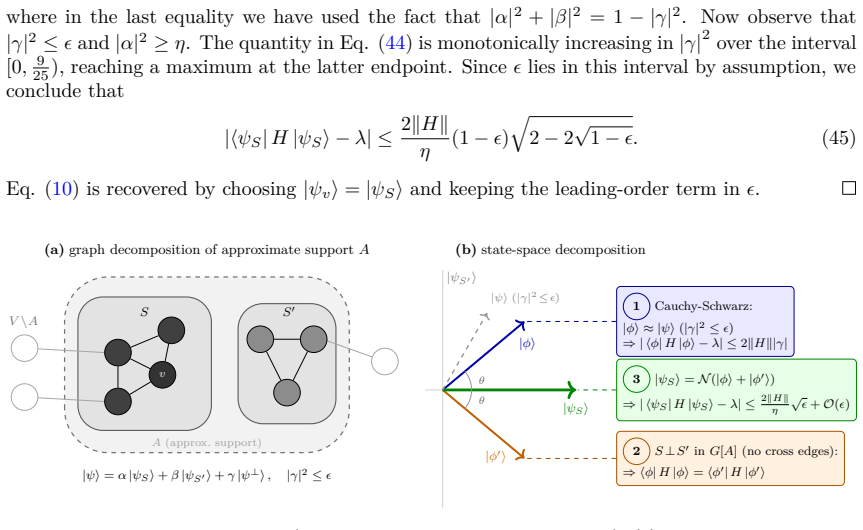
For every sparse eigenvector of a Hermitian matrix there exists (possibly different) sparse eigenvector with the same eigenvalue whose support is contained in a subgraph whose diameter scales linearly with the sparsity and is independent of the total number of vertices. Consequently, if a 2^n-dimensional poly(n)-sparse Hamiltonian possesses an O(1)-sparse extremal eigenvector and a single support vertex is supplied, an exact eigenvector of the same eigenvalue can be recovered in poly(n) time; the same holds for a non-extremal eigenvector that is sparser than every eigenvector with a different eigenvalue.
What carries the argument
The support-localization theorem for sparse eigenvectors on the graph induced by nonzero entries, which guarantees a representative eigenvector whose support diameter is linear in its sparsity.
If this is right
- Exact eigenvector recovery becomes polynomial-time when the Hamiltonian is poly(n)-sparse, the target eigenvector is O(1)-sparse and extremal, and one support index is known.
- The same polynomial-time guarantee holds for non-extremal eigenvectors that are strictly sparser than all eigenvectors of different eigenvalues.
- No assumptions on degeneracy, locality, spectral width, or gap are required for the polynomial-time result.
- The identical localization principle applies to sparse principal component analysis without further modification.
Where Pith is reading between the lines
- If a reliable heuristic for guessing an initial support vertex can be supplied, the method yields a practical classical algorithm for finding sparse ground states of large sparse Hamiltonians.
- The same bounded-diameter search can be used as a subroutine inside hybrid quantum-classical algorithms that only need to certify or refine a candidate support.
- Because the diameter bound is independent of dimension, the approach scales to any matrix whose sparsity graph has bounded degree, including adjacency matrices of regular graphs of arbitrary size.
Load-bearing premise
At least one vertex inside the desired support must already be known or guessed.
What would settle it
A concrete Hermitian matrix whose every eigenvector with a given sparsity level has support diameter strictly larger than linear in that sparsity.
Figures

read the original abstract
Computing quantum ground states is generically difficult, but additional structure can sometimes allow diagonalization to be recast as a more feasible problem. For example, when the desired ground state is sparse in a given basis, diagonalization can be facilitated via graph search. We make this reformulation precise by introducing the eigenwalk problem, which seeks the support of a sparse eigenvector of a Hermitian matrix by exploring the graph induced by its nonzero entries. However, it is not obvious whether the relevant support vertices must always be efficiently reachable by a search on the graph. To resolve this question, we prove that for every sparse eigenvector, there exists a (possibly different) sparse eigenvector with the same eigenvalue whose support is tightly localized in the graph, with diameter scaling only linearly in the sparsity and independently of the total number of vertices. As a consequence, if a $2^n$-dimensional, ${\rm poly}(n)$-sparse Hamiltonian has an $\mathcal{O}(1)$-sparse extremal eigenvector and one support element is known, then an exact eigenvector with the same eigenvalue can be computed classically in ${\rm poly}(n)$ time. The same conclusion follows when the $\mathcal{O}(1)$-sparse eigenvector is non-extremal, provided that it is sparser than every eigenvector with a different eigenvalue. These results hold with no assumptions on the degeneracy, locality, spectral width, or spectral gap of the Hamiltonian, and the underlying support-localization principle also extends to problems beyond exact diagonalization, such as sparse principal component analysis.
Editorial analysis
A structured set of objections, weighed in public.
Referee Report
Summary. The paper introduces the eigenwalk problem of recovering the support of a sparse eigenvector of a Hermitian matrix by search on the graph of its nonzero entries. It proves a localization theorem stating that for every sparse eigenvector there exists (possibly different) sparse eigenvector with identical eigenvalue whose support has graph diameter linear in the sparsity level and independent of dimension. As a consequence, exact diagonalization of a 2^n-dimensional poly(n)-sparse Hamiltonian possessing an O(1)-sparse extremal eigenvector (or a non-extremal eigenvector sparser than all others) can be performed in poly(n) time provided one support vertex is already known. The result requires no assumptions on degeneracy, locality, spectral gap or width, and is claimed to extend to sparse PCA.
Significance. If the localization theorem is correct, the work supplies a parameter-free, assumption-light route to exact classical diagonalization for a nontrivial class of sparse high-dimensional Hermitian operators once a single support vertex is supplied. The absence of fitted parameters, self-referential definitions, or reductions to quantities defined inside the paper is a clear strength. The result is of theoretical interest for structured quantum many-body problems and for sparse principal-component analysis, though its algorithmic utility remains conditional on the availability of a seed vertex.
major comments (2)
- The central localization theorem is presented as an existence result whose proof is not reproduced in the provided abstract or reader notes; without the explicit derivation steps (presumably in §3 or §4) it is impossible to verify whether the diameter bound is obtained without hidden assumptions on the support or on the matrix entries.
- [Abstract] Abstract, final paragraph: the poly(n)-time claim is correctly qualified by the proviso that one support element must already be known. No mechanism is supplied for locating such a seed in the worst case, so the algorithmic consequence remains conditional exactly as stated; this qualification is load-bearing for any claim of unconditional polynomial-time diagonalization.
minor comments (1)
- Notation for the sparsity graph and the precise definition of 'eigenwalk' should be introduced with a small illustrative example early in the text to aid readability.
Simulated Author's Rebuttal
We thank the referee for their careful review and for acknowledging the potential significance of the localization theorem. We respond point-by-point to the major comments below.
read point-by-point responses
-
Referee: The central localization theorem is presented as an existence result whose proof is not reproduced in the provided abstract or reader notes; without the explicit derivation steps (presumably in §3 or §4) it is impossible to verify whether the diameter bound is obtained without hidden assumptions on the support or on the matrix entries.
Authors: The complete proof of the localization theorem, including all explicit derivation steps, appears in Sections 3 and 4 of the full manuscript. These sections derive the linear-diameter bound directly from the eigenvector sparsity and the graph induced by nonzero matrix entries, without additional assumptions on support structure or matrix values. revision: no
-
Referee: Abstract, final paragraph: the poly(n)-time claim is correctly qualified by the proviso that one support element must already be known. No mechanism is supplied for locating such a seed in the worst case, so the algorithmic consequence remains conditional exactly as stated; this qualification is load-bearing for any claim of unconditional polynomial-time diagonalization.
Authors: We agree that the result is conditional on the availability of one support vertex and that the abstract states this limitation accurately. The manuscript neither claims nor supplies a general method for locating such a seed, so the algorithmic consequence is correctly presented as conditional. revision: no
Circularity Check
No circularity: mathematical existence proof is self-contained
full rationale
The paper presents a graph-theoretic existence theorem establishing that any sparse eigenvector has a counterpart with the same eigenvalue whose support has diameter linear in the sparsity (independent of dimension). This is proved directly from the definition of the induced graph on nonzero matrix entries and standard linear-algebra facts about eigenspaces; no parameters are fitted, no quantities are defined in terms of the result itself, and no load-bearing steps reduce to self-citations or prior ansatzes by the same authors. The poly-time algorithm is explicitly conditional on an external seed vertex, which is stated as an assumption rather than derived internally. The derivation chain therefore contains no reductions of the enumerated circular kinds.
Axiom & Free-Parameter Ledger
axioms (1)
- standard math Properties of Hermitian matrices and the graph induced by their nonzero entries
Reference graph
Works this paper leans on
-
[1]
Ab initio quantum chemistry: Methodology and applications
Richard A Friesner. “Ab initio quantum chemistry: Methodology and applications”. Proc. Natl. Acad. Sci.102, 6648–6653 (2005). url:https://doi.org/10.1073/pnas.0408036102
-
[2]
Quantum monte carlo simulations of solids
William MC Foulkes, Lubos Mitas, RJ Needs, and Guna Rajagopal. “Quantum monte carlo simulations of solids”. Rev. Mod. Phys73, 33 (2001). url:https://link.aps.org/doi/10. 1103/RevModPhys.73.33
2001
-
[3]
The density-matrix renormalization group
Ulrich Schollw¨ ock. “The density-matrix renormalization group”. Rev. Mod. Phys77, 259– 315 (2005). url:https://journals.aps.org/rmp/abstract/10.1103/RevModPhys.77.259
-
[4]
Coupled-cluster theory in quantum chemistry
Rodney J Bartlett and Monika Musia l. “Coupled-cluster theory in quantum chemistry”. Rev. Mod. Phys79, 291–352 (2007). url:https://doi.org/10.1103/RevModPhys.79.291
-
[5]
James P. F. LeBlanc, Andrey E Antipov, Federico Becca, Ireneusz W Bulik, Garnet Kin- Lic Chan, Chia-Min Chung, Youjin Deng, Michel Ferrero, Thomas M Henderson, Carlos A Jim´ enez-Hoyos, et al. “Solutions of the two-dimensional hubbard model: benchmarks and results from a wide range of numerical algorithms”. Phys. Rev. X5, 041041 (2015). url:https: //doi.o...
-
[6]
The quantum theory of the electron
Paul Adrien Maurice Dirac. “The quantum theory of the electron”. Proc. R. Soc. Lond. A 117, 610–624 (1928). url:https://doi.org/10.1098/rspa.1928.0023
-
[7]
Nobel lecture: Electronic structure of matter—wave functions and density functionals
Walter Kohn. “Nobel lecture: Electronic structure of matter—wave functions and density functionals”. Rev. Mod. Phys71, 1253 (1999). url:https://www.nobelprize.org/uploads/ 2018/06/kohn-lecture.pdf
1999
-
[8]
Nobel lecture: Quantum chemical models
John A Pople. “Nobel lecture: Quantum chemical models”. Rev. Mod. Phys71, 1267 (1999). url:https://doi.org/10.1103/RevModPhys.71.1267
-
[9]
A direct formulation for sparse pca using semidefinite programming
Alexandre d’Aspremont, Laurent El Ghaoui, Michael I. Jordan, and Gert R. G. Lanckriet. “A direct formulation for sparse pca using semidefinite programming”. SIAM Rev49, 434– 448 (2007)
2007
-
[10]
Finding a large hidden clique in a random graph
Noga Alon, Michael Krivelevich, and Benny Sudakov. “Finding a large hidden clique in a random graph”. Random Struct. Algorithms13, 457–466 (1998)
1998
-
[11]
Locally supported eigenvectors of matrices associ- ated with connected and unweighted power-law graphs
Van Emden Henson and Geoffrey Sanders. “Locally supported eigenvectors of matrices associ- ated with connected and unweighted power-law graphs”. Electronic Transactions on Numerical Analysis39, 353–378 (2012)
2012
-
[12]
Estimates for some computational techniques in linear algebra
Shmuel Kaniel. “Estimates for some computational techniques in linear algebra”. Math. Comp.20, 369–378 (1966). url:https://doi.org/10.1090/S0025-5718-1966-0234618-4
-
[13]
The computation of eigenvalues and eigenvectors of very large sparse matrices
Christopher Conway Paige. “The computation of eigenvalues and eigenvectors of very large sparse matrices”. PhD thesis. University of London. (1971). url:https://ethos.bl.uk/ OrderDetails.do?uin=uk.bl.ethos.307848
1971
-
[14]
On the rates of convergence of the lanczos and the block-lanczos methods
Y. Saad. “On the rates of convergence of the lanczos and the block-lanczos methods”. SIAM J. Numer. Anal17, 687–706 (1980)
1980
-
[15]
George H Booth, Alex JW Thom, and Ali Alavi. “Fermion monte carlo without fixed nodes: A game of life, death, and annihilation in slater determinant space”. J. Chem. Phys131(2009). url:https://doi.org/10.1063/1.3193710
-
[16]
A deterministic alternative to the full configuration interaction quantum monte carlo method
Norm M Tubman, Joonho Lee, Tyler Y Takeshita, Martin Head-Gordon, and K Birgitta Whaley. “A deterministic alternative to the full configuration interaction quantum monte carlo method”. J. Chem. Phys145(2016). url:https://doi.org/10.1063/1.4955109
-
[17]
Heat-bath configuration interaction: An efficient selected configuration interaction algorithm inspired by heat-bath sampling
Adam A Holmes, Norm M Tubman, and CJ Umrigar. “Heat-bath configuration interaction: An efficient selected configuration interaction algorithm inspired by heat-bath sampling”. J. Chem. Theory Comput12, 3674–3680 (2016). url:https://pubs.acs.org/doi/10.1021/ acs.jctc.6b00407
2016
-
[18]
Jeffrey B Schriber and Francesco A Evangelista. “Communication: An adaptive configura- tion interaction approach for strongly correlated electrons with tunable accuracy”. J. Chem. Phys144(2016). url:https://doi.org/10.1063/1.4948308
-
[19]
Studies in configuration interaction: The first-row diatomic hydrides
Charles F Bender and Ernest R Davidson. “Studies in configuration interaction: The first-row diatomic hydrides”. Phys. Rev.183, 23 (1969). url:https://link.aps.org/doi/10.1103/ PhysRev.183.23. 23
1969
-
[20]
Bernard Huron, JP Malrieu, and P Rancurel. “Iterative perturbation calculations of ground and excited state energies from multiconfigurational zeroth-order wavefunctions”. J. Chem. Phys58, 5745–5759 (1973). url:https://doi.org/10.1063/1.1679199
-
[21]
Individualized configuration selection in ci calculations with subsequent energy extrapolation
Robert J Buenker and Sigrid D Peyerimhoff. “Individualized configuration selection in ci calculations with subsequent energy extrapolation”. Theor. Chim. Acta35, 33–58 (1974). url:https://link.springer.com/article/10.1007/BF02394557
-
[22]
Robert J Buenker, Sigrid D Peyerimhoff, and Werner Butscher. “Applicability of the multi- reference double-excitation ci (mrd-ci) method to the calculation of electronic wavefunctions and comparison with related techniques”. Mol. Phys35, 771–791 (1978). url:https://www. tandfonline.com/doi/abs/10.1080/00268977800100581
-
[23]
Convergence of an im- proved cipsi algorithm
Stefano Evangelisti, Jean-Pierre Daudey, and Jean-Paul Malrieu. “Convergence of an im- proved cipsi algorithm”. Chem. Phys75, 91–102 (1983). url:https://doi.org/10.1016/ 0301-0104(83)85011-3
1983
-
[24]
Nonperturbative ab initio calculations in strong magneticfieldsusingLondonorbitals
F Illas, J Rubio, JM Ricart, and PS Bagus. “Selected versus complete configuration interac- tion expansions”. J. Chem. Phys95, 1877–1883 (1991). url:https://doi.org/10.1063/1. 461037
work page doi:10.1063/1 1991
-
[25]
Robert J Harrison. “Approximating full configuration interaction with selected configuration interaction and perturbation theory”. J. Chem. Phys94, 5021–5031 (1991). url:https: //doi.org/10.1063/1.460537
-
[26]
P Stampfuß and W Wenzel. “Improved implementation and application of the individually selecting configuration interaction method”. J. Chem. Phys122, 024110 (2005). url:https: //doi.org/10.1063/1.1829045
-
[27]
Identification of deadwood in configuration spaces through general direct configuration interaction
Joseph Ivanic and Klaus Ruedenberg. “Identification of deadwood in configuration spaces through general direct configuration interaction”. Theor. Chem. Acc106, 339–351 (2001). url:https://link.springer.com/article/10.1007/s002140100285
-
[28]
A priori identification of configurational dead- wood
Laimutis Bytautas and Klaus Ruedenberg. “A priori identification of configurational dead- wood”. Chem. Phys356, 64–75 (2009). url:https://doi.org/10.1016/j.chemphys.2008. 11.021
-
[29]
The stark effect from the point of view of schroedinger’s quantum theory
Paul S Epstein. “The stark effect from the point of view of schroedinger’s quantum theory”. Phys. Rev.28, 695 (1926). url:https://doi.org/10.1103/PhysRev.28.695
-
[30]
Configuration interaction in orbital theories
RK Nesbet. “Configuration interaction in orbital theories”. Proc. Roy. Soc. London A230, 312–321 (1955). url:https://doi.org/10.1098/rspa.1955.0134
-
[31]
Graphic characterization and clustering configuration descriptors of determinant space for molecules
Lei Sun, Zixi Zhang, Tonghuan Jiang, Yilin Chen, and Ji Chen. “Graphic characterization and clustering configuration descriptors of determinant space for molecules”. J. Chem. Theory Comput19, 2282–2290 (2023)
2023
-
[32]
From random determinants to the ground state
Hao Zhang and Matthew Otten. “From random determinants to the ground state” (2025). arXiv:2511.14734
arXiv 2025
-
[33]
Chemistry beyond the scale of exact diagonalization on a quantum- centric supercomputer
Javier Robledo-Moreno, Mario Motta, Holger Haas, Ali Javadi-Abhari, Petar Jurcevic, William Kirby, Simon Martiel, Kunal Sharma, Sandeep Sharma, Tomonori Shirakawa, Iskan- dar Sitdikov, Rong-Yang Sun, Kevin J. Sung, Maika Takita, Minh C. Tran, Seiji Yunoki, and Antonio Mezzacapo. “Chemistry beyond the scale of exact diagonalization on a quantum- centric su...
2025
-
[34]
Keita Kanno, Masaya Kohda, Ryosuke Imai, Sho Koh, Kosuke Mitarai, Wataru Mizukami, and Yuya O Nakagawa. “Quantum-selected configuration interaction: Classical diagonalization of hamiltonians in subspaces selected by quantum computers” (2023). arXiv:2302.11320
Pith/arXiv arXiv 2023
-
[35]
Quantum-selected configuration interaction with time-evolved state
Mathias Mikkelsen and Yuya O Nakagawa. “Quantum-selected configuration interaction with time-evolved state”. Phys. Rev. Res7, 043043 (2025). url:https://doi.org/10.1103/ 75pv-hbrx
2025
-
[36]
Hamil- tonian simulation-based quantum-selected configuration interaction for large-scale elec- tronic structure calculations with a quantum computer
Kenji Sugisaki, Shu Kanno, Toshinari Itoko, Rei Sakuma, and Naoki Yamamoto. “Hamil- tonian simulation-based quantum-selected configuration interaction for large-scale elec- tronic structure calculations with a quantum computer”. Phys. Chem. Chem. Phys27, 20869–20884 (2025). url:https://pubs.rsc.org/en/content/articlelanding/2025/cp/ d5cp02202a
2025
-
[37]
Quantum-centric algorithm for sample-based krylov diagonalization
Jeffery Yu, Javier Robledo Moreno, Joseph T. Iosue, Luke Bertels, Daniel Claudino, Bryce Fuller, Peter Groszkowski, Travis S. Humble, Petar Jurcevic, William Kirby, Thomas A. Maier, Mario Motta, Bibek Pokharel, Alireza Seif, Amir Shehata, Kevin J. Sung, Minh C. 24 Tran, Vinay Tripathi, Antonio Mezzacapo, and Kunal Sharma. “Quantum-centric algorithm for sa...
arXiv 2025
-
[38]
Quantum filter diagonalization: Quantum eigen- decomposition without full quantum phase estimation
Robert M Parrish and Peter L McMahon. “Quantum filter diagonalization: Quantum eigen- decomposition without full quantum phase estimation” (2019). arXiv:1909.08925
arXiv 2019
-
[39]
A multireference quantum krylov algorithm for strongly correlated electrons
Nicholas H Stair, Renke Huang, and Francesco A Evangelista. “A multireference quantum krylov algorithm for strongly correlated electrons”. J. Chem. Theory Comput16, 2236– 2245 (2020). url:https://pubs.acs.org/doi/10.1021/acs.jctc.9b01125
-
[40]
A theory of quantum subspace diago- nalization
Ethan N Epperly, Lin Lin, and Yuji Nakatsukasa. “A theory of quantum subspace diago- nalization”. SIAM J. Matrix Anal43, 1263–1290 (2022). url:https://doi.org/10.1137/ 21M145954X
2022
-
[41]
Analysis of quantum krylov algorithms with errors
William Kirby. “Analysis of quantum krylov algorithms with errors”. Quantum8, 1457 (2024). url:https://quantum-journal.org/papers/q-2024-08-29-1457/
2024
-
[42]
Truncated power method for sparse eigenvalue problems
Xiao-Tong Yuan and Tong Zhang. “Truncated power method for sparse eigenvalue problems”. J. Mach. Learn. Res14, 899–925 (2013). url:http://jmlr.org/papers/v14/yuan13a.html
2013
-
[43]
Matrix analysis
Roger A. Horn and Charles R. Johnson. “Matrix analysis”. Cambridge University Press. (2012). 2nd edition
2012
-
[44]
The eigen-problem for some special near-Toeplitz centro-skew tridiagonal matrices
Antonio Behn, Kenneth R. Driessel, and Irvin R. Hentzel. “The eigen-problem for some special near-Toeplitz centro-skew tridiagonal matrices” (2011). arXiv:1101.5788. 25
Pith/arXiv arXiv 2011
discussion (0)
Sign in with ORCID, Apple, or X to comment. Anyone can read and Pith papers without signing in.