Observation of even-denominator fractional quantum Hall states at ν = 3/4 and 5/4 in the lowest Landau level
Pith reviewed 2026-06-26 06:34 UTC · model grok-4.3
The pith
Even-denominator fractional quantum Hall states appear at filling factors 3/4 and 5/4 in the lowest Landau level.
A machine-rendered reading of the paper's core claim, the machinery that carries it, and where it could break.
Core claim
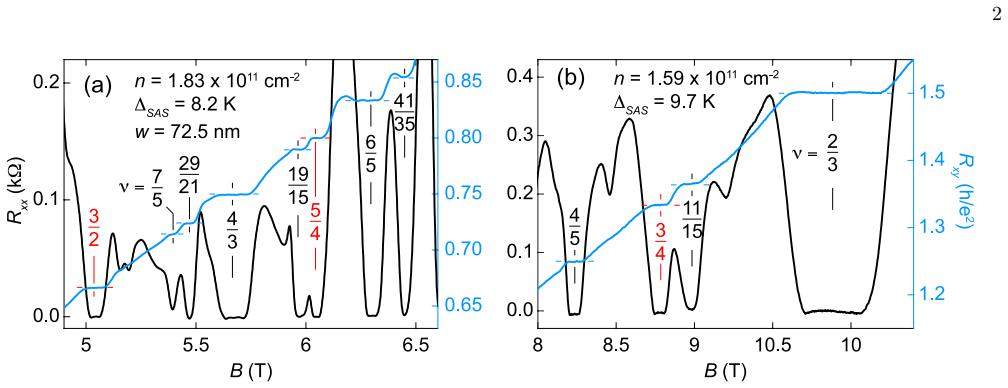
Even-denominator FQHSs are observed at ν = 3/4 and 5/4 in the N = 0 Landau level. As density is increased the ground states evolve from composite-fermion Fermi seas into incompressible states once interlayer tunneling drops and the 2DES becomes two-component, a change also marked by the flanking FQHSs. Both states are extremely sensitive to bilayer symmetry, disappearing when the charge distribution is made asymmetric by only about 2 percent. The states are accounted for as a particle-hole conjugate pair within the Scarola-Jain bilayer composite-fermion framework that generalizes the two-component Halperin Ψ331 state.
What carries the argument
Scarola-Jain bilayer composite-fermion framework that generalizes the Halperin Ψ331 state to produce particle-hole symmetric even-denominator states at 3/4 and 5/4.
If this is right
- The 3/4 and 5/4 states are two-component and linked by particle-hole symmetry.
- Both states disappear rapidly once the bilayer charge distribution is made asymmetric.
- Competing tunneling and Coulomb energy scales in wide wells can stabilize even-denominator states inside the lowest Landau level.
- The bilayer composite-fermion construction accounts for the observed states and their symmetry properties.
Where Pith is reading between the lines
- Similar even-denominator states could appear at other fractions if the interlayer tunneling and layer separation are tuned independently in other wide-well samples.
- The same density-tuning method might reveal whether the Scarola-Jain framework also describes states at higher Landau levels or in different host materials.
- Precise control of bilayer asymmetry could be used to switch the 3/4 and 5/4 states on and off in a single device.
Load-bearing premise
The states at 3/4 and 5/4 become two-component FQHSs only after density is raised enough to reduce interlayer tunneling, as signaled by the behavior of the states that flank them.
What would settle it
Measurement of the 3/4 and 5/4 states in the same sample after the charge distribution is deliberately made asymmetric by 2 percent, or after the density is lowered back into the single-component regime.
Figures



read the original abstract
Two-dimensional electron systems (2DESs) confined to wide GaAs quantum wells provide a unique platform to study exotic fractional quantum Hall states (FQHSs) because the 2DES has a bilayer charge distribution with significant interlayer tunneling. Precise control over the 2DES density allows the tuning of the interlayer tunneling over a wide range. Here, we present our discovery of new even-denominator FQHSs in the lowest Landau level (orbital index \textit{N} = 0) at filling factors $\nu = 3/4$ and 5/4 in an ultrahigh-quality 2DES confined to a 72.5-nm-wide GaAs quantum well. The ground states at $\nu = 3/4$ and 5/4 both evolve from composite fermion Fermi seas to FQHSs as the density is raised so that interlayer tunneling is sufficiently reduced and the 2DES becomes two-component, signaled by the behavior of the FQHSs flanking $\nu = 3/4$ and 5/4. The two-component nature of the $\nu=3/4$ and 5/4 FQHSs is also evident from their extreme sensitivity to the bilayer charge distribution symmetry: both states disappear quickly when the charge distribution is made asymmetric by only $\simeq 2\%$. We find a natural explanation for the 3/4 and 5/4 FQHSs in terms of two states linked by particle-hole symmetry, and using the Scarola-Jain bilayer composite fermion framework which is a generalization of the well-known, two-component, Halperin state ($\Psi_{331}$ state). Our observations elucidate the crucial role of competing energy and length scales in wide quantum wells in stabilizing new ground states.
Editorial analysis
A structured set of objections, weighed in public.
Referee Report
Summary. The manuscript reports the experimental discovery of even-denominator FQHSs at filling factors ν = 3/4 and 5/4 in the lowest Landau level (N=0) of an ultrahigh-quality 2DES confined to a 72.5-nm-wide GaAs quantum well. The ground states at these fillings are claimed to evolve from composite-fermion Fermi seas to FQHSs as density is increased (reducing interlayer tunneling and rendering the 2DES two-component), with this transition signaled by the evolution of flanking FQHSs; the states are further reported to be extremely sensitive to ~2% asymmetry in the bilayer charge distribution and are interpreted within the Scarola-Jain bilayer composite-fermion framework as particle-hole conjugates linked to the Halperin 331 state.
Significance. If the observations hold, the work identifies new even-denominator states in the LLL, a regime where such states are uncommon, and demonstrates density-tuned control over bilayer character in wide wells. This could extend the applicability of bilayer CF constructions and provide a platform for studying competing energy scales in two-component systems.
major comments (1)
- [Abstract] Abstract: the central interpretive step—that raising density reduces interlayer tunneling sufficiently for the 2DES to become two-component, with this transition signaled by the behavior of the FQHSs flanking ν = 3/4 and 5/4—is not uniquely established. Density variation simultaneously alters mobility, screening, and subband occupation in a wide well; the manuscript must supply quantitative controls or additional measurements (e.g., tunneling gap vs. density, or direct comparison of mobility-screening effects) to isolate tunneling as the dominant driver.
minor comments (1)
- [Abstract] The abstract states the states 'disappear quickly' under ~2% asymmetry; a quantitative plot or table of the asymmetry dependence (e.g., gap vs. asymmetry parameter) would strengthen the two-component claim.
Simulated Author's Rebuttal
We thank the referee for their careful reading of our manuscript and for highlighting the need to strengthen the interpretation of the density-driven transition. We respond to the major comment below.
read point-by-point responses
-
Referee: [Abstract] Abstract: the central interpretive step—that raising density reduces interlayer tunneling sufficiently for the 2DES to become two-component, with this transition signaled by the behavior of the FQHSs flanking ν = 3/4 and 5/4—is not uniquely established. Density variation simultaneously alters mobility, screening, and subband occupation in a wide well; the manuscript must supply quantitative controls or additional measurements (e.g., tunneling gap vs. density, or direct comparison of mobility-screening effects) to isolate tunneling as the dominant driver.
Authors: We acknowledge that varying density in a wide well simultaneously affects mobility, screening, and subband occupation, so tunneling is not isolated by density alone. Our central evidence for the two-component regime remains the evolution of the flanking FQHSs (whose bilayer character is established in the literature) together with the extreme ~2% asymmetry sensitivity of the 3/4 and 5/4 states themselves. These observables are known to track the interlayer tunneling strength more directly than mobility or screening in this geometry. We will revise the manuscript to add a dedicated paragraph that (i) estimates the relative magnitudes of the competing energy scales with density and (ii) explicitly states that the transition is inferred from the collective behavior of multiple indicators rather than from tunneling in isolation. No new experimental data are available, but the added discussion will make the interpretive logic clearer. revision: partial
Circularity Check
No circularity: experimental observation grounded in data
full rationale
The paper reports direct experimental observations of FQHSs at ν=3/4 and 5/4 via transport measurements in a tunable-density GaAs quantum well. All central claims (evolution with density, two-component character, sensitivity to asymmetry) are tied to measured quantities such as resistance minima and their response to external parameters. The interpretive reference to the Scarola-Jain framework is an external citation, not a self-citation chain or self-definitional reduction. No equations, fitted parameters, or uniqueness theorems are invoked that collapse back to the paper's own inputs by construction. The derivation chain is therefore self-contained against external benchmarks.
Axiom & Free-Parameter Ledger
axioms (2)
- standard math Physics of two-dimensional electron systems in magnetic fields follows Landau level quantization.
- domain assumption The Scarola-Jain bilayer composite fermion framework applies to this system.
Reference graph
Works this paper leans on
-
[1]
The negligibly small interlayer tun- neling in these systems allows the individual layers to act as a pseudospin
is stabilized. The negligibly small interlayer tun- neling in these systems allows the individual layers to act as a pseudospin. Indeed, in multicomponent systems such as spin-coupled subbands [43] or valleys [44], the 2C, even-denominator FQHS is observed. Yet another mechanism that can also soften the residual interaction between CFs and result in pairi...
-
[2]
For example, the 6/7 FQHS can be understood as two independent layers each forming a 3/7 FQHS. In- terestingly, in wide GaAs QWs, FQHSs withunequal layer densities (and layer fillings) can also be stabilized by an interaction-induced, spontaneous charge distribu- tion asymmetry [55], such as atν= 29/35 and 11/15. Atν= 11/15, for e.g., as demonstrated in R...
-
[3]
is the (1/3,1/3|1) state. It should also be empha- sized that the parametersν 1,2 andmare related to the total filling factorνby the expressions: ν= ¯ν1 + ¯ν2 = ν2−1 −m ν1−1ν2−1 −m 2 + ν1−1 −m ν1−1ν2−1 −m 2 ,(4) where ¯ν1,2 are the individual layer fillings. In the trivial case without any interlayer correlations (m= 0), the individual layer filling ¯ν1,2...
-
[4]
J. K. Jain, Composite-fermion approach for the fractional quantum Hall effect, Phys. Rev. Lett.63, 199 (1989)
1989
-
[6]
B. I. Halperin, P. A. Lee, and N. Read, Theory of the half-filled Landau level, Phys. Rev. B47, 7312 (1993)
1993
-
[7]
R. L. Willett, R. R. Ruel, K. W. West, and L. N. Pfeiffer, Experimental demonstration of a Fermi surface at one- half filling of the lowest Landau level, Phys. Rev. Lett. 71, 3846 (1993)
1993
-
[8]
Willett, J
R. Willett, J. P. Eisenstein, H. L. St¨ ormer, D. C. Tsui, A. C. Gossard, and J. H. English, Observation of an even- denominator quantum number in the fractional quantum Hall effect, Phys. Rev. Lett.59, 1776 (1987)
1987
-
[9]
Pan, J.-S
W. Pan, J.-S. Xia, V. Shvarts, D. E. Adams, H. L. Stormer, D. C. Tsui, L. N. Pfeiffer, K. W. Baldwin, and K. W. West, Exact Quantization of the Even- Denominator Fractional Quantum Hall State atν= 5/2 Landau Level Filling Factor, Phys. Rev. Lett.83, 3530 (1999)
1999
-
[10]
J. S. Xia, W. Pan, C. L. Vicente, E. D. Adams, N. S. Sullivan, H. L. Stormer, D. C. Tsui, L. N. Pfeiffer, K. W. Baldwin, and K. W. West, Electron Correlation in the Second Landau Level: A Competition Between Many Nearly Degenerate Quantum Phases, Phys. Rev. Lett. 93, 176809 (2004)
2004
-
[11]
V. W. Scarola, K. Park, and J. K. Jain, Cooper instability of composite fermions, Nature406, 863 (2000)
2000
-
[12]
Falson, D
J. Falson, D. Maryenko, B. Friess, D. Zhang, Y. Kozuka, A. Tsukazaki, J. Smet, and M. Kawasaki, Even- denominator fractional quantum Hall physics in ZnO, Nat. Phys.11, 347 (2015)
2015
-
[13]
Y. Kim, A. C. Balram, T. Taniguchi, K. Watanabe, J. K. Jain, and J. H. Smet, Even denominator fractional quan- tum Hall states in higher Landau levels of graphene, Nat. Phys.15, 154 (2019)
2019
-
[14]
D.-K. Ki, V. I. Fal’ko, D. A. Abanin, and A. F. Mor- purgo, Observation of even denominator fractional quan- tum Hall effect in suspended bilayer graphene, Nano Lett. 14, 2135 (2014)
2014
-
[15]
A. A. Zibrov, C. Kometter, H. Zhou, E. Spanton, T. Taniguchi, K. Watanabe, M. Zaletel, and A. Young, Tunable interacting composite fermion phases in a half- filled bilayer-graphene Landau level, Nature549, 360 (2017)
2017
-
[16]
J. Li, C. Tan, S. Chen, Y. Zeng, T. Taniguchi, K. Watan- abe, J. Hone, and C. Dean, Even-denominator fractional quantum Hall states in bilayer graphene, Science358, 648 (2017)
2017
-
[17]
Huang, H
K. Huang, H. Fu, D. R. Hickey, N. Alem, X. Lin, K. Watanabe, T. Taniguchi, and J. Zhu, Valley Isospin Controlled Fractional Quantum Hall States in Bilayer Graphene, Phys. Rev. X12, 031019 (2022)
2022
-
[18]
Assouline, T
A. Assouline, T. Wang, H. Zhou, L. A. Cohen, F. Yang, R. Zhang, T. Taniguchi, K. Watanabe, R. S. K. Mong, M. P. Zaletel, and A. F. Young, Energy Gap of the Even- Denominator Fractional Quantum Hall State in Bilayer Graphene, Phys. Rev. Lett.132, 046603 (2024)
2024
-
[19]
Hu, Y.-C
Y. Hu, Y.-C. Tsui, M. He, U. Kamber, T. Wang, A. S. Mohammadi, K. Watanabe, T. Taniguchi, Z. Papi´ c, M. P. Zaletel,et al., High-resolution tunnelling spectroscopy of fractional quantum Hall states, Nat. Phys.21, 716 (2025)
2025
-
[20]
Shi, E.-M
Q. Shi, E.-M. Shih, M. V. Gustafsson, D. A. Rhodes, B. Kim, K. Watanabe, T. Taniguchi, Z. Papi´ c, J. Hone, and C. R. Dean, Odd-and even-denominator fractional quantum Hall states in monolayer WSe2, Nat. Nanotech- nol.15, 569 (2020)
2020
-
[21]
Nayak, S
C. Nayak, S. H. Simon, A. Stern, M. Freedman, and S. Das Sarma, Non-Abelian anyons and topological quan- tum computation, Rev. Mod. Phys.80, 1083 (2008)
2008
-
[22]
J. K. Jain, Incompressible quantum Hall states, Phys. Rev. B40, 8079 (1989)
1989
-
[23]
R. B. Laughlin, Anomalous Quantum Hall Effect: An In- compressible Quantum Fluid with Fractionally Charged Excitations, Phys. Rev. Lett.50, 1395 (1983)
1983
-
[24]
Y. W. Suen, L. W. Engel, M. B. Santos, M. Shayegan, and D. C. Tsui, Observation of aν= 1/2 fractional quan- tum Hall state in a double-layer electron system, Phys. Rev. Lett.68, 1379 (1992)
1992
-
[25]
J. P. Eisenstein, G. S. Boebinger, L. N. Pfeiffer, K. W. West, and S. He, New fractional quantum Hall state in double-layer two-dimensional electron systems, Phys. Rev. Lett.68, 1383 (1992)
1992
-
[26]
Eisenstein, Exciton condensation in bilayer quantum Hall systems, Annu
J. Eisenstein, Exciton condensation in bilayer quantum Hall systems, Annu. Rev. Condens. Matter Phys.5, 159 (2014)
2014
-
[27]
Y. W. Suen, M. B. Santos, and M. Shayegan, Corre- lated states of an electron system in a wide quantum well, Phys. Rev. Lett.69, 3551 (1992)
1992
-
[28]
Y. W. Suen, H. C. Manoharan, X. Ying, M. B. Santos, and M. Shayegan, Origin of theν= 1/2 fractional quan- tum Hall state in wide single quantum wells, Phys. Rev. Lett.72, 3405 (1994)
1994
-
[29]
Y. Liu, A. L. Graninger, S. Hasdemir, M. Shayegan, L. N. Pfeiffer, K. W. West, K. W. Baldwin, and R. Winkler, Fractional Quantum Hall Effect atν= 1/2 in Hole Sys- tems Confined to GaAs Quantum Wells, Phys. Rev. Lett. 112, 046804 (2014)
2014
-
[30]
J. I. A. Li, Q. Shi, Y. Zeng, K. Watanabe, T. Taniguchi, J. Hone, and C. Dean, Pairing states of composite fermions in double-layer graphene, Nat. Phys.15, 898 (2019)
2019
-
[31]
M. S. Hossain, M. K. Ma, Y. J. Chung, S. K. Singh, A. Gupta, K. W. West, K. W. Baldwin, L. N. Pfeif- fer, R. Winkler, and M. Shayegan, Valley-Tunable Even- Denominator Fractional Quantum Hall State in the Low- est Landau Level of an Anisotropic System, Phys. Rev. Lett.130, 126301 (2023)
2023
-
[32]
N. J. Zhang, R. Q. Nguyen, N. Batra, X. Liu, K. Watan- abe, T. Taniguchi, D. Feldman, and J. Li, Excitons in the fractional quantum Hall effect, Nature637, 327 (2025)
2025
-
[33]
D. R. Luhman, W. Pan, D. C. Tsui, L. N. Pfeiffer, K. W. Baldwin, and K. W. West, Observation of a Fractional Quantum Hall State atν= 1/4 in a Wide GaAs Quan- tum Well, Phys. Rev. Lett.101, 266804 (2008)
2008
-
[34]
Shabani, T
J. Shabani, T. Gokmen, and M. Shayegan, Correlated States of Electrons in Wide Quantum Wells at Low Fill- ings: The Role of Charge Distribution Symmetry, Phys. Rev. Lett.103, 046805 (2009)
2009
-
[35]
Shabani, T
J. Shabani, T. Gokmen, Y. T. Chiu, and M. Shayegan, Evidence for Developing Fractional Quantum Hall States 9 at Even Denominator 1/2 and 1/4 Fillings in Asymmet- ric Wide Quantum Wells, Phys. Rev. Lett.103, 256802 (2009)
2009
-
[36]
K. Park, V. Melik-Alaverdian, N. E. Bonesteel, and J. K. Jain, Possibility of p-wave pairing of composite fermions atν= 1 2, Phys. Rev. B58, R10167 (1998)
1998
-
[37]
Shabani, Y
J. Shabani, Y. Liu, M. Shayegan, L. N. Pfeiffer, K. W. West, and K. W. Baldwin, Phase diagrams for the sta- bility of theν= 1 2 fractional quantum Hall effect in elec- tron systems confined to symmetric, wide GaAs quantum wells, Phys. Rev. B88, 245413 (2013)
2013
-
[38]
M. R. Peterson and S. Das Sarma, Quantum Hall phase diagram of half-filled bilayers in the lowest and the second orbital Landau levels: Abelian versus non-Abelian in- compressible fractional quantum Hall states, Phys. Rev. B81, 165304 (2010)
2010
-
[39]
W. Zhu, Z. Liu, F. D. M. Haldane, and D. N. Sheng, Frac- tional quantum Hall bilayers at half filling: Tunneling- driven non-Abelian phase, Phys. Rev. B94, 245147 (2016)
2016
-
[40]
Sharma, A
A. Sharma, A. C. Balram, and J. K. Jain, Composite- fermion pairing at half-filled and quarter-filled lowest Landau level, Phys. Rev. B109, 035306 (2024)
2024
-
[41]
M. A. Mueed, D. Kamburov, S. Hasdemir, M. Shayegan, L. N. Pfeiffer, K. W. West, and K. W. Baldwin, Geomet- ric Resonance of Composite Fermions Near theν= 1/2 Fractional Quantum Hall State, Phys. Rev. Lett.114, 236406 (2015)
2015
-
[42]
M. A. Mueed, D. Kamburov, L. N. Pfeiffer, K. W. West, K. W. Baldwin, and M. Shayegan, Geometric Reso- nance of Composite Fermions near Bilayer Quantum Hall States, Phys. Rev. Lett.117, 246801 (2016)
2016
-
[43]
S. K. Singh, C. Wang, C. T. Tai, C. S. Calhoun, K. A. Villegas Rosales, P. T. Madathil, A. Gupta, K. W. Bald- win, L. N. Pfeiffer, and M. Shayegan, Topological phase transition between Jain states and daughter states of the ν= 1/2 fractional quantum Hall state, Nat. Phys.20, 1247 (2024)
2024
-
[44]
S. K. Singh, C. Wang, A. Gupta, K. W. Baldwin, L. N. Pfeiffer, and M. Shayegan, Fractional Quantum Hall State atν= 1/2 with Energy Gap Up to 6 K and Possi- ble Transition from the One- to Two-Component State, Phys. Rev. Lett.135, 246603 (2025)
2025
-
[45]
B. I. Halperin, Theory of the quantized Hall conductance, Helv. Phys. Acta56, 75 (1983)
1983
-
[46]
Y. Liu, S. Hasdemir, D. Kamburov, A. L. Graninger, M. Shayegan, L. N. Pfeiffer, K. W. West, K. W. Baldwin, and R. Winkler, Even-denominator fractional quantum Hall effect at a Landau level crossing, Phys. Rev. B89, 165313 (2014)
2014
-
[47]
Zibrov, E
A. Zibrov, E. Spanton, H. Zhou, C. Kometter, T. Taniguchi, K. Watanabe, and A. Young, Even- denominator fractional quantum Hall states at an isospin transition in monolayer graphene, Nat. Phys.14, 930 (2018)
2018
-
[48]
C. Wang, A. Gupta, S. K. Singh, Y. J. Chung, L. N. Pfeiffer, K. W. West, K. W. Baldwin, R. Winkler, and M. Shayegan, Even-Denominator Fractional Quantum Hall State at Filling Factorν= 3/4, Phys. Rev. Lett. 129, 156801 (2022)
2022
-
[49]
C. Wang, A. Gupta, S. K. Singh, P. T. Madathil, Y. J. Chung, L. N. Pfeiffer, K. W. Baldwin, R. Winkler, and M. Shayegan, Fractional Quantum Hall State at Fill- ing Factorν= 1/4 in Ultra-High-Quality GaAs Two- Dimensional Hole Systems, Phys. Rev. Lett.131, 266502 (2023)
2023
-
[50]
C. Wang, A. Gupta, P. T. Madathil, S. K. Singh, Y. J. Chung, L. N. Pfeiffer, K. W. Baldwin, and M. Shayegan, Next-generation even-denominator fractional quantum Hall states of interacting composite fermions, Proc. Natl. Acad. Sci. U.S.A.120, e2314212120 (2023)
2023
-
[51]
T. Zhao, A. C. Balram, and J. K. Jain, Composite Fermion Pairing Induced by Landau Level Mixing, Phys. Rev. Lett.130, 186302 (2023)
2023
-
[52]
Kumar, A
R. Kumar, A. Haug, J. Kim, M. Yutushui, K. Khudiakov, V. Bhardwaj, A. Ilin, K. Watanabe, T. Taniguchi, D. F. Mross, and Y. Ronen, Quarter- and half-filled quantum Hall states and their competing interactions in bilayer graphene, Nat. Comm.16, 7255 (2025)
2025
-
[53]
Y. Chen, Y. Huang, Q. Li, B. Tong, G. Kuang, C. Xi, K. Watanabe, T. Taniguchi, G. Liu, Z. Zhu,et al., Tun- able even-and odd-denominator fractional quantum Hall states in trilayer graphene, Nat. Comm.15, 6236 (2024)
2024
-
[54]
T. Chanda, S. Kaur, H. Singh, K. Watanabe, T. Taniguchi, M. Jain, U. Khanna, A. C. Balram, and A. Bid, Even denominator fractional quantum Hall states in the zeroth Landau level of monolayer-like band of ABA trilayer graphene, arXiv:2502.06245 [cond-mat.mes-hall] (2025)
-
[56]
Y. W. Suen, J. Jo, M. B. Santos, L. W. Engel, S. W. Hwang, and M. Shayegan, Missing integral quantum Hall effect in a wide single quantum well, Phys. Rev. B44, 5947 (1991)
1991
-
[57]
Shayegan, Electrons in a Flatland, in1998 Les Houches Summer School, Session LXIX, Topological As- pects of Low Dimensional Systems, NATO Advanced Study Institute, edited by A
M. Shayegan, Electrons in a Flatland, in1998 Les Houches Summer School, Session LXIX, Topological As- pects of Low Dimensional Systems, NATO Advanced Study Institute, edited by A. Comtet, T. Jolicœur, S. Ou- vry, and F. David (Springer-Verlag, Berlin, 1999) pp. 1– 51
1999
-
[58]
H. C. Manoharan, Y. W. Suen, T. S. Lay, M. B. Santos, and M. Shayegan, Spontaneous Interlayer Charge Trans- fer near the Magnetic Quantum Limit, Phys. Rev. Lett. 79, 2722 (1997)
1997
- [59]
-
[60]
See Supplemental Material for a detailed discussion on the 1C to 2C transition of the 2DES for 2> ν >1
-
[61]
Y. J. Chung, K. Villegas Rosales, K. Baldwin, P. Ma- dathil, K. West, M. Shayegan, and L. Pfeiffer, Ultra-high- quality two-dimensional electron systems, Nat. Mater. 20, 632 (2021)
2021
-
[62]
Y. J. Chung, A. Gupta, K. W. Baldwin, K. W. West, M. Shayegan, and L. N. Pfeiffer, Understanding limits to mobility in ultrahigh-mobility GaAs two-dimensional electron systems: 100 million cm 2/Vs and beyond, Phys. Rev. B106, 075134 (2022)
2022
-
[63]
Huang, W
H. Huang, W. Hussain, S. Myers, L. Pfeiffer, K. West, K. Baldwin, and G. Cs´ athy, Evidence for Topological Protection Derived from Six-Flux Composite Fermions, Nat. Comm.15, 1461 (2024)
2024
-
[64]
Therefore, the 10 only other relevant energy scale for the 1C to 2C transi- tion is ∆ SAS
We emphasize that in the range of densities of interest in our 72.5-nm-wide sample, the composite fermions around ν= 3/2 and 1/2 are fully spin polarized. Therefore, the 10 only other relevant energy scale for the 1C to 2C transi- tion is ∆ SAS. Refer to [?] for a phase diagram of the spin polarization of composite fermions
-
[65]
T. S. Lay, T. Jungwirth, L. Smrˇ cka, and M. Shayegan, One-component to two-component transition of theν= 2/3 fractional quantum Hall effect in a wide quantum well induced by an in-plane magnetic field, Phys. Rev. B 56, R7092 (1997)
1997
-
[66]
Sajoto, Y
T. Sajoto, Y. W. Suen, L. W. Engel, M. B. Santos, and M. Shayegan, Fractional quantum Hall effect in very-low- density GaAs/AlxGa1−xAs heterostructures, Phys. Rev. B41, 8449 (1990)
1990
-
[67]
W. Pan, H. L. Stormer, D. C. Tsui, L. N. Pfeiffer, K. W. Baldwin, and K. W. West, Fractional Quantum Hall Ef- fect of Composite Fermions, Phys. Rev. Lett.90, 016801 (2003)
2003
-
[68]
Samkharadze, I
N. Samkharadze, I. Arnold, L. N. Pfeiffer, K. W. West, and G. A. Cs´ athy, Observation of incompressibility at ν= 4/11 andν= 5/13, Phys. Rev. B91, 081109 (2015)
2015
-
[69]
V. W. Scarola and J. K. Jain, Phase diagram of bi- layer composite fermion states, Phys. Rev. B64, 085313 (2001)
2001
-
[70]
Similarly, the 11/15 FQHS can also be described by the (3/5, 5/9|1) state
Alternate possibilities for the 4/5 and 4/7 FQHSs are the (2/3, 2/3|1) and (2/5, 2/5|1) states, respectively. Similarly, the 11/15 FQHS can also be described by the (3/5, 5/9|1) state. The stability of the different com- peting states is strongly dependent on 2DES parameters such asα, d/ℓ B andλ/ℓ B. Further experimental investi- gations sensitive to the ...
-
[71]
A. T. Hatke, Y. Liu, L. W. Engel, L. N. Pfeiffer, K. W. West, K. W. Baldwin, and M. Shayegan, Microwave spectroscopic observation of a Wigner solid within the ν= 1/2 fractional quantum Hall effect, Phys. Rev. B95, 045417 (2017)
2017
-
[72]
W. N. Faugno, A. C. Balram, M. Barkeshli, and J. K. Jain, Prediction of a Non-Abelian Fractional Quantum Hall State withf-Wave Pairing of Composite Fermions in Wide Quantum Wells, Phys. Rev. Lett.123, 016802 (2019)
2019
-
[73]
V. J. Goldman, M. Shayegan, and D. C. Tsui, Evidence for the Fractional Quantum Hall State atν= 1 7, Phys. Rev. Lett.61, 881 (1988)
1988
-
[74]
Barkeshli and X.-G
M. Barkeshli and X.-G. Wen, Classification of Abelian and non-Abelian multilayer fractional quantum Hall states through the pattern of zeros, Phys. Rev. B82, 245301 (2010)
2010
-
[75]
Barkeshli and X.-G
M. Barkeshli and X.-G. Wen, Non-Abelian two- component fractional quantum Hall states, Phys. Rev. B82, 233301 (2010)
2010
-
[76]
M. R. Peterson, Y.-L. Wu, M. Cheng, M. Barkeshli, Z. Wang, and S. Das Sarma, Abelian and non-Abelian states inν= 2/3 bilayer fractional quantum Hall sys- tems, Phys. Rev. B92, 035103 (2015)
2015
-
[77]
W. N. Faugno, A. C. Balram, A. W´ ojs, and J. K. Jain, Theoretical phase diagram of two-component composite fermions in double-layer graphene, Phys. Rev. B101, 085412 (2020)
2020
-
[78]
S. Q. Murphy, J. P. Eisenstein, G. S. Boebinger, L. N. Pfeiffer, and K. W. West, Many-body integer quantum Hall effect: Evidence for new phase transitions, Phys. Rev. Lett.72, 728 (1994)
1994
-
[80]
Observation of even-denominator fractional quantum Hall states atν= 3/4 and 5/4 in the lowest Landau level
K. Yang, K. Moon, L. Belkhir, H. Mori, S. M. Girvin, A. H. MacDonald, L. Zheng, and D. Yoshioka, Spon- taneous interlayer coherence in double-layer quantum Hall systems: Symmetry-breaking interactions, in-plane fields, and phase solitons, Phys. Rev. B54, 11644 (1996). Supplemental Material for “Observation of even-denominator fractional quantum Hall state...
1996
-
[81]
H. C. Manoharan, Y. W. Suen, M. B. Santos, and M. Shayegan, Evidence for a Bilayer Quantum Wigner Solid, Phys. Rev. Lett.77, 1813 (1996)
1996
-
[82]
S. K. Singh, C. Wang, A. Gupta, K. W. Baldwin, L. N. Pfeiffer, and M. Shayegan, Fractional Quantum Hall State atν= 1/2 with Energy Gap Up to 6 K and Possible Transition from the One- to Two-Component State, Phys. Rev. Lett.135, 246603 (2025)
2025
-
[83]
J. K. Jain,Composite Fermions(Cambridge University Press, Cambridge, England, 2007)
2007
discussion (0)
Sign in with ORCID, Apple, or X to comment. Anyone can read and Pith papers without signing in.