Micron-Scale Technosignatures: How a Cubic Metre of Lunar Regolith May Begin to Constrain the Number of Past Technological Civilisations in the Galaxy
Pith reviewed 2026-06-25 23:23 UTC · model grok-4.3
The pith
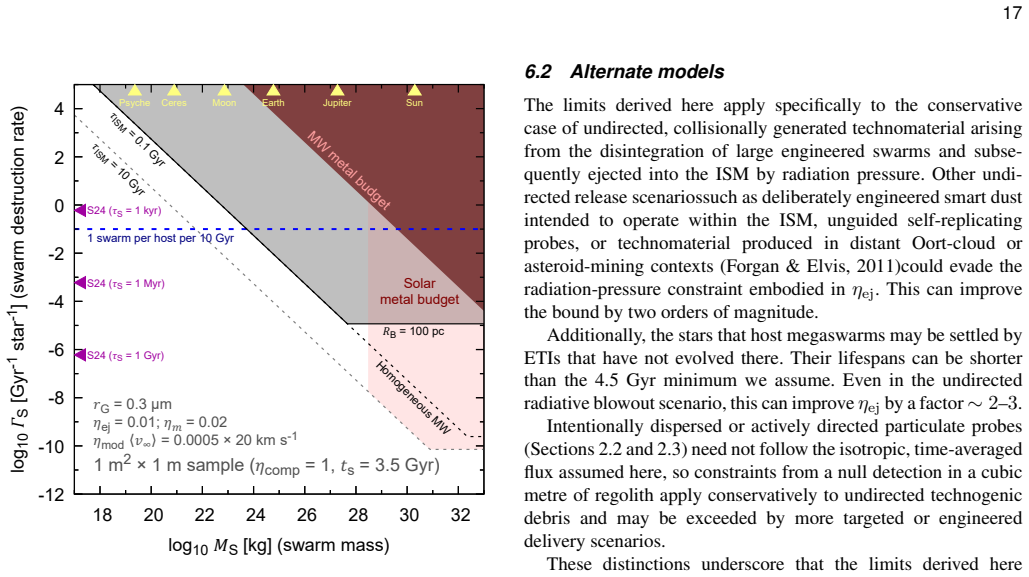
A cubic metre of lunar regolith excludes typical dispersal of more than 0.09 Earth masses of artificial particulate debris per Solar-type star over Galactic history.
A machine-rendered reading of the paper's core claim, the machinery that carries it, and where it could break.
Core claim
The authors show that a null detection in a cubic metre of lunar regolith excludes scenarios in which Solar-type stars typically disperse more than approximately 0.09 Earth mass equivalents of long-lived artificial particulate debris over Galactic history.
What carries the argument
The slow-arrival channel for ~0.3-micron refractory particles, set by solar radiation pressure and heliospheric filtering, that permits a small surviving fraction to reach the Earth-Moon system at low enough velocities for regolith survival.
If this is right
- A null result in one cubic metre already constrains undirected technomaterial output across the Galaxy.
- Targeted releases aimed at the inner Solar System raise detection probability by orders of magnitude compared with undirected dispersal.
- A multi-modal strategy of machine-vision triage followed by laboratory forensic analysis can separate anomalous grains from the natural background.
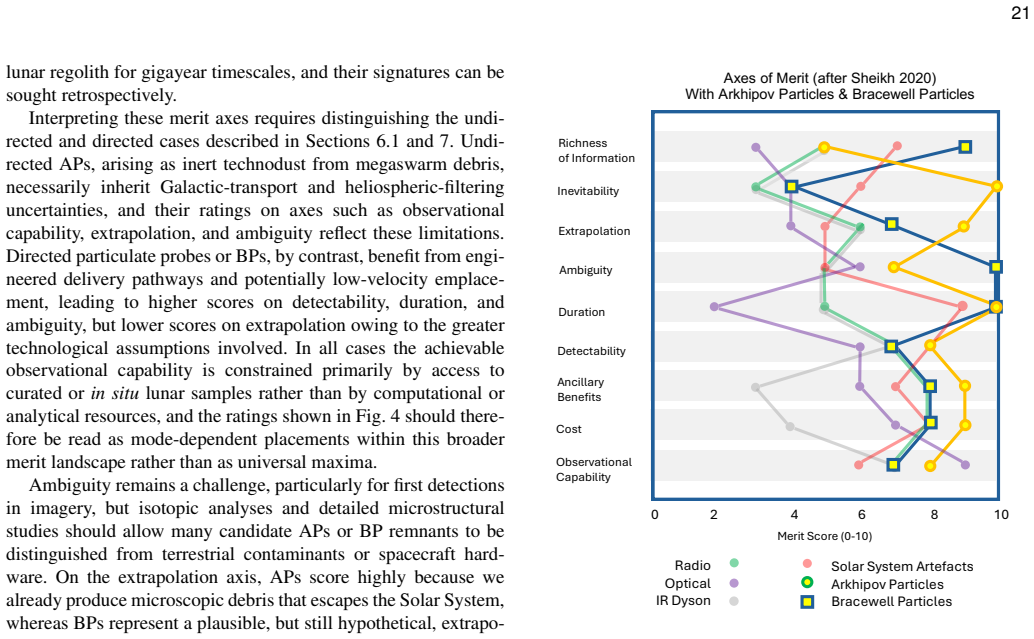
- Particulate technosignatures constitute an experimentally accessible channel of exo-archaeology that can return either upper limits or direct material evidence.
Where Pith is reading between the lines
- The same regolith samples could be cross-checked against existing meteoritic and cosmic-dust collections to test consistency of any anomalous population.
- If anomalous grains are recovered, isotopic or structural signatures could distinguish artificial from natural origins without requiring in-situ spacecraft visits.
- Extending the analysis to larger regolith volumes or to asteroid surfaces would tighten the same limit proportionally to the sampled mass.
Load-bearing premise
Particles of characteristic 0.3-micron size can travel kiloparsec distances over 0.1-1 Gyr while remaining intact enough to reach the Moon at survivable speeds.
What would settle it
Direct measurement or simulation showing that 0.3-micron refractory grains are destroyed by ISM sputtering or gas drag before they can cross even 100 parsecs, or that lunar regolith gardening buries or vaporizes arriving grains on timescales much shorter than 0.1 Gyr.
Figures


read the original abstract
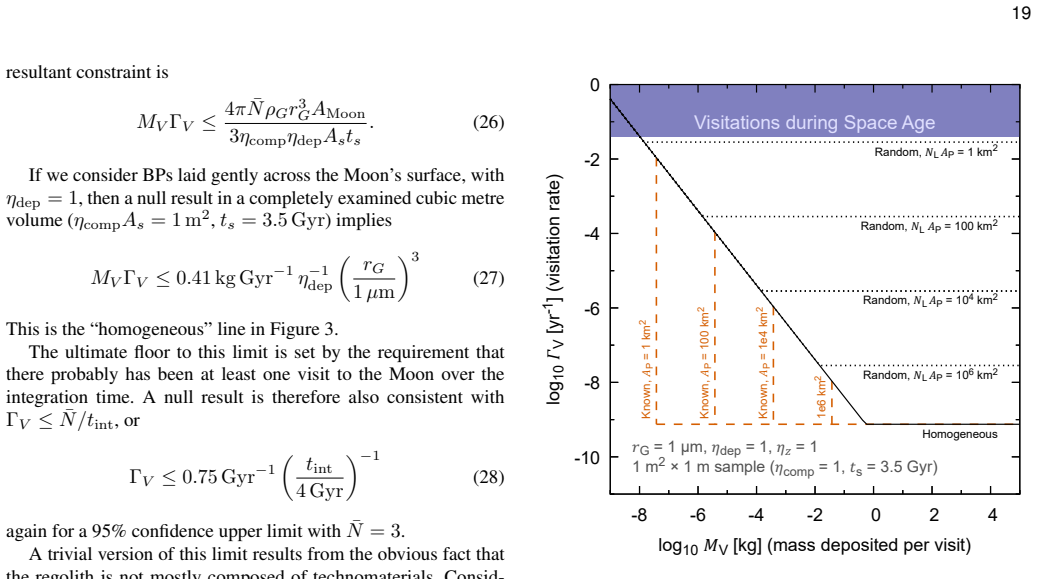
Building on Arkhipov's proposal that technogenic artefacts may survive natural interstellar transport and accumulate on airless Solar System bodies, we examine the prospects for identifying micron-scale engineered particulate material within the lunar regolith. We analyse the transport of micron and submicron grains through the interstellar medium, including gas drag, sputtering, and ISM phase-dependent survival, and show that refractory particles with characteristic radii of order 0.3 microns may traverse kiloparsec scales over residence times of 0.1-1 Gyr. Solar radiation pressure and heliospheric filtering define a dynamically constrained slow-arrival channel in which a small fraction of grains reach the Earth-Moon system at relative velocities compatible with survival upon impact. Combining these properties with regolith-mixing constraints yields quantitative upper limits on the cumulative undirected technomaterial output of large-scale spacefaring civilisations: a null detection in a cubic metre of regolith excludes scenarios in which Solar-type stars typically disperse more than approximately 0.09 Earth mass equivalents of long-lived artificial particulate debris over Galactic history. Deliberate targeting of the inner Solar System with artificial particulate matter defines a complementary regime characterised by the visitation frequency and deposited mass of such releases, for which the probabilities of detection may be orders of magnitude higher. We outline a multi-modal detection strategy integrating machine-vision triage with laboratory forensic techniques to identify anomalous grains within a well-characterised natural background. Particulate technosignatures thus establish an experimentally accessible form of exo-archaeology, capable of placing meaningful constraints -- and, in favourable cases, yielding direct material evidence -- of the Galaxy's technological history.
Editorial analysis
A structured set of objections, weighed in public.
Referee Report
Summary. The paper claims that modeling the interstellar transport of ~0.3 μm refractory artificial particles (including gas drag, sputtering, radiation pressure, and heliospheric filtering) shows that a small fraction can reach the Earth-Moon system at survivable velocities over 0.1-1 Gyr residence times. Combined with regolith mixing constraints, a null detection in 1 m³ of lunar regolith excludes scenarios in which Solar-type stars typically disperse more than ~0.09 M_⊕ of long-lived technogenic particulate debris over Galactic history. It also outlines a multi-modal detection strategy for such grains.
Significance. If the transport and survival calculations are robust, the work would establish a new, experimentally accessible channel for constraining the cumulative technomaterial output of spacefaring civilizations, converting lunar regolith sampling into a quantitative probe of galactic technological history. The approach is distinctive in deriving a specific numerical exclusion limit from physical transport models rather than direct observation.
major comments (2)
- [Transport analysis] Transport analysis (abstract and implied § on ISM traversal): the headline 0.09 M_⊕ exclusion limit is directly proportional to the modeled arrival fraction of 0.3 μm grains. No sensitivity analysis or error propagation is evident for key inputs (particle radius, residence time, sputtering yields, optical constants); if the net survival/arrival efficiency is overestimated by even 2–3 orders of magnitude, the quantitative constraint vanishes. This is load-bearing for the central claim.
- [Regolith-mixing constraints] Regolith-mixing and sampling section: the translation from arrival rate to the specific 0.09 M_⊕ per star limit requires explicit equations linking mixing depth, 1 m³ volume, and Galactic stellar density; without these the numerical result cannot be reproduced or tested.
minor comments (1)
- [Abstract] The abstract states the 0.09 M_⊕ figure but does not list the free parameters or the exact functional dependence on arrival fraction; this should be made explicit in the main text.
Simulated Author's Rebuttal
We thank the referee for their constructive comments on the transport modeling and the derivation of the quantitative limit. We address each major point below.
read point-by-point responses
-
Referee: [Transport analysis] Transport analysis (abstract and implied § on ISM traversal): the headline 0.09 M_⊕ exclusion limit is directly proportional to the modeled arrival fraction of 0.3 μm grains. No sensitivity analysis or error propagation is evident for key inputs (particle radius, residence time, sputtering yields, optical constants); if the net survival/arrival efficiency is overestimated by even 2–3 orders of magnitude, the quantitative constraint vanishes. This is load-bearing for the central claim.
Authors: We agree that the absence of a sensitivity analysis leaves the robustness of the arrival fraction insufficiently demonstrated. The manuscript presents baseline transport calculations but does not quantify how variations in particle radius, residence time, sputtering yields, or optical constants propagate to the net efficiency. In the revised version we will add a dedicated subsection with sensitivity tests on these parameters, including order-of-magnitude variations and a simple error-propagation estimate, to show the range of arrival fractions over which the 0.09 M_⊕ limit remains valid. revision: yes
-
Referee: [Regolith-mixing constraints] Regolith-mixing and sampling section: the translation from arrival rate to the specific 0.09 M_⊕ per star limit requires explicit equations linking mixing depth, 1 m³ volume, and Galactic stellar density; without these the numerical result cannot be reproduced or tested.
Authors: We acknowledge that the manuscript states the final numerical limit without displaying the full chain of equations that connect grain arrival rate, regolith mixing depth, the 1 m³ sampling volume, and the assumed Galactic density of Solar-type stars. The revised manuscript will include an expanded methods section or appendix that presents these linking equations explicitly, allowing the 0.09 M_⊕ per star exclusion limit to be reproduced from the arrival fraction and the adopted stellar density. revision: yes
Circularity Check
No significant circularity; derivation relies on independent physical models
full rationale
The paper derives its 0.09 M_⊕ upper limit by combining external transport physics (gas drag, sputtering, radiation pressure, heliospheric filtering), survival estimates, and regolith-mixing constraints applied to a hypothetical null detection. No step reduces by construction to a fitted parameter, self-citation chain, or renamed input; the central quantitative claim is a forward model prediction from stated assumptions rather than a tautology. Self-citations, if present, are not load-bearing for the exclusion limit. The derivation is therefore self-contained against external benchmarks.
Axiom & Free-Parameter Ledger
free parameters (2)
- particle radius =
0.3 microns
- residence time =
0.1-1 Gyr
axioms (2)
- domain assumption Refractory particles can survive ISM sputtering and gas drag over galactic distances
- domain assumption Regolith mixing allows accumulation of particles over galactic history
Reference graph
Works this paper leans on
-
[1]
Anguiano, B., Majewski, S. R., Schiavon, R. P., et al. (2018). The chemo-dynamical structure of the Milky Way disk. Monthly Notices of the Royal Astronomical Society 474, 854--865. doi:10.1093/mnras/stx2819
-
[2]
Arkhipov, A. V. (1993). The Moon as attractor of alien artifacts. Selenology, Journal of the American Lunar Society 12(1), 6
1993
-
[3]
Arkhipov, A. V. (1994a). Search for alien artifacts on the Moon: a justification. RIAP Bulletin 1(2), 9
-
[4]
Arkhipov, A. V. (1994b). Invasion effect on the Moon. Selenology, Journal of the American Lunar Society 13(1), 9
-
[5]
Arkhipov, A. V. (1995). A search for alien artifacts on the Moon. In Progress in the Search for Extraterrestrial Life, ASP Conference Series, Vol. 74, ed. G. S. Shostak (San Francisco, CA: Astronomical Society of the Pacific), 259--262
1995
-
[6]
Arkhipov, A. V. (1996). Extraterrestrial artefacts. The Observatory 116, 175--176
1996
-
[7]
Arkhipov, A. V. (1997). Extraterrestrial technogenic component of the meteoroid flux. Astrophysics and Space Science, 252, 67--71. doi:10.1023/A:1000801830046
-
[8]
Arkhipov, A. V. (1998). Earth--Moon system as a collector of alien artifacts. Journal of the British Interplanetary Society 51, 181--184
1998
-
[9]
M., Grevesse, N
Asplund, M., Amarsi, A. M., Grevesse, N. The chemical make-up of the Sun: A 2020 vision. Astronomy & Astrophysics, 653, A141
2020
-
[10]
Ball, J. A. (1973). The zoo hypothesis. Icarus 19(3), 347--349
1973
-
[11]
Barbillon, M., Recio-Blanco, A., de Laverny, P. & Palicio, P. A. (2025). 3D extinction maps of the Milky Way disc from Gaia GSP-Spec parameters. arXiv e-prints, arXiv:2511.12156
arXiv 2025
-
[12]
& Benford, D
Benford, J., Benford, G. & Benford, D. (2019). Looking for Lurkers: Objects Co-orbital with Earth as SETI Observables. Acta Astronautica 161, 365--373
2019
-
[13]
Benford, J. (2021). A Drake Equation for alien artifacts. Astrobiology 21(6), 722--729
2021
-
[14]
The Galaxy in Context: Structural, Kinematic and Integrated Properties
Bland-Hawthorn, J. & Gerhard, O. (2016). The Galaxy in context: Structural, kinematic, and integrated properties. Annual Review of Astronomy and Astrophysics 54, 529--596. doi:10.1146/annurev-astro-081915-023441
work page Pith review doi:10.1146/annurev-astro-081915-023441 2016
-
[15]
Bovy, J. (2017). The Milky Way's stellar disk. Monthly Notices of the Royal Astronomical Society 470, 1360--1381
2017
-
[16]
Bracewell, R. N. (1960). Communications from superior galactic communities. Nature 186, 670--671. doi:10.1038/186670a0
-
[17]
Session on Biological Technosignatures and Genomic SETI
Breakthrough Discuss Conference (2019). Session on Biological Technosignatures and Genomic SETI. Stanford University, 11--12 April 2019
2019
-
[18]
Burgess, K. D. & Stroud, R. M. (2018). Phase-dependent space weathering effects and spectroscopic identification of retained helium in a lunar soil grain. Geochimica et Cosmochimica Acta 224, 64--79. doi:10.1016/j.gca.2017.12.023
-
[19]
J., et al
Burchell, M. J., et al. (1999). Hypervelocity impact studies using the 2 MV Van de Graaff accelerator and two-stage light gas gun. Measurement Science and Technology 10(1), 41--50
1999
-
[20]
J., Mann, J., Bunch, A
Burchell, M. J., Mann, J., Bunch, A. W., & Brand \ a o, P. F. B. (2001). Survivability of bacteria in hypervelocity impact. Icarus 154(2), 545--547
2001
-
[21]
J., Mann, J
Burchell, M. J., Mann, J. R., & Bunch, A. W. (2004). Survival of bacteria and spores under extreme shock pressures. Monthly Notices of the Royal Astronomical Society 352(4), 1273--1278
2004
-
[22]
Burchell, M. J. (2006). W(h)ither the Drake equation? International Journal of Astrobiology 5(3), 243--250
2006
-
[23]
J., Graham, G
Burchell, M. J., Graham, G. A., & Kearsley, A. T. (2008). Survival of meteoritic material in hypervelocity impacts. International Journal of Impact Engineering 35(10), 987--993
2008
-
[24]
Carrigan, R. A. (2009). IRAS-based whole-sky upper limit on Dyson spheres. The Astrophysical Journal 698, 2075--2086. doi:10.1088/0004-637X/698/2/2075
-
[25]
SDR-2104 software-defined radio module
CesiumAstro (2024). SDR-2104 software-defined radio module. Available at: https://www.cesiumastro.com/products/sdr-2104 (accessed 2026)
2024
-
[26]
Chabrier, G. (2003). Galactic stellar and substellar initial mass function. Publications of the Astronomical Society of the Pacific 115, 763--795
2003
-
[27]
Ćirković, M. M. (2018). The Great Silence: Science and Philosophy of Fermi’s Paradox. Oxford University Press, Oxford
2018
-
[28]
Clarke, A. C. (1951). The Sentinel. Avon Science Fiction and Fantasy Reader. Avon Periodicals
1951
-
[29]
Cocconi, G., & Morrison, P. (1959). Searching for interstellar communications. Nature 184, 844--846
1959
-
[30]
Colaprete, A., Schultz, P., Heldmann, J., et al. (2022). Commercial Lunar Payload Services: Enabling rapid and sustained lunar surface access. Space Science Reviews 218, 11. doi:10.1007/s11214-022-00893-6
-
[31]
S., Ghent, R
Costello, E. S., Ghent, R. R., & Lucey, P. G. (2018). The mixing of lunar regolith: Vital updates to a canonical model. Icarus 314, 327--344
2018
-
[32]
S., Ghent, R
Costello, E. S., Ghent, R. R., Hirabayashi, M., & Lucey, P. G. (2020). Impact Gardening as a Constraint on the Age, Source, and Evolution of Ice on Mercury and the Moon. Journal of Geophysical Research (Planets) 125(3), e06172
2020
-
[33]
S., Ghent, R
Costello, E. S., Ghent, R. R., & Lucey, P. G. (2021). Secondary impact burial and excavation gardening on the Moon and the depth to ice in permanent shadow. Journal of Geophysical Research: Planets 126(9), e2021JE006933
2021
-
[34]
Crawford, I. A. (2006). The astrobiological case for renewed robotic and human exploration of the Moon. International Journal of Astrobiology 5, 191--197
2006
-
[35]
Crawford, I. A., Anand, M., Cockell, C. S., Falcke, H., Green, D. A., Jaumann, R. and Wieczorek, M. A. (2012). Back to the Moon: The scientific rationale for resuming lunar surface exploration. Planetary and Space Science 74, 3--14. doi:10.1016/j.pss.2012.08.003
-
[36]
Crawford, I. A. (2016). The Moon as a recorder of nearby supernovae. In: Handbook of Supernovae, eds. A. W. Alsabti & P. Murdin. Springer, Cham, pp. 2541--2560
2016
-
[37]
Crawford, I. A., Joy, K. H., Pasckert, J. H. and Hiesinger, H. (2021). The lunar surface as a recorder of astrophysical processes. Philosophical Transactions of the Royal Society A 379, 20190562. doi:10.1098/rsta.2019.0562
-
[38]
& Pinault, L
Crawford, I.\ A. & Pinault, L. J. (2023). Constraining the Fermi paradox: the case for keeping eyes (and minds) open for technosignatures on the Moon. European Lunar Symposium 2023, abstract
2023
-
[39]
A., & Schulze-Makuch, D
Crawford, I. A., & Schulze-Makuch, D. (2024). Is the apparent absence of extraterrestrial technological civilizations down to the zoo hypothesis or nothing? Nature Astronomy 8, 44--49
2024
-
[40]
Dartois, E., Engrand, C., Brunetto, R., Duprat, J., Pino, T., Quirico, E., Remusat, L., et al. (2013). Ultra-carbonaceous Antarctic micrometeorites: probing the solar system beyond the nitrogen snow-line. Icarus 224(1), 243--252
2013
-
[41]
Davies, P. (2012). Footprints of alien technology in DNA? Acta Astronautica, 73, 250--257
2012
-
[42]
Davies, P. C. W., & Wagner, R. V. (2013). Searching for alien artifacts on the Moon. Acta Astronautica, 89, 261--269
2013
-
[43]
Deamer, D. W. (2011). First Life: Discovering the Connections Between Stars, Cells, and How Life Began. University of California Press
2011
-
[44]
W., & Szostak, J
Deamer, D. W., & Szostak, J. W. (2019). The Origins of Life. Oxford University Press
2019
-
[45]
de Avillez, M. A. & Mac Low, M.-M. (2002). The global evolution of the interstellar medium in star-forming galaxies. The Astrophysical Journal 581, 1047--1060. doi:10.1086/344256
-
[46]
de Avillez, M. A. & Mac Low, M.-M. (2007). Mixing timescales in a supernova-driven interstellar medium. The Astrophysical Journal 665, 35--43. doi:10.1086/519271
-
[47]
In: Proceedings of the IEEE Conference on Computer Vision and Pat- tern Recognition, pp
Deng, J., Dong, W., Socher, R., Li, L.-J., Li, K. & Fei-Fei, L. (2009). ImageNet: A large-scale hierarchical image database. In Proceedings of the IEEE Conference on Computer Vision and Pattern Recognition (CVPR 2009), Miami, FL, USA, 248--255. doi:10.1109/CVPR.2009.5206848
-
[48]
W., Manson, N
Doherty, M. W., Manson, N. B., Delaney, P., Jelezko, F., Wrachtrup, J. & Hollenberg, L. C. L. (2013). The nitrogen–vacancy centre in diamond. Physics Reports 528, 1–45
2013
-
[49]
Draine, B. T., & Salpeter, E. E. (1979). Destruction mechanisms for interstellar dust. Astrophysical Journal 231, 77--94. doi:10.1086/157165
-
[50]
Draine, B. T. (2011). Physics of the Interstellar and Intergalactic Medium. Princeton University Press, Princeton, NJ
2011
-
[51]
T., Aniano, G., Chen, C.-A., et al
Draine, B. T., Aniano, G., Chen, C.-A., et al. (2014). The dust and gas content of M31. Astrophysical Journal 780, 172
2014
-
[52]
Drake, F. D. (1961). Project Ozma. Physics Today 14(4), 40--46
1961
-
[53]
& Spergel, D
Drimmel, R. & Spergel, D. N. (2001). Three-dimensional structure of the Milky Way disk: The distribution of stars and dust. Astrophysical Journal 556, 181--202
2001
-
[54]
G., Childress, L., Jiang, L., Togan, E., Maze, J., Jelezko, F., Wrachtrup, J., Hemmer, P
Dutt, M. G., Childress, L., Jiang, L., Togan, E., Maze, J., Jelezko, F., Wrachtrup, J., Hemmer, P. R. & Lukin, M. D. (2007). Quantum register based on individual electronic and nuclear spin qubits in diamond. Science 316, 1312–1316
2007
-
[55]
Dyson, F. J. (1960). Search for artificial stellar sources of infrared radiation. Science 131(3414), 1667--1668
1960
-
[56]
Ellery, A. (2022). The prospect of von Neumann probes and the implications for the Sagan--Tipler debate. International Journal of Astrobiology 21(4), 197--199
2022
-
[57]
Ellery, A. (2025). Von Neumann probes revisited: mechanical, informational, and material constraints on cosmic self-replication. arXiv:2510.00082 [astro-ph.IM]
arXiv 2025
-
[58]
Feynman, R.\ P., Leighton, R.\ B., & Sands, M.\ L. (1964). The Feynman Lectures on Physics, Vol.\ I. Addison--Wesley, Reading, MA
1964
-
[59]
Feynman, R.\ P., Leighton, R.\ B., & Sands, M.\ L. (1964). Exercises and Problems in The Feynman Lectures on Physics, Vol.\ I. Addison--Wesley, Reading, MA
1964
-
[60]
Flynn, G. J. (1994). Interplanetary dust particles collected from the stratosphere: physical, chemical, and mineralogical properties and implications for their sources. Planetary and Space Science 42(12), 1151--1161
1994
-
[61]
Forgan, D., & Elvis, M. (2011). Extrasolar asteroid mining as a source of technosignatures. International Journal of Astrobiology, 10(4), 307--315
2011
-
[62]
Foster, G. V. (1972). On the search for extraterrestrial artefacts in the Solar System. Journal of the British Interplanetary Society 25, 407--412
1972
-
[63]
Freitas, R. A. Jr. (1983). The search for extraterrestrial artifacts (SETA). Journal of the British Interplanetary Society 36, 501--506
1983
-
[64]
Freitas, R. A. Jr., & Valdes, F. (1980). A search for natural or artificial objects located at the Earth--Moon libration points. Icarus 42, 442--447
1980
-
[65]
Freitas, R. A. Jr., & Valdes, F. (1985). The search for extraterrestrial artifacts (SETA). Acta Astronautica 12, 1027--1034
1985
-
[66]
Frisch, P. C., Redfield, S., & Slavin, J. D. (2011). The interstellar medium surrounding the Sun. Annual Review of Astronomy and Astrophysics 49, 237--279. doi:10.1146/annurev-astro-081710-102613
-
[67]
J., Van Ginneken, M., & Suttle, M
Genge, M. J., Van Ginneken, M., & Suttle, M. D. (2020). Micrometeorites: insights into the flux, sources and atmospheric entry of extraterrestrial dust at Earth. Planetary and Space Science 187, 104900
2020
-
[68]
J., Almeida, N., Van Ginneken, M., Pinault, L
Genge, M. J., Almeida, N., Van Ginneken, M., Pinault, L. J., Wozniakiewicz, P., & Yano, H. (2023). Ice and liquid water in asteroid Ryugu: constraints from sample A0180. 14th Symposium on Polar Science, National Institute of Polar Research, Tachikawa, Tokyo, 14--17 November 2023
2023
-
[69]
Genge, M. J., Almeida, N. V., Van Ginneken, M., Pinault, L. J., Wozniakiewicz, P. J., & Yano, H. (2024a). Evidence from 162173 Ryugu for the influence of freeze--thaw on the hydration of asteroids. Nature Astronomy. doi:10.1038/s41550-024-02369-7
-
[70]
J., Almeida, N
Genge, M. J., Almeida, N. V., Van Ginneken, M., Pinault, L. J., Wozniakiewicz, P. J., & Yano, H. (2024b). The discovery of a large porphyritic chondrule in 162173 Ryugu. 86th Annual Meeting of the Meteoritical Society, LPI Contribution No. 3036
-
[71]
Gharsallaoui, A., Chambin, O., Cases, E., & Saurel, R. (2022). Microencapsulation: an updated review of technologies and their applications. Trends in Food Science & Technology 127, 156--173. doi:10.1016/j.tifs.2022.06.021
-
[72]
Goodfellow, I., Bengio, Y., & Courville, A. (2016). Deep learning. MIT Press
2016
-
[73]
M., Schlafly, E
Green, G. M., Schlafly, E. F., Zucker, C., Speagle, J. S. & Finkbeiner, D. P. (2019). A 3D dust map based on Gaia, Pan-STARRS 1, and 2MASS. Astrophysical Journal 887, 93
2019
-
[74]
Grind, K. (2025). Now tech moguls want to build data centers in outer space. The Wall Street Journal, 16 November 2025. https://www.wsj.com/tech/now-tech-moguls-want-to-build-data-centers-in-outer-space-a8d08b4b
2025
-
[75]
Grün, E., Horányi, M., & Sternovsky, Z. (2011). The lunar dust environment. Planetary and Space Science 59(14), 1672--1680
2011
-
[76]
Gu, L., Lin, Y., Chen, Y., Xu, Y., Tang, X. & Li, J. (2025). Submicron-scale craters on Chang’e-5 lunar soils: records of complex space weathering processes. Geochimica et Cosmochimica Acta 398, 139--151. doi:10.1016/j.gca.2025.04.004
-
[77]
Guo, R., Li, Z.-Y., Shen, J., Mao, S. & Liu, C. (2024). Measuring the Milky Way vertical potential with the phase snail in a model-independent way. The Astrophysical Journal 960(2), 133. doi:10.3847/1538-4357/ad037b
-
[78]
Haase, I., Oberst, J., Scholten, F., Wählisch, M., Gläser, P., Karachevtseva, I., & Robinson, M. (2012). Mapping the Apollo 17 landing site using LRO camera images and Apollo surface photography. Journal of Geophysical Research: Planets 117, E00H24
2012
-
[79]
Haqq-Misra, J. & Kopparapu, R. K. (2012). On the likelihood of non-terrestrial artifacts in the Solar System. Acta Astronautica 72, 15--20. doi:10.1016/j.actaastro.2011.10.010
-
[80]
Haqq-Misra, J., Ashtari, R., Benford, J., Carroll-Nellenback, J., D\"obler, N. A., Farah, W., Fauchez, T. J., Gajjar, V., Grinspoon, D., Huggahalli, A., Kopparapu, R. K., Lazio, J., Profitiliotis, G., Sneed, E. L., Shynu Varghese, S. & Vidal, C. (2022). Opportunities for technosignature science in the Planetary Science and Astrobiology Decadal Survey. arX...
arXiv 2022
discussion (0)
Sign in with ORCID, Apple, or X to comment. Anyone can read and Pith papers without signing in.