From the Great Wave of Translation to the Force between Quarks
Pith reviewed 2026-06-26 00:08 UTC · model grok-4.3
The pith
The KdV equation for solitons yields reflectionless potentials that approximate the confining force between quarks.
A machine-rendered reading of the paper's core claim, the machinery that carries it, and where it could break.
Core claim
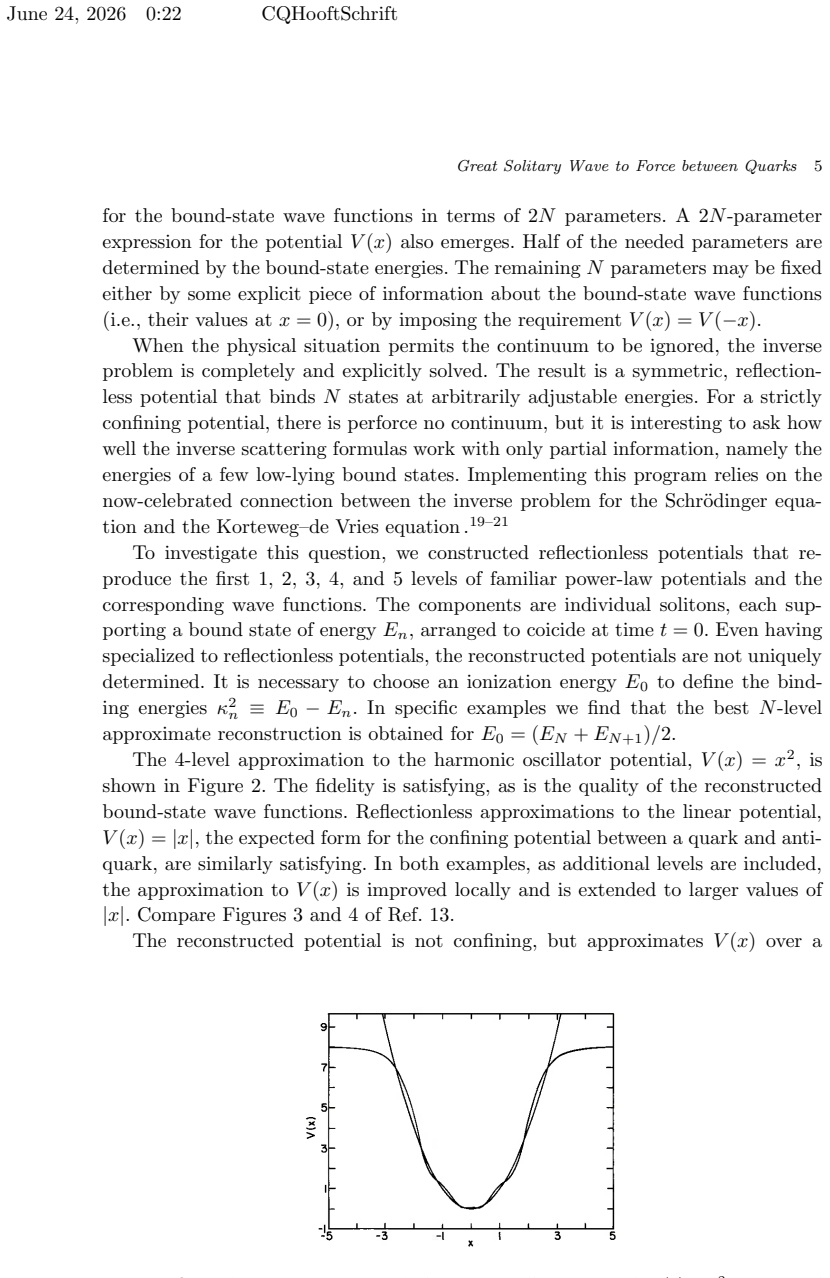
The chance observation of a novel traveling wave in a canal led over time to the formulation of a nonlinear wave equation -- the Korteweg--de Vries equation -- that describes strikingly robust disturbances now called solitons. The figure of an isolated soliton corresponds to a reflectionless potential that supports a single bound state in the one-dimensional Schrödinger equation. An appropriate combination of individual solitons yields a symmetric reflectionless potential that supports multiple bound states. Thus, the KdV equation opens the path to solving the inverse scattering problem for a collection of bound states. Applied to the quarkonium spectra, this formalism allows the constructio
What carries the argument
Symmetric combination of reflectionless soliton potentials derived from the KdV equation, used as the potential in the one-dimensional Schrödinger equation whose eigenvalues reproduce quarkonium bound-state spectra.
If this is right
- Reflectionless approximations to the confining potentials can be constructed directly from the observed quarkonium spectra.
- These approximations describe the force between quarks.
- Direct tests become possible for whether the interquark interaction is independent of quark flavor.
- The inverse scattering problem for any collection of bound states is solvable via combinations of KdV solitons.
Where Pith is reading between the lines
- The same soliton-construction technique could be applied to other quantum bound-state problems whose spectra are known experimentally.
- Success of the approximations would indicate that certain features of confinement can be captured by classical nonlinear wave equations without explicit QCD dynamics.
- The historical thread from 19th-century canal observations to modern particle spectra illustrates a direct mathematical bridge between classical wave equations and quantum bound states.
Load-bearing premise
The bound-state spectra of quarkonium can be faithfully represented as eigenvalues of a one-dimensional Schrödinger equation whose potential is a symmetric combination of reflectionless soliton potentials derived from the KdV equation.
What would settle it
Precise experimental measurements of charmonium and bottomonium energy levels that deviate substantially from the spectra predicted by the reflectionless soliton-potential approximations would show the approach does not faithfully represent the interquark force.
Figures

read the original abstract
The chance observation of a novel traveling wave in a canal led over time to the formulation of a nonlinear wave equation -- the Korteweg--de Vries equation -- that describes strikingly robust disturbances now called solitons. The figure of an isolated soliton corresponds to a reflectionless potential that supports a single bound state in the one-dimensional Schr\"odinger equation. An appropriate combination of individual solitons yields a symmetric reflectionless potential that supports multiple bound states. Thus, the KdV equation opens the path to solving the inverse scattering problem for a collection of bound states. Applied to the quarkonium spectra, this formalism allows the construction of reflectionless approximations to the confining potentials that account for the force between quarks, and to tests of the flavor-independence of the interquark interaction.
Editorial analysis
A structured set of objections, weighed in public.
Referee Report
Summary. The paper claims that combinations of reflectionless soliton potentials derived from the KdV equation can be used to construct symmetric potentials whose bound-state eigenvalues reproduce quarkonium spectra. These constructions are presented as reflectionless approximations to the confining interquark potentials and as a basis for testing the flavor independence of the quark-quark force.
Significance. If the central identification were valid, the work would supply a novel soliton-based route to potential models in QCD and a method for flavor-independence tests with minimal parameters. The manuscript does not, however, establish that the constructed potentials reproduce the linear rise or infinite discrete spectrum required by confinement.
major comments (2)
- [Abstract and central construction] The KdV-derived reflectionless potentials (sums of sech² profiles) satisfy V(x) → const as |x| → ∞ and therefore support only finitely many bound states plus a continuum. This directly contradicts the defining property of confining potentials (V(r) → +∞), which must produce an infinite tower of states with no scattering continuum. The claim that these constructions furnish “approximations to the confining potentials that account for the force between quarks” therefore rests on an unexamined identification that is not demonstrated anywhere in the manuscript.
- [Application to spectra] Application to quarkonium spectra for flavor-independence tests presupposes that the same finite set of eigenvalues can be used both to define the potential and to test its flavor independence. No section shows how the construction avoids circularity or how the resulting short-range potentials can be compared with the long-range behavior required by confinement.
Simulated Author's Rebuttal
We thank the referee for the thorough review and for highlighting important distinctions between our constructions and true confining potentials. We respond point-by-point to the major comments below, clarifying the intended scope of the approximations while acknowledging limitations.
read point-by-point responses
-
Referee: [Abstract and central construction] The KdV-derived reflectionless potentials (sums of sech² profiles) satisfy V(x) → const as |x| → ∞ and therefore support only finitely many bound states plus a continuum. This directly contradicts the defining property of confining potentials (V(r) → +∞), which must produce an infinite tower of states with no scattering continuum. The claim that these constructions furnish “approximations to the confining potentials that account for the force between quarks” therefore rests on an unexamined identification that is not demonstrated anywhere in the manuscript.
Authors: We agree that the soliton-derived potentials approach a nonzero constant at large |x| and therefore admit only a finite number of bound states. The manuscript presents these as approximations specifically for reproducing the finite set of observed quarkonium eigenvalues, not as models of the full linear confining potential at all distances. The reflectionless property permits an exact inverse-scattering construction that matches the discrete spectrum; the continuum is extraneous for states below open-flavor thresholds. We will revise the abstract and introduction to state explicitly that the constructions approximate the effective potential only in the spatial region supporting the known bound states, without claiming reproduction of the linear rise or infinite tower. revision: yes
-
Referee: [Application to spectra] Application to quarkonium spectra for flavor-independence tests presupposes that the same finite set of eigenvalues can be used both to define the potential and to test its flavor independence. No section shows how the construction avoids circularity or how the resulting short-range potentials can be compared with the long-range behavior required by confinement.
Authors: The potential for a given flavor sector is constructed from the eigenvalues of that sector alone. Flavor independence is then tested by comparing the resulting potentials (or their parameters) across different sectors, e.g., charmonium versus bottomonium. Because the input spectra are distinct, the test is not circular. We will add a dedicated subsection that (i) details the separate construction for each flavor, (ii) presents numerical comparisons of the extracted potentials, and (iii) notes that long-range linear behavior lies outside the present approximation and would require additional terms not generated by the KdV soliton sums. revision: yes
Circularity Check
No circularity; derivation applies standard inverse scattering to spectra
full rationale
The paper describes constructing reflectionless potentials from prescribed bound-state spectra using KdV solitons, which is the direct output of the inverse scattering method. No quoted step shows a 'prediction' that reduces to the input spectrum by construction, no self-citation chain justifies a uniqueness claim, and no ansatz is smuggled in. The formalism is self-contained as a mathematical mapping from eigenvalues to potential; any subsequent flavor-independence test would be an external comparison, not a definitional loop. This matches the default expectation of no significant circularity.
Axiom & Free-Parameter Ledger
Reference graph
Works this paper leans on
-
[1]
J. Scott Russell, Report on Waves: Made to the Meetings of the British Association in 1842–43, in14th Meeting of the British Association for the Advancement of Science, York, September 1844, (John Murray, London, September 1845), pp. 311–390; Plates XLVII–LVII.https://archive.org/details/reportonwavesma00russgoog/
-
[2]
Hydrodynamic Soliton
Laboratoire Interdisciplinaire Carnot de Bourgogne, ´Equipe Solitons, “Hydrodynamic Soliton” YouTube video, (2009),https://www.youtube.com/watch?v=hfc3IL9gAts
2009
-
[3]
Collision of KdV Solitons
Laboratoire Interdisciplinaire Carnot de Bourgogne, ´Equipe Solitons, “Collision of KdV Solitons” YouTube video, (2009),https://www.youtube.com/watch?v= wEbYELtGZwI
2009
-
[4]
Unsigned Obituary of John Scott Russell, FRS, 1808–1882,Minutes of the Proceedings of the Institution of Civil Engineers87, 427 (January 1887),https://doi.org/10. 1680/imotp.1887.21314
-
[5]
Also seehttps:// kdvi.uva.nl/about/korteweg-and-de-vries/references-and-links.html
Brief biographies appear on the KdV Institute web site:https://kdvi.uva.nl/ about/korteweg-and-de-vries/korteweg-and-de-vries.html. Also seehttps:// kdvi.uva.nl/about/korteweg-and-de-vries/references-and-links.html
-
[6]
D. J. Korteweg and G. de Vries,Phil. Mag. Ser. 539, 422 (1895),https://doi.org/ 10.1080/14786449508620739; Scanned copy made available by Tom Koorwinder
-
[7]
Lamb,Hydrodynamics(Cambridge University Press, Cambridge, 1879)
H. Lamb,Hydrodynamics(Cambridge University Press, Cambridge, 1879)
-
[8]
A. B. Basset,Hydrodynamics(Brighton & Bell, Cambridge, 1888)
-
[9]
J. V. Boussinesq,Journal de Math´ ematiques Pures et Appliqu´ ees17, 55 (1872),https: //archive.org/details/s2journaldemat17liou/page/54/mode/2up
-
[10]
Lord Rayleigh,Phil. Mag. Ser. 51, 257 (1876),https://doi.org/10.1080/ 14786447608639037
-
[11]
McCowan,Phil
J. McCowan,Phil. Mag. Ser. 532, 45 (1891),https://doi.org/10.1080/ 14786449108621390
-
[12]
N. J. Zabusky and M. D. Kruskal,Phys. Rev. Lett.15, 240 (1965),https://doi.org/ 10.1103/PhysRevLett.15.240
-
[13]
H. B. Thacker, C. Quigg and J. L. Rosner,Phys. Rev. D18, 274 (1978),https: //doi.org/10.1103/PhysRevD.18.274
-
[14]
Y. Goda, On the Historical Development of the Mathematical Theory of Water Waves (1999),https://bit.ly/4thOG32; translated from the original Japanese paper pub- lished in 35th Summer Training Course Lecture Collection, Japan Society of Civil Engineers Coastal Engineering Committeehttp://library.jsce.or.jp/jsce/open/ 00027/1999/35-B03.pdf
1999
-
[15]
F. Van der Blij,Nieuw Arch. Wiskd., III. Ser.26, 54 (1978),https://zbmath. June 24, 2026 0:22 CQHooftSchrift Great Solitary Wave to Force between Quarks9 org/0377.76002; scan:https://staff.fnwi.uva.nl/t.h.koornwinder/pastkdvi/ Korteweg_deVries/1978_NieuwArchiefWisk_vanderBlij.pdf
arXiv 1978
-
[16]
R. D. Palais,Bull. Amer. Math. Soc34, 339 (1997),https://pubs.ams.org/BULL/ 1997-34-04/S0273-0979-97-00732-5
1997
-
[17]
I. M. Gel’fand and B. M. Levitan,Amer. Math. Soc. Transl. Ser. 21, 253 (1955), https://api.semanticscholar.org/CorpusID:124078768; original Russian publica- tion,Izv. Akad. Nauk SSSR, Ser. Mat.15, 309 (1951),https://zbmath.org/?q=an: 0044.09301
arXiv 1955
-
[18]
I. Kay and H. E. Moses,Journal of Applied Physics27, 1503 (1956),https://doi. org/10.1063/1.1722296
-
[19]
C. S. Gardner, J. M. Greene, M. D. Kruskal and R. M. Miura,Phys. Rev. Lett.19, 1095 (1967),doi.org/10.1103/PhysRevLett.19.1095
-
[20]
C. S. Gardner, J. M. Greene, M. D. Kruskal and R. M. Miura,Communications on Pure and Applied Mathematics27, 97 (1974),https://doi.org/10.1002/cpa. 3160270108
work page doi:10.1002/cpa 1974
-
[21]
A. C. Scott, F. Y. F. Chu and D. W. McLaughlin,IEEE Proc.61, 1443 (1973), https://doi.org/10.1109/PROC.1973.9296
-
[22]
J. F. Schonfeld, W. Kwong, J. L. Rosner, C. Quigg and H. B. Thacker,Annals Phys. 128, 1 (1980),https://doi.org/10.1016/0003-4916(80)90055-X
-
[23]
H. B. Thacker, C. Quigg and J. L. Rosner,Phys. Rev. D18, 287 (1978),https: //10.1103/PhysRevD.18.287
-
[24]
Quigg, H
C. Quigg, H. B. Thacker and J. L. Rosner,Phys. Rev. D21, 234 (1980),doi.org/10. 1103/PhysRevD.21.234
1980
-
[25]
W. Kwong, J. L. Rosner, J. F. Schonfeld, C. Quigg and H. B. Thacker,Am. J. Phys. 48, 926 (1980),doi.org/10.1119/1.12203
-
[26]
S. R. Coleman, Classical Lumps and Their Quantum Descendants, inNew Phenomena in Subnuclear Physics: Part A, ed. A. Zichichi, Subnuclear Series, Vol. 13 (Springer US, Boston, MA, 1977), pp. 297–421.https://doi.org/10.1007/978-1-4613-4208-3_ 11
-
[27]
D. Tong, TASI lectures on solitons: Instantons, monopoles, vortices and kinks (2005), Lectures given at TASI 2005, University of Colorado, Boulder,https://arXiv.org/ hep-th/0509216
Pith/arXiv arXiv 2005
-
[28]
J. M. Dudley, C. Finot, G. Genty and R. Taylor,Optics & Photonics News 34, 26 (May 2023),https://www.optica-opn.org/home/articles/volume_34/may_ 2023/features/fifty_years_of_fiber_solitons/
2023
-
[29]
Hasegawa,Frontiers in Physics10, 1044845 (2022),https://doi.org/10.3389/ fphy.2022.1044845
A. Hasegawa,Frontiers in Physics10, 1044845 (2022),https://doi.org/10.3389/ fphy.2022.1044845
arXiv 2022
-
[30]
Hertz, ¨Uber die Beziehungen zwischen Licht und Elektrizit¨ at, inGesammelte Werke, ed
H. Hertz, ¨Uber die Beziehungen zwischen Licht und Elektrizit¨ at, inGesammelte Werke, ed. P. E. A. Lenard (J. A. Barth, Leipzig, 1894), p. 344.https://babel. hathitrust.org/cgi/pt?id=uc1.a0009380098&seq=386,
discussion (0)
Sign in with ORCID, Apple, or X to comment. Anyone can read and Pith papers without signing in.