neBEM: A GPU-accelerated Electrostatic Field Solver
Pith reviewed 2026-06-25 22:24 UTC · model grok-4.3
The pith
GPU acceleration makes the nearly exact Boundary Element Method practical for large detector simulations by delivering major speedups without accuracy loss.
A machine-rendered reading of the paper's core claim, the machinery that carries it, and where it could break.
Core claim
The implementation of OpenMP and CUDA acceleration in neBEM, including the dynamic space charge calculation, achieves substantial speedups while preserving the solver's inherent accuracy, with simulations on staggered thick Gas Electron Multiplier geometries demonstrating agreement with other commercially available field solvers.
What carries the argument
The CUDA-accelerated dynamic space charge calculation within the optimized neBEM solver.
If this is right
- Large-scale MPGD configurations can be simulated rapidly yet precisely.
- Benchmarking shows significant speedup making the tool practical for detector design.
- The accelerated version maintains fidelity as verified against commercial solvers.
Where Pith is reading between the lines
- Similar GPU strategies could speed up other analytical field computation methods in particle physics instrumentation.
- Adoption in design workflows may allow iterative optimization of detector geometries that was previously computationally prohibitive.
- Potential exists for extending the acceleration to time-dependent or more complex charge distributions.
Load-bearing premise
The CUDA implementation of the dynamic space charge calculation and the algorithmic optimizations introduce no numerical discrepancies or artifacts that would affect field accuracy.
What would settle it
A side-by-side computation on a staggered thick GEM geometry where the electric field values from the GPU-accelerated neBEM differ from those of a commercial solver by more than the tolerance expected from floating-point precision.
Figures





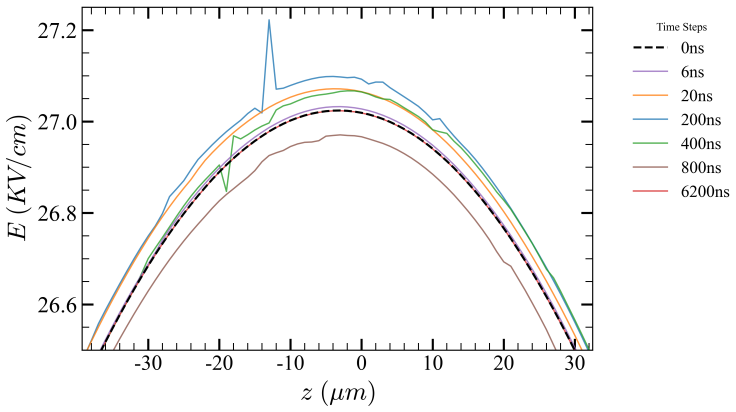

read the original abstract
Accurate electric field estimation is critical for the design and optimization of Micro Pattern Gaseous Detectors (MPGDs). The nearly exact Boundary Element Method (neBEM) offers high precision field computation but is limited by long CPU runtime arising from its complex analytical formulations. This work presents a comprehensive optimization of the neBEM solver, focusing on a hybrid hardware acceleration strategy using OpenMP for multi-core CPUs and GPU acceleration using NVIDIA's CUDA. A key contribution is the new implementation of a dynamic space charge calculation, which has also been designed to be accelerated by CUDA. This primary acceleration is complemented by enhanced algorithmic optimizations to reduce the complexity of the problem. The proposed implementation achieves substantial speedups while preserving inherent accuracy of the solver. Simulations on staggered thick Gas Electron Multiplier geometries demonstrate agreement with other commercially available field solvers, verifying the fidelity of accelerated neBEM. Benchmarking tests show a significant speedup, enabling rapid yet precise simulations for complex MPGD configurations. These improvements make GPU-accelerated neBEM a practical tool for large-scale detector simulation.
Editorial analysis
A structured set of objections, weighed in public.
Referee Report
Summary. The manuscript presents a hybrid OpenMP/CUDA implementation of the nearly exact Boundary Element Method (neBEM) electrostatic solver, with a new dynamic space charge module also accelerated on GPU. It claims that the optimizations deliver substantial speedups while preserving the solver's inherent accuracy, as verified by agreement with commercial field solvers on staggered thick Gas Electron Multiplier (GEM) geometries. Benchmarking is said to show significant performance gains for complex MPGD simulations.
Significance. If the accuracy claims hold under rigorous numerical checks, the work would make high-precision neBEM simulations practical for large-scale MPGD design and optimization, addressing a known computational bottleneck in the field. The hybrid acceleration strategy and explicit CUDA port of dynamic space charge are potentially valuable contributions, though the absence of quantitative error metrics and isolated validation tests limits the assessed impact.
major comments (2)
- [Abstract] Abstract: the central claim that the CUDA implementation 'preserves inherent accuracy' while achieving speedups rests on agreement with commercial solvers on staggered thick GEM geometries, yet no quantitative error metrics (e.g., maximum field deviation, RMS residuals, or convergence rates) or benchmark tables are provided. This omission prevents assessment of whether the reported agreement is within acceptable tolerances for detector applications.
- [Abstract] Abstract (dynamic space charge section): the new CUDA implementation of dynamic space charge is highlighted as a key contribution, but validation relies solely on external commercial-solver comparisons. These cannot isolate potential numerical discrepancies introduced by the GPU port (e.g., reduced-precision reductions, atomic operations, or summation reordering). Direct CPU-vs-GPU residual checks on the space-charge component or analytical test cases are required to confirm numerical equivalence.
minor comments (2)
- The abstract refers to 'enhanced algorithmic optimizations' without specifying which algorithms were modified or how complexity was reduced; a dedicated methods subsection would improve clarity.
- Benchmarking results are mentioned but not detailed (e.g., hardware specifications, problem sizes, or speedup factors relative to the original CPU neBEM); inclusion of such data would strengthen the performance claims.
Simulated Author's Rebuttal
We thank the referee for the constructive comments on our manuscript. We address each major comment below and will revise the paper to strengthen the validation sections.
read point-by-point responses
-
Referee: [Abstract] Abstract: the central claim that the CUDA implementation 'preserves inherent accuracy' while achieving speedups rests on agreement with commercial solvers on staggered thick GEM geometries, yet no quantitative error metrics (e.g., maximum field deviation, RMS residuals, or convergence rates) or benchmark tables are provided. This omission prevents assessment of whether the reported agreement is within acceptable tolerances for detector applications.
Authors: We agree that quantitative error metrics are needed to allow readers to evaluate the accuracy claim rigorously. In the revised manuscript we will add a table (and accompanying text) reporting maximum field deviations, RMS residuals, and convergence behavior from the neBEM–commercial-solver comparisons on the staggered thick GEM geometries, together with a brief discussion of the tolerances relevant to MPGD design. revision: yes
-
Referee: [Abstract] Abstract (dynamic space charge section): the new CUDA implementation of dynamic space charge is highlighted as a key contribution, but validation relies solely on external commercial-solver comparisons. These cannot isolate potential numerical discrepancies introduced by the GPU port (e.g., reduced-precision reductions, atomic operations, or summation reordering). Direct CPU-vs-GPU residual checks on the space-charge component or analytical test cases are required to confirm numerical equivalence.
Authors: The referee correctly identifies that external comparisons alone do not isolate GPU-specific numerical effects. We will add, in the revised version, explicit CPU-versus-GPU residual comparisons for the dynamic space-charge module on representative test cases, including checks for summation and reduction consistency. Where feasible we will also include simple analytical benchmarks to confirm numerical equivalence. revision: yes
Circularity Check
Implementation report with external benchmarks; no derivation chain present
full rationale
The manuscript is an engineering/implementation paper describing CUDA/OpenMP acceleration of an existing neBEM solver plus a new dynamic space-charge module. Accuracy is asserted via direct numerical agreement with independent commercial field solvers on staggered thick GEM geometries, not via any internal derivation, fitted parameter, or self-citation chain. No equations, uniqueness theorems, or ansatzes are introduced that could reduce to the paper's own inputs. The central performance and fidelity claims therefore rest on external validation and benchmarking rather than self-referential construction.
Axiom & Free-Parameter Ledger
Reference graph
Works this paper leans on
-
[1]
R. Bouclier, M. Capeans, W. Dominik, M. Hoch, J.-C. Labbe, G. Mil- lion, L. Ropelewski, F. Sauli, A. Sharma, The gas electron multiplier (gem), IEEE Transactions on Nuclear Science 44 (3) (1997) 646–650. doi:10.1109/23.603726
-
[2]
Y. Giomataris, P. Rebourgeard, J. Robert, G. Charpak, Mi- cromegas: a high-granularity position-sensitive gaseous detector for high particle-flux environments, Nuclear Instruments and Methods in Physics Research Section A: Accelerators, Spectrom- eters, Detectors and Associated Equipment 376 (1) (1996) 29–35. doi:https://doi.org/10.1016/0168-9002(96)00175...
-
[3]
URLhttps://www.sciencedirect.com/science/article/pii/ S0168900222011305
P.Roy, P.K.Rout, J.Datta, P.Bhattacharya, S.Mukhopadhyay, N.Ma- jumdar, S.Sarkar, Studyofspacechargephenomenaingem-baseddetec- tors, Nuclear Instruments and Methods in Physics Research Section A: Accelerators, Spectrometers, Detectors and Associated Equipment 1047 (2023) 167838.doi:https://doi.org/10.1016/j.nima.2022.167838. URLhttps://www.sciencedirect.c...
-
[4]
T. Dey, P. Bhattacharya, S. Mukhopadhyay, N. Majumdar, A. Seal, S. Chattopadhyay, Parallelization of garfield++ and nebem to simulate space-charge effects in rpcs, Computer Physics Communications 294 (2024) 108944.doi:https://doi.org/10.1016/j.cpc.2023.108944. URLhttps://www.sciencedirect.com/science/article/pii/ S0010465523002898
-
[5]
P. Bhattacharya, P. Roy, T. Dey, J. Datta, P. K. Rout, N. Majumdar, S. Mukhopadhyay, Numerical simulation of charging up, accumulation of space charge and formation of discharges, Nuclear Instruments and Methods in Physics Research Section A: Accelerators, Spec- trometers, Detectors and Associated Equipment 1075 (2025) 170336. doi:https://doi.org/10.1016/...
-
[6]
Garfield++,https://gitlab.cern.ch/garfield/garfieldpp, ac- cessed: 12.08.2025
2025
-
[7]
S. Biagi, Monte carlo simulation of electron drift and diffusion in count- ing gases under the influence of electric and magnetic fields, Nuclear Instruments and Methods in Physics Research Section A: Accelerators, Spectrometers, Detectors and Associated Equipment 421 (1) (1999) 234–240.doi:https://doi.org/10.1016/S0168-9002(98)01233-9. URLhttps://www.sci...
-
[8]
I. Smirnov, Modeling of ionization produced by fast charged par- ticles in gases, Nuclear Instruments and Methods in Physics Research Section A: Accelerators, Spectrometers, Detectors and Associated Equipment 554 (1) (2005) 474–493.doi:https: //doi.org/10.1016/j.nima.2005.08.064. URLhttps://www.sciencedirect.com/science/article/pii/ S0168900205016724
-
[9]
Comsol multiphysics,https://www.comsol.co.in, accessed: 03.11.2025
2025
-
[10]
Ansys,https://www.ansys.com, accessed: 03.11.2025
2025
-
[11]
S. Muhkopadhyay, N. Majumdar, Computation of 3d mems electrostatics using a nearly exact bem solver, Engineering Analysis with Boundary Elements 30 (8) (2006) 687–696. doi:https://doi.org/10.1016/j.enganabound.2006.03.002. URLhttps://www.sciencedirect.com/science/article/pii/ S0955799706000518
-
[12]
N. Majumdar, S. Mukhopadhyay, Simulation of three-dimensional elec- trostaticfieldconfigurationinwirechambers: Anovelapproach, Nuclear Instruments and Methods in Physics Research Section A: Accelerators, Spectrometers, Detectors and Associated Equipment 566 (2) (2006) 489–494.doi:https://doi.org/10.1016/j.nima.2006.06.035. URLhttps://www.sciencedirect.com...
-
[13]
N. Majumdar, S. Mukhopadhyay, Simulation of 3d electrostatic config- uration in gaseous detectors, Journal of Instrumentation 2 (09) (2007) P09006.doi:10.1088/1748-0221/2/09/P09006. URLhttps://doi.org/10.1088/1748-0221/2/09/P09006
-
[14]
N. Majumdar, S. Mukhopadhyay, S. Bhattacharya, Computation of 3d electrostatic weighting field in resistive plate chambers, Nuclear Instruments and Methods in Physics Research Section A: Accelerators, Spectrometers, Detectors and Associated Equipment 595 (2) (2008) 346–352.doi:https://doi.org/10.1016/j.nima.2008.07.033. URLhttps://www.sciencedirect.com/sc...
-
[15]
S. Mukhopadhyay, N. Majumdar, A study of three-dimensional edge and corner problems using the nebem solver, Engineer- ing Analysis with Boundary Elements 33 (2) (2009) 105–119. doi:https://doi.org/10.1016/j.enganabound.2008.06.003. URLhttps://www.sciencedirect.com/science/article/pii/ S0955799708001045
-
[16]
T. Neep, K. Nikolopoulos, M. Slater, Accelerating garfield++ with cuda, Journal of Instrumentation 20 (12) (2025) P12019.doi:10.1088/ 1748-0221/20/12/P12019. URLhttps://doi.org/10.1088/1748-0221/20/12/P12019
-
[17]
S. Dutta, P. Bhattacharya, T. Dey, N. Majumdar, S. Mukhopadhyay, Numerical simulation of space charge effects in mpgds, Journal of In- strumentation 20 (06) (2025) C06054.doi:10.1088/1748-0221/20/ 06/C06054. URLhttps://doi.org/10.1088/1748-0221/20/06/C06054
-
[18]
Openmp,https://www.openmp.org, accessed: 03.11.2025
2025
-
[19]
Nvidia cuda toolkit,https://developer.nvidia.com/cuda-toolkit, accessed: 03.11.2025
2025
-
[20]
P. Bhattacharya, S. Biswas, B. Mohanty, N. Majumdar, S. Mukhopad- hyay, Detailed 3d simulation of the gem-based detector, Journal of Physics: Conference Series 759 (1) (2016) 012071.doi:10.1088/ 39 1742-6596/759/1/012071. URLhttps://doi.org/10.1088/1742-6596/759/1/012071
-
[21]
S. Biagi, A multiterm boltzmann analysis of drift velocity, diffusion, gain and magnetic-field effects in argon-methane-water-vapour mixtures, Nu- clear Instruments and Methods in Physics Research Section A: Accelera- tors, Spectrometers, DetectorsandAssociatedEquipment283(3)(1989) 716–722.doi:https://doi.org/10.1016/0168-9002(89)91446-0. URLhttps://www.s...
-
[22]
W. H. Furry, On fluctuation phenomena in the passage of high energy electrons through lead, Phys. Rev. 52 (1937) 569–581.doi:10.1103/ PhysRev.52.569. URLhttps://link.aps.org/doi/10.1103/PhysRev.52.569 40
discussion (0)
Sign in with ORCID, Apple, or X to comment. Anyone can read and Pith papers without signing in.