Non-adiabatic transitions in the density matrix formalism
Pith reviewed 2026-06-26 00:22 UTC · model grok-4.3
The pith
A density matrix formalism yields a general analytical solution for non-adiabatic transitions in two-state systems.
A machine-rendered reading of the paper's core claim, the machinery that carries it, and where it could break.
Core claim
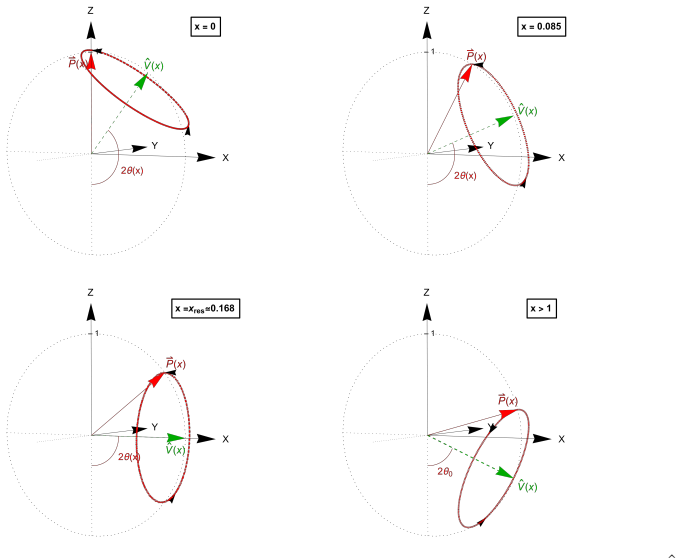
We show that a density matrix formalism provides a useful description of non-adiabatic transitions in two-state quantum systems. Compared to a traditional Hamiltonian formalism, even in the absence of decoherence when there is full equivalence between the two, the density matrix formalism provides a convenient change of variables that yields a powerful general analytical solution. This solution nicely describes a transition regime between the well known Landau-Zener-Stuckelberg-Majorana (LZSM) approximation and the extremely non-adiabatic limit. Our results have very general applications, within a large variety of problems in quantum physics, neutrino physics, cosmology.
What carries the argument
The change of variables from the Hamiltonian to the density-matrix picture, which converts the transition equations into an analytically solvable form.
Load-bearing premise
That the change of variables in the density matrix picture produces an analytically solvable system whose solution is both general and more powerful than existing approximations.
What would settle it
A numerical integration of the Schrödinger equation for a two-state system with linear avoided crossing in the intermediate non-adiabatic regime that yields transition probabilities differing from the derived analytical expressions.
Figures

read the original abstract
We show that a density matrix formalism provides a useful description of non-adiabatic transitions in two-state quantum systems. Compared to a traditional Hamiltonian formalism, even in the absence of decoherence when there is full equivalence between the two, the density matrix formalism provides a convenient change of variables that yields a powerful general analytical solution. This solution nicely describes a transition regime between the well known Landau-Zener-Stuckelberg-Majorana (LZSM) approximation and the extremely non-adiabatic limit. Our results have very general applications, within a large variety of problems in quantum physics, neutrino physics, cosmology.
Editorial analysis
A structured set of objections, weighed in public.
Referee Report
Summary. The manuscript claims that the density matrix formalism for non-adiabatic transitions in two-state quantum systems provides a convenient change of variables (even when fully equivalent to the Hamiltonian picture without decoherence) that yields a powerful general analytical solution. This solution is asserted to describe the transition regime between the Landau-Zener-Stückelberg-Majorana (LZSM) approximation and the extremely non-adiabatic (sudden) limit, with broad applications in quantum physics, neutrino physics, and cosmology.
Significance. If the asserted analytical solution exists and is both exact and general, the result would be significant because it would supply closed-form transition probabilities in the intermediate regime where standard approximations break down, potentially simplifying calculations across multiple fields without numerical integration.
major comments (2)
- [Abstract] Abstract: the central claim that the density-matrix change of variables 'yields a powerful general analytical solution' is stated without any derivation, explicit transformed ODEs, closed-form expression for the transition probability, or verification that the solution interpolates between the LZSM and sudden limits. Because the two formalisms are stated to be equivalent without decoherence, the advantage must reside in the algebraic solvability of the new equations; this is not demonstrated.
- [Abstract] Abstract: the assertion that the solution 'nicely describes a transition regime' is load-bearing for the paper's novelty, yet no limiting-case checks, comparison to known LZSM or sudden expressions, or parameter-free derivation is supplied.
minor comments (1)
- [Abstract] Abstract: the phrase 'very general applications' is not accompanied by any concrete example, reference to prior LZSM literature, or indication of how the new solution improves on existing treatments.
Simulated Author's Rebuttal
We thank the referee for their careful reading and constructive feedback on the abstract. We address the two major comments point by point below. The full derivations appear in the body of the manuscript, but we agree the abstract can be strengthened to better convey the key technical steps and verifications.
read point-by-point responses
-
Referee: [Abstract] Abstract: the central claim that the density-matrix change of variables 'yields a powerful general analytical solution' is stated without any derivation, explicit transformed ODEs, closed-form expression for the transition probability, or verification that the solution interpolates between the LZSM and sudden limits. Because the two formalisms are stated to be equivalent without decoherence, the advantage must reside in the algebraic solvability of the new equations; this is not demonstrated.
Authors: We agree the abstract is too terse on this point. Section 2 of the manuscript introduces the density-matrix change of variables and derives the transformed ODEs. Section 3 solves these equations in closed form, obtaining an explicit transition probability. The algebraic advantage is demonstrated by showing that the new equations admit an exact solution where the original Hamiltonian equations do not. We will revise the abstract to briefly outline the change of variables, state the resulting closed-form probability, and note the equivalence without decoherence while highlighting the improved solvability. revision: yes
-
Referee: [Abstract] Abstract: the assertion that the solution 'nicely describes a transition regime' is load-bearing for the paper's novelty, yet no limiting-case checks, comparison to known LZSM or sudden expressions, or parameter-free derivation is supplied.
Authors: The manuscript performs the limiting-case analysis in Section 4: the general closed-form expression reduces exactly to the LZSM formula in the appropriate adiabatic regime and to the sudden-approximation result in the opposite limit. These reductions are parameter-free, following directly from the analytic expression without additional assumptions. We will revise the abstract to include a concise statement of these verifications and the interpolation property. revision: yes
Circularity Check
No significant circularity; derivation is self-contained reparametrization
full rationale
The paper explicitly acknowledges full equivalence between Hamiltonian and density-matrix pictures in the absence of decoherence, then presents the density-matrix change of variables as an algebraic reparametrization whose transformed ODEs admit an exact closed-form solution that interpolates between LZSM and sudden limits. No quoted step reduces a claimed prediction to a fitted parameter, self-citation chain, or input by construction; the central claim rests on the explicit solution of the transformed system rather than on renaming or smuggling an ansatz. The derivation is therefore independent of the inputs once the change of variables is performed.
Axiom & Free-Parameter Ledger
Reference graph
Works this paper leans on
-
[1]
L. D. Landau,A theory of energy transfer on collisions,Phys. Z. Sowjetunion1 (1932), 88
1932
-
[2]
Zener,Nonadiabatic crossing of energy levels, Proc
C. Zener,Nonadiabatic crossing of energy levels, Proc. Roy. Soc. Lond. A137(1932), 696-702
1932
-
[3]
Stückelberg,Theory of Inelastic Collisions between AtomsHelvetcia Physica Acta,5(1932) 369
E.C.G. Stückelberg,Theory of Inelastic Collisions between AtomsHelvetcia Physica Acta,5(1932) 369
1932
-
[4]
Majorana,Oriented atoms in a variable magnetic field, Nuovo Cim.9(1932), 43-50
E. Majorana,Oriented atoms in a variable magnetic field, Nuovo Cim.9(1932), 43-50
1932
-
[5]
Boucher, Peter Sun, Ivan Keresztes, Lee E
Michael C. Boucher, Peter Sun, Ivan Keresztes, Lee E. Harrell, John A. Marohn, The Landau–Zener–Stückelberg–Majorana transition in theT2 ≪T 1 limit, Journal of Magnetic Resonance354(2023) 107523
2023
-
[6]
(2020) 5809-5820
Suchan J, Janos J, Slavicek P.Pragmatic Approach to Photodynamics: Mixed Landau-Zener Surface Hopping with Intersystem Crossing, J Chem Theory Comput. (2020) 5809-5820
2020
-
[7]
S. N. Shevchenko, S. Ashhab and F. Nori,Landau-Zener-Stuckelberg Interferometry, Phys. Rept.492(2010), 1 [arXiv:0911.1917 [cond-mat.supr-con]]. 24
Pith/arXiv arXiv 2010
- [8]
-
[9]
Wolfenstein,Neutrino Oscillations in Matter, Phys
L. Wolfenstein,Neutrino Oscillations in Matter, Phys. Rev. D17(1978), 2369-2374
1978
-
[10]
S. P. Mikheyev and A. Y. Smirnov,Resonance Amplification of Oscillations in Matter and Spectroscopy of Solar Neutrinos, Sov. J. Nucl. Phys.42(1985), 913-917
1985
-
[11]
J. N. Bahcall, M. C. Gonzalez-Garcia and C. Pena-Garay,Solar neutrinos before and after KamLAND, JHEP02(2003), 009 [arXiv:hep-ph/0212147 [hep-ph]]
Pith/arXiv arXiv 2003
-
[12]
G. G. Raffelt,Particle physics from stars, Ann. Rev. Nucl. Part. Sci.49(1999), 163-216 [arXiv:hep-ph/9903472 [hep-ph]]
Pith/arXiv arXiv 1999
-
[13]
K.Hirataet al.[Kamiokande-II],Observation of a Neutrino Burst from the Supernova SN 1987a, Phys. Rev. Lett.58(1987), 1490-1493
1987
-
[14]
R. M. Bionta, G. Blewitt, C. B. Bratton, D. Casper, A. Ciocio, R. Claus, B. Cortez, M. Crouch, S. T. Dye and S. Errede,et al. Observation of a Neutrino Burst in Coincidence with Supernova SN 1987a in the Large Magellanic Cloud, Phys. Rev. Lett.58(1987), 1494
1987
-
[15]
A. S. Dighe and A. Y. Smirnov,Identifying the neutrino mass spectrum from the neu- trino burst from a supernova, Phys. Rev. D62(2000), 033007 [arXiv:hep-ph/9907423 [hep-ph]]
Pith/arXiv arXiv 2000
-
[16]
Barbieri and A
R. Barbieri and A. Dolgov,Bounds on Sterile-neutrinos from Nucleosynthesis, Phys. Lett. B237(1990), 440-445
1990
-
[17]
Enqvist, K
K. Enqvist, K. Kainulainen and M. J. Thomson,Stringent cosmological bounds on inert neutrino mixing, Nucl. Phys. B373(1992), 498-528
1992
-
[18]
R. Foot, M. J. Thomson and R. R. Volkas,Large neutrino asymmetries from neutrino oscillations, Phys. Rev. D53(1996), R5349-R5353 [arXiv:hep-ph/9509327 [hep-ph]]
Pith/arXiv arXiv 1996
-
[19]
P. Di Bari, P. Lipari and M. Lusignoli,The muon-neutrino<—>s neutrino inter- pretation of the atmospheric neutrino data and cosmological constraints, Int. J. Mod. Phys. A15(2000), 2289-2328 [arXiv:hep-ph/9907548 [hep-ph]]
Pith/arXiv arXiv 2000
-
[20]
S. Dodelson and L. M. Widrow,Sterile-neutrinos as dark matter, Phys. Rev. Lett. 72(1994), 17-20 [arXiv:hep-ph/9303287 [hep-ph]]. 25
Pith/arXiv arXiv 1994
-
[21]
P. Di Bari and R. Foot,Active sterile neutrino oscillations in the early universe: Asymmetry generation at low|δm2|and the Landau-Zener approximation, Phys. Rev. D65(2002), 045003 [arXiv:hep-ph/0103192 [hep-ph]]
Pith/arXiv arXiv 2002
-
[22]
B. Dev, P. Di Bari, I. Martinez-Soler and R. Roshan,Boomerang mechanism explain- ing the excess radio background, [arXiv:2509.03441 [hep-ph]]
-
[23]
A. Anisimov and P. Di Bari,Cold Dark Matter from heavy Right-Handed neutrino mixing, Phys. Rev. D80(2009), 073017 [arXiv:0812.5085 [hep-ph]]
Pith/arXiv arXiv 2009
-
[24]
P. Di Bari, D. Marfatia and Y. L. Zhou,Gravitational waves from neutrino mass and dark matter genesis, Phys. Rev. D102(2020) no.9, 095017 [arXiv:2001.07637 [hep-ph]]
arXiv 2020
-
[25]
A. Mirizzi, J. Redondo and G. Sigl,Microwave Background Constraints on Mixing of Photons with Hidden Photons, JCAP03(2009), 026 [arXiv:0901.0014 [hep-ph]]
Pith/arXiv arXiv 2009
-
[26]
Lindblad,On the Generators of Quantum Dynamical Semigroups, Commun
G. Lindblad,On the Generators of Quantum Dynamical Semigroups, Commun. Math. Phys.48(1976), 119
1976
-
[27]
Gorini, A
V. Gorini, A. Kossakowski and E. C. G. Sudarshan,Completely Positive Dynamical Semigroups of N Level Systems, J. Math. Phys.17(1976), 821
1976
-
[28]
Franke,On the general form of the dynamical transformation of density matri- ces.Theor Math Phys 27, 406–413 (1976)
V.A. Franke,On the general form of the dynamical transformation of density matri- ces.Theor Math Phys 27, 406–413 (1976)
1976
-
[29]
N. F. Bell, R. R. Volkas and Y. Y. Y. Wong,Relic neutrino asymmetry evolution from first principles, Phys. Rev. D59(1999), 113001 [arXiv:hep-ph/9809363 [hep-ph]]
Pith/arXiv arXiv 1999
-
[30]
P. Di Bari, K. Farrag, R. Samanta and Y. L. Zhou,Density matrix calculation of the dark matter abundance in the Higgs induced right-handed neutrino mixing model, JCAP10(2020), 029 [arXiv:1908.00521 [hep-ph]]
arXiv 2020
-
[31]
Bloch,Nuclear Induction, Phys
F. Bloch,Nuclear Induction, Phys. Rev.70(1946), 460-474
1946
-
[32]
Giunti and C
For more details and references see: C. Giunti and C. W. Kim,Fundamentals of Neutrino Physics and Astrophysics, Oxford University Press, March 2007
2007
-
[33]
I. Esteban, M. C. Gonzalez-Garcia, M. Maltoni, I. Martinez-Soler, J. P. Pinheiro and T. Schwetz,NuFit-6.0: updated global analysis of three-flavor neutrino oscilla- tions, www.nufit.org JHEP12(2024), 216 [arXiv:2410.05380 [hep-ph]] and NuFIT 6.1 (2025) www.nufit.org. 26
Pith/arXiv arXiv 2024
-
[34]
C. Laber-Smith, E. Armstrong, A. B. Balantekin, E. K. Jones, L. Newkirk, A. V. Pat- wardhan, S. Ranginwala, M. M. Sanchez and H. Torres,Constraining solar electron number density via neutrino flavor data at Borexino, Phys. Rev. D110(2024) no.4, 043011 [arXiv:2404.06468 [astro-ph.SR]]
arXiv 2024
-
[35]
T. K. Kuo and J. T. Pantaleone,Nonadiabatic Neutrino Oscillations in Matter, Phys. Rev. D39(1989), 1930
1989
-
[36]
Schlosshauer,Quantum decoherence, Phys
M. Schlosshauer,Quantum decoherence, Phys. Rept.831(2019), 1-57 [arXiv:1911.06282 [quant-ph]]. 27
arXiv 2019
discussion (0)
Sign in with ORCID, Apple, or X to comment. Anyone can read and Pith papers without signing in.