Dark-Sector Deformations of Holographic Anisotropic Superfluids in Asymptotically Hyperscaling Violation Geometry
Pith reviewed 2026-06-25 22:38 UTC · model grok-4.3
The pith
Dark scalar portal weakly suppresses strip anisotropy in holographic superfluids at vanishing strength
A machine-rendered reading of the paper's core claim, the machinery that carries it, and where it could break.
Core claim
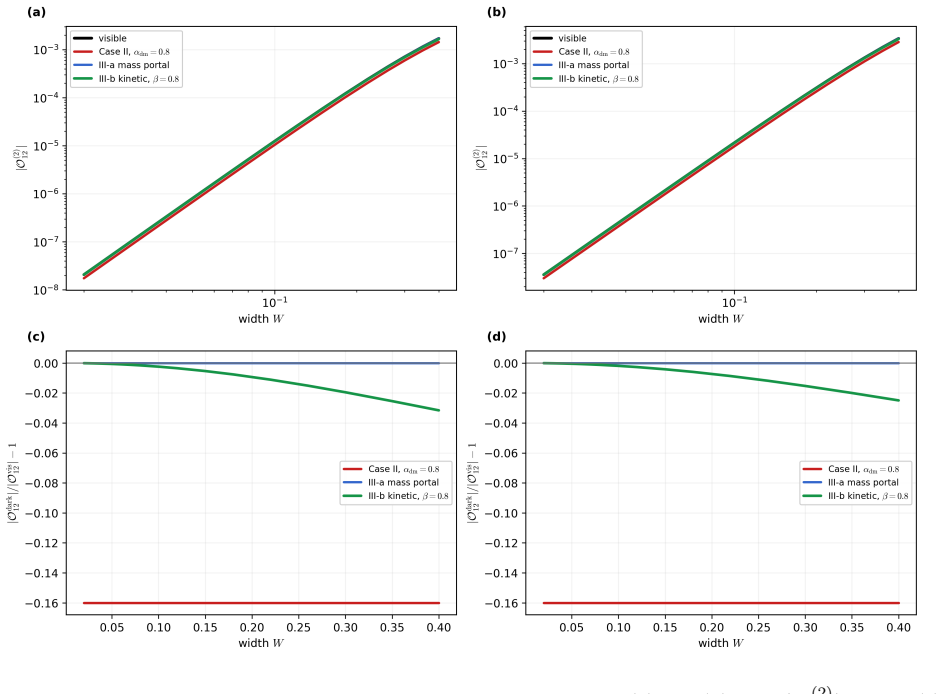
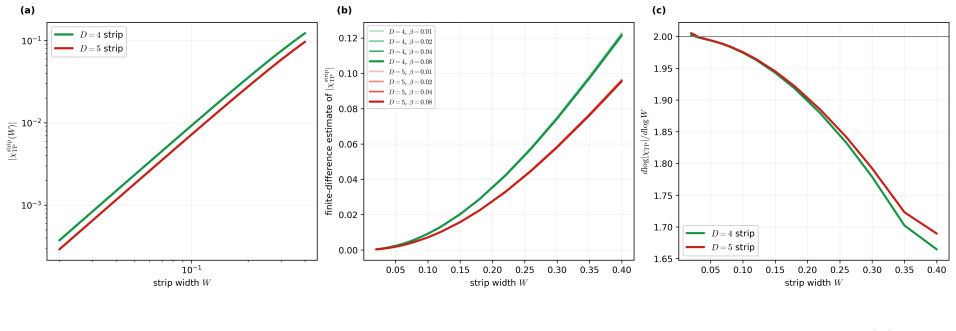
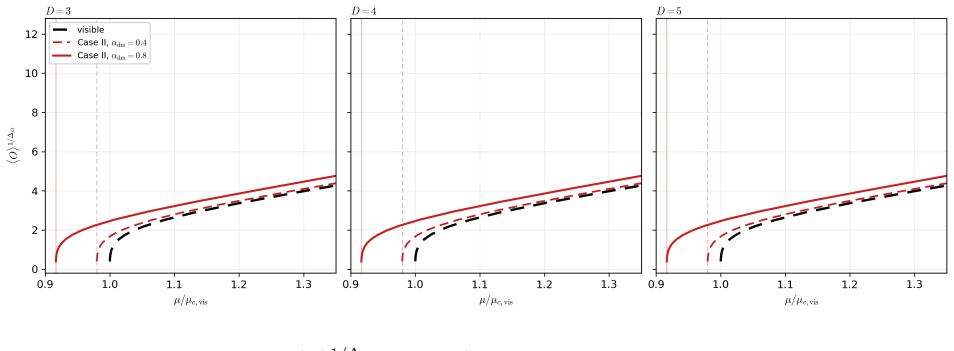
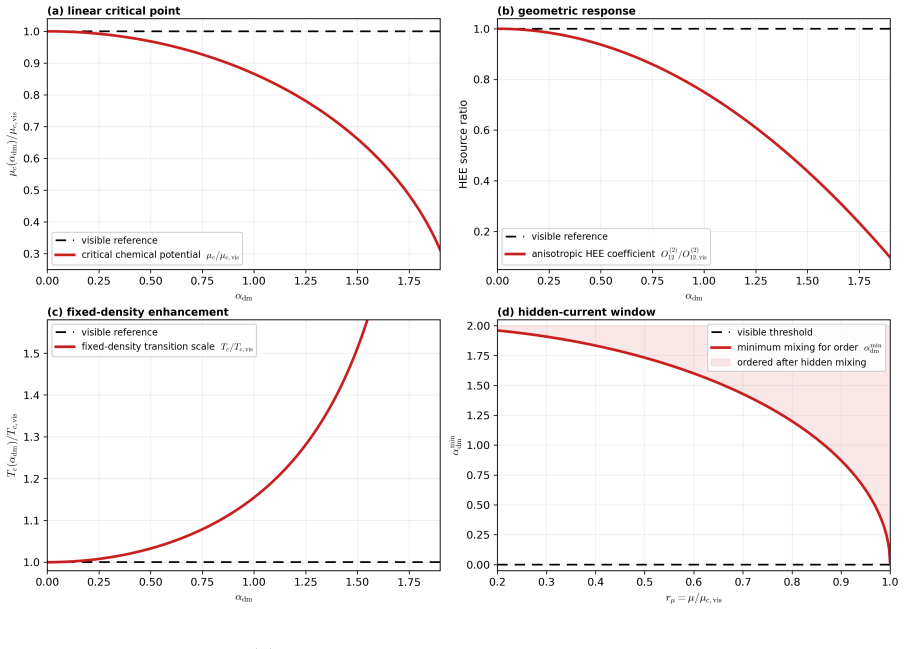
The main result is a strip susceptibility at vanishing portal strength. It is negative in the D=4 and D=5 backgrounds, so the portal weakly suppresses visible strip anisotropy. This has a holographic RG interpretation: the normalizable dark scalar is weighted toward the IR horizon, while narrow strips probe the UV near-boundary RT region. Thus, the portal decouples in the UV and the susceptibility vanishes quadratically with strip width.
What carries the argument
The kinetic dark-scalar portal Z_dm(Φ) which deforms the Yang-Mills operator in the visible sector.
If this is right
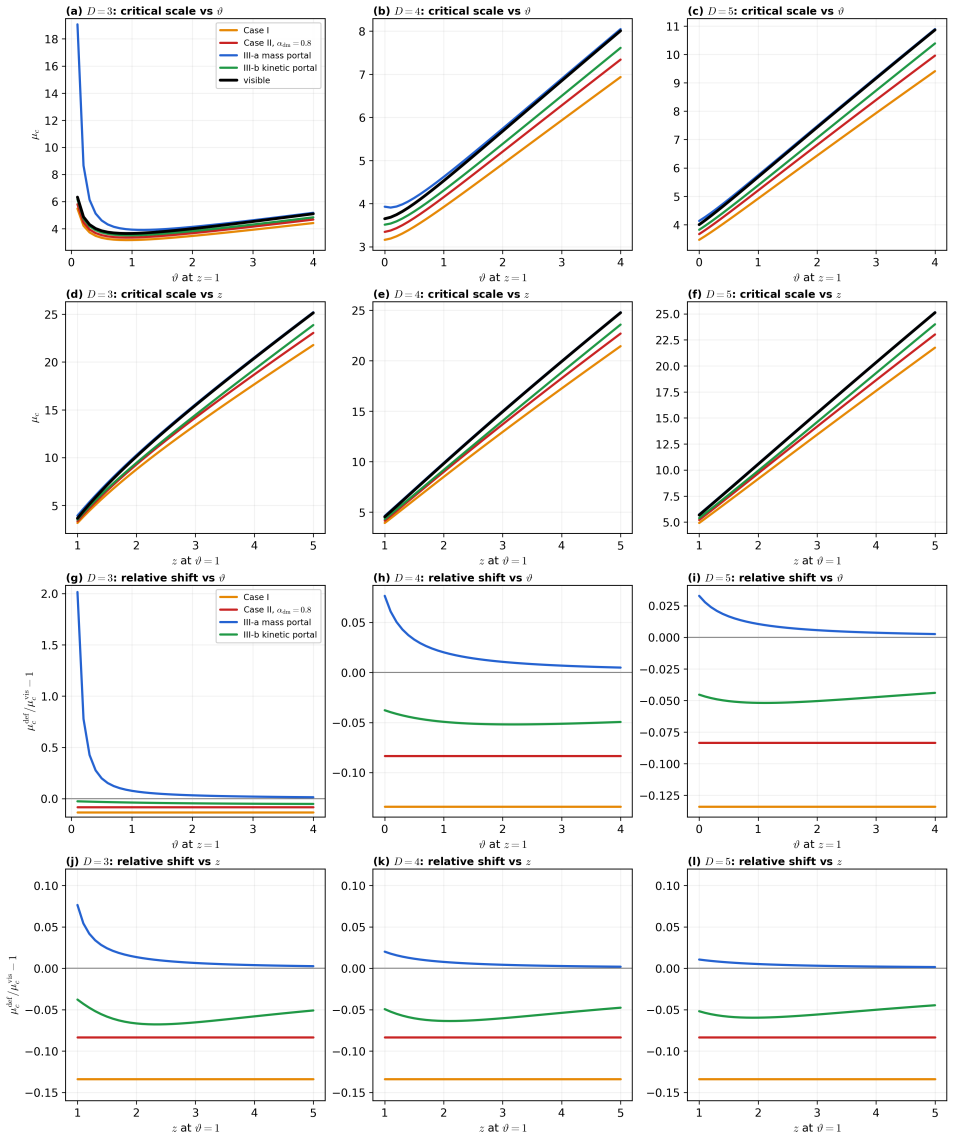
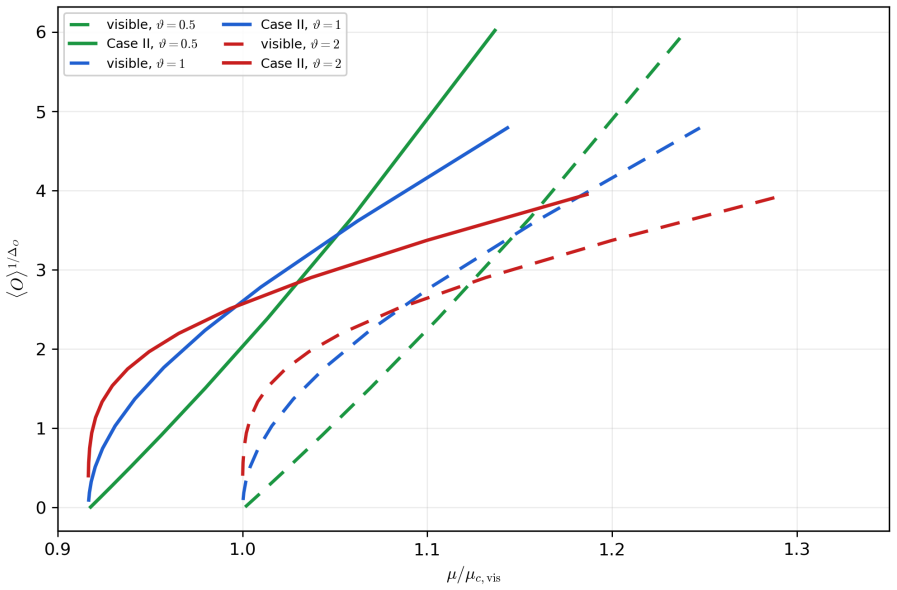
- The critical shift depends on the hyperscaling-violating background and can change sign.
- Hidden-current mixing provides a solvable example of hidden gauge sectors.
- Isotropic dark sources cancel their contribution to the strip difference.
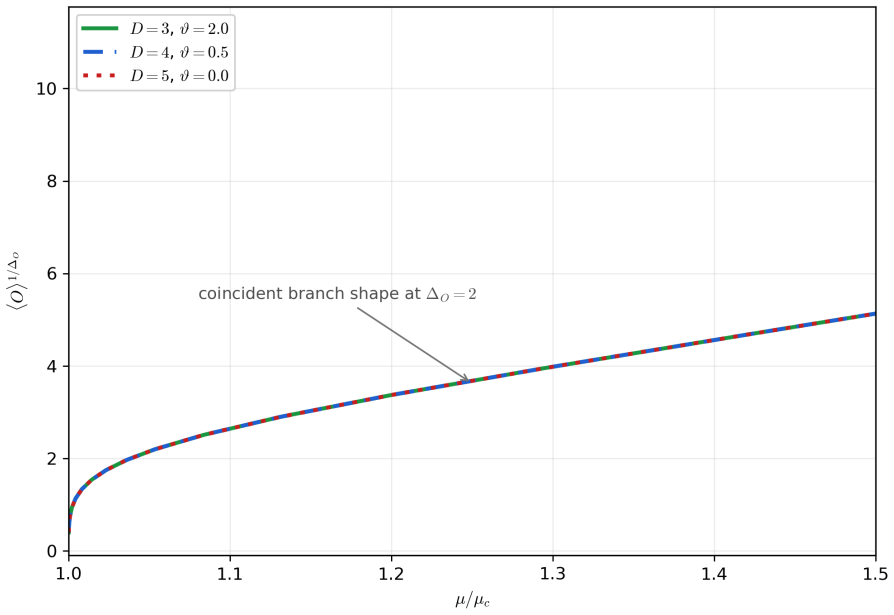
- Visible quantities like critical chemical potential and condensate vary with dimension and hyperscaling exponents.
Where Pith is reading between the lines
- The suppression effect might allow dark sectors to control anisotropy in holographic models of condensed matter systems.
- Wider strips, which probe deeper into the bulk, should exhibit stronger influence from the dark sector.
- This perturbative approach could be extended to non-perturbative regimes to check if the suppression persists.
Load-bearing premise
The dark-scalar portal can be treated as a small perturbative deformation of the visible sector without causing significant backreaction on the background geometry.
What would settle it
Computing the strip susceptibility explicitly in the D=4 case at zero portal strength and finding it positive rather than negative would falsify the suppression claim.
Figures




read the original abstract
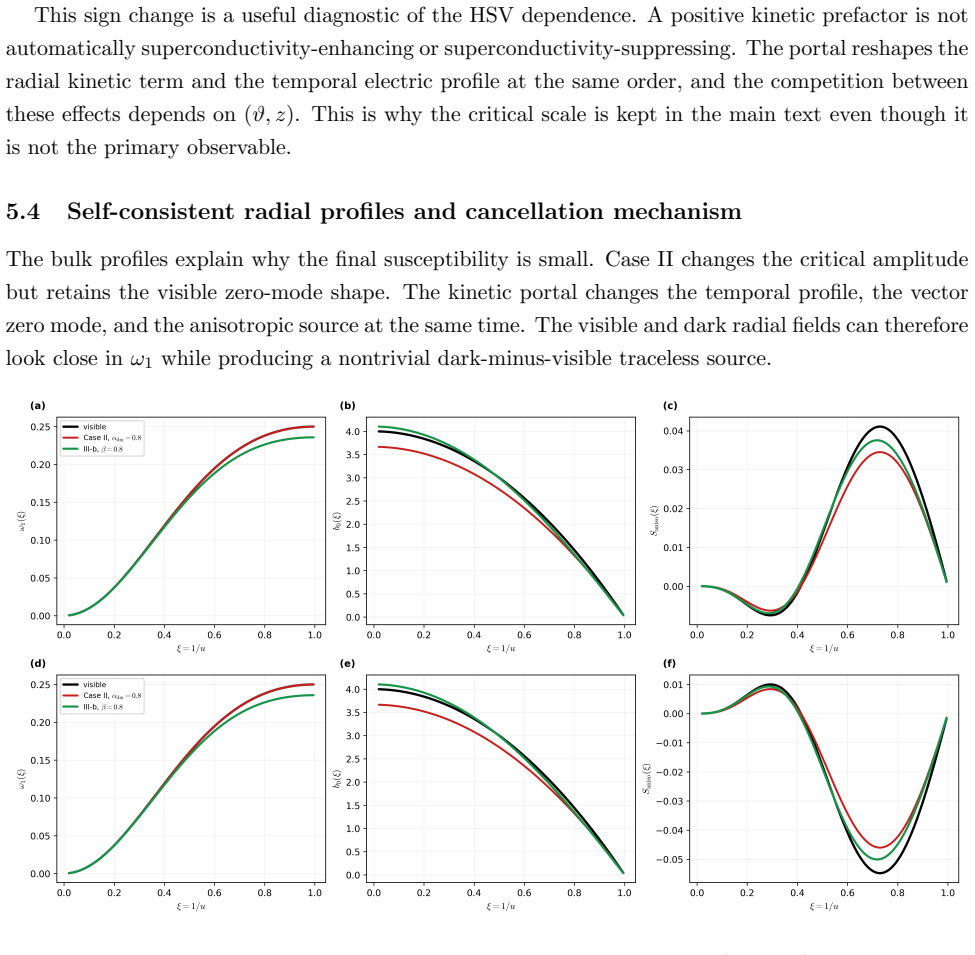
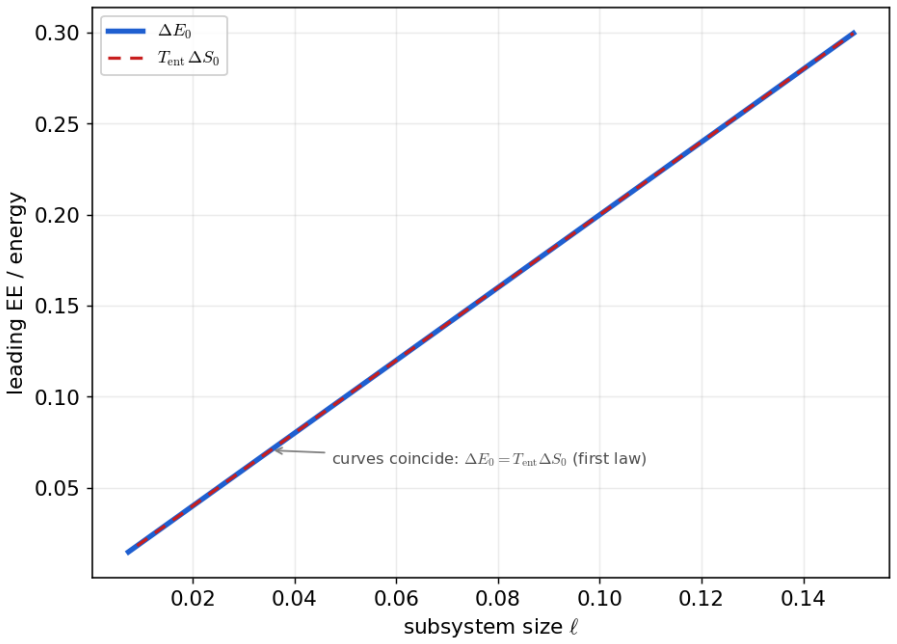
We study dark-sector deformations of holographic anisotropic \(p\)-wave superfluids in hyperscaling-violating black-brane backgrounds. In the visible \(SU(2)\) sector, \(b(u)\) fixes the chemical potential and charge density, while \(\omega(u)\) condenses and selects a boundary direction, producing anisotropic strip entanglement. The visible critical chemical potential, radial profiles, condensate branch, and strip-entanglement difference vary with dimension and hyperscaling-violating exponents. We then add hidden gauge sectors and hidden dark-scalar portals. Hidden-current mixing gives a solvable example, whereas isotropic dark sources cancel in the strip difference. For the kinetic dark-scalar portal, \(Z_{\rm dm}(\Phi)\) deforms the Yang--Mills operator; hence \(b_0(u)\), \(\omega_1(u)\), and the order-\(\epsilon^2\) anisotropic stress are computed in the same deformed problem. The critical shift depends on the hyperscaling-violating background and can change sign. The main result is a strip susceptibility at vanishing portal strength. It is negative in the \(D=4\) and \(D=5\) backgrounds, so the portal weakly suppresses visible strip anisotropy. This has a holographic RG interpretation: the normalizable dark scalar is weighted toward the IR horizon, while narrow strips probe the UV near-boundary RT region. Thus, the portal decouples in the UV and the susceptibility vanishes quadratically with strip width; wider strips reach deeper into the bulk and recover the IR dark-sector effects.
Editorial analysis
A structured set of objections, weighed in public.
Referee Report
Summary. The paper studies dark-sector deformations of holographic anisotropic p-wave superfluids in hyperscaling-violating black-brane backgrounds. In the visible SU(2) sector, it examines how b(u) sets the chemical potential and charge density while ω(u) condenses to produce anisotropic strip entanglement. It then introduces hidden gauge sectors and a kinetic dark-scalar portal Z_dm(Φ) that deforms the Yang-Mills operator. The central result is the strip susceptibility at vanishing portal strength ε, which is negative for D=4 and D=5 backgrounds, implying that the portal weakly suppresses visible strip anisotropy. The analysis includes dependence on dimension and hyperscaling exponents, plus a holographic RG interpretation linking the IR-weighted normalizable dark scalar to UV decoupling for narrow strips.
Significance. If the central claim holds, the work provides a concrete holographic example of how a perturbative dark-sector portal can modulate visible-sector observables such as strip entanglement anisotropy, with an explicit RG interpretation of UV/IR decoupling. The sign change of the susceptibility with background parameters and the cancellation properties for isotropic sources are potentially useful for model-building in holographic dark-sector scenarios.
major comments (1)
- [Abstract] Abstract and the paragraph describing the kinetic portal: the central claim (negative strip susceptibility at vanishing portal strength) is obtained by solving the deformed equations for b0(u), ω1(u) and the O(ε²) anisotropic stress while treating the hyperscaling-violating black-brane geometry as fixed. No explicit check is given that the stress-energy of the normalizable dark scalar induces only O(ε²) corrections to the radial warp factor or blackening function; if backreaction enters at O(ε), both the extracted susceptibility and its reported sign become unreliable. This assumption is load-bearing for the main result.
Simulated Author's Rebuttal
We thank the referee for the careful reading and the constructive comment on the backreaction of the normalizable dark scalar. We address the concern below and will revise the manuscript to strengthen the presentation of this point.
read point-by-point responses
-
Referee: [Abstract] Abstract and the paragraph describing the kinetic portal: the central claim (negative strip susceptibility at vanishing portal strength) is obtained by solving the deformed equations for b0(u), ω1(u) and the O(ε^{2}) anisotropic stress while treating the hyperscaling-violating black-brane geometry as fixed. No explicit check is given that the stress-energy of the normalizable dark scalar induces only O(ε^{2}) corrections to the radial warp factor or blackening function; if backreaction enters at O(ε), both the extracted susceptibility and its reported sign become unreliable. This assumption is load-bearing for the main result.
Authors: We agree that an explicit verification of the backreaction order is necessary to confirm the reliability of the susceptibility and its sign. The current analysis solves the deformed visible-sector equations on the fixed hyperscaling-violating background, which is the standard probe approximation for such portal deformations. The normalizable dark scalar is IR-weighted, which already suggests suppression of its stress-energy contribution near the boundary (relevant for narrow strips). To address the referee's point directly, we will add a new appendix that computes the leading O(ε^{2}) corrections to the metric functions induced by the dark scalar's stress-energy tensor and verifies that these corrections do not modify the O(ε^{2}) anisotropic stress or the extracted susceptibility at leading order for the D=4 and D=5 backgrounds. This will explicitly confirm that backreaction remains subleading and does not affect the reported sign. revision: yes
Circularity Check
No significant circularity; derivation is a direct perturbative computation within the model
full rationale
The paper computes the strip susceptibility by explicitly solving the deformed Yang-Mills equations with the Z_dm(Phi) portal term for b0(u), omega1(u) and the O(epsilon^2) stress tensor in the fixed hyperscaling-violating background. This is a standard holographic calculation of a derived quantity from the bulk equations rather than a self-definitional loop, a fitted parameter renamed as prediction, or a load-bearing self-citation. No uniqueness theorem or ansatz is imported from prior author work in the provided text, and the result is not equivalent to its inputs by construction. The model is self-contained as a theoretical derivation without external data fitting.
Axiom & Free-Parameter Ledger
free parameters (2)
- hyperscaling-violating exponents
- portal coupling strength epsilon
axioms (2)
- domain assumption Einstein-Yang-Mills equations admit hyperscaling-violating black-brane solutions with the stated asymptotics
- ad hoc to paper The dark scalar is normalizable and does not back-react at leading order
invented entities (1)
-
kinetic dark-scalar portal Z_dm(Phi)
no independent evidence
Reference graph
Works this paper leans on
-
[1]
The Large N limit of superconformal field theories and supergravity,
J. M. Maldacena, “The Large N limit of superconformal field theories and supergravity,” Adv. Theor. Math. Phys.2(1998) 231 [hep-th/9711200]
Pith/arXiv arXiv 1998
-
[2]
Gauge theory correlators from non-critical string theory,
S. S. Gubser, I. R. Klebanov and A. M. Polyakov, “Gauge theory correlators from non-critical string theory,” Phys. Lett. B428(1998) 105 [hep-th/9802109]
Pith/arXiv arXiv 1998
-
[3]
Anti-de Sitter space and holography,
E. Witten, “Anti-de Sitter space and holography,” Adv. Theor. Math. Phys.2(1998) 253 [hep- th/9802150]
arXiv 1998
-
[4]
Large N field theories, string theory and gravity,
O. Aharony, S. S. Gubser, J. M. Maldacena, H. Ooguri and Y. Oz, “Large N field theories, string theory and gravity,” Phys. Rept.323(2000) 183 [hep-th/9905111]
Pith/arXiv arXiv 2000
-
[5]
Minkowski-space correlators in AdS/CFT correspondence,
D. T. Son and A. O. Starinets, “Minkowski-space correlators in AdS/CFT correspondence,” JHEP 09(2002) 042 [hep-th/0205051]
Pith/arXiv arXiv 2002
-
[6]
Universality of the hydrodynamic limit in AdS/CFT and the membrane paradigm,
N. Iqbal and H. Liu, “Universality of the hydrodynamic limit in AdS/CFT and the membrane paradigm,” Phys. Rev. D79(2009) 025023 [arXiv:0809.3808]. 40
Pith/arXiv arXiv 2009
-
[7]
The shear viscosity of strongly coupled N=4 supersymmetric Yang–Mills plasma,
G. Policastro, D. T. Son and A. O. Starinets, “The shear viscosity of strongly coupled N=4 supersymmetric Yang–Mills plasma,” Phys. Rev. Lett.87(2001) 081601 [hep-th/0104066]
Pith/arXiv arXiv 2001
-
[8]
From AdS/CFT correspondence to hydrodynam- ics,
G. Policastro, D. T. Son and A. O. Starinets, “From AdS/CFT correspondence to hydrodynam- ics,” JHEP09(2002) 043 [hep-th/0205052]
Pith/arXiv arXiv 2002
-
[9]
Viscosity in strongly interacting quantum field theories from black hole physics,
P. Kovtun, D. T. Son and A. O. Starinets, “Viscosity in strongly interacting quantum field theories from black hole physics,” Phys. Rev. Lett.94(2005) 111601 [hep-th/0405231]
Pith/arXiv arXiv 2005
-
[10]
Nonlinear fluid dynamics from gravity,
S. Bhattacharyya, V. E. Hubeny, S. Minwalla and M. Rangamani, “Nonlinear fluid dynamics from gravity,” JHEP02(2008) 045 [arXiv:0712.2456]
Pith/arXiv arXiv 2008
-
[11]
Forced fluid dynamics from gravity,
S. Bhattacharyya, R. Loganayagam, S. Minwalla, S. Nampuri, S. P. Trivedi and S. R. Wadia, “Forced fluid dynamics from gravity,” JHEP02(2009) 018 [arXiv:0806.0006]
Pith/arXiv arXiv 2009
-
[12]
The gravity dual of a p-wave superconductor,
S. S. Gubser and S. S. Pufu, “The gravity dual of a p-wave superconductor,” JHEP11(2008) 033 [arXiv:0805.2960]
Pith/arXiv arXiv 2008
-
[13]
Pseudogap and time reversal breaking in a holographic superconductor,
M. M. Roberts and S. A. Hartnoll, “Pseudogap and time reversal breaking in a holographic superconductor,” JHEP08(2008) 035 [arXiv:0805.3898]
Pith/arXiv arXiv 2008
-
[14]
Non-universal shear viscosity from Einstein gravity,
J. Erdmenger, P. Kerner and H. Zeller, “Non-universal shear viscosity from Einstein gravity,” Phys. Lett. B699(2011) 301 [arXiv:1011.5912]
Pith/arXiv arXiv 2011
-
[15]
Analytic approaches to anisotropic holographic superfluids,
P. Basu and J. H. Oh, “Analytic approaches to anisotropic holographic superfluids,” JHEP07 (2012) 106 [arXiv:1109.4592]
Pith/arXiv arXiv 2012
-
[16]
Running shear viscosities in anisotropic holographic superfluids,
J. H. Oh, “Running shear viscosities in anisotropic holographic superfluids,” JHEP06(2012) 103 [arXiv:1201.5605]
Pith/arXiv arXiv 2012
-
[17]
Two U(1)’s and epsilon charge shifts,
B. Holdom, “Two U(1)’s and epsilon charge shifts,” Phys. Lett. B166(1986) 196
1986
-
[18]
Kinetic mixing and the supersymmetric gauge hierarchy,
K. R. Dienes, C. F. Kolda and J. March-Russell, “Kinetic mixing and the supersymmetric gauge hierarchy,” Nucl. Phys. B492(1997) 104 [hep-ph/9610479]
Pith/arXiv arXiv 1997
-
[19]
Brane-antibrane kinetic mixing, millicharged particles and SUSY breaking,
S. A. Abel and B. W. Schofield, “Brane-antibrane kinetic mixing, millicharged particles and SUSY breaking,” Nucl. Phys. B685(2004) 150 [hep-th/0311051]
Pith/arXiv arXiv 2004
-
[20]
Illuminating the hidden sector of string theory by shining light through a magnetic field,
S. A. Abel, J. Jaeckel, V. V. Khoze and A. Ringwald, “Illuminating the hidden sector of string theory by shining light through a magnetic field,” Phys. Lett. B666(2008) 66 [hep-ph/0608248]
Pith/arXiv arXiv 2008
-
[21]
Kinetic mixing of the photon with hidden U(1)s in string phenomenology,
S. A. Abel, M. D. Goodsell, J. Jaeckel, V. V. Khoze and A. Ringwald, “Kinetic mixing of the photon with hidden U(1)s in string phenomenology,” JHEP07(2008) 124 [arXiv:0803.1449]
Pith/arXiv arXiv 2008
-
[22]
Analytic study on backreacting holographic superconductors with dark matter sector,
L. Nakonieczny and M. Rogatko, “Analytic study on backreacting holographic superconductors with dark matter sector,” Phys. Rev. D90(2014) 106004 [arXiv:1411.0798]. 41
Pith/arXiv arXiv 2014
-
[23]
Magnetic field in holographic superconductors with dark matter sector,
L. Nakonieczny, M. Rogatko and K. I. Wysoki´ nski, “Magnetic field in holographic superconductors with dark matter sector,” Phys. Rev. D91(2015) 046007 [arXiv:1501.04902]
Pith/arXiv arXiv 2015
-
[24]
Analytic investigation of holographic phase transitions influenced by dark matter sector,
L. Nakonieczny, M. Rogatko and K. I. Wysoki´ nski, “Analytic investigation of holographic phase transitions influenced by dark matter sector,” Phys. Rev. D92(2015) 066008 [arXiv:1509.01769]
Pith/arXiv arXiv 2015
-
[25]
P-wave holographic superconductor/insulator phase transi- tions affected by dark matter sector,
M. Rogatko and K. I. Wysoki´ nski, “P-wave holographic superconductor/insulator phase transi- tions affected by dark matter sector,” JHEP03(2016) 215 [arXiv:1508.02869]
Pith/arXiv arXiv 2016
-
[26]
Holographic vortices in the presence of dark matter sector,
M. Rogatko and K. I. Wysoki´ nski, “Holographic vortices in the presence of dark matter sector,” JHEP12(2015) 041 [arXiv:1510.06137]
Pith/arXiv arXiv 2015
-
[27]
Condensate flow in holographic models in the presence of dark matter,
M. Rogatko and K. I. Wysoki´ nski, “Condensate flow in holographic models in the presence of dark matter,” JHEP10(2016) 152 [arXiv:1608.00343]
Pith/arXiv arXiv 2016
-
[28]
Holographic entanglement entropy in superconductor phase transition with dark matter sector,
Y. Peng, “Holographic entanglement entropy in superconductor phase transition with dark matter sector,” Phys. Lett. B750(2015) 420 [arXiv:1507.07399]
Pith/arXiv arXiv 2015
-
[29]
Y. Peng, Q. Pan and Y. Liu, “A general holographic insulator/superconductor model with dark matter sector away from the probe limit,” Nucl. Phys. B915(2017) 69 [arXiv:1512.08950]
Pith/arXiv arXiv 2017
-
[30]
C. Park, G. Kim, J. s. Chae and J. H. Oh, JHEP02, 182 (2023) doi:10.1007/JHEP02(2023)182 [arXiv:2210.08919 [hep-th]]
-
[31]
Holographic DC SQUID in the presence of dark matter,
B. Kiczek, M. Rogatko and K. I. Wysoki´ nski, “Holographic DC SQUID in the presence of dark matter,” arXiv:1904.00653
arXiv 1904
-
[32]
Two interacting current model of holographic Dirac fluid in graphene,
M. Rogatko and K. I. Wysoki´ nski, “Two interacting current model of holographic Dirac fluid in graphene,” Phys. Rev. D97(2018) 024053 [arXiv:1708.08051]
Pith/arXiv arXiv 2018
-
[33]
Holographic calculation of magneto-transport coefficients in Dirac semimetals,
M. Rogatko and K. I. Wysoki´ nski, “Holographic calculation of magneto-transport coefficients in Dirac semimetals,” JHEP01(2018) 078 [arXiv:1710.05002]
Pith/arXiv arXiv 2018
-
[34]
Viscosity bound for anisotropic superfluids with dark matter sector,
M. Rogatko and K. I. Wysoki´ nski, “Viscosity bound for anisotropic superfluids with dark matter sector,” Phys. Rev. D96(2017) 026015 [arXiv:1612.02593]
Pith/arXiv arXiv 2017
-
[35]
Aspects of holography for theories with hyperscaling violation,
X. Dong, S. Harrison, S. Kachru, G. Torroba and H. Wang, “Aspects of holography for theories with hyperscaling violation,” JHEP06(2012) 041 [arXiv:1201.1905]
Pith/arXiv arXiv 2012
-
[36]
Generalized holographic quantum criticality at finite density,
B. Gout´ eraux and E. Kiritsis, “Generalized holographic quantum criticality at finite density,” JHEP12(2011) 036 [arXiv:1107.2116]
Pith/arXiv arXiv 2011
-
[37]
Hidden Fermi surfaces in compressible states of gauge- gravity duality,
L. Huijse, S. Sachdev and B. Swingle, “Hidden Fermi surfaces in compressible states of gauge- gravity duality,” Phys. Rev. B85(2012) 035121 [arXiv:1112.0573]
Pith/arXiv arXiv 2012
-
[38]
Charged Black Branes with Hyperscaling Violating Factor,
M. Alishahiha, E. O. Colgain and H. Yavartanoo, “Charged Black Branes with Hyperscaling Violating Factor,” JHEP11(2012) 137 [arXiv:1209.3946]. 42
Pith/arXiv arXiv 2012
-
[39]
G. Kim, Y. S. Choi and J. H. Oh, “Analytic approaches to anisotropic holographic superfluids in asymptotically hyperscaling violation geometry,” arXiv:2504.13635
-
[40]
Holographic study ofT ¯Tlike deformed HV QFTs: holographic entanglement entropy,
H.-S. Jeong, W.-B. Pan, Y.-W. Sun and Y.-T. Wang, “Holographic study ofT ¯Tlike deformed HV QFTs: holographic entanglement entropy,” JHEP02(2023) 018 [arXiv:2211.00518]
arXiv 2023
-
[41]
G. Cavini, D. Seminara, J. Sisti and E. Tonni, “On shape dependence of holographic entanglement entropy in AdS 4/CFT3 with Lifshitz scaling and hyperscaling violation,” JHEP02(2020) 172 [arXiv:1907.10030]
arXiv 2020
-
[42]
Learning geometries beyond asymptotic AdS,
C. Ran, S.-F. Wu and Z.-Y. Xian, “Learning geometries beyond asymptotic AdS,” JHEP03 (2026) 031 [arXiv:2508.05808]
arXiv 2026
-
[43]
Holographic derivation of entanglement entropy from AdS/CFT,
S. Ryu and T. Takayanagi, “Holographic derivation of entanglement entropy from AdS/CFT,” Phys. Rev. Lett.96(2006) 181602 [hep-th/0603001]
Pith/arXiv arXiv 2006
-
[44]
Aspects of holographic entanglement entropy,
S. Ryu and T. Takayanagi, “Aspects of holographic entanglement entropy,” JHEP08(2006) 045 [hep-th/0605073]
Pith/arXiv arXiv 2006
-
[45]
Entanglement entropy, conformal invariance and extrinsic geometry,
S. N. Solodukhin, “Entanglement entropy, conformal invariance and extrinsic geometry,” Phys. Lett. B665(2008) 305 [arXiv:0802.3117]
Pith/arXiv arXiv 2008
-
[46]
On holographic entanglement entropy and higher curvature gravity,
L.-Y. Hung, R. C. Myers and M. Smolkin, “On holographic entanglement entropy and higher curvature gravity,” JHEP04(2011) 025 [arXiv:1101.5813]
Pith/arXiv arXiv 2011
-
[47]
Towards a derivation of holographic entanglement en- tropy,
H. Casini, M. Huerta and R. C. Myers, “Towards a derivation of holographic entanglement en- tropy,” JHEP05(2011) 036 [arXiv:1102.0440]
Pith/arXiv arXiv 2011
-
[48]
Thermodynamical property of en- tanglement entropy for excited states,
J. Bhattacharya, M. Nozaki, T. Takayanagi and T. Ugajin, “Thermodynamical property of en- tanglement entropy for excited states,” Phys. Rev. Lett.110(2013) 091602 [arXiv:1212.1164]
Pith/arXiv arXiv 2013
-
[49]
On the architecture of spacetime geometry,
E. Bianchi and R. C. Myers, “On the architecture of spacetime geometry,” Class. Quant. Grav. 31(2014) 214002 [arXiv:1212.5183]
Pith/arXiv arXiv 2014
-
[50]
Dynamics of entanglement entropy from Einstein equation,
M. Nozaki, T. Numasawa, A. Prudenziati and T. Takayanagi, “Dynamics of entanglement entropy from Einstein equation,” Phys. Rev. D88(2013) 026012 [arXiv:1304.7100]
Pith/arXiv arXiv 2013
-
[51]
Entanglement entropy: a perturbative calculation,
V. Rosenhaus and M. Smolkin, “Entanglement entropy: a perturbative calculation,” JHEP12 (2014) 179 [arXiv:1403.3733]
Pith/arXiv arXiv 2014
-
[52]
Entanglement entropy, planar surfaces, and spectral functions,
V. Rosenhaus and M. Smolkin, “Entanglement entropy, planar surfaces, and spectral functions,” JHEP02(2015) 015 [arXiv:1410.6530]
Pith/arXiv arXiv 2015
-
[53]
Colorful horizons with charge,
S. S. Gubser, “Colorful horizons with charge,” Phys. Rev. Lett.101(2008) 191601 [arXiv:0803.3483]
Pith/arXiv arXiv 2008
-
[54]
Building a holographic superconductor,
S. A. Hartnoll, C. P. Herzog and G. T. Horowitz, “Building a holographic superconductor,” Phys. Rev. Lett.101(2008) 031601 [arXiv:0803.3295]. 43
Pith/arXiv arXiv 2008
-
[55]
S. A. Hartnoll, C. P. Herzog and G. T. Horowitz, “Holographic superconductors,” JHEP12 (2008) 015 [arXiv:0810.1563]
Pith/arXiv arXiv 2008
-
[56]
Lectures on holographic superfluidity and superconductivity,
C. P. Herzog, “Lectures on holographic superfluidity and superconductivity,” J. Phys. A42(2009) 343001 [arXiv:0904.1975]
Pith/arXiv arXiv 2009
-
[57]
Introduction to holographic superconductors,
G. T. Horowitz, “Introduction to holographic superconductors,” Lect. Notes Phys.828(2011) 313 [arXiv:1002.1722]
Pith/arXiv arXiv 2011
-
[58]
Phase transition in anisotropic holographic superfluids with arbitraryzandα,
M. Park, J. Park and J. H. Oh, “Phase transition in anisotropic holographic superfluids with arbitraryzandα,” Eur. Phys. J. C77(2017) 810 [arXiv:1609.08241]
Pith/arXiv arXiv 2017
-
[59]
Superconductivity from gauge/gravity duality with flavor,
M. Ammon, J. Erdmenger, M. Kaminski and P. Kerner, “Superconductivity from gauge/gravity duality with flavor,” Phys. Lett. B680(2009) 516 [arXiv:0810.2316]
Pith/arXiv arXiv 2009
-
[60]
Competition between the s-wave and p-wave su- perconductivity phases in a holographic model,
Z.-Y. Nie, R.-G. Cai, X. Gao and H. Zhang, “Competition between the s-wave and p-wave su- perconductivity phases in a holographic model,” JHEP11(2013) 087 [arXiv:1309.2204]
Pith/arXiv arXiv 2013
-
[61]
Phase diagram of a holographic superconductor model with s-wave and p-wave,
T. Nishida, “Phase diagram of a holographic superconductor model with s-wave and p-wave,” JHEP09(2014) 154 [arXiv:1403.6070]
Pith/arXiv arXiv 2014
-
[62]
Competition between s-wave order and p-wave order in holographic superconductors,
W. Li, “Competition between s-wave order and p-wave order in holographic superconductors,” JHEP11(2014) 147 [arXiv:1405.0382]
Pith/arXiv arXiv 2014
-
[63]
Introduction to holographic superconductor models,
R.-G. Cai, L. Li, L.-F. Li and R.-Q. Yang, “Introduction to holographic superconductor models,” Sci. China Phys. Mech. Astron.58(2015) 060401 [arXiv:1502.00437]
Pith/arXiv arXiv 2015
-
[64]
On holographic p-wave superfluids with back-reaction,
M. Ammon, J. Erdmenger, V. Grass, P. Kerner and A. O’Bannon, “On holographic p-wave superfluids with back-reaction,” Phys. Lett. B686(2010) 192 [arXiv:0912.3515]
Pith/arXiv arXiv 2010
-
[65]
Holographic superfluidity in imbalanced mixtures,
J. Erdmenger, V. Grass, P. Kerner and T. H. Ngo, “Holographic superfluidity in imbalanced mixtures,” JHEP08(2011) 037 [arXiv:1103.4145]
Pith/arXiv arXiv 2011
-
[66]
Lectures on holographic methods for condensed matter physics,
S. A. Hartnoll, “Lectures on holographic methods for condensed matter physics,” Class. Quant. Grav.26(2009) 224002 [arXiv:0903.3246]
Pith/arXiv arXiv 2009
-
[67]
Holographic duality with a view toward many-body physics,
J. McGreevy, “Holographic duality with a view toward many-body physics,” Adv. High Energy Phys.2010(2010) 723105 [arXiv:0909.0518]
Pith/arXiv arXiv 2010
-
[68]
Effective holographic theories for low-temperature condensed matter systems,
C. Charmousis, B. Gouteraux, B. S. Kim, E. Kiritsis and R. Meyer, “Effective holographic theories for low-temperature condensed matter systems,” JHEP11(2010) 151 [arXiv:1005.4690]
Pith/arXiv arXiv 2010
-
[69]
Quantum critical lines in holographic phases with (un)broken symmetry,
B. Gouteraux and E. Kiritsis, “Quantum critical lines in holographic phases with (un)broken symmetry,” JHEP04(2013) 053 [arXiv:1212.2625]
Pith/arXiv arXiv 2013
-
[70]
On holographic insulators and supersolids,
E. Kiritsis and J. Ren, “On holographic insulators and supersolids,” JHEP09(2015) 168 [arXiv:1503.03481]. 44
Pith/arXiv arXiv 2015
-
[71]
Gravity duals of Lifshitz-like fixed points,
S. Kachru, X. Liu and M. Mulligan, “Gravity duals of Lifshitz-like fixed points,” Phys. Rev. D 78(2008) 106005 [arXiv:0808.1725]
Pith/arXiv arXiv 2008
-
[72]
M. Taylor, “Non-relativistic holography,” arXiv:0812.0530
-
[73]
Small hairy black holes in global AdS spacetime,
S. Bhattacharyya, S. Minwalla and K. Papadodimas, “Small hairy black holes in global AdS spacetime,” JHEP11(2011) 035 [arXiv:1005.1287]
Pith/arXiv arXiv 2011
-
[74]
Superconductivity from D3/D7: holographic pion superfluid,
P. Basu, J. He, A. Mukherjee and H.-H. Shieh, “Superconductivity from D3/D7: holographic pion superfluid,” JHEP11(2009) 070 [arXiv:0810.3970]
Pith/arXiv arXiv 2009
-
[75]
The anisotropic N=4 super Yang–Mills plasma and its instabili- ties,
D. Mateos and D. Trancanelli, “The anisotropic N=4 super Yang–Mills plasma and its instabili- ties,” Phys. Rev. Lett.107(2011) 101601 [arXiv:1105.3472]
Pith/arXiv arXiv 2011
-
[76]
Violation of the holographic viscosity bound in a strongly coupled anisotropic plasma,
A. Rebhan and D. Steineder, “Violation of the holographic viscosity bound in a strongly coupled anisotropic plasma,” Phys. Rev. Lett.108(2012) 021601 [arXiv:1110.6825]. 45
Pith/arXiv arXiv 2012
discussion (0)
Sign in with ORCID, Apple, or X to comment. Anyone can read and Pith papers without signing in.